DFT-Guided Operando Raman Characterization of Ni-Based Phases Relevant to Electrochemical Systems
Pith reviewed 2026-05-19 06:40 UTC · model grok-4.3
The pith
Idealized DFT models provide phase-specific references that match operando Raman spectra for nickel oxides and hydroxides.
A machine-rendered reading of the paper's core claim, the machinery that carries it, and where it could break.
Core claim
DFT+U calculations of zone-center phonon modes for cubic NiO, hexagonal NiO, monoclinic Ni(OH)2, trigonal Ni(OH)2, and NiOOH produce fingerprints that match experimental operando Raman spectra; small 0.03 Å symmetry-breaking displacements remove imaginary modes in NiOOH and stabilize the lattice, allowing the idealized models to serve as clean references for the complex, dynamically evolving surfaces observed experimentally.
What carries the argument
Ground-state DFT+U phonon calculations of zone-center vibrational modes used as phase-specific references for operando Raman spectra.
If this is right
- Cubic NiO is confirmed dynamically and electronically stable, matching dominant experimental Raman modes.
- Hexagonal NiO is structurally verified by TEM despite phonon instabilities, indicating substrate- or defect-stabilized metastability.
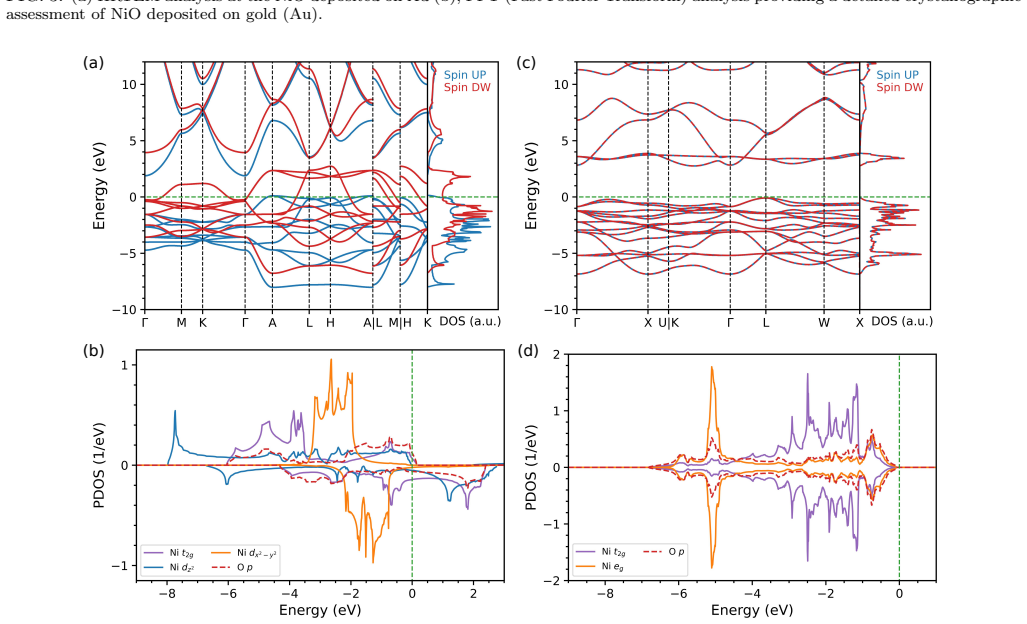
- Both Ni(OH)2 polymorphs are vibrationally stable semiconductors, with the trigonal phase showing stronger spin polarization.
- NiOOH exhibits spin-polarized electronic states across the Brillouin zone whose Raman spectra align with calculated modes after the small displacement stabilization.
- The integrated DFT-Raman-TEM framework can anchor interpretation of vibrational responses in other dynamically evolving Ni-based electrocatalysts.
Where Pith is reading between the lines
- The same DFT-guided reference approach could be applied to track phase evolution in other transition-metal oxide catalysts during operation.
- Explicit inclusion of solvation shells or surface defects in future calculations might reveal how real operando conditions further modify the observed spectra.
- Substrate interactions that stabilize metastable phases such as hexagonal NiO could be deliberately engineered to improve catalyst durability.
Load-bearing premise
Small symmetry-breaking displacements of 0.03 Å in the NiOOH model remain representative of the solvated, defect-containing surface present under actual operando conditions.
What would settle it
Recording operando Raman spectra for NiOOH that deviate from the stabilized DFT modes when the electrochemical potential or electrolyte is changed would show the idealized stabilization does not capture the real surface.
Figures




read the original abstract
We present a phase-resolved investigation of Ni-based oxides and hydroxides relevant to the oxygen evolution reaction (OER), combining ground-state DFT+U calculations with operando and in situ Raman spectroscopy, supported by high-resolution TEM. Five crystalline phases-cubic and hexagonal NiO, monoclinic and trigonal Ni(OH)2, and NiOOH-are systematically characterized in terms of their vibrational and electronic structure. Although the DFT models are idealized (0 K, defect-free, no solvation), they serve as clean, phase-specific references for interpreting complex experimental spectra. Cubic NiO is confirmed to be dynamically and electronically stable, consistent with dominant Raman modes observed experimentally. Despite dynamic instabilities in phonon dispersions, hexagonal NiO is structurally verified via TEM, suggesting substrate- or defect-stabilized metastability. Ni(OH)2 polymorphs are both vibrationally stable semiconductors, with the trigonal phase exhibiting stronger spin polarization. NiOOH exhibits spin-polarized electronic states across the Brillouin zone, consistent with its asymmetric band structure under ferromagnetic ordering. Independently, phonon calculations reveal soft modes near the Gamma-point, indicating dynamic instability under idealized conditions, yet operando Raman spectra align closely with calculated zone-center modes. However, introducing 0.03 Angstrom symmetry-breaking displacements relaxes the NiOOH lattice off its saddle point, removing imaginary phonon modes and stabilizing the phase. This integrated framework demonstrates how idealized DFT can reveal intrinsic fingerprints that anchor the interpretation of vibrational and electronic responses in catalytically active, dynamically evolving Ni-based materials.
Editorial analysis
A structured set of objections, weighed in public.
Referee Report
Summary. The manuscript combines DFT+U calculations of vibrational and electronic structures for five Ni-based phases (cubic/hexagonal NiO, monoclinic/trigonal Ni(OH)2, and NiOOH) with operando Raman spectroscopy and high-resolution TEM. It claims that these idealized (0 K, defect-free, unsolvated) models provide clean, phase-specific references whose zone-center modes align with experimental spectra, even for dynamically unstable phases; for NiOOH, small (0.03 Å) symmetry-breaking displacements are used to remove imaginary phonon modes and stabilize the structure.
Significance. If the reported alignments are robust, the work supplies a practical reference framework for assigning phases in complex, time-evolving operando spectra of Ni-based OER catalysts. The explicit acknowledgment of model limitations and the cross-validation with TEM and Raman data are strengths that could help experimentalists interpret spectra without over-fitting to idealized theory.
major comments (2)
- [NiOOH phonon analysis] Abstract and final paragraph: the procedure of applying 0.03 Å symmetry-breaking displacements to lift the saddle point and eliminate imaginary modes in NiOOH is presented without quantitative assessment of how the resulting frequencies or eigenvectors compare to those of the undisplaced structure or to anharmonic/defect-averaged modes. This step is load-bearing for the claim that idealized DFT still anchors operando spectra, yet the manuscript does not demonstrate that the stabilized lattice samples the same effective potential experienced by the solvated, fluctuating surface.
- [Comparison of DFT modes with Raman data] Results on vibrational properties: no mean absolute deviation, root-mean-square error, or intensity-ratio metrics are reported for the alignment between calculated zone-center modes and the operando Raman bands. Without such statistics it is difficult to judge whether the agreement is sufficiently close to support the central interpretive claim, especially given the acknowledged dynamic instabilities.
minor comments (2)
- [Computational details] The choice of Hubbard U value for Ni d-states is listed as a free parameter but its specific numerical value and sensitivity analysis are not stated in the methods or results sections.
- [Figures and tables] Figure captions and text should explicitly label which Raman bands are assigned to which calculated modes for each phase to improve traceability.
Simulated Author's Rebuttal
We thank the referee for the constructive and detailed comments. The suggestions regarding quantitative assessment of the NiOOH stabilization and statistical metrics for mode alignment have been addressed through revisions that add direct comparisons and error metrics while clarifying the scope of our idealized models. We respond point by point below.
read point-by-point responses
-
Referee: [NiOOH phonon analysis] Abstract and final paragraph: the procedure of applying 0.03 Å symmetry-breaking displacements to lift the saddle point and eliminate imaginary modes in NiOOH is presented without quantitative assessment of how the resulting frequencies or eigenvectors compare to those of the undisplaced structure or to anharmonic/defect-averaged modes. This step is load-bearing for the claim that idealized DFT still anchors operando spectra, yet the manuscript does not demonstrate that the stabilized lattice samples the same effective potential experienced by the solvated, fluctuating surface.
Authors: We agree that a quantitative comparison of the displacement procedure strengthens the presentation. In the revised manuscript we have added a direct side-by-side listing of the zone-center frequencies and mode characters for the original and 0.03 Å displaced NiOOH structures, showing that the majority of frequencies shift by less than 8 cm⁻¹ and that the dominant eigenvectors remain consistent. This supports the use of the stabilized structure as a practical reference. We do not claim that the displaced lattice exactly reproduces the effective potential of a solvated, anharmonic surface; our work is limited to idealized 0 K, defect-free models that provide clean phase-specific fingerprints. Explicit solvation and dynamics are noted as valuable future extensions rather than part of the current scope. revision: yes
-
Referee: [Comparison of DFT modes with Raman data] Results on vibrational properties: no mean absolute deviation, root-mean-square error, or intensity-ratio metrics are reported for the alignment between calculated zone-center modes and the operando Raman bands. Without such statistics it is difficult to judge whether the agreement is sufficiently close to support the central interpretive claim, especially given the acknowledged dynamic instabilities.
Authors: We accept this criticism and have revised the Results section to include mean absolute deviation (MAD) and root-mean-square error (RMSE) values quantifying the frequency alignment for each phase against the operando Raman bands. These statistics are now reported alongside the mode assignments. Raman intensities were not computed in the original DFT workflow, as they require separate polarizability calculations; we have added an explicit statement of this limitation and retained frequency matching as the primary comparison criterion, cross-validated by the independent TEM structural data. The added metrics allow readers to evaluate the closeness of agreement more objectively. revision: yes
Circularity Check
No significant circularity in DFT-to-Raman comparison chain
full rationale
The paper computes idealized DFT+U structures and zone-center phonon modes for five Ni-based phases, then compares those modes to independent operando Raman spectra and TEM data. The 0.03 Å symmetry-breaking displacement applied to NiOOH is an explicit methodological step to lift a saddle point and obtain real frequencies; the resulting alignment is reported as an empirical observation rather than a quantity forced by construction or by re-fitting the input data. No load-bearing self-citations, self-definitional loops, or renamed fitted parameters appear in the derivation. The central claim—that idealized models provide useful phase-specific references—rests on external experimental benchmarks and is therefore self-contained.
Axiom & Free-Parameter Ledger
free parameters (1)
- Hubbard U value for Ni d-states
axioms (2)
- standard math Born-Oppenheimer approximation and harmonic phonon model remain valid for zone-center modes under idealized 0 K conditions
- ad hoc to paper Small symmetry-breaking displacements of 0.03 Å produce a physically relevant stabilized structure for NiOOH
Reference graph
Works this paper leans on
-
[1]
B. S. Yeo and A. T. Bell, J. Phys. Chem. C 116, 8394 (2012)
work page 2012
-
[2]
S. Kumaravel, R. Jayakumar, K. K. Saravanan, V. Ni- harika, B. Eunice Evangeline, V. Singaram, and S. Kundu, Dalton Trans. 51, 17454 (2022)
work page 2022
-
[3]
F. Dionigi, Z. Zeng, J. Zhu, T. Merzdorf, M. Klingenhof, P. W. Buchheister, W.-X. Li, J. Greeley, and P. Strasser, Meet. Abstr. MA2023-01, 2062 (2023)
work page 2062
-
[4]
S. Li, R. Ma, J. Hu, Z. Li, L. Liu, X. Wang, Y. Lu, G. E. Sterbinsky, S. Liu, L. Zheng, J. Liu, D. Liu, and J. Wang, Nat. Commun. 13, 2916 (2022)
work page 2022
- [5]
-
[6]
G. V. Romanenko and N. V. Podberezskaya, J. Struct. Chem. 34, 280 (1993)
work page 1993
- [7]
-
[8]
D. S. Hall, D. J. Lockwood, S. Poirier, C. Bock, and B. R. MacDougall, J. Phys. Chem. A 116, 6771 (2012)
work page 2012
-
[9]
H. Moreno Fern´ andez, A. Alkemper, K. Wang, C. J. Mempin, J. Gallenberger, and J. P. Hofmann, J. Catal. 440, 115823 (2024)
work page 2024
-
[10]
N. Mironova-Ulmane, A. Kuzmin, I. Steins, J. Grabis, I. Sildos, and M. P¨ ars, J. Phys.: Conf. Ser. 93, 012039 (2007)
work page 2007
- [11]
-
[12]
K. Zellagui, M. Khedidji, H. Yousfi, A. Dekhira, O. Ouamerali, and M. Trari, Theor. Chem. Acc. 143, 79 (2024)
work page 2024
-
[13]
H. Uchiyama, S. Tsutsui, and A. Q. R. Baron, Phys. Rev. B 81, 241103 (2010)
work page 2010
-
[14]
N. Mironova-Ulmane, A. Kuzmin, I. Sildos, L. Puust, and J. Grabis, Latv. J. Phys. Tech. Sci. 56, 61 (2019)
work page 2019
-
[15]
J. Gallenberger, H. Moreno Fern´ andez, A. Alkemper, M. Li, C. Tian, B. Kaiser, and J. P. Hofmann, Catal. Sci. Technol. 13, 4693 (2023)
work page 2023
-
[16]
R. E. Dietz, G. I. Parisot, and A. E. Meixner, Phys. Rev. B 4, 2302 (1971)
work page 1971
-
[17]
R. E. Dietz, W. F. Brinkman, A. E. Meixner, and H. J. Guggenheim, Phys. Rev. Lett. 27, 814 (1971)
work page 1971
-
[18]
M. M. Lacerda, F. Kargar, E. Aytan, R. Samnakay, B. Debnath, J. X. Li, A. Khitun, R. K. Lake, J. Shi, and A. A. Balandin, Appl. Phys. Lett. 110, 202406 (2017)
work page 2017
- [19]
- [20]
-
[21]
M. R. Bunow and I. W. Levin, Biochim. Biophys. Acta, Lipids Lipid Metab. 487, 388 (1977)
work page 1977
-
[22]
H. Edwards, Spectra–structure correlations in raman spectroscopy, in Handbook of Vibrational Spectroscopy (Wiley, 2006)
work page 2006
-
[23]
Socrates, Infrared and Raman Characteristic Group Frequencies: Tables and Charts (Wiley, 2004)
G. Socrates, Infrared and Raman Characteristic Group Frequencies: Tables and Charts (Wiley, 2004)
work page 2004
-
[24]
A. P. Solomon, E. C. O’Quinn, J. Liu, I. M. Gussev, X. Guo, J. Neuefeind, C. Trautmann, R. C. Ewing, G. Baldinozzi, and M. K. Lang, Sci. Adv. 11, eadq5943 14 (2025)
work page 2025
-
[25]
G. A. Sawatzky and J. W. Allen, Phys. Rev. Lett. 53, 2339 (1984)
work page 1984
-
[26]
G. M. Gaifutdinov and I. V. Leonov, Phys. Rev. B 110, 235103 (2024)
work page 2024
-
[27]
O. Tjernberg, S. S¨ oderholm, T. Rogelet, U. Karlsson, M. Qvarford, I. Lindau, C.-O. Almbladh, and L. Hellbom, Vacuum 46, 1215 (1995)
work page 1995
-
[28]
J. M. McKay and V. E. Henrich, Phys. Rev. Lett. 53, 2343 (1984)
work page 1984
- [29]
-
[30]
H. Moreno Fern´ andez, J. Gallenberger, C. Mempin, I. Khalek, M. Neumann, S. Lotfi, S. M. Kim, M. Li, C. Tian, and J. P. Hofmann, Electrochim. Acta 498, 144626 (2024)
work page 2024
- [31]
-
[32]
M. Toufani, H. Besic, W. Tong, and P. Farr` as, Results Chem. 6, 101031 (2023)
work page 2023
-
[33]
T. S. Duffy, R. J. Hemley, and H. K. Mao, AIP Conf. Proc. 341, 211 (1995)
work page 1995
-
[34]
D. S. Hall, D. J. Lockwood, S. Poirier, C. Bock, and B. R. MacDougall, ACS Appl. Mater. Interfaces 6, 3141 (2014)
work page 2014
-
[35]
J. Zhao, M. Yang, and Z. Hua, J. Magn. Magn. Mater. 371, 10 (2014)
work page 2014
- [36]
-
[37]
O. Diaz-Morales, D. Ferrus-Suspedra, and M. T. M. Koper, Chem. Sci. 7, 2639 (2016)
work page 2016
-
[38]
J. L. Bantignies, S. Deabate, A. Righi, S. Rols, P. Her- met, J. L. Sauvajol, and F. Henn, J. Phys. Chem. C 112, 2193 (2008)
work page 2008
-
[39]
J. Desilvestro, D. A. Corrigan, and M. J. Weaver, J. Phys. Chem. 90, 6408 (1986)
work page 1986
- [40]
-
[41]
D. S. Hall, D. J. Lockwood, C. Bock, and B. R. Mac- Dougall, Proc. R. Soc. A: Math. Phys. Eng. Sci. 471, 20140792 (2015)
work page 2015
-
[42]
T. G. Yun, Y. Heo, H. Bin Bae, and S.-Y. Chung, Nat. Commun. 12, 824 (2021)
work page 2021
-
[43]
I. Pallikara, P. Kayastha, J. M. Skelton, and L. D. Whal- ley, Electron. Struct. 4, 033002 (2022)
work page 2022
-
[44]
M. K. Carpenter and D. A. Corrigan, J. Electrochem. Soc. 136, 1022 (1989)
work page 1989
- [45]
-
[46]
G. A. Niklasson and C. G. Granqvist, J. Mater. Chem. 17, 127 (2007)
work page 2007
-
[47]
J. Varignon, M. N. Grisolia, J. ´I˜ niguez, A. Barth´ el´ emy, and M. Bibes, npj Quantum Mater. 2, 21 (2017)
work page 2017
- [48]
-
[49]
R. Karsthof, M. Grundmann, A. M. Anton, and F. Kre- mer, Phys. Rev. B 99, 235201 (2019)
work page 2019
- [50]
-
[51]
H. A. Al-Abadleh and V. H. Grassian, Surf. Sci. Rep. 52, 63 (2003)
work page 2003
- [52]
- [53]
-
[54]
P. E. Bl¨ ochl, Phys. Rev. B50, 17953 (1994)
work page 1994
- [55]
- [56]
-
[57]
J. P. Perdew, K. Burke, and M. Ernzerhof, Phys. Rev. Lett. 77, 3865 (1996)
work page 1996
-
[58]
H. J. Monkhorst and J. D. Pack, Phys. Rev. B 13, 5188 (1976)
work page 1976
-
[59]
A. Togo, L. Chaput, T. Tadano, and I. Tanaka, J. Phys. Condens. Matter 35, 353001 (2023)
work page 2023
-
[60]
A. Togo, J. Phys. Soc. Jpn. 92, 012001 (2023)
work page 2023
-
[61]
M. Cococcioni and S. de Gironcoli, Phys. Rev. B 71, 035105 (2005). 15 NiOOH FIG. 10. Graphical abstract
work page 2005
discussion (0)
Sign in with ORCID, Apple, or X to comment. Anyone can read and Pith papers without signing in.