REVIEW 3 major objections 4 minor 67 references
Monitoring for a Phase Transition in a Time Series of Wigner Matrices
T0 review · 3 major / 4 minor · reviewed 2026-08-06 · deepseek-v4-flash
Pith's one-line read A monitoring test watches the largest eigenvalue of a stream of deformed Wigner matrices and declares a supercritical phase transition the moment a latent rank-one signal becomes detectable; self-normalization makes the limiting null…
desk verdict Genuinely new monitoring method for streams of deformed Wigner matrices; the main theorem has a gap that excludes the paper's own simulations, so it needs a careful referee. read the letter →
The pith
A machine-rendered reading of the paper's core claim, the machinery that carries it, and where it could break.
The reading
What carries the argument
The carrying object is the self-normalized detector $\Gamma_{n,m}(k) = D_m(k)/V_m$, where $D_m(k) = \frac{n^{2/3}\sqrt{m}}{m+k}\left(\sum_{t=m+1}^{m+k}\lambda_t - \frac{k}{m}\sum_{t=1}^m \lambda_t\right)$ compares the post-training average largest eigenvalue with the training average, and $V_m = \frac{n^{2/3}}{m^{3/2}}\sum_{t=1}^m \left|\sum_{s=1}^t \lambda_s - \frac{t}{m}\sum_{s=1}^m \lambda_s\right|$ is the training-sample normalizer that cancels the variance scale. The supporting machinery is a Gaussian approximation (Theorem 3.6) that couples the eigenvalue partial-sum process $P_m(x) = \frac{1}{\sqrt{m}\tau_n}\sum_{t=1}^{\lfloor mx \rfloor} n^{2/3}[\lambda_t - b(n)]$ to a Brownian motion on intervals of length $T_m \asymp m^{1/2-\rho}$, proved by truncating eigenvalues to the event $\Lambda_t = \{|\lambda_t - 2\sigma| < n^{\varepsilon - 2/3}\}$, bounding the truncated variables, concentrating the finite-sample variance $\tau_n$, and applying a functional CLT for $\phi$-mixing arrays; a tail bound (Lemma 3.7) controls all later $k$. The truncation is what turns the difficult eigenvalue process into a sum of bounded, weakly dependent, centered variables.
What would settle it
Generate the model with $P^{(1)}$ supported on $[0, \sigma - n^{-\gamma}]$ for a slowly decaying gap and compare the empirical false-alarm rate of the test to the nominal level; if the rate drifts away from $\alpha$ as $n, m$ grow, or if $n^{2/3}(\lambda - 2\sigma)$ under this design visibly departs from the Tracy-Widom distribution, the theorem's stated generality is false.
Extended reading notes
Core claim
The central claim is that the emergence of a supercritical signal in a time series of spiked Wigner matrices can be detected online from the extremal eigenvalues alone. Under the null hypothesis that all signal strengths stay subcritical, the self-normalized detector $\Gamma_{n,m}(k) = D_m(k)/V_m$ converges in distribution, as $m, n \to \infty$ with $m \asymp n^\theta$, to $\sup_{0 \le x < \infty} [B(1+x) - B(1) - xB(1)] / [(1+x)\int_0^1 |B(s) - sB(1)|\,ds]$, where $B$ is standard Brownian motion. Because the limit is pivotal, rejecting when $\Gamma_{n,m}(k)$ exceeds the upper-$\alpha$ quantile gives an asymptotically exact test of level $\alpha$. Under the alternative, once a signal with strength in the supercritical range appears at some unknown time, the detector tends to infinity and the test is consistent. The proof combines a Gaussian approximation for the eigenvalue partial-sum process with eigenvalue truncation and tail bounds, and the self-normalization cancels the unknown variance scale in finite samples rather than estimating a long-run variance.
Load-bearing premise
The load-bearing premise is that subcritical signal strengths stay strictly below the critical threshold $\sigma$, because the proof of Lemma 3.2 requires the support of $s/\sigma$ to lie in $[\lambda_l, \lambda_r]$ with $\lambda_r < 1$; Assumption 3.1 only states support in $[0,\sigma)$, so the argument fails if that support approaches $\sigma$.
Editorial extensions
If this is right
- The test has asymptotic size $\alpha$ under the null hypothesis, so a stream with no detectable signal produces false alarms only at the nominal rate, with no unknown variance or signal distribution to estimate.
- Under the alternative, once a supercritical signal appears, the probability that the detector eventually exceeds the threshold tends to one, so the transition is identified in the limit.
- The critical values depend only on the Brownian functional; the paper reports $q_{0.90}=4.57$ and $q_{0.95}=5.85$ from simulation, making implementation a matter of comparing a single path to a fixed threshold.
- Weak dependence (exponentially decaying $\phi$-mixing coefficients) and a polynomial relation $m \asymp n^\theta$ between training length and dimension are allowed, covering realistic streaming regimes.
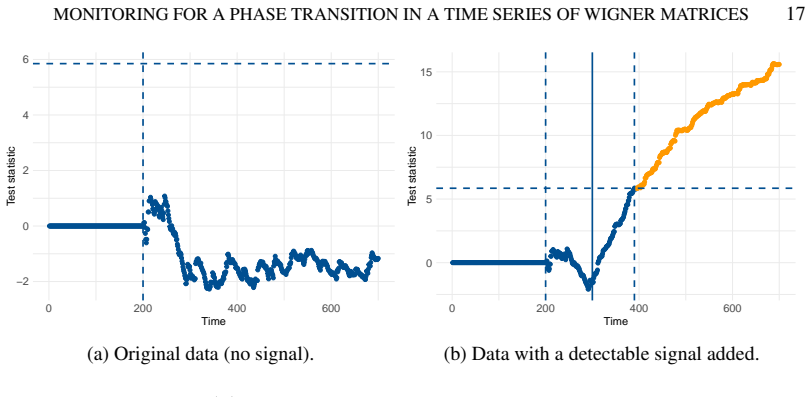
- In the paper's applications, the detector flags the Cameron Peak Fire from PM2.5 data on August 19, 2020, a few days after the first report, and remains below threshold for the baboon social-interaction data until a synthetic signal is added, which is then detected quickly.
Reading between the lines
- The self-normalization strategy should transfer to other high-dimensional spectral statistics with Tracy-Widom-type edge fluctuations, such as leading singular values of spiked covariance matrices, where moment bounds for the edge are likewise unavailable.
- A natural extension is to monitor several leading eigenvalues or the eigenvector overlap in addition to the top eigenvalue; the pivotal limit would change, but the finite-sample variance cancellation could be preserved.
- The simulations place $P^{(1)}$ on $[0,1]$ while the proof needs the subcritical support to stay bounded away from $\sigma = 1$; a reader can test whether the empirical size degrades as the support approaches $1$, which would mark the practical boundary of the theorem.
- Because the limiting functional involves only Brownian motion, the same critical values apply to any model admitting a comparable Gaussian approximation, making this construction a template for other matrix-stream monitoring problems.
Editorial analysis
A structured set of objections, weighed in public.
Referee Report
Summary. The paper develops a monitoring procedure for a time series of deformed Wigner matrices, aiming to detect in real time the transition from a subcritical to a supercritical signal. The proposed detector is a self-normalized functional of cumulative sums of the largest eigenvalues, designed so that all nuisance parameters cancel and the limit is a pivotal Brownian functional. The main theoretical result, Theorem 3.8, claims weak convergence of the detector under H0, and Corollary 3.1 claims asymptotic level control and power consistency under H1. The proof strategy combines eigenvalue rigidity and Tracy-Widom fluctuations for subcritical deformed Wigner matrices with Gaussian approximations for weakly dependent triangular arrays. The paper also reports simulations and two applications.
Significance. If the gaps identified below are repaired, this is a valuable and original contribution: it is, to my knowledge, the first monitoring procedure for an eigenvalue phase transition in a stream of random matrices, and the self-normalization construction is genuinely parameter-free. The Gaussian approximation for the partial-sum process of leading eigenvalues is innovative, and the empirical sections demonstrate that the method can work in realistic finite samples. The main theoretical mechanism is credible and uses appropriate external results, but the manuscript is not currently acceptable because the central theorem is not proved for the settings that are actually simulated, and the power claim is overbroad.
major comments (3)
- [Section 5.5, Lemma 3.2] The proof of Lemma 3.2 chooses 0 ≤ λ_l ≤ λ_r < 1 independent of n such that the support of λ = s/σ is contained in [λ_l, λ_r], and uses λ_r < 1 to verify condition (5.33) of Lee and Schnelli. This uniform support-gap condition is not stated in Assumption 3.1 or in the model specification before (1.3), and it fails for the Uniform(0,1) design of Section 4.1 when σ = 1, since that distribution has mass arbitrarily close to 1. Near-critical values of s can change the rigidity and fluctuation scales of the largest eigenvalue, so the cited results [48, 44] do not justify Lemma 3.2(a)-(b) for such P(1). Because Lemma 3.2 drives the truncation events Λ_t in (3.8), Remark 5.1, Lemma 5.3, and hence Theorems 3.6, 3.7, and 3.8, the central claim is unproved for the settings actually simulated. The authors should either add a uniform gap assumption to the model and adjust the simulations accordingly, or provide a separate argument covering supports that accumulate at σ.
- [Section 3.3, Eqs. (3.9)-(3.11), Theorem 3.6] The normalizing definitions are internally inconsistent. In (3.11), Y_t is defined without the factor n^{2/3} that appears in the same Y_t in (5.2), and the denominator in (3.9) as printed is √m τ_n rather than √(mτ_n). Theorem 3.6 states a coupling of P_m to √τ_n B_m, while the proof in Section 5.1 concludes with a coupling to a standard Brownian motion B_m, and the proof of Theorem 3.8 also substitutes a standard Brownian motion. As written, Theorem 3.6 cannot be true for all three formulations simultaneously, and the reader cannot verify the pivotal cancellation that leads to (3.6). These displays need to be reconciled.
- [Section 5.4, Corollary 3.1(b)] The power proof analyzes only the case k* ≍ m and asserts that all other cases are analogous. This is not correct for small k*. For fixed k*, the dominant term R_3 in the decomposition of D_m(2k*) is of order n^{2/3} m^{-1/2}, while (5.24) shows that V_m/√τ_n is tight. Under Assumption 3.4 with θ > 4/3, this ratio tends to 0, so the claimed power 1 for every D ≥ 0 in (3.13) is false. The statement of Corollary 3.1(b) must either restrict k* to be sufficiently large relative to θ, or the proof must contain a separate argument for early change points.
minor comments (4)
- [Section 2] The phrase "Exiting approaches" should be "Existing approaches".
- [Section 3.1] In the display defining the φ-mixing coefficients, the expression contains a duplicated "sup_n sup_n" that should be cleaned up.
- [Section 5.1] The phrase "null sequence null-sequence" is a duplicate and should be reduced to a single description of the sequence (d_m).
- [Section 5.2] The proof of Lemma 3.7 refers to "Lemma C.1 of [46]" without stating the version used; since [46] is a functional-data paper, the relevant lemma and its hypotheses should be stated explicitly.
Circularity Check
No significant circularity: the Brownian-functional limiting law is derived from a genuine Gaussian approximation and tail bound; the only proof-time self-citation ([46]) is an auxiliary mixing maximal inequality, not the target result.
full rationale
The derivation of Theorem 3.8 does not reduce to its inputs. The limiting functional sup_x [B(1+x)-B(1)-xB(1)] / ((1+x)∫|B(s)-sB(1)|ds) is obtained by (i) coupling the partial-sum process P_m to a Brownian motion in Theorem 3.6, (ii) bounding the region k > m^{1+ζ} by Lemma 3.7, and (iii) applying the continuous mapping theorem. The centering b(n) and variance τ_n are internal normalizing constants that cancel in the self-normalized ratio; no fitted nuisance parameters enter the threshold, and critical values are generated from standard Brownian motion, not from the observed eigenvalues. The only self-citation used inside a proof is [46], invoked in Lemma 3.7 to justify that sup_k k^{-1/2-ν} |Σ Y_t| is O_P(1) for bounded φ-mixing variables; this is an auxiliary maximal inequality independent of the eigenvalue phase-transition claim, so it is not a load-bearing circular step. A genuine weakness is not circularity: the proof of Lemma 3.2 asserts an unstated compact-support condition ('we may choose 0 ≤ λ_l ≤ λ_r < 1 ... such that the support of λ is contained in [λ_l, λ_r]') that is not implied by P(1) having support in [0,σ) and is violated by the Uniform(0,1) design with σ=1; this is a correctness gap in the cited RMT input, not an equivalence between the theorem and its assumptions.
Assumptions & free parameters
assumptions (9)
- domain assumption Under H0, the signal strengths s_t are distributed according to P(1) with support in [0, sigma).
- domain assumption Under H1, post-change signal strengths s_t are distributed according to P(2) with support in (sigma, infinity).
- domain assumption The unit vector x_t is independent of the Wigner noise W_t.
- domain assumption The matrix time series is strictly stationary and phi-mixing with exponentially decaying coefficients.
- domain assumption The long-run variance tau(n) of the truncated eigenvalue process is bounded away from zero uniformly in epsilon.
- domain assumption Dimension n and training length m satisfy m is asymptotically proportional to n^theta for some theta > 0.
- ad hoc to paper The support of s/sigma is contained in [lambda_l, lambda_r] with lambda_r < 1 under H0.
- standard math The leading eigenvalue of a subcritical deformed Wigner matrix has Tracy-Widom fluctuations and eigenvalue rigidity.
- standard math The leading eigenvalue in the supercritical regime concentrates around s + sigma^2/s.
Cite this review
Pith. "Pith review of Monitoring for a Phase Transition in a Time Series of Wigner Matrices." pith.science (2026). https://pith.science/paper/6V6AYGRB
@misc{pith2026250704983,
  author       = {Pith},
  title        = {Pith review of: Monitoring for a Phase Transition in a Time Series of Wigner Matrices},
  year         = {2026},
  howpublished = {\url{https://pith.science/paper/6V6AYGRB}},
  note         = {Machine review of arXiv:2507.04983}
}
abstract
We develop methodology and theory for the detection of a phase transition in a time-series of high-dimensional random matrices. In the model we study, at each time point \( t = 1,2,\ldots \), we observe a deformed Wigner matrix \( \mathbf{M}_t \), where the unobservable deformation represents a latent signal. This signal is detectable only in the supercritical regime, and our objective is to detect the transition to this regime in real time, as new matrix--valued observations arrive. Our approach is based on a partial sum process of extremal eigenvalues of $\mathbf{M}_t$, and its theoretical analysis combines state-of-the-art tools from random-matrix-theory and Gaussian approximations. The resulting detector is self-normalized, which ensures appropriate scaling for convergence and a pivotal limit, without any additional parameter estimation. Simulations show excellent performance for varying dimensions. Applications to pollution monitoring and social interactions in primates illustrate the usefulness of our approach.
Figures


Figures from the paper (3 more)


Reference graph
Works this paper leans on
-
[1]
A LAOUI , A. E., K RZAKALA , F. and J ORDAN , M. (2020). Fundamental limits of detection in the spiked Wigner model. The Annals of Statistics 48 863 – 885
work page 2020
-
[2]
A UE, A., H ÖRMANN , S., H ORVÁTH, L. and H UŠKOVÁ, M. (2014). Dependent functional linear models with applications to monitoring structural change. Statistica Sinica 24 1043–1073
work page 2014
-
[3]
A UE, A., H ORVÁTH , L., H UŠKOVÁ , M. and K OKOSZKA , P. (2006). Change–point monitoring in linear models with conditionally heteroskedastic errors. Econometrics Journal 9 373–403
work page 2006
-
[4]
A UE, A. and K IRCH , C. (2024). The state of cumulative sum sequential changepoint testing 70 years after Page. Biometrika 1-25
work page 2024
-
[5]
B AIK , J., B EN AROUS , G. and P ÉCHÉ , S. (2005). Phase transition of the largest eigenvalue for nonnull complex sample covariance matrices. The Annals of Probability 33 1643–1697
work page 2005
-
[6]
B EN AROUS , G. and G UIONNET , A. (2010). Wigner matrices. In Handbook on random matrices 433–451. Oxford University Press, New York
work page 2010
-
[7]
B ENAYCH -GEORGES , F. and N ADAKUDITI , R. R. (2009). The eigenvalues and eigenvectors of finite, low rank perturbations of large random matrices. Advances in Mathematics 227 494-521
work page 2009
-
[8]
B ERKES , I., G OMBAY, E., H ORVÁTH , L. and K OKOSZKA , P. (2004). Sequential change-point detection in GARCH(p, q) models. Econometric Theory 20 1140–1167
work page 2004
Show all 67 references
-
[9]
and F ÉRAL , D
C APITAINE , M., D ONATI -MARTIN , C. and F ÉRAL , D. (2009). The largest eigenvalues of finite rank de- formation of large Wigner matrices: Convergence and nonuniversality of the fluctuations. The Annals of Probability 37 1–47
2009
-
[10]
C APITANIO , J. P. (2012). Social Processes and Disease in Nonhuman Primates. American Journal of Pri- matology 74 491–499
2012
-
[11]
H., N G, W
C HAN , N. H., N G, W. L. and YAU, C. Y. (2021). A Self-Normalized Approach to Sequential Change-Point Detection for Time Series. Statistica Sinica 31 491–517
2021
-
[12]
and K ATO, K
C HEN , X. and K ATO, K. (2020). Jackknife multiplier bootstrap: finite sample approximations to the U- process supremum with applications. Probability Theory and Related Fields 176 1097–1163
2020
-
[13]
and S AMWORTH , R
C HEN , Y., W ANG , T. and S AMWORTH , R. (2022). High-Dimensional, Multiscale Online Changepoint Detection. Journal of the Royal Statistical Society Series B: Statistical Methodology 84 234-266
2022
-
[14]
J., S TINCHCOMBE , M
C HU, C. J., S TINCHCOMBE , M. and W HITE , H. (1996). Monitoring structural change. Econometrica 64 1045–1065. 34
1996
-
[15]
C HUNG , H. W. and L EE, J. O. (2019). Weak Detection of Signal in the Spiked Wigner Model. In Proceed- ings of the 36th International Conference on Machine Learning 97 1233–1241. PMLR
2019
-
[16]
H., C ROFOOT , M
D AVIS, G. H., C ROFOOT , M. C. and F ARINE , D. R. (2018). Estimating the Robustness and Uncertainty of Animal Social Networks Using Different Observational Methods. Animal Behaviour 141 29–44
2018
-
[17]
and S ØRENSEN , M
D EHLING , H., M IKOSCH , T. and S ØRENSEN , M. (2002). Empirical Process Techniques for Dependent Data. Birkhäuser, New York
2002
-
[18]
and WANG , Z
D ING , X., H U, Y. and WANG , Z. (2024). Two sample test for covariance matrices in ultra-high dimension. Journal of the American Statistical Association 1–12
2024
-
[19]
and Y ANG , F
D ING , X. and Y ANG , F. (2022). Tracy-Widom distribution for heterogeneous Gram matrices with applica- tions in signal detection. IEEE Transactions on Information Theory 68 6682–6715
2022
-
[20]
and P AUL, D
D ÖRNEMANN , N. and P AUL, D. (2025). Detecting Spectral Breaks in Spiked Covariance Models. arXiv preprint arXiv:2404.19176, to appear: Bernoulli
2025 arXiv
-
[21]
and L OPES , M
D ÖRNEMANN , N. and L OPES , M. E. (2025). Tracy-Widom, Gaussian, and Bootstrap: Approximations for Leading Eigenvalues in High-Dimensional PCA. arXiv:2503.23097
2025 arXiv
-
[22]
and P ENTLAND , A
E AGLE , N. and P ENTLAND , A. (2006). Reality Mining: Sensing Complex Social Systems. Personal and Ubiquitous Computing 10 255–268
2006
-
[23]
E RD ˝OS, L. (2011). Universality of Wigner random matrices: a survey of recent results. Russian Mathemat- ical Surveys 66 507
2011
-
[24]
E RD ˝OS, L., P ÉCHÉ , S., R AMÍREZ , J. A. et al. (2010). Bulk universality for Wigner matrices.Mathematical Physics, Analysis and Geometry 13 265–301
2010
-
[25]
E RD ˝OS, L., Y AU, H. T. and Y IN, J. (2012). Rigidity of eigenvalues of generalized Wigner matrices. Ad- vances in Mathematics 229 1435–1515
2012
-
[26]
and M ISHRA , N
E SWARAN , D., F ALOUTSOS , C., G UHA , S. and M ISHRA , N. (2018). Detecting anomalies in streaming graphs. In Proceedings of the 24th ACM SIGKDD international conference on knowledge discovery and data mining 1378–1386
2018
-
[27]
F REMDT , S. (2015). Page’s Sequential Procedure for Change-Point Detection in Time Series Regression. Statistics 49 128–155
2015
-
[28]
and PÉCHÉ , S
F ÉRAL , D. and PÉCHÉ , S. (2007). The largest eigenvalue of rank one deformation of large Wigner matrices. Communications in Mathematical Physics 272 185–228
2007
-
[29]
and B ARRAT, A
G ELARDI , V., G ODARD , J., P ALERESSOMPOULLE , D., C LAIDIERE , N. and B ARRAT, A. (2020). Mea- suring Social Networks in Primates: Wearable Sensors versus Direct Observations.Proceedings of the Royal Society A: Mathematical, Physical and Engineering Sciences 476 20190737
2020
-
[30]
and D ETTE , H
G ÖSMANN , J., K LEY, T. and D ETTE , H. (2021). A new approach for open-end sequential change point monitoring. Journal of Time Series Analysis 42 63-84
2021
-
[31]
and D ETTE , H
G ÖSMANN , J., S TOEHR , C., H EINY, J. and D ETTE , H. (2022). Sequential change point detection in high dimensional time series. Electronic Journal of Statistics 16 3608–3671
2022
-
[32]
H AFOUTA , Y. (2023). Convergence rates in the functional CLT for α-mixing triangular arrays. Stochastic Processes and their Applications 161 247–264
2023
-
[33]
and Y U, L
H E, Y., KONG , X., T RAPANI , L. and Y U, L. (2024). Online change-point detection for matrix-valued time series with latent two-way factor structure. The Annals of Statistics 52 1646–1670
2024
-
[34]
and STEINEBACH , J
H ORVÁTH , L., H UŠKOVÁ , M., K OKOSZKA , P. and STEINEBACH , J. (2003). Monitoring changes in linear models. Journal of Statistical Planning and Inference 126 225-251
2003
-
[35]
and R ICE , G
H ORVÁTH , L. and R ICE , G. (2024). Change Point Analysis for Time Series. Springer, New York
2024
-
[36]
H UBER , P. J. and R ONCHETTI , E. M. (2009). Robust Statistics. Wiley, Hoboken
2009
-
[37]
and L IU, G
J IANG , Y. and L IU, G. (2022). Two-stage anomaly detection algorithm via dynamic community evolution in temporal graph. Applied Intelligence 52 12222–12240
2022
-
[38]
J OHNSTONE , I. M. and O NATSKI , A. (2020). Testing in high-dimensional spiked models. The Annals of Statistics 48 1231 – 1254
2020
-
[39]
H., C HUNG , H
J UNG , J. H., C HUNG , H. W. and L EE, J. O. (2024). Detection problems in the spiked random matrix models. IEEE Transactions on Information Theory
2024
-
[40]
E., L AGRAA , S., A MROUCHE , K
K IOUCHE , A. E., L AGRAA , S., A MROUCHE , K. and S EBA, H. (2020). A simple graph embedding for anomaly detection in a stream of heterogeneous labeled graphs. Pattern Recognition 112 107746
2020
-
[41]
and W EBER , S
K IRCH , C. and W EBER , S. (2018). Modified sequential change point procedures based on estimating func- tions. Electronic Journal of Statistics 12 1579-1613
2018
-
[42]
and Y IN, J
K NOWLES , A. and Y IN, J. (2013). Eigenvector distribution of Wigner matrices. Probability Theory and Related Fields 157 543–582
2013
-
[43]
and Y IN, J
K NOWLES , A. and Y IN, J. (2014). The Outliers of a Deformed Wigner Matrix. The Annals of Probability 42 1980–2031
2014
-
[44]
and Y IN, J
K NOWLES , A. and Y IN, J. (2017). Anisotropic local laws for random matrices. Probability Theory and Related Fields 169 257–352. MONITORING FOR A PHASE TRANSITION IN A TIME SERIES OF WIGNER MATRICES 35
2017
-
[45]
and DÖRNEMANN , N
K UTTA, T. and DÖRNEMANN , N. (2025). Monitoring Time Series with Short Detection Delay. Electron. J. Statist. 19 2239–2275. https://doi.org/10.1214/25-EJS2385
2025 doi
-
[46]
and K OKOSZKA , P
K UTTA, T., JACH, A. and K OKOSZKA , P. (2024). Monitoring Panels of Sparse Functional Data. Journal of Time Series Analysis
2024
-
[47]
L AI, T. L. (1995). Sequential Changepoint Detection in Quality Control and Dynamical Systems. Journal of the Royal Statistical Society. Series B (Methodological) 57 613–658
1995
-
[48]
L EE, J. O. and S CHNELLI , K. (2015). Edge universality for deformed Wigner matrices. Reviews in Mathe- matical Physics 27 1550018
2015
-
[49]
A., S ERFLING , R
M ORICZ , F. A., S ERFLING , R. J. and S TOUT, W. F. (1982). Moment and Probability Bounds with Quasi- Superadditive Structure for the Maximum Partial Sum. The Annals of Probability 4 1032 – 1040
1982
-
[50]
O NATSKI , A., M OREIRA , M. J. and H ALLIN , M. (2014). Signal detection in high dimension: The multi- spiked case. The Annals of Statistics 42 225 – 254
2014
-
[51]
and S OSHNIKOV , A
P IZZO , A., R ENFREW , D. and S OSHNIKOV , A. (2013). On finite rank deformations of Wigner matrices. Annales de l’Institut Henri Poincaré - Probabilités et Statistiques49 64–94
2013
-
[52]
S HAO, X. (2010). A self-normalized approach to confidence interval construction in time series. Journal of the Royal Statistical Society (B) 72 343–366. Corrigendum: 2010, 72(5), 695–696
2010
-
[53]
S HAO, X. (2015). Self-Normalization for Time Series: A Review of Recent Developments. Journal of the American Statistical Association 110 1797–1817
2015
-
[54]
and FALOUTSOS , C
S HIN , K., H OOI , B., K IM, J. and FALOUTSOS , C. (2017). D-cube: Dense-block detection in terabyte-scale tensors. In Proceedings of the tenth ACM international conference on web search and data mining 681–689
2017
-
[55]
S IEGMUND , D. (1985). Sequential Analysis: Tests and Confidence Intervals. Springer, New York
1985
-
[56]
T RACY, C. A. and W IDOM , H. (1994). Level-spacing distributions and the Airy kernel. Communications in Mathematical Physics 159 151–174
1994
-
[57]
T RACY, C. A. and W IDOM , H. (1996). On orthogonal and symplectic matrix ensembles. Communications in Mathematical Physics 177 727–754
1996
-
[58]
T RACY, C. A. and W IDOM , H. (2000). The Distribution of the Largest Eigenvalue in the Gaussian Ensem- bles: β = 1, 2, 4 In Calogero—Moser— Sutherland Models 461–472. Springer, New York
2000
-
[59]
VAN DER VAART, A. W. and W ELLNER , J. A. (1996). Weak ConvergenceIn Weak Convergence and Em- pirical Processes: With Applications to Statistics 16–28. Springer, New York
1996
-
[60]
and R INALDO , A
W ANG , F., L I, W., M ADRID PADILLA , O., Y U, Y. and R INALDO , A. (2024). Multilayer random dot product graphs: Estimation and online change point detection. arXiv:2306.15286
2024 arXiv
-
[61]
and F ELIX , S
W ANG , T., F ANG , C., L IN, D. and F ELIX , S. (2015). Localizing Temporal Anomalies in Large Evolving Graphs. In Proceedings of SIAM International Conference on Data Mining 927–935
2015
-
[62]
and S HAO, X
W U, T., W ANG , R., Y AN, H. and S HAO, X. (2022). Adaptive Change Point Monitoring for High- Dimensional Data. Statistica Sinica 32 1583–1610
2022
-
[63]
and Y U, Y
X U, H., D UBEY, P. and Y U, Y. (2024). Online network change point detection with missing values and temporal dependence Technical Report
2024
-
[64]
and WANG , Q
Y E, J., X U, Y. and WANG , Q. (2023). Subspace Change Point Detection Under Spiked Wigner Mode.IEEE Transactions on Signal Processing 71 1995–2010
2023
-
[65]
Y OSHIHARA , K. (1978). Moment inequalities for mixing sequences. Kodai Mathematical Journal 1 316- 328
1978
-
[66]
and R INALDO , A
Y U, Y., M ADRID PADILLA , O., W ANG , D. and R INALDO , A. (2024). Network Online Change Point Localization. SIAM Journal on Mathematics of Data Science 6 176–198
2024
-
[67]
and LAVITAS, L
Z HANG , T. and LAVITAS, L. (2018). Unsupervised Self-Normalized Change-Point Testing for Time Series. Journal of the American Statistical Association 113 637–648
2018
Reviewed August 6, 2026 · model on record in the stance chip above.
Discussion (0). Continue with ORCID to comment.