REVIEW 3 major objections 6 minor 3 cited by
Strongly polarised radio pulses from a new white-dwarf-hosting long-period transient
T0 review · 3 major / 6 minor · reviewed 2026-08-06 · deepseek-v4-flash
Pith's one-line read A radio transient has been found whose pulses alternate between 100% circular and 100% linear polarisation, tied to an 841-second rotation and a likely white-dwarf companion.
desk verdict Solid new LPT discovery with a tentative white-dwarf identification; the title overstates the photometric evidence, but the radio result deserves a serious referee. read the letter →
The pith
A machine-rendered reading of the paper's core claim, the machinery that carries it, and where it could break.
The reading
What carries the argument
The load-bearing mechanism is a spin-orbit resonance between the white dwarf's 841 s rotation and the companion's orbit (about 2103 s for a 5:2 resonance, 1402 s for a 5:3 resonance). Because the radio beam is narrow, at most 4.3 degrees wide, a pulse is only seen when the white dwarf's magnetic axis points at Earth and the companion lies in a particular orbital-phase window, so pulses appear after two or three rotations but never after one or four; a slight detuning of the resonance explains the phase shift between the 2015-2016 and 2019 observations. The energy budget is supplied by unipolar induction between the magnetised white dwarf and the companion, with relativistic electron-cyclotron maser emission or a pulsar-like mechanism as the coherent radiator that can switch between circular and linear polarisation.
What would settle it
Take a deep, space-based ultraviolet image or spectrum at the radio position: if the 5.2$\sigma$ GALEX FUV source and the three UNIONS detections do not persist, or turn out to be a background galaxy or artifact, the white-dwarf identification fails. Independently, monitor the source over several years: the resonance model predicts pulses will always arrive after two or three rotations, never one or four, and the active rotation number should drift as the resonance detunes; even one pulse arriving one period after the previous one would break the model.
Extended reading notes
Core claim
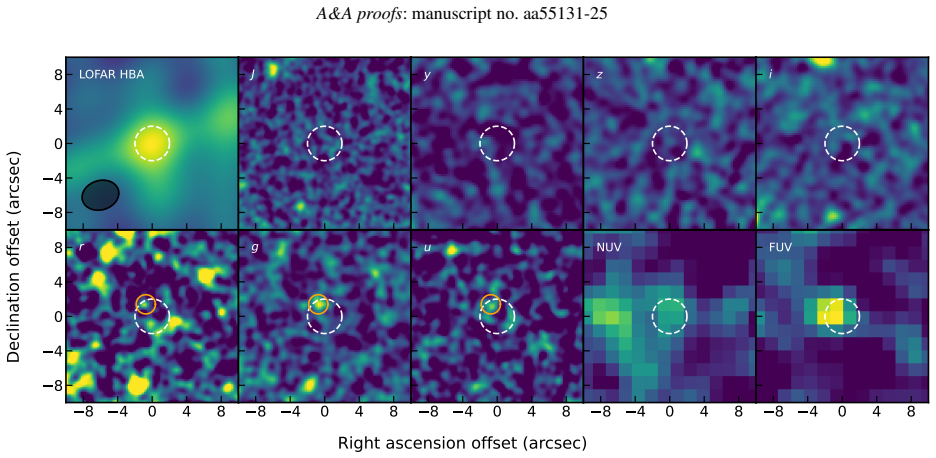
The central claim is that J1634+44 is a long-period transient of a kind not seen before: it produces 19 bright pulses at 120-167 MHz, each no longer than 10 s and each with a total polarisation fraction of roughly 100%, but with the polarisation state alternating between fully circular and fully linear depending on which of the two pulse slots in the five-period cycle it occupies. The pulses arrive at integer multiples of an $841.24808 \pm 0.00015$ s period, with two pulses every five periods and waiting times of two or three periods, never one or four. A 5.2$\sigma$ GALEX FUV detection and $u$-, $g$-, $r$-band UNIONS detections at 3.2-3.9$\sigma$, coincident within 2 arcseconds, point to a white dwarf with an effective temperature of 15000-33000 K and a mass of at least 0.78 $M_\odot$, while a deep UKIRT $J$-band limit of 24.7 AB mag rules out any main-sequence or brown-dwarf companion earlier than M7. The authors conclude that the white dwarf is in a binary with an ultracool dwarf or another white dwarf in a near 5:2 or 5:3 spin-orbit resonance, with the companion modulating when beamed radio emission is directed at us.
Load-bearing premise
The case that J1634+44 contains a white dwarf rests on a handful of faint ultraviolet and optical detections that are individually near the noise floor; if those sources are spurious or unrelated to the radio source, the white-dwarf interpretation and everything built on it falls away.
Editorial extensions
If this is right
- If correct, J1634+44 is the first LPT observed to switch between 100% circular and 100% linear polarisation from pulse to pulse, so the polarisation state is not a fixed property of an LPT.
- The 5:2 or 5:3 spin-orbit resonance implies some LPTs are binaries with short, roughly 35-minute orbits, and the pulse pattern directly tracks the orbital phase of the companion.
- The detection of a hot white dwarf with an age below 1.5 Gyr in an LPT supports the white-dwarf origin hypothesis for at least some members of the class, rather than a magnetar origin.
- The emission mechanism must be coherent and able to produce both polarisation states, which rules out classical electron-cyclotron maser emission and favours relativistic ECMI or a pulsar-like process.
- Extrapolating from one detection, the authors expect about 4 more objects like J1634+44 once the full LOFAR Two-Metre Sky Survey is searched.
Reading between the lines
- Extension: if the polarisation state is tied to the waiting time (circular after three periods, linear after two), then the polarisation mode is set by orbital phase rather than by intrinsic rotation phase; this can be tested directly once more pulses are collected.
- Not in the paper: the claimed line-of-sight magnetic field of about 0.4 $\mu$G could be checked independently by measuring Faraday rotation of polarised background sources along the same sight line, providing a test of the distance and interstellar interpretation.
- Not in the paper: if many more LPTs show a 5:2 or 5:3 pulse pattern, spin-orbit resonance could become a standard clock for measuring white-dwarf braking and binary orbital decay on timescales of years.
- Not in the paper: the quoted occurrence rate implies a handful of similar sources should appear in the remaining LoTSS data, so a targeted search in the unsurveyed sky is an immediate, concrete test of the rate estimate.
Editorial analysis
A structured set of objections, weighed in public.
Referee Report
Summary. The paper reports the discovery of ILT J163430+445010, a long-period transient (LPT) found in a blind Stokes V search of LoTSS DR2. It presents 19 pulses with an 841.24808 +/- 0.00015 s period, a dispersion measure of 22.5 +/- 5.5 pc cm^-3, a rotation measure of 6.27 +/- 0.04 rad m^-2, and pulse-to-pulse switching between ~100% circular and ~100% linear polarization. A marginal UV/optical counterpart (GALEX FUV, UNIONS u/g/r) is interpreted as a white dwarf with effective temperature between 15000 K and 33000 K and mass > 0.78 M_sun, and a companion in a 5:2 or 5:3 spin-orbit resonance is suggested. The text itself repeatedly qualifies the counterpart as marginal and states that deeper observations are required.
Significance. If the radio discovery holds, this is a significant addition to the LPT population: the complete polarization-state switching within a few periods would be new among LPTs, and a high-latitude LPT with a candidate white-dwarf host would provide an important data point for progenitor models. The paper's strengths include the blind-search provenance, the machine-readable TOA table, the use of public archival data, and the explicit caveats about the photometric counterpart. The main risk is that the white-dwarf identification rests on detections at 5.2 sigma (FUV) and 3.2-3.9 sigma (UNIONS), which is below the usual threshold for a secure host identification. The spin-orbit resonance model is clearly presented as illustrative rather than independently tested, which is appropriate.
major comments (3)
- [Sections 3.1.2, 3.1.3, Table 4, Abstract/Title] The physical association of the radio source with the GALEX FUV source (5.2 sigma, below the MIS catalogue threshold) and the UNIONS detections (3.5 sigma, 3.2 sigma, 3.9 sigma in u, g, r) is the sole evidence for the white-dwarf interpretation. The paper does not provide a trials-corrected probability of finding a blue background source within the 2 arcsec radio uncertainty circle, and individual detections are at the 3 sigma level. Given that 'white-dwarf-hosting' appears in the title and abstract and that Section 4 derives the white-dwarf properties from these detections, this is a load-bearing point. Please add a quantitative chance-coincidence analysis (including the number of independent counterpart positions examined and the FUV/u/g/r source densities) or explicitly re-label the object as a 'candidate white dwarf' in the title, abstract, and conclusions.
- [Section 2.2, Table 3, Section 4.2.1] The short-period model with Pdot = -9 +/- 3 x 10^-12 is degenerate with the long-period model with an interpulse and a 0.614 phase jump between 2015-2016 and 2019; Table 3 shows comparable reduced chi-squared values. The period derivative is therefore not an independent measurement: it is one way to absorb the two-epoch phase offset. Since Section 4.2.1 uses the negative Pdot to argue for accretion spin-up from an ultracool dwarf companion, the paper should report a formal model comparison (e.g., AIC/BIC or a phase-connected timing residual search) and state explicitly that Pdot is tentative until more epochs are obtained.
- [Section 4.2, orbital period ranges] The companion orbital periods quoted in Section 4.2 (2103.1061-2103.1141 s and 1402.0814-1402.0853 s) are derived from the same 841.24808 s period and the same 2015-2016 to 2019 phase shift that the resonance model is intended to explain; the active-phase-window width and beaming geometry are free parameters. This is therefore a consistency interpretation rather than an independent prediction. The wording 'We show that such a pattern can be explained' overstates the evidential value; it should be rephrased as 'is consistent with' and the absence of an independent orbital-period measurement (e.g., from periodic Doppler shifts) should be stated.
minor comments (6)
- [Section 2.3] The waiting-time simulation says '20 pulses' but the text elsewhere reports 19 detected pulses; please reconcile.
- [Section 3.1.2] Please report the GALEX image pixel scale and whether the 5.2 sigma FUV detection is measured in the same way as the UNIONS source (aperture versus PSF fitting).
- [Section 4.2] The sentence describing how a slightly shorter 5/2 period shifts the pulse from rotations (1,4) to (2,5) to (3,1) is confusing; a small table of the sequence would help.
- [Table 2] The Time column is described in the notes as 'seconds of modified Julian date' but the column header says UTC; please clarify the column format.
- [Figure 5] The color scale used to identify observing epochs is difficult to read in grayscale or print; add a legend that identifies the epochs directly.
- [Appendix A] Figures A.1-A.4 would be more informative with the residual RMS or reduced chi-squared value included in each caption.
Circularity Check
Radio discovery is self-contained; the spin-orbit resonance companion-period 'result' is a consistency interpretation that reduces by construction to the assumed resonance times the measured 841 s spin period.
-
other
[Section 4.2, 'Binary system' (companion orbital period range; also Table 1 'Modulating period')]
"We assume the white dwarf rotation period is the period we measure in the short-period timing solution, 841.24808±0.00015 s. In our observations, we see pulses arrive at rotation one and four in 2015–2016, and one and three in 2019. Assuming only one change in pulse phase has happened in that time period, and assuming the active phase window covers 0.3 of the orbital phase, we find that the orbit of the companion must be between 2103.1061±0.0004 s and 2103.1141±0.0004 s for a 5:2 resonance, and between 1402.0814±0.0003 and 1402.0853±0.0003 for a 5:3 resonance."
Once the 5:2 (or 5:3) resonance is assumed, the companion orbital period is fixed as 5/2 (or 5/3) times the measured 841.24808 s spin period; the observed 2015-2016 vs 2019 phase shift only selects a narrow interval around these arithmetic values. Thus the 'derived' 2103.110 s / 1402.08 s periods are a restatement of the assumed resonance plus the input spin period, not an independent measurement or prediction. The paper does present the model as a possibility ('could be a result', 'can be explained'), so this is a consistency interpretation rather than a test, and it is not load-bearing for the central radio discovery.
full rationale
The paper's central claims are derived directly from the LOFAR observations: the 19 detected pulses, the 841.24808 s periodicity and period derivative, the DM/RM, and the pulse-to-pulse switching between ~100% circular and ~100% linear polarisation are all measured quantities (Secs. 2.1-2.4), not fits disguised as predictions. The white-dwarf identification rests on marginal GALEX/UNIONS photometry (the paper itself calls it marginal and asks for deeper observations), but that is a data-quality limitation, not a circular argument. The only step that reduces by construction is the spin-orbit resonance companion period in Sec. 4.2, where P_orb is essentially (5/2) or (5/3) times the measured spin period under the assumed resonance. Because the paper frames this as a possible explanation and the discovery stands without it, the overall circularity is low.
Assumptions & free parameters
free parameters (5)
- Active orbital phase window =
±0.15 (width 0.3)
- White dwarf magnetic field strengths for induction estimates =
1 kG and 1 MG test values
- Ultracool dwarf companion mass and radius =
0.1 Msun, 0.1-0.12 Rsun
- Electron temperature in white dwarf atmosphere =
10^4 K
- Orbital period range for 5:2 and 5:3 resonances =
2103.1061-2103.1141 s (5:2); 1402.0814-1402.0853 s (5:3)
assumptions (7)
- standard math Cold plasma dispersion relation governs the pulse frequency sweep
- domain assumption Galactic electron density models (Cordes & Lazio 2002; Yao et al. 2017) give distances of 1.0-4.3 kpc
- domain assumption The faint UV/optical sources at the radio position are physically associated with J1634+44
- domain assumption The white dwarf has a pure-hydrogen, homogeneous-temperature atmosphere for SED fitting
- domain assumption The 841 s period is the rotation period of the white dwarf
- ad hoc to paper Spin-orbit resonance 5:2 or 5:3 with an active orbital phase window explains the pulse pattern
- domain assumption High brightness temperature and high polarization imply a coherent emission process
Cite this review
Pith. "Pith review of Strongly polarised radio pulses from a new white-dwarf-hosting long-period transient." pith.science (2026). https://pith.science/paper/A3HBN6MT
@misc{pith2026250705078,
  author       = {Pith},
  title        = {Pith review of: Strongly polarised radio pulses from a new white-dwarf-hosting long-period transient},
  year         = {2026},
  howpublished = {\url{https://pith.science/paper/A3HBN6MT}},
  note         = {Machine review of arXiv:2507.05078}
}
abstract
Long-period transients (LPTs) are a new and enigmatic class of objects that produce bright pulsations in the radio, with periods far exceeding those seen in rotationally powered pulsars. The proposed progenitors for LPTs are contested, with white dwarfs or magnetars being likely candidates. Here, we present the discovery of ILT\,J163430+445010, a new LPT detected in a blind search for Stokes\,V transients in the LOFAR Two-Metre Sky Survey. Unusual for LPTs, J1634+44 shows pulses that are 100\% circularly polarised, as well as pulses that are 100\% linearly polarised, with the polarisation state changing from pulse to pulse. We detect 19 pulses in total, each with a total polarisation fraction of $\sim100\%$ and a pulse duration of at most 10\,s. The pulses show a periodicity at $841.24808\pm0.00015$\,s, implying a low duty cycle of $0.012$. J1634+44 has a marginally detected counterpart in the ultraviolet GALEX MIS survey and the ultraviolet/optical UNIONS survey, suggesting that it contains a white dwarf with an effective temperature between 15000\,K and 33000\,K. We do not detect J1634+44 with a deep $J$-band exposure with UKIRT at a $3\sigma$ AB magnitude limit of 24.7, ruling out a main-sequence star or ultracool dwarf with a spectral type earlier than M7. The pulses from J1634+44 follow a particular pattern, with two pulses being produced every five periods after a waiting time of two or three periods. This pattern could be a result of spin-orbit coupling in a binary system with a 5:2 or 5:3 resonance, where a companion induces beamed radio emission on the white dwarf. The companion is most likely an ultracool dwarf or another white dwarf, making J1634+44 unique among the currently known sample of LPTs.
Figures


Figures from the paper (6 more)



Forward citations
Cited by 3 Pith papers
-
Unraveling the emission mechanism powering long period radio transients from interacting white dwarf binaries via kinetic plasma simulations
Kinetic plasma simulations show the electron cyclotron maser instability can produce efficient, narrowband, partially linearly polarized radio emission under conditions inferred for white dwarf-M dwarf binaries.
-
A new long period radio transient: Discovery of pulses repeating every 1.16 hours from ASKAP J175534.9-252749.1
ASKAP J175534.9-252749.1 is confirmed as a long period radio transient with a period of 4186.3285 seconds (about 1.16 hours), based on new multi-telescope detections and a timing solution.
-
The Lunar Farside Transients and Technology Telescope (LFT3) Mission
Proposes a $150M-class lunar farside radio telescope (LFT3) to survey 0.1–2700 MHz in the RFI-pristine shielded zone before lunar-orbital interference closes the window.
Reference graph
Works this paper leans on
-
[1]
Astropy Collaboration, Robitaille, T. P., Tollerud, E. J., et al. 2013, A&A, 558, A33 Barrett,P.,Dieck,C.,Beasley,A.J.,Mason,P.A.,&Singh,K.P.2020,Advances in Space Research, 66, 1226 Bédard, A., Bergeron, P., Brassard, P., & Fontaine, G. 2020, ApJ, 901, 93
work page 2013
-
[2]
Bergeron, P., Wesemael, F., & Beauchamp, A. 1995, PASP, 107, 1047
work page 1995
-
[3]
2011, ApJ, 737, 28
Bergeron, P., Wesemael, F., Dufour, P., et al. 2011, ApJ, 737, 28
2011
-
[4]
2011, in Astronomical Society of the Pacific Conference Series, Vol
Bertin, E. 2011, in Astronomical Society of the Pacific Conference Series, Vol. 442, Astronomical Data Analysis Software and Systems XX, ed. I. N. Evans, A. Accomazzi, D. J. Mink, & A. H. Rots, 435
2011
-
[5]
Best, W. M. J., Magnier, E. A., Liu, M. C., et al. 2018, ApJS, 234, 1
work page 2018
-
[6]
R., Vedantham, H
Bloot, S., Callingham, J. R., Vedantham, H. K., et al. 2024, A&A, 682, A170
2024
-
[7]
Blouin, S., Dufour, P., & Allard, N. F. 2018, ApJ, 863, 184
work page 2018
-
[8]
Buckley, D. A. H., Meintjes, P. J., Potter, S. B., Marsh, T. R., & Gänsicke, B. T. 2017, Nature Astronomy, 1, 0029
work page 2017
Show all 68 references
-
[9]
L., et al
Caleb, M., Lenc, E., Kaplan, D. L., et al. 2024, Nature Astronomy, 8, 1159
2024
-
[10]
R., Shimwell, T
Callingham, J. R., Shimwell, T. W., Vedantham, H. K., et al. 2023, A&A, 670, A124
2023
-
[11]
2007, A&A, 467, 777
Casali, M., Adamson, A., Alves de Oliveira, C., et al. 2007, A&A, 467, 777
2007
-
[12]
C., Magnier, E
Chambers, K. C., Magnier, E. A., Metcalfe, N., et al. 2016, arXiv e-prints, arXiv:1612.05560
2016 arXiv
-
[13]
Cooper, A. J. & Wadiasingh, Z. 2024, MNRAS, 533, 2133
2024
-
[14]
Cordes, J. M. & Lazio, T. J. W. 2002, arXiv e-prints, astro de Gasperin, F., Dijkema, T. J., Drabent, A., et al. 2019, A&A, 622, A5 de Ruiter, I., Rajwade, K. M., Bassa, C. G., et al. 2024, arXiv e-prints, arXiv:2408.11536 Dong,F.A.,Clarke,T.,Curtin,A.P.,etal.2024,arXive-prints...
2002
-
[15]
A., Shin, K., Law, C., et al
Dong, F. A., Shin, K., Law, C., et al. 2025, ApJ, under review
2025
-
[16]
Dulk, G. A. 1985, ARA&A, 23, 169
1985
-
[17]
A., Magnier, E
Flewelling, H. A., Magnier, E. A., Chambers, K. C., et al. 2020, ApJS, 251, 7
2020
-
[18]
1986, ApJ, 303, 336
Gehrels, N. 1986, ApJ, 303, 336
1986
-
[19]
Gould, D. M. & Lyne, A. G. 1998, MNRAS, 301, 235
1998
-
[20]
2016, ApJ, 823, L28
Gu, W.-M., Dong, Y.-Z., Liu, T., Ma, R., & Wang, J. 2016, ApJ, 823, L28
2016
-
[21]
W., Cuillandre, J.-C., et al
Gwyn, S., McConnachie, A. W., Cuillandre, J.-C., et al. 2025, UNIONS: The Ultraviolet Near-Infrared Optical Northern Survey
2025
-
[22]
G., Lau, R
Han, Y., Tuthill, P. G., Lau, R. M., et al. 2020, MNRAS, 498, 5604
2020
-
[23]
Holberg, J. B. & Bergeron, P. 2006, AJ, 132, 1221
2006
-
[24]
Hunter, J. D. 2007, Computing In Science & Engineering, 9, 90
2007
-
[25]
J., Bahramian, A., et al
Hurley-Walker, N., McSweeney, S. J., Bahramian, A., et al. 2024, ApJ, 976, L21
2024
-
[26]
J., et al
Hurley-Walker, N., Rea, N., McSweeney, S. J., et al. 2023, Nature, 619, 487
2023
-
[27]
2022, Nature, 601, 526
Hurley-Walker, N., Zhang, X., Bahramian, A., et al. 2022, Nature, 601, 526
2022
-
[28]
D., Lazio, T
Hyman, S. D., Lazio, T. J. W., Kassim, N. E., et al. 2005, Nature, 434, 50
2005
-
[29]
A., McConnachie, A., Cuillandre, J.-C., et al
Ibata, R. A., McConnachie, A., Cuillandre, J.-C., et al. 2017, ApJ, 848, 128
2017
-
[30]
J., Lewis, J., Hodgkin, S., et al
Irwin, M. J., Lewis, J., Hodgkin, S., et al. 2004, in Society of Photo-Optical Instrumentation Engineers (SPIE) Conference Series, Vol. 5493, Optimizing Scientific Return for Astronomy through Information Technologies, ed. P. J. Quinn & A. Bridger, 411–422 Jones,E.,Oliphant,T....
2004
-
[31]
Kaspi, V. M. & Beloborodov, A. M. 2017, ARA&A, 55, 261
2017
-
[32]
Katz, J. I. 2017, MNRAS, 471, L92
2017
-
[33]
Katz, J. I. 2022, Ap&SS, 367, 108
2022
-
[34]
& Melrose, D
Kennett, M. & Melrose, D. 1998, PASA, 15, 211
1998
-
[35]
2010, Mem
Koester, D. 2010, Mem. Soc. Astron. Italiana, 81, 921
2010
-
[36]
Kowalski, P. M. & Saumon, D. 2006, ApJ, 651, L137
2006
-
[37]
J., Almaini, O., et al
Lawrence, A., Warren, S. J., Almaini, O., et al. 2007, MNRAS, 379, 1599
2007
-
[38]
Lee, Y. W. J., Caleb, M., Murphy, T., et al. 2025, Nature Astronomy, 9, 393
2025
-
[39]
2024, arXiv e-prints, arXiv:2411.15739
Li, D., Yuan, M., Wu, L., et al. 2024, arXiv e-prints, arXiv:2411.15739
2024
-
[40]
1998, ApJ, 503, L151
Li, J., Ferrario, L., & Wickramasinghe, D. 1998, ApJ, 503, L151
1998
-
[41]
J., Tovmassian, G., Rodrigues, C
Lima, I. J., Tovmassian, G., Rodrigues, C. V., et al. 2025, ApJ, 984, 152
2025
-
[42]
2021, ApJ, 911, 45
Luo, J., Ransom, S., Demorest, P., et al. 2021, ApJ, 911, 45
2021
-
[43]
2020, ApJ, 897, 1
Lyubarsky, Y. 2020, ApJ, 897, 1
2020
-
[44]
R., Gänsicke, B
Marsh, T. R., Gänsicke, B. T., Hümmerich, S., et al. 2016, Nature, 537, 374
2016
-
[45]
C., Fanson, J., Schiminovich, D., et al
Martin, D. C., Fanson, J., Schiminovich, D., et al. 2005, ApJ, 619, L1
2005
-
[46]
Melrose, D. B. & Dulk, G. A. 1982, ApJ, 259, 844
1982
-
[47]
Most, E. R. & Philippov, A. A. 2023, Phys. Rev. Lett., 130, 245201
2023
-
[48]
2018, ApJ, 866, 88 Offringa,A.R.,McKinley,B.,Hurley-Walker,N.,etal.2014,MNRAS,444,606
Nelson, L., Schwab, J., Ristic, M., & Rappaport, S. 2018, ApJ, 866, 88 Offringa,A.R.,McKinley,B.,Hurley-Walker,N.,etal.2014,MNRAS,444,606
2018
-
[49]
1976, in IAU Symposium, Vol
Paczynski, B. 1976, in IAU Symposium, Vol. 73, Structure and Evolution of Close Binary Systems, ed. P. Eggleton, S. Mitton, & J. Whelan, 75
1976
-
[50]
& Raymond, J
Patterson, J. & Raymond, J. C. 1985, ApJ, 292, 535
1985
-
[51]
R., Buckley, D
Pelisoli, I., Marsh, T. R., Buckley, D. A. H., et al. 2023, Nature Astronomy, 7, 931 Pérez, F. & Granger, B. E. 2007, Computing in Science and Engineering, 9, 21 Popov,S.B.,Mereghetti,S.,Blinnikov,S.I.,Kuranov,A.G.,&Yungelson,L.R. 2018, MNRAS, 474, 2750 Purcell,C.R.,VanEck,C.L...
2023
-
[52]
& Zhang, B
Qu, Y. & Zhang, B. 2025, ApJ, 981, 34
2025
-
[53]
C., Dehman, C., et al
Rea, N., Zelati, F. C., Dehman, C., et al. 2022, The Astrophysical Journal, 940, 72
2022
-
[54]
S., Pellegrini, E
Reissl, S., Klessen, R. S., Pellegrini, E. W., et al. 2023, Nature Astronomy, 7, 1295
2023
-
[55]
Rodriguez, A. C. 2025, A&A, 695, L8
2025
-
[56]
Sazonov, V. N. 1969, Soviet Journal of Experimental and Theoretical Physics, 29, 578
1969
-
[57]
W., Hardcastle, M
Shimwell, T. W., Hardcastle, M. J., Tasse, C., et al. 2022, A&A, 659, A1
2022
-
[58]
W., Tasse, C., Hardcastle, M
Shimwell, T. W., Tasse, C., Hardcastle, M. J., et al. 2019, A&A, 622, A1
2019
-
[59]
Taylor, J. H. & Weisberg, J. M. 1989, ApJ, 345, 434
1989
-
[60]
E., Bergeron, P., & Gianninas, A
Tremblay, P. E., Bergeron, P., & Gianninas, A. 2011, ApJ, 730, 128 Van Der Walt, S., Colbert, S. C., & Varoquaux, G. 2011, Computing in Science & Engineering, 13, 22 van Weeren, R. J., Shimwell, T. W., Botteon, A., et al. 2021, A&A, 651, A115
2011
-
[61]
1999, A&A, 349, 389
Voges, W., Aschenbach, B., Boller, T., et al. 1999, A&A, 349, 389
1999
-
[62]
F., Wang, C., & Han, J
Wang, P. F., Wang, C., & Han, J. L. 2012, Monthly Notices of the Royal Astro- nomical Society, 423, 2464
2012
-
[63]
2024, arXiv e-prints, arXiv:2411.16606
Wang, Z., Rea, N., Bao, T., et al. 2024, arXiv e-prints, arXiv:2411.16606
2024 arXiv
-
[64]
Z., Magnier, E
Waters, C. Z., Magnier, E. A., Price, P. A., et al. 2020, ApJS, 251, 4
2020
-
[65]
Wilson, E. C. & Nordhaus, J. 2020, MNRAS, 497, 1895
2020
-
[66]
2002, MNRAS, 331, 221
Wu, K., Cropper, M., Ramsay, G., & Sekiguchi, K. 2002, MNRAS, 331, 221
2002
-
[67]
M., Manchester, R
Yao, J. M., Manchester, R. N., & Wang, N. 2017, ApJ, 835, 29
2017
-
[68]
& Gil, J
Zhang, B. & Gil, J. 2005, ApJ, 631, L143 Article number, page 13 of 14 A&A proofs: manuscript no. aa55131-25 Appendix A: Timing residuals Thisappendixcontainstheresidualsforthefourdifferenttiming solutions presented in Tab.3. Fig.A.1 shows the residuals for a timing model with...
2005
Reviewed August 6, 2026 · model on record in the stance chip above.
Discussion (0). Sign in to comment.