Guidelines for the optimization of hafnia-based ferroelectrics through superlattice engineering
Pith reviewed 2026-05-19 06:10 UTC · model grok-4.3
The pith
Superlattices alternating hafnia-zirconia layers boost polarization to record levels while improving endurance and sustainability.
A machine-rendered reading of the paper's core claim, the machinery that carries it, and where it could break.
Core claim
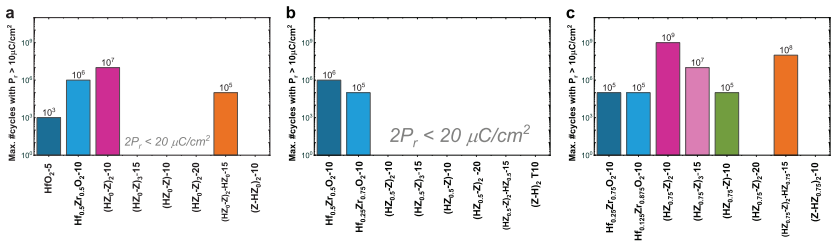
By alternating Hf1-xZrxO2 sublayers of varying compositions with pure ZrO2 sublayers in superlattices, the ZrO2 layers boost the total remnant polarization and the added interfaces prevent breakdown. This allows superlattices with 87.5% ZrO2 content to exhibit a record 2Pr value of 84 μC/cm² that endures 10^9 cycles while keeping 2Pr greater than 20 μC/cm², advancing both performance and sustainability.
What carries the argument
Superlattice structure with alternating Hf_{1-x}Zr_xO_2 and pure ZrO_2 sublayers that boosts polarization and stabilizes against breakdown.
If this is right
- High ZrO2 content superlattices can deliver higher polarization than conventional hafnia films.
- Interface effects from the superlattice design enhance cycling endurance to 10^9 cycles.
- Replacing HfO2 with abundant ZrO2 reduces reliance on scarce materials for ferroelectric applications.
- Optimization through varying sublayer stoichiometries provides a path to tailor ferroelectric properties.
Where Pith is reading between the lines
- These superlattices could enable denser or more reliable ferroelectric memory cells in commercial chips.
- Similar interface engineering might improve other thin-film oxides used in electronics.
- Further studies could test the limits by increasing the number of layers or applying to different substrates.
Load-bearing premise
The pure ZrO2 sublayers act only to boost polarization and the interfaces reliably prevent breakdown without creating defects or leakage that would lower the measured polarization or endurance.
What would settle it
Fabricating and testing non-superlattice films with the same average composition to check if polarization drops or if breakdown occurs earlier than 10^9 cycles.
Figures




read the original abstract
Hafnia-based ferroelectrics are revolutionizing the data storage industry and the field of ferroelectrics, with improved materials and devices being reported monthly. However, full understanding and control has not been reached yet and the ideal material still needs to be found. Here we report ferroelectric hafnia-zirconia superlattices made out of zirconium-substituted hafnia (Hf$_{1-x}$Zr$_x$O$_2$) sublayers of varying stoichiometries alternating with pure ZrO$_2$ sublayers. It is observed that the ZrO$_2$ layers in these superlattices act as a booster for the total remnant polarization (P$_r$). By combining the benefits of the ZrO$_2$ layers and the added interfaces, which help prevent breakdown, we fabricate superlattices with a total 87.5% ZrO$_2$ content, exhibiting record polarizations with a 2P$_r$ value of 84 $\mu$C/cm$^2$ that can be cycled 10$^9$ times, while maintaining a 2P$_r$ > 20 $\mu$C/cm$^2$. Next to these attractive properties, substitution of HfO$_2$ by the much more abundant ZrO$_2$ offers a significant step towards the sustainable application of these devices.
Editorial analysis
A structured set of objections, weighed in public.
Referee Report
Summary. The manuscript reports experimental fabrication of hafnia-zirconia superlattices formed by alternating zirconium-substituted hafnia (Hf1-xZrxO2) sublayers with pure ZrO2 sublayers. It claims that ZrO2 layers boost remnant polarization while added interfaces suppress breakdown, enabling structures with 87.5% total ZrO2 content that achieve a record 2Pr of 84 μC/cm², endure 10^9 cycles, and retain 2Pr > 20 μC/cm², with additional benefits for sustainability from higher Zr incorporation.
Significance. If the reported polarization values are confirmed to reflect genuine ferroelectric switching, the superlattice approach would offer a practical route to higher-performance and more sustainable hafnia-based ferroelectrics by maximizing abundant ZrO2 while preserving endurance, directly addressing needs in data storage and ferroelectric devices.
major comments (2)
- [Abstract] Abstract: The central claim of a true ferroelectric 2Pr = 84 μC/cm² (and retained >20 μC/cm² after 10^9 cycles) at 87.5% ZrO2 content rests on the assumption that ZrO2 sublayers purely enhance polarization and that interfaces prevent breakdown without introducing leakage paths or compensating defects. Standard triangular-wave P-E measurements can register non-ferroelectric current as remnant polarization when Zr fraction increases conductivity; the manuscript must supply explicit controls (e.g., frequency-dependent loops, leakage-current subtraction, or positive-up-negative-down measurements) to rule this out, as the skeptic concern directly challenges the headline performance numbers.
- [Results] Results section on electrical characterization: Without reported raw P-E data, error bars, baseline comparisons to single-layer HfO2 or HfZrO2 films, or methods details on how the 2Pr values were extracted, the record-polarization and endurance claims cannot be independently verified from the given information.
minor comments (2)
- [Abstract] Specify the exact substitution level x used in the Hf1-xZrxO2 sublayers for the optimized 87.5% ZrO2 superlattices and how it was chosen.
- [Figures] Ensure all figures showing P-E loops include scale bars, measurement frequency, and any leakage correction applied.
Simulated Author's Rebuttal
We thank the referee for their careful review and constructive comments, which help strengthen the presentation of our results on hafnia-zirconia superlattices. We address each major comment below and indicate the corresponding revisions.
read point-by-point responses
-
Referee: [Abstract] Abstract: The central claim of a true ferroelectric 2Pr = 84 μC/cm² (and retained >20 μC/cm² after 10^9 cycles) at 87.5% ZrO2 content rests on the assumption that ZrO2 sublayers purely enhance polarization and that interfaces prevent breakdown without introducing leakage paths or compensating defects. Standard triangular-wave P-E measurements can register non-ferroelectric current as remnant polarization when Zr fraction increases conductivity; the manuscript must supply explicit controls (e.g., frequency-dependent loops, leakage-current subtraction, or positive-up-negative-down measurements) to rule this out, as the skeptic concern directly challenges the headline performance numbers.
Authors: We agree that rigorous confirmation of ferroelectric switching is essential, especially at high ZrO2 fractions where conductivity may rise. The original manuscript presented standard triangular-wave P-E data as the primary evidence. In the revised version we will add frequency-dependent P-E loops demonstrating the expected weak frequency dependence of the switched charge, positive-up-negative-down (PUND) measurements to isolate the true switched polarization, and leakage-current characteristics with explicit subtraction protocols. These additions will directly address the possibility of non-ferroelectric contributions. revision: yes
-
Referee: [Results] Results section on electrical characterization: Without reported raw P-E data, error bars, baseline comparisons to single-layer HfO2 or HfZrO2 films, or methods details on how the 2Pr values were extracted, the record-polarization and endurance claims cannot be independently verified from the given information.
Authors: We acknowledge that the current manuscript does not include raw P-E traces, statistical error bars, or explicit baseline comparisons, which limits independent verification. In the revised manuscript we will insert representative raw hysteresis loops with error bars derived from multiple devices, add direct comparisons to single-layer HfO2 and Hf0.5Zr0.5O2 reference films fabricated under identical conditions, and expand the Methods section with a precise description of the 2Pr extraction procedure, including integration limits and any averaging protocol. revision: yes
Circularity Check
No circularity: experimental measurements stand alone
full rationale
The paper is a purely experimental report on fabrication and electrical testing of HfO2-ZrO2 superlattices. Central results (2Pr = 84 μC/cm², endurance to 10^9 cycles) are direct P-E loop and cycling measurements on fabricated samples, not outputs of any derivation, fit, or model that reduces to prior inputs by construction. No equations, ansatze, or predictions appear. Any self-citations are incidental and non-load-bearing for the measured performance claims. The work is self-contained against external benchmarks via the reported device data.
Axiom & Free-Parameter Ledger
free parameters (1)
- Zr substitution level x in Hf1-xZrxO2 sublayers
axioms (1)
- domain assumption Standard ferroelectric measurement protocols accurately capture remnant polarization and endurance without significant artifacts from electrode interfaces or leakage.
Lean theorems connected to this paper
-
IndisputableMonolith/Cost/FunctionalEquation.leanwashburn_uniqueness_aczel unclear?
unclearRelation between the paper passage and the cited Recognition theorem.
By combining the benefits of the ZrO2 layers and the added interfaces, which help prevent breakdown, we fabricate superlattices with a total 87.5% ZrO2 content, exhibiting record polarizations with a 2Pr value of 84 μC/cm²
What do these tags mean?
- matches
- The paper's claim is directly supported by a theorem in the formal canon.
- supports
- The theorem supports part of the paper's argument, but the paper may add assumptions or extra steps.
- extends
- The paper goes beyond the formal theorem; the theorem is a base layer rather than the whole result.
- uses
- The paper appears to rely on the theorem as machinery.
- contradicts
- The paper's claim conflicts with a theorem or certificate in the canon.
- unclear
- Pith found a possible connection, but the passage is too broad, indirect, or ambiguous to say the theorem truly supports the claim.
Reference graph
Works this paper leans on
-
[1]
and (020) reflections of the monoclinic phase, respectively, which are indicativ e of strain relaxation in the superlattice. Comparing the different samples, several conclu sions can be made regarding r-phase stability in epitaxial Hf 1-xZrxO2-ZrO2 superlattices: i The higher the Zr content of the Hf 1-xZrxO2 layers, the less prone they are to thickness rel...
-
[2]
display low P r values and high coercivities (E c), or simply exhibit dielectric behaviour (P r=0, Ec=0) in cases where the m-phase is dominant. No antiferroelectric be haviour was observed, confirming that for all superlattices the presence of t-phase ZrO 2 is negligible. The results also show the ferroelectric behaviour of r-phase superlattices diff ers f...
discussion (0)
Sign in with ORCID, Apple, or X to comment. Anyone can read and Pith papers without signing in.