REVIEW 3 major objections 5 minor 1 cited by
Rossby number regime, convection suppression, and dynamo-generated magnetism in inflated hot Jupiters
T0 review · 3 major / 5 minor · reviewed 2026-08-06 · deepseek-v4-flash
Pith's one-line read The paper argues that when the extra heat that inflates hot Jupiters is deposited in the outer envelope rather than in the deep dynamo region, convection in the dynamo region is suppressed and the resulting surface magnetic fields drop to…
desk verdict A clean MESA demonstration that where inflation heat is deposited controls whether hot Jupiter dynamos stay strong or collapse; the missing piece is a self-consistent Ohmic heating profile. read the letter →
The pith
A machine-rendered reading of the paper's core claim, the machinery that carries it, and where it could break.
The reading
What carries the argument
The operative machinery is a one-dimensional evolutionary model of an irradiated giant planet in which the heating geometry is chosen by hand. The code computes convective velocities and fluxes; the Rossby number $\mathrm{Ro}=P_{\mathrm{orb}}v_{\mathrm{conv}}/H_\rho$ fixes which dynamo regime applies, and the Christensen scaling law $B^2/2\mu_0 = c f_{\mathrm{ohm}}\langle\rho\rangle^{1/3}(Fq_o)^{2/3}$ converts the volume-averaged convective heat flux of the metallic-hydrogen shell into a field strength. The decisive input is deposition geometry: heat deposited outside the dynamo shell inverts the radiative gradient and creates a positive entropy gradient, stalling convection and driving the convective flux $q_c$ toward zero.
What would settle it
A confirmed detection of coherent cyclotron radio emission above 10 MHz from an inflated hot Jupiter would directly contradict the prediction that most such planets have surface dipole fields below the 3.5 G cutoff; so would an updated electrical-resistance heating model whose peak deposition lies below the 1-Mbar metallic-hydrogen boundary while still inflating the radius.
Extended reading notes
Core claim
On the paper's own terms, the discovery is that magnetic-field estimates for inflated hot Jupiters are controlled less by how much heat is added than by where it is added. Extended heat deposition through the dynamo shell leaves almost all hot Jupiters in the fast-rotator regime, with Rossby numbers $\mathrm{Ro}\lesssim0.1$, and recovers the canonical picture: dynamo-region fields of order 900 G and equatorial surface dipole fields near 100 G for the most inflated planets. Outer deposition, the geometry expected of Ohmic heating, stabilizes the deep layers, suppresses convection, and cuts the convective heat flux that feeds the dynamo; the derived surface dipolar fields fall to Jovian values or below, and the corresponding coherent radio fluxes fall below the ionospheric cutoff. The authors present this as a possible resolution of the long-standing failure to detect radio emission from hot Jupiters.
Load-bearing premise
The entire suppression argument rests on the assumption that the extra heat responsible for inflation is deposited mostly in the outer envelope, above the deep metallic-hydrogen layer where a dynamo can operate, rather than deeper; if realistic heating models ever move that heat downward, the predicted strong fields return.
Editorial extensions
If this is right
- If the outer-heating scenario is right, inflated hot Jupiters are generically weak radio emitters, so the null results of radio surveys are expected rather than puzzling.
- The best remaining radio and star-planet interaction targets shift to massive, long-period, tidally locked planets whose interiors resist inflation and whose Rossby numbers can exceed 0.1.
- Even in the optimistic extended-heating case, surface dipole fields are far below dynamo-region fields because inflation swells the outer layers and the dipole decays as the cube of radius.
- The mechanism can feed back on itself: a strong dynamo field drives more Ohmic heating, which suppresses convection, weakens the field, and reduces the heating, possibly producing oscillatory behaviour.
- The suppression mechanism parallels the accepted explanation for Venus lacking an active dynamo: a blanketing layer that stabilizes the interior and stalls convective cooling.
Reading between the lines
- The authors do not state it this way, but their two scenarios imply an observable anti-correlation: at fixed equilibrium temperature, the most inflated planets should show the weakest magnetic indicators.
- Their logic generalizes to non-Ohmic inflation mechanisms: any heat source that peaks above the dynamo shell should suppress the deep dynamo by the same gradient-inversion mechanism.
- A three-dimensional test is the natural next step: day-night asymmetric deposition might keep localized convection alive in some sectors even when the spherical average is stably stratified.
Editorial analysis
A structured set of objections, weighed in public.
Referee Report
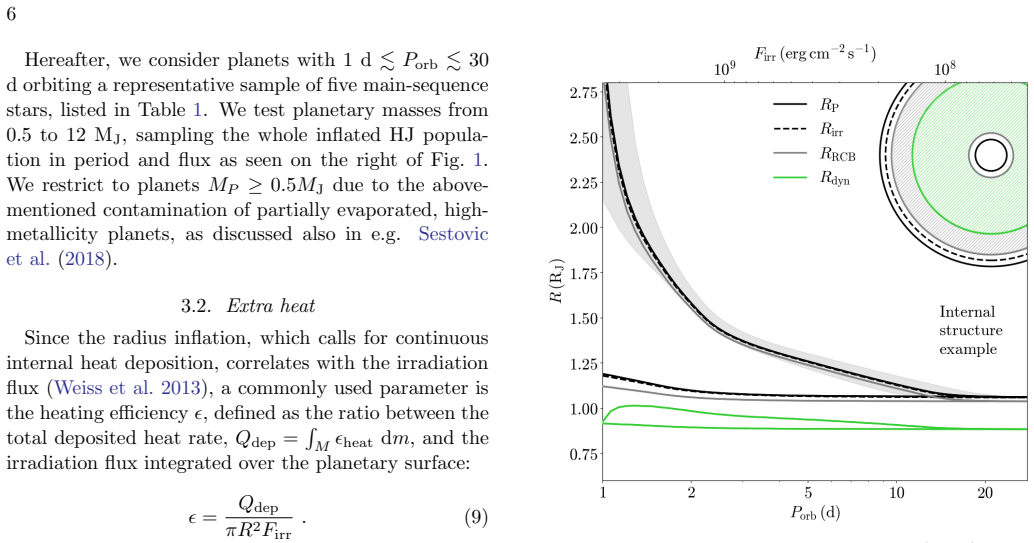
Summary. The paper uses the MESA stellar-evolution code (version 24.08.1) to compute one-dimensional evolutionary models of irradiated, inflated hot Jupiters, with the extra heating rate set by the Thorngren & Fortney (2018) efficiency law. After arguing that hot Jupiters are tidally synchronized, the authors compute internal Rossby number profiles Ro(r) for a grid of orbital periods, planetary masses, and host-star types. With heat deposited throughout the envelope down to the dynamo region, the dynamo region stays in the fast-rotator regime (Ro below about 0.1) for almost all models, and the Christensen et al. (2009) scaling yields dynamo-region fields of order 900 G and surface dipole fields of order 100 G, consistent with Yadav & Thorngren (2017). With heat deposited only between the dynamo boundary Rdyn (defined by P_dyn = 1 Mbar) and the irradiation depth, the MESA models develop a subadiabatic, radiative zone that suppresses convection in the metallic-hydrogen region; the predicted surface dipole fields then fall to or below Jovian values, which the paper offers as an explanation for the absence of confirmed coherent radio emission from hot Jupiters.
Significance. The paper's conditional claim is physically clear and of substantial interest: if the heating responsible for inflation is deposited outside the dynamo region, deep convection and dynamo-generated fields are strongly suppressed, which would resolve the long-standing tension between optimistic radio flux predictions and the null results of observing campaigns. The calculation is transparent and largely reproducible: the code version, structure equations, irradiation implementation, and the two heating geometries are all specified, and the field estimates are genuine predictions rather than fits to the nondetections. The paper also makes specific, falsifiable target predictions for massive, long-period planets (GJ 86 b, HD 72892 b, TIC 393818343 b), and it honestly flags the sensitivity of its magnetic-field integral to Rdyn. The main weakness is that the physically decisive choice between the two heating scenarios depends on an imported Ohmic deposition profile that is never computed, quantified, or varied in this work, and the quantitative field values in the suppressed regime employ a scaling law in a regime whose validity the authors themselves question.
major comments (3)
- [Section 3.2 and Section 6] The bridge between the two idealized heating scenarios and real Ohmic dissipation is the load-bearing input of the paper, and it is never quantified. In the 'outer' scenario, heat is deposited as a step function between Rdyn and Rirr with exactly zero heating below Rdyn, and no run in the paper varies the fraction of the deposited power that lies below Rdyn, even though every physical heating profile (Ohmic, tidal, or turbulent) has some finite tail at depth. Because the deep convective luminosity carries the interior cooling flux, which is small compared with the deposited heating, a deep fraction of even a few percent of the dissipated power could restore a convective flux comparable to the unheated value, moving the predicted surface fields from sub-Jovian back toward the Jovian range and potentially crossing the ~3.5 G radio cutoff. The authors should either implement published Ohmic dissipation profiles directly in their models, or add a scenario that deposits a fraction f of the heat below Rdyn and present Bdyn and Bdip,surf as functions of f. Without this, the headline conclusion rests on an untested edge of the parameter space.
- [Section 5.1, Eqs. (14)-(16)] The quantitative prediction that the suppressed models fall below the coherent-radio cutoff is less secure than the qualitative suppression result. The Christensen et al. (2009) scaling is applied in a regime where the convective flux in the integration shell is vanishing; the manuscript itself concedes that 'it might not be accurate to estimate the magnetic field strength created in these shallower convective layers with the same scaling laws,' and that Eq. (15) is 'very sensitive to both the assumed definition of Rdyn, and the radial interval used in the outer heating.' No sensitivity test to the metallization pressure is provided, even though Section 3.1 notes that the 1 Mbar value is an approximation with temperature dependence. Varying Pdyn over the plausible range given by French et al. (2012) and Bonitz et al. (2024) would change both the integration limits of Eq. (15) and the location of the heating cutoff, thereby changing the surviving deep convective flux. The authors should quantify these two sensitivities; until then, the sub-Jovian field values should be presented as a scenario-dependent estimate rather than a robust prediction.
- [Sections 3.2 and 6 (cited Ohmic profiles)] The assertion that realistic Ohmic models predict essentially all dissipation above the dynamo region is supported by citations rather than by any quantity shown in this paper. A normalized dissipation profile from at least one published Ohmic model, plotted against pressure with Rdyn marked, is needed to verify that the step function between Rdyn and Rirr is a faithful approximation in the region that matters. One of the four cited pillars, Viganò et al. (2025), is a submitted manuscript that shares co-authors with this paper, so it does not provide an independent check. This is a case of missing support for a load-bearing input; the gap is fixable within the scope of the manuscript if the authors extract and display the relevant profiles.
minor comments (5)
- [Section 1 and Section 4] The dynamo-regime transition is quoted as Ro ~ 0.12 in the introduction, while the abstract, figures, and summary statements use the threshold Ro <= 0.1; the adopted value should be stated consistently.
- [Section 5.2, Eq. (17)] In the sentence 'we simply assume a representative solar value, Mdot_star = Mdot_sun ~ 400 km s^-1', the quantity 400 km s^-1 is the wind speed V_W, not a mass-loss rate; this typo should be corrected.
- [Section 3.2] The sentence 'the results are almost indistinguishable results from the first one' contains a duplicated word, and the parenthetical list of radii and scenarios would be easier to follow if split into separate sentences.
- [Section 5.1] The agreement with Yadav & Thorngren (2017) for the extended-heating branch should be framed as a consistency check rather than an independent confirmation, since both calculations assume that the inflation heat is carried by the convective flux that powers the dynamo.
- [Section 2] Given the recent magnetic-torque asynchronization mechanism proposed by Wazny & Menou (2025), a sentence explaining why this effect does not change the Ro conclusions beyond the scope statement would strengthen the tidal-locking argument.
Circularity Check
No material circularity: the low-field suppression branch is an emergent MESA result given an imported (not fitted) heat-deposition profile; self-citations are present but non-load-bearing.
full rationale
The paper's derivation chain is: adopted heat-deposition profile (scenario 1: extended below Rdyn; scenario 2: outer, above Rdyn) yields MESA 1D structure via the energy equation and MLT, which yields qc, which feeds the externally calibrated Christensen et al. (2009) scaling to produce Bdyn and Bdip,surf. No link equates an output to an input by construction: the convection suppression below Rdyn in scenario 2 is computed from the radiative-versus-adiabatic gradient comparison and the resulting sub-dynamo luminosity, not assumed; the field values are post-processed, and no magnetic or radio observable is fitted anywhere. The extended-heating branch 'recovers' the Yadav & Thorngren (2017) values, but the paper states this explicitly ('we recover ... compatible with the work of Yadav & Thorngren (2017) ... conceptually similar to our extended heat case'), so it is a disclosed consistency check rather than a renamed prediction. The genuinely load-bearing premise is that Ohmic heating deposits most of its power above Rdyn; that premise is imported from published external models (Batygin et al. 2011; Ginzburg & Sari 2016; Knierim et al. 2022), with the submitted co-authored Viganò et al. (2025) appearing alongside them in the citation chain. Because the claim survives without the self-citation, the self-citation is not load-bearing, and the 'as realistic Ohmic models predict' bridge is an external physical input, not a circular reduction. The manuscript itself flags the sensitivity of the field integral (Eq. 15) to the assumed Rdyn and the outer-heating radial interval (Sec. 5.1), the purely phenomenological character of the Thorngren & Fortney (2018) efficiency fit (Sec. 3.2), and the possible dynamo-Ohmic feedback loop (Sec. 6); these are honestly disclosed correctness risks and model-dependence concerns, not circular steps. Overall, the central derivation is self-contained given its inputs, and the self-citations are minor, so the circularity score is 2 rather than 0.
Assumptions & free parameters
free parameters (7)
- Heating efficiency Gaussian (epsilon_max, peak, width) =
2.37%, log10(Firr/F0)=0.14, sigma=0.37
- Planetary albedo A_B =
0
- Irradiation absorption column Sigma_star =
200 g/cm^2
- Dynamo boundary pressure P_dyn =
1 Mbar
- Core mass and density =
10 Earth masses, 10 g/cm^3
- Christensen scaling-law normalization c and f_ohm =
c=0.63, f_ohm=1
- Radio flux stellar wind parameters =
Solar mass-loss rate and 400 km/s wind
assumptions (7)
- domain assumption All hot Jupiters in the sample are tidally locked, so rotation period equals orbital period
- domain assumption Realistic Ohmic (and other) heat deposition is concentrated in the outer envelope, above the dynamo region
- domain assumption MESA one-dimensional mixing-length theory describes convection and convective heat flux adequately
- domain assumption Christensen et al. (2009) heat-flux scaling law applies to hot Jupiter dynamo regions
- domain assumption Thorngren & Fortney (2018) heating efficiency from Eq. (10) is representative of the population
- domain assumption The hydrogen metallization boundary is at a fixed pressure of 1 Mbar
- domain assumption Stellar irradiation is constant in time and deposited uniformly through the outermost 200 g/cm^2 column
Cite this review
Pith. "Pith review of Rossby number regime, convection suppression, and dynamo-generated magnetism in inflated hot Jupiters." pith.science (2026). https://pith.science/paper/B7POIEGP
@misc{pith2026250705202,
  author       = {Pith},
  title        = {Pith review of: Rossby number regime, convection suppression, and dynamo-generated magnetism in inflated hot Jupiters},
  year         = {2026},
  howpublished = {\url{https://pith.science/paper/B7POIEGP}},
  note         = {Machine review of arXiv:2507.05202}
}
abstract
Hot Jupiters (HJs) are commonly thought to host the strongest dynamo-generated magnetic fields among exoplanets, up to one order of magnitude larger than Jupiter. Thus, they have often been regarded as the most promising exoplanets to display magnetic star-planet interaction signals and magnetically-driven coherent radio emission, which unfortunately remains elusive, despite many diversified observational campaigns. In this work, we investigate the evolution of the internal convection and dynamo properties of HJs via one-dimensional models. We explore the dependency on orbital distance, planetary and stellar masses, and types of heat injection. We employ one-dimensional evolutionary models to obtain internal convective structures. Specifically, we obtain the Rossby number $\mathrm{Ro}$ as a function of planetary depth and orbital period, after showing that tidal synchronization is likely valid for all HJs. When the heat is applied uniformly, the convective layers of almost all HJs remain in the fast rotator regime, $\mathrm{Ro} \lesssim 0.1$, except possibly the most massive planets with large orbital distances (but still tidally locked). We recover magnetic field strengths for inflated HJs by applying well-known scaling laws for fast rotators. When strong heat sources are applied mostly in the outer envelope and outside the dynamo region, as realistic Ohmic models predict, convection in the dynamo region often breaks down. Consequently, the heat flux and the derived surface magnetic fields can be greatly reduced to or below Jovian values, contrary to what is commonly assumed, thus negatively affecting estimates for coherent radio emission, and possibly explaining the failure in detecting it so far.
Figures


Figures from the paper (7 more)


Forward citations
Cited by 1 Pith paper
-
Inflated hot Jupiters: Inferring average atmospheric velocity via Ohmic models coupled with internal dynamo evolution
Ohmic heating models with an evolving dynamo field reproduce observed hot Jupiter radii only for sub-10-bar winds of 0.01 to 1 km/s that decline steeply with temperature and roughly linearly with mass.
Reference graph
Works this paper leans on
-
[1]
2006, ApJ, 650, 394, doi: 10.1086/506011
Arras, P., & Bildsten, L. 2006, ApJ, 650, 394, doi: 10.1086/506011
doi:10.1086/506011 2006
-
[2]
Bastian, T. S., Dulk, G. A., & Leblanc, Y. 2000, ApJ, 545, 1058, doi: 10.1086/317864
doi:10.1086/317864 2000
-
[3]
2018, AJ, 155, 178, doi: 10.3847/1538-3881/aab54e
Batygin, K. 2018, AJ, 155, 178, doi: 10.3847/1538-3881/aab54e
-
[4]
Batygin, K., & Stevenson, D. J. 2010, The Astrophysical Journal Letters, 714, L238, doi: 10.1088/2041-8205/714/2/L238
-
[5]
Batygin, K., Stevenson, D. J., & Bodenheimer, P. H. 2011, ApJ, 738, 1, doi: 10.1088/0004-637X/738/1/1
-
[6]
2024, Physics of Plasmas, 31, 110501, doi: 10.1063/5.0219405
Bonitz, M., Vorberger, J., Bethkenhagen, M., et al. 2024, Physics of Plasmas, 31, 110501, doi: 10.1063/5.0219405
-
[7]
Burrows, A., Hubeny, I., Budaj, J., & Hubbard, W. B. 2007, ApJ, 661, 502, doi: 10.1086/514326
doi:10.1086/514326 2007
-
[8]
Callingham, J. R., Shimwell, T. W., Vedantham, H. K., et al. 2023, A&A, 670, A124, doi: 10.1051/0004-6361/202245567
Show all 98 references
-
[9]
W., & Ostlie, D
Carroll, B. W., & Ostlie, D. A. 2017, An introduction to modern astrophysics, Second Edition
2017
-
[10]
W., Shkolnik, E
Cauley, P. W., Shkolnik, E. L., Llama, J., & Lanza, A. F. 2019, Nature Astronomy, 3, 1128, doi: 10.1038/s41550-019-0840-x
2019 doi
-
[11]
2007, ApJL, 661, L81, doi: 10.1086/518473
Chabrier, G., & Baraffe, I. 2007, ApJL, 661, L81, doi: 10.1086/518473
2007 doi
-
[12]
R., & Aubert, J
Christensen, U. R., & Aubert, J. 2006, Geophysical Journal International, 166, 97, doi: 10.1111/j.1365-246X.2006.03009.x
2006 arXiv
-
[13]
R., Holzwarth, V., & Reiners, A
Christensen, U. R., Holzwarth, V., & Reiners, A. 2009, Nature, 457, 167, doi: 10.1038/nature07626
2009 doi
- [14]
-
[15]
P., & Giuli, R
Cox, J. P., & Giuli, R. T. 1968, Principles of stellar structure
1968
-
[16]
H., & Musielak, Z
Cuntz, M., Saar, S. H., & Musielak, Z. E. 2000, ApJL, 533, L151, doi: 10.1086/312609
2000 doi
-
[17]
B., Schwartz, J
Dang, L., Cowan, N. B., Schwartz, J. C., et al. 2018, Nature Astronomy, 2, 220, doi: 10.1038/s41550-017-0351-6
2018 doi
-
[18]
Davidson, P. A. 2013, Geophysical Journal International, 195, 67, doi: 10.1093/gji/ggt167 de Gasperin, F., Brunetti, G., Bruggen, M., et al. 2020, doi: 10.26093/cds/vizier.36420085
2013 doi
-
[19]
J., et al
Dietrich, W., Kumar, S., Poser, A. J., et al. 2022, MNRAS, 517, 3113, doi: 10.1093/mnras/stac2849
2022 doi
-
[20]
Dulk, G. A. 1985, ARA&A, 23, 169, doi: 10.1146/annurev.aa.23.090185.001125 Elias-L´ opez, A., Del Sordo, F., Vigan` o, D., et al. 2025, A&A, 696, A161, doi: 10.1051/0004-6361/202453372
1985
-
[21]
P., Vogt, S
Feng, F., Butler, R. P., Vogt, S. S., et al. 2022, ApJS, 262, 21, doi: 10.3847/1538-4365/ac7e57
2022 doi
-
[22]
J., Dawson, R
Fortney, J. J., Dawson, R. I., & Komacek, T. D. 2021, Journal of Geophysical Research (Planets), 126, e06629, doi: 10.1029/2020JE006629
2021 doi
-
[23]
J., Marley, M
Fortney, J. J., Marley, M. S., & Barnes, J. W. 2007, ApJ, 659, 1661, doi: 10.1086/512120
2007 doi
-
[24]
2012, The Astrophysical Journal Supplement Series, 202, 5, doi: 10.1088/0067-0049/202/1/5
French, M., Becker, A., Lorenzen, W., et al. 2012, The Astrophysical Journal Supplement Series, 202, 5, doi: 10.1088/0067-0049/202/1/5
2012 doi
-
[25]
2023, in AAS/Division for Planetary Sciences Meeting
Fuentes, R., Cumming, A., Anders, E., & Hindman, B. 2023, in AAS/Division for Planetary Sciences Meeting
2023
-
[26]
X., Wang, S., et al
Gan, T., Wang, S. X., Wang, S., et al. 2023, AJ, 165, 17, doi: 10.3847/1538-3881/ac9b12
2023 doi
-
[27]
2015, ApJ, 803, 111, doi: 10.1088/0004-637X/803/2/111 18 —
Ginzburg, S., & Sari, R. 2015, ApJ, 803, 111, doi: 10.1088/0004-637X/803/2/111 18 —. 2016, ApJ, 819, 116, doi: 10.3847/0004-637X/819/2/116
2015 doi
-
[28]
1966, Icarus, 5, 375, doi: 10.1016/0019-1035(66)90051-0 Grießmeier, J
Goldreich, P., & Soter, S. 1966, Icarus, 5, 375, doi: 10.1016/0019-1035(66)90051-0 Grießmeier, J. M., Zarka, P., & Spreeuw, H. 2007, A&A, 475, 359, doi: 10.1051/0004-6361:20077397
1966 doi
-
[29]
1996, ApJL, 459, L35, doi: 10.1086/309935
Saumon, D. 1996, ApJL, 459, L35, doi: 10.1086/309935
1996 doi
-
[30]
Guillot, T., & Showman, A. P. 2002, A&A, 385, 156, doi: 10.1051/0004-6361:20011624
2002 doi
-
[31]
Heng, K., & Showman, A. P. 2015, Annual Review of Earth and Planetary Sciences, 43, 509, doi: 10.1146/annurev-earth-060614-105146
2015 doi
-
[32]
2021, ApJ, 908, 77, doi: 10.3847/1538-4357/abd8d1
Hori, Y. 2021, ApJ, 908, 77, doi: 10.3847/1538-4357/abd8d1
2021 doi
-
[33]
A., Rubie, D
Jacobson, S. A., Rubie, D. C., Hernlund, J., Morbidelli, A., & Nakajima, M. 2017, Earth and Planetary Science Letters, 474, 375, doi: 10.1016/j.epsl.2017.06.023
2017 doi
-
[34]
S., & Cantiello, M
Jermyn, A. S., & Cantiello, M. 2020, ApJ, 900, 113, doi: 10.3847/1538-4357/ab9e70
2020 doi
-
[35]
S., Bauer, E
Jermyn, A. S., Bauer, E. B., Schwab, J., et al. 2023, ApJS, 265, 15, doi: 10.3847/1538-4365/acae8d
2023 doi
-
[36]
2015, A&A, 577, A27, doi: 10.1051/0004-6361/201425300
Brott, I. 2015, A&A, 577, A27, doi: 10.1051/0004-6361/201425300
2015 doi
-
[37]
Jones, C. A. 2011, Annual Review of Fluid Mechanics, 43, 583, doi: 10.1146/annurev-fluid-122109-160727
2011 doi
-
[38]
M., Hallinan, G., Pineda, J
Kao, M. M., Hallinan, G., Pineda, J. S., et al. 2016, ApJ, 818, 24, doi: 10.3847/0004-637X/818/1/24
2016 doi
-
[39]
2018, ApJS, 237, 25, doi: 10.3847/1538-4365/aac2d5
Burgasser, A. 2018, ApJS, 237, 25, doi: 10.3847/1538-4365/aac2d5
2018 doi
-
[40]
A., Allan, A., & Kubyshkina, D
Kilmetis, K., Vidotto, A. A., Allan, A., & Kubyshkina, D. 2024, MNRAS, 535, 3646, doi: 10.1093/mnras/stae2505
2024 doi
-
[41]
2022, A&A, 658, L7, doi: 10.1051/0004-6361/202142588
Knierim, H., Batygin, K., & Bitsch, B. 2022, A&A, 658, L7, doi: 10.1051/0004-6361/202142588
2022 doi
-
[42]
A., Charbonneau, D., Allen, L
Knutson, H. A., Charbonneau, D., Allen, L. E., et al. 2007, Nature, 447, 183, doi: 10.1038/nature05782
2007 doi
-
[43]
2020, ApJ, 893, 36, doi: 10.3847/1538-4357/ab7eb4
Ginzburg, S. 2020, ApJ, 893, 36, doi: 10.3847/1538-4357/ab7eb4
2020 doi
-
[44]
D., & Youdin, A
Komacek, T. D., & Youdin, A. N. 2017, ApJ, 844, 94, doi: 10.3847/1538-4357/aa7b75
2017 doi
-
[45]
1986, A&A, 160, 116
Kuhfuss, R. 1986, A&A, 160, 116
1986
-
[46]
J., Sch¨ ottler, M., et al
Kumar, S., Poser, A. J., Sch¨ ottler, M., et al. 2021, PhRvE, 103, 063203, doi: 10.1103/PhysRevE.103.063203
2021 doi
-
[47]
Lanza, A. F. 2013, A&A, 557, A31, doi: 10.1051/0004-6361/201321790
2013 doi
-
[48]
Laughlin, G., Crismani, M., & Adams, F. C. 2011, ApJL, 729, L7, doi: 10.1088/2041-8205/729/1/L7
2011 doi
-
[49]
Lazovik, Y. A. 2023, MNRAS, 520, 3749, doi: 10.1093/mnras/stad394
2023 doi
-
[50]
2010, ApJ, 725, 1146, doi: 10.1088/0004-637X/725/1/1146
Li, J., & Goodman, J. 2010, ApJ, 725, 1146, doi: 10.1088/0004-637X/725/1/1146
2010 doi
-
[51]
D., & Fortney, J
Lopez, E. D., & Fortney, J. J. 2016, ApJ, 818, 4, doi: 10.3847/0004-637X/818/1/4
2016 doi
-
[52]
2012, ApJ, 745, 138, doi: 10.1088/0004-637X/745/2/138
Menou, K. 2012, ApJ, 745, 138, doi: 10.1088/0004-637X/745/2/138
2012 doi
- [53]
-
[54]
H., et al
Narang, M., Puravankara, M., Ishwara Chandra, C. H., et al. 2024, MNRAS, 529, 1161, doi: 10.1093/mnras/stae536
2024 doi
-
[55]
2002, Geology, 30, 987, doi: 10.1130/0091- 7613(2002)030⟨0987:WDVLAM⟩2.0.CO;2
Nimmo, F. 2002, Geology, 30, 987, doi: 10.1130/0091- 7613(2002)030⟨0987:WDVLAM⟩2.0.CO;2
2002 doi
-
[56]
Parker, E. N. 1965, SSRv, 4, 666, doi: 10.1007/BF00216273
1965 doi
-
[57]
2011, ApJS, 192, 3, doi: 10.1088/0067-0049/192/1/3
Paxton, B., Bildsten, L., Dotter, A., et al. 2011, ApJS, 192, 3, doi: 10.1088/0067-0049/192/1/3
2011 doi
-
[58]
2013, ApJS, 208, 4, doi: 10.1088/0067-0049/208/1/4
Paxton, B., Cantiello, M., Arras, P., et al. 2013, ApJS, 208, 4, doi: 10.1088/0067-0049/208/1/4
2013 doi
-
[59]
2015, ApJS, 220, 15, doi: 10.1088/0067-0049/220/1/15
Paxton, B., Marchant, P., Schwab, J., et al. 2015, ApJS, 220, 15, doi: 10.1088/0067-0049/220/1/15
2015 doi
-
[60]
B., et al
Paxton, B., Schwab, J., Bauer, E. B., et al. 2018, ApJS, 234, 34, doi: 10.3847/1538-4365/aaa5a8
2018 doi
-
[61]
2019, ApJS, 243, 10, doi: 10.3847/1538-4365/ab2241 P´ erez-Torres, M., G´ omez, J
Paxton, B., Smolec, R., Schwab, J., et al. 2019, ApJS, 243, 10, doi: 10.3847/1538-4365/ab2241 P´ erez-Torres, M., G´ omez, J. F., Ortiz, J. L., et al. 2021, A&A, 645, A77, doi: 10.1051/0004-6361/202039052
2019 doi
-
[62]
2010a, ApJ, 724, 313, doi: 10.1088/0004-637X/724/1/313 —
Perna, R., Menou, K., & Rauscher, E. 2010a, ApJ, 724, 313, doi: 10.1088/0004-637X/724/1/313 —. 2010b, ApJ, 719, 1421, doi: 10.1088/0004-637X/719/2/1421
-
[63]
Reiners, A., Basri, G., & Christensen, U. R. 2009, ApJ, 697, 373, doi: 10.1088/0004-637X/697/1/373
2009 doi
-
[64]
Reiners, A., & Christensen, U. R. 2010, A&A, 522, A13, doi: 10.1051/0004-6361/201014251
2010 doi
-
[65]
Reiners, A., Sch¨ ussler, M., & Passegger, V. M. 2014, ApJ, 794, 144, doi: 10.1088/0004-637X/794/2/144
2014 doi
-
[66]
J., et al
Reiners, A., Shulyak, D., K¨ apyl¨ a, P. J., et al. 2022, A&A, 662, A41, doi: 10.1051/0004-6361/202243251 S´ anchez-Lavega, A. 2004, ApJL, 609, L87, doi: 10.1086/422840
2022 doi
-
[67]
D., & Molli` ere, P
Sarkis, P., Mordasini, C., Henning, T., Marleau, G. D., & Molli` ere, P. 2021, A&A, 645, A79, doi: 10.1051/0004-6361/202038361
2021 doi
-
[68]
Saumon, D., Chabrier, G., & van Horn, H. M. 1995, ApJS, 99, 713, doi: 10.1086/192204
1995 doi
-
[69]
2013, A&A, 552, A119, doi: 10.1051/0004-6361/201118179
Simon, S. 2013, A&A, 552, A119, doi: 10.1051/0004-6361/201118179
2013 doi
-
[70]
Scharf, C. A. 2010, ApJ, 722, 1547, doi: 10.1088/0004-637X/722/2/1547 19
2010 doi
-
[71]
M., Marsden, S
Seach, J. M., Marsden, S. C., Carter, B. D., et al. 2020, MNRAS, 494, 5682, doi: 10.1093/mnras/staa1107
2020 doi
-
[72]
2018, A&A, 616, A76, doi: 10.1051/0004-6361/201731454
Sestovic, M., Demory, B.-O., & Queloz, D. 2018, A&A, 616, A76, doi: 10.1051/0004-6361/201731454
2018 doi
-
[73]
A., Dalba, P
Sgro, L. A., Dalba, P. A., Esposito, T. M., et al. 2024, AJ, 168, 26, doi: 10.3847/1538-3881/ad5096
2024 doi
-
[74]
P., Fortney, J
Showman, A. P., Fortney, J. J., Lian, Y., et al. 2009, ApJ, 699, 564, doi: 10.1088/0004-637X/699/1/564
2009 doi
-
[75]
P., & Guillot, T
Showman, A. P., & Guillot, T. 2002, A&A, 385, 166, doi: 10.1051/0004-6361:20020101
2002 doi
-
[76]
2023, MNRAS, 525, 626, doi: 10.1093/mnras/stad2311
Palenzuela, C. 2023, MNRAS, 525, 626, doi: 10.1093/mnras/stad2311
2023 doi
- [77]
-
[78]
S., & Burrows, A
Spiegel, D. S., & Burrows, A. 2013, ApJ, 772, 76, doi: 10.1088/0004-637X/772/1/76
2013 doi
-
[79]
G., Collins, K
Stassun, K. G., Collins, K. A., & Gaudi, B. S. 2017, AJ, 153, 136, doi: 10.3847/1538-3881/aa5df3
2017 doi
-
[80]
Stevens, I. R. 2005, MNRAS, 356, 1053, doi: 10.1111/j.1365-2966.2004.08528.x
2005
-
[81]
2016, ApJ, 833, 140, doi: 10.3847/1538-4357/833/2/140
Strugarek, A. 2016, ApJ, 833, 140, doi: 10.3847/1538-4357/833/2/140
2016 doi
-
[82]
Thorngren, D. P. 2024, arXiv e-prints, arXiv:2405.05307, doi: 10.48550/arXiv.2405.05307
2024 doi
-
[83]
P., & Fortney, J
Thorngren, D. P., & Fortney, J. J. 2018, AJ, 155, 214, doi: 10.3847/1538-3881/aaba13
2018 doi
-
[84]
Lopez, E. D. 2016, ApJ, 831, 64, doi: 10.3847/0004-637X/831/1/64
2016 doi
-
[85]
2024, A&A, 688, A66, doi: 10.1051/0004-6361/202450095
Mauduit, E. 2024, A&A, 688, A66, doi: 10.1051/0004-6361/202450095
2024 doi
-
[86]
D., Zarka, P., Grießmeier, J.-M., et al
Turner, J. D., Zarka, P., Grießmeier, J.-M., et al. 2021, A&A, 645, A59, doi: 10.1051/0004-6361/201937201 Vigan` o, D., Sengupta, S., Soriano-Guerrero, C., et al. 2025, A&A submitted
2021 doi
-
[87]
M., Hubbard, W
Wahl, S. M., Hubbard, W. B., Militzer, B., et al. 2017, Geophys. Res. Lett., 44, 4649, doi: 10.1002/2017GL073160
2017 doi
-
[88]
2025, ApJL, 979, L31, doi: 10.3847/2041-8213/ada954
Wazny, M., & Menou, K. 2025, ApJL, 979, L31, doi: 10.3847/2041-8213/ada954
2025 doi
-
[89]
M., Marcy, G
Weiss, L. M., Marcy, G. W., Rowe, J. F., et al. 2013, ApJ, 768, 14, doi: 10.1088/0004-637X/768/1/14
2013 doi
-
[90]
2005, ApJL, 628, L143, doi: 10.1086/432716
Redfield, S. 2005, ApJL, 628, L143, doi: 10.1086/432716
2005 doi
-
[91]
E., M¨ uller, H.-R., Redfield, S., et al
Wood, B. E., M¨ uller, H.-R., Redfield, S., et al. 2021, ApJ, 915, 37, doi: 10.3847/1538-4357/abfda5
2021 doi
-
[92]
2013, ApJ, 763, 13, doi: 10.1088/0004-637X/763/1/13
Wu, Y., & Lithwick, Y. 2013, ApJ, 763, 13, doi: 10.1088/0004-637X/763/1/13
2013 doi
-
[93]
K., Gastine, T., Christensen, U
Yadav, R. K., Gastine, T., Christensen, U. R., & Duarte, L. D. V. 2013, ApJ, 774, 6, doi: 10.1088/0004-637X/774/1/6
2013 doi
-
[94]
K., & Thorngren, D
Yadav, R. K., & Thorngren, D. P. 2017, ApJL, 849, L12, doi: 10.3847/2041-8213/aa93fd Yıldız, M., C ¸ elik Orhan, Z.,¨Ortel, S., & C ¸ akır, T. 2024, MNRAS, 528, 6881, doi: 10.1093/mnras/stae476
2017 doi
-
[95]
N., & Mitchell, J
Youdin, A. N., & Mitchell, J. L. 2010, ApJ, 721, 1113, doi: 10.1088/0004-637X/721/2/1113
2010 doi
-
[96]
Zarka, P. 1998, J. Geophys. Res., 103, 20159, doi: 10.1029/98JE01323
1998 doi
-
[97]
A., Ryabov, B
Zarka, P., Treumann, R. A., Ryabov, B. P., & Ryabov, V. B. 2001, Ap&SS, 277, 293, doi: 10.1023/A:1012221527425
2001 doi
-
[98]
K., & Howard, A
Zink, J. K., & Howard, A. W. 2023, ApJL, 956, L29, doi: 10.3847/2041-8213/acfdab 20 APPENDIX A. ROSSBY NUMBER DEPENDENCE ON STELLAR TYPE To evaluate the dependence of Ro on stellar type, we use the properties of the specific stars shown in Table 1. Note that, by construction, ...
2023 doi
Reviewed August 6, 2026 · model on record in the stance chip above.
Discussion (0). Sign in to comment.