REVIEW 4 major objections 4 minor 83 references
SegmentDreamer: Towards High-fidelity Text-to-3D Synthesis with Segmented Consistency Trajectory Distillation
T0 review · 4 major / 4 minor · reviewed 2026-08-06 · deepseek-v4-flash
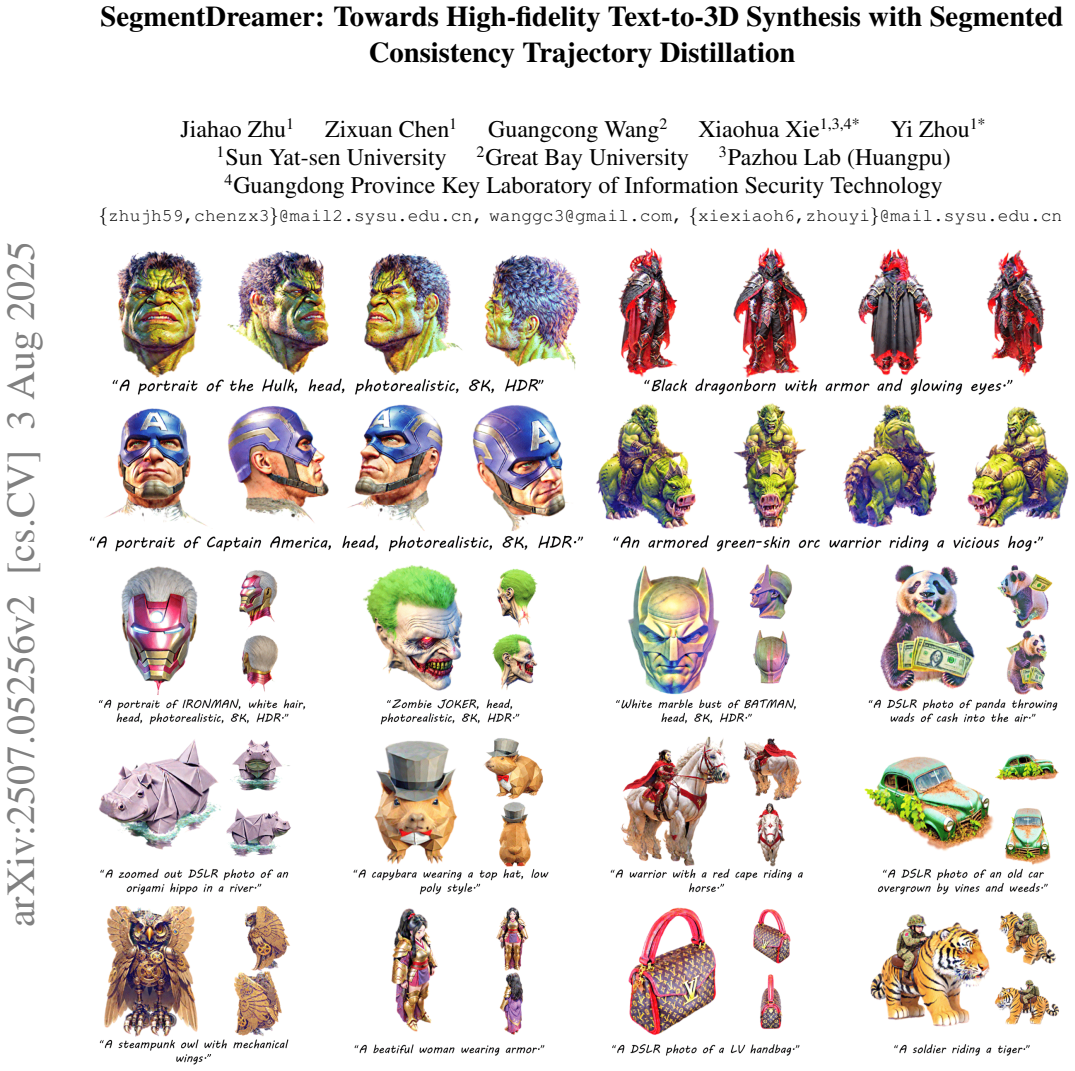
Pith's one-line read SegmentDreamer reformulates Score Distillation Sampling as Segmented Consistency Trajectory Distillation, proving a tighter error bound and producing higher-fidelity 3D assets in about 32 to 38 minutes.
desk verdict A useful, incremental SDS variant with a real proof gap: the empirical gains look genuine, but the advertised tighter error bound is not established under the first-order solver implementation. read the letter →
The pith
A machine-rendered reading of the paper's core claim, the machinery that carries it, and where it could break.
The reading
What carries the argument
The central object is the segment-indexed consistency function $G^m_\theta(z_t,t,s_m,y)=\frac{\alpha_{s_m}}{\alpha_t}z_t-\alpha_{s_m}\epsilon_\phi(z_t,t,y)\int_{\lambda_t}^{\lambda_{s_m}}e^{-\lambda}d\lambda$, a DPM-Solver-1-style estimator that maps a noisy point in a segment to the segment's start point $s_m$. The full timestep range $[0,T]$ is split into $N_s$ segments, and the SCTD loss enforces self-consistency (points in the same segment map to the same start) and cross-consistency (conditional and unconditional segments agree) with stop-gradient on the target. The proof machinery is a Lipschitz recursion on the consistency error $e_n$ that telescopes from the boundary condition $e_{s_m}=0$ to yield $\sup_{t,s\in[s_m,s_{m+1})}\|z_0-z_{\mathrm{data}}\|=O(\Delta t)(s_{m+1}-s_m)$.
What would settle it
Run the pipeline and directly measure the round-trip error at segment boundaries: diffuse a rendered view $z_0$ to $z_{s_m}$, solve forward to $t$ and back to $s_m$ with the same first-order solver, and compare against $z_{s_m}$. If that error is not much smaller than the segment length, the proof's boundary condition $e_{s_m}=0$ fails and the claimed bound $O(\Delta t)(s_{m+1}-s_m)$ does not describe the actual distillation error.
Extended reading notes
Core claim
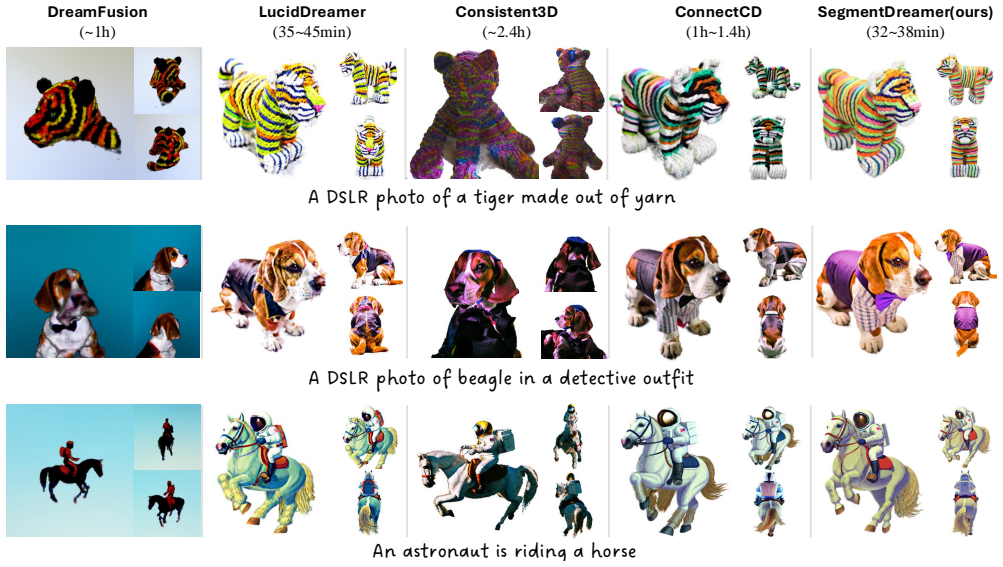
The central claim is that Score Distillation Sampling can be rewritten as a sum of a self-consistency constraint, a cross-consistency constraint, and a generative-prior term by expressing the noise residual through a segment-indexed consistency function. Dropping the generative prior and enforcing the two constraints separately yields a loss whose optimum enforces both self- and cross-consistency within each segment, which existing CD-based losses do not. The paper proves that, under Lipschitz continuity of the consistency function and an exact solver boundary condition, the worst-case distance between the rendered image and the true data image is $O(\Delta t)(s_{m+1}-s_m)$, improving on the bounds $O(\Delta t)T$ for CDS and $O(\Delta t)(T-e)$ for GCS. With $N_s=5$ segments and a dynamic time-threshold sampling scheme, the method reports better CLIP score, ImageReward, FID, and user-study rankings than DreamFusion, LucidDreamer, Consistent3D, and Connect3D, while taking less wall-clock time. The paper also replaces the unconditional consistency estimate with the segment-start point $z_{s_m}$ in practice, justified by the theoretical invertibility of the unconditional PF-ODE, to reduce cost and stabilize optimization.
Load-bearing premise
The proof assumes the numerical solver is exact at segment boundaries and that the unconditional denoising trajectory is perfectly reversible, so the initial consistency error is zero; with a first-order solver neither is exactly true.
Editorial extensions
If this is right
- The tighter error bound means rendered views used to optimize the 3D representation stay closer to true data images, which should reduce gradient noise and over-smoothing.
- SCTD makes Brightness-Equalized Generation and similar exposure fixes unnecessary, because cross-consistency is balanced rather than dominant.
- Generation time drops to about 32 minutes with classifier-free guidance (38 with Perp-Neg) on a single A100 GPU, down from one to two and a half hours for prior CD-based methods.
- The same loss can be plugged into 3D avatar and portrait generation pipelines.
- The recommended $N_s=5$ segmentation with a dynamic time threshold balances detail and coherence across prompts.
Reading between the lines
- Editorial extension: the segmentation strategy in the paper is heuristic; optimizing segment boundaries to account for variable solver error along the trajectory is a natural next step and could tighten the bound further.
- Editorial extension: because the loss is defined on rendered views, SCTD should transfer to NeRF or mesh parameterizations, and to 2D distillation tasks, without changing the core identity.
- Editorial extension: the approximation that replaces $G^m_\theta(\tilde z_t^\Phi,t,\emptyset)$ with $z_{s_m}$ works despite the first-order solver not being perfectly invertible; testing with a higher-order solver would separate the benefit of the approximation from the benefit of the bound.
- Editorial extension: the paper states its method is built for single-instance generation; extending SCTD to multi-instance scenes would likely require instance-level conditioning on top of the segment consistency.
Editorial analysis
A structured set of objections, weighed in public.
Referee Report
Summary. The paper proposes SegmentDreamer, a text-to-3D generation framework built on 3D Gaussian Splatting, which reformulates Score Distillation Sampling (SDS) as a Segmented Consistency Trajectory Distillation (SCTD) loss. The probability-flow ODE trajectory is partitioned into sub-trajectories, and self- and cross-consistency constraints are imposed within each segment. The authors claim that this provides a tighter upper bound on distillation error, O(Δt)(s_{m+1}-s_m), compared with CDS and GCS, and they introduce a dynamic sampling strategy plus a consistency-function approximation for faster optimization. Experiments on 40 prompts report improved CLIP, ImageReward, FID, and user-study scores over DreamFusion, LucidDreamer, Consistent3D, and Connect3D.
Significance. If fully established, the theoretical contribution would be valuable: a principled algebraic reformulation of SDS in terms of segmented consistency, with a segment-length-dependent error bound that justifies the partitioning. The derivation of Eqs. (8)–(9) is a genuine technical contribution, and the empirical evaluation is reasonably broad, including a user study and multiple metrics. However, the central theorem relies on a boundary condition that is not satisfied by the first-order ODE solver used in the implementation, and the actual training loss differs from the theoretically analyzed loss through the fixed-noise and consistency-function approximations. These gaps currently prevent the theoretical guarantee from being accepted as proven, although the empirical gains may still be real.
major comments (4)
- [App. F / Sec. 4.5] The proof of Theorem 1 (App. F, Eq. (13)) sets the boundary condition e_{s_m} = 0, which requires the first-order ODE solver to satisfy Φ(Φ(z_{s_m}, s_m, t, ∅), t, s_m, y) = z_{s_m} exactly. The paper states in Sec. 4.4 that perfect invertibility cannot be guaranteed with a first-order solver. An exact round trip is therefore not available, and the accumulated solver error enters e_{s_m} as an O(Δt) term that is not accounted for in the induction. As a result, the claimed bound sup ||z0-zdata|| = O(Δt)(s_{m+1}-s_m) is not established by the presented proof. Please either revise the theorem to include the solver residual, change the solver to one that supports the invertibility assumption, or provide a numerical measurement showing that the round-trip error is negligible in the training regime.
- [Sec. 4.4 / Eq. (10) / Algorithm 1] The implemented loss replaces G_θ(˜z_t^Φ, t, ∅) with z_{s_m} (the approximation strategy in Sec. 4.4), whereas the theoretical analysis in Sec. 4.5 and App. F applies to the unapproximated SCTD loss of Eq. (10). Figure 7 shows that this substitution changes the output qualitatively, so the approximation is not negligible. Please state explicitly that Theorem 1 concerns the idealized loss and provide a bound on the approximation error ||G_θ(˜z_t^Φ, t, ∅) - z_{s_m}||, or frame the theoretical claim as applying to the surrogate loss that is actually optimized.
- [Sec. 4.3 / Eq. (12) / App. D] The derivation of the equivalence between SDS and SCTD uses the noise ϵ sampled for z_t = α_t z0 + σ_t ϵ (App. D, Eq. (7)), while Algorithm 1 fixes a single ϵ* throughout training (Sec. 4.3). Equation (12) then states LSDS = E_t[b(t)||z_{s_m} - G_θ(...)||^2] with ϵ*, which is not the SDS expectation in Eq. (3) because it lacks the expectation over ϵ. Please clarify whether the theory assumes a freshly sampled ϵ per step, and if so, justify the fixed-noise implementation as a particular estimator of the SDS objective.
- [App. F, Lemma 1] Lemma 1's statement assumes the consistency property G_θ(˜z_t, t, ∅) = G_θ(ˆz_s, s, ∅), but the proof applies the condition with y (Eq. (11) in App. F), and Theorem 1's assumption also uses y. This inconsistency must be resolved; otherwise it is unclear which consistency constraint (unconditional or conditional) is actually required for the bound to hold.
minor comments (4)
- [Sec. 5.2, Table 2] The quantitative metrics (CLIP, ImageReward, FID) are reported without error bars or significance tests; because the differences are small (e.g., CLIP 30.88 vs. 30.73), please add variance estimates or statistical tests over multiple random seeds.
- [Algorithm 1, line 8] The argument 'Φ(˜z_s^Φ, t, s, y)' appears to contain a typo; it should likely be 'Φ(˜z_t^Φ, t, s, y)'.
- [Sec. 4.4, Eq. (11)] The inner integration variable in Φ(Φ(z_sm, sm, s, ∅), sm, t, ∅) is written as 's', which conflicts with the sampling time s used elsewhere in the paper; please use a different symbol (e.g., τ) for this intermediate time.
- [Sec. 5.2 / Fig. 5] The paper alternates between 'Connect3D' and 'ConnectCD' when referring to the baseline from [22]; please use a single consistent name.
Circularity Check
Theorem 1's tightness proof asserts the very equality (z0 = zdata) it is supposed to bound; otherwise the derivation and empirical comparison are self-contained.
-
self definitional
[Sec. 4.5 (Theorem 1) and Supplementary App. F, proof of Theorem 1, Eq. (15)]
"According to Eq. (12), one can ideally optimize a 3D model θ such that zsm = Gmθ (˜zΦ t , t,y). In this case, we have Φ(˜zΦ s , s, sm, y) = zdata sm , where zdata sm = αsm zdata + σsm ϵ∗. Based on this, we have ||Gmθ (˜zΦ t , t,y)−Φ(˜zΦ t , t, sm, y)|| = ||zsm−zdata sm || = ||z0−zdata||."
The theorem claims to prove sup ||z0−zdata|| = O(Δt)(sm+1−sm). In the proof, the key equality Φ(˜zΦ_s, s, sm, y) = zdata_sm is asserted immediately after assuming the SCTD/SDS optimum zsm = Gmθ(˜zΦ_t, t, y). Since zsm = αsm z0 + σsm ϵ* and zdata_sm = αsm zdata + σsm ϵ*, subtracting the two equalities yields αsm(z0 − zdata) = 0, i.e. the proof assumes the very quantity the theorem is meant to bound. The earlier boundary step e_sm = z_sm − z_sm = 0 is not itself circular because the solver returns its initial value at zero integration time; the circular substitution is the later identification Φ(...) = zdata_sm. Consequently, the claimed O(Δt)(sm+1−sm) bound is not an independent guarantee for a first-order solver; it holds only if the conclusion z0 ≈ zdata is already exact.
full rationale
The paper's central derivation (reformulating SDS as SCTD in Eqs. 7–10) is algebraic manipulation of the SDS noise-residual identity and is not circular. There is no load-bearing self-citation: the cited consistency-model and consistency-distillation results [18,22,26,27,33,40,44,48] are prior external work, not the present authors' own claims. The one significant circular step is in the proof of Theorem 1 (App. F): the proof substitutes an equality that is equivalent to z0 = zdata, which is precisely the quantity the theorem sets out to bound. This makes the advertised 'significantly tighter upper bound' conditional on its own conclusion rather than derived from independent solver-error analysis. The paper itself acknowledges in Sec. 4.4 that the approximation Gmθ(˜zΦ_t, t, ∅) ≈ zsm is not guaranteed with first-order ODE solvers, which is a correctness risk distinct from circularity. The empirical contribution remains self-contained: comparisons use external methods (DreamFusion, Consistent3D, Connect3D, LucidDreamer), held-out prompts, and a user study. A score of 5 reflects a load-bearing theoretical proof gap that assumes the target equality, while the experimental system does not reduce to a fit or to self-citation.
Assumptions & free parameters
free parameters (3)
- Segment number N_s =
5
- Time threshold t_τ =
150
- CFG guidance scale ω =
7.5
assumptions (4)
- standard math G^mθ satisfies a Lipschitz condition
- domain assumption ODE solver local error is uniformly bounded by O((t-s)^{p+1}) with p≥1
- ad hoc to paper The unconditional PF-ODE is theoretically invertible, so G^mθ(z̃_t^Φ,t,∅) can be replaced by z_sm
- domain assumption A 3D representation θ can be optimized to satisfy both self- and cross-consistency constraints simultaneously
Cite this review
Pith. "Pith review of SegmentDreamer: Towards High-fidelity Text-to-3D Synthesis with Segmented Consistency Trajectory Distillation." pith.science (2026). https://pith.science/paper/XYALV5IY
@misc{pith2026250705256,
  author       = {Pith},
  title        = {Pith review of: SegmentDreamer: Towards High-fidelity Text-to-3D Synthesis with Segmented Consistency Trajectory Distillation},
  year         = {2026},
  howpublished = {\url{https://pith.science/paper/XYALV5IY}},
  note         = {Machine review of arXiv:2507.05256}
}
read the original abstract
Recent advancements in text-to-3D generation improve the visual quality of Score Distillation Sampling (SDS) and its variants by directly connecting Consistency Distillation (CD) to score distillation. However, due to the imbalance between self-consistency and cross-consistency, these CD-based methods inherently suffer from improper conditional guidance, leading to sub-optimal generation results. To address this issue, we present SegmentDreamer, a novel framework designed to fully unleash the potential of consistency models for high-fidelity text-to-3D generation. Specifically, we reformulate SDS through the proposed Segmented Consistency Trajectory Distillation (SCTD), effectively mitigating the imbalance issues by explicitly defining the relationship between self- and cross-consistency. Moreover, SCTD partitions the Probability Flow Ordinary Differential Equation (PF-ODE) trajectory into multiple sub-trajectories and ensures consistency within each segment, which can theoretically provide a significantly tighter upper bound on distillation error. Additionally, we propose a distillation pipeline for a more swift and stable generation. Extensive experiments demonstrate that our SegmentDreamer outperforms state-of-the-art methods in visual quality, enabling high-fidelity 3D asset creation through 3D Gaussian Splatting (3DGS).
Figures


Figures from the paper (7 more)




Reference graph
Works this paper leans on
-
[1]
Mohammadreza Armandpour, Ali Sadeghian, Huangjie Zheng, Amir Sadeghian, and Mingyuan Zhou. Re-imagine the negative prompt algorithm: Transform 2d diffusion into 3d, alleviate janus problem and beyond. arXiv preprint arXiv:2304.04968, 2023. 1, 5, 6
arXiv 2023
-
[2]
Mip-nerf: A multiscale representation for anti-aliasing neu- ral radiance fields
Jonathan T Barron, Ben Mildenhall, Matthew Tancik, Peter Hedman, Ricardo Martin-Brualla, and Pratul P Srinivasan. Mip-nerf: A multiscale representation for anti-aliasing neu- ral radiance fields. In Proceedings of the International Conference on Computer Vision (ICCV), pages 5855–5864,
-
[3]
Fan- tasia3d: Disentangling geometry and appearance for high- quality text-to-3d content creation
Rui Chen, Yongwei Chen, Ningxin Jiao, and Kui Jia. Fan- tasia3d: Disentangling geometry and appearance for high- quality text-to-3d content creation. In Proceedings of the International Conference on Computer Vision (ICCV), pages 22246–22256, 2023. 2, 3
2023
-
[4]
Cunerf: Cube-based neural radiance field for zero-shot medical image arbitrary-scale super resolution
Zixuan Chen, Lingxiao Yang, Jian-Huang Lai, and Xiaohua Xie. Cunerf: Cube-based neural radiance field for zero-shot medical image arbitrary-scale super resolution. In Proceed- ings of the International Conference on Computer Vision (ICCV), pages 21185–21195, 2023. 3
2023
-
[5]
Text-to-3d using gaussian splatting
Zilong Chen, Feng Wang, Yikai Wang, and Huaping Liu. Text-to-3d using gaussian splatting. In Proceedings of the IEEE/CVF Conference on Computer Vision and Pattern Recognition (CVPR), pages 21401–21412, 2024. 2, 3
work page 2024
-
[6]
Guardsplat: Efficient and robust watermarking for 3d gaussian splatting
Zixuan Chen, Guangcong Wang, Jiahao Zhu, Jian-Huang Lai, and Xiaohua Xie. Guardsplat: Efficient and robust watermarking for 3d gaussian splatting. In Proceedings of the IEEE/CVF Conference on Computer Vision and Pattern Recognition (CVPR), 2025. 3
work page 2025
-
[7]
Get3d: A generative model of high quality 3d tex- tured shapes learned from images
Jun Gao, Tianchang Shen, Zian Wang, Wenzheng Chen, Kangxue Yin, Daiqing Li, Or Litany, Zan Gojcic, and Sanja Fidler. Get3d: A generative model of high quality 3d tex- tured shapes learned from images. In Proceedings of the International Conference on Neural Information Processing Systems (NeurIPS), pages 31841–31854, 2022. 3
work page 2022
-
[8]
3dgen: Triplane latent diffusion for textured mesh generation
Anchit Gupta, Wenhan Xiong, Yixin Nie, Ian Jones, and Bar- las O˘guz. 3dgen: Triplane latent diffusion for textured mesh generation. arXiv preprint arXiv:2303.05371, 2023. 3
arXiv 2023
Show all 83 references
-
[9]
Classifier-free diffusion guidance
Jonathan Ho and Tim Salimans. Classifier-free diffusion guidance. In Proceedings of the International Conference on Neural Information Processing Systems Workshop (NeurIPS Workshop), 2021. 1, 4, 6
2021
-
[10]
Efficientdreamer: High-fidelity and robust 3d cre- ation via orthogonal-view diffusion priors
Zhipeng Hu, Minda Zhao, Chaoyi Zhao, Xinyue Liang, Lincheng Li, Zeng Zhao, Changjie Fan, Xiaowei Zhou, and Xin Yu. Efficientdreamer: High-fidelity and robust 3d cre- ation via orthogonal-view diffusion priors. InProceedings of the IEEE/CVF Conference on Computer Vision and Pat...
2024
-
[11]
Dreamtime: An improved optimiza- tion strategy for diffusion-guided 3d generation
Yukun Huang, Jianan Wang, Yukai Shi, Boshi Tang, Xian- biao Qi, and Lei Zhang. Dreamtime: An improved optimiza- tion strategy for diffusion-guided 3d generation. In Proceed- ings of the International Conference on Learning Represen- tations (ICLR), 2023. 2, 3
2023
-
[12]
Jointdreamer: Ensur- ing geometry consistency and text congruence in text-to-3d generation via joint score distillation
Chenhan Jiang, Yihan Zeng, Tianyang Hu, Songcun Xu, Wei Zhang, Hang Xu, and Dit-Yan Yeung. Jointdreamer: Ensur- ing geometry consistency and text congruence in text-to-3d generation via joint score distillation. In Proceedings of the European Conference on Computer Vision (ECC...
2025
-
[13]
Shap-e: Generat- ing conditional 3d implicit functions
Heewoo Jun and Alex Nichol. Shap-e: Generat- ing conditional 3d implicit functions. arXiv preprint arXiv:2305.02463, 2023. 3
2023 arXiv
-
[14]
Ray tracing volume densities
James T Kajiya and Brian P V on Herzen. Ray tracing volume densities. In ACM SIGGRAPH, pages 165–174. ACM New York, NY , USA, 1984. 3
1984
-
[15]
Elucidating the design space of diffusion-based generative models
Tero Karras, Miika Aittala, Timo Aila, and Samuli Laine. Elucidating the design space of diffusion-based generative models. In Proceedings of the International Conference on Neural Information Processing Systems (NeurIPS), pages 26565–26577, 2022. 3
2022
-
[16]
Noise-free score distillation
Oren Katzir, Or Patashnik, Daniel Cohen-Or, and Dani Lischinski. Noise-free score distillation. In Proceedings of the International Conference on Learning Representations (ICLR), 2024. 2, 3
2024
-
[17]
3d gaussian splatting for real-time radiance field rendering
Bernhard Kerbl, Georgios Kopanas, Thomas Leimk ¨uhler, and George Drettakis. 3d gaussian splatting for real-time radiance field rendering. ACM Transactions on Graphics (ACM TOG), 42(4):139–1, 2023. 2, 3
2023
-
[18]
Consistency trajectory mod- els: Learning probability flow ode trajectory of diffusion
Dongjun Kim, Chieh-Hsin Lai, Wei-Hsiang Liao, Naoki Mu- rata, Yuhta Takida, Toshimitsu Uesaka, Yutong He, Yuki Mitsufuji, and Stefano Ermon. Consistency trajectory mod- els: Learning probability flow ode trajectory of diffusion. In Proceedings of the International Conference o...
2024
-
[19]
Adam: A method for stochastic optimization
Diederik P Kingma and Jimmy Ba. Adam: A method for stochastic optimization. arXiv preprint arXiv:1412.6980 ,
-
[20]
Point-based neural rendering with per- view optimization
Georgios Kopanas, Julien Philip, Thomas Leimk ¨uhler, and George Drettakis. Point-based neural rendering with per- view optimization. Computer Graphics Forum (CGF) , 40 (4), 2021. 3
2021
-
[21]
Diffusion- sdf: Text-to-shape via voxelized diffusion
Muheng Li, Yueqi Duan, Jie Zhou, and Jiwen Lu. Diffusion- sdf: Text-to-shape via voxelized diffusion. InProceedings of the IEEE/CVF Conference on Computer Vision and Pattern Recognition (CVPR), pages 12642–12651, 2023. 3
2023
-
[22]
Connecting consistency distillation to score distillation for text-to-3d generation
Zongrui Li, Minghui Hu, Qian Zheng, and Xudong Jiang. Connecting consistency distillation to score distillation for text-to-3d generation. In Proceedings of the European Conference on Computer Vision (ECCV) , pages 274–291. Springer, 2025. 2, 3, 4, 6, 7, 8, 1
2025
-
[23]
Luciddreamer: Towards high- fidelity text-to-3d generation via interval score matching
Yixun Liang, Xin Yang, Jiantao Lin, Haodong Li, Xiaogang Xu, and Yingcong Chen. Luciddreamer: Towards high- fidelity text-to-3d generation via interval score matching. In Proceedings of the IEEE/CVF Conference on Computer Vision and Pattern Recognition (CVPR) , pages 6517–6526,
-
[24]
Magic3d: High-resolution text-to-3d content creation
Chen-Hsuan Lin, Jun Gao, Luming Tang, Towaki Takikawa, Xiaohui Zeng, Xun Huang, Karsten Kreis, Sanja Fidler, Ming-Yu Liu, and Tsung-Yi Lin. Magic3d: High-resolution text-to-3d content creation. In Proceedings of the IEEE/CVF Conference on Computer Vision and Pattern Recognitio...
2023
-
[25]
Unidream: Unifying diffusion priors for re- lightable text-to-3d generation
Zexiang Liu, Yangguang Li, Youtian Lin, Xin Yu, Sida Peng, Yan-Pei Cao, Xiaojuan Qi, Xiaoshui Huang, Ding Liang, and Wanli Ouyang. Unidream: Unifying diffusion priors for re- lightable text-to-3d generation. In Proceedings of the Euro- pean Conference on Computer Vision (ECCV)...
2025
-
[26]
Dpm-solver: A fast ode solver for diffusion probabilistic model sampling in around 10 steps
Cheng Lu, Yuhao Zhou, Fan Bao, Jianfei Chen, Chongxuan Li, and Jun Zhu. Dpm-solver: A fast ode solver for diffusion probabilistic model sampling in around 10 steps. InProceed- ings of the International Conference on Neural Information Processing Systems (NeurIPS), pages 5775–5...
2022
-
[27]
Latent consistency models: Synthesizing high- resolution images with few-step inference
Simian Luo, Yiqin Tan, Longbo Huang, Jian Li, and Hang Zhao. Latent consistency models: Synthesizing high- resolution images with few-step inference. arXiv preprint arXiv:2310.04378, 2023. 3, 4, 6
2023 arXiv
-
[28]
Gaussian splatting slam
Hidenobu Matsuki, Riku Murai, Paul HJ Kelly, and An- drew J Davison. Gaussian splatting slam. In Proceedings of the IEEE/CVF Conference on Computer Vision and Pat- tern Recognition (CVPR), pages 18039–18048, 2024. 3
2024
-
[29]
Nerf: Representing scenes as neural radiance fields for view syn- thesis
Ben Mildenhall, Pratul P Srinivasan, Matthew Tancik, Jonathan T Barron, Ravi Ramamoorthi, and Ren Ng. Nerf: Representing scenes as neural radiance fields for view syn- thesis. Communications of the ACM, 65(1):99–106, 2021. 2, 3
2021
-
[30]
Point-e: A system for generat- ing 3d point clouds from complex prompts
Alex Nichol, Heewoo Jun, Prafulla Dhariwal, Pamela Mishkin, and Mark Chen. Point-e: A system for generat- ing 3d point clouds from complex prompts. arXiv preprint arXiv:2212.08751, 2022. 3, 5, 6
2022 arXiv
-
[31]
Dreamfusion: Text-to-3d using 2d diffusion
Ben Poole, Ajay Jain, Jonathan T Barron, and Ben Milden- hall. Dreamfusion: Text-to-3d using 2d diffusion. In Pro- ceedings of the International Conference on Learning Rep- resentations (ICLR), pages 1–10, 2022. 2, 3, 6, 7, 8, 4
2022
-
[32]
Compositing digital im- ages
Thomas Porter and Tom Duff. Compositing digital im- ages. In Proceedings of the Annual Conference on Computer Graphics and Interactive Techniques, pages 253–259, 1984. 3
1984
-
[33]
Hyper-sd: Trajectory segmented consistency model for efficient image synthesis
Yuxi Ren, Xin Xia, Yanzuo Lu, Jiacheng Zhang, Jie Wu, Pan Xie, Xing Wang, and Xuefeng Xiao. Hyper-sd: Trajectory segmented consistency model for efficient image synthesis. In Proceedings of the International Conference on Neural Information Processing Systems (NeurIPS), 2024. 2, 4
2024
-
[34]
High-resolution image synthesis with latent diffusion models
Robin Rombach, Andreas Blattmann, Dominik Lorenz, Patrick Esser, and Bj ¨orn Ommer. High-resolution image synthesis with latent diffusion models. In Proceedings of the IEEE/CVF Conference on Computer Vision and Pattern Recognition (CVPR), pages 10684–10695, 2022. 2, 3, 6
2022
-
[35]
Let 2d diffusion model know 3d- consistency for robust text-to-3d generation
Junyoung Seo, Wooseok Jang, Min-Seop Kwak, Hyeonsu Kim, Jaehoon Ko, Junho Kim, Jin-Hwa Kim, Jiyoung Lee, and Seungryong Kim. Let 2d diffusion model know 3d- consistency for robust text-to-3d generation. In Proceedings of the International Conference on Learning Representations...
2024
-
[36]
Splattingavatar: Realistic real-time human avatars with mesh-embedded gaussian splatting
Zhijing Shao, Zhaolong Wang, Zhuang Li, Duotun Wang, Xiangru Lin, Yu Zhang, Mingming Fan, and Zeyu Wang. Splattingavatar: Realistic real-time human avatars with mesh-embedded gaussian splatting. In Proceedings of the IEEE/CVF Conference on Computer Vision and Pattern Recogniti...
2024
-
[37]
Mvdream: Multi-view diffusion for 3d gen- eration
Yichun Shi, Peng Wang, Jianglong Ye, Mai Long, Kejie Li, and Xiao Yang. Mvdream: Multi-view diffusion for 3d gen- eration. In Proceedings of the International Conference on Learning Representations (ICLR), 2024. 2, 3
2024
-
[38]
Denois- ing diffusion implicit models
Jiaming Song, Chenlin Meng, and Stefano Ermon. Denois- ing diffusion implicit models. In Proceedings of the Inter- national Conference on Learning Representations (ICLR) ,
-
[39]
Score-based generative modeling through stochastic differential equa- tions
Yang Song, Jascha Sohl-Dickstein, Diederik P Kingma, Ab- hishek Kumar, Stefano Ermon, and Ben Poole. Score-based generative modeling through stochastic differential equa- tions. In Proceedings of the International Conference on Learning Representations (ICLR), 2021. 3
2021
-
[40]
Consistency models
Yang Song, Prafulla Dhariwal, Mark Chen, and Ilya Sutskever. Consistency models. In Proceedings of the In- ternational Conference on Machine Learning (ICLR), 2023. 2, 3, 4
2023
-
[41]
Splatter image: Ultra-fast single-view 3d recon- struction
Stanislaw Szymanowicz, Chrisitian Rupprecht, and Andrea Vedaldi. Splatter image: Ultra-fast single-view 3d recon- struction. In Proceedings of the IEEE/CVF Conference on Computer Vision and Pattern Recognition (CVPR) , pages 10208–10217, 2024. 3
2024
-
[42]
Dreamgaussian: Generative gaussian splatting for effi- cient 3d content creation
Jiaxiang Tang, Jiawei Ren, Hang Zhou, Ziwei Liu, and Gang Zeng. Dreamgaussian: Generative gaussian splatting for effi- cient 3d content creation. InProceedings of the International Conference on Learning Representations (ICLR), 2024. 3
2024
-
[43]
Diverse text-to-3d synthesis with aug- mented text embedding
Uy Dieu Tran, Minh Luu, Phong Ha Nguyen, Khoi Nguyen, and Binh-Son Hua. Diverse text-to-3d synthesis with aug- mented text embedding. In Proceedings of the European Conference on Computer Vision (ECCV) , pages 217–235. Springer, 2025. 2, 3
2025
-
[44]
Phased consistency model
Fu-Yun Wang, Zhaoyang Huang, Alexander William Bergman, Dazhong Shen, Peng Gao, Michael Lingelbach, Keqiang Sun, Weikang Bian, Guanglu Song, Yu Liu, et al. Phased consistency model. In Proceedings of the Interna- tional Conference on Neural Information Processing Sys- tems (Ne...
2024
-
[45]
Sparsenerf: Distilling depth ranking for few-shot novel view synthesis
Guangcong Wang, Zhaoxi Chen, Chen Change Loy, and Zi- wei Liu. Sparsenerf: Distilling depth ranking for few-shot novel view synthesis. In Proceedings of the International Conference on Computer Vision (ICCV), pages 9065–9076,
-
[46]
Score jacobian chaining: Lifting pretrained 2d diffusion models for 3d generation
Haochen Wang, Xiaodan Du, Jiahao Li, Raymond A Yeh, and Greg Shakhnarovich. Score jacobian chaining: Lifting pretrained 2d diffusion models for 3d generation. In Pro- ceedings of the IEEE/CVF Conference on Computer Vision and Pattern Recognition (CVPR), pages 12619–12629, 2023. 2
2023
-
[47]
Prolificdreamer: High-fidelity and diverse text-to-3d generation with variational score dis- tillation
Zhengyi Wang, Cheng Lu, Yikai Wang, Fan Bao, Chongxuan LI, Hang Su, and Jun Zhu. Prolificdreamer: High-fidelity and diverse text-to-3d generation with variational score dis- tillation. In Proceedings of the International Conference on Neural Information Processing Systems (Neu...
2023
-
[48]
Consistent3d: Towards consistent high-fidelity text-to-3d generation with deterministic sampling prior
Zike Wu, Pan Zhou, Xuanyu Yi, Xiaoding Yuan, and Han- wang Zhang. Consistent3d: Towards consistent high-fidelity text-to-3d generation with deterministic sampling prior. In Proceedings of the IEEE/CVF Conference on Computer Vi- sion and Pattern Recognition (CVPR) , pages 9892–9902,
-
[49]
Structured 3d latents for scalable and versatile 3d gen- eration
Jianfeng Xiang, Zelong Lv, Sicheng Xu, Yu Deng, Ruicheng Wang, Bowen Zhang, Dong Chen, Xin Tong, and Jiaolong Yang. Structured 3d latents for scalable and versatile 3d gen- eration. arXiv preprint arXiv:2412.01506, 2024. 3
2024 arXiv
-
[50]
Gs-slam: Dense visual slam with 3d gaussian splatting
Chi Yan, Delin Qu, Dan Xu, Bin Zhao, Zhigang Wang, Dong Wang, and Xuelong Li. Gs-slam: Dense visual slam with 3d gaussian splatting. In Proceedings of the IEEE/CVF Confer- ence on Computer Vision and Pattern Recognition (CVPR) , pages 19595–19604, 2024. 3
2024
-
[51]
Dream- reward: Text-to-3d generation with human preference
Junliang Ye, Fangfu Liu, Qixiu Li, Zhengyi Wang, Yikai Wang, Xinzhou Wang, Yueqi Duan, and Jun Zhu. Dream- reward: Text-to-3d generation with human preference. In Proceedings of the European Conference on Computer Vi- sion (ECCV), pages 259–276. Springer, 2025. 2, 3
2025
-
[52]
Gaussiandreamer: Fast generation from text to 3d gaussians by bridging 2d and 3d diffusion models
Taoran Yi, Jiemin Fang, Junjie Wang, Guanjun Wu, Lingxi Xie, Xiaopeng Zhang, Wenyu Liu, Qi Tian, and Xinggang Wang. Gaussiandreamer: Fast generation from text to 3d gaussians by bridging 2d and 3d diffusion models. In Pro- ceedings of the IEEE/CVF Conference on Computer Vision...
2024
-
[53]
Text-to-3d with classifier score distillation
Xin Yu, Yuan-Chen Guo, Yangguang Li, Ding Liang, Song- Hai Zhang, and Xiaojuan Qi. Text-to-3d with classifier score distillation. In Proceedings of the International Conference on Learning Representations (ICLR), 2024. 2, 3, 4, 5
2024
-
[54]
Mip-splatting: Alias-free 3d gaussian splat- ting
Zehao Yu, Anpei Chen, Binbin Huang, Torsten Sattler, and Andreas Geiger. Mip-splatting: Alias-free 3d gaussian splat- ting. In Proceedings of the IEEE/CVF Conference on Com- puter Vision and Pattern Recognition (CVPR), pages 19447– 19456, 2024. 3
2024
-
[55]
Gavatar: Animatable 3d gaussian avatars with implicit mesh learning
Ye Yuan, Xueting Li, Yangyi Huang, Shalini De Mello, Koki Nagano, Jan Kautz, and Umar Iqbal. Gavatar: Animatable 3d gaussian avatars with implicit mesh learning. InProceed- ings of the IEEE/CVF Conference on Computer Vision and Pattern Recognition (CVPR), pages 896–905, 2024. 3
2024
-
[56]
Adding conditional control to text-to-image diffusion models
Lvmin Zhang, Anyi Rao, and Maneesh Agrawala. Adding conditional control to text-to-image diffusion models. In Proceedings of the International Conference on Computer Vision (ICCV), pages 3836–3847, 2023. 5
2023
-
[57]
Hifa: High- fidelity text-to-3d generation with advanced diffusion guid- ance
Junzhe Zhu, Peiye Zhuang, and Sanmi Koyejo. Hifa: High- fidelity text-to-3d generation with advanced diffusion guid- ance. In Proceedings of the International Conference on Learning Representations (ICLR), 2024. 2, 3
2024
-
[58]
Vivid- dreamer: Invariant score distillation for hyper-realistic text- to-3d generation
Wenjie Zhuo, Fan Ma, Hehe Fan, and Yi Yang. Vivid- dreamer: Invariant score distillation for hyper-realistic text- to-3d generation. In Proceedings of the European Confer- ence on Computer Vision (ECCV), pages 122–139. Springer,
-
[60]
A blue motorcycle
A cat with a mullet 21. A blue motorcycle
-
[61]
Michelangelo style statue of an astronaut
A pig wearing a backpack 22. Michelangelo style statue of an astronaut
-
[62]
A DSLR photo of a chow chow puppy
A DSLR photo of an origami crane 23. A DSLR photo of a chow chow puppy
-
[63]
A DSLR photo of cats wearing eyeglasses
A photo of a mouse playing the tuba 24. A DSLR photo of cats wearing eyeglasses
-
[64]
A red panda
An orange road bike 25. A red panda
-
[65]
A DSLR photo of an elephant skull
A ripe strawberry 26. A DSLR photo of an elephant skull
-
[66]
A DSLR photo of the Imperial State Crown of Eng- land
-
[67]
An amigurumi bulldozer
-
[68]
A typewriter
A photo of a wizard raccoon casting a spell 28. A typewriter
-
[69]
A red-eyed tree frog, low poly
A DSLR photo of a corgi wearing a top hat 29. A red-eyed tree frog, low poly
-
[70]
A rabbit, animated movie character, high-detail 3D model
-
[71]
A DSLR photo of a chimpanzee wearing head- phones
-
[72]
A robot made out of vegetables
A panda rowing a boat 31. A robot made out of vegetables
-
[73]
A DSLR photo of a red rotary telephone
A highly detailed sand castle 32. A DSLR photo of a red rotary telephone
-
[74]
A DSLR photo of a chimpanzee dressed like Henry VIII king of England
-
[75]
A DSLR photo of a blue lobster
-
[76]
A photo of a skiing penguin wearing a puffy jacket, highly realistic DSLR photo
-
[77]
A DSLR photo of a squirrel flying a biplane
-
[78]
A DSLR photo of a baby dragon hatching out of a stone egg
A blue poison-dart frog sitting on a water lily 35. A DSLR photo of a baby dragon hatching out of a stone egg
-
[79]
A DSLR photo of a bear dancing ballet
A DSLR photo of a bear dressed in medieval armor 36. A DSLR photo of a bear dancing ballet
-
[80]
A plate of delicious tacos
A DSLR photo of a squirrel dressed like a clown 37. A plate of delicious tacos
-
[81]
A DSLR photo of a car made out of cheese
A plush toy of a corgi nurse 38. A DSLR photo of a car made out of cheese
-
[82]
A yellow school bus
A humanoid robot playing the violin 39. A yellow school bus
-
[83]
A DSLR photo of a shiny beetle
A DSLR photo of a bear dressed as a lumberjack 40. A DSLR photo of a shiny beetle
-
[2025]
excessive conditional guid- ance,
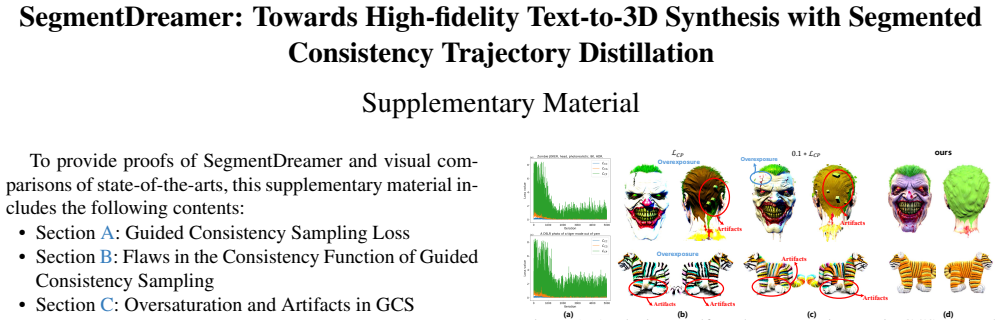
2, 3 SegmentDreamer: Towards High-fidelity Text-to-3D Synthesis with Segmented Consistency Trajectory Distillation Supplementary Material To provide proofs of SegmentDreamer and visual com- parisons of state-of-the-arts, this supplementary material in- cludes the following con...
Reviewed August 6, 2026 · model on record in the stance chip above.
Discussion (0). Sign in to comment.