PLACE: Prompt Learning for Attributed Community Search in Large Graphs
Pith reviewed 2026-05-25 07:45 UTC · model grok-4.3
The pith
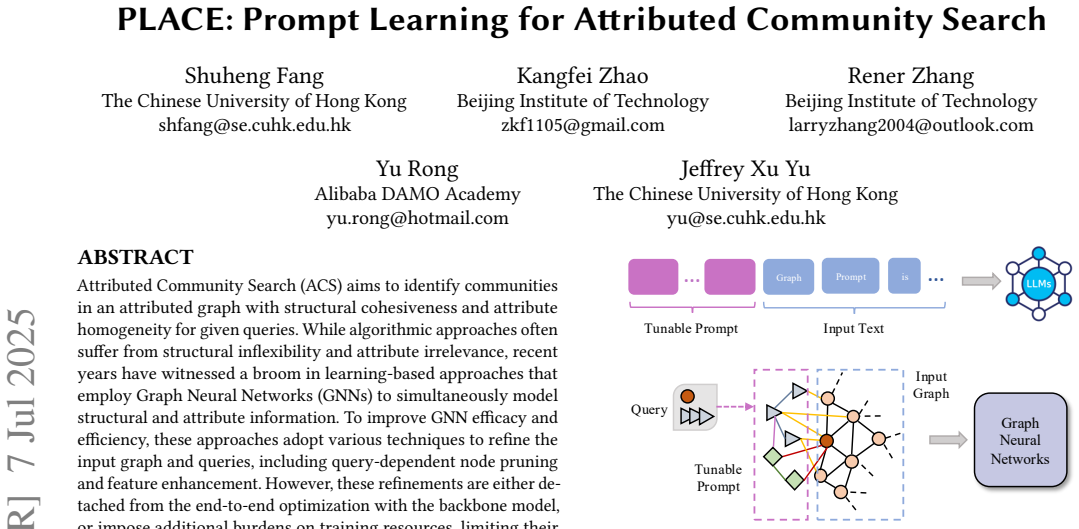
Learnable prompt tokens inserted into graphs act as bridges to let GNNs identify attributed communities matching specific queries.
A machine-rendered reading of the paper's core claim, the machinery that carries it, and where it could break.
Core claim
The central claim is that integrating structural and learnable prompt tokens into the graph forms a prompt-augmented graph in which the learned prompt tokens serve as a bridge that strengthens connections between graph nodes for the query. This bridge enables the GNN to more effectively identify patterns of structural cohesiveness and attribute similarity related to the specific query. An alternating training paradigm optimizes both the prompt parameters and the GNN jointly, and a divide-and-conquer strategy supports handling million-scale graphs.
What carries the argument
The prompt-augmented graph, created by inserting learnable prompt tokens as a query-dependent refinement mechanism that bridges node connections.
If this is right
- The GNN gains the ability to focus on query-specific cohesiveness and attribute patterns through the strengthened connections.
- Joint alternating optimization lets the prompt tokens and the GNN adapt together to the community search task.
- The divide-and-conquer strategy allows the framework to scale to graphs with millions of nodes.
- The same prompt-insertion approach applies across multiple types of attributed community search queries.
Where Pith is reading between the lines
- The same insertion of learnable tokens could be tried on other graph tasks that involve matching a query to local structure and attributes.
- If the bridge effect holds, one could test whether the prompts remain useful when the underlying GNN architecture is swapped for a different one.
- Extending the alternating training to graphs that change over time might let communities update as new queries arrive.
Load-bearing premise
Learnable prompt tokens inserted into the graph will serve as an effective bridge that strengthens connections between nodes for the query.
What would settle it
Running the same GNN on the nine real-world graphs and three query types but without the inserted prompt tokens, and finding equal or higher community detection accuracy, would show the bridge mechanism adds no value.
Figures


read the original abstract
In this paper, we propose PLACE (Prompt Learning for Attributed Community Search), an innovative graph prompt learning framework for ACS. Enlightened by prompt-tuning in Natural Language Processing (NLP), where learnable prompt tokens are inserted to contextualize NLP queries, PLACE integrates structural and learnable prompt tokens into the graph as a query-dependent refinement mechanism, forming a prompt-augmented graph. Within this prompt-augmented graph structure, the learned prompt tokens serve as a bridge that strengthens connections between graph nodes for the query, enabling the GNN to more effectively identify patterns of structural cohesiveness and attribute similarity related to the specific query. We employ an alternating training paradigm to optimize both the prompt parameters and the GNN jointly. Moreover, we design a divide-and-conquer strategy to enhance scalability, supporting the model to handle million-scale graphs. Extensive experiments on 9 real-world graphs demonstrate the effectiveness of PLACE for three types of ACS queries, where PLACE achieves higher F1 scores by 22% compared to the state-of-the-arts on average.
Editorial analysis
A structured set of objections, weighed in public.
Referee Report
Summary. The manuscript proposes PLACE, a graph prompt learning framework for attributed community search (ACS). It inserts structural and learnable prompt tokens into the input graph to create a prompt-augmented graph in which the tokens act as query-dependent bridges that strengthen connections, enabling a GNN to better capture structural cohesiveness and attribute similarity. The method optimizes prompt embeddings and GNN parameters via alternating training and employs a divide-and-conquer strategy for scalability to million-scale graphs. Experiments on nine real-world graphs report an average 22% F1 improvement over state-of-the-art baselines across three ACS query types.
Significance. If the reported F1 gains hold under standard experimental controls, the work would contribute a concrete adaptation of NLP-style prompt tuning to attributed community search, with the prompt-augmented graph construction and alternating training as the core technical ideas. The scalability component is presented separately from the performance numbers and addresses a practical requirement for large graphs. The manuscript supplies an explicit mechanistic hypothesis (prompt tokens as bridges) that is directly tied to the empirical claim.
minor comments (2)
- [Abstract] Abstract: the phrase 'state-of-the-arts' should read 'state-of-the-art methods' for standard English usage.
- [Abstract] Abstract: the description of the prompt-augmented graph mechanism is concise but would benefit from a parenthetical reference to the relevant figure or section that illustrates the token insertion and bridging effect.
Simulated Author's Rebuttal
We thank the referee for the positive summary, significance assessment, and recommendation for minor revision. We appreciate the recognition of the prompt-augmented graph construction, alternating training, and scalability strategy as core contributions. No major comments appear in the provided report, so we have no specific points requiring rebuttal or revision at this stage.
Circularity Check
No significant circularity; empirical performance claims only
full rationale
The paper introduces PLACE as a prompt-augmented graph framework for attributed community search, relying on alternating training of prompts and GNN plus a divide-and-conquer scalability strategy. All load-bearing claims are empirical (average 22% F1 improvement across 9 graphs and three query types) and are validated against external baselines rather than derived from internal equations. No self-definitional reductions, fitted inputs renamed as predictions, or load-bearing self-citations appear in the provided text. The prompt-token bridge mechanism is an explicit modeling choice presented as validated by experiment, not a derivation that collapses to its own inputs. The work is therefore self-contained against external benchmarks.
Axiom & Free-Parameter Ledger
free parameters (2)
- learnable prompt token embeddings
- GNN model parameters
axioms (1)
- domain assumption GNNs can learn patterns of structural cohesiveness and attribute similarity from prompt-augmented graphs
invented entities (1)
-
prompt tokens
no independent evidence
Reference graph
Works this paper leans on
-
[1]
[n.d.]. Pytorch. https://github.com/pytorch/pytorch
- [2]
-
[3]
Esra Akbas and Peixiang Zhao. 2017. Truss-based community search: a truss- equivalence based indexing approach. Proceedings of the VLDB Endowment 10, 11 (2017), 1298–1309
work page 2017
-
[4]
Jiazun Chen, Jun Gao, and Bin Cui. 2023. ICS-GNN +: lightweight interactive community search via graph neural network. VLDB J. 32, 2 (2023), 447–467. https://doi.org/10.1007/S00778-022-00754-0
-
[5]
Jiazun Chen, Yikuan Xia, and Jun Gao. 2023. CommunityAF: An Example-Based Community Search Method via Autoregressive Flow. Proceedings of the VLDB Endowment 16, 10 (2023), 2565–2577
work page 2023
-
[6]
Wei-Lin Chiang, Xuanqing Liu, Si Si, Yang Li, Samy Bengio, and Cho-Jui Hsieh
-
[7]
In Proceedings of the 25th ACM SIGKDD international conference on knowledge discovery & data mining
Cluster-gcn: An efficient algorithm for training deep and large graph convolutional networks. In Proceedings of the 25th ACM SIGKDD international conference on knowledge discovery & data mining . 257–266
-
[8]
Wanyun Cui, Yanghua Xiao, Haixun Wang, Yiqi Lu, and Wei Wang. 2013. Online search of overlapping communities. In Proceedings of the 2013 ACM SIGMOD international conference on Management of data . 277–288
work page 2013
-
[9]
Wanyun Cui, Yanghua Xiao, Haixun Wang, and Wei Wang. 2014. Local search of communities in large graphs. In Proceedings of the 2014 ACM SIGMOD interna- tional conference on Management of data . 991–1002
work page 2014
-
[10]
Shuheng Fang, Kangfei Zhao, Guanghua Li, and Jeffrey Xu Yu. 2023. Community search: a meta-learning approach. In 2023 IEEE 39th International Conference on Data Engineering (ICDE). IEEE, 2358–2371
work page 2023
-
[11]
Shuheng Fang, Kangfei Zhao, Yu Rong, Zhixun Li, and Jeffrey Xu Yu. 2024. Inductive Attributed Community Search: To Learn Communities Across Graphs. Proceedings of the VLDB Endowment 17, 10 (2024), 2576–2589
work page 2024
-
[12]
Yixiang Fang, CK Cheng, Siqiang Luo, and Jiafeng Hu. 2016. Effective community search for large attributed graphs. Proceedings of the VLDB Endowment (2016)
work page 2016
-
[13]
Yixiang Fang, Xin Huang, Lu Qin, Ying Zhang, Wenjie Zhang, Reynold Cheng, and Xuemin Lin. 2020. A survey of community search over big graphs.The VLDB Journal 29 (2020), 353–392
work page 2020
-
[14]
Jun Gao, Jiazun Chen, Zhao Li, and Ji Zhang. 2021. ICS-GNN: lightweight interactive community search via graph neural network. Proceedings of the VLDB Endowment 14, 6 (2021), 1006–1018
work page 2021
- [15]
-
[16]
Fangda Guo, Ye Yuan, Guoren Wang, Xiangguo Zhao, and Hao Sun. 2021. Multi- attributed community search in road-social networks. In 2021 IEEE 37th Interna- tional Conference on Data Engineering (ICDE) . IEEE, 109–120
work page 2021
-
[17]
Will Hamilton, Zhitao Ying, and Jure Leskovec. 2017. Inductive representation learning on large graphs. Advances in neural information processing systems 30 (2017)
work page 2017
-
[18]
Xin Huang, Hong Cheng, Lu Qin, Wentao Tian, and Jeffrey Xu Yu. 2014. Querying k-truss community in large and dynamic graphs. In Proc. SIGMOD. ACM, 1311– 1322
work page 2014
-
[19]
Xin Huang, Laks VS Lakshmanan, Jeffrey Xu Yu, and Hong Cheng. 2015. Approx- imate closest community search in networks. arXiv preprint arXiv:1505.05956 (2015)
work page internal anchor Pith review Pith/arXiv arXiv 2015
-
[20]
Xin Huang and Laks V. S. Lakshmanan. 2017. Attribute-Driven Community Search. Proc. VLDB Endow. 10, 9 (2017), 949–960
work page 2017
-
[21]
Belongie, Bharath Hariharan, and Ser-Nam Lim
Menglin Jia, Luming Tang, Bor-Chun Chen, Claire Cardie, Serge J. Belongie, Bharath Hariharan, and Ser-Nam Lim. 2022. Visual Prompt Tuning. In Computer Vision - ECCV 2022 - 17th European Conference, Tel A viv, Israel, October 23-27, 2022, Proceedings, Part XXXIII (Lecture Notes in Computer Science) , Vol. 13693. Springer, 709–727. https://doi.org/10.1007/9...
-
[22]
Yuli Jiang, Yu Rong, Hong Cheng, Xin Huang, Kangfei Zhao, and Junzhou Huang
-
[23]
Proceedings of the VLDB Endow- ment 15, 6 (2022), 1243–1255
Query driven-graph neural networks for community search: from non- attributed, attributed, to interactive attributed. Proceedings of the VLDB Endow- ment 15, 6 (2022), 1243–1255
work page 2022
-
[24]
George Karypis and Vipin Kumar. 1997. METIS: A software package for parti- tioning unstructured graphs, partitioning meshes, and computing fill-reducing orderings of sparse matrices. (1997)
work page 1997
-
[25]
Juyong Lee and Jooyoung Lee. 2013. Hidden information revealed by optimal community structure from a protein-complex bipartite network improves protein function prediction. PloS one 8, 4 (2013), e60372
work page 2013
-
[26]
Jure Leskovec and Julian Mcauley. 2012. Learning to discover social circles in ego networks. Advances in neural information processing systems 25 (2012)
work page 2012
-
[27]
Brian Lester, Rami Al-Rfou, and Noah Constant. 2021. The Power of Scale for Parameter-Efficient Prompt Tuning. In Proceedings of the 2021 Conference on Em- pirical Methods in Natural Language Processing, EMNLP 2021, Virtual Event / Punta Cana, Dominican Republic, 7-11 November, 2021 . Association for Computational Linguistics, 3045–3059. https://doi.org/1...
-
[28]
Ling Li, Siqiang Luo, Yuhai Zhao, Caihua Shan, Zhengkui Wang, and Lu Qin
-
[29]
COCLEP: Contrastive Learning-based Semi-Supervised Community Search. IEEE 39th ICDE (2023)
work page 2023
-
[30]
Rong-Hua Li, Lu Qin, Jeffrey Xu Yu, and Rui Mao. 2015. Influential community search in large networks. Proceedings of the VLDB Endowment 8, 5 (2015), 509– 520
work page 2015
-
[31]
Qing Liu, Yifan Zhu, Minjun Zhao, Xin Huang, Jianliang Xu, and Yunjun Gao. 2020. VAC: vertex-centric attributed community search. In2020 IEEE 36th International Conference on Data Engineering (ICDE) . IEEE, 937–948
work page 2020
-
[32]
Xiao Liu, Kaixuan Ji, Yicheng Fu, Weng Tam, Zhengxiao Du, Zhilin Yang, and Jie Tang. 2022. P-Tuning: Prompt Tuning Can Be Comparable to Fine-tuning Across Scales and Tasks. In Proceedings of the 60th Annual Meeting of the Association for Computational Linguistics (Volume 2: Short Papers), ACL 2022, Dublin, Ireland, May 22-27, 2022, Smaranda Muresan, Presl...
-
[33]
Zemin Liu, Xingtong Yu, Yuan Fang, and Xinming Zhang. 2023. Graphprompt: Unifying pre-training and downstream tasks for graph neural networks. In Pro- ceedings of the ACM Web Conference 2023 . 417–428
work page 2023
-
[34]
Jiehuan Luo, Xin Cao, Xike Xie, Qiang Qu, Zhiqiang Xu, and Christian S Jensen
-
[35]
In 2020 IEEE 36th International Conference on Data Engineering (ICDE)
Efficient attribute-constrained co-located community search. In 2020 IEEE 36th International Conference on Data Engineering (ICDE) . IEEE, 1201–1212
work page 2020
-
[36]
Sungho Park and Hyeran Byun. 2024. Fair-VPT: Fair Visual Prompt Tuning for Image Classification. In IEEE/CVF Conference on Computer Vision and Pattern Recognition, CVPR 2024, Seattle, W A, USA, June 16-22, 2024. IEEE, 12268–12278. https://doi.org/10.1109/CVPR52733.2024.01166
-
[37]
Hongbin Pei, Bingzhe Wei, Kevin Chen-Chuan Chang, Yu Lei, and Bo Yang
-
[38]
arXiv preprint arXiv:2002.05287 (2020)
Geom-gcn: Geometric graph convolutional networks. arXiv preprint arXiv:2002.05287 (2020)
-
[39]
Dhiman Sarma, Wahidul Alam, Ishita Saha, Mohammad Nazmul Alam, Moham- mad Jahangir Alam, and Sohrab Hossain. 2020. Bank fraud detection using community detection algorithm. In 2020 second international conference on inven- tive research in computing applications (ICIRCA) . IEEE, 642–646
work page 2020
-
[40]
Michael Schlichtkrull, Thomas N Kipf, Peter Bloem, Rianne Van Den Berg, Ivan Titov, and Max Welling. 2018. Modeling relational data with graph convolu- tional networks. In The semantic web: 15th international conference, ESWC 2018, Heraklion, Crete, Greece, June 3–7, 2018, proceedings 15 . Springer, 593–607
work page 2018
- [41]
-
[42]
Yixin Song, Lihua Zhou, Peizhong Yang, Jialong Wang, and Lizhen Wang
-
[43]
CS-DAHIN: Community Search Over Dynamic Attribute Heterogeneous Network. IEEE Trans. Knowl. Data Eng. 36, 11 (2024), 5874–5888. https: //doi.org/10.1109/TKDE.2024.3402258
-
[44]
Mauro Sozio and Aristides Gionis. 2010. The community-search problem and how to plan a successful cocktail party. In Proceedings of the 16th ACM SIGKDD international conference on Knowledge discovery and data mining . 939–948
work page 2010
-
[45]
Mingchen Sun, Kaixiong Zhou, Xin He, Ying Wang, and Xin Wang. 2022. Gppt: Graph pre-training and prompt tuning to generalize graph neural networks. In Proceedings of the 28th ACM SIGKDD Conference on Knowledge Discovery and Data Mining. 1717–1727
work page 2022
-
[46]
Xiangguo Sun, Hong Cheng, Jia Li, Bo Liu, and Jihong Guan. 2023. All in one: Multi-task prompting for graph neural networks. In Proceedings of the 29th ACM SIGKDD Conference on Knowledge Discovery and Data Mining . 2120–2131
work page 2023
- [47]
-
[48]
Zhen Tan, Ruocheng Guo, Kaize Ding, and Huan Liu. 2023. Virtual node tuning for few-shot node classification. In Proceedings of the 29th ACM SIGKDD Conference on Knowledge Discovery and Data Mining . 2177–2188
work page 2023
-
[49]
Jiaxi Tang and Ke Wang. 2018. Personalized top-n sequential recommenda- tion via convolutional sequence embedding. In Proceedings of the eleventh ACM international conference on web search and data mining . 565–573
work page 2018
-
[50]
Laurens Van der Maaten and Geoffrey Hinton. 2008. Visualizing data using t-SNE. Journal of machine learning research 9, 11 (2008)
work page 2008
-
[51]
Md. Vasimuddin, Sanchit Misra, Guixiang Ma, Ramanarayan Mohanty, Evangelos Georganas, Alexander Heinecke, Dhiraj D. Kalamkar, Nesreen K. Ahmed, and Sasikanth Avancha. 2021. DistGNN: scalable distributed training for large-scale graph neural networks. In International Conference for High Performance Comput- ing, Networking, Storage and Analysis, SC 2021, S...
-
[52]
Gomez, Lukasz Kaiser, and Illia Polosukhin
Ashish Vaswani, Noam Shazeer, Niki Parmar, Jakob Uszkoreit, Llion Jones, Aidan N. Gomez, Lukasz Kaiser, and Illia Polosukhin. 2017. Attention is All you Need. In Advances in Neural Information Processing Systems 30: Annual Con- ference on Neural Information Processing Systems 2017, December 4-9, 2017, Long Beach, CA, USA . 5998–6008. https://proceedings.n...
work page 2017
-
[53]
Petar Velickovic, Guillem Cucurull, Arantxa Casanova, Adriana Romero, Pietro Lio, Yoshua Bengio, et al. 2017. Graph attention networks. stat 1050, 20 (2017), 10–48550
work page 2017
- [54]
-
[55]
Jianwei Wang, Kai Wang, Xuemin Lin, Wenjie Zhang, and Ying Zhang. 2024. Neural Attributed Community Search at Billion Scale. Proceedings of the ACM on Management of Data 1, 4 (2024), 1–25
work page 2024
- [56]
-
[57]
Keyulu Xu, Weihua Hu, Jure Leskovec, and Stefanie Jegelka. 2019. How Powerful are Graph Neural Networks?. In 7th International Conference on Learning Rep- resentations, ICLR 2019, New Orleans, LA, USA, May 6-9, 2019 . OpenReview.net. https://openreview.net/forum?id=ryGs6iA5Km
work page 2019
-
[58]
Zhilin Yang, William Cohen, and Ruslan Salakhudinov. 2016. Revisiting semi- supervised learning with graph embeddings. In International conference on ma- chine learning. PMLR, 40–48
work page 2016
-
[59]
Fajie Yuan, Alexandros Karatzoglou, Ioannis Arapakis, Joemon M Jose, and Xi- angnan He. 2019. A simple convolutional generative network for next item recommendation. In Proceedings of the twelfth ACM international conference on web search and data mining . 582–590
work page 2019
-
[60]
Long Yuan, Lu Qin, Wenjie Zhang, Lijun Chang, and Jianye Yang. 2017. Index- based densest clique percolation community search in networks. IEEE Transac- tions on Knowledge and Data Engineering 30, 5 (2017), 922–935
work page 2017
-
[61]
Hanqing Zeng, Hongkuan Zhou, Ajitesh Srivastava, Rajgopal Kannan, and Viktor K. Prasanna. 2020. GraphSAINT: Graph Sampling Based Inductive Learning Method. In 8th International Conference on Learning Representations, ICLR 2020, Addis Ababa, Ethiopia, April 26-30, 2020 . OpenReview.net. https: //openreview.net/forum?id=BJe8pkHFwS
work page 2020
- [62]
-
[63]
Da Zheng, Chao Ma, Minjie Wang, Jinjing Zhou, Qidong Su, Xiang Song, Quan Gan, Zheng Zhang, and George Karypis. 2020. DistDGL: Distributed graph neural network training for billion-scale graphs. In 2020 IEEE/ACM 10th Workshop on Irregular Applications: Architectures and Algorithms (IA3) . IEEE, 36–44
work page 2020
- [64]
discussion (0)
Sign in with ORCID, Apple, or X to comment. Anyone can read and Pith papers without signing in.