REVIEW 3 major objections 5 minor 1 cited by
Topological Sequence Analysis of Genomes: Delta Complex approaches
T0 review · 3 major / 5 minor · reviewed 2026-08-06 · deepseek-v4-flash
Pith's one-line read Genome sequences can be turned into $\Delta$-complexes whose persistent homology and Laplacian spectral gaps give fast, alignment-free phylogenetic classification.
desk verdict A useful but uneven paper: the TSA pipeline and code are real, but the central Delta-closure proposition is false as stated and the phylogenetics validation is thinner than advertised. read the letter →
The pith
A machine-rendered reading of the paper's core claim, the machinery that carries it, and where it could break.
The reading
What carries the argument
The central object is the $\Delta$-complex $EX$ whose $n$-simplices are all $(n+1)$-tuples over the finite alphabet $X$, with face maps $d_i$ deleting the $i$-th entry; because repeats are allowed, $EX$ is a genuine $\Delta$-complex rather than a simplicial complex. The carrying filtrations come from $\ell(\sigma)=\inf\{\mathrm{length}(P(\sigma))\}$ over subsequences $P(\sigma)$ of $\xi$, which is face-preserving, and from the occurrence count $N$, whose superlevel sets form a path complex. For arbitrary functions the paper uses the $\Delta$-closure $\Delta S$, which adds every face of every simplex in $S$, and claims in Proposition 3.1 that this closure filtration has the same persistent homology as the face-preserving envelope $\tilde{f}(\sigma)=\max_{\tau} f(\tau)$ over faces of $\sigma$. The persistent Laplacian machinery then turns the smallest positive eigenvalue $\lambda(t)$ of the 1-dimensional Laplacian into the practical clustering feature.
What would settle it
Take a two-letter alphabet with $f(x)=f(y)=1$ and $f(x,y)=0$ at threshold $a=0.5$: under sublevel sets the envelope $\tilde{f}^{-}(0.5)$ is empty, while the $\Delta$-closure $\Delta f^{-}(0.5)$ contains the edge and both vertices, so their homology groups differ and Proposition 3.1 fails under the paper's stated convention; switching both sides to superlevel sets makes the two sets equal, pinpointing the repair.
Extended reading notes
Core claim
The paper's central claim is that for any finite alphabet $X$ and sequence $\xi$, the graded set $EX$ of all finite tuples over $X$ is a $\Delta$-complex whose face maps delete entries. The length function $\ell(\sigma)$, defined as the length of the shortest subsequence of $\xi$ realizing $\sigma$, is face-preserving and therefore defines a filtration of sub-$\Delta$-complexes; the occurrence count $N$ is not face-preserving, but its superlevel sets $N^{+}(a)$ are path complexes, yielding persistent path homology. When the alphabet is a finite group $G$, averaging any face-preserving function over the group orbit gives a face-preserving function on the classifying space $BG$ and hence persistent homology that records symmetry information. The paper further defines $\Delta$-complex persistent Laplacians whose kernel is isomorphic to the persistent homology group, and uses the smallest positive eigenvalue (the spectral gap) of the 1-dimensional Laplacian as a sequence feature. On the Ebola and bacterial datasets, Manhattan distances between these spectral-gap curves produce phylogenetic trees that separate the annotated families with minor discrepancies, and the whole 30-genome computation runs roughly 30 to 100 times faster than the k-mer topology baseline.
Load-bearing premise
The load-bearing premise is that closing a sublevel set under faces does not change persistent homology; Proposition 3.1 asserts this, but its proof appears to run with superlevel sets instead of the paper's stated sublevel convention, and with sublevel sets the claimed equality is false, so if the proof cannot be repaired the general $\Delta$-closure framework for arbitrary functions is unsupported even though the concrete $\ell$ and $N$ constructions remain well defined.
Editorial extensions
If this is right
- Persistent homology, persistent path homology, and persistent Laplacians are defined directly on sequences, so no pairwise alignment between genomes is required.
- A 5-million-base-pair genome yields 0- to 3-dimensional Betti and spectral-gap curves in about 6 seconds on a laptop, so the method scales to whole-genome collections.
- The dimension-1 spectral-gap curve separates the five Ebola virus families and separates the nine bacterial families with only minor discrepancies, two of which the paper identifies explicitly.
- Because only segment frequency and position are used, the same construction transfers to any character stream, including linguistic, musical, and social data.
- Spectral-gap curves encode more than Betti numbers, since the persistent Laplacian kernel recovers persistent homology while the nonzero spectrum adds an independent fingerprint.
Reading between the lines
- Editorial inference: the speed advantage comes mostly from avoiding k-mer enumeration, so the gap over k-mer topology should widen for larger alphabets and longer genomes; running the comparison on protein sequences would test this directly.
- Editorial inference: the Proposition 3.1 convention mismatch disappears if the entire filtration theory is restated with superlevel sets, which would also unify the persistent-homology and path-homology conventions in one framework.
- Editorial inference: because $\ell(\sigma)$ measures how soon a segment appears as a subsequence, the spectral-gap curve can be read as a compressed motif spectrum, pointing toward anomaly detection in streams such as logs, texts, or event histories rather than only phylogeny.
Editorial analysis
A structured set of objections, weighed in public.
Referee Report
Summary. The manuscript proposes a framework for topological sequence analysis (TSA) in which the set E_X of all finite tuples over an alphabet X is treated as a Delta-complex, and functions on E_X (sequence length, occurrence count, group-averaged length) induce filtrations. The authors define persistent homology and persistent Laplacians for these filtrations, introduce a Delta-closure construction intended to handle non-face-preserving functions, and extend the construction to classifying spaces of finite groups. The methods are demonstrated on two datasets: 59 Ebola virus sequences and 30 whole bacterial genomes, using spectral-gap curves of the 1-dimensional persistent Laplacian as features for distance-based clustering. The paper claims that the resulting TSA is substantially faster than the k-mer topology method of Hozumi and Wei.
Significance. If the mathematical statements were correct, this would provide an alignment-free topological approach to genome comparison that avoids systematic k-mer enumeration, with a public GitHub implementation and a clear runtime advantage over k-mer topology. The construction of persistent path homology from occurrence counts and the classifying-space variant are interesting and fit a growing literature on algebraic topology for sequence data. However, the main general-purpose Delta-closure proposition is false as stated, and the primary worked example contains an inconsistent persistent Betti number, so the advertised generality of the framework is not currently established. The specific length-based and count-based constructions used in the applications are more credible and may survive revision.
major comments (3)
- [Section 3.3, Proposition 3.1] The proof of the equality ef^-(a) = Delta f^-(a) uses the superlevel convention f^-(a) = {sigma : f(sigma) >= a}, whereas Definition 3.1 and the surrounding text in Sections 3.1 and 3.2 use the sublevel convention f^-(a) = {sigma : f(sigma) <= a}. Under the stated sublevel convention the equality is false: for X={0,1,2}, f(0,1,2)=1, f(0,1)=10, and f=0 on all other tuples, with a=2, Delta f^-(2) contains (0,1) because (0,1) is a face of (0,1,2), but ef(0,1)=10, so (0,1) is not in ef^-(2). Reading f^-(a) as superlevel does not repair the proof, because if sigma is in Delta f^-(a) then some face tau of an element of f^-(a) is involved, not necessarily a face of sigma with f(tau)>=a. The claimed isomorphism H^{a,b}_n(f) is isomorphic to H^{a,b}_n(ef) is therefore unsupported, and the general Delta-closure framework for arbitrary functions, advertised in the Introduction, needs either a corrected proposition (for sublevel sets, a lower envelope over cofaces is the appropriate construction) or a clear restriction of the scope.
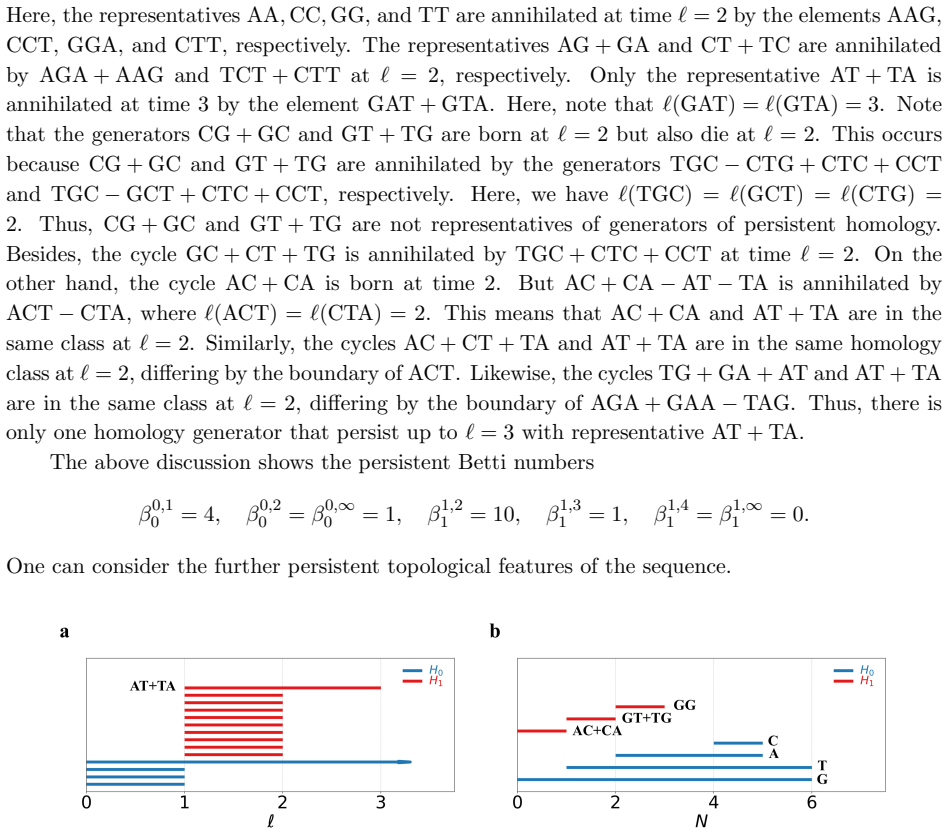
- [Example 3.1, persistent Betti numbers] The reported value beta^{1,2}_1 = 10 is inconsistent with Definition 3.1 and with the annihilation data in the same example. According to the text, the classes AA, CC, GG, TT, AG+GA, CT+TC, and GC+CT+TG are annihilated at l=2, while AC+CT+TA and TG+GA+AT are homologous to AT+TA in H_1(f^{-1}(2)). Hence the image of H_1(f^{-1}(1)) in H_1(f^{-1}(2)) has rank at most one, so beta^{1,2}_1 should be 1 (the class of AT+TA), not 10. The barcode in Figure 2a must be reconciled with the definition of beta^{a,b} as a rank of an image, or the definition must be amended.
- [Section 3.2, persistent Laplacian definition] With the preceding convention d^{a,b}_m : C^{a,b}_{m+1} -> C^a_m, the displayed formula Delta^{a,b}_n = d^{a,b}_{n+1} (d^{a,b}_{n+1})^* + (d^a_n)^* d^a_n is not an operator on C^a_n: the first summand acts on C^a_{n+1} (after composing with the adjoint), while the second acts on C^a_n. The standard persistent Laplacian on n-chains is d^{a,b}_n (d^{a,b}_n)^* + (d^a_n)^* d^a_n with d^{a,b}_n as defined in the paper. Because the spectral-gap curves in Section 4 are computed from this operator, the indexing error must be corrected and the kernel-isomorphism claim restated for the corrected operator.
minor comments (5)
- [Section 2.2, face-map identity] The identity d_i d_j = d_j d_{i-1} for i<j is not the standard simplicial identity; the usual relation is d_i d_j = d_{j-1} d_i. The tuple complex satisfies the standard identity, so this appears to be a typo, but it should be corrected because it is used to assert that E_X is a Delta-complex.
- [Section 3.4, proof of Proposition 3.2] The inequality N(x0...x_{n-1}) >= N(x1...x_n) is false in general (for example, the sequence BAB has N(A)=1 and N(B)=2). The needed inequalities are N(x0...x_{n-1}) >= N(x0...x_n) and N(x1...x_n) >= N(x0...x_n), which do imply the conclusion. The proof should be rewritten accordingly.
- [Section 3.5, notation] In the definition of the sublevel set for the averaged function, the text writes {[sigma] in BG | f([sigma]) <= a}; the function should be \bar f([sigma]), not f([sigma]).
- [Section 4, phylogenetic evaluation] The phylogenetic evaluation is qualitative. No external cluster-quality measure (for example, adjusted Rand index, F1 score, or Robinson-Foulds distance) is reported, and the text acknowledges discrepancies for CP000578.1 and CP001151.1. Adding quantitative measures would support the claim that the trees closely align with the expected classifications.
- [Table 1, runtime comparison] The runtime comparison should state whether the k-mer topology timings were obtained on the same machine and implementation, since the TSA timing is reported for a specific laptop while the k-mer timings are cited from reference [15].
Circularity Check
No significant circularity: the TSA constructions are defined directly from sequences and benchmarked on external datasets; same-group citations are attribution and comparison, not load-bearing derivation.
full rationale
The paper's central derivation is not circular. The Delta-complex EX and classifying-space BG constructions are defined explicitly in Sections 3.1-3.5; the face-preserving functions ell and N are constructed directly from the input sequence, and the persistent homology and persistent Laplacian definitions are built from the paper's own chain-complex formalism. The phylogenetic applications use unsupervised Manhattan distances between spectral-gap curves and are checked against external family labels; no parameter is fitted from those labels, so the clustering result is an independent empirical outcome. The self-citations ([8,15,30]) appear as attribution to prior persistent path homology, persistent path Laplacian, and k-mer topology work, but none of these citations is used to justify a claim that would otherwise be unsupported: the paper defines the persistent Laplacians itself, and the timing comparison with k-mer topology is a direct measurement. A separate mathematical correctness concern, not a circularity, is that Proposition 3.1's proof switches from the sublevel convention used in Sections 3.1 and 3.2 to superlevel sets, and the asserted equality of filtrations fails under the paper's stated convention. That affects the generality of the claimed Delta-closure framework for arbitrary functions, but the concrete ell- and N-based constructions used in the applications do not depend on Proposition 3.1. Because the paper repeatedly leans on same-group prior work for context and baselines, a mild score of 2 is assigned, but no circular reduction of the central claim to its own inputs was found.
Assumptions & free parameters
assumptions (4)
- standard math Standard results in algebraic topology: homology of Delta-complexes, and the classifying space BG of a finite group has the homotopy type K(G,1)
- standard math The kernel of the persistent Laplacian is isomorphic to the persistent homology group
- domain assumption Spectral gap curves of the 1-dimensional persistent Laplacian built from occurrence counts carry enough signal to separate biological families
- domain assumption Frequency counts N(sigma) of sequence fragments are sufficient features for phylogenetic inference
Cite this review
Pith. "Pith review of Topological Sequence Analysis of Genomes: Delta Complex approaches." pith.science (2026). https://pith.science/paper/NGNQ5ZDY
@misc{pith2026250705452,
  author       = {Pith},
  title        = {Pith review of: Topological Sequence Analysis of Genomes: Delta Complex approaches},
  year         = {2026},
  howpublished = {\url{https://pith.science/paper/NGNQ5ZDY}},
  note         = {Machine review of arXiv:2507.05452}
}
abstract
Algebraic topology has been widely applied to point cloud data to capture geometric shapes and topological structures. However, its application to genome sequence analysis remains rare. In this work, we propose topological sequence analysis (TSA) techniques by constructing $\Delta$-complexes and classifying spaces, leading to persistent homology, and persistent path homology on genome sequences. We also develop $\Delta$-complex-based persistent Laplacians to facilitate the topological spectral analysis of genome sequences. Finally, we demonstrate the utility of the proposed TSA approaches in phylogenetic analysis using Ebola virus sequences and whole bacterial genomes. The present TSA methods are more efficient than earlier TSA model, k-mer topology, and thus have a potential to be applied to other time-consuming sequential data analyses, such as those in linguistics, literature, music, media, and social contexts.
Figures


Figures from the paper (4 more)


Forward citations
Cited by 1 Pith paper
-
Topological Data Analysis and Topological Deep Learning Beyond Persistent Homology -- A Review
A survey organizing recent TDA and TDL methods beyond persistent homology and connecting them to data structures and vectorization.
Reference graph
Works this paper leans on
-
[1]
Bernardo Ameneyro, Vasileios Maroulas, and George Siopsis. Quantum persistent homology. Journal of Applied and Computational Topology , 8(7):1961–1980, 2024
work page 1961
-
[2]
Zixuan Cang and Guo-Wei Wei. Topologynet: Topology based deep convolutional and multi- task neural networks for biomolecular property predictions. PLoS computational biology , 13(7):e1005690, 2017
work page 2017
-
[3]
Topology and data
Gunnar Carlsson. Topology and data. Bulletin of the American Mathematical Society , 46(2):255–308, 2009
2009
-
[4]
Joseph Minhow Chan, Gunnar Carlsson, and Raul Rabadan. Topology of viral evolution. Proceedings of the National Academy of Sciences , 110(46):18566–18571, 2013
work page 2013
-
[5]
Dong Chen, Jian Liu, and Guo-Wei Wei. Multiscale topology-enabled structure-to-sequence transformer for protein–ligand interaction predictions. Nature Machine Intelligence , 6(7):799– 810, 2024
work page 2024
-
[6]
Path topology in molecular and materials sciences
Dong Chen, Jian Liu, Jie Wu, Guo-Wei Wei, Feng Pan, and Shing-Tung Yau. Path topology in molecular and materials sciences. Journal of Physical Chemistry Letters , 14(4):954–964, 2023
work page 2023
-
[7]
Evolutionary de Rham-Hodge method
Jiahui Chen, Rundong Zhao, Yiying Tong, and Guo-Wei Wei. Evolutionary de Rham-Hodge method. Discrete and continuous dynamical systems. Series B , 26(7):3785, 2021
work page 2021
-
[8]
Persistent path homology of directed networks
Samir Chowdhury and Facundo M´ emoli. Persistent path homology of directed networks. In Proceedings of the Twenty-Ninth Annual ACM-SIAM Symposium on Discrete Algorithms , pages 1152–1169. SIAM, 2018
work page 2018
Show all 32 references
-
[9]
A novel method of characterizing genetic sequences: genome space with biological distance and applications
Mo Deng, Chenglong Yu, Qian Liang, Rong L He, and Stephen S-T Yau. A novel method of characterizing genetic sequences: genome space with biological distance and applications. PloS one , 6(3):e17293, 2011
2011
-
[10]
Combinatorial topological models for phylogenetic networks and the mergegram invariant
Pawe l D lotko, Jan Felix Senge, and Anastasios Stefanou. Combinatorial topological models for phylogenetic networks and the mergegram invariant. Foundations of data science (Springfield, Mo.), 7(2):617–670, 2025
2025
-
[11]
Persistent homology-a survey
Herbert Edelsbrunner, John Harer, et al. Persistent homology-a survey. Contemporary math- ematics, 453(26):257–282, 2008
2008
-
[12]
Homologies of path complexes and digraphs
Alexander Grigor’yan, Yong Lin, Yuri Muranov, and Shing-Tung Yau. Homologies of path complexes and digraphs. arXiv preprint arXiv:1207.2834 , 2012
2012 arXiv
-
[13]
Cohomology of digraphs and (undirected) graphs
Alexander Grigor’yan, Yong Lin, Yuri Muranov, and Shing-Tung Yau. Cohomology of digraphs and (undirected) graphs. Asian Journal of Mathematics , 19(5):887–932, 2015
2015
-
[14]
A new method to cluster dna sequences using fourier power spectrum
Tung Hoang, Changchuan Yin, Hui Zheng, Chenglong Yu, Rong Lucy He, and Stephen S- T Yau. A new method to cluster dna sequences using fourier power spectrum. Journal of theoretical biology, 372:135–145, 2015. 22
2015
-
[15]
Revealing the shape of genome space via k-mer topology
Yuta Hozumi and Guo-Wei Wei. Revealing the shape of genome space via k-mer topology. arXiv preprint arXiv:2412.20202 , 2024
2024 arXiv
-
[16]
Whole-proteome phylogeny of prokaryotes by feature frequency profiles: An alignment-free method with optimal feature resolution
Se-Ran Jun, Gregory E Sims, Guohong A Wu, and Sung-Hou Kim. Whole-proteome phylogeny of prokaryotes by feature frequency profiles: An alignment-free method with optimal feature resolution. Proceedings of the National Academy of Sciences , 107(1):133–138, 2010
2010
-
[17]
Persistent interaction topology in data analysis
Jian Liu, Dong Chen, and Guo-Wei Wei. Persistent interaction topology in data analysis. Foundations of data science (Springfield, Mo.) , page in press, 2025
2025
-
[18]
The algebraic stability for persistent Laplacians
Jian Liu, Jingyan Li, and Jie Wu. The algebraic stability for persistent Laplacians. Homology, Homotopy and Applications , 26:297–323, 2024
2024
-
[19]
Persistent laplacians: Properties, algo- rithms and implications
Facundo M´ emoli, Zhengchao Wan, and Yusu Wang. Persistent laplacians: Properties, algo- rithms and implications. SIAM Journal on Mathematics of Data Science , 4(2):858–884, 2022
2022
-
[20]
A topological characterization of dna sequences based on chaos geometry and persistent homology
Dong Quan Ngoc Nguyen, Phuong Dong Tan Le, Lin Xing, and Lizhen Lin. A topological characterization of dna sequences based on chaos geometry and persistent homology. In 2022 International Conference on Computational Science and Computational Intelligence (CSCI) , pages 1591–15...
2022
-
[21]
Position: Topo- logical deep learning is the new frontier for relational learning
Theodore Papamarkou, Tolga Birdal, Michael M Bronstein, Gunnar E Carlsson, Justin Curry, Yue Gao, Mustafa Hajij, Roland Kwitt, Pietro Lio, Paolo Di Lorenzo, et al. Position: Topo- logical deep learning is the new frontier for relational learning. In Forty-first International C...
2024
-
[22]
Persistent-homology-based machine learning: a survey and a comparative study
Chi Seng Pun, Si Xian Lee, and Kelin Xia. Persistent-homology-based machine learning: a survey and a comparative study. Artificial Intelligence Review , 55(7):5169–5213, 2022
2022
-
[23]
Whole proteome prokaryote phylogeny without sequence alignment: Ak-string composition approach
Ji Qi, Bin Wang, and Bai-Iin Hao. Whole proteome prokaryote phylogeny without sequence alignment: Ak-string composition approach. Journal of molecular evolution , 58:1–11, 2004
2004
-
[24]
Alignment-free genome comparison with feature frequency profiles (ffp) and optimal resolutions
Gregory E Sims, Se-Ran Jun, Guohong A Wu, and Sung-Hou Kim. Alignment-free genome comparison with feature frequency profiles (ffp) and optimal resolutions. Proceedings of the National Academy of Sciences , 106(8):2677–2682, 2009
2009
-
[25]
Revealing hidden medium-range order in amorphous materials using topological data analysis
Søren S Sørensen, Christophe AN Biscio, Mathieu Bauchy, Lisbeth Fajstrup, and Morten M Smedskjaer. Revealing hidden medium-range order in amorphous materials using topological data analysis. Science Advances, 6(37):eabc2320, 2020
2020
-
[26]
Persistent dirac of paths on digraphs and hypergraphs
Faisal Suwayyid and Guo-Wei Wei. Persistent dirac of paths on digraphs and hypergraphs. Foundations of data science (Springfield, Mo.) , 6(2):124, 2024
2024
-
[27]
Alignment-free sequence comparison—a review
Susana Vinga and Jonas Almeida. Alignment-free sequence comparison—a review. Bioinfor- matics, 19(4):513–523, 2003
2003
-
[28]
Mutations on covid-19 diag- nostic targets
Rui Wang, Yuta Hozumi, Changchuan Yin, and Guo-Wei Wei. Mutations on covid-19 diag- nostic targets. Genomics, 112(6):5204–5213, 2020. 23
2020
-
[29]
Persistent spectral graph
Rui Wang, Duc Duy Nguyen, and Guo-Wei Wei. Persistent spectral graph. International journal for numerical methods in biomedical engineering , 36(9):e3376, 2020
2020
-
[30]
Persistent path laplacian
Rui Wang and Guo-Wei Wei. Persistent path laplacian. Foundations of data science (Spring- field, Mo.) , 5(1):26, 2023
2023
-
[31]
Persistent dirac for molecular representation
JunJie Wee, Ginestra Bianconi, and Kelin Xia. Persistent dirac for molecular representation. Scientific Reports, 13(1):11183, 2023
2023
-
[32]
Real time classification of viruses in 12 dimensions
Chenglong Yu, Troy Hernandez, Hui Zheng, Shek-Chung Yau, Hsin-Hsiung Huang, Rong Lucy He, Jie Yang, and Stephen S-T Yau. Real time classification of viruses in 12 dimensions. PloS one, 8(5):e64328, 2013. 24
2013
Reviewed August 6, 2026 · model on record in the stance chip above.
Discussion (0). Continue with ORCID to comment.