REVIEW 4 major objections 5 minor 21 references
On the Gaussian Assumption in the Estimation of Parameters for Dark Energy Models
T0 review · 4 major / 5 minor · reviewed 2026-08-06 · deepseek-v4-flash
Pith's one-line read Normality of supernova residuals is rejected; a six-degree skew-t distribution fits the Pantheon+ residuals while bootstrap confidence intervals are built for an interacting dark-energy model.
desk verdict The paper convincingly rejects Gaussianity for Pantheon+ residuals but fails to show the practical impact on dark-energy parameters because it ignores the covariance matrix and overclaims a redshift t-distribution. read the letter →
The pith
A machine-rendered reading of the paper's core claim, the machinery that carries it, and where it could break.
The reading
What carries the argument
The load-bearing statistical object is the residual distribution, tested by the Lilliefors and Jarque-Bera normality tests and compared with the skewed generalized $t$ density, a four-parameter family with location, scale, skewness, and tail-weight parameters. On the cosmological side, the model is a sign-changeable interaction $Q = q(\alpha \rho_x' + \beta \rho_x)$, where the deceleration parameter $q$ controls the sign change and the energy densities follow from a second-order differential equation. Bootstrap percentiles provide confidence intervals without invoking a Gaussian likelihood.
What would settle it
Repeat the Lilliefors and Jarque-Bera tests on residuals weighted by the full Pantheon+ covariance matrix, and bootstrap from the corresponding multivariate distribution; if normality is not rejected or the skew-t fit then fails the Kolmogorov-Smirnov test, the paper's central conclusion collapses.
Extended reading notes
Core claim
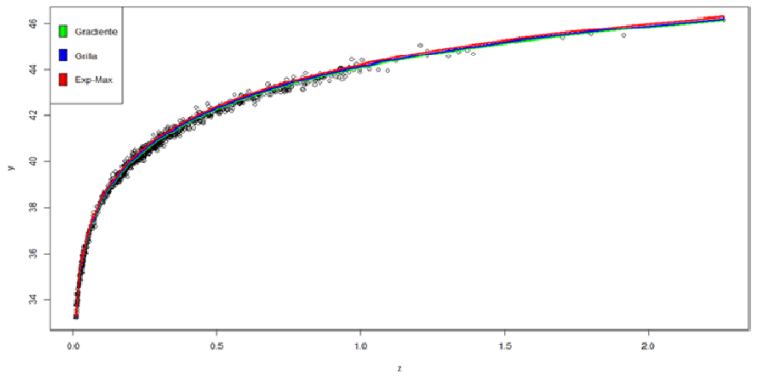
The central discovery is that the Pantheon+ data and the residuals of the paper's interacting dark-sector model are not Gaussian, and the residuals are better described by a slightly skewed, heavy-tailed $t$-distribution. Descriptive statistics show asymmetry and a residual standard deviation of $0.1425$; the Lilliefors test gives $D = 0.039194$ with $p = 0.0007$, and the Jarque-Bera test gives $JB = 26.19$ with $p = 10^{-16}$, both rejecting normality. Fitting the skewed generalized $t$ density produces location $\mu = -0.03$, scale $\sigma = 0.12$, skewness $\lambda = 0.04$, and $q = 6$ degrees of freedom, and the Kolmogorov-Smirnov test does not reject this fit ($p = 0.9099$). The paper then uses bootstrap resampling of the 1,358 distance moduli to construct 95% percentile confidence intervals for the matter density parameter, the Hubble parameter, and the dark-sector equation-of-state parameters.
Load-bearing premise
The argument rests on treating the Pantheon+ distance moduli and the residuals of a single nonlinear least-squares fit as effectively independent draws, without using the survey's published covariance matrix; if the correlated systematic uncertainties are substantial, the reported $p$-values and bootstrap confidence intervals may not be valid.
Editorial extensions
If this is right
- Minimum chi-squared estimation, which assumes Gaussian errors, is not an adequate inferential basis for the interacting dark-energy model fit here.
- A skew-t likelihood with about six degrees of freedom should replace or at least compete with the Gaussian likelihood for these supernova residuals.
- Bootstrap percentile intervals, being distribution-free, give a defensible way to quote cosmological parameter uncertainties even when residuals are non-Gaussian.
- The interacting dark-sector model remains viable under the non-Gaussian treatment: late-time acceleration occurs with $q_0$ near $-0.7$, and the interaction changes sign depending on the sign of $\beta$.
Reading between the lines
- If the residual distribution is truly heavy-tailed, published Pantheon+ parameter uncertainties computed under Gaussian likelihoods are likely too narrow; re-deriving them from a skew-t likelihood is a direct test of the practical impact.
- The present tests fit residuals without the Pantheon+ covariance matrix, so a natural robustness check is to repeat the Lilliefors, Jarque-Bera, and skew-t fits using covariance-weighted residuals; the result could go either way.
- The paper hints that the redshift distribution may be a mixture of two normals or two $t$ distributions; fitting such a mixture to the full Pantheon+ sample would be a testable extension.
- The same battery of distribution tests could be applied to other cosmological probes, such as baryon acoustic oscillations or cosmic microwave background likelihoods, where systematic correlations may preserve or destroy Gaussianity.
Editorial analysis
A structured set of objections, weighed in public.
Referee Report
Summary. The paper tests whether the Gaussianity assumption is valid for the Pantheon+ supernova data and for residuals of an interacting dark-energy model. Using the Lilliefors and Jarque-Bera tests on residuals from a restricted-gradient fit, the authors report strong rejection of normality (D = 0.039, p = 0.0007 and JB = 26.19, p = 10^-16). They then fit a skewed generalized t (SGT) distribution with q = 6 degrees of freedom, obtaining a Kolmogorov-Smirnov p-value of 0.9099, and construct bootstrap 95% confidence intervals for the cosmological parameters Omega_m, H0, gamma_m, and gamma_x. The paper concludes that non-Gaussianity is untenable for the standard assumption and that a skew-t distribution describes the residuals better.
Significance. If the residual non-Gaussianity finding is robust, it is a useful caution for the many cosmological analyses that assume Gaussian distance-modulus errors. The paper reports explicit test statistics and p-values, and the bootstrap procedure is clearly described. The main limitation is that the analysis ignores the Pantheon+ covariance matrix and applies the normality tests to residuals from a single fit, so the reported p-values and confidence intervals are conditional on an independence assumption that is likely violated for this dataset. In addition, the abstract's claim about the redshift distribution is not supported by the tests performed, and the paper does not demonstrate that the non-Gaussianity actually changes parameter estimates. These issues are load-bearing for the paper's main message and require substantial revision.
major comments (4)
- [Abstract and Section 3.1] The abstract states that 'the redshift distribution is more accurately described by a t-distribution,' but no normality test is applied to the redshift variable. The Lilliefors, Jarque-Bera, and Kolmogorov-Smirnov tests in Section 3.1 are applied to the residuals of the restricted-gradient fit, not to the redshift distribution. The manuscript should either test the redshift variable directly or revise the abstract to refer to model residuals rather than the redshift distribution.
- [Section 3.1, bootstrap paragraph] The bootstrap resamples the 1,358 distance moduli independently and does not use the Pantheon+ covariance matrix. Because Pantheon+ distance moduli have significant correlated systematic uncertainties (for example, calibration, bias corrections, and peculiar velocities), treating them as exchangeable draws can produce confidence intervals that are too narrow and p-values that are not exact. The 95% intervals in Table 5 should be recomputed using the published covariance matrix, for instance by sampling from the multivariate normal with the full covariance or by a residual bootstrap that accounts for the correlation structure, and the effect on the intervals should be reported.
- [Section 3.1, skew-t fit] The skew-t distribution is fitted to the same residuals that are subsequently used for the Kolmogorov-Smirnov test. The reported p = 0.9099 is therefore a goodness-of-fit diagnostic rather than an independent confirmation of the model. Additionally, Equation (7) is the skewed generalized t distribution, not the ordinary skew-t distribution; the terminology should be corrected, and the fit should be compared with a Gaussian model using information criteria or cross-validation to justify the choice.
- [Title, Abstract, and Section 3.1] The paper promises an analysis of the impact of non-Gaussianity on parameter estimation, but no comparison is made between parameter estimates obtained under Gaussian and non-Gaussian assumptions. The bootstrap confidence intervals in Table 5 are based on least-squares estimation, which is equivalent to Gaussian maximum likelihood; the fitted skew-t distribution is not used in the estimation. To support the claim that non-Gaussianity affects parameter estimation, the authors should present a likelihood or weighted fit using the SGT error model and compare the resulting parameters and confidence intervals with the Gaussian-based results.
minor comments (5)
- [Abstract] There is a typo in the abstract: 'comprehensive statistical, analysis' should read 'comprehensive statistical analysis.'
- [Section 2, Equation (5)] The prime notation in Equation (5) is used without defining the derivative variable; the authors should specify whether the prime denotes differentiation with respect to ln a or another variable.
- [Section 3.1, Table 3] The statement that a standard deviation of 0.14 'provides evidence' of a platykurtic distribution is not justified; kurtosis should be estimated directly rather than inferred from the standard deviation.
- [Table 2] The goodness-of-fit column mixes minimum sum of squares for the Grid and Gradient methods with a maximum for the EM method, making the values non-comparable across methods; this should be clarified or presented in separate columns.
- [Section 3.1, bootstrap paragraph] The text refers to the 'original Pantheon dataset, which contains 1,358 observations' while the paper otherwise uses the Pantheon+ dataset; the exact sample and the number of distance moduli used should be clarified.
Circularity Check
No significant circularity: the Gaussianity tests and parameter estimates are self-contained; the main caveats are in-sample KS validation and an abstract overstatement, not circular reductions.
full rationale
The central statistical finding—rejection of normality via Lilliefors (D=0.039, p=0.0007) and Jarque-Bera (JB=26.19, p=10^-16)—is an independent test on the residuals of a fitted model and does not reduce to the paper's own assumptions. The skew-t distribution is fitted to the same residuals and then assessed with a Kolmogorov-Smirnov test (p=0.9099); this is an in-sample goodness-of-fit diagnostic, so the p-value is not an independent confirmation, but the paper does not call it a prediction, and no derived quantity is forced by construction. The abstract's wording that the 'redshift distribution' is t-distributed overstates the residual-based analysis, but this is a labeling error rather than a circular step. The interaction Q is introduced as an ansatz proportional to the deceleration parameter q, and the paper explicitly notes that the observed sign change is 'expected given the role of the deceleration parameter in its formulation,' so the sign change is transparently built into the model rather than presented as an independent result. Self-citations [11,12] supply the model form, not a load-bearing uniqueness claim or fitted parameter. The bootstrap confidence intervals are standard resampling of the Pantheon+ data, not an independent prediction. Consequently, the derivation chain is self-contained aside from non-circular statistical limitations.
Assumptions & free parameters
free parameters (9)
- Omega_m =
0.3371 (case I gradient)
- H0 =
0.7449 (case I gradient)
- gamma_m =
1.1239 (case I gradient)
- gamma_x =
-0.2760 (case I gradient)
- beta =
0.15 fixed in cases I-V; -0.4471 in case VI
- skew-t mu =
-0.03
- skew-t sigma =
0.12
- skew-t lambda =
0.04
- skew-t q =
6
assumptions (5)
- domain assumption Flat FLRW metric and Friedmann equations describe the late Universe.
- domain assumption Radiation and other minor components are negligible; only dark matter and dark energy contribute.
- ad hoc to paper The interaction term Q = q(alpha rho_x' + beta rho_x) is a valid phenomenological model.
- domain assumption Pantheon+ distance moduli are treated as independent observations for the residual normality tests.
- standard math The skew-t distribution family is flexible enough to capture the residual distribution.
invented entities (1)
-
Phenomenological dark-sector interaction Q = q(alpha rho_x' + beta rho_x)
Cite this review
Pith. "Pith review of On the Gaussian Assumption in the Estimation of Parameters for Dark Energy Models." pith.science (2026). https://pith.science/paper/5S4UFE73
@misc{pith2026250705468,
  author       = {Pith},
  title        = {Pith review of: On the Gaussian Assumption in the Estimation of Parameters for Dark Energy Models},
  year         = {2026},
  howpublished = {\url{https://pith.science/paper/5S4UFE73}},
  note         = {Machine review of arXiv:2507.05468}
}
read the original abstract
Type Ia supernovae have provided fundamental observational data in the discovery of the late acceleration of the expansion of the Universe in cosmology. However, this analysis has relied on the assumption of a Gaussian distribution for the data, a hypothesis that can be challenged with the increasing volume and precision of available supernova data. In this work, we rigorously assess this Gaussianity hypothesis and analyze its impact on parameter estimation for dark energy cosmological models. We utilize the Pantheon+ dataset and perform a comprehensive statistical, analysis including the Lilliefors and Jarque-Bera tests, to assess the normality of both the data and model residuals. We find that the Gaussianity assumption is untenable and that the redshift distribution is more accurately described by a t-distribution, as indicated by the Kolmogorov Smirnov test. Parameters are estimated for a model incorporating a nonlinear cosmological interaction for the dark sector. The free parameters are estimated using multiple methods, and bootstrap confidence intervals are constructed for them.
Figures


Figures from the paper (2 more)


Reference graph
Works this paper leans on
-
[1]
Observational Evidence from Supernovae for an Accelerating Uni- verse and a Cosmological Constant,
A. G. Riess et al., "Observational Evidence from Supernovae for an Accelerating Uni- verse and a Cosmological Constant," The Astronomical Journal, vol. 116, no. 3, pp. 1009–1038, 1998. [arXiv:astro-ph/9805201]
arXiv 1998
-
[2]
Measurements of Omega and Lambda from 42 High-Redshift Supernovae,
S. Perlmutter et al., "Measurements of Omega and Lambda from 42 High-Redshift Supernovae," The Astrophysical Journal, vol. 517, no. 2, pp. 565–586, 1999. [arXiv:astro- ph/9812133]
arXiv 1999
-
[3]
Tsujikawa, doi:10.1007/978-90-481-8685-3_8 [arXiv:1004.1493 [astro-ph.CO]]
S. Tsujikawa, doi:10.1007/978-90-481-8685-3_8 [arXiv:1004.1493 [astro-ph.CO]]
-
[4]
D. Scolnic, D. Brout, A. Carr, A. G. Riess, T. M. Davis, A. Dwomoh, D. O. Jones, N. Ali, P. Charvu and R. Chen, et al. Astrophys. J. 938 (2022) no.2, 113 doi:10.3847/1538-4357/ac8b7a [arXiv:2112.03863 [astro-ph.CO]]
arXiv 2022
-
[5]
On The Non-Gaussian Errors in High-z Supernovae Type Ia Data
M. Singh, A. Pandey, A. Sharma, S. Gupta and S. Sharma, Res. Astron. Astrophys.16 (2016) no.11, 171 doi:10.1088/1674-4527/16/11/171 [arXiv:1604.08885 [astro-ph.CO]]
work page Pith review arXiv 2016
-
[6]
Dainotti, M.G. and Bargiacchi, G. and Bogdan, M. and Capozziello, S. and Nagataki, S. (2024). "On the statistical assumption on the distance moduli of Supernovae Ia and its impact on the determination of cosmological parameters". Journal of High Energy Astrophysics, volume 41, pages 30–41,
work page 2024
-
[7]
A Critical Reanalysis of Supernova Type Ia Data
R. Singh, A. C. N and H. K. Jassal, [arXiv:2501.02204 [astro-ph.CO]]
- [8]
Show all 21 references
-
[9]
P. Bull, Y. Akrami, J. Adamek, T. Baker, E. Bellini, J. Beltran Jimenez, E. Ben- tivegna, S. Camera, S. Clesse and J. H. Davis,et al. Phys. Dark Univ.12 (2016), 56-99 doi:10.1016/j.dark.2016.02.001 [arXiv:1512.05356 [astro-ph.CO]]. 11
2016 arXiv
-
[10]
B. Wang, E. Abdalla, F. Atrio-Barandela and D. Pavon, Rept. Prog. Phys.79 (2016) no.9, 096901 doi:10.1088/0034-4885/79/9/096901 [arXiv:1603.08299 [astro-ph.CO]]
2016 arXiv
-
[11]
Arevalo and A
F. Arevalo and A. Cid, Eur. Phys. J. C82 (2022) no.10, 946 doi:10.1140/epjc/s10052- 022-10898-6 [arXiv:2202.05130 [astro-ph.CO]]
2022 arXiv
-
[12]
Arevalo, A
F. Arevalo, A. Cid, L. P. Chimento and P. Mella, Eur. Phys. J. C79 (2019) no.4, 355 doi:10.1140/epjc/s10052-019-6872-7 [arXiv:1901.04300 [gr-qc]]
2019 arXiv
-
[13]
L. P. Chimento, Phys. Rev. D81 (2010), 043525 doi:10.1103/PhysRevD.81.043525 [arXiv:0911.5687 [astro-ph.CO]]
2010 arXiv
-
[14]
Nesterov, Introductory Lectures on Convex Optimization: A Basic Course , Springer, 2004
Y. Nesterov, Introductory Lectures on Convex Optimization: A Basic Course , Springer, 2004
2004
-
[15]
McLachlan and T
G. McLachlan and T. Krishnan,The EM Algorithm and Extensions , John Wiley & Sons, 2007
2007
-
[16]
Spearman, The proof and measurement of association between two things,Am
C. Spearman, The proof and measurement of association between two things,Am. J. Psychol. 15, 72–101 (1904),https://doi.org/10.2307/1412159
1904 doi
-
[17]
Verde, Statistical methods in cosmology, in D
L. Verde, Statistical methods in cosmology, in D. Baumann (Ed.),Lectures on Cos- mology: Accelerated Expansion of the Universe , pp. 147–177, Springer, 2010
2010
-
[18]
Betoule et al
M. Betoule et al. [SDSS Collaboration], Improved cosmological constraints from a joint analysis of the SDSS-II and SNLS supernova samples, Astron. Astrophys. 568, A22 (2014), doi:10.1051/0004-6361/201423413, [arXiv:1401.4064 [astro-ph.CO]]
2014 arXiv
-
[19]
Lilliefors, On the Kolmogorov-Smirnov test for normality with mean and variance unknown, J
H. Lilliefors, On the Kolmogorov-Smirnov test for normality with mean and variance unknown, J. Am. Stat. Assoc. 62, 399–402(1967), https://doi.org/10.2307/2283974
1967 doi
-
[20]
Jarque and A
C. Jarque and A. Bera, A test for normality of observations and regression residuals, Int. Stat. Rev. 55, 163–172 (1987),https://doi.org/10.2307/1403192
1987 doi
-
[21]
Davis, The skewed generalized t distribution: Tree package vignette,R Vignette (2015), https://cran.r-project.org/web/packages/sgt/vignettes/sgt.pdf
C. Davis, The skewed generalized t distribution: Tree package vignette,R Vignette (2015), https://cran.r-project.org/web/packages/sgt/vignettes/sgt.pdf. 12
2015
Reviewed August 6, 2026 · model on record in the stance chip above.
Discussion (0). Continue with ORCID to comment.