REVIEW 4 major objections 5 minor 1 cited by
Dynamical Archetype Analysis: Autonomous Computation
T0 review · 4 major / 5 minor · reviewed 2026-08-06 · deepseek-v4-flash
Pith's one-line read This paper proposes a trajectory-only dissimilarity that assigns a neural system to the closest dynamical archetype by balancing a learned coordinate transformation against its complexity.
desk verdict A promising trajectory-based dissimilarity for comparing neural dynamics, undercut by a false invariance claim and loose theory; worth refereeing after major revision. read the letter →
The pith
A machine-rendered reading of the paper's core claim, the machinery that carries it, and where it could break.
The reading
What carries the argument
The central object is the dissimilarity pair $(\bar{d}_1, c)$: $\bar{d}_1$ is the expected squared distance between target trajectories and archetype trajectories mapped through a learned diffeomorphism $\Phi_\theta$, and $c = d_{\mathrm{cxty}}(\Phi_\theta)$ is the integrated deviation of the diffeomorphism's Jacobian from the identity matrix. A Neural ODE—a trainable continuous-time map defined by integrating a neural-network vector field—parameterizes $\Phi_\theta$, so the map is invertible and can approximate the needed coordinate transformations; the complexity penalty $c$ prevents a wild deformation from trivially zeroing the trajectory error. A Gronwall-type bound shows that small vector-field perturbations imply small finite-time trajectory deviations, so the trajectory mismatch lower-bounds the perturbation needed, and the trade-off between perturbation size and deformation complexity is analyzed as a Pareto frontier.
What would settle it
Take the canonical ring attractor archetype, generate target trajectories, then generate a second target by rotating those trajectories by ninety degrees (or reflecting them) and rerun the proposed dissimilarity against the archetype. If the reported dissimilarity differs from the unrotated case—or the complexity penalty jumps because the diffeomorphism must encode the rotation—then the measure is not invariant under the isometries the paper says it should tolerate, and archetype assignment can change with the coordinate frame.
Extended reading notes
Core claim
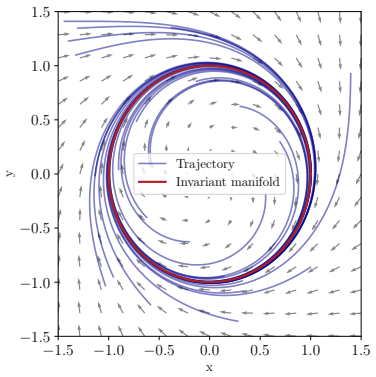
The paper's central claim is that effective behavior of an autonomous dynamical system can be quantified by a two-part dissimilarity to an archetype: the mean squared trajectory error after the best-learned diffeomorphic mapping, plus the complexity of that mapping. On approximate ring attractors—systems whose continuous attractor has been broken into slow manifolds or fixed points—this dissimilarity grows slowly and the archetype assignment remains correct, whereas existing methods report fragility. The same assignment works for high-dimensional recurrent networks trained as internal compasses: the ring attractor archetype fits their low-dimensional trajectories across network sizes. The authors frame this as the start of a library-based vocabulary for neural computation, organizing archetypes by the dimension of their invariant manifold and allowing composition by Cartesian products.
Load-bearing premise
The target and archetype trajectories are assumed to live in a common coordinate frame, so rotations, reflections, permutations, and other symmetry transformations of the target are not free: the learned diffeomorphism must absorb them and the dissimilarity grows as a result.
Editorial extensions
If this is right
- Observed trajectory data alone—without estimating the underlying vector field—becomes enough to assign a neural system to one archetype from a small library.
- Approximate continuous attractors, including noisy, deformed, and perturbed ring attractors, would be recognized as ring-attractor-like instead of being misclassified, resolving a previously reported fragility.
- High-dimensional recurrent networks can be compared with low-dimensional archetypes through the learned diffeomorphism, so the method applies where the state space is large but the computation lives on a low-dimensional manifold.
- The archetype library can be organized by invariant-manifold dimension and composed via Cartesian products, giving a grammar for building higher-dimensional computations from interpretable parts.
- The dissimilarity pair provides a Pareto-style trade-off: systems are effectively similar when a simple transformation makes their finite-time trajectories nearly coincide, and the frontier can guide how much deformation to allow.
Reading between the lines
- Extension: the coordinate-frame sensitivity is the natural next pressure point—if a rotation- and reflection-invariant alignment step were added, the method could be applied across animals or sessions without pre-aligned latent spaces.
- Extension: the Pareto trade-off between perturbation and diffeomorphism complexity suggests a scalar effective-behavior distance at a fixed complexity budget, turning archetype assignment into a model-selection problem.
- Extension: the dissimilarity could be used as an objective to discover new archetypes from data rather than fixing the library a priori, or to test whether a proposed library is complete for a given family of tasks.
- Extension: because the measure integrates only over $[0, T_{\max}]$, two systems with identical finite-time behavior but different asymptotic fates will look similar; choosing $T_{\max}$ is therefore an implicit modeling decision that should be reported with every assignment.
Editorial analysis
A structured set of objections, weighed in public.
Referee Report
Summary. This paper introduces Dynamical Archetype Analysis (DAA), a framework for comparing autonomous dynamical systems by their finite-time, trajectory-based "effective behavior." The core dissimilarity is a pair: (i) how well a source system's trajectories can be mapped onto a target system's trajectories by a diffeomorphism, and (ii) the complexity of that diffeomorphism measured by its deviation from the identity. The authors define a library of archetypes (single fixed point, bistable, bounded line attractor, ring attractor, limit cycle), estimate the dissimilarity from trajectories with a Neural ODE, and report experiments on deformed and perturbed ring attractors, nonlinear oscillators, and a task-trained compass RNN. They claim that the resulting archetype assignment overcomes failures of DSA and SPE on approximate continuous attractors and high-dimensional recurrent neural networks.
Significance. If the method is made rigorous, it would provide a practical, vector-field-free way to compare neural dynamics against interpretable dynamical motifs, and the explicit two-axis dissimilarity (trajectory distance plus deformation complexity) is a useful conceptual contribution. The archetype library is defined a priori, so the approach does not fit archetypes to data in a circular way, and the experiments cover several target classes including an RNN compass network. The paper does not supply machine-checked proofs or a code repository, and the theoretical bounds currently do not support the invariance claims; nevertheless the core idea is promising and the falsifiable predictions (ring-like targets map to the ring archetype, oscillator targets to the limit cycle archetype) are clearly stated.
major comments (4)
- [§3.1, Eq. (5)] The statement that bar{d}_1 is zero when the source and target are topologically conjugate on the support of mu is not correct for the loss as written. If Phi is a conjugacy, then Phi(phi_g^t(x)) = phi_f^t(Phi(x)), whereas Eq. (5) compares phi_f^t(x) with Phi(phi_g^t(x)); these two trajectories agree only when Phi(x)=x for mu-almost every x. Thus the loss is zero only for diffeomorphisms that are the identity on the sampled region, not for non-identity conjugacies. Consequently, the bound in Eq. (11), which transfers the perturbation estimate Eq. (8) to bar{d}_1, does not follow from the preceding argument; the loss needs to be defined on matched initial conditions, for example bar{d}_1 = E_{xsimmu} int || phi_f^t(Phi(x)) − Phi(phi_g^t(x)) || dt, and a separate Gronwall estimate is needed for this quantity.
- [§3.1, Eq. (6), and Supp. J.1.1–J.1.2] The claimed invariance to isometric scaling, rotations, and affine transformations is not realized by the dissimilarity that is actually computed. For a target that is a rotated copy of the archetype, the diffeomorphism Phi = R^{\-1} makes the trajectory term in Eq. (5) vanish, but the complexity penalty in Eq. (6) is int || R^{\-1} − I || dx, which is positive and increases with the rotation angle. Because the archetype assignment combines the similarity and simplicity scores (Supp. J.1.1–J.1.2), a target presented in rotated, reflected, or permuted coordinates receives a different dissimilarity pair than the same target in canonical coordinates. Since neural latent coordinates are arbitrary up to orthogonal and permutation transformations, this is a load-bearing issue for the application described in §3.1; the method must either optimize over the transformation equivalence class before measuring complexity or define complexity on the quotient by those transformations.
- [Supp. C, Eq. (15)] The first-order computation contains a sign error. From y = x + epsilon Phitilde(x), equating dot{y} = f(x) + epsilon Delta(x) + epsilon nablaPhitilde(x) f(x) + O(epsilon^2) with dot{y} = f(y) = f(x) + epsilon nabla f(x) Phitilde(x) + O(epsilon^2) gives epsilon Delta = epsilon(nabla f)Phitilde − epsilon(nablaPhitilde) f, which is the negative of Eq. (15). The pointwise bound in Eq. (16) is unchanged in magnitude, but the displayed derivation should be corrected, and the role of Eq. (15) in the bound Eq. (22) should be rechecked.
- [§3.1, Eq. (22)] The claimed upper bound in Eq. (22) is not established by the preceding inequalities. Eq. (8) bounds bar{d}_0(f, f+Delta), a comparison in a fixed coordinate frame with identical initial conditions, whereas Eq. (22) concerns bar{d}_1(f, g; c), which involves a diffeomorphism and trajectories evaluated at points related by that diffeomorphism. In addition, Delta_1 in Eqs. (9)–(10) is defined as the solution of a constrained optimization problem, and no proof is given that this solution satisfies the Lipschitz and boundedness assumptions needed for the Gronwall argument. The authors should either provide a complete proof of Eq. (22) or explicitly label it as a heuristic bound that motivates the empirical dissimilarity rather than a theorem.
minor comments (5)
- [Supp. A.3.1] The text reads "We fill be using a Multi-layer Perceptron"; this should be "We will be using a multi-layer perceptron."
- [Eq. (18)] The line "g(x) = f(x) target system" is confusing because g is introduced as the source system; the decomposition should use distinct labels or a clearer explanatory sentence.
- [Supp. J.1.1] The paper should state explicitly whether the similarity scores in Figs. 3–4 are computed on the validation split used during training or on a fully independent test set; the text says "validation dataset" and this needs clarification for reproducibility.
- [Supp. F.2.1] The initialization "MLP weight initialization sim N(0.02, 0.5)" is ambiguous; please specify whether 0.5 is the standard deviation or the variance.
- [§3.1] The phrase "reasonable duration of time[0, Tmax]" is missing a space before the interval; a minor typo.
Circularity Check
No circularity: the DAA dissimilarity is defined as the fitted loss itself and is evaluated on held-out trajectories against a priori archetypes.
full rationale
The paper's derivation chain is self-contained. Equations (5) and (6) define the proposed dissimilarity as a two-part measure: a trajectory-matching loss under a coordinate diffeomorphism and a complexity penalty on that diffeomorphism. Equation (23) is explicitly presented as an empirical estimator of the same trajectory loss, fitted by a Neural ODE and evaluated on held-out data, so the reported similarity scores are normalized transforms of the fitted objective, not independent predictions masquerading as confirmations. The archetypes are defined a priori in Section 4 and the appendix, not inferred from the target data, and the numerical experiments compare the fitted losses across a fixed library. The only self-citations (refs. 19 and 20) provide background on continuous attractor fragility and supply the compass RNN target; they are not used to justify the method's validity, to restrict alternatives, or to import a uniqueness theorem. The Grönwall bound in Eq. (7) is an independent parameter-free inequality, and the decomposition in Eqs. (18)-(21) is definitional bookkeeping rather than a result derived from its own conclusion. The known non-invariance of Eqs. (5)-(6) under rotations and reflections is a correctness and robustness concern, not a circularity: the measure is what it is defined to be, and the paper does not claim to predict coordinate-frame-independent classifications without caveats.
Assumptions & free parameters
free parameters (6)
- Tmax =
2, 5, or 15 per experiment
- The sampling measure mu(x) =
uniform over sampled trajectory points
- Complexity norm choice =
Frobenius norm, p = 2
- Data standardization (mu, sigma) =
computed from training data
- Similarity score normalization =
per-archetype max normalization
- Neural ODE hidden sizes and epochs =
[64] or [128], 200 or 1000 epochs
assumptions (6)
- standard math Gronwall's inequality
- standard math Universal approximation of homeomorphisms by Neural ODEs and i-ResNets
- domain assumption Autonomous dynamics over a finite interval [0, Tmax] with a known sampling distribution
- domain assumption The support of mu is contained in a low-dimensional, task-relevant region
- ad hoc to paper Existence of a minimal perturbation achieving topological conjugacy on the support of mu
- ad hoc to paper The optimal diffeomorphism can be approximated by a first-order expansion Phi = x + epsilon*Phi_tilde + O(epsilon^2)
Cite this review
Pith. "Pith review of Dynamical Archetype Analysis: Autonomous Computation." pith.science (2026). https://pith.science/paper/K2HCT2PU
@misc{pith2026250705505,
  author       = {Pith},
  title        = {Pith review of: Dynamical Archetype Analysis: Autonomous Computation},
  year         = {2026},
  howpublished = {\url{https://pith.science/paper/K2HCT2PU}},
  note         = {Machine review of arXiv:2507.05505}
}
read the original abstract
The study of neural computation aims to understand the function of a neural system as an information processing machine. Neural systems are undoubtedly complex, necessitating principled and automated tools to abstract away details to organize and incrementally build intuition. We argue that systems with the same effective behavior should be abstracted by their ideal representative, i.e., archetype, defined by its asymptotic dynamical structure. We propose a library of archetypical computations and a new measure of dissimilarity that allows us to group systems based on their effective behavior by explicitly considering both deformations that break topological conjugacy as well as diffeomorphisms that preserve it. The proposed dissimilarity can be estimated from observed trajectories. Numerical experiments demonstrate our method's ability to overcome previously reported fragility of existing (dis)similarity measures for approximate continuous attractors and high-dimensional recurrent neural networks. Although our experiments focus on working memory systems, our theoretical approach naturally extends to general mechanistic interpretation of recurrent dynamics in both biological and artificial neural systems. We argue that abstract dynamical archetypes, rather than detailed dynamical systems, offer a more useful vocabulary for describing neural computation.
Figures


Figures from the paper (18 more)




Forward citations
Cited by 1 Pith paper
-
Universal Approximation Theorems for Dynamical Systems with Infinite-Time Horizon Guarantees
Neural ODEs can approximate Morse-Smale and continuous-attractor dynamical systems over infinite time in an ε-δ sense, provided limit-cycle periods are matched exactly.
Reference graph
Works this paper leans on
-
[1]
Nair, A., Karigo, T., Yang, B., Ganguli, S., Schnitzer, M. J., Linderman, S. W., Anderson, D. J. & Kennedy, A. An approximate line attractor in the hypothalamus encodes an aggressive state. Cell, 186(1):178–193. e15, 2023
work page 2023
-
[2]
Pei, F. C., Ye, J., Zoltowski, D. M., Wu, A., Chowdhury, R. H., Sohn, H., O’Doherty, J. E., Shenoy, K. V ., Kaufman, M., Churchland, M. M. & others, . Neural Latents Benchmark ’21: Evaluating latent variable models of neural population activity. In Thirty-fifth Conference on Neural Information Processing Systems Datasets and Benchmarks Track (Round 2), 2021
work page 2021
- [3]
-
[4]
Machens, C. K. & Brody, C. D. Design of continuous attractor networks with monotonic tuning using a symmetry principle. Neural Computation, 20(2):452–485, 2008
work page 2008
-
[5]
Mante, V ., Sussillo, D., Shenoy, K. V . & Newsome, W. T. Context-dependent computation by recurrent dynamics in prefrontal cortex. Nature, 503(7474):78–84, 2013
work page 2013
-
[6]
Driscoll, L. N., Shenoy, K. & Sussillo, D. Flexible multitask computation in recurrent networks utilizes shared dynamical motifs. Nature Neuroscience, 27(7):1349–1363, 2024
work page 2024
-
[7]
Vyas, S., Golub, M. D., Sussillo, D. & Shenoy, K. V . Computation through neural population dynamics. Annual Review of Neuroscience, 43:249–275, 2020
work page 2020
-
[8]
Versteeg, C., McCart, J. D., Ostrow, M., Zoltowski, D. M., Washington, C. B., Driscoll, L., Codol, O., Michaels, J. A., Linderman, S. W., Sussillo, D. & others, . Computation-through- Dynamics Benchmark: Simulated datasets and quality metrics for dynamical models of neural activity. bioRxiv, pages 2025–02, 2025
work page 2025
Show all 80 references
-
[9]
Beer, R. D. On the dynamics of small continuous-time recurrent neural networks. Adaptive Behavior, 3(4):469–509, 1995
1995
-
[10]
Beer, R. D. Parameter space structure of continuous-time recurrent neural networks. Neural Computation, 18(12):3009–3051, 2006
2006
-
[11]
Neural circuits as computational dynamical systems
Sussillo, D. Neural circuits as computational dynamical systems. Current opinion in neurobi- ology, 25:156–163, 2014
2014
-
[12]
Zhang, W., Wu, Y . N. & Wu, S. Translation-equivariant representation in recurrent networks with a continuous manifold of attractors. Advances in Neural Information Processing Systems, 35:15770–15783, 2022
2022
-
[13]
& Romani, S
Hoeller, J., Zhong, L., Pachitariu, M. & Romani, S. Bridging tuning and invariance with equivariant neuronal representations. bioRxiv, pages 2024–08, 2024
2024
-
[14]
& Miolane, N
Kurtkaya, B., Dinc, F., Yuksekgonul, M., Blanco-Pozo, M., Cirakman, E., Schnitzer, M., Yemez, Y ., Tanaka, H., Yuan, P. & Miolane, N. Dynamical phases of short-term memory mechanisms in RNNs. arXiv preprint arXiv:2502.17433, 2025
2025 arXiv
-
[15]
Strogatz, S. H. Nonlinear dynamics and chaos : with applications to physics, biology, chem- istry, and engineering. Studies in nonlinearity. Westview Press, 1 edition, January 2000. ISBN 9780738204536
2000
-
[16]
Arnol’d, V . I. The theory of bifurcations in the work of A.A. Andronov. In Dynamical Sys- tems V, Encyclopaedia of mathematical sciences, pages 224–232. Springer Berlin Heidelberg, Berlin, Heidelberg, 1994. ISBN 9783540653790,9783642578847
1994
-
[17]
A lemma in the theory of structural stability of differential equations
Hartman, P. A lemma in the theory of structural stability of differential equations. Proceedings of the American Mathematical Society, 11(4):610–620, 1960
1960
-
[18]
& Abbott, L
Dayan, P. & Abbott, L. F. Theoretical neuroscience: Computational and mathematical model- ing of neural systems. MIT press, 2005. 11
2005
-
[19]
& Park, I
S ´agodi, A., Mart´ın-S´anchez, G., Sok ´oł, P. & Park, I. M. Back to the continuous attractor. In Advances in Neural Information Processing Systems (NeurIPS), December 2024
2024
-
[20]
M., S ´agodi, ´A
Park, I. M., S ´agodi, ´A. & Sok´oł, P. A. Persistent learning signals and working memory without continuous attractors. August 2023, arXiv:2308.12585 [q-bio.NC]
2023 arXiv
-
[21]
& Bandettini, P
Kriegeskorte, N., Mur, M. & Bandettini, P. A. Representational similarity analysis-connecting the branches of systems neuroscience. Frontiers in systems neuroscience, 2:249, 2008
2008
-
[22]
& Sohl-Dickstein, J
Raghu, M., Gilmer, J., Yosinski, J. & Sohl-Dickstein, J. SVCCA: Singular vector canoni- cal correlation analysis for deep learning dynamics and interpretability. Advances in Neural Information Processing Systems, 30, 2017
2017
-
[23]
H., Kunz, E., Kornblith, S
Williams, A. H., Kunz, E., Kornblith, S. & Linderman, S. Generalized shape metrics on neural representations. Advances in Neural Information Processing Systems, 34:4738–4750, 2021
2021
-
[24]
R., Zhou, J., Nassar, J., Berman, J., Olieslagers, J
Duong, L. R., Zhou, J., Nassar, J., Berman, J., Olieslagers, J. & Williams, A. H. Rep- resentational dissimilarity metric spaces for stochastic neural networks. arXiv preprint arXiv:2211.11665, 2022
2022 arXiv
-
[25]
R., Harvey, S
Barbosa, J., Nejatbakhsh, A., Duong, L. R., Harvey, S. E., Brincat, S. L., Siegel, M., Miller, E. K. & Williams, A. H. Quantifying differences in neural population activity with shape metrics. bioRxiv, pages 2025–01, 2025
2025
-
[26]
Williams, A. H. Equivalence between representational similarity analysis, centered kernel alignment, and canonical correlations analysis. bioRxiv, pages 2024–10, 2024
2024
-
[27]
& Fiete, I
Ostrow, M., Eisen, A., Kozachkov, L. & Fiete, I. Beyond geometry: Comparing the temporal structure of computation in neural circuits with dynamical similarity analysis. Advances in Neural Information Processing Systems, 36, 2024
2024
-
[28]
& Nitzan, M
Moriel, N., Ricci, M. & Nitzan, M. Let’s do the time-warp-attend: Learning topological invariants of dynamical systems. In The Twelfth International Conference on Learning Repre- sentations, 2024
2024
-
[29]
Chen, R., Vedovati, G., Braver, T. S. & Ching, S. Dform: Diffeomorphic vector field alignment for assessing dynamics across learned models. CoRR, abs/2402.09735, 2024
2024 arXiv
-
[30]
& Nitzan, M
Friedman, R., Moriel, N., Ricci, M., Pelc, G., Weiss, Y . & Nitzan, M. Characterizing nonlinear dynamics via smooth prototype equivalences. arXiv preprint arXiv:2503.10336, 2025
2025
-
[31]
& Ortega, J.-P
Grigoryeva, L. & Ortega, J.-P. Dimension reduction in recurrent networks by canonicalization. arXiv preprint arXiv:2007.12141, 2020
2007 arXiv
-
[32]
& Ortega, J.-P
Gonon, L., Grigoryeva, L. & Ortega, J.-P. Approximation bounds for random neural networks and reservoir systems. The Annals of Applied Probability, 33(1):28–69, 2023
2023
-
[33]
& Thurm, M
Durstewitz, D., Koppe, G. & Thurm, M. I. Reconstructing computational system dynamics from neural data with recurrent neural networks. Nature Reviews Neuroscience, 24(11):693– 710, 2023
2023
-
[34]
J., Monfared, Z
Brenner, M., Hemmer, C. J., Monfared, Z. & Durstewitz, D. Almost-linear RNNs yield highly interpretable symbolic codes in dynamical systems reconstruction. arXiv preprint arXiv:2410.14240, 2024
2024 arXiv
-
[35]
& Sahani, M
Duncker, L., Bohner, G., Boussard, J. & Sahani, M. Learning interpretable continuous-time models of latent stochastic dynamical systems. In International conference on machine learn- ing, pages 1726–1734. PMLR, 2019
2019
-
[36]
& Haller, G
Cenedese, M., Ax ˚as, J., B ¨auerlein, B., Avila, K. & Haller, G. Data-driven modeling and prediction of non-linearizable dynamics via spectral submanifolds. Nature communications, 13(1):872, 2022
2022
-
[37]
& Nitzan, M
Ricci, M., Moriel, N., Piran, Z. & Nitzan, M. Phase2vec: Dynamical systems embedding with a physics-informed convolutional network. arXiv preprint arXiv:2212.03857, 2022. 12
2022 arXiv
-
[38]
L., Arnaudon, A., Barahona, M
Gosztolai, A., Peach, R. L., Arnaudon, A., Barahona, M. & Vandergheynst, P. MARBLE: Interpretable representations of neural population dynamics using geometric deep learning. Nature Methods, 2025
2025
-
[39]
The Gronwall inequality
Howard, R. The Gronwall inequality. arXiv [math.FA], March 2025, arXiv:2503.23639 [math.FA]
2025 arXiv
-
[40]
& Barak, O
Sussillo, D. & Barak, O. Opening the black box: Low-dimensional dynamics in high- dimensional recurrent neural networks. Neural Computation, 25(3):626–649, 2013
2013
-
[41]
Katz, G. E. & Reggia, J. A. Using directional fibers to locate fixed points of recurrent neural networks. IEEE transactions on neural networks and learning systems , 29(8):3636–3646, 2017
2017
-
[42]
Golub, M. D. & Sussillo, D. FixedPointFinder: A Tensorflow toolbox for identifying and characterizing fixed points in recurrent neural networks. Journal of Open Source Software, 3 (31):1003, 2018
2018
-
[43]
G., McClements, W., Ruiz, A
Townley, S., Ilchmann, A., Weiß, M. G., McClements, W., Ruiz, A. C., Owens, D. H. & Pratzel-Wolters, D. Existence and learning of oscillations in recurrent neural networks. IEEE Transactions on neural networks, 11(1):205–214, 2000
2000
-
[44]
E., Pei, F., Gloeckler, M
Pals, M., Sa ˘gtekin, A. E., Pei, F., Gloeckler, M. & Macke, J. H. Inferring stochastic low-rank recurrent neural networks from neural data. arXiv preprint arXiv:2406.16749, 2024
2024 arXiv
-
[45]
The Brain Abstracted: Simplification in the history and philosophy of neuro- science
Chirimuuta, M. The Brain Abstracted: Simplification in the history and philosophy of neuro- science. MIT Press, 2024
2024
-
[46]
F., DePasquale, B., Pillow, J
Panichello, M. F., DePasquale, B., Pillow, J. W. & Buschman, T. J. Error-correcting dynamics in visual working memory. Nature communications, 10(1):3366, 2019
2019
-
[47]
M., Ardalan, A., Markov, N
Tafazoli, S., Bouchacourt, F. M., Ardalan, A., Markov, N. T., Uchimura, M., Mattar, M. G., Daw, N. D. & Buschman, T. J. Building compositional tasks with shared neural subspaces. bioRxiv, 2024
2024
-
[48]
& Engel, T
Langdon, C., Genkin, M. & Engel, T. A. A unifying perspective on neural manifolds and circuits for cognition. Nature Reviews Neuroscience, pages 1–15, 2023
2023
-
[49]
& Krishnamurthy, K
Can, T. & Krishnamurthy, K. Emergence of memory manifolds. arXiv preprint arXiv:2109.03879, 2021
2021 arXiv
-
[50]
J., Ardalan, A., Tsodyks, M
Cueva, C. J., Ardalan, A., Tsodyks, M. & Qian, N. Recurrent neural network models for work- ing memory of continuous variables: Activity manifolds, connectivity patterns, and dynamic codes. arXiv preprint arXiv:2111.01275, 2021
2021 arXiv
-
[51]
Emergence of universal computations through neural manifold dynamics
Gort, J. Emergence of universal computations through neural manifold dynamics. Neural Computation, 36(2):227–270, 2024
2024
-
[52]
& Narayanan, R
Mishra, P. & Narayanan, R. Stable continual learning through structured multiscale plasticity manifolds. Current opinion in neurobiology, 70:51–63, 2021
2021
-
[53]
& Fiete, I
Chaudhuri, R., Gerc ¸ek, B., Pandey, B., Peyrache, A. & Fiete, I. The intrinsic attractor manifold and population dynamics of a canonical cognitive circuit across waking and sleep. Nature neuroscience, 22(9):1512–1520, 2019
2019
-
[54]
& Ching, S
Ghazizadeh, E. & Ching, S. Slow manifolds within network dynamics encode working mem- ory efficiently and robustly. PLoS computational biology, 17(9):e1009366, 2021
2021
-
[55]
& Sahani, M
Duncker, L. & Sahani, M. Dynamics on the manifold: Identifying computational dynamical activity from neural population recordings. Current opinion in neurobiology , 70:163–170, 2021
2021
-
[56]
& Gerstner, W
Pezon, L., Schmutz, V . & Gerstner, W. Linking neural man- ifolds to circuit structure in recurrent networks. bioRxiv, 2024, https://www.biorxiv.org/content/early/2024/06/10/2024.02.28.582565.full.pdf. 13
2024
-
[57]
C., Miller, L
Fortunato, C., Bennasar-V ´azquez, J., Park, J., Chang, J. C., Miller, L. E., Dudman, J. T., Perich, M. G. & Gallego, J. A. Nonlinear manifolds underlie neural population activity during behaviour. bioRxiv, pages 2023–07, 2024
2023
-
[58]
T., Rubanova, Y ., Bettencourt, J
Chen, R. T., Rubanova, Y ., Bettencourt, J. & Duvenaud, D. K. Neural ordinary differential equations. Advances in Neural Information Processing Systems, 31, 2018
2018
-
[59]
Popper, K. R. The open universe: An argument for indeterminism , volume 2. Psychology Press, 1988
1988
-
[60]
& Arodz, T
Zhang, H., Gao, X., Unterman, J. & Arodz, T. Approximation capabilities of Neural ODEs and Invertible Residual Networks. In III, H. D. & Singh, A., editors, Proceedings of the 37th International Conference on Machine Learning, volume 119 of Proceedings of Machine Learning Rese...
2020
-
[61]
Cohen, M. A. & Grossberg, S. Absolute stability of global pattern formation and parallel memory storage by competitive neural networks. IEEE transactions on systems, man, and cybernetics, (5):815–826, 1983
1983
-
[62]
D., Luo, T
Kim, T. D., Luo, T. Z., Pillow, J. W. & Brody, C. D. Inferring latent dynamics underlying neural population activity via neural differential equations. In International Conference on Machine Learning, pages 5551–5561. PMLR, 2021
2021
-
[63]
& Calhoun, V
Geenjaar, E., Kim, D., Ohib, R., Duda, M., Kashyap, A., Plis, S. & Calhoun, V . Learn- ing low-dimensional dynamics from whole-brain data improves task capture. arXiv preprint arXiv:2305.14369, 2023
2023 arXiv
-
[64]
R., Versteeg, C
Sedler, A. R., Versteeg, C. & Pandarinath, C. Expressive architectures enhance interpretability of dynamics-based neural population models. Neurons, behavior, data analysis, and theory , 2023
2023
-
[65]
& Gerven, M.van
ElGazzar, A. & Gerven, M.van . Universal differential equations as a common modeling language for neuroscience. arXiv preprint arXiv:2403.14510, 2024
2024 arXiv
-
[66]
Rubanova, Y ., Chen, R. T. & Duvenaud, D. K. Latent ordinary differential equations for irregularly-sampled time series. Advances in Neural Information Processing Systems , 32, 2019
2019
-
[67]
Coelho, C., Costa, M. F. P. & Ferr´as, L. L. Enhancing continuous time series modelling with a latent ODE-LSTM approach. Applied Mathematics and Computation, 475:128727, 2024
2024
-
[68]
& Koseska, A
Koch, D., Nandan, A., Ramesan, G. & Koseska, A. Biological computations: Limitations of attractor-based formalisms and the need for transients. Biochemical and Biophysical Research Communications, 720:150069, 2024
2024
-
[69]
Skufca, J. D. & Bollt, E. M. Relaxing conjugacy to fit modeling in dynamical systems.Physical Review E—Statistical, Nonlinear, and Soft Matter Physics, 76(2):026220, 2007
2007
-
[70]
Skufca, J. D. & Bollt, E. M. A concept of homeomorphic defect for defining mostly conjugate dynamical systems. Chaos: An Interdisciplinary Journal of Nonlinear Science, 18(1), 2008
2008
-
[71]
Bollt, E. M. & Skufca, J. D. On comparing dynamical systems by defective conjugacy: A symbolic dynamics interpretation of commuter functions. Physica D: Nonlinear Phenomena, 239(10):579–590, 2010
2010
-
[72]
& Park, I
Zhao, Y . & Park, I. M. Interpretable nonlinear dynamic modeling of neural trajectories. In Advances in Neural Information Processing Systems (NIPS), 2016
2016
-
[73]
W., Bugallo, M
Nassar, J., Linderman, S. W., Bugallo, M. & Park, I. M. Tree-structured recurrent switching linear dynamical systems for multi-scale modeling. In International Conference on Learning Representations (ICLR), November 2019
2019
-
[74]
On ’relaxation-oscillations’
Pol, B.van der . On ’relaxation-oscillations’. The London, Edinburgh, and Dublin Philosophi- cal Magazine and Journal of Science, 2(11):978–992, 1926. 14
1926
-
[75]
Sel’kov, E. E. Self-oscillations in glycolysis 1. A simple kinetic model. European Journal of Biochemistry, 4(1):79–86, 1968
1968
-
[76]
& Asama, H
Massaroli, S., Poli, M., Park, J., Yamashita, A. & Asama, H. Dissecting Neural ODEs. Ad- vances in Neural Information Processing Systems, 33:3952–3963, 2020
2020
-
[77]
Chen, R. T. Q. torchdiffeq, 2018. Available from: https://github.com/rtqichen/ torchdiffeq
2018
-
[78]
closeness
Kingma, D. P. & Ba, J. Adam: A method for stochastic optimization. arXiv preprint arXiv:1412.6980, 2014. 15 A Topology A.1 Approximating homeomorphisms Any homeomorphism on a p-dimensional Euclidean space can be approximated by a Neural ODE or an i-ResNet operating on a 2p-dim...
2014 arXiv
-
[79]
Inside the Bounded Region When the state x is within the hypercube [−B, B]D, the flow is zero: dx dt = 0, for x ∈ [−B, B]D
-
[80]
The projection proj (x) can be written component-wise as: proj(xi) = clip(xi, −B, B) for each i = 1, 2,
Outside the Bounded Region When the state x is outside the hypercube [−B, B]D, the flow is directed towards the nearest bound- ary, with a scaling factor α controlling the flow magnitude: dx dt = −α(x − proj(x)), for x /∈ [−B, B]D, where proj(x) denotes the projection of x ont...
1968
Reviewed August 6, 2026 · model on record in the stance chip above.
Discussion (0). Sign in to comment.