Modeling Deontic Modal Logic in the s(CASP) Goal-directed Predicate Answer Set Programming System
Pith reviewed 2026-05-19 05:16 UTC · model grok-4.3
The pith
Deontic modal logic operators are expressed directly in answer set programming using default negation, strong negation, and global constraints.
A machine-rendered reading of the paper's core claim, the machinery that carries it, and where it could break.
Core claim
Deontic modal operators can be elegantly and directly expressed using default negation and strong negation in ASP, with global constraints representing obligations, prohibitions, and permissions, resulting in the resolution of decades-old paradoxes.
What carries the argument
Default negation (negation-as-failure), strong negation, and global constraints in answer set programming to represent deontic modal operators.
Load-bearing premise
The semantics of default negation and strong negation together with global constraints in ASP can faithfully capture the intended meaning of deontic modal operators.
What would settle it
A concrete deontic paradox or standard axiom violation that still appears when obligations and permissions are encoded with these ASP constructs.
Figures
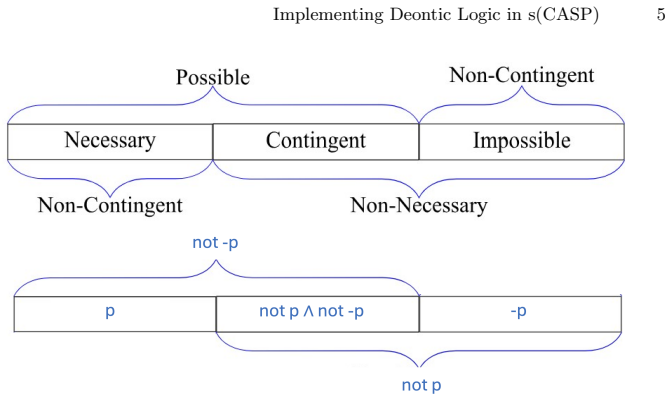

read the original abstract
We consider the problem of implementing deontic modal logic. We show how (deontic) modal operators can be elegantly and directly expressed using default negation (negation-as-failure) and strong negation present in answer set programming (ASP). We propose using global constraints of ASP to represent obligations, prohibitions, and permissions in deontic modal logic. We show that our proposed representation results in the various decades-old paradoxes of deontic modal logic being simply and elegantly resolved. Our method also serves as a means for modeling conditional obligations and conditional prohibitions in knowledge representation.
Editorial analysis
A structured set of objections, weighed in public.
Referee Report
Summary. The manuscript presents a method for modeling deontic modal logic within the s(CASP) goal-directed predicate answer set programming system. It demonstrates how deontic operators for obligation (O), permission (P), and prohibition can be represented using default negation (negation-as-failure), strong negation, and global constraints in ASP. The central claim is that this representation resolves various long-standing paradoxes in deontic logic, such as those identified by Ross and Chisholm, in a simple and elegant manner, while also enabling the modeling of conditional obligations and prohibitions.
Significance. Should the proposed encoding faithfully capture the semantics of standard deontic logic without introducing non-monotonic artifacts that alter the intended meanings, this work could offer a valuable bridge between modal logic and practical ASP-based reasoning systems. It has potential significance for applications in AI ethics, legal reasoning, and knowledge representation where deontic concepts are crucial. The goal-directed nature of s(CASP) may provide computational benefits for querying such models.
major comments (2)
- [Proposed Representation and Paradox Resolution] The central claim that paradoxes are resolved by the ASP encoding (via default/strong negation and global constraints) requires explicit demonstration that key deontic properties such as O(p) → ¬O(¬p) and consistency under conditional obligations are preserved rather than being side-effects of stable-model minimality or constraint failure. Without a semantic correspondence argument or counterexample check, it is unclear whether the approach solves the paradoxes internally to deontic logic or merely avoids them through ASP mechanisms.
- [Modeling Conditional Obligations] The modeling of conditional obligations is described at a high level but lacks detail on how global constraints interact with default negation in s(CASP) to prevent unintended propagation or loss of intended conditional semantics; this is load-bearing for the claim that the method supports conditional obligations without introducing new inconsistencies.
minor comments (2)
- [Notation and Encoding] Clarify the precise ASP syntax used for representing the modal operators (e.g., how 'not' and '-' are mapped to O, P, and ~O) with at least one fully worked example that includes both a query and the resulting answer set.
- [Introduction] Add citations to foundational deontic logic literature on the specific paradoxes addressed (Ross, Chisholm) and to prior work on ASP encodings of modal logics to situate the contribution.
Simulated Author's Rebuttal
We thank the referee for their constructive and detailed comments. We address each major comment below and indicate the revisions planned for the next version of the manuscript.
read point-by-point responses
-
Referee: [Proposed Representation and Paradox Resolution] The central claim that paradoxes are resolved by the ASP encoding (via default/strong negation and global constraints) requires explicit demonstration that key deontic properties such as O(p) → ¬O(¬p) and consistency under conditional obligations are preserved rather than being side-effects of stable-model minimality or constraint failure. Without a semantic correspondence argument or counterexample check, it is unclear whether the approach solves the paradoxes internally to deontic logic or merely avoids them through ASP mechanisms.
Authors: We agree that an explicit demonstration of the key properties would strengthen the central claim. In the revised manuscript we will add a dedicated subsection that shows O(p) → ¬O(¬p) is enforced directly by the global constraint encoding of obligation together with strong negation, and that models violating this property are eliminated. We will also supply counterexample checks for Ross’s and Chisholm’s paradoxes, demonstrating that the resolutions follow from the intended deontic mapping rather than being incidental consequences of stable-model minimality. A short semantic-correspondence argument relating the ASP stable models to the standard deontic semantics will be included. revision: yes
-
Referee: [Modeling Conditional Obligations] The modeling of conditional obligations is described at a high level but lacks detail on how global constraints interact with default negation in s(CASP) to prevent unintended propagation or loss of intended conditional semantics; this is load-bearing for the claim that the method supports conditional obligations without introducing new inconsistencies.
Authors: We accept that the current description of conditional obligations is too high-level. The revised version will expand this section with concrete s(CASP) program fragments and a step-by-step account of how the goal-directed solver evaluates a conditional obligation rule. We will illustrate that the global constraint is activated only when the antecedent is satisfied, that default negation prevents unintended propagation to unrelated literals, and that the resulting answer sets preserve the intended conditional semantics without introducing new inconsistencies. Additional query examples will be provided to make the interaction explicit. revision: yes
Circularity Check
No circularity: standard ASP semantics applied to deontic modeling without self-referential reductions or fitted predictions
full rationale
The paper presents an encoding of deontic operators (obligation, permission, prohibition) via default negation, strong negation, and global constraints in s(CASP). No equations, derivations, or parameter fits are shown that reduce the claimed resolution of paradoxes (Ross, Chisholm, etc.) to the inputs by construction. The central claim rests on applying established non-monotonic ASP semantics to a new domain rather than redefining terms or importing uniqueness via self-citation chains. Any prior author work on s(CASP) is not load-bearing for the deontic encoding itself, which is presented as a direct modeling choice. The approach is self-contained as a representational proposal and does not exhibit self-definitional, fitted-input, or ansatz-smuggling patterns.
Axiom & Free-Parameter Ledger
axioms (2)
- domain assumption Default negation and strong negation in answer set programming can directly express deontic modal operators.
- domain assumption Global constraints in ASP can represent obligations, prohibitions, and permissions.
Reference graph
Works this paper leans on
-
[1]
Theory and Practice of Logic Programming18(3-4), 337–354 (2018)
Arias, J., Carro, M., Salazar, E., Marple, K., Gupta, G.: Constraint answer set pro- gramming without grounding. Theory and Practice of Logic Programming18(3-4), 337–354 (2018)
work page 2018
-
[2]
Electronic Proceedings in Theoretical Com- puter Science 325, 59–72 (Sep 2020)
Arias, J., Carro, M., Chen, Z., Gupta, G.: Justifications for goal-directed con- straint answer set programming. Electronic Proceedings in Theoretical Com- puter Science 325, 59–72 (Sep 2020). https://doi.org/10.4204/eptcs.325.12, http: //dx.doi.org/10.4204/EPTCS.325.12
-
[3]
Cambridge University Press (2003)
Baral, C.: Knowledge representation, reasoning and declarative problem solving. Cambridge University Press (2003)
work page 2003
-
[4]
Brewka, G., Eiter, T., Truszczynski, M.: Answer set programming at a glance. Commun. ACM 54, 92–103 (12 2011). https://doi.org/10.1145/2043174.2043195
-
[5]
Cabalar, P.: personal communication (July, 2025)
work page 2025
-
[6]
In: Gaggl, S.A., Martinez, M.V., Ortiz, M
Cabalar, P., Ciabattoni, A., van der Torre, L.: Deontic equilibrium logic with ex- plicit negation. In: Gaggl, S.A., Martinez, M.V., Ortiz, M. (eds.) Logics in Artificial Intelligence - 18th European Conference, JELIA 2023, Dresden, Germany, Septem- ber 20-22, 2023, Proceedings. Lecture Notes in Computer Science, vol. 14281, pp. 498–514. Springer (2023)
work page 2023
-
[7]
Journal of Philosophy 74(12), 775–791 (1977)
Cataneda, H.N.: Ought, time, and the deontic paradoxes. Journal of Philosophy 74(12), 775–791 (1977)
work page 1977
-
[8]
Logique Et Analyse 25(n/a), 339 (1982)
Eck, J.V.: A system of temporally relative modal and deontic predicate logic and its philosophical applications. Logique Et Analyse 25(n/a), 339 (1982)
work page 1982
-
[9]
Cambridge University Press (2014)
Gelfond, M., Kahl, Y.: Knowledge representation, reasoning, and the design of intelligent agents: The answer-set programming approach. Cambridge University Press (2014)
work page 2014
-
[10]
Governatori, G.: An ASP implementation of defeasible deontic logic. K¨ unstliche Intell. 38(1), 79–88 (2024)
work page 2024
-
[11]
Grosof, B.: CODORD: Human-AI Communication for Deontic Reasoning Devops (2024), https://www.darpa.mil/research/programs/codord
work page 2024
- [12]
- [13]
-
[14]
Gupta, G., Salazar, E., Varanasi, S.C., Basu, K., Arias, J., Shakerin, F., Li, F., Wang, H.: Tutorial: Automating commonsense reasoning. In: Proc. ICLP 2022 Workshop on Goal-directed Execution of Answer Set Programs (GDE’22). CEUR Workshop Proceedings, vol. 3193. CEUR-WS.org (2022)
work page 2022
-
[15]
Deontic Logic: Introductory and Systematic Readings pp
Hansson, B.: An analysis of some deontic logics. Deontic Logic: Introductory and Systematic Readings pp. 121–147 (1971)
work page 1971
- [16]
- [17]
-
[18]
Handbook of Deontic Logic and Normative Systems pp
Hilpinen, R., McNamara, P.: Deontic logic: a historical survey and introduction. Handbook of Deontic Logic and Normative Systems pp. 3–136 (2013)
work page 2013
-
[19]
Horty, J.F.: Deontic logic as founded on nonmonotonic logic. Ann. Math. Artif. Intell. 9(1-2), 69–91 (1993)
work page 1993
-
[20]
Erkenntnis 7(1), 288–296 (1937) Implementing Deontic Logic in s(CASP) 23
Jørgensen, J.: Imperatives and logic. Erkenntnis 7(1), 288–296 (1937) Implementing Deontic Logic in s(CASP) 23
work page 1937
-
[21]
Kowalski, R.A.: Satisfiability for first-order logic as a non-modal deontic logic. In: Proceedings of the Workshop on Bridging the Gap between Human and Automated Reasoning - CogSci 2017. vol. 1994, pp. 84–90. CEUR-WS.org (2017)
work page 2017
-
[22]
Kowalski, R.A., Satoh, K.: Obligation as optimal goal satisfaction. J. Philos. Log. 47(4), 579–609 (2018)
work page 2018
-
[23]
New Studies on Deontic Logic and Computer Science
Makinson, D.: On a fundamental problem of deontic logic. New Studies on Deontic Logic and Computer Science. Norms, Logics and Information Systems pp. 29–54 (1999)
work page 1999
-
[24]
McNamara, P.: A Puzzle Surrounding Kant’s Law. In: Zalta, E.N., Nodelman, U. (eds.) The Stanford Encyclopedia of Philosophy. Metaphysics Research Lab, Stanford University, Fall 2010 edn. (2010)
work page 2010
-
[25]
McNamara, P.: A bit more on Chisolm’s Paradox. In: Zalta, E.N., Nodelman, U. (eds.) The Stanford Encyclopedia of Philosophy. Metaphysics Research Lab, Stanford University, Fall 2017 edn. (2017)
work page 2017
-
[26]
McNamara, P., Van De Putte, F.: Deontic Logic. In: Zalta, E.N., Nodelman, U. (eds.) The Stanford Encyclopedia of Philosophy. Metaphysics Research Lab, Stan- ford University, Fall 2022 edn. (2022)
work page 2022
-
[27]
McNamara, P., Van De Putte, F.: Supplement to Deontic Logic. In: Zalta, E.N., Nodelman, U. (eds.) The Stanford Encyclopedia of Philosophy. Metaphysics Re- search Lab, Stanford University, Fall 2022 edn. (2022)
work page 2022
-
[28]
Studia Logica 57(1), 91–115 (1996)
Prakken, H., Sergot, M.: Contrary-to-duty obligations. Studia Logica 57(1), 91–115 (1996)
work page 1996
-
[29]
Prakken, H., Sergot, M.: Dyadic deontic logic and contrary-to-duty obligations. In: Nute, D. (ed.) Defeasible Deontic Logic. pp. 223–262. Springer Netherlands, Dordrecht (1997)
work page 1997
-
[30]
Philosophia 47(4), 1247–1282 (2019)
Ronnedal, D.: Contrary-to-duty paradoxes and counterfactual deontic logic. Philosophia 47(4), 1247–1282 (2019)
work page 2019
-
[31]
In: Internat Encyclopedia of Philosophy
Ronnedal, D.: Contrary-to-duty paradox. In: Internat Encyclopedia of Philosophy. https://iep.utm.edu/contrary-to-duty-paradox/ (2024)
work page 2024
-
[32]
Journal of Applied Logic 9(1), 61–80 (2011)
Strasser, C.: A deontic logic framework allowing for factual detachment. Journal of Applied Logic 9(1), 61–80 (2011)
work page 2011
-
[33]
New Studies in Deontic Logic pp
Thomason, R.H.: Deontic logic as founded on tense logic. New Studies in Deontic Logic pp. 165–176 (1981)
work page 1981
-
[34]
˚Aqvist, L.: Good samaritans, contrary-to-duty imperatives, and epistemic obliga- tions. Noˆ us1(4), 361–379 (1967) A Partial models and justifications tree As we already mentioned s(CASP) evaluation provides partial models (including only the literals needed to support the query) and a justification tree that can be translated in a human readable explana...
work page 1967
discussion (0)
Sign in with ORCID, Apple, or X to comment. Anyone can read and Pith papers without signing in.