REVIEW 4 major objections 5 minor 47 references
GSVR: 2D Gaussian-based Video Representation for 800+ FPS with Hybrid Deformation Field
T0 review · 4 major / 5 minor · reviewed 2026-08-06 · deepseek-v4-flash
Pith's one-line read The paper claims a 2D Gaussian-based video representation that decodes at 800+ FPS on Bunny and reaches 35+ PSNR in about 2 seconds of training per frame.
desk verdict A credible, fast-decoding video representation with clear design choices, but the training-time claim omits optical-flow preprocessing and the adaptive GOP threshold is undisclosed, so it needs transparency fixes before publication. read the letter →
The pith
A machine-rendered reading of the paper's core claim, the machinery that carries it, and where it could break.
The reading
What carries the argument
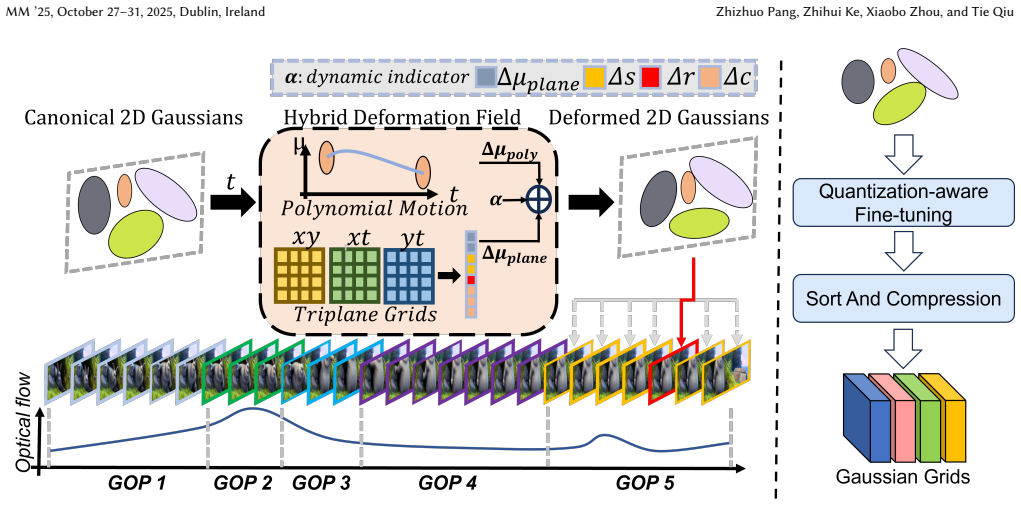
The load-bearing object is the canonical 2D Gaussian, an ellipse with position, scale, rotation, and color, rasterized by weighted blending in screen space. Around it sits the hybrid deformation field, which is fully explicit: tri-plane grids return attribute offsets by bilinear interpolation of $(x,y)$, $(x,t)$, and $(y,t)$ planes, and a learnable quadratic polynomial returns a position offset for fast motion; a per-Gaussian dynamic indicator $\alpha$ fuses the two. Because there is no MLP anywhere in the deformation path, decoding reduces to grid lookups, polynomial evaluation, and Gaussian blending. The dynamic-aware time slicing strategy supplies the video-level structure, using the mean absolute optical flow per frame to accumulate a motion score and cut GOP boundaries when it crosses a threshold.
What would settle it
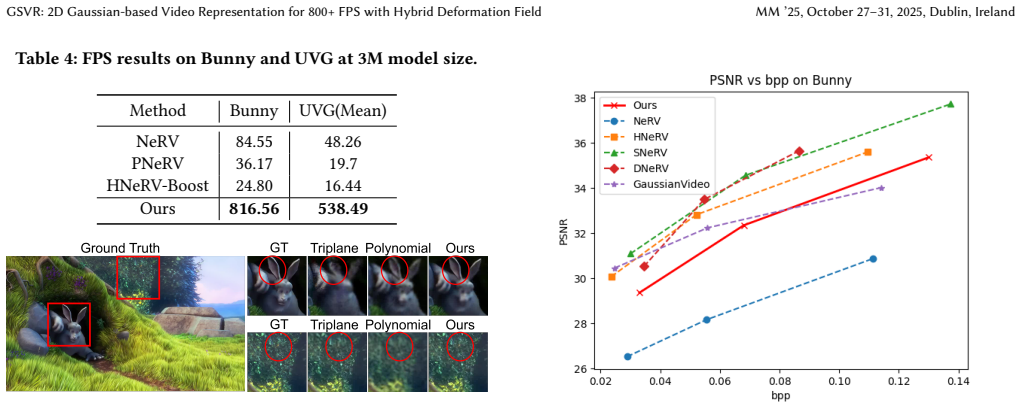
Run the full encoding pipeline on Bunny with a timer that includes RAFT optical-flow computation and the adaptive GOP segmentation, and compare total encode time against the reported 2 seconds per frame; also check whether 816.56 FPS still holds when tri-plane bilinear interpolation and Gaussian rasterization are included in the timed forward pass.
Extended reading notes
Core claim
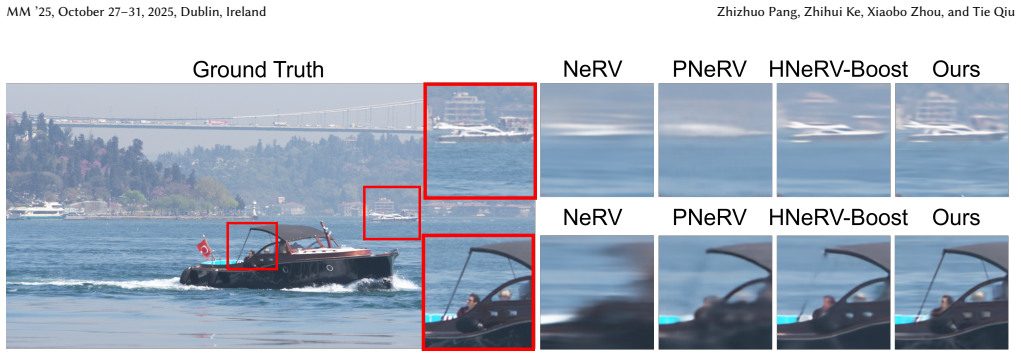
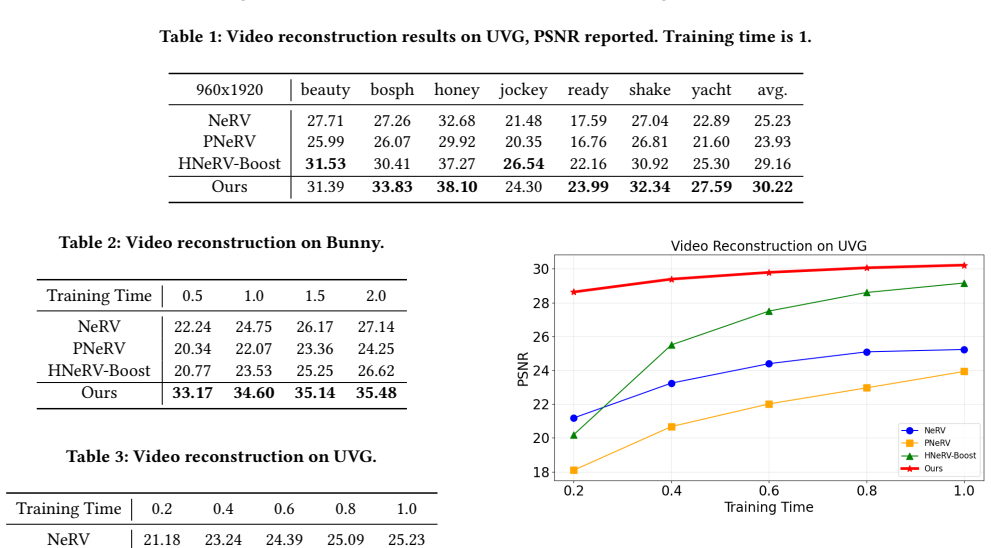
On its own terms, the paper's discovery is that 2D Gaussian splatting, previously used for images, can serve as the backbone of a video representation that is simultaneously fast to train and fast to decode. Each frame is produced by rasterizing a canonical set of 2D Gaussians deformed through time by a hybrid deformation field: tri-plane grids capture camera motion and slowly changing regions, a quadratic polynomial term captures high-dynamic objects, and a learnable dynamic indicator per Gaussian blends the two. Removing the MLP decoder that most deformation fields use keeps inference cheap, and dividing the video into adaptive GOPs based on optical-flow magnitude prevents long sequences from degrading. The reported numbers on Bunny are 816.56 FPS decoding and 35.48 PSNR at 2.0 training seconds per frame, versus 84.55 FPS for NeRV; on UVG the method averages 538.49 FPS and 30.22 PSNR.
Load-bearing premise
The reported 2-second-per-frame training time appears to exclude the cost of computing RAFT optical flow used by the dynamic-aware time slicing, and the optical-flow threshold that sets GOP boundaries is never reported.
Editorial extensions
If this is right
- Decoding exceeds 60 FPS at 1080p-class resolutions on the tested GPU, so real-time playback with random frame access is feasible for neural video representations.
- Training time near 2 seconds per frame makes the representation practical for episodic or streaming content rather than offline-only processing.
- The same canonical Gaussians plus explicit deformation support video interpolation with temporal continuity, since motion is modeled rather than baked into frame embeddings.
- Quantization plus image-codec compression yields compact bitrates, making the representation a candidate for neural codecs that reuse standard still-image encoders.
- Because the representation separates dynamic and static elements, downstream editing tasks could target the moving object by adjusting its polynomial coefficients and dynamic indicator.
Reading between the lines
- The reported 2-second-per-frame training time likely omits the cost of computing RAFT optical flow for dynamic-aware time slicing, since the paper never mentions its runtime; the true end-to-end encoding cost is probably higher.
- The optical-flow threshold that decides GOP boundaries is never reported, so the adaptive slicing cannot be reproduced exactly from the text; reporting it would make the strategy deterministic and comparable.
- One testable extension is to replace the quadratic polynomial with higher-order or piecewise motion for sequences with repeated fast motion, and to check whether the dynamic indicator still cleanly separates foreground from background.
- The hybrid deformation idea transfers naturally to dynamic-scene representations that currently rely on MLP deformation fields, potentially giving them the same decoding-speed boost.
Editorial analysis
A structured set of objections, weighed in public.
Referee Report
Summary. The paper proposes GSVR, a 2D-Gaussian-based video representation with a hybrid deformation field combining tri-plane grids and polynomial motion, a dynamic-aware time-slicing strategy based on optical flow to segment the video into GOPs, and a compression pipeline using quantization-aware fine-tuning and image codecs. The central claims are that GSVR achieves 800+ FPS decoding, 35+ PSNR on Bunny, and roughly 2 seconds per frame training time, with faster convergence than NeRV-style baselines. Experiments on Bunny and UVG report PSNR, FPS, interpolation, and compression results against NeRV, PNeRV, and HNeRV-Boost, plus an ablation of GOP length. The method is clearly described and the reported internal measurements are plausible, but the training-time accounting omits the RAFT optical-flow preprocessing required by the time-slicing strategy, and several reproducibility-critical details (GOP threshold, parameter accounting across GOPs, interpolation protocol) are missing.
Significance. If the training-time and FPS claims hold after a full accounting of preprocessing and model-structure costs, GSVR would be a substantial advance over convolution-based neural video representations: it removes the MLP/convolution decoder bottleneck, reaches two orders of magnitude higher decode throughput, and converges to high PSNR far earlier than NeRV-style baselines. The paper also contributes a hybrid motion model that explicitly separates camera-like and object-like motion through a per-Gaussian dynamic indicator, and a compression scheme with quantization-aware fine-tuning. The strengths are the clarity of the core representation, the direct FPS measurements on two datasets, and the inclusion of a GOP-length ablation. However, the headline '2 seconds per frame' and the faster-convergence comparison are not yet fully supported because the RAFT preprocessing cost and the number/parameters of GOPs are not reported; the comparison also omits the closest concurrent 2D-Gaussian video methods. These are fixable with additional reporting and targeted experiments, not fundamental flaws in the representation.
major comments (4)
- [§3.3, §4.1.2, §4.1.3, Tables 2–3] The headline training-time comparison is not end-to-end. Section 3.3 requires a pre-trained RAFT optical-flow forward pass per frame to compute the motion magnitude D, but Section 4.1.3 reports no RAFT details and Section 4.1.2 defines training time as total training seconds divided by total frame numbers without mentioning preprocessing. The adaptive GOP threshold is also never reported. Because Tables 2 and 3 plot PSNR against this training-time axis, the claimed '2 seconds per frame' and the faster-convergence comparison are currently under-specified. Please report the end-to-end encoding time including RAFT and per-GOP re-initialization, or explicitly state that preprocessing is excluded and quantify its cost, and give the threshold and resulting GOP boundaries for each sequence.
- [§3.3, §4.1.2, Table 7] The parameter accounting across GOPs is unclear. Section 3.3 states that each GOP is represented by independent 2D Gaussians and a deformation field, while Section 4.1.2 says all models are 3M parameters. If each GOP is independent, the total parameter count would scale with the number of GOPs unless the budget is shared; if the 3M budget is shared, the per-GOP model size varies and must be specified. This ambiguity affects the training-time comparison in Tables 2–3 and the bits-per-pixel compression numbers in Table 7, both of which are load-bearing for the paper's central claims.
- [§4.5.1, Table 5] The interpolation protocol is not reproducible as written. The paper uses odd frames for training and even frames for testing, but Section 3.3's GOP segmentation is based on optical flow computed on the video; the text does not state whether flow was computed on the full video, whether GOP boundaries were aligned with the train/test split, or how many frames fell in each set. In addition, the note that HNeRV-Boost requires test frames to form frame embeddings conflicts with the test-set PSNR reported in Table 5. Please specify the exact protocol for both methods and, if test frames were used for HNeRV-Boost, state this explicitly and discuss the implication for the comparison.
- [§2.2, §4.2–4.3, Tables 1–4] The main FPS and quality tables omit the closest concurrent methods. Section 2.2 names D2GV and GaussianVideo as deformable 2D-Gaussian video representations, and D2GV is reported to reach 400 FPS; nevertheless, Tables 1–4 compare only NeRV, PNeRV, and HNeRV-Boost. The abstract's 10x decoding-speed claim and the method's positioning therefore need at least a quantitative comparison or a clear explanation of why D2GV/GaussianVideo cannot be compared. At minimum, include their published FPS, PSNR, and training-time numbers in the discussion.
minor comments (5)
- [§3.2, Eq. (4)] The notation in Eq. (4) uses a product over three plane interpolations, but the text later describes a fusion and Eq. (10) uses a weighted sum; please clarify whether the plane features are multiplied, summed, or concatenated before producing the attribute offsets.
- [§3.2, Eq. (10)] The per-Gaussian dynamic indicator alpha is said to be learnable, but its range and initialization are not stated; if it is meant to be a convex combination weight, please constrain or regularize alpha to [0,1] and describe the initialization.
- [§4.4.2, Table 6] The 'Adaptive' row in Table 6 reports the best mean PSNR, but the paper does not give the adaptive threshold or the resulting GOP lengths for any UVG sequence; please report these values so the adaptive slicing can be reproduced.
- [§3.4, Table 7] Table 7 does not specify which image codec (PNG or JPEG-XL) and settings were used, nor whether the reported bits per pixel include both the Gaussian attribute grids and the tri-plane grids; please clarify, and add an ablation comparing quantization-aware fine-tuning with post-hoc quantization.
- [Throughout] There are several typographical errors and inconsistent hyphenations, including 'utlize' in §3.3, 'polymonical' in Figure 3, and 'indictor' in §3.2; a careful proofreading pass is needed.
Circularity Check
No significant circularity: the paper's decoding-speed, reconstruction, interpolation, and compression claims are evaluated against ground-truth or held-out frames, and no fitted quantity is relabeled as a prediction.
full rationale
GSVR's central claims are empirically benchmarked against external ground truth (Bunny and UVG frames) and a held-out interpolation split (odd/even frames), so the results are not equivalent to the model's training inputs by construction. The decoding-speed measurement is a direct inference-time count over forward passes, and the training-time comparison, while possibly omitting RAFT optical-flow preprocessing, is a completeness/cost-accounting concern rather than a circularity: the reported PSNR values are not derived from the same fitted quantities used to define the method. The dynamic-aware time-slicing threshold is an adaptive hyperparameter tuned on the dataset, which is standard practice and does not force the reconstruction or interpolation outcomes. The only self-citation, DS-NeRV [33], appears in related work and baseline selection, not as a load-bearing justification for GSVR's design or results; no uniqueness theorem from the authors is invoked to forbid alternatives. The hybrid deformation field combines tri-plane grids and polynomial motion through a learnable dynamic indicator, and the ablation studies compare these components against each other, but the final evaluation is against external frames. Thus there is no step where a prediction reduces by definition or by self-citation to the paper's own inputs.
Assumptions & free parameters
free parameters (5)
- GOP segmentation threshold
- Polynomial degree n =
2
- Tri-plane resolutions =
xy 32x16, time T/2, C=8
- Quantization bit widths =
16-bit position/color, 8-bit other attributes
- Number of Gaussians =
implied by 3M total parameters
assumptions (4)
- domain assumption Average absolute RAFT optical flow is a reliable proxy for motion intensity
- domain assumption Adjacent 2D Gaussians share spatio-temporal information, so tri-plane bilinear interpolation is a sufficient smooth-motion model
- domain assumption A degree-2 polynomial can represent the motion of high-dynamic objects
- standard math Gaussian blending with L2 loss is a valid image formation model
Cite this review
Pith. "Pith review of GSVR: 2D Gaussian-based Video Representation for 800+ FPS with Hybrid Deformation Field." pith.science (2026). https://pith.science/paper/Z3GU426H
@misc{pith2026250705594,
  author       = {Pith},
  title        = {Pith review of: GSVR: 2D Gaussian-based Video Representation for 800+ FPS with Hybrid Deformation Field},
  year         = {2026},
  howpublished = {\url{https://pith.science/paper/Z3GU426H}},
  note         = {Machine review of arXiv:2507.05594}
}
abstract
Implicit neural representations for video have been recognized as a novel and promising form of video representation. Existing works pay more attention to improving video reconstruction quality but little attention to the decoding speed. However, the high computation of convolutional network used in existing methods leads to low decoding speed. Moreover, these convolution-based video representation methods also suffer from long training time, about 14 seconds per frame to achieve 35+ PSNR on Bunny. To solve the above problems, we propose GSVR, a novel 2D Gaussian-based video representation, which achieves 800+ FPS and 35+ PSNR on Bunny, only needing a training time of $2$ seconds per frame. Specifically, we propose a hybrid deformation field to model the dynamics of the video, which combines two motion patterns, namely the tri-plane motion and the polynomial motion, to deal with the coupling of camera motion and object motion in the video. Furthermore, we propose a Dynamic-aware Time Slicing strategy to adaptively divide the video into multiple groups of pictures(GOP) based on the dynamic level of the video in order to handle large camera motion and non-rigid movements. Finally, we propose quantization-aware fine-tuning to avoid performance reduction after quantization and utilize image codecs to compress Gaussians to achieve a compact representation. Experiments on the Bunny and UVG datasets confirm that our method converges much faster than existing methods and also has 10x faster decoding speed compared to other methods. Our method has comparable performance in the video interpolation task to SOTA and attains better video compression performance than NeRV.
Figures


Figures from the paper (4 more)

Reference graph
Works this paper leans on
-
[1]
Yunpeng Bai, Chao Dong, Cairong Wang, and Chun Yuan. 2023. Ps-nerv: Patch- wise stylized neural representations for videos. In 2023 IEEE International Confer- ence on Image Processing (ICIP) . IEEE, 41–45
work page 2023
-
[2]
Andrew Bond, Jui-Hsien Wang, Long Mai, Erkut Erdem, and Aykut Erdem. 2025. GaussianVideo: Efficient Video Representation via Hierarchical Gaussian Splat- ting. arXiv preprint arXiv:2501.04782 (2025)
arXiv 2025
-
[3]
Hao Chen, Matthew Gwilliam, Ser-Nam Lim, and Abhinav Shrivastava. 2023. HNeRV: Neural Representations for Videos. In CVPR
work page 2023
-
[4]
Hao Chen, Bo He, Hanyu Wang, Yixuan Ren, Ser-Nam Lim, and Abhinav Shri- vastava. 2021. NeRV: Neural Representations for Videos. In NeurIPS
work page 2021
-
[5]
Yuanxing Duan, Fangyin Wei, Qiyu Dai, Yuhang He, Wenzheng Chen, and Bao- quan Chen. 2024. 4d-rotor gaussian splatting: towards efficient novel view synthesis for dynamic scenes. In ACM SIGGRAPH 2024 Conference Papers . 1–11
work page 2024
-
[6]
Bo He, Xitong Yang, Hanyu Wang, Zuxuan Wu, Hao Chen, Shuaiyi Huang, Yixuan Ren, Ser-Nam Lim, and Abhinav Shrivastava. 2023. Towards scalable GSVR: 2D Gaussian-based Video Representation for 800+ FPS with Hybrid Deformation Field MM ’25, October 27–31, 2025, Dublin, Ireland neural representation for diverse videos. InProceedings of the IEEE/CVF Conference ...
work page 2023
-
[7]
Yi-Hua Huang, Yang-Tian Sun, Ziyi Yang, Xiaoyang Lyu, Yan-Pei Cao, and Xiao- juan Qi. 2024. Sc-gs: Sparse-controlled gaussian splatting for editable dynamic scenes. In Proceedings of the IEEE/CVF conference on computer vision and pattern recognition. 4220–4230
work page 2024
-
[8]
Bernhard Kerbl, Georgios Kopanas, Thomas Leimkühler, and George Drettakis
Show all 47 references
-
[9]
Jina Kim, Jihoo Lee, and Je-Won Kang. 2024. Snerv: Spectra-preserving neural representation for video. In European Conference on Computer Vision . Springer, 332–348
2024
-
[10]
Ho Man Kwan, Ge Gao, Fan Zhang, Andrew Gower, and David Bull. 2023. Hin- erv: Video compression with hierarchical encoding-based neural representation. Advances in Neural Information Processing Systems 36 (2023), 72692–72704
2023
-
[11]
Inseo Lee, Youngyoon Choi, and Joonseok Lee. 2025. GaussianVideo: Efficient Video Representation and Compression by Gaussian Splatting. arXiv preprint arXiv:2503.04333 (2025)
2025 arXiv
-
[12]
Joo Chan Lee, Daniel Rho, Jong Hwan Ko, and Eunbyung Park. 2023. Ffnerv: Flow-guided frame-wise neural representations for videos. In Proceedings of the 31st ACM International Conference on Multimedia . 7859–7870
2023
-
[13]
Zhan Li, Zhang Chen, Zhong Li, and Yi Xu. 2024. Spacetime gaussian feature splatting for real-time dynamic view synthesis. In Proceedings of the IEEE/CVF Conference on Computer Vision and Pattern Recognition . 8508–8520
2024
-
[14]
Zizhang Li, Mengmeng Wang, Huaijin Pi, Kechun Xu, Jianbiao Mei, and Yong Liu
-
[15]
Yiqing Liang, Numair Khan, Zhengqin Li, Thu Nguyen-Phuoc, Douglas Lanman, James Tompkin, and Lei Xiao. 2023. Gaufre: Gaussian deformation fields for real-time dynamic novel view synthesis. arXiv preprint arXiv:2312.11458 (2023)
2023 arXiv
-
[16]
Mufan Liu, Qi Yang, Miaoran Zhao, He Huang, Le Yang, Zhu Li, and Yiling Xu
-
[17]
Alexandre Mercat, Marko Viitanen, and Jarno Vanne. 2020. UVG dataset: 50/120fps 4K sequences for video codec analysis and development. InProceedings of the 11th ACM Multimedia Systems Conference . 297–302
2020
-
[18]
Srinivasan, Matthew Tancik, Jonathan T
Ben Mildenhall, Pratul P. Srinivasan, Matthew Tancik, Jonathan T. Barron, Ravi Ramamoorthi, and Ren Ng. 2020. NeRF: Representing Scenes as Neural Radiance Fields for View Synthesis. In ECCV
2020
-
[19]
Wieland Morgenstern, Florian Barthel, Anna Hilsmann, and Peter Eisert. 2025. Compact 3D Scene Representation via Self-Organizing Gaussian Grids. In Com- puter Vision – ECCV 2024 . Springer Nature Switzerland, Cham, 18–34. https: //doi.org/10.1007/978-3-031-73013-9_2
2025 doi
-
[20]
Albert Pumarola, Enric Corona, Gerard Pons-Moll, and Francesc Moreno-Noguer
-
[21]
Ton Roosendaal. 2008. Big buck bunny. In ACM SIGGRAPH ASIA 2008 computer animation festival. 62–62
2008
-
[22]
Jens Eirik Saethre, Roberto Azevedo, and Christopher Schroers. 2024. Combining Frame and GOP Embeddings for Neural Video Representation. In Proceedings of the IEEE/CVF Conference on Computer Vision and Pattern Recognition . 9253–9263
2024
-
[23]
Richard Shaw, Michal Nazarczuk, Jifei Song, Arthur Moreau, Sibi Catley-Chandar, Helisa Dhamo, and Eduardo Pérez-Pellitero. 2025. Swings: sliding windows for dynamic 3D gaussian splatting. In European Conference on Computer Vision . Springer, 37–54
2025
-
[24]
Vincent Sitzmann, Julien Martel, Alexander Bergman, David Lindell, and Gordon Wetzstein. 2020. Implicit neural representations with periodic activation func- tions. Advances in neural information processing systems 33 (2020), 7462–7473
2020
-
[25]
Jiakai Sun, Han Jiao, Guangyuan Li, Zhanjie Zhang, Lei Zhao, and Wei Xing
-
[26]
Yang-Tian Sun, Yi-Hua Huang, Lin Ma, Xiaoyang Lyu, Yan-Pei Cao, and Xiaojuan Qi. 2024. Splatter a Video: Video Gaussian Representation for Versatile Processing. arXiv preprint arXiv:2406.13870 (2024)
2024 arXiv
-
[27]
Zachary Teed and Jia Deng. 2020. RAFT: Recurrent All-Pairs Field Transforms for Optical Flow. Springer Science and Business Media Deutschland GmbH (2020)
2020
-
[28]
Joanna Waczyńska, Tomasz Szczepanik, Piotr Borycki, Sławomir Tadeja, Thomas Bohné, and Przemysław Spurek. 2024. MiraGe: Editable 2D Images using Gaussian Splatting. (2024). arXiv:2410.01521 [cs.CV]
2024 arXiv
-
[29]
Diwen Wan, Ruijie Lu, and Gang Zeng. 2024. Superpoint gaussian splat- ting for real-time high-fidelity dynamic scene reconstruction. arXiv preprint arXiv:2406.03697 (2024)
2024 arXiv
-
[30]
Chang Wu, Guancheng Quan, Gang He, Xin-Quan Lai, Yunsong Li, Wenxin Yu, Xianmeng Lin, and Cheng Yang. 2024. QS-NeRV: Real-Time Quality-Scalable Decoding with Neural Representation for Videos. In Proceedings of the 32nd ACM International Conference on Multimedia . 2584–2592
2024
-
[31]
Guanjun Wu, Taoran Yi, Jiemin Fang, Lingxi Xie, Xiaopeng Zhang, Wei Wei, Wenyu Liu, Qi Tian, and Xinggang Wang. 2024. 4d gaussian splatting for real-time dynamic scene rendering. In Proceedings of the IEEE/CVF Conference on Computer Vision and Pattern Recognition . 20310–20320
2024
-
[32]
Yunjie Xu, Xiang Feng, Feiwei Qin, Ruiquan Ge, Yong Peng, and Changmiao Wang. 2024. Vq-nerv: A vector quantized neural representation for videos. arXiv preprint arXiv:2403.12401 (2024)
2024 arXiv
-
[33]
Hao Yan, Zhihui Ke, Xiaobo Zhou, Tie Qiu, Xidong Shi, and Dadong Jiang. 2024. DS-NeRV: Implicit Neural Video Representation with Decomposed Static and Dynamic Codes. In Proceedings of the IEEE/CVF Conference on Computer Vision and Pattern Recognition. 23019–23029
2024
-
[34]
Ziyi Yang, Xinyu Gao, Wen Zhou, Shaohui Jiao, Yuqing Zhang, and Xiaogang Jin. 2024. Deformable 3d gaussians for high-fidelity monocular dynamic scene reconstruction. In Proceedings of the IEEE/CVF Conference on Computer Vision and Pattern Recognition. 20331–20341
2024
-
[35]
Zeyu Yang, Hongye Yang, Zijie Pan, and Li Zhang. 2024. Real-time Photorealistic Dynamic Scene Representation and Rendering with 4D Gaussian Splatting. In International Conference on Learning Representations (ICLR)
2024
-
[36]
Vickie Ye, Ruilong Li, Justin Kerr, Matias Turkulainen, Brent Yi, Zhuoyang Pan, Otto Seiskari, Jianbo Ye, Jeffrey Hu, Matthew Tancik, and Angjoo Kanazawa
-
[37]
Xinjie Zhang, Xingtong Ge, Tongda Xu, Dailan He, Yan Wang, Hongwei Qin, Guo Lu, Jing Geng, and Jun Zhang. 2024. GaussianImage: 1000 FPS Image Repre- sentation and Compression by 2D Gaussian Splatting. In European Conference on Computer Vision
2024
-
[38]
Xinjie Zhang, Ren Yang, Dailan He, Xingtong Ge, Tongda Xu, Yan Wang, Hongwei Qin, and Jun Zhang. 2024. Boosting Neural Representations for Videos with a Conditional Decoder. In The IEEE/CVF Conference on Computer Vision and Pattern Recognition
2024
-
[39]
Yunxiang Zhang, Alexandr Kuznetsov, Akshay Jindal, Kenneth Chen, Anton Sochenov, Anton Kaplanyan, and Qi Sun. 2024. Image-GS: Content-Adaptive Image Representation via 2D Gaussians. arXiv preprint arXiv:2407.01866 (2024)
2024 arXiv
-
[40]
Qi Zhao, M Salman Asif, and Zhan Ma. 2023. Dnerv: Modeling inherent dynamics via difference neural representation for videos. In Proceedings of the IEEE/CVF Conference on Computer Vision and Pattern Recognition . 2031–2040
2023
-
[41]
Qi Zhao, M Salman Asif, and Zhan Ma. 2024. PNeRV: Enhancing Spatial Con- sistency via Pyramidal Neural Representation for Videos. In Proceedings of the IEEE/CVF Conference on Computer Vision and Pattern Recognition . 19103–19112
2024
-
[42]
arXiv preprint arXiv:2409.06765 (2024)
gsplat: An Open-Source Library for Gaussian Splatting. arXiv preprint arXiv:2409.06765 (2024). arXiv:2409.06765 [cs.CV] https://arxiv.org/abs/2409. 06765
2024 arXiv
-
[2021]
In Proceedings of the IEEE/CVF Conference on Computer Vision and Pattern Recognition
D-nerf: Neural radiance fields for dynamic scenes. In Proceedings of the IEEE/CVF Conference on Computer Vision and Pattern Recognition . 10318–10327
-
[2022]
In European Conference on Computer Vision
E-nerv: Expedite neural video representation with disentangled spatial- temporal context. In European Conference on Computer Vision. Springer, 267–284
-
[2023]
ACM Trans
3d gaussian splatting for real-time radiance field rendering. ACM Trans. Graph. 42, 4 (2023), 139–1
2023
-
[2024]
In Proceedings of the IEEE/CVF Conference on Computer Vision and Pattern Recognition
3dgstream: On-the-fly training of 3d gaussians for efficient streaming of photo-realistic free-viewpoint videos. In Proceedings of the IEEE/CVF Conference on Computer Vision and Pattern Recognition . 20675–20685
-
[2025]
arXiv preprint arXiv:2503.05600 (2025)
D2GV: Deformable 2D Gaussian Splatting for Video Representation in 400FPS. arXiv preprint arXiv:2503.05600 (2025)
2025
Reviewed August 6, 2026 · model on record in the stance chip above.
Discussion (0). Sign in to comment.