REVIEW 4 major objections 6 minor 53 references
Dynamic Rank Adaptation for Vision-Language Models
T0 review · 4 major / 6 minor · reviewed 2026-08-06 · deepseek-v4-flash
Pith's one-line read Dynamic Rank Adaptation claims that fine-tuning CLIP-like vision-language models with adapter capacity allocated by token importance improves accuracy on unseen new classes while keeping base-class accuracy nearly intact.
desk verdict A plausible adapter variant with a genuinely new training-time mechanism, but the dynamic-rank story does not survive contact with the inference-time equations, and the sorting is non-differentiable as written. read the letter →
The pith
A machine-rendered reading of the paper's core claim, the machinery that carries it, and where it could break.
The reading
What carries the argument
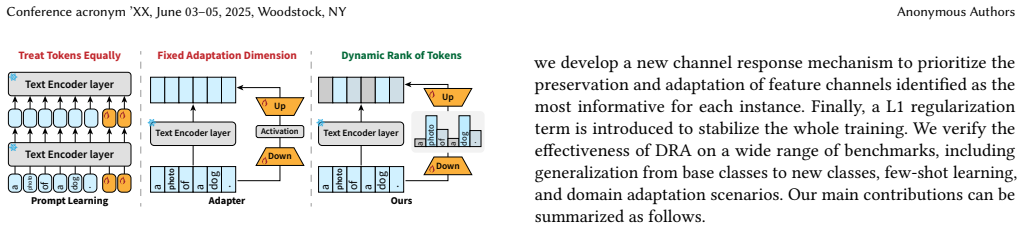
The load-bearing object is the token-level rank mask $\mathbf{M}'$. Token importance scores $a_t$ are computed as averaged self-attention over the low-rank adapter projection; tokens are sorted and split into $K=4$ groups with rank ratios $[1.0, 0.8, 0.6, 0.4]$. Each group keeps the top $\lfloor e_i \times r \rfloor$ channels according to a channel response score $a_c$, the per-channel variance of the projected low-rank features. The mask is applied after sorting tokens and then restored, so each sample receives its own rank allocation while the final projection path remains a standard adapter at inference.
What would settle it
Measure new-class accuracy after replacing the learned token importance scores with random scores drawn from the same Gumbel distribution while keeping the identical rank budget; if random grouping matches DRA's new-class gain over the fixed-rank baseline, the importance mechanism is not the source of the improvement.
Extended reading notes
Core claim
The central claim is that the fixed-rank bottleneck shared by all tokens limits new-class generalization, and replacing it with adaptive per-token rank allocation removes that limitation. DRA computes token importance scores from a low-rank self-attention map, sorts tokens into four groups, and assigns rank ratios [1.0, 0.8, 0.6, 0.4] so important tokens keep full capacity while unimportant tokens are compressed. A channel response mechanism keeps the most active channels of each sample when compressing, and an L1 loss pulls training output toward inference output to stabilize training. The paper reports that DRA outperforms prior methods on new-class accuracy in 7/11 datasets, on harmonic mean in 8/11 datasets, and also tops cross-dataset and domain generalization averages.
Load-bearing premise
The method assumes the self-attention scores computed inside the adapter rank tokens by true semantic importance, so the most informative tokens are the ones kept at full rank; the paper shows only a qualitative visualization, not a quantitative check.
Editorial extensions
If this is right
- On base-to-new generalization over 11 datasets, DRA improves average new-class accuracy to 77.75 and harmonic mean to 80.32, with base accuracy 83.06 nearly unchanged from the MMA baseline.
- DRA improves new-class accuracy on 7/11 datasets and harmonic mean on 8/11 datasets compared with the best prior method.
- Channel response and L1 regularization each add measurable gains: removing either lowers the harmonic mean relative to the full DRA configuration.
- Cross-dataset average accuracy (66.71) and domain generalization average accuracy (60.64) are the highest reported among the compared methods.
- At inference, dynamic allocation is unwound: features pass through the same linear projections as a normal adapter, so DRA adds no inference-time token selection step.
Reading between the lines
- If the importance scores are genuinely semantic, the same dynamic-rank principle should transfer beyond classification: any transformer adapter could allocate capacity by token importance for detection, segmentation, or retrieval tasks that the paper does not test.
- The paper's own ablations leave open the possibility that part of the gain is a regularization effect of masking; comparing DRA against random token masks with the same rank budget would separate those explanations.
- The token importance scores could be reused as free saliency maps; evaluating them against foreground annotations would both test the core mechanism and produce a side product.
- Because DRA converges in five epochs, the same capacity-allocation idea may reduce fine-tuning compute for larger vision-language models, though the paper only reports results on CLIP ViT-B/16.
Editorial analysis
A structured set of objections, weighed in public.
Referee Report
Summary. The paper proposes Dynamic Rank Adaptation (DRA), an adapter-based method for few-shot fine-tuning of CLIP on base-to-new class generalization. DRA computes per-token importance scores in a low-rank space (Eq. 10), sorts tokens into K groups (Eq. 11), and assigns each group a different effective rank by masking channels in a group-dependent manner (Eqs. 14-16). A channel-variance criterion (Eq. 12) is used to retain the most informative channels, and an L1 loss (Eq. 19) aligns the training-time dynamic output with a fixed-rank inference-time path. The authors report average base/new/HM accuracies of 83.06/77.75/80.32 across 11 base-to-new datasets, claiming SOTA new-class and harmonic-mean performance, together with cross-dataset and domain-generalization results.
Significance. If the mechanistic claim were established, DRA would be a valuable contribution: token-conditional rank allocation is a plausible way to avoid overfitting to background or template tokens during CLIP adaptation, and the new-class evaluation is a genuine held-out test rather than a fit to the evaluation classes. The paper provides broad benchmark coverage (11 datasets for base-to-new, 10 for cross-dataset, 4 for domain generalization) and reports efficiency comparisons. However, the significance is currently limited because the central mechanism described in Sections 3.2.1-3.2.3 is not supported as written: the importance projections are not trainable under the stated equations, the dynamic path is absent at inference, and the ablations do not isolate the proposed components from the added linear layer and the regularization loss.
major comments (4)
- [§3.2.1 (Eqs. 11 and 13) and §3.2.3 (Eq. 15)] The sorting and masking operations are non-differentiable with respect to the 'learnable' importance projections W_t and W_c. Equation (11) applies arg sort to a_t + g, and Eq. (13) does the same for a_c + g; hard arg-sort has zero derivative almost everywhere, and the binary mask M in Eq. (15) has no gradient channel back to the scores. Adding Gumbel noise does not make the sorting process differentiable; a straight-through estimator or a soft-sort relaxation would be required but is never stated. Consequently, W_t and W_c cannot be trained by the given loss, and the reported token grouping is determined by the random initialization of W_t rather than by learned importance. The authors should either specify a concrete gradient estimator or compare against a variant with frozen/random W_t and W_c to demonstrate that learned grouping contributes to the results.
- [§3.2.3 (Eq. 18) and §3.3 (Eq. 19)] The deployed model at inference is a fixed-rank adapter with an extra linear layer W_p; it contains no sorting, no group masks, and no importance grouping. The paper states that DRA is enabled only during training, and Eq. (19) explicitly penalizes the training-time dynamic output for deviating from this static inference output (with λ_T = λ_V = 1 in the experiments). Therefore, the headline gains in Table 1 cannot be attributed to dynamic rank allocation at inference time; they may instead come from the added projection W_p or from stochastic masking acting as a training regularizer. The authors should ablate W_p alone and also compare against a variant that uses static or random masks during training to separate these effects.
- [§4.3.1, Table 4] The component ablation does not isolate the proposed components. 'Baseline' is not defined in the experimental settings, and the DRA-T&V rows all include W_p as part of the DRA module. Removing CR and L1 leaves a variant that differs from Baseline by both token-group masking and the extra linear layer W_p, so the observed +0.33 HM over Baseline (and the full +0.91 HM) could be entirely due to W_p. The authors should ablate W_p alone and compare DRA against random token/channel masks to establish that the learned importance scores, rather than the extra capacity or the regularization, drive the reported improvement.
- [§4.1.2, §4.3.2-4.3.4, Table 5, Figure 3] The hyperparameters K, the rank ratios e_i, the intermediate dimension r, and the starting layer h were chosen by maximizing harmonic mean on the same 11 datasets used for the headline comparison, and no separate validation split is reported. This selection-on-test-set procedure biases the reported averages in DRA's favor and makes the 0.95 New / 0.45 HM margin over MMA difficult to interpret. The authors should either fix hyperparameters a priori, use a validation split, or report a leave-one-dataset-out selection protocol.
minor comments (6)
- [§3.2.1, Eq. (10)] The softmax is written over an N×N matrix and then averaged over the row index i, but the normalization dimension and the exact indexing should be stated explicitly; the current notation is ambiguous about whether Softmax is applied row-wise or column-wise.
- [§3.2.3, Eq. (16)] Equation (16) contains a typo: 'RestoringSort(Sort(X′,t)⊙M′),t)' has an extra comma and parenthesis; the argument order of RestoringSort should be clarified.
- [§3.2.3, Eq. (18)] Equation (18) uses X on both sides of the assignment, which is confusing because the left-hand side is the adapter output while the right-hand side is the input to the adapter; the output should be renamed (e.g., X_out).
- [§4.3.1, Table 4] The row labels 'DRA-T&V - -', 'DRA-T&V ✓ -', and 'DRA-T&V - ✓' are not self-explanatory; the table should explicitly define which components each checkmark denotes.
- [§4.4, Figure 4] The histogram axes and the color scale for the token importance and rank allocation are not labeled, and the cropping of the <SOS> score is mentioned but not shown, which makes the visualization difficult to interpret.
- [§4.2.1, Table 1] The text claims that DRA improves over SOTA methods on new classes and harmonic mean, but the average base-class accuracy (83.06) is below LFA (83.62), MetaPrompt (83.38), and TCP (84.13); the conclusion should qualify that the improvement is specifically on new-class and harmonic-mean metrics, not on base-class accuracy.
Circularity Check
The headline new-class result is partly forced by hyperparameters selected on the same evaluation benchmark, while no derivation chain is itself circular.
-
fitted input called prediction
[Section 4.3.2 and 4.3.3 (Table 5, Figure 3) vs. Section 4.1.2 and 4.2.1 (Table 1)]
"We set the number of token importance groups K to 4 and the rank ratio is set to [1.0, 0.8, 0.6, 0.4]. ... This trend continues until r = 32 when the model reaches a peak in the harmonic mean accuracy. ... Therefore, r = 32 was determined to be the optimal intermediate dimension setting."
The configuration reported as the final DRA result in Table 1 (Base=83.06, New=77.75, HM=80.32) is exactly the configuration selected as best on the same 11-dataset benchmark in Table 5 (K=4, ratios [1.0, 0.8, 0.6, 0.4]) and Figure 3 (r=32, h=5). No separate validation split or held-out hyperparameter selection is reported; the paper only states that 'the final performance is averaged over three random seeds.' The headline claim that 'the new classes and HM of our proposed method outperform the SOTA methods' is therefore the maximum of the searched grid over the evaluation data, so the new-class/HM advantage is partly forced by the selection procedure rather than an independent prediction.
full rationale
The paper contains no self-citation chain, no imported uniqueness theorem, and no equation-level reduction in which an output is defined as its own input. The method's derivation is self-contained: token importance scores, channel response, rank grouping, and the L1 regularization are all specified with explicit equations. The main circularity concern is empirical rather than formal: the final hyperparameters (r=32, h=5, K=4, rank ratios [1.0, 0.8, 0.6, 0.4]) were chosen by harmonic-mean performance on the exact benchmarks used for the headline comparison, and the selected configuration is then presented as the method's result in Table 1. This makes the reported new-class generalization advantage partially an artifact of test-set model selection. Separately, the skeptic's points about the non-differentiability of the hard sorting mask and about the inference-time model (Eq. 18) not containing the dynamic masking path are substantive correctness and mechanism-identification concerns, but they are not circularity: an inert or mis-specified mechanism does not make the reported numbers equivalent to their inputs by construction. Overall, the central result is an empirical comparison with real held-out new classes, so the partial circularity is limited to the hyperparameter-selection loop.
Assumptions & free parameters
free parameters (6)
- intermediate dimension r =
32
- number of token groups K =
4
- rank ratios e_i =
[1.0, 0.8, 0.6, 0.4]
- starting layer h =
5 (base-new), 7 (cross-dataset and domain generalization)
- regularization weights lambda_T and lambda_V =
1.0
- scaling factor s =
0.001
assumptions (4)
- domain assumption CLIP features (ViT-B/16) are frozen and retain their general zero-shot representations, with adaptation confined to injected adapters.
- ad hoc to paper Token importance scores from self-attention in the low-rank space (Eq. 10) correspond to semantic informativeness.
- ad hoc to paper Channel variance (Eq. 12) identifies the most informative channels for a sample.
- domain assumption Fine-tuning lower layers of CLIP is harmful, so adapters start at layer h (based on prior work [33,35]).
Cite this review
Pith. "Pith review of Dynamic Rank Adaptation for Vision-Language Models." pith.science (2026). https://pith.science/paper/7UIAYFB2
@misc{pith2026250705668,
  author       = {Pith},
  title        = {Pith review of: Dynamic Rank Adaptation for Vision-Language Models},
  year         = {2026},
  howpublished = {\url{https://pith.science/paper/7UIAYFB2}},
  note         = {Machine review of arXiv:2507.05668}
}
read the original abstract
Pre-trained large vision-language models (VLMs) like CLIP demonstrate impressive generalization ability. Existing prompt-based and adapter-based works have made significant progress in fine-tuning VLMs but still face the challenges of maintaining strong generalization abilities, particularly towards unseen new classes. This limitation partly arises from these methods treating all tokens of the image and text encoder equally, which can lead to overfitting on less informative features (e.g., background noise, template words) and degrade the general representations that are crucial for novel concept recognition. To address this issue, we propose Dynamic Rank Adaptation (DRA), a novel adapter variant method, designed specifically to enhance new class generalization. DRA dynamically allocates adaptation ranks based on the importance of features during training to preserve general knowledge. DRA first employs token importance grouping, using sequence attention to evaluate and group tokens by their importance. Then, we adopt rank adaptation according to the importance of each token group dynamically by assigning higher feature ranks to the more important tokens. Also, we design a new channel response mechanism to prioritize the preservation and adaptation of feature channels identified as the most informative for each instance. In addition, a L1 regularization term is introduced to stabilize the training. Extensive experiments demonstrate the effectiveness and superiority of our proposed DRA over existing works, especially on enhancing the performance of new classes on various benchmarks, including base-new classes, cross-datasets evaluation and domain generalization. The source code will be published after the paper is received.
Figures


Figures from the paper (1 more)

Reference graph
Works this paper leans on
-
[1]
Lukas Bossard, Matthieu Guillaumin, and Luc Van Gool. 2014. Food-101–mining discriminative components with random forests. In Computer vision–ECCV 2014: 13th European conference, zurich, Switzerland, September 6-12, 2014, proceedings, part VI 13. Springer, 446–461
2014
-
[2]
Guangyi Chen, Weiran Yao, Xiangchen Song, Xinyue Li, Yongming Rao, and Kun Zhang. 2023. PLOT: Prompt Learning with Optimal Transport for Vision- Language Models. ICLR (2023)
work page 2023
-
[3]
Shoufa Chen, Chongjian GE, Zhan Tong, Jiangliu Wang, Yibing Song, Jue Wang, and Ping Luo. 2022. AdaptFormer: Adapting Vision Transformers for Scalable Vi- sual Recognition. In Advances in Neural Information Processing Systems, S. Koyejo, S. Mohamed, A. Agarwal, D. Belgrave, K. Cho, and A. Oh (Eds.), Vol. 35. Curran Associates, Inc., 16664–16678
work page 2022
-
[4]
Mircea Cimpoi, Subhransu Maji, Iasonas Kokkinos, Sammy Mohamed, and An- drea Vedaldi. 2014. Describing textures in the wild. In Proceedings of the IEEE conference on computer vision and pattern recognition . 3606–3613
2014
-
[5]
Jia Deng, Wei Dong, Richard Socher, Li-Jia Li, Kai Li, and Li Fei-Fei. 2009. Im- ageNet: A large-scale hierarchical image database. In 2009 IEEE Conference on Computer Vision and Pattern Recognition . 248–255
2009
-
[6]
Li Fei-Fei, Rob Fergus, and Pietro Perona. 2004. Learning generative visual models from few training examples: An incremental bayesian approach tested on 101 object categories. In 2004 conference on computer vision and pattern recognition workshop. IEEE, 178–178
2004
-
[7]
Chengjian Feng, Yujie Zhong, Zequn Jie, Xiangxiang Chu, Haibing Ren, Xiaolin Wei, Weidi Xie, and Lin Ma. 2022. Promptdet: Towards open-vocabulary detection using uncurated images. In European Conference on Computer Vision . Springer, 701–717
work page 2022
-
[8]
Peng Gao, Shijie Geng, Renrui Zhang, Teli Ma, Rongyao Fang, Yongfeng Zhang, Hongsheng Li, and Yu Qiao. 2024. Clip-adapter: Better vision-language models with feature adapters. International Journal of Computer Vision 132, 2 (2024), 581–595
2024
Show all 53 references
-
[9]
Xiuye Gu, Tsung-Yi Lin, Weicheng Kuo, and Yin Cui. 2021. Open-vocabulary object detection via vision and language knowledge distillation. arXiv preprint arXiv:2104.13921 (2021)
2021 arXiv
-
[10]
Wenbin He, Suphanut Jamonnak, Liang Gou, and Liu Ren. 2023. Clip-s4: Language-guided self-supervised semantic segmentation. In Proceedings of the IEEE/CVF Conference on Computer Vision and Pattern Recognition . 11207–11216
2023
-
[11]
Patrick Helber, Benjamin Bischke, Andreas Dengel, and Damian Borth. 2019. Eurosat: A novel dataset and deep learning benchmark for land use and land cover classification. IEEE Journal of Selected Topics in Applied Earth Observations and Remote Sensing 12, 7 (2019), 2217–2226
2019
-
[12]
Neil Houlsby, Andrei Giurgiu, Stanislaw Jastrzebski, Bruna Morrone, Quentin De Laroussilhe, Andrea Gesmundo, Mona Attariyan, and Sylvain Gelly. 2019. Parameter-efficient transfer learning for NLP. In International conference on machine learning. PMLR, 2790–2799
2019
-
[13]
Edward J Hu, Yelong Shen, Phillip Wallis, Zeyuan Allen-Zhu, Yuanzhi Li, Shean Wang, Lu Wang, and Weizhu Chen. 2021. Lora: Low-rank adaptation of large language models. arXiv preprint arXiv:2106.09685 (2021)
2021 arXiv
-
[14]
Lianyu Hu, Liqing Gao, Zekang Liu, Chi-Man Pun, and Wei Feng. 2024. COMMA: Co-articulated Multi-Modal Learning.. In AAAI Conference on Artificial Intelli- gence (AAAI). 2238–2246
2024
-
[15]
Shaohan Huang, Li Dong, Wenhui Wang, Yaru Hao, Saksham Singhal, Shuming Ma, Tengchao Lv, Lei Cui, Owais Khan Mohammed, Barun Patra, and others
-
[16]
Sajid Javed, Arif Mahmood, Iyyakutti Iyappan Ganapathi, Fayaz Ali Dharejo, Naoufel Werghi, and Mohammed Bennamoun. 2024. Cplip: zero-shot learning for histopathology with comprehensive vision-language alignment. In Proceedings of the IEEE/CVF conference on computer vision and ...
2024
-
[17]
Menglin Jia, Luming Tang, Bor-Chun Chen, Claire Cardie, Serge Belongie, Bharath Hariharan, and Ser-Nam Lim. 2022. Visual prompt tuning. In Euro- pean Conference on Computer Vision . Springer, 709–727
2022
-
[18]
Muhammad Uzair Khattak, Hanoona Rasheed, Muhammad Maaz, Salman Khan, and Fahad Shahbaz Khan. 2023. MaPLe: Multi-Modal Prompt Learning. In Pro- ceedings of the IEEE/CVF Conference on Computer Vision and Pattern Recognition (CVPR). 19113–19122
2023
-
[19]
Muhammad Uzair Khattak, Syed Talal Wasim, Muzammal Naseer, Salman Khan, Ming-Hsuan Yang, and Fahad Shahbaz Khan. 2023. Self-regulating prompts: Foundational model adaptation without forgetting. InProceedings of the IEEE/CVF international conference on computer vision . 15190–15200
2023
-
[20]
Junnan Li, Dongxu Li, Caiming Xiong, and Steven C. H. Hoi. 2022. BLIP: Boot- strapping Language-Image Pre-training for Unified Vision-Language Understand- ing and Generation.. In International Conference on Machine Learning (ICML) . 12888–12900
2022
-
[21]
Pengfei Liu, Weizhe Yuan, Jinlan Fu, Zhengbao Jiang, Hiroaki Hayashi, and Graham Neubig. 2023. Pre-train, prompt, and predict: A systematic survey of prompting methods in natural language processing. Comput. Surveys 55, 9 (2023), 1–35
2023
-
[22]
Yuning Lu, Jianzhuang Liu, Yonggang Zhang, Yajing Liu, and Xinmei Tian. 2022. Prompt distribution learning. In Proceedings of the IEEE/CVF Conference on Com- puter Vision and Pattern Recognition . 5206–5215
2022
-
[23]
Subhransu Maji, Esa Rahtu, Juho Kannala, Matthew Blaschko, and Andrea Vedaldi
-
[24]
Maria-Elena Nilsback and Andrew Zisserman. 2008. Automated flower classifica- tion over a large number of classes. In 2008 Sixth Indian conference on computer vision, graphics & image processing . IEEE, 722–729
2008
-
[25]
Yassine Ouali, Adrian Bulat, Brais Matinez, and Georgios Tzimiropoulos. 2023. Black box few-shot adaptation for vision-language models. In Proceedings of the IEEE/CVF International Conference on Computer Vision . 15534–15546
2023
-
[26]
Omkar M Parkhi, Andrea Vedaldi, Andrew Zisserman, and CV Jawahar. 2012. Cats and dogs. In 2012 IEEE conference on computer vision and pattern recognition . IEEE, 3498–3505
2012
-
[27]
Thinh Phan, Khoa Vo, Duy Le, Gianfranco Doretto, Donald Adjeroh, and Ngan Le
-
[28]
Alec Radford, Jong Wook Kim, Chris Hallacy, Aditya Ramesh, Gabriel Goh, Sandhini Agarwal, Girish Sastry, Amanda Askell, Pamela Mishkin, Jack Clark, and others. 2021. Learning transferable visual models from natural language supervision. In International conference on machine l...
2021
-
[29]
Sylvestre-Alvise Rebuffi, Hakan Bilen, and Andrea Vedaldi. 2017. Learning mul- tiple visual domains with residual adapters. Advances in neural information processing systems 30 (2017)
2017
-
[30]
Christoph Schuhmann, Romain Beaumont, Richard Vencu, Cade Gordon, Ross Wightman, Mehdi Cherti, Theo Coombes, Aarush Katta, Clayton Mullis, Mitchell Wortsman, Patrick Schramowski, Srivatsa Kundurthy, Katherine Crowson, Lud- wig Schmidt, Robert Kaczmarczyk, and Jenia Jitsev. 202...
2022
-
[31]
K Soomro. 2012. UCF101: A dataset of 101 human actions classes from videos in the wild. arXiv preprint arXiv:1212.0402 (2012)
2012 arXiv
-
[32]
Xinyu Tian, Shu Zou, Zhaoyuan Yang, and Jing Zhang. 2024. ArGue: Attribute- Guided Prompt Tuning for Vision-Language Models. In Proceedings of the IEEE/CVF Conference on Computer Vision and Pattern Recognition (CVPR) . 28578– 28587
2024
-
[33]
Shihan Wu, Ji Zhang, Pengpeng Zeng, Lianli Gao, Jingkuan Song, and Heng Tao Shen. 2024. Skip Tuning: Pre-trained Vision-Language Models are Effective and Efficient Adapters Themselves. arXiv preprint arXiv:2412.11509 (2024)
2024 arXiv
-
[34]
Jianxiong Xiao, James Hays, Krista A Ehinger, Aude Oliva, and Antonio Torralba
-
[35]
Lingxiao Yang, Ru-Yuan Zhang, Yanchen Wang, and Xiaohua Xie. 2024. MMA: Multi-Modal Adapter for Vision-Language Models. In IEEE/CVF Conference on Computer Vision and Pattern Recognition (CVPR)
2024
-
[36]
Hantao Yao, Rui Zhang, and Changsheng Xu. 2023. Visual-Language Prompt Tuning With Knowledge-Guided Context Optimization. In Proceedings of the IEEE/CVF Conference on Computer Vision and Pattern Recognition (CVPR) . 6757– 6767
2023
-
[37]
Hantao Yao, Rui Zhang, and Changsheng Xu. 2024. TCP:Textual-based Class- aware Prompt tuning for Visual-Language Model. In Proceedings of the IEEE/CVF Conference on Computer Vision and Pattern Recognition (CVPR) . 23438–23448
2024
-
[38]
Lewei Yao, Runhui Huang, Lu Hou, Guansong Lu, Minzhe Niu, Hang Xu, Xiaodan Liang, Zhenguo Li, Xin Jiang, and Chunjing Xu. 2022. FILIP: Fine-grained Inter- active Language-Image Pre-Training.. In International Conference on Learning Representations (ICLR)
2022
-
[39]
Maxime Zanella and Ismail Ben Ayed. 2024. On the test-time zero-shot gen- eralization of vision-language models: Do we really need prompt learning?. In Proceedings of the IEEE/CVF Conference on Computer Vision and Pattern Recogni- tion. 23783–23793
2024
-
[40]
Xiaohua Zhai, Xiao Wang, Basil Mustafa, Andreas Steiner, Daniel Keysers, Alexan- der Kolesnikov, and Lucas Beyer. 2022. Lit: Zero-shot transfer with locked-image text tuning. In Proceedings of the IEEE/CVF conference on computer vision and pattern recognition. 18123–18133. Con...
2022
-
[41]
Ji Zhang, Shihan Wu, Lianli Gao, Heng Tao Shen, and Jingkuan Song. 2024. DePT: Decoupled Prompt Tuning. In Proceedings of the IEEE/CVF Conference on Computer Vision and Pattern Recognition (CVPR) . 12924–12933
2024
-
[42]
Renrui Zhang, Wei Zhang, Rongyao Fang, Peng Gao, Kunchang Li, Jifeng Dai, Yu Qiao, and Hongsheng Li. 2022. Tip-Adapter: Training-Free Adaption of CLIP for Few-Shot Classification.. In European Conference on Computer Vision (ECCV) . 493–510
2022
-
[43]
Cairong Zhao, Yubin Wang, Xinyang Jiang, Yifei Shen, Kaitao Song, Dongsheng Li, and Duoqian Miao. 2024. Learning Domain Invariant Prompt for Vision- Language Models. IEEE Transactions on Image Processing 33 (2024), 1348–1360
2024
-
[44]
Wangbo Zhao, Jiasheng Tang, Yizeng Han, Yibing Song, Kai Wang, Gao Huang, Fan Wang, and Yang You. 2024. Dynamic Tuning Towards Parameter and In- ference Efficiency for ViT Adaptation.. In Conference on Neural Information Processing Systems (NeurIPS)
2024
-
[45]
Yiwu Zhong, Jianwei Yang, Pengchuan Zhang, Chunyuan Li, Noel Codella, Liu- nian Harold Li, Luowei Zhou, Xiyang Dai, Lu Yuan, Yin Li, et al. 2022. Regionclip: Region-based language-image pretraining. In Proceedings of the IEEE/CVF confer- ence on computer vision and pattern rec...
2022
-
[46]
Chong Zhou, Chen Change Loy, and Bo Dai. 2022. Extract free dense labels from clip. In European Conference on Computer Vision . Springer, 696–712
2022
-
[47]
Kaiyang Zhou, Jingkang Yang, Chen Change Loy, and Ziwei Liu. 2022. Conditional prompt learning for vision-language models. In Proceedings of the IEEE/CVF conference on computer vision and pattern recognition . 16816–16825
2022
-
[48]
Kaiyang Zhou, Jingkang Yang, Chen Change Loy, and Ziwei Liu. 2022. Learning to Prompt for Vision-Language Models. International Journal of Computer Vision 130, 9 (2022), 2337–2348
2022
-
[49]
Beier Zhu, Yulei Niu, Yucheng Han, Yue Wu, and Hanwang Zhang. 2023. Prompt- aligned gradient for prompt tuning. In Proceedings of the IEEE/CVF International Conference on Computer Vision . 15659–15669
2023
-
[2010]
In 2010 IEEE computer society conference on computer vision and pattern recognition
Sun database: Large-scale scene recognition from abbey to zoo. In 2010 IEEE computer society conference on computer vision and pattern recognition . IEEE, 3485–3492
2010
-
[2013]
arXiv preprint arXiv:1306.5151 (2013)
Fine-grained visual classification of aircraft. arXiv preprint arXiv:1306.5151 (2013)
2013 arXiv
-
[2023]
Advances in Neural Information Processing Systems 36 (2023), 72096–72109
Language is not all you need: Aligning perception with language models. Advances in Neural Information Processing Systems 36 (2023), 72096–72109
2023
-
[2024]
In Proceedings of the IEEE/CVF winter conference on applications of computer vision
Zeetad: Adapting pretrained vision-language model for zero-shot end-to- end temporal action detection. In Proceedings of the IEEE/CVF winter conference on applications of computer vision . 7046–7055
Reviewed August 6, 2026 · model on record in the stance chip above.
Discussion (0). Continue with ORCID to comment.