REVIEW 2 major objections 5 minor 17 references
PULSE-A Mission Overview: Optical Communications for Undergraduate Students
T0 review · 2 major / 5 minor · reviewed 2026-08-06 · deepseek-v4-flash
Pith's one-line read PULSE-A is a student-led 3U CubeSat mission that aims to demonstrate space-to-ground optical communication at up to 10 Mbps using circular polarization shift keying, a modulation format not yet flown on an optical downlink mission.
desk verdict Solid mission overview, not a research claim; the random-EDFA polarization concern is real and needs a referee question. read the letter →
The pith
A machine-rendered reading of the paper's core claim, the machinery that carries it, and where it could break.
The reading
What carries the argument
The load-bearing mechanism is the pointing, acquisition, and tracking (PAT) chain together with the CPolSK modulation path. CPolSK encodes data by alternating two orthogonally polarized seed lasers, amplifying them in an erbium-doped fiber amplifier, and converting the signal to circular polarization with a quarter-wave plate; the ground station then splits left- and right-handed components into separate avalanche photodiodes. The PAT chain keeps that narrow beam on the receiver: the satellite body points at the ground station with attitude control specified better than 1 degree 3-sigma in shadow, a fine steering mirror centers the ground beacon on a quadrant photodiode, and the ground telescope uses a tracking camera and its own mirror to center the payload beacon on the detectors. The three-laser scheme lets the two tracking beacons and the data beam coexist, so closed-loop tracking and data transmission happen simultaneously.
What would settle it
A concrete calculation would settle the claim: build the link budget using the beacon laser divergence, the specified 1 degree 3-sigma body pointing error, the fine steering mirror's angular range, and typical atmospheric turbulence at the intended 450-550 km orbit, and check whether the worst-case pointing offset fits inside the receiver's field of view with enough margin for 10 Mbps. If the offset exceeds the field of view, the closed-loop pointing assumption, and with it the mission's central technical objective, fails. An end-to-end ground test of the same pointing chain at representative distances would give the same answer.
Extended reading notes
Core claim
The central claim is that PULSE-A's primary technical objective is to demonstrate space-to-ground optical downlink at up to 10 Mbps using circular polarization shift keying, in which bits are encoded by switching between left- and right-handed circular polarization states of a 1550 nm laser beam. According to the paper, this would be the first realization of CPolSK in an optical downlink mission. The downlink is made possible by a three-laser architecture: the payload transmits the modulated beam plus a 638 nm beacon, the ground station responds with a 1064 nm beacon, and both ends track each other in a closed loop while the ground station splits the incoming beam by polarization handedness into two avalanche photodiodes whose signals are compared and digitized into bits. The mission's secondary claims are educational and infrastructural: over 100 undergraduates have contributed, the hardware is being developed in-house and shared as open source, and the same optical terminal design is intended to support a later quantum key distribution mission.
Load-bearing premise
The whole mission rests on the assumption that the satellite's attitude control (better than 1 degree 3-sigma in shadow) plus the fine steering mirror can keep the optical beams overlapped at the ground receiver despite the narrow laser divergence, and that assumption is not backed by a published link budget or beam divergence analysis.
Editorial extensions
If this is right
- If PULSE-A reaches its data rate goal, CPolSK becomes a flight-tested modulation format that small satellites can use to exceed RF downlink rates by roughly an order of magnitude without large RF terminals.
- The open-source payload, bus, and ground station would give other university-class missions a starting reference for building polarization-based optical links instead of starting from scratch.
- Successful polarization-state preservation through the atmosphere would flight-qualify the same optical terminal for PULSE-Q, the paper's planned follow-up demonstration of space-to-ground quantum key distribution.
- A demonstrated 10 Mbps optical downlink with a sub-1.5 U terminal would strengthen the case that optical communications, rather than higher-power RF, is the practical way to move large sensor data volumes from CubeSats.
Reading between the lines
- The paper stops short of a link budget, so the open question is whether the 1 degree 3-sigma body pointing error falls inside the fine steering mirror's correction range; if it does not, the same design would still work with a wider beacon divergence at lower data rate.
- The CPolSK terminal's polarization-switching hardware could be reused outside space, for example in ground-to-ground or airborne free-space links where polarization is the only modulation degree of freedom.
- Because atmospheric turbulence and pass geometry are not modeled in the overview, a practical next step would be to measure polarization extinction ratio over a terrestrial long-range link before launch; that test would directly bound the achievable bit-error rate for the 10 Mbps claim.
- The educational contribution may be independent of flight success: even if the downlink is never closed, the program's open-source documentation and student-team structure could still serve as a reproducible template for engineering education at teaching-focused institutions.
Editorial analysis
A structured set of objections, weighed in public.
Referee Report
Summary. The paper presents an overview of the PULSE-A mission, a University of Chicago CubeSat project led by over 60 undergraduate students, whose primary technical objective is to demonstrate space-to-ground optical communications at up to 10 Mbps using circular polarization shift keying (CPolSK). The mission also serves an educational purpose and aims to release open-source hardware and software designs. The paper describes the concept of operations, mission timeline, optical payload and ground station design, spacecraft bus, RF ground station, team organization, educational outcomes, and a follow-on QKD mission (PULSE-Q). The technical descriptions are at a high level; the authors refer to companion papers for detailed design and analysis.
Significance. The mission is notable for its scale and educational model: a self-organized undergraduate team managing an end-to-end CubeSat program with a relatively modest budget of $550k including launch. The paper is candid about the challenges of knowledge transfer and systems engineering in a student-led context, and its emphasis on open-source documentation is commendable. If successful, PULSE-A would be the first flight demonstration of CPolSK for an optical downlink, which would be a meaningful technical benchmark. However, the paper does not provide quantitative support for the feasibility of the core optical link (no link budget, polarization extinction measurements, or PAT simulation), and one element of the described transmit chain appears internally inconsistent with stable circular polarization generation. These issues must be resolved before the technical claims can be taken at face value.
major comments (2)
- [Optical System] The described transmit chain cannot produce the two stable orthogonal circular polarization states required for CPolSK. The two seed lasers are linearly and orthogonally polarized, but the signal is amplified by a "random polarization erbium-doped fiber amplifier (EDFA)" before passing through a quarter-wave plate. A non-polarization-maintaining EDFA does not preserve the input state of polarization; it introduces uncontrolled birefringence and can produce a time- and temperature-dependent elliptical or arbitrary SOP at its output. A fixed quarter-wave plate converts only a linear polarization state aligned at 45° to its axes into circular polarization. As written, the receiver's polarizing splitter and two APDs would not reliably decode the two CPolSK symbols. The paper lists "strong requirements to maintain polarization states" as a design challenge but does not describe any polarization control, PM fiber, or expected polarization extinction ratio. This point is load-bearing because the primary technical objective is the CPolSK downlink. The authors should either correct the design description (e.g., specify a polarization-maintaining amplifier or active polarization control) or explicitly defer to the companion paper (Mansilla et al.) for a credible polarization-management design.
- [Concept of Operations / Optical System] The PAT architecture is not quantitatively shown to be feasible. The ADCS will provide better than 1° 3σ pointing, and the fine steering mirror is expected to compensate for residual pointing error. For a 1550 nm downlink from 450–550 km, the beam divergence needed to close the link with 250 mW is likely in the range of tens to hundreds of microradians, while 1° is approximately 17.5 mrad. The paper does not provide a link budget, beam divergence estimate, or FSM dynamic range, so it is unclear whether the closed-loop tracking can center the beacon on the quadrant photodiode and the APDs with sufficient accuracy. Without such quantitative support, the central claim that the link can be established is not supported. I recommend adding at least a first-order link budget and a PAT error budget, or an explicit reference to where they are derived.
minor comments (5)
- [Optical System] The text contains a typo "EDF A" with a stray space; it should read "EDFA".
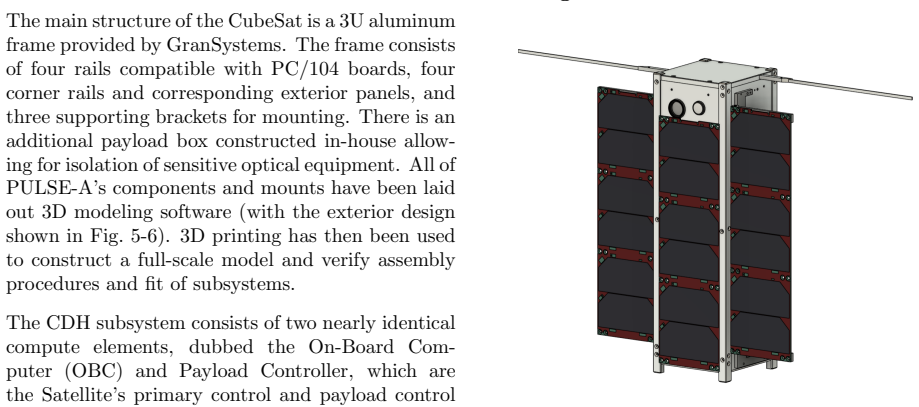
- [Figure 6 caption] The caption reads "F ully Deployed CubeSat Exterior"; the spacing in "F ully" should be corrected to "Fully".
- [In-House Designed Bus] The phrase "1 ° 3σ" contains an unnecessary space; it should be formatted as "1° 3σ".
- [Optical System / Mission Goals] The relationship between the 1–10 MHz seed modulation rate and the "up to 10 Mbps" data rate is not stated explicitly; if each symbol carries one bit, the data rate equals the modulation rate, but this should be made clear to avoid ambiguity.
- [Introduction / PULSE-A Mission Goals] The statement that CPolSK "has yet to be realized in an optical downlink mission" should acknowledge the specific architecture and context of the prior work cited in reference [3], so that the novelty claim is precise rather than sweeping.
Circularity Check
No significant circularity: the paper is a mission overview with no derivation chain or fitted inputs to reduce.
full rationale
This paper is an undergraduate CubeSat mission overview. It makes no quantitative derivations, fits no data, and does not present a prediction that is equivalent to its own input by construction. The central technical claim, that PULSE-A aims to demonstrate space-to-ground optical communication at up to 10 Mbps using circular polarization shift keying, is stated as a mission objective and design goal, not derived from any fitted parameter or self-referential definition. The paper cites companion papers for in-depth design details, but those citations are pointers to separate work and are not used as load-bearing evidence to define a result in terms of the paper's own inputs. Potential technical concerns, such as the random-polarization EDFA scrambling the seed lasers' polarization states or the lack of a link budget, are engineering feasibility and correctness risks, not circularity. Therefore no step in the paper reduces by construction to its own input, and the appropriate finding is no significant circularity.
Assumptions & free parameters
assumptions (3)
- domain assumption The chosen CubeSpace ADCS can achieve better than 1 degree 3sigma pointing accuracy in shaded orbit.
- domain assumption CPolSK with direct detection will work over a turbulent atmospheric channel at the planned data rates.
- domain assumption The NASA cFS framework running on Debian Linux with PREEMPT RT will provide sufficient real-time determinism for laser tracking.
Cite this review
Pith. "Pith review of PULSE-A Mission Overview: Optical Communications for Undergraduate Students." pith.science (2026). https://pith.science/paper/KTFFNU36
@misc{pith2026250705684,
  author       = {Pith},
  title        = {Pith review of: PULSE-A Mission Overview: Optical Communications for Undergraduate Students},
  year         = {2026},
  howpublished = {\url{https://pith.science/paper/KTFFNU36}},
  note         = {Machine review of arXiv:2507.05684}
}
read the original abstract
Recent advances in the size, weight, and power (SWaP) requirements for space-based sensing have dramatically increased the demand for high-bandwidth downlink. However, high data rate RF transceivers still pose significant SWaP and cost restrictions, especially for university-class CubeSat missions. Optical communication may provide a solution to this challenge, enabling data transmission with order-of-magnitude rate increases over RF while being both secure and SWaP-efficient. The Polarization-modUlated Laser Satellite Experiment (PULSE-A) is a University of Chicago mission to demonstrate optical downlink at a data rate of up to 10 Mbps using circular polarization shift keying (CPolSK). PULSE-A comprises a <1.5U Optical Transmission Terminal, 3U CubeSat Bus, Optical Ground Station (OGS) employing an amateur telescope, and RF Ground Station (RFGS), all of which are being designed and integrated by a team of over 60 undergraduate students. The mission objective is threefold: (1) to provide hands-on educational experiences for undergraduate students, (2) to make hardware for optical communication systems more accessible via open-source design, and (3) to explore the viability and potential advantages of using CPolSK for optical downlink. In this work, we present an overview of the mission, and we describe the PULSE-A Team's learning-oriented approach to program management and engineering. We especially emphasize the importance of student leadership in PULSE-A's development process and the resulting benefits for the University of Chicago community. We also highlight takeaways from the experience of founding and operating an undergraduate student-led CubeSat program.
Figures


Figures from the paper (5 more)




Reference graph
Works this paper leans on
- [1]
-
[2]
Near-Earth Laser Communi- cations
Hamid Hemmati. Near-Earth Laser Communi- cations. CRC Press, 2 edition, 2021
work page 2021
-
[3]
Circle polarization shift keying with direct detection for free-space optical communication
Xinhui Zhao, Yong Yao, Yunxu Sun, and Chao Liu. Circle polarization shift keying with direct detection for free-space optical communication. Journal of Optical Communications and Net- working, 1(4):307, 2009
work page 2009
-
[4]
Core Flight System (cFS) [Computer software]
National Aeronautics and Space Administra- tion. Core Flight System (cFS) [Computer software]. https://github.com/nasa/cFS, n.d
-
[5]
NASA Selects New Round of Candidates for CubeSat Missions to Station
NASA. NASA Selects New Round of Candidates for CubeSat Missions to Station. https://www.nasa.gov/centers- and-facilities/kennedy/nasa-selects- new-round-of-candidates-for-cubesat- missions-to-station/, March 2024. Accessed: 2025-06-10
work page 2024
-
[6]
Development of a Compact Optical Communications Terminal for the PULSE-A CubeSat
Sofia Mansilla et al. Development of a Compact Optical Communications Terminal for the PULSE-A CubeSat. In 39th Annual Small Satellite Conference , Communications, Research & Academia, pages SSC25–P1–04, August 2025
work page 2025
-
[7]
Juan Ignacio Prieto Asbun et al. Development of a Polarization-Based Optical Communica- tions Ground Station for the PULSE-A Cube- Sat. In 39th Annual Small Satellite Conference, Communications, Research & Academia, pages SSC25–P1–39, August 2025
work page 2025
-
[8]
PyCubed: An Open-Source, Radiation-Tested SmallSat Framework Programmable Entirely in Python
Maximillian Holliday et al. PyCubed: An Open-Source, Radiation-Tested SmallSat Framework Programmable Entirely in Python. https://pycubed.org/, n.d. Hanssler 13 39 th Annual Small Satellite Conference
Show all 17 references
-
[9]
Artemis CubeSat Kit
Hawai‘i Space Flight Laboratory. Artemis CubeSat Kit. https://www.hsfl.hawaii.edu/ 101cubesats/artemiscubesatkit/, n.d
-
[10]
Development of an Open-Source Spacecraft Bus for the PULSE-A CubeSat
Graydon Schulze-Kalt et al. Development of an Open-Source Spacecraft Bus for the PULSE-A CubeSat. In 39th Annual Small Satellite Conference, Emerging Technologies II, Research & Academia, pages SSC25–P1–42, August 2025
2025
-
[11]
OreSat Open Source CubeSat Project
Portland State Aerospace Society OreSat Team. OreSat Open Source CubeSat Project. https: //github.com/oresat, n.d. Accessed: 2025-06- 10
2025
-
[12]
Phoenix CubeSat
Arizona State University Phoenix CubeSat Team. Phoenix CubeSat. https:// phxcubesat.asu.edu/, n.d. Accessed: 2025-06- 10
2025
-
[13]
UChicago PULSE GitHub
UChicago Space Program. UChicago PULSE GitHub. https://github.com/UChicago- PULSE, n.d
-
[14]
Micius quantum experi- ments in space
Chao-Yang Lu, Yuan Cao, Cheng-Zhi Peng, and Jian-Wei Pan. Micius quantum experi- ments in space. Reviews of Modern Physics, 94(3):035001, July 2022
2022
-
[15]
ESA and Honeywell join forces for ultra-secure data protection with quantum-enabled satellites
European Space Agency. ESA and Honeywell join forces for ultra-secure data protection with quantum-enabled satellites. https://www.esa.int/Applications/ Connectivity_and_Secure_Communications/ ESA_and_Honeywell_join_forces_for_ ultra-secure_data_protection_with_ quantum-enable...
2024
-
[16]
SpeQtral-1 Spacecraft (QKD CubeSat)
Nanosats Database (Erik Kulu). SpeQtral-1 Spacecraft (QKD CubeSat). https: //www.nanosats.eu/sat/speqtral-1, August
-
[2024]
Hanssler 14 39 th Annual Small Satellite Conference
Last modified: 2024-08-29; accessed: 2025-06-22. Hanssler 14 39 th Annual Small Satellite Conference
2024
Reviewed August 6, 2026 · model on record in the stance chip above.
Discussion (0). Continue with ORCID to comment.