REVIEW 3 major objections 5 minor 52 references
When Transformers Meet Recommenders: Integrating Self-Attentive Sequential Recommendation with Fine-Tuned LLMs
T0 review · 3 major / 5 minor · reviewed 2026-08-06 · deepseek-v4-flash
Pith's one-line read A three-part hybrid—SASRec encoder, mapping layer, and LoRA-tuned LLM—reports consistent gains over baselines on cold-start and warm-start recommendation.
desk verdict The central claim of consistent improvement is contradicted by the paper's own Table 2 and warm-start section, so the paper as submitted should be rejected rather than sent to referees. read the letter →
The pith
A machine-rendered reading of the paper's core claim, the machinery that carries it, and where it could break.
The reading
What carries the argument
The load-bearing mechanism is the mapping layer: a two-hidden-layer MLP that projects SASRec's low-dimensional user and item embeddings into the LLM's high-dimensional token embedding space through transformation and reshaping. Those aligned embeddings are inserted into a fixed textual prompt at the user-ID and item-ID positions, so a hybrid encoding mixes ordinary token embeddings with collaborative embeddings. Around this sit three training strategies: Dual-Stage Training (pretrain SASRec and the LLM separately, then fine-tune them jointly), Hierarchical Freezing (freeze one component while tuning another), and Plug-and-Play Tuning (isolate LoRA, mapping, and SASRec updates), all optimized against binary cross-entropy.
What would settle it
Re-run TALLRec and SASRecLLM on the exact Amazon Book subset used here (users and items with IDs up to 4000, ratings at least 4 treated as positive) with the same TinyLlama-1.1B and LoRA settings, and compare AUC and UAUC. If TALLRec's measured Amazon numbers match the MovieLens values printed in the same row (AUC about 0.689, UAUC about 0.676), then Table 2 is not a valid baseline measurement and the paper's 'consistent improvement' claim would need to be re-evaluated.
Extended reading notes
Core claim
The central discovery the paper tries to establish is that collaborative and semantic signals can be fused at the embedding level rather than by letting the LLM reason about items from text alone. SASRecLLM does this by replacing the user-ID and item-ID placeholders in a textual prompt with aligned collaborative embeddings computed by SASRec, so the language model sees both the story told by the interaction sequence and the meaning stored in the item titles. The paper presents experiments on MovieLens-1M and a filtered Amazon Book subset in which SASRecLLM records the best overall AUC/UAUC and competitive confusion-matrix metrics, with the sharpest gains appearing in cold-start scenarios. The author interprets this as evidence that the modular 'collaborative encoder + aligner + tuned LLM' pattern is a valid paradigm for the next generation of LLM-based recommenders.
Load-bearing premise
The central claim assumes the reported baseline numbers are correct, in particular that the TALLRec row in the Amazon Book table was measured on that dataset and not copied from the MovieLens table.
Editorial extensions
If this is right
- If the reported gains hold, LLM-based recommenders no longer have to choose between collaborative accuracy and semantic flexibility; the same LLM can serve both cold and warm users.
- Because only LoRA, the mapping layer, and the SASRec encoder are trained, the approach can be adopted at a fraction of full fine-tuning cost.
- The modular design means the SASRec encoder or the LLM backbone can be swapped without rebuilding the whole system, opening a practical path for cross-domain recommendation.
- The binary Yes/No formulation suggests immediate extension to click-through-rate estimation and preference classification tasks in production pipelines.
Reading between the lines
- The paper leaves implicit that the same architecture could be lifted from binary Yes/No prediction to top-K ranking or multiclass interaction prediction by changing the prompt head, because the SASRec encoder already produces ranked sequence representations.
- A testable extension the author does not run: replace the MLP mapping layer with cross-attention between collaborative embeddings and token embeddings; the warm-start result, where SASRec alone slightly beats SASRecLLM, suggests the current projection may be the bottleneck.
- The cold-start result suggests LLM world knowledge can substitute for interaction history; one could map performance against a continuous history-length sweep to find where SASRec's contribution begins to dominate.
Editorial analysis
A structured set of objections, weighed in public.
Referee Report
Summary. The paper proposes SASRecLLM, a hybrid recommender that combines a SASRec collaborative encoder with a LoRA-fine-tuned TinyLlama-1.1B language model, bridged by a two-layer mapping layer that projects collaborative embeddings into the LLM token space. Three training strategies (Dual-Stage Training, Hierarchical Freezing, and Plug-and-Play Tuning) are introduced. The model is evaluated on MovieLens-1M and Amazon Book for binary like/dislike prediction using AUC, UAUC, Log Loss, and confusion-matrix metrics, with additional cold-start and warm-start analyses on MovieLens. The central claim is that SASRecLLM achieves 'robust and consistent improvements over strong baselines in both cold-start and warm-start scenarios.'
Significance. If the reported results were sound, the paper would offer a useful modular blueprint for injecting collaborative signals into instruction-tuned LLMs, and the accompanying open-source implementation and detailed ablation study would be valuable to the LLM4Rec community. The paper is transparent about its computational constraints and the resulting design choices (e.g., TinyLlama backbone, Amazon downsampling), and it candidly discusses limitations in Section 6.1. However, the core empirical claim is undermined by internal contradictions in the reported data: a duplicated baseline row across the two datasets and a warm-start result that directly contradicts the abstract. These issues are load-bearing because the paper's contribution is explicitly an empirical demonstration of consistent improvement, and the current manuscript does not support that claim.
major comments (3)
- [Table 2 (Amazon Book) and Table 1 (MovieLens)] The TALLRec row in Table 2 is identical to the TALLRec row in Table 1 across every reported quantity, including Log Loss 0.649 ± 0.063, Precision 0.628 ± 0.116, Recall 0.636 ± 0.048, F1 0.688 ± 0.078, Accuracy 0.635 ± 0.064, AUC 0.689 ± 0.052, UAUC 0.676 ± 0.059, and the relative improvement of 1.17%. It is implausible that the Amazon Book evaluation, after different preprocessing (including filtering user/item IDs above 4,000), reproduces the MovieLens metrics to three decimals with identical standard errors. If the row is taken at face value, SASRecLLM is substantially worse than TALLRec on Amazon (AUC 0.601 vs 0.689, UAUC 0.517 vs 0.676, F1 0.489 vs 0.688), which directly contradicts the claimed consistent improvement. If the row is a copy error, the evaluation table is unreliable. Either way, the central comparison is not supported.
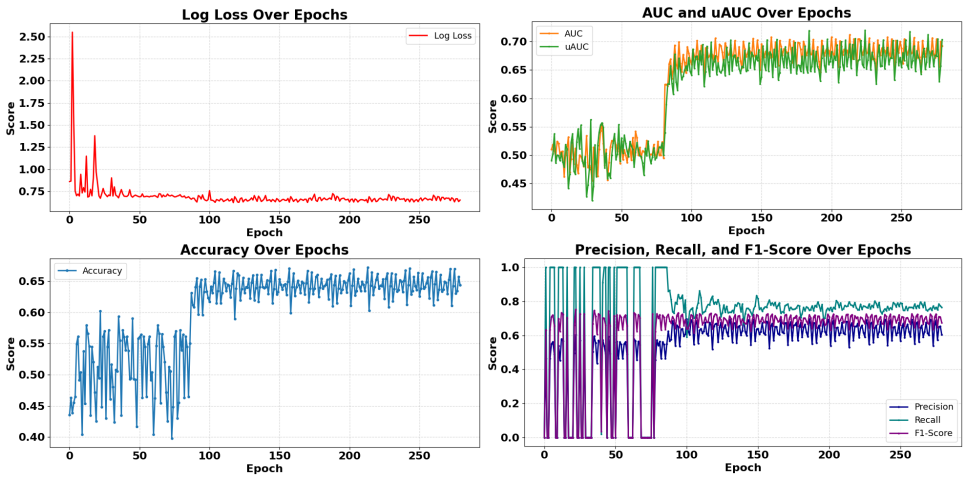
- [Section 5.3.3 (RQ3), Fig. 11, and Section 6.3] The warm-start analysis in Fig. 11 is described in the text: 'SASRec slightly outperforms SASRecLLM.' This observation directly contradicts the abstract's claim of 'robust and consistent improvements over strong baselines in both cold-start and warm-start scenarios' and the conclusion in Section 6.3 that SASRecLLM 'excels in both cold-start and warm-start scenarios.' The paper's own data show that the proposed model is not the best method in the warm-start setting, so the central claim of consistent improvement is internally inconsistent.
- [Section 5.3.3 and Section 6.1] The cold-start and warm-start evaluation is performed on MovieLens only ('MovieLens is used as the focus'), yet the abstract and conclusion generalize the claim to both datasets without qualification. For Amazon Book, the full comparison shows SASRecLLM underperforming TALLRec on the primary metrics (AUC and UAUC), and no cold/warm breakdown is provided for Amazon. Consequently, the claim of robust and consistent improvements across datasets and scenarios is unsupported by the presented evidence.
minor comments (5)
- [Abstract and Title] The title contains a typo: 'Fine-T uned' should read 'Fine-Tuned.'
- [Section 3.1] The subsection numbering is inconsistent: Section 3.1.1.1 and 3.1.2.1 are used, but the parent subsections are 3.1.1 and 3.1.2; this should be cleaned up (presumably 3.1.1.1, 3.1.1.2, 3.1.1.3, and 3.1.2.1, 3.1.2.2).
- [References] Reference [38] cites 'ChatGPT. Request for the limitations...' as a source; this is not a scholarly reference and should be replaced with a proper citation or removed.
- [Fig. 7] The confusion-matrix figure in Fig. 7 uses the language of 'failures' (TP: Correctly predicted failures), which is inconsistent with the recommendation context of the paper; the caption and labels should be adapted to the like/dislike setting.
- [Throughout] There are several grammatical and typographical issues, such as 'This method training method improves' (Section 3.2) and 'summaried' (Section 6); a careful proofreading pass is needed.
Circularity Check
No circularity: the paper is an empirical engineering comparison, not a derivation whose conclusions equal its inputs.
full rationale
The paper is an empirical system paper rather than a derivation from first principles. The method section defines SASRec embeddings (Eq. 1), the mapping projection (Eqs. 7-9), and the LoRA LLM prediction (Eq. 12), and the experiments then compare the assembled model against implemented baselines on held-out test splits with standard metrics (Eqs. 15-16). I find no parameter that is fitted to the target metric and then reported as a prediction, no self-citation chain that supplies the central premise, and no uniqueness theorem imported from the author's prior work. The closest concerns are not circularity: Section 6.1 explicitly admits all baselines were re-implemented and customized, Table 2's TALLRec row is byte-identical to Table 1's, and Fig. 11 states SASRec slightly outperforms SASRecLLM in the warm-start scenario, contradicting the abstract. These are data-integrity and claim-consistency problems that would affect correctness, but they do not make any stated result definitionally equal to its inputs, so the circularity score is 0.
Assumptions & free parameters
free parameters (3)
- Rating threshold for binary labels =
4
- Amazon data reduction filter =
user/item IDs > 4000 removed
- Warm/cold interaction threshold =
3 interactions
assumptions (3)
- domain assumption Balanced binary classification is a meaningful proxy for recommendation quality.
- domain assumption Re-implemented baselines are faithful to their original methods.
- domain assumption The prompt template is equally fair to all LLM-based methods.
Cite this review
Pith. "Pith review of When Transformers Meet Recommenders: Integrating Self-Attentive Sequential Recommendation with Fine-Tuned LLMs." pith.science (2026). https://pith.science/paper/XDYA2PIS
@misc{pith2026250705733,
  author       = {Pith},
  title        = {Pith review of: When Transformers Meet Recommenders: Integrating Self-Attentive Sequential Recommendation with Fine-Tuned LLMs},
  year         = {2026},
  howpublished = {\url{https://pith.science/paper/XDYA2PIS}},
  note         = {Machine review of arXiv:2507.05733}
}
read the original abstract
Self-Attentive Sequential Recommendation (SASRec) effectively captures long-term user preferences by applying attention mechanisms to historical interactions. Concurrently, the rise of Large Language Models (LLMs) has motivated research into LLM-based recommendation, which leverages their powerful generalization and language understanding capabilities. However, LLMs often lack the domain-specific knowledge and collaborative signals essential for high-quality recommendations when relying solely on textual prompts. To address this limitation, this study proposes SASRecLLM, a novel framework that integrates SASRec as a collaborative encoder with an LLM fine-tuned using Low-Rank Adaptation (LoRA). The components are connected via a mapping layer to align their dimensional spaces, and three targeted training strategies are designed to optimize the hybrid architecture. Extensive experiments on multiple datasets demonstrate that SASRecLLM achieves robust and consistent improvements over strong baselines in both cold-start and warm-start scenarios. This work advances the field of LLM-based recommendation by presenting a modular and effective paradigm for fusing structured collaborative filtering with the semantic power of fine-tuned LLMs. The implementation is available on GitHub: https://github.com/kechenkristin/RecLLM
Figures



Figures from the paper (7 more)


Reference graph
Works this paper leans on
-
[1]
Llama: Open and efficient foundation language models
Hugo Touvron et al. “Llama: Open and efficient foundation language models”. In: arXiv preprint arXiv:2302.13971 (2023)
arXiv 2023
-
[2]
Training language models to follow instructions with human feedback
Long Ouyang et al. “Training language models to follow instructions with human feedback”. In: Advances in neural information processing sys- tems 35 (2022), pp. 27730–27744
work page 2022
-
[3]
A comprehensive overview of large language models
Humza Naveed et al. “A comprehensive overview of large language models”. In: arXiv preprint arXiv:2307.06435 (2023)
arXiv 2023
-
[4]
Recommender systems: An overview
Robin Burke, Alexander Felfernig, and Mehmet H Göker. “Recommender systems: An overview”. In: Ai Magazine 32.3 (2011), pp. 13– 18
work page 2011
-
[5]
Self- Attentive Sequential Recommendation
Wang-Cheng Kang and Julian McAuley. “Self- Attentive Sequential Recommendation”. In: Proceedings of the 2018 IEEE International Con- ference on Data Mining (ICDM). 2018, pp. 197–
work page 2018
-
[6]
Llara: Large language- recommendation assistant
Jiayi Liao et al. “Llara: Large language- recommendation assistant”. In: Proceedings of the 47th International ACM SIGIR Conference on Research and Development in Information Retrieval. 2024, pp. 1785–1795
work page 2024
-
[7]
BERT4Rec: Sequential Recom- mendation with Bidirectional Encoder Repre- sentations from Transformers
Fei Sun et al. “BERT4Rec: Sequential Recom- mendation with Bidirectional Encoder Repre- sentations from Transformers”. In: Proceedings of the 28th ACM International Conference on In- formation and Knowledge Management (CIKM) . 2019, pp. 1441–1450. doi: 10.1145/3357384. 3357895. arXiv: 1904.06690 [cs.IR]
arXiv 2019
-
[8]
Self-supervised Learning for Large-scale Item Recommendations
Kun Zhou et al. “Self-Supervised Learning for Sequential Recommendation with Bidirectional Transformers”. In: Proceedings of the 43rd In- ternational ACM SIGIR Conference on Research and Development in Information Retrieval (SIGIR) . 2020, pp. 1471–1480. doi: 10.1145/3394486. 3403198. arXiv: 2007.12865 [cs.IR]
work page Pith review arXiv 2020
Show all 52 references
-
[9]
S3-Rec: Self-Supervised Learn- ing for Sequential Recommendation with Mu- tual Information Maximization
Kun Zhou et al. “S3-Rec: Self-Supervised Learn- ing for Sequential Recommendation with Mu- tual Information Maximization”. In: Proceedings of the 29th ACM International Conference on In- formation and Knowledge Management (CIKM) . 2020, pp. 1893–1902. doi: 10.1145/3340531. 341...
2020 arXiv
-
[10]
Recommender Systems in the Era of Large Language Models (LLM4Rec)
Zhipeng Zhao et al. “Recommender Systems in the Era of Large Language Models (LLM4Rec)”. In: arXiv preprint (2023). arXiv: 2307 . 02046 [cs.IR]
2023
-
[11]
Tallrec: An effective and effi- cient tuning framework to align large language model with recommendation
Keqin Bao et al. “Tallrec: An effective and effi- cient tuning framework to align large language model with recommendation”. In: Proceedings of the 17th ACM Conference on Recommender Sys- tems. 2023, pp. 1007–1014
2023
-
[12]
Aggarwal
Charu C. Aggarwal. A Survey of Collaborative Filtering-Based Recommender Systems. Springer,
-
[13]
Sequential Recommender Systems: Challenges, Progress, and Prospects
Shuai Wang et al. “Sequential Recommender Systems: Challenges, Progress, and Prospects”. In: arXiv preprint (2020). arXiv: 2001 . 04830 [cs.IR]
2020
-
[14]
Recommender Systems Handbook
Francesco Ricci, Lior Rokach, and Bracha Shapira. Recommender Systems Handbook . Springer, 2015. doi: 10 . 1007 / 978 - 1 - 4899 - 7637-6
2015
-
[15]
Markov Chain Recommendation System (MCRS)
Ahmed Adam Ahmed and Naomie Salim. “Markov Chain Recommendation System (MCRS)”. In: International Journal of Novel Re- search in Computer Science and Software Engineer- ing 3.1 (2016), p. 11
2016
-
[16]
Session-based Recom- mendations with Recurrent Neural Networks
Balázs Hidasi et al. “Session-based Recom- mendations with Recurrent Neural Networks”. In: Proceedings of the International Conference on Learning Representations (ICLR). 2016. arXiv: 1511.06939 [cs.IR]. 16
2016 arXiv
-
[17]
Attention is all you need
Ashish Vaswani et al. “Attention is all you need”. In: Advances in neural information pro- cessing systems 30 (2017)
2017
-
[18]
Transformers4Rec: Bridging the Gap Between NLP and Sequential Recommendation
Júlio C. De Souza et al. “Transformers4Rec: Bridging the Gap Between NLP and Sequential Recommendation”. In: Proceedings of the 30th ACM International Conference on Information and Knowledge Management (CIKM). 2021, pp. 2025–
2021
-
[19]
The application of large lan- guage models in recommendation systems
Peiyang Yu et al. “The application of large lan- guage models in recommendation systems”. In: arXiv preprint arXiv:2501.02178 (2025)
2025 arXiv
-
[20]
Large language models are competitive near cold-start recommenders for language-and item-based preferences
Scott Sanner et al. “Large language models are competitive near cold-start recommenders for language-and item-based preferences”. In: Proceedings of the 17th ACM conference on recom- mender systems. 2023, pp. 890–896
2023
-
[21]
Harnessing the power of llms in practice: A survey on chatgpt and beyond
Jingfeng Yang et al. “Harnessing the power of llms in practice: A survey on chatgpt and beyond”. In: ACM Transactions on Knowledge Discovery from Data 18.6 (2024), pp. 1–32
2024
-
[22]
Towards Semantic Equivalence of Tokenization in Multimodal LLM
Shengqiong Wu et al. “Towards Semantic Equivalence of Tokenization in Multimodal LLM”. In: arXiv preprint arXiv:2406.05127 (2024)
2024 arXiv
-
[23]
Neural network methods for natural language processing
Yang Liu and Meng Zhang. Neural network methods for natural language processing. 2018
2018
-
[24]
Quick start guide to large lan- guage models: strategies and best practices for us- ing ChatGPT and other LLMs
Sinan Ozdemir. Quick start guide to large lan- guage models: strategies and best practices for us- ing ChatGPT and other LLMs. Addison-Wesley Professional, 2023
2023
-
[25]
Full parameter fine-tuning for large language models with limited resources
Kai Lv et al. “Full parameter fine-tuning for large language models with limited resources”. In: arXiv preprint arXiv:2306.09782 (2023)
2023 arXiv
-
[26]
Lora: Low-rank adaptation of large language models
Edward J Hu et al. “Lora: Low-rank adaptation of large language models.” In: ICLR 1.2 (2022), p. 3
2022
-
[27]
Lecture Slides on Transformers
Hung-Yi Lee. Lecture Slides on Transformers
-
[28]
A comprehensive recommender system model: Improving accuracy for both warm and cold start users
Anupriya Gogna and Angshul Majumdar. “A comprehensive recommender system model: Improving accuracy for both warm and cold start users”. In: IEEE Access 3 (2015), pp. 2803– 2813
2015
-
[29]
A system- atic review and taxonomy of explanations in decision support and recommender systems
Ingrid Nunes and Dietmar Jannach. “A system- atic review and taxonomy of explanations in decision support and recommender systems”. In: User Modeling and User-Adapted Interaction 27 (2017), pp. 393–444
2017
-
[30]
A systematic review of explainable artificial intelligence in terms of different application domains and tasks
Mir Riyanul Islam et al. “A systematic review of explainable artificial intelligence in terms of different application domains and tasks”. In: Applied Sciences 12.3 (2022), p. 1353
2022
-
[31]
How can recommender systems benefit from large language models: A survey
Jianghao Lin et al. “How can recommender systems benefit from large language models: A survey”. In: arXiv preprint arXiv:2306.05817 (2023)
2023 arXiv
-
[32]
Language models are few- shot learners
Tom Brown et al. “Language models are few- shot learners”. In: Advances in neural information processing systems 33 (2020), pp. 1877–1901
2020
-
[33]
Improving sequential rec- ommendations with llms
Artun Boz et al. “Improving sequential rec- ommendations with llms”. In: arXiv preprint arXiv:2402.01339 (2024)
2024 arXiv
-
[34]
Collm: Integrating collabo- rative embeddings into large language mod- els for recommendation
Yang Zhang et al. “Collm: Integrating collabo- rative embeddings into large language mod- els for recommendation”. In: arXiv preprint arXiv:2310.19488 (2023)
2023 arXiv
-
[35]
Llm-enhanced user- item interactions: Leveraging edge informa- tion for optimized recommendations
Xinyuan Wang et al. “Llm-enhanced user- item interactions: Leveraging edge informa- tion for optimized recommendations”. In: arXiv preprint arXiv:2402.09617 (2024)
2024 arXiv
-
[36]
Adapting large language models by integrating collaborative semantics for recommendation
Bowen Zheng et al. “Adapting large language models by integrating collaborative semantics for recommendation”. In: 2024 IEEE 40th Inter- national Conference on Data Engineering (ICDE). IEEE. 2024, pp. 1435–1448
2024
-
[37]
Empowering news recom- mendation with pre-trained language models
Chuhan Wu et al. “Empowering news recom- mendation with pre-trained language models”. In: Proceedings of the 44th international ACM SI- GIR conference on research and development in information retrieval. 2021, pp. 1652–1656
2021
-
[38]
Request for the limitations of training all the components of a model
ChatGPT. Request for the limitations of training all the components of a model. Accessed via OpenAI ChatGPT on Apr. 6, 2025. Apr. 2025
2025
-
[39]
Cost-sensitive learning for predictive maintenance
Stephan Spiegel et al. “Cost-sensitive learning for predictive maintenance”. In: arXiv preprint arXiv:1809.10979 (2018)
2018 arXiv
-
[40]
MovieLens 1M Dataset
Oded Golden. MovieLens 1M Dataset . https : / / www . kaggle . com / datasets / odedgolden / movielens - 1m - dataset . Accessed: 2024- 03-15. 2023. url: https : / / www . kaggle . com / datasets / odedgolden / movielens - 1m - dataset
2024
-
[41]
Amazon Review Data (2018 and ear- lier)
Jianmo Ni. Amazon Review Data (2018 and ear- lier). https://nijianmo.github.io/amazon/ . Accessed: 2024-03-15. 2019. url: https : / / nijianmo.github.io/amazon/
2018
-
[42]
TinyLlama: An Open-Source Small Language Model
Peiyuan Zhang et al. TinyLlama: An Open-Source Small Language Model. 2024. arXiv: 2401.02385 [cs.CL]. 17
2024 arXiv
-
[43]
Trustworthy recom- mender systems
Shoujin Wang et al. “Trustworthy recom- mender systems”. In: ACM Transactions on Intel- ligent Systems and Technology 15.4 (2024), pp. 1– 20
2024
-
[44]
Matrix factorization model in collaborative filtering algorithms: A survey
Dheeraj Bokde, Sheetal Girase, and Debajyoti Mukhopadhyay. “Matrix factorization model in collaborative filtering algorithms: A survey”. In: Procedia Computer Science 49 (2015), pp. 136– 146
2015
-
[45]
Neural collaborative fil- tering
Xiangnan He et al. “Neural collaborative fil- tering”. In: Proceedings of the 26th international conference on world wide web. 2017, pp. 173–182
2017
-
[46]
An MDP-based recommender sys- tem
Guy Shani, David Heckerman, and Ronen I Brafman. “An MDP-based recommender sys- tem”. In: Journal of machine Learning research 6.Sep (2005), pp. 1265–1295
2005
-
[47]
Receiver operating characteristic (ROC) area under the curve (AUC): A diagnostic measure for evalu- ating the accuracy of predictors of education outcomes
Alex J Bowers and Xiaoliang Zhou. “Receiver operating characteristic (ROC) area under the curve (AUC): A diagnostic measure for evalu- ating the accuracy of predictors of education outcomes”. In: Journal of Education for Students Placed at Risk (JESP AR)24.1 (2019), pp. 20–46
2019
-
[48]
The uniform AUC: Dealing with the representativeness effect in presence–absence models
Alberto Jiménez-Valverde. “The uniform AUC: Dealing with the representativeness effect in presence–absence models”. In: Methods in Ecol- ogy and Evolution 13.6 (2022), pp. 1224–1236. 18
2022
- [206]
-
[2016]
doi: 10.1007/978-3-319-29659-3
-
[2024]
url: https://speech.ee.ntu.edu.tw/ ~hylee / genai / 2024 - spring - course - data / 0503/0503_transformer.pdf
2024
-
[2034]
arXiv: 2105.12853 [cs.IR]
doi: 10.1145/3459637.3482143 . arXiv: 2105.12853 [cs.IR]
Reviewed August 6, 2026 · model on record in the stance chip above.
Discussion (0). Sign in to comment.