On the detection of medium inhomogeneity by contrast agent: wave scattering models and numerical implementations
Pith reviewed 2026-05-19 06:37 UTC · model grok-4.3
The pith
A small low-bulk-modulus droplet lets far-field wave data reconstruct inhomogeneity in a surrounding medium via the Helmholtz equation.
A machine-rendered reading of the paper's core claim, the machinery that carries it, and where it could break.
Core claim
By establishing the approximate relation between the far-field patterns of the scattered wave before and after the injection of a droplet, the scattered wave of the inhomogeneous medium after injecting the droplet is represented by a measurable far-field patterns, and consequently the inhomogeneity of the medium can be reconstructed from the Helmholtz equation.
What carries the argument
Approximate relation between pre- and post-injection far-field patterns obtained from the Lippmann-Schwinger integral equation for the scattered field.
If this is right
- The scattered field inside the medium after droplet injection becomes expressible directly from observable far-field data.
- The unknown inhomogeneity reduces to a standard inverse Helmholtz problem whose data are now available.
- Moving the droplet through the domain produces a pointwise reconstruction of the bulk-modulus function throughout a three-dimensional region.
- The dual reciprocity method supplies a concrete numerical scheme that converts the far-field measurements into the recovered function.
- Mollification regularizes the ill-posed inverse step and yields stable reconstructions from simulated far-field data.
Where Pith is reading between the lines
- The same contrast-agent idea could be tested with other small inclusions whose material parameters differ from the background in controlled ways.
- Practical imaging systems might combine this reconstruction with existing ultrasound or seismic acquisition geometries that already record far-field returns.
- Repeated droplet placements at different times could extend the method to track slow changes in the surrounding medium.
Load-bearing premise
The droplet must be small enough, have constant mass density, and possess a sufficiently small bulk modulus for the derived approximation to remain accurate at every location inside the background.
What would settle it
Increase the droplet radius while keeping all other parameters fixed and check whether the reconstructed bulk-modulus function deviates sharply from the true distribution once the size exceeds the regime where the approximation was derived.
Figures



read the original abstract
We consider the wave scattering and inverse scattering in an inhomogeneous medium embedded a homogeneous droplet with a small size, which is modeled by a constant mass density and a small bulk modulus. Based on the Lippmann-Schwinger integral equation for scattering wave in inhomogeneous medium, we firstly develop an efficient approximate scheme for computing the scattered wave as well as its far-field pattern for any droplet located in the inhomogeneous background medium. By establishing the approximate relation between the far-field patterns of the scattered wave before and after the injection of a droplet, the scattered wave of the inhomogeneous medium after injecting the droplet is represented by a measurable far-field patterns, and consequently the inhomogeneity of the medium can be reconstructed from the Helmholtz equation. Finally, the reconstruction process in terms of the dual reciprocity method is proposed to realize the numerical algorithm for recovering the bulk modulus function inside a bounded domain in three dimensional space, by moving the droplet inside the bounded domain. Numerical implementations are given using the simulation data of the far-field pattern to show the validity of the reconstruction scheme, based on the mollification scheme for dealing with the ill-posedness of this inverse problem.
Editorial analysis
A structured set of objections, weighed in public.
Referee Report
Summary. The manuscript develops an approximate forward model for acoustic scattering from an inhomogeneous background medium containing a small homogeneous droplet (constant density, small bulk modulus). Starting from the Lippmann-Schwinger integral equation, the authors derive a relation linking the far-field pattern before and after droplet injection; this relation is then used to recast the inverse problem of recovering the bulk-modulus function as a Helmholtz-equation reconstruction inside a bounded 3-D domain. The reconstruction is implemented via the dual reciprocity method, with mollification applied to stabilize the ill-posed inverse step. Numerical experiments on simulated far-field data are presented to illustrate the procedure.
Significance. If the small-droplet approximation can be shown to be uniformly accurate, the approach supplies a practical contrast-agent strategy for medium inhomogeneity detection that combines an explicit forward perturbation formula with an existing boundary-element-type solver. The numerical demonstration on synthetic data and the explicit use of mollification for regularization are concrete strengths that would be of interest to the inverse-scattering community.
major comments (2)
- [Approximate scheme and far-field relation] The derivation of the approximate far-field relation (abstract and the section developing the Lippmann-Schwinger scheme) asserts that the post-injection pattern equals the pre-injection pattern plus a term proportional to the local bulk modulus when the droplet radius a is small. No explicit remainder estimate, dependence on wavelength, or Lipschitz constant of the background contrast is supplied, so it is unclear whether the neglected O(a^3) and higher-order terms remain negligible uniformly as the droplet traverses regions of varying inhomogeneity. This gap directly affects the stability claim for the subsequent reconstruction.
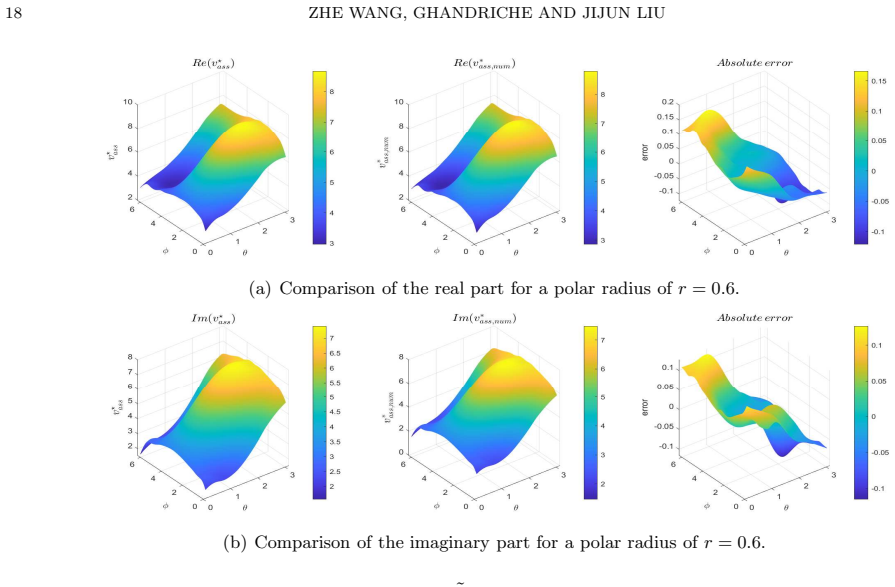
- [Numerical implementations] The numerical validation (final section) reports reconstructions from simulated far-field data but supplies neither quantitative error tables, convergence rates with respect to droplet size or mesh parameter, nor comparisons against an exact solution or a reference solver. Without such metrics it is difficult to assess whether the observed reconstructions support the central claim that the inhomogeneity can be recovered reliably.
minor comments (2)
- Notation for the droplet parameters (radius a, bulk modulus, density) should be introduced once and used consistently; the abstract and main text occasionally switch between “small bulk modulus” and specific symbols without cross-reference.
- [Reconstruction process] The mollification scheme is mentioned as the regularization tool, yet the choice of mollification radius or the precise form of the kernel is not stated; a short paragraph or reference would clarify reproducibility.
Simulated Author's Rebuttal
We thank the referee for the positive evaluation of the work's significance and for the constructive major comments. We address each point below and indicate the revisions planned for the manuscript.
read point-by-point responses
-
Referee: [Approximate scheme and far-field relation] The derivation of the approximate far-field relation (abstract and the section developing the Lippmann-Schwinger scheme) asserts that the post-injection pattern equals the pre-injection pattern plus a term proportional to the local bulk modulus when the droplet radius a is small. No explicit remainder estimate, dependence on wavelength, or Lipschitz constant of the background contrast is supplied, so it is unclear whether the neglected O(a^3) and higher-order terms remain negligible uniformly as the droplet traverses regions of varying inhomogeneity. This gap directly affects the stability claim for the subsequent reconstruction.
Authors: We agree that an explicit remainder estimate would strengthen the presentation. The derivation begins from the Lippmann-Schwinger integral equation and retains the leading-order contribution for a small homogeneous droplet with constant density and small bulk modulus; higher-order terms are formally O(a^3) under the standard small-obstacle scaling. While the manuscript does not supply a full uniform asymptotic expansion with explicit dependence on wavelength or the Lipschitz constant of the background contrast, the approximation is consistent with classical results on small scatterers. In the revision we will insert a brief discussion of the expected error order together with a reference to the relevant scattering literature, thereby clarifying the regime in which the neglected terms remain negligible for the subsequent reconstruction step. revision: partial
-
Referee: [Numerical implementations] The numerical validation (final section) reports reconstructions from simulated far-field data but supplies neither quantitative error tables, convergence rates with respect to droplet size or mesh parameter, nor comparisons against an exact solution or a reference solver. Without such metrics it is difficult to assess whether the observed reconstructions support the central claim that the inhomogeneity can be recovered reliably.
Authors: We concur that quantitative metrics would improve the assessment of the numerical results. The final section demonstrates the reconstruction procedure on synthetic far-field data with mollification applied to stabilize the inverse step. In the revised manuscript we will add tables reporting L^2 reconstruction errors for several droplet radii and mesh sizes, include convergence plots with respect to these parameters, and, where computationally feasible, compare selected forward solutions against a reference boundary-element solver. revision: yes
Circularity Check
Derivation chain is self-contained; no circular reductions identified
full rationale
The paper starts from the standard Lippmann-Schwinger integral equation, derives an approximate far-field relation for a small droplet with given density and bulk modulus, and uses the pre/post-injection difference to express the post-injection scattered field in terms of measurable far-field data. This feeds a standard inverse Helmholtz reconstruction solved by the dual reciprocity method on simulated data. No equation equates the target bulk-modulus function to a parameter fitted from the same far-field measurements, no uniqueness theorem is imported from self-citation, and no ansatz is smuggled via prior work. The reconstruction step remains independent of the forward approximation once the far-field data are treated as given inputs.
Axiom & Free-Parameter Ledger
free parameters (1)
- droplet size
axioms (1)
- standard math The scattering problem in the inhomogeneous medium satisfies the Lippmann-Schwinger integral equation
Lean theorems connected to this paper
-
IndisputableMonolith/Foundation/AlexanderDuality.leanalexander_duality_circle_linking unclear?
unclearRelation between the paper passage and the cited Recognition theorem.
the reconstruction process in terms of the dual reciprocity method is proposed to realize the numerical algorithm for recovering the bulk modulus function inside a bounded domain in three dimensional space
-
IndisputableMonolith/Cost/FunctionalEquation.leanwashburn_uniqueness_aczel unclear?
unclearRelation between the paper passage and the cited Recognition theorem.
Based on the Lippmann-Schwinger integral equation for scattering wave in inhomogeneous medium
What do these tags mean?
- matches
- The paper's claim is directly supported by a theorem in the formal canon.
- supports
- The theorem supports part of the paper's argument, but the paper may add assumptions or extra steps.
- extends
- The paper goes beyond the formal theorem; the theorem is a base layer rather than the whole result.
- uses
- The paper appears to rely on the theorem as machinery.
- contradicts
- The paper's claim conflicts with a theorem or certificate in the canon.
- unclear
- Pith found a possible connection, but the passage is too broad, indirect, or ambiguous to say the theorem truly supports the claim.
Reference graph
Works this paper leans on
-
[1]
A. Abubakar and P. M. van den Berg, The contrast source inv ersion method for location and shape reconstructions. Inverse Probl., 18(2), 2002, 495-510
work page 2002
-
[2]
R.A. Adams and J.J.F. Fournier, Sobolev Spaces. Elsevie r, British, 2003
work page 2003
-
[3]
H. Ammari, D.P. Challa, A.P. Choudhury and M. Sini, The po int-interaction approximation for the fields generated by contrasted bubbles at arbitrary fixed frequencies. J. Diff . Eqns., 267(4), 2019, 2104-2191
work page 2019
-
[4]
H. Ammari, D.P. Challa, A.P. Choudhury and M. Sini, The eq uivalent media generated by bubbles of high contrasts: volumetric metamaterials and metasurfaces. SIAM Multisca le Model. Simul., 18(1), 2020, 240-293
work page 2020
- [5]
-
[6]
R.E. Caflisch, M.J. Miksis, G.C. Papanicolaou and L. Ting , Effective equations for wave propagation in bubbly liquids. J. Fluid Mech., 153, 1985, 259-273
work page 1985
-
[7]
R.E. Caflisch, M.J. Miksis, G.C. Papanicolaou and L. Ting , Wave propagation in bubbly liquids at finite volume fraction. J. Fluid Mech., 160, 1985, 1-14
work page 1985
-
[8]
J. Cheng, Y.C. Hon, T. Wei and M. Yamamoto, Numerical comp utation of a Cauchy problem for Laplace’s equation. Zammz. Angew. Math. Mech., 81(10), 2001, 665–674
work page 2001
-
[9]
D. Colton and R. Kress, Inverse Acoustic and Electromagn etic Scattering Theory. Springer Nature, Switzerland, 2019
work page 2019
-
[10]
A. Dabrowski, A. Ghandriche and M. Sini, Mathematical a nalysis of the acoustic imaging modality using bubbles as contrast agents at nearly resonating frequencies. Inver se Probl. Imag., 15(3), 2021, 555-597
work page 2021
-
[11]
Deveney, Inverse-scattering theory within the Ryto v approximation
A. Deveney, Inverse-scattering theory within the Ryto v approximation. Opt. Lett., 6(8), 1981, 374-376
work page 1981
-
[12]
J. Ding, W. Ye and L.J. Gray, An accelerated surface disc retization-based BEM approach for non-homogeneous linear problems in 3-D complex domains. Int. J. Numer. Meth. Engin., 63(12), 2005, 1775-1795
work page 2005
-
[13]
Evans, Partial Differential Equations, Vol.19, Am erican Mathematical Society, Providence, 2022
L.C. Evans, Partial Differential Equations, Vol.19, Am erican Mathematical Society, Providence, 2022
work page 2022
-
[14]
M. Ganesh and L.G. Graham, A high-order algorithm for ob stacle scattering in three dimensions. J. Comput. Phys., 198(1), 2004, 211-242
work page 2004
-
[15]
H. Ghassemi, S. Fazelifar, and A.R. Nadery, DRBEM appli ed to the 3D Helmholtz equation and its particular solutions with various radial basis functions. Int. J. Part . Diff. Eqns. Appl., 4(1), 2016, 1-6
work page 2016
-
[16]
M.A. Golberg, C.S. Chen, H. Bowman and H. Power, Some com ments on the use of Radial basis functions in the dual reciprocity method. Comput. Mech., 21(2), 1998, 141-1 48
work page 1998
-
[17]
D.N. H` ao and D. Lesnic, The Cauchy problem for Laplace’ s equation via the conjugate gradient method. IMA J. Appl. Math., 65(2), 2000, 199–217
work page 2000
-
[18]
H` ao, A mollification method for ill-posed problem s
D.N. H` ao, A mollification method for ill-posed problem s. Numerische Mathematik, 68(4), 1994, 469-506
work page 1994
-
[19]
L.W. Johnson and R.D. Riess, An error analysis for numer ical differentiation. J. Inst. Math. Appl., 11, 1973, 115-12 0
work page 1973
-
[20]
Johnson, Numerical solution of partial differential equations by the finite element method
C. Johnson, Numerical solution of partial differential equations by the finite element method. Courier Corporation , New York, 2009
work page 2009
-
[21]
T.S. Kalmenov and D. Suragan, A boundary condition and s pectral problems for the Newton potential. Modern Aspects of the Theory of Partial Differential Equations, Spr inger, Basel, 2011, 187-210
work page 2011
-
[22]
Kargl, Effective medium approach to linear acousti cs in bubbly liquids
S.G. Kargl, Effective medium approach to linear acousti cs in bubbly liquids. J. Acoust. Soc. Amer., 111(1), 2002, 168-173
work page 2002
-
[23]
S.R. Karur and P.A. Ramachandran, Radial basis functio n approximation in the dual reciprocity method. Mathe- matical and Computer Modelling, 20(7), 1994, 59-70
work page 1994
-
[24]
Murio, The Mollification Method and the Numerical S olution of Ill-posed Problems
D.A. Murio, The Mollification Method and the Numerical S olution of Ill-posed Problems. John Wiley and Sons, New York, 1993
work page 1993
-
[25]
A.J. Nowak and C.A. Brebbia, The multiple-reciprocity method. A new approach for transforming BEM domain integrals to the boundary. Engineering Analysis with Bound ary Elements, 6(3), 1989, 164-167
work page 1989
-
[26]
Oliver, An algorithm for numerical differentiation o f a function of one real variable
J. Oliver, An algorithm for numerical differentiation o f a function of one real variable. J. Comput. Appl. Math., 6(2), 1980, 145-160
work page 1980
-
[27]
P.W. Partridge, C.A. Brebbia and L.C. Wrobel, The Dual R eciprocity Boundary Element Method. Computational Mechanics Publications, Southampton, 1992
work page 1992
-
[28]
P.M. Van Den Berg and R.E. Kleinman, A contrast source in version method. Inverse Probl., 13(6), 1997, 1607-1620
work page 1997
- [29]
-
[30]
W.F. Wang and J.R. Wang, Wavelet solution to the three-d imensional Cauchy problem for Laplace equation, J. Math., 36, 2012, 239–248
work page 2012
- [31]
discussion (0)
Sign in with ORCID, Apple, or X to comment. Anyone can read and Pith papers without signing in.