REVIEW 3 major objections 5 minor 38 references
Time-domain interferences as the source of electron-ion entanglement in Rabi-dressed photoemission
T0 review · 3 major / 5 minor · reviewed 2026-08-06 · deepseek-v4-flash
Pith's one-line read The purity of the photoion can be read off the fringe visibility of a photoelectron spectrum.
desk verdict The P=(1+V^2)/2 purity-visibility mapping in Rabi-dressed photoemission is clean and numerically supported, but the derivation silently drops the photoelectron wave-packet overlap, so the paper's stated generality outruns its proof until that limit is flagged. read the letter →
The pith
A machine-rendered reading of the paper's core claim, the machinery that carries it, and where it could break.
The reading
What carries the argument
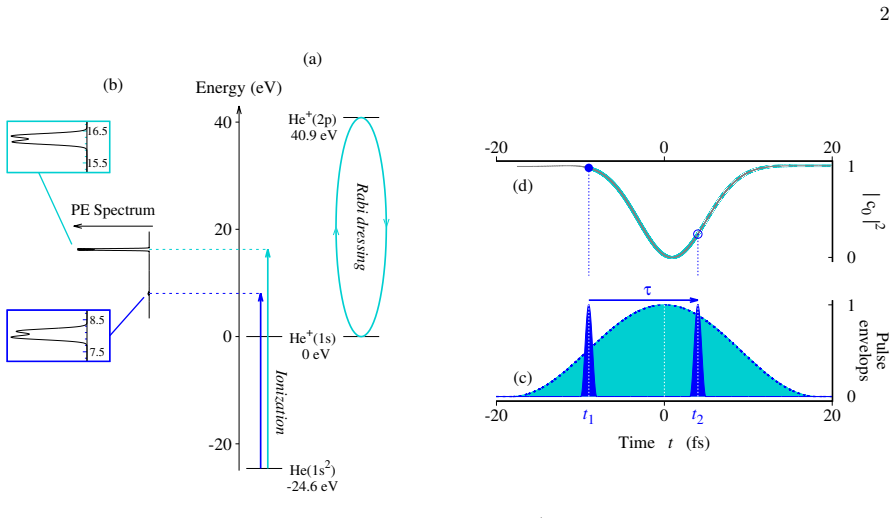
The load-bearing identity is $P = \tfrac{1}{2}(1+V^2)$, connecting the purity of the ionic reduced density matrix (the state of the ion alone after the electron's degrees of freedom are averaged out) to the visibility $V$ of the time-domain fringes in the photoelectron spectrum. The fringe pattern itself comes from a two-event ansatz in which the final state is a coherent superposition of two pure product states, one from ionization at time $t_1$ and one at $t_2$, with photoelectron spectral amplitudes differing only by the phase $e^{iE\tau}$ accumulated between birth times. The visibility is the overlap $V=|\langle\chi_1|\chi_2\rangle|$ of the two ionic dressed states, so it tracks how different the ionic superpositions are at the two ionization times; when they are orthogonal, $V=0$ and the purity drops to its entanglement-maximum value $1/2$. This machinery turns a spectral measurement into a state-tomography protocol for the dressed ion.
What would settle it
Measure the photoelectron spectrum for two short ionizing pulses with unequal intensities, and independently determine the ion purity by detecting the ionic state; if the observed purity deviates from $P=(1+V^2)/2$ computed from the fringe visibility, the equal-weight two-event ansatz is falsified.
Extended reading notes
Core claim
The central discovery is that time-domain interference is the entanglement mechanism in Rabi-dressed photoemission, and that the entanglement is quantitatively readable from the photoelectron spectrum. Writing the final electron-ion wavefunction as an equal-weight coherent superposition of two pure product states, one created at $t_1$ and one at $t_2$, with spectral amplitudes related by $\psi_2(E) = \psi_1(E) e^{iE\tau}$, the paper shows the total spectrum takes the form $S(E) = |\psi_1(E)|^2 [1 + V \cos(E\tau+\phi)]$, where $V = |\sum_j c_j(t_1)c_j^*(t_2)|$ is the overlap of the two ionic dressed states. Tracing out the photoelectron gives the ionic reduced density matrix, and the purity obeys $P = \mathrm{tr}(\rho_{\mathrm{ion}}^2)/\mathrm{tr}(\rho_{\mathrm{ion}})^2 = \tfrac{1}{2}(1+V^2)$. The same measurement also yields tomography: with one ionizing pulse after the dressing field has ended, the visibility and phase directly give $c_0(t)=V_0 e^{-i\phi_0}$, and a second scan gives $c_1(t)$ through Eq. (12). Numerical simulations on a two-electron model of helium reproduce the characteristic doublet and confirm both the purity mapping and the reconstructed ion dynamics.
Load-bearing premise
The whole derivation assumes that ionization happens at exactly two instants, with equal probability, and with the two electron wave packets differing only by a phase; if the real atom ionizes continuously throughout the pulse, the simple link between fringe visibility and ion purity is not guaranteed.
Editorial extensions
If this is right
- A photoelectron spectrum recorded with two time-delayed ionizing pulses yields the final ion purity directly from the fringe visibility, without any coincidence measurement.
- The measured visibility and phase give both the modulus and the phase of the dressed-state amplitude $c_0(t)$, and a second scan supplies $c_1(t)$, so the full ionic Rabi dynamics can be tomographed from spectra alone.
- At zero delay the two pulses merge, no fringes appear, $V=1$, and the purity is $1$, showing that ionization at a single well-defined time produces no electron-ion entanglement.
- When the delay reaches half a Rabi period, the purity drops to its minimum $1/2$, corresponding to maximal entanglement, matching the value found in the single-pulse experiment that shows the doublet.
- The characteristic doublet seen with one intense pulse is recovered when many ionization times sample the whole Rabi cycle, identifying that doublet as a time-domain interference signature.
Reading between the lines
- The two-event derivation suggests that the $P=(1+V^2)/2$ relation should hold for any equal-weight superposition of two product states whose relative phase is linear in the measured variable, so the same visibility-to-purity reading could transfer to other interferometers with which-path recorders.
- A testable extension beyond the paper is to use a train of more than two short ionizing pulses; the spectrum should then show multi-slit interference whose envelope encodes the full time-correlation function of the dressed ionic state, generalizing Eq. (7).
- If real ionization is continuous over the pulse rather than confined to two instants, the measured visibility would be an average over birth times, and Eq. (10) would report an effective purity; comparing that value with an independent measurement would quantify the validity of the two-event idealization.
Editorial analysis
A structured set of objections, weighed in public.
Referee Report
Summary. This manuscript studies electron-ion entanglement in photoemission from a Rabi-dressed ion, using a two-electron one-dimensional model of helium and tSurff-based numerical solution of the time-dependent Schrödinger equation. The authors propose that the entanglement originates from ionization events occurring at two different times, derive a relation P = (1 + V^2)/2 between the final ion purity and the visibility V of time-domain fringes in the photoelectron spectrum, and present a tomographic protocol that reconstructs the dressed ionic state coefficients c0(t) and c1(t) from the measured visibility and phase. The numerical simulations show good agreement between the purity extracted from the visibility and the purity computed directly from the ionic reduced density matrix for delays of 0, 2, 6, and 10 fs, and the reconstructed coefficients match the TDSE dynamics.
Significance. If the proposed relation and tomography protocol are correct, they offer an experimentally accessible route to the final ion purity and to the dressed-state dynamics from a single class of photoelectron spectra, which would be a valuable extension of the recent Nandi et al. experiment. The paper is clearly written, the analytic framework is simple and transparent, and the numerical validation uses a nontrivial two-active-electron model with quantitative agreement in Fig. 3 and Fig. 4. The main weakness is that the derivation of the central formula (10) silently ignores the overlap of the two photoelectron wavepackets in the trace, so the generality claimed for the formula is not established by the derivation as written. The numerical tests cover only a regime in which this overlap is small, and the tomography validation is largely a self-consistency check of the model. These issues are fixable, but they require either a corrected derivation with explicit validity conditions or a substantial revision of the claims.
major comments (3)
- [Formal derivation, Eqs. (2)-(10)] The derivation of Eq. (10) is incomplete because Eq. (9) is obtained from Eq. (2) only in the limit of orthogonal photoelectron wavepackets. Tracing the electron out of |Ψ⟩ = (|χ1⟩|ψ1⟩ + |χ2⟩|ψ2⟩)/√2 gives off-diagonal ionic coherences multiplied by γ = ⟨ψ1|ψ2⟩, and the total state is normalized only after dividing by 1 + Re(αγ); Eq. (9) drops both γ and this normalization. With Eq. (4), γ(τ) = ∫ dE |ψ1(E)|² e^{iEτ}, so γ(0) = 1 and γ is non-negligible whenever ΔE·τ ≲ 1. The manuscript does not state the condition ΔE·τ ≫ 1, and the numerical tests in Fig. 3 use τ = 0 or τ ≥ 2 fs with a bandwidth of roughly 2 eV, which is exactly the regime where γ is small. The final applicability conditions (i)-(ii) should be extended accordingly, or Eq. (10) should be replaced by the exact expression involving α and γ. Since Eq. (10) is the central claim, this gap must be fixed.
- [Two-event ansatz, Eqs. (2) and (4)] The two-event ansatz is assumed rather than derived. It gives equal weight to ionization at t1 and t2, assumes both ionic branches are launched from |g⟩, and assumes identical photoelectron spectral amplitudes apart from the phase e^{iEτ}. These assumptions exclude ground-state depletion, ionization from the excited ionic state, and any overlap of the two ionizing pulses when τ is comparable to T_I. Because Eqs. (10)-(12) are algebraic consequences of this ansatz, the good agreement in Figs. 3 and 4 demonstrates that the ansatz captures the model dynamics for the chosen parameters, but it does not by itself support the stated generality. The authors should either derive the ansatz from the time-dependent Schrödinger equation under the stated pulse conditions or explicitly list the conditions (e.g., weak per-pulse ionization, negligible excited-state ionization, τ ≫ T_I) under which the formulas are expected to hold.
- [Tomography, Eqs. (11)-(12)] The tomographic reconstruction is presented as a validation, but it is primarily a self-consistency check of the model. Equation (11) reads c0(t) directly from the visibility and phase of the same fitted spectrum whose functional form is derived from the model, and Eq. (12) obtains c1(t) by algebraically inverting Eq. (8). The agreement with the TDSE curves in Fig. 4 therefore confirms that the model's internal relations are satisfied by the numerical data, but it does not independently test the two-event ansatz against a measurement that is not already encoded in the visibility/phase extraction. The authors should state this limitation explicitly, or compare the reconstructed coefficients with a separately computed observable that does not enter the inversion.
minor comments (5)
- [General] There is a typo in the text where 'Ramsey' is written as 'Ramsay' in the phrase 'reminiscent of Ramsay fringes'.
- [Methods] The purity definition is written as P = tr(ρ²_ion)/tr(ρion)²; this should be P = tr(ρ_ion²)/(tr ρ_ion)² to avoid ambiguity.
- [Throughout] The word 'envelops' should be 'envelopes' in the descriptions of the pulse temporal profiles.
- [Figure 3] The visibility and phase values in Fig. 3(a) are stated for the fitted curves, but no fit residuals or uncertainty estimates are provided; adding these would strengthen the quantitative claim.
- [Introduction] The manuscript describes Eq. (2) as the 'normalized wavefunction', but as written the state has norm 1 + Re(αγ); this inconsistency should be corrected at the same time as the overlap issue in Eq. (9).
Circularity Check
No significant circularity: the purity-visibility relation is a derived identity under a stated ansatz and is tested against independent TDSE simulations.
full rationale
The paper's central result, P = (1/2)(1 + V^2), is derived algebraically from the two-event ansatz in Eq. (2) and the orthogonal-basis expansion leading to Eq. (9). The visibility V in Eq. (8) is the modulus of the same ionic overlap alpha that enters the reduced density matrix, so the purity formula is a consequence of the model rather than a fitted parameter renamed as a prediction. Numerical validation compares P obtained from V fitted to the TDSE photoelectron spectrum with the purity computed directly from the ion reduced density matrix of the full TDSE simulation; the latter is independent of the two-event ansatz, making this a genuine test. The tomographic formulas in Eqs. (11) and (12) invert the forward model of Eq. (8), recovering the model coefficients from synthetic spectra; this is a self-consistency check, but not circular, because the spectra and the exact ion dynamics are produced by the full simulation rather than by the ansatz itself. One technical caveat is that Eq. (9) silently drops the photoelectron overlap gamma = <psi1|psi2> when tracing Eq. (2); the exact reduced density matrix contains terms proportional to gamma and a normalization factor 1 + Re(alpha gamma). This is an unstated approximation, valid when the photoelectron spectrum is broad enough that Delta E * tau >> 1, and it is a correctness limitation rather than a circular step. No load-bearing self-citation, uniqueness imported from the authors, or ansatz smuggled in via citation was found.
Assumptions & free parameters
free parameters (2)
- soft-Coulomb potential parameters (1.1225, 0.6317, a=0.3028 a.u.) =
1.1225, 0.6317, a=0.3028
- spectral fringe visibility V and phase phi (per delay) =
e.g., V=0.94, phi=-0.06 rad at tau=2 fs; V=0.20, phi=-2.49 rad at tau=10 fs
assumptions (4)
- ad hoc to paper Equal-weight two-event ansatz, Eq. (2): |Psi> = (1/sqrt(2))(|chi1>|psi1> + |chi2>|psi2>), with each ion state launched from |g>.
- ad hoc to paper Identical spectral amplitudes, Eq. (4): psi2(E) = psi1(E) e^{i E tau}.
- domain assumption Orthogonality of the two photoelectron wave packets when tracing out the electron, leading to Eq. (9).
- domain assumption Soft-Coulomb model Hamiltonian (Eq. 1) with parameters from Ref. [32] faithfully represents the He and He+ levels relevant to the experiment.
Cite this review
Pith. "Pith review of Time-domain interferences as the source of electron-ion entanglement in Rabi-dressed photoemission." pith.science (2026). https://pith.science/paper/MOIQSBT2
@misc{pith2026250705850,
  author       = {Pith},
  title        = {Pith review of: Time-domain interferences as the source of electron-ion entanglement in Rabi-dressed photoemission},
  year         = {2026},
  howpublished = {\url{https://pith.science/paper/MOIQSBT2}},
  note         = {Machine review of arXiv:2507.05850}
}
read the original abstract
We investigate bipartite entanglement between a photoelectron and its parent ion when the latter undergoes Rabi oscillations, following the recent experiment of [Nandi et al. Science Advances 10, eado0668 (2024)]. Using numerical simulations on a model atom, we show that this entanglement results from ionization events occurring at different times, with the photoelectron leaving the ion in distinct superpositions of internal states due to the Rabi coupling. Our interpretation brings forward the possibility to access the purity of the photoion state from photoelectron spectra. Furthermore, we demonstrate a tomographic reconstruction of the dressed ionic state dynamics from the observable spectra.
Figures


Figures from the paper (1 more)

Reference graph
Works this paper leans on
- [1]
- [2]
- [3]
- [4]
- [5]
- [6]
-
[7]
C. A. Sackett, D. Kielpinski, B. E. King, C. Langer, V. Meyer, et al., Nature404, 256–259 (2000)
work page 2000
- [8]
Show all 38 references
-
[9]
Almanakly, B
A. Almanakly, B. Yankelevich, M. Hays, et al., Nat. Phys.21, 825–830 (2025)
2025
-
[10]
Yin, Y.-H
J. Yin, Y.-H. Li, S.-K. Liao, et al., Nature582, 501–505 (2020)
2020
-
[11]
M. J. J. Vrakking, Phys. Rev. Lett.126, 113203 (2021)
2021
-
[12]
L.-M. Koll, L. Maikowski, L. Drescher, T. Wit- ting, and M. J. J. Vrakking, Phys. Rev. Lett. 128, 043201 (2022)
2022
-
[13]
Graham, Y
T. Graham, Y. Song, J. Scott, et al., Nature604, 457–462 (2022)
2022
-
[14]
Evered, Bluvstein, M
S. Evered, Bluvstein, M. D., Kalinowski, et al., Nature622, 268–272 (2023)
2023
-
[15]
Einstein, B
A. Einstein, B. Podolsky, and N. Rosen, Phys. Rev.47, 777 (1935)
1935
-
[16]
K. L. Ishikawa, K. C. Prince, and K. Ueda, J. Phys. Chem. A127, 10638 (2023)
2023
-
[17]
Laurell, S
H. Laurell, S. Luo, R. Weissenbilder, et al., Nat. Photon.19, 352–357 (2025)
2025
-
[18]
Berkane, R
M. Berkane, R. Ta ¨ ıeb, G. Granveau, P. Sali` eres, C. Bourassin-Bouchet, C. L´ evˆ eque, and J. Cail- lat, Phys. Rev. A111, L041101 (2025)
2025
-
[19]
Shen, Y.-J
B.-R. Shen, Y.-J. Mao, Z.-H. Zhang, Y. Li, T. Sato, K. L. Ishikawa, and F. He, Phys. Rev. A111, 063113 (2025)
2025
-
[20]
Nandi, A
S. Nandi, A. Stenquist, A. Papoulia, et al., Sci- ence Advances10, eado0668 (2024)
2024
-
[21]
McNeil and N
B. McNeil and N. Thompson, Nature Photon4, 814–821 (2010)
2010
-
[22]
Grobe and J
R. Grobe and J. H. Eberly, Phys. Rev. A48, 623 (1993)
1993
-
[23]
M. G. Girju, K. Hristov, O. Kidun, and D. Bauer, Journal of Physics B: Atomic, Molec- ular and Optical Physics40, 4165 (2007)
2007
-
[24]
Rohringer and R
N. Rohringer and R. Santra, Phys. Rev. A77, 053404 (2008)
2008
-
[25]
P. V. Demekhin and L. S. Cederbaum, Phys. Rev. Lett.108, 253001 (2012)
2012
-
[26]
P. V. Demekhin and L. S. Cederbaum, Phys. Rev. A86, 063412 (2012)
2012
-
[27]
S. B. Zhang and N. Rohringer, Phys. Rev. A89, 013407 (2014)
2014
-
[28]
Y. Deng, X. Zhang, Y. Zhou, and P. Lu, Phys. Rev. A111, 043110 (2025)
2025
-
[29]
Wan, G.-Y
W.-Q. Wan, G.-Y. Liu, M.-F. Xie, Q.-B. Meng, and W.-C. Jiang, Phys. Rev. A111, 033117 (2025)
2025
-
[30]
Nandi, E
S. Nandi, E. Olofsson, M. Bertolino, et al., Na- ture608, 488–493 (2022)
2022
-
[31]
Stenquist and J
A. Stenquist and J. M. Dahlstr¨ om, Phys. Rev. Res.7, 013270 (2025)
2025
-
[32]
Yu and L
C. Yu and L. B. Madsen, Phys. Rev. A98, 033404 (2018)
2018
-
[33]
Tao and A
L. Tao and A. Scrinzi, New Journal of Physics 14, 013021 (2012)
2012
-
[34]
Scrinzi, New Journal of Physics14, 085008 (2012)
A. Scrinzi, New Journal of Physics14, 085008 (2012). 7
2012
-
[35]
N. F. Ramsey, Phys. Rev.78, 695 (1950)
1950
-
[36]
Dittel, G
C. Dittel, G. Dufour, G. Weihs, and A. Buch- leitner, Phys. Rev. X11, 031041 (2021)
2021
-
[37]
Blanes and P
S. Blanes and P. Moan, Journal of Compu- tational and Applied Mathematics142, 313 (2002)
2002
-
[38]
R. I. McLachlan, Communications in Computa- tional Physics31, 987 (2022)
2022
Reviewed August 6, 2026 · model on record in the stance chip above.
Discussion (0). Continue with ORCID to comment.