REVIEW 4 major objections 5 minor 72 references
Drag modelling for flows through assemblies of spherical particles with machine learning: A comparison of approaches
T0 review · 4 major / 5 minor · reviewed 2026-08-06 · deepseek-v4-flash
Pith's one-line read One GNN, trained across Reynolds numbers from 0.1 to 300, learns pairwise drag interactions that genetic programming can rewrite as compact symbolic expressions; the formulas explain the same features but lose a few points of $R^2$.
desk verdict Solid GNN results and an honest regime extension, but the symbolic-vs-GNN comparison is undermined by a target mismatch in the reported R^2. read the letter →
The pith
A machine-rendered reading of the paper's core claim, the machinery that carries it, and where it could break.
The reading
What carries the argument
The load-bearing object is the pairwise superposition ansatz, Eq. (8), which represents each particle's drag deviation as the sum of a single shared pairwise interaction function over its neighbours. The GNN's shared edge model learns that function from PR-DNS data; the GP algorithm then fits symbolic expressions to the extracted pairwise input\textendash output samples, with a feature-permutation analysis identifying which inputs the GNN relies on. The unit-aware GP framework with tuneable-constant 'joker' units, complexity control, and a Pareto archive supplies the search machinery that keeps the resulting formulas compact and dimensionally meaningful.
What would settle it
Train the genetic programming stage directly on pairwise residual targets formed from PR-DNS data (for instance, the difference between the pairwise-interaction-extended point-particle model and the full simulation) instead of on GNN outputs, and compare the resulting symbolic $R^2$ on the same test set. If the directly fitted formulas do not beat or match the GNN-derived ones, the symbolic expressions are largely reproducing the surrogate's view; if they do, the GNN transmission was the bottleneck. A second check is to test the final equations at intermediate Reynolds numbers (e.g., $\mathrm{Re}_p=20$ and $\mathrm{Re}_p=150$) that were not in the training set.
Extended reading notes
Core claim
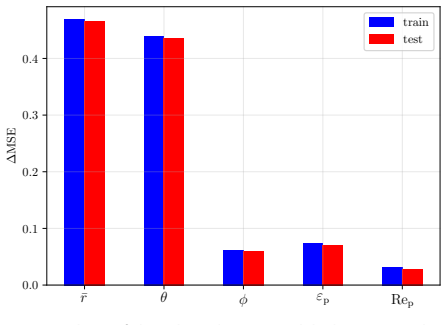
The paper's central claim is that a single GNN trained on PR-DNS data can learn, for all considered Reynolds numbers and volume fractions at once, the pairwise interaction function $\tilde{f}_x(\bar{r}_j,\theta_j,\varphi_j,\varepsilon_p,\mathrm{Re}_p)$ whose sum over the 30 nearest neighbours reproduces the per-particle drag deviation $\Delta F_{x,i}/\langle F_x\rangle$. On the test set the GNN attains $R^2$ values of 0.64\textendash 0.80 across $\mathrm{Re}_p$ and 0.63\textendash 0.79 across $\varepsilon_p$. Feeding the GNN's extracted pairwise outputs to a multi-objective, unit-aware GP search yields symbolic expressions per $\mathrm{Re}_p$ and per $\varepsilon_p$ with test $R^2$ of 0.46\textendash 0.64. The authors take this as evidence that the GP pipeline can find relatively simple symbolic models whose structure mirrors the GNN's learned importance pattern\textemdash distance and polar angle dominate, azimuthal angle never appears, and volume fraction appears less often than expected\textemdash while acknowledging that the symbolic models fall slightly behind the GNN in accuracy.
Load-bearing premise
The whole pipeline assumes the pairwise superposition ansatz is faithful and, more immediately, that the GNN's extracted pairwise outputs are an accurate representation of the true physics; if the GNN errs, the symbolic formulas inherit and propagate that error rather than correcting it.
Editorial extensions
If this is right
- If the claim is right, drag-deviation corrections for point-particle simulations can be written as small algebraic expressions per flow regime rather than as neural-network evaluations, which is cheaper and inspectable.
- The symbolic expressions' consistent exclusion of the azimuthal angle supports the pairwise-superposition view that drag variation around the mean is rotationally symmetric about the flow direction.
- Recurring patterns and sub-expressions in the GP results could be used as building blocks toward a single generalized symbolic drag-deviation model covering multiple $(\mathrm{Re}_p,\varepsilon_p)$ pairs.
- The accuracy gap between symbolic models and the GNN quantifies the interpretability cost and defines the target for future constraint-based GP refinements.
- The low feature importance of $\mathrm{Re}_p$ and $\varepsilon_p$ in the GNN suggests that local geometry, not global flow conditions, controls the deviation, so future closures should prioritize local arrangement features.
Reading between the lines
- Editorial inference: because the GP equations are fit to one selected GNN's pairwise outputs, their reported $R^2$ is an upper bound set by the GNN; the true quality relative to PR-DNS could be lower, and the equations may not capture physics the GNN missed.
- Editorial inference: the suggested multi-view approach\textemdash fitting equation constants separately for each $(\mathrm{Re}_p,\varepsilon_p)$ combination while sharing the functional form\textemdash could close much of the accuracy gap while preserving interpretability, and would be a cheap next experiment.
- Editorial inference: imposing physically motivated shape constraints, such as requiring the pairwise contribution to vanish as $\bar{r}\to\infty$ and to respect fore-aft symmetry at low $\mathrm{Re}_p$, could make the symbolic models extrapolate more safely than the GNN.
- Editorial inference: the framework is not specific to drag; the same GNN-to-GP distillation could be applied to lift and torque deviations, or to bidisperse assemblies, wherever a pairwise superposition ansatz is plausible.
Editorial analysis
A structured set of objections, weighed in public.
Referee Report
Summary. The paper presents a two-step machine-learning pipeline for modelling the variation of drag forces on spherical particles in random assemblies. A graph neural network (GNN) is first trained on particle-resolved direct numerical simulation (PR-DNS) data to predict the deviation of each particle's drag from the mean, using a pairwise superposition ansatz in which the particle-level deviation is the sum of per-neighbour edge-model outputs. In the second step, genetic programming (GP) is applied to the pairwise outputs extracted from the trained GNN edge model, producing compact symbolic expressions for the pairwise contribution. The GNN is trained once over all Reynolds numbers and volume fractions, and its test R^2 values range from about 0.64 to 0.80. The GP symbolic expressions, developed separately at fixed Rep or fixed εp, are reported with R^2 values between about 0.46 and 0.64. The paper concludes that GP can find relatively simple symbolic models whose accuracy 'slightly falls behind' the GNN, and presents a feature-importance analysis identifying inter-particle distance and polar angle as the most influential features.
Significance. If the central comparison were established, the contribution would be a useful, interpretable alternative to black-box GNN drag closures, extending earlier Stokes-regime work to finite Reynolds numbers. The paper has several genuine strengths: the GNN is characterized over 11 repeated runs with a held-out PR-DNS test set; the data are openly available; the GNN fidelity prerequisite is explicitly acknowledged in Section 3.1; and the feature-importance analysis is a reasonable way to link the GNN to the later symbolic expressions. However, the headline comparison between GNN and GP accuracy is not currently supported because the two reported R^2 values are computed on different targets (particle-level PR-DNS deviations versus pair-level GNN outputs). The symbolic expressions are not directly evaluated on PR-DNS data, so the claimed 'slightly fall behind' conclusion and the attribution of the discovered formulas to physical structure are not yet established.
major comments (4)
- [Section 4.2, Tables 5-7] The R^2 values in Tables 6 and 7 are computed on the pairwise interaction outputs extracted from the GNN (see Section 3.3 and Table 2), whereas the GNN R^2 values in Table 5 are computed on particle-level drag deviations against PR-DNS using Eq. (9). Comparing these two sets of numbers in Section 4.2 to conclude that the symbolic models 'slightly fall behind' the GNN is not a controlled comparison: a pair-level fit can be numerically different from its particle-level aggregate. No step is described in which the symbolic pairwise expressions are summed over the 30 neighbours, as in Eq. (8), and evaluated against PR-DNS labels. The manuscript should either perform this aggregate-level evaluation and report the resulting R^2 values, or explicitly reframe the claim as measuring how well GP reproduces the GNN's edge model, without implying comparable drag-prediction accuracy.
- [Section 3.1, Sections 3.3 and 4.2] The GP symbolic models are fitted exclusively to pairwise outputs of a single selected GNN, never to PR-DNS drag labels. Section 3.1 acknowledges that errors in the GNN will be propagated to the symbolic expressions. Consequently, the reported GP R^2 values bound the fidelity of the symbolic expressions to the GNN's learned pairwise decomposition, not to the physical drag data. To make the central claim that the discovered expressions capture physical structure, the paper should include an evaluation of the full symbolic models (summed over neighbours) against the held-out PR-DNS test set, and ideally quantify the propagation of GNN uncertainty by repeating the GP step on edge outputs from more than one of the 11 trained GNNs.
- [Section 4.1, model selection] The selection of the GNN used for GP target extraction is made by computing, for each of the 11 runs, the maximum train-test R^2 difference over Rep, and choosing the model with the lowest gap. This procedure uses the test labels to choose a model, and the same model's test R^2 is then reported in Table 5 and used as the GNN reference in the comparison with GP. This is a test-informed selection and can bias the reported GNN performance. The authors should either select the model using a validation partition only, or report the spread of the selection criterion and acknowledge the potential optimism in the reported GNN numbers.
- [Tables 6 and 7] The symbolic expressions in Tables 6 and 7 replace all numerical coefficients with placeholder variables C_k and the actual fitted values are never reported. As presented, these are templates rather than concrete symbolic models: the R^2 values cannot be independently reproduced, and the expressions cannot be used in any downstream simulation. The fitted constants should be reported for each displayed equation, or the code and fitted parameter sets should be made available, so that the symbolic models are actually usable and verifiable.
minor comments (5)
- [Section 4.1] In the text near Figure 6, the acronym 'PD-DNS' appears; it should be 'PR-DNS'.
- [Section 4.1, feature importance] The paper states that the azimuthal angle φ should have no influence due to rotational symmetry, yet the permutation analysis shows a small increase in MSE when φ is permuted. This discrepancy should be commented on — for example, as a small symmetry violation in the GNN — rather than left as an unexplained observation.
- [Section 4.2] The GP runs were repeated 11 times, but Tables 6 and 7 report only a single R^2 value for each displayed expression, with no indication of variance across runs. Reporting the range or standard deviation (or at least stating that the displayed expression is representative) would make the comparison much more informative.
- [Section 3.3] The paper says the GP target is the pairwise contribution f~x and the training features exclude either Rep or εp depending on the experiment. The captions of Tables 6 and 7 should state explicitly that the R^2 values are computed on the pair-level GP test set, to avoid the ambiguity discussed in the major comments.
- [Section 5] The conclusion says 'patters' instead of 'patterns'; the manuscript would benefit from a careful proofread for this and similar typographical errors.
Circularity Check
No significant circularity: the symbolic expressions are explicitly distilled from GNN pairwise outputs, and the central GNN evaluation is independently grounded in held-out PR-DNS data.
full rationale
The claimed pipeline is a supervised distillation chain, not a circular derivation. PR-DNS supplies particle-level drag deviations; the GNN is trained on those and decomposes them into pairwise edge outputs; the GP then fits symbolic edge expressions to those GNN-extracted pairwise outputs (Sections 3.1 and 3.3, Table 2). No equation is defined in terms of the quantity it is claimed to predict, and no fitted constant is relabeled as a discovery. The paper explicitly frames the symbolic models as approximating the GNN, stating that the GP 'searches for symbolic expressions that fit the input data' and aims to 'capture the underlying patterns learnt by the GNN,' while acknowledging that errors in the GNN 'will be further propagated to the resulting symbolic expressions.' The GNN R^2 values in Table 5 are evaluated against held-out PR-DNS via Eq. (9), which is independent of the GP fit. The main caveat, that the symbolic R^2 values in Tables 6/7 appear to be computed on the GNN-derived pair-level target rather than on particle-level PR-DNS, is a comparison-validity or correctness concern rather than a circularity of the derivation. Self-citations to the authors' prior Stokes-flow GP work provide context and design rationale but do not carry the empirical weight of the present results, which are benchmarked against the cited PR-DNS data. Therefore no step reduces to its own input by construction.
Assumptions & free parameters
free parameters (5)
- Symbolic expression constants C_k =
not reported
- GNN edge-model trainable weights =
not disclosed (30 neurons per hidden layer)
- Neighbour count N_n =
30
- GP complexity cap and population settings =
population 500, generations 200, max complexity 30
- log10(Rep) preprocessing transform =
applied
assumptions (5)
- domain assumption Drag deviation from the mean is a sum of independent pairwise interaction functions (Eq. 8).
- domain assumption A perfect mean drag model exists, so only the deviation Delta F_x / <F_x> needs modelling.
- domain assumption The PR-DNS dataset of van Wachem et al. [66,67] is accurate and representative for all Rep and eps_p pairs.
- ad hoc to paper The selected GNN's pairwise interaction outputs are a faithful target for symbolic regression.
- domain assumption Rotational symmetry about the streamwise axis makes the azimuthal angle phi nearly irrelevant.
Cite this review
Pith. "Pith review of Drag modelling for flows through assemblies of spherical particles with machine learning: A comparison of approaches." pith.science (2026). https://pith.science/paper/G3BLRTCA
@misc{pith2026250705983,
  author       = {Pith},
  title        = {Pith review of: Drag modelling for flows through assemblies of spherical particles with machine learning: A comparison of approaches},
  year         = {2026},
  howpublished = {\url{https://pith.science/paper/G3BLRTCA}},
  note         = {Machine review of arXiv:2507.05983}
}
read the original abstract
Drag forces on particles in random assemblies can be accurately estimated through particle-resolved direct numerical simulations (PR-DNS). Despite its limited applicability to relatively small assemblies, data obtained from PR-DNS has been the driving force for the development of drag closures for much more affordable simulation frameworks, such as Eulerian-Lagrangian point particle methods. Recently, more effort has been invested in the development of deterministic drag models that account for the effect of the structure of the particle assembly. Current successful deterministic models are mainly black-box neural networks which: 1) Assume pairwise superposition of the neighbours' effect on the drag, and 2) Are trained on PR-DNS data for a wide range of particle concentrations and flow regimes. To alleviate the black-box nature of neural networks, we use genetic programming (GP) to develop interpretable models. In our previous research, this has been proven successful in the Stokes regime. In the current contribution, we extend the application of GP to higher particle Reynolds number regimes. This is done by training a graph neural network (GNN) on the PR-DNS data to learn the pairwise interactions among the particles that constitute the drag variation. The significance of the input features of the GNN is assessed via a feature permutation approach. Then, the estimated pairwise interactions as extracted from the GNN are fed to a GP algorithm, which searches for symbolic expressions that fit the input data. A comparison between the trained GNN model and the resulting symbolic expressions is presented, to assess whether the symbolic expression can capture the underlying patterns learnt by the GNN. The comparison demonstrates the potential of GP in finding relatively simple symbolic models. At the same time, the accuracy of the symbolic models slightly fall behind the GNN.
Figures


Figures from the paper (5 more)


Reference graph
Works this paper leans on
-
[1]
Force variation within arrays of monodisperse spherical particles
Akiki, G., Jackson, T.L., Balachandar, S., 2016. Force variation within arrays of monodisperse spherical particles. Physical Review Fluids 1, 044202. doi:10.1103/PhysRevFluids.1.044202
-
[2]
Pairwise interaction extended point-particle model for a random array of monodisperse spheres
Akiki, G., Jackson, T.L., Balachandar, S., 2017a. Pairwise interaction extended point-particle model for a random array of monodisperse spheres. Journal of Fluid Mechanics 813, 882–928. doi:10.1017/jfm.2016.877
-
[3]
Pairwise-interaction extended point-particle model for particle-laden flows
Akiki, G., Moore, W.C., Balachandar, S., 2017b. Pairwise-interaction extended point-particle model for particle-laden flows. Journal of Computational Physics 351, 329–357. doi:10.1016/j.jcp.2017.07.056
-
[4]
Asadzadeh, M.Z., Gänser, H.P., Mücke, M., 2021. Symbolic regression based hybrid semiparametric modelling of processes: An example case of a bending process. Applications in Engineering Science 6, 100049. doi:10.1016/j. apples.2021.100049
arXiv 2021
-
[5]
Balachandar,S.,2020. LagrangianandEuleriandragmodelsthatareconsistentbetweenEuler-LagrangeandEuler-Euler (two-fluid)approachesforhomogeneoussystems.PhysicalReviewFluids5.doi: 10.1103/PhysRevFluids.5.084302
-
[6]
Theoretical and Computational Fluid Dynamics doi:10.1007/s00162-020-00538-8
Balachandar,S.,Moore,W.C.,Akiki,G.,Liu,K.,2020.Towardparticle-resolvedaccuracyinEuler–Lagrangesimulations of multiphase flow using machine learning and pairwise interaction extended point-particle (PIEP) approximation. Theoretical and Computational Fluid Dynamics doi:10.1007/s00162-020-00538-8
-
[7]
Bandaru, S., Deb, K., 2013. A Dimensionally-Aware Genetic Programming Architecture for Automated Innovization, in:Purshouse,R.C.,Fleming,P.J.,Fonseca,C.M.,Greco,S.,Shaw,J.(Eds.),EvolutionaryMulti-CriterionOptimization, Springer, Berlin, Heidelberg. pp. 513–527. doi:10.1007/978-3-642-37140-0_39
-
[8]
Relational inductive biases, deep learning, and graph networks
Battaglia, P.W., Hamrick, J.B., Bapst, V., Sanchez-Gonzalez, A., Zambaldi, V., Malinowski, M., Tacchetti, A., Raposo, D., Santoro, A., Faulkner, R., Gulcehre, C., Song, F., Ballard, A., Gilmer, J., Dahl, G., Vaswani, A., Allen, K., Nash, C., Langston,V.,Dyer,C.,Heess,N.,Wierstra,D.,Kohli,P.,Botvinick,M.,Vinyals,O.,Li,Y.,Pascanu,R.,2018. Relational inducti...
Show all 72 references
- [9]
-
[10]
Drag force of intermediate Reynolds number flow past mono-and bidisperse arrays of spheres
Beetstra, R., Van der Hoef, M., Kuipers, J., 2007. Drag force of intermediate Reynolds number flow past mono-and bidisperse arrays of spheres. AIChE journal 53, 489–501. doi:10.1002/aic
2007 doi
-
[11]
Geometric Deep Learning: Going beyond Euclidean data
Bronstein, M.M., Bruna, J., LeCun, Y., Szlam, A., Vandergheynst, P., 2017. Geometric Deep Learning: Going beyond Euclidean data. IEEE Signal Processing Magazine 34, 18–42. doi:10.1109/MSP.2017.2693418
2017
-
[12]
Machine Learning for Partial Differential Equations
Brunton, S.L., Kutz, J.N., 2023. Machine Learning for Partial Differential Equations. doi:10.48550/arXiv.2303. 17078
2023 doi
-
[13]
Discovering governing equations from data by sparse identification of nonlinear dynamical systems
Brunton, S.L., Proctor, J.L., Kutz, J.N., 2016. Discovering governing equations from data by sparse identification of nonlinear dynamical systems. Proceedings of the National Academy of Sciences 113, 3932–3937. doi:10.1073/pnas. 1517384113
2016 doi
-
[14]
Operon C++: an efficient genetic programming framework for symbolicregression,in:Proceedingsofthe2020GeneticandEvolutionaryComputationConferenceCompanion,ACM, Cancún Mexico
Burlacu, B., Kronberger, G., Kommenda, M., 2020. Operon C++: an efficient genetic programming framework for symbolicregression,in:Proceedingsofthe2020GeneticandEvolutionaryComputationConferenceCompanion,ACM, Cancún Mexico. pp. 1562–1570. doi:10.1145/3377929.3398099
2020
-
[15]
Solving symbolic regression problems with formal constraints, in: Proceedings of the Genetic and Evolutionary Computation Conference, ACM, Prague Czech Republic
Błądek, I., Krawiec, K., 2019. Solving symbolic regression problems with formal constraints, in: Proceedings of the Genetic and Evolutionary Computation Conference, ACM, Prague Czech Republic. pp. 977–984. doi:10.1145/ 3321707.3321743. 21
2019
-
[16]
A hybrid immersed boundary method for dense particle-laden flows
Chéron, V., Evrard, F., van Wachem, B., 2023. A hybrid immersed boundary method for dense particle-laden flows. Computers & Fluids , 105892doi:10.1016/j.compfluid.2023.105892
2023
- [17]
-
[18]
Discovering Symbolic Models from Deep Learning with Inductive Biases, in: Advances in Neural Information Processing Sys- tems, Curran Associates, Inc
Cranmer, M., Sanchez Gonzalez, A., Battaglia, P., Xu, R., Cranmer, K., Spergel, D., Ho, S., 2020. Discovering Symbolic Models from Deep Learning with Inductive Biases, in: Advances in Neural Information Processing Sys- tems, Curran Associates, Inc.. pp. 17429–17442. URL:https:...
2020
-
[19]
Scientific Machine Learning Through Physics–Informed Neural Networks: Where we are and What’s Next
Cuomo, S., Di Cola, V.S., Giampaolo, F., Rozza, G., Raissi, M., Piccialli, F., 2022. Scientific Machine Learning Through Physics–Informed Neural Networks: Where we are and What’s Next. Journal of Scientific Computing 92, 88. doi:10.1007/s10915-022-01939-z
2022 doi
- [20]
-
[21]
Discovery of Physics From Data: Universal Laws and Discrepancies
De Silva, B.M., Higdon, D.M., Brunton, S.L., Kutz, J.N., 2020. Discovery of Physics From Data: Universal Laws and Discrepancies. Frontiers in Artificial Intelligence 3, 25. doi:10.3389/frai.2020.00025
2020
-
[22]
A fast and elitist multiobjective genetic algorithm: NSGA-II
Deb, K., Pratap, A., Agarwal, S., Meyarivan, T., 2002. A fast and elitist multiobjective genetic algorithm: NSGA-II. IEEE Transactions on Evolutionary Computation 6, 182–197. doi:10.1109/4235.996017. conference Name: IEEE Transactions on Evolutionary Computation
2002
-
[23]
Conservative finite-volume framework and pressure-based algorithm for flows of incompressible, ideal-gas and real-gas fluids at all speeds
Denner, F., Evrard, F., van Wachem, B., 2020. Conservative finite-volume framework and pressure-based algorithm for flows of incompressible, ideal-gas and real-gas fluids at all speeds. Journal of Computational Physics 409, 109348. doi:10.1016/j.jcp.2020.109348
2020
-
[24]
Deterministic drag modelling for spherical particles in Stokes regime using data-driven approaches
Elmestikawy, H., Reuter, J., Evrard, F., Mostaghim, S., van Wachem, B., 2024. Data for the paper: "Deterministic drag modelling for spherical particles in Stokes regime using data-driven approaches". doi:10.5281/zenodo.10611852
2024 doi
- [25]
-
[26]
Alleviating overfitting in transformation-interaction-rational symbolic regression with multi- objective optimization
de França, F.O., 2023. Alleviating overfitting in transformation-interaction-rational symbolic regression with multi- objective optimization. Genetic Programming and Evolvable Machines 24, 13. doi:10.1007/s10710-023-09461-3
2023 doi
-
[27]
Shape-constrained multi-objective genetic programming for symbolic regression
Haider, C., De Franca, F., Burlacu, B., Kronberger, G., 2022a. Shape-constrained multi-objective genetic programming for symbolic regression. Applied Soft Computing 132, 109855. doi:10.1016/j.asoc.2022.109855
2022
-
[28]
Haider, C., de França, F.O., Kronberger, G., Burlacu, B., 2022b. Comparing optimistic and pessimistic constraint evaluation in shape-constrained symbolic regression, in: Proceedings of the Genetic and Evolutionary Computation Conference, ACM, Boston Massachusetts. pp. 938–945....
-
[29]
Shape-ConstrainedSymbolicRegressionwithNSGA-III,in:Moreno-Díaz,R.,Pichler, F., Quesada-Arencibia, A
Haider,C.,Kronberger,G.,2022. Shape-ConstrainedSymbolicRegressionwithNSGA-III,in:Moreno-Díaz,R.,Pichler, F., Quesada-Arencibia, A. (Eds.), Computer Aided Systems Theory – EUROCAST 2022, Springer Nature Switzerland, Cham. pp. 164–172. doi:10.1007/978-3-031-25312-6_19
2022 doi
-
[30]
A supervised machine learning approach for predicting variable drag forces on spherical particles in suspension
He, L., Tafti, D.K., 2019. A supervised machine learning approach for predicting variable drag forces on spherical particles in suspension. Powder Technology 345, 379–389. doi:10.1016/j.powtec.2019.01.013
2019 doi
-
[31]
Deep Generative Symbolic Regression
Holt, S., Qian, Z., van der Schaar, M., 2023. Deep Generative Symbolic Regression. doi:10.48550/arXiv.2401. 00282
2023 doi
-
[32]
End-to-end Symbolic Regression with Transformers, in: Koyejo, S
Kamienny, P.A., Lample, G., Charton, F., 2023. End-to-end Symbolic Regression with Transformers, in: Koyejo, S. (Ed.), 36th Conference on Neural Information Processing Systems (NeurIPS 2022). Curran Associates, Inc.. number 35 in Advances in Neural Information Processing Syste...
2023
-
[33]
Physics-informedmachinelearning
Karniadakis,G.E.,Kevrekidis,I.G.,Lu,L.,Perdikaris,P.,Wang,S.,Yang,L.,2021. Physics-informedmachinelearning. Nature Reviews Physics 3, 422–440. doi:10.1038/s42254-021-00314-5
2021 doi
-
[34]
Dimensionally Aware Genetic Programming, in: GECCO’99: Proceedings of the 1st Annual Conference on Genetic and Evolutionary Computation
Keijzer, M., Babovic, V., 1999. Dimensionally Aware Genetic Programming, in: GECCO’99: Proceedings of the 1st Annual Conference on Genetic and Evolutionary Computation. volume 2, pp. 1069–1076
1999
- [35]
-
[36]
Shape-Constrained Symbolic Regression—Improving Extrapolation with Prior Knowledge
Kronberger, G., De Franca, F.O., Burlacu, B., Haider, C., Kommenda, M., 2022. Shape-Constrained Symbolic Regression—Improving Extrapolation with Prior Knowledge. Evolutionary Computation 30, 75–98. doi:10.1162/ evco_a_00294
2022
-
[37]
Symbolic regression driven by training data and prior knowledge, in: Proceedings of the 2020 Genetic and Evolutionary Computation Conference, ACM, Cancún Mexico
Kubalík, J., Derner, E., Babuška, R., 2020. Symbolic regression driven by training data and prior knowledge, in: Proceedings of the 2020 Genetic and Evolutionary Computation Conference, ACM, Cancún Mexico. pp. 958–966. doi:10.1145/3377930.3390152
2020
-
[38]
Rediscovering orbital mechanics with machine learning
Lemos, P., Jeffrey, N., Cranmer, M., Ho, S., Battaglia, P., 2023. Rediscovering orbital mechanics with machine learning. Machine Learning: Science and Technology 4, 045002. doi:10.1088/2632-2153/acfa63
2023 doi
-
[39]
Dimensionally Aware Multi-Objective Genetic Programming for Automatic Crowd Behavior Modeling
Li, D., Zhong, J., 2020. Dimensionally Aware Multi-Objective Genetic Programming for Automatic Crowd Behavior Modeling. ACM Transactions on Modeling and Computer Simulation 30, 19:1–19:24. doi:10.1145/3391407. 22
2020 doi
-
[40]
MetaSymNet: A Dynamic Symbolic Regression Network Capable of Evolving into Arbitrary Formulations
Li, Y., Li, W., Yu, L., Wu, M., Liu, J., Li, W., Hao, M., Wei, S., Deng, Y., 2023. MetaSymNet: A Dynamic Symbolic Regression Network Capable of Evolving into Arbitrary Formulations. doi:10.48550/arXiv.2311.07326
-
[41]
Graphneuralnetwork-acceleratedLagrangianfluidsimulation
Li,Z.,Farimani,A.B.,2022. Graphneuralnetwork-acceleratedLagrangianfluidsimulation. Computers&Graphics103, 201–211. doi:10.1016/j.cag.2022.02.004
2022 doi
-
[42]
IntroducingThermodynamics-InformedSymbolicRegression – A Tool for Thermodynamic Equations of State Development
Martinek,V.,Frotscher,O.,Richter,M.,Herzog,R.,2023. IntroducingThermodynamics-InformedSymbolicRegression – A Tool for Thermodynamic Equations of State Development. doi:10.48550/arXiv.2309.02805
-
[43]
Mei, Y., Nguyen, S., Zhang, M., 2017. Constrained Dimensionally Aware Genetic Programming for Evolving Interpretable Dispatching Rules in Dynamic Job Shop Scheduling, in: Shi, Y., Tan, K.C., Zhang, M., Tang, K., Li, X., Zhang,Q.,Tan,Y.,Middendorf,M.,Jin,Y.(Eds.),SimulatedEvolu...
2017 doi
-
[44]
PyTorch: An Imperative Style, High-Performance Deep Learning Library doi:10.48550/ARXIV
Paszke, A., Gross, S., Massa, F., Lerer, A., Bradbury, J., Chanan, G., Killeen, T., Lin, Z., Gimelshein, N., Antiga, L., Desmaison, A., Köpf, A., Yang, E., DeVito, Z., Raison, M., Tejani, A., Chilamkurthy, S., Steiner, B., Fang, L., Bai, J., Chintala, S., 2019. PyTorch: An Imp...
-
[45]
Deepsymbolicregression: Recoveringmathematicalexpressionsfromdataviarisk-seekingpolicygradients
Petersen,B.K., Landajuela,M.,Mundhenk,T.N., Santiago,C.P.,Kim,S.K., Kim,J.T.,2021. Deepsymbolicregression: Recoveringmathematicalexpressionsfromdataviarisk-seekingpolicygradients. doi: 10.48550/arXiv.1912.04871. arXiv:1912.04871 [cs, stat]
-
[46]
Powers, S., Smith, J., Pinciroli, C., 2022. Extracting Symbolic Models of Collective Behaviors with Graph Neural Networks and Macro-Micro Evolution, in: Dorigo, M., Hamann, H., López-Ibáñez, M., García-Nieto, J., Engelbrecht, A.,Pinciroli,C.,Strobel,V.,Camacho-Villalón,C.(Eds....
2022 doi
-
[47]
Physics-informed neural networks: A deep learning framework for solvingforwardandinverseproblemsinvolvingnonlinearpartialdifferentialequations
Raissi, M., Perdikaris, P., Karniadakis, G., 2019. Physics-informed neural networks: A deep learning framework for solvingforwardandinverseproblemsinvolvingnonlinearpartialdifferentialequations. JournalofComputationalPhysics 378, 686–707. doi:10.1016/j.jcp.2018.10.045
2019 doi
-
[48]
Hidden fluid mechanics: Learning velocity and pressure fields from flow visualizations
Raissi, M., Yazdani, A., Karniadakis, G.E., 2020. Hidden fluid mechanics: Learning velocity and pressure fields from flow visualizations. Science 367, 1026–1030. doi:10.1126/science.aaw4741
2020 doi
-
[49]
Towards Improving Simulations of Flows around Spherical Particles Using Genetic Programming, in: 2022 IEEE Congress on Evolutionary Computation (CEC), pp
Reuter, J., Cendrollu, M., Evrard, F., Mostaghim, S., van Wachem, B., 2022. Towards Improving Simulations of Flows around Spherical Particles Using Genetic Programming, in: 2022 IEEE Congress on Evolutionary Computation (CEC), pp. 1–8. doi:10.1109/CEC55065.2022.9870301
2022
-
[50]
Graph Networks as Inductive Bias for Genetic Programming: Symbolic Models for Particle-Laden Flows, Springer Nature Switzerland, Cham
Reuter, J., Elmestikawy, H., Evrard, F., Mostaghim, S., van Wachem, B., 2023. Graph Networks as Inductive Bias for Genetic Programming: Symbolic Models for Particle-Laden Flows, Springer Nature Switzerland, Cham. volume 13986. doi:10.1007/978-3-031-29573-7_3
2023 doi
-
[51]
Reuter, J., Martinek, V., Herzog, R., Mostaghim, S., 2024. Unit-Aware Genetic Programming for the Development of Empirical Equations, in: Affenzeller, M., Winkler, S.M., Kononova, A.V., Trautmann, H., Tušar, T., Machado, P., Bäck,T.(Eds.),ParallelProblemSolvingfromNature–PPSNX...
2024 doi
-
[52]
Sedimentation and fluidisation: Part I
Richardson, J., Zaki, W., 1954. Sedimentation and fluidisation: Part I. Transactions of the Institution of Chemical Engineers 32, 35–53. doi:10.1016/S0263-8762(97)80006-8
1954 doi
-
[53]
Russeil, E., de França, F.O., Malanchev, K., Burlacu, B., Ishida, E., Leroux, M., Michelin, C., Moinard, G., Gangler, E.,
- [54]
-
[55]
Schmidt,M.D.,Lipson,H.,2009. Incorporatingexpertknowledgeinevolutionarysearch:astudyofseedingmethods,in: Proceedings of the 11th Annual conference on Genetic and evolutionary computation, ACM, Montreal Québec Canada. pp. 1091–1098. doi:10.1145/1569901.1570048
2009
-
[56]
Improving Expert Knowledge in Dynamic Process Monitoring by Symbolic Regression,in:2012SixthInternationalConferenceonGeneticandEvolutionaryComputing,IEEE,Kitakyushu,Japan
Schwab, I., Senn, M., Link, N., 2012. Improving Expert Knowledge in Dynamic Process Monitoring by Symbolic Regression,in:2012SixthInternationalConferenceonGeneticandEvolutionaryComputing,IEEE,Kitakyushu,Japan. pp. 132–135. doi:10.1109/ICGEC.2012.105
2012 doi
-
[57]
Microstructure-informedprobability-drivenpoint-particlemodelforhydrodynamic forces and torques in particle-laden flows
Seyed-Ahmadi,A.,Wachs,A.,2020. Microstructure-informedprobability-drivenpoint-particlemodelforhydrodynamic forces and torques in particle-laden flows. Journal of Fluid Mechanics 900. doi:10.1017/jfm.2020.453
2020 doi
-
[58]
Physics-inspired architecture for neural network modeling of forces and torques in particle-laden flows
Seyed-Ahmadi, A., Wachs, A., 2022. Physics-inspired architecture for neural network modeling of forces and torques in particle-laden flows. Computers & Fluids 238, 105379. doi:10.1016/j.compfluid.2022.105379
2022
-
[59]
Point-particle drag, lift, and torque closure models using machine learning: Hierarchical approach and interpretability
Siddani, B., Balachandar, S., 2023. Point-particle drag, lift, and torque closure models using machine learning: Hierarchical approach and interpretability. Physical Review Fluids 8, 014303. doi:10.1103/PhysRevFluids.8. 014303
2023 doi
-
[60]
Investigatingtheinfluenceofparticledistributiononforce and torque statistics using hierarchical machine learning
Siddani,B.,Balachandar,S.,Zhou,J.,Subramaniam,S.,2024. Investigatingtheinfluenceofparticledistributiononforce and torque statistics using hierarchical machine learning. AIChE Journal , e18339doi:10.1002/aic.18339. 23
2024 doi
-
[61]
A new drag correlation from fully resolved simulations of flow past monodisperse static arrays of spheres
Tang, Y., Peters, E.A.J.F., Kuipers, J.A.M., Kriebitzsch, S.H.L., van der Hoef, M.A., 2015. A new drag correlation from fully resolved simulations of flow past monodisperse static arrays of spheres. AIChE Journal 61, 688–698. doi:10.1002/aic.14645
2015 doi
-
[62]
Deep Symbolic Regression for Physics Guided by Units Constraints: Toward the Automated Discovery of Physical Laws
Tenachi, W., Ibata, R., Diakogiannis, F.I., 2023. Deep Symbolic Regression for Physics Guided by Units Constraints: Toward the Automated Discovery of Physical Laws. The Astrophysical Journal 959, 99. doi:10.3847/1538-4357/ ad014c
2023 doi
-
[63]
Draglawformonodispersegas–solidsystemsusingparticle-resolveddirect numericalsimulationof flowpastfixedassembliesofspheres
Tenneti,S.,Garg,R.,Subramaniam,S.,2011. Draglawformonodispersegas–solidsystemsusingparticle-resolveddirect numericalsimulationof flowpastfixedassembliesofspheres. InternationalJournalofMultiphase Flow37,1072–1092. doi:10.1016/j.ijmultiphaseflow.2011.05.010
2011 doi
-
[64]
AI Feynman 2.0: Pareto- optimal symbolic regression exploiting graph modularity, in: Larochelle, H., Ranzato, M., Hadsell, R., Bal- can, M., Lin, H
Udrescu, S.M., Tan, A., Feng, J., Neto, O., Wu, T., Tegmark, M., 2020. AI Feynman 2.0: Pareto- optimal symbolic regression exploiting graph modularity, in: Larochelle, H., Ranzato, M., Hadsell, R., Bal- can, M., Lin, H. (Eds.), Advances in Neural Information Processing Systems...
2020
-
[65]
AIFeynman:Aphysics-inspiredmethodforsymbolicregression
Udrescu,S.M.,Tegmark,M.,2020. AIFeynman:Aphysics-inspiredmethodforsymbolicregression. ScienceAdvances 6, eaay2631. doi:10.1126/sciadv.aay2631. publisher: American Association for the Advancement of Science
2020 doi
-
[66]
Microstructure-based prediction of hydrodynamic forces in stationary particle assemblies
van Wachem, B., Chéron, V., Elmestikawy, H., 2023. Microstructure-based prediction of hydrodynamic forces in stationary particle assemblies. doi:10.5281/ZENODO.8282784
2023 doi
-
[67]
Microstructure-basedpredictionofhydrodynamicforcesinstation- ary particle assemblies
VanWachem,B.,Elmestikawy,H.,Chéron,V.,2024. Microstructure-basedpredictionofhydrodynamicforcesinstation- ary particle assemblies. International Journal of Multiphase Flow 175, 104815. doi:10.1016/j.ijmultiphaseflow. 2024.104815
2024
-
[68]
Data driven modeling of plastic deformation
Versino, D., Tonda, A., Bronkhorst, C.A., 2017. Data driven modeling of plastic deformation. Computer Methods in Applied Mechanics and Engineering 318, 981–1004. doi:10.1016/j.cma.2017.02.016
2017 doi
-
[69]
Machine Learning the Gravity Equation for International Trade
Verstyuk, S., Douglas, M.R., 2022. Machine Learning the Gravity Equation for International Trade. SSRN Electronic Journal doi:10.2139/ssrn.4053795
2022 doi
-
[70]
Machine Learning with Physics Knowledge for Prediction: A Survey
Watson, J., Song, C., Weeger, O., Gruner, T., Le, A.T., Hansel, K., Hendawy, A., Arenz, O., Trojak, W., Cranmer, M., D’Eramo, C., Bülow, F., Goyal, T., Peters, J., Hoffman, M.W., 2024. Machine Learning with Physics Knowledge for Prediction: A Survey. doi:10.48550/arXiv.2408.09840
-
[71]
Zille, H., Evrard, F., Reuter, J., Mostaghim, S., Wachem, B., 2021. Assessment of Multi-objective and Coevolutionary GeneticProgrammingforPredictingtheStokesFlowaroundaSphere,in:14thInternationalConferenceonEvolutionary and Deterministic Methods for Design, Optimization and Co...
2021
-
[2024]
MultiviewSymbolicRegression,in:ProceedingsoftheGeneticandEvolutionaryComputationConference,ACM, Melbourne VIC Australia. pp. 961–970. doi:10.1145/3638529.3654087
Reviewed August 6, 2026 · model on record in the stance chip above.
Discussion (0). Sign in to comment.