REVIEW 3 major objections 6 minor 49 references
Kernel Trace Distance: Quantum Statistical Metric between Measures through RKHS Density Operators
T0 review · 3 major / 6 minor · reviewed 2026-08-06 · deepseek-v4-flash
Pith's one-line read A new kernel distance between measures sits between MMD and total variation and converges at dimension-free rates.
desk verdict A genuinely useful kernel distance with solid rates, but the TV bound is off by a factor of 2 and the computation section needs a fix before this is citable as-is. read the letter →
The pith
A machine-rendered reading of the paper's core claim, the machinery that carries it, and where it could break.
The reading
What carries the argument
The load-bearing object is the RKHS density operator $\Sigma_\mu=\int \varphi(x)\varphi(x)^*\,d\mu(x)$, a self-adjoint positive operator of trace one when the kernel satisfies $k(x,x)=1$; the distance is the Schatten 1-norm of the difference of two such operators. Its dual representation as a supremum over bounded operators $U$ yields the IPM function class $\mathcal{F}_1$, which is what connects the norm to a statistical distance. For finite samples, the signed difference $\Sigma_{\mu_n}-\Sigma_{\nu_m}$ is encoded by a difference kernel matrix $K=Z^*Z$ whose complex off-diagonal entries $i\sqrt{|(\mu_n-\nu_m)(\{z_k\})|}$ absorb the signs of the weights; the paper claims $K$ and $\Sigma_{\mu_n}-\Sigma_{\nu_m}$ share the same eigenvalues, so the norm is read off from a finite matrix. The convergence proof splits the error with projection operators and uses kernel PCA concentration bounds for the projected pieces.
What would settle it
Compute empirical $d_{\mathrm{KT}}$ on distributions engineered to have slow spectral decay, for example heavy-tailed data with polynomial eigenvalue exponent $\alpha \le 1$, and check whether the rate $n^{-1/2+1/(2\alpha)}$ is observed; a clear breakdown would refute the dimension-free claim. A more localized check: on a three-point signed example, compare the eigenvalues of the complex difference kernel matrix $K$ from Proposition 2.3 with the eigenvalues of $\Sigma_{\mu_n}-\Sigma_{\nu_m}$ computed directly on the finite feature span; a mismatch would falsify the computation claim.
Extended reading notes
Core claim
The central claim is that $\Sigma_\mu \mapsto \|\Sigma_\mu-\Sigma_\nu\|_1$ defines a metric $d_{\mathrm{KT}}$ with $\operatorname{MMD}_{k^2}(\mu,\nu) \le d_{\mathrm{KT}}(\mu,\nu) \le \|\mu-\nu\|_{\mathrm{TV}}$, and that $d_{\mathrm{KT}}$ is an IPM generated by $\mathcal{F}_1=\{x \mapsto \varphi(x)^*U\varphi(x) : \|U\|_\infty=1\}$. Under Assumption 1, a kernel with unit diagonal, $d_{\mathrm{KT}}$ is Lipschitz in the kernel feature map, bounded by a kernel Wasserstein distance, stable under $\varepsilon$-contamination, and its empirical counterpart converges to the population value at rate $n^{-1/2+1/(2\alpha)}$ under polynomial eigenvalue decay or $(\log n)^{3/2}/\sqrt{n}$ under exponential decay. The paper further asserts that for discrete measures the distance is computed exactly by the eigenvalues of a difference kernel matrix built from signed, complex-weighted feature vectors, giving an $O(r^3)$ algorithm on $r$ distinct sample points.
Load-bearing premise
The dimension-free rate theorem depends on the unverified assumption that the population covariance operator's eigenvalues are positive, simple, and decay at a known polynomial or exponential rate; if the spectrum of a real distribution decays more slowly, the claimed $n^{-1/2}$-style rates need not hold.
Editorial extensions
If this is right
- For any characteristic kernel, $d_{\mathrm{KT}}$ is a metric and separates any two distinct measures, while $\operatorname{MMD}_{k^2} \le d_{\mathrm{KT}}$ guarantees at least as much separating power as MMD.
- Two-sample comparisons with $d_{\mathrm{KT}}$ are computable in $O((n+m)^3)$ through the difference kernel matrix, replacing neural-network optimization of the covariance-matching dual.
- Empirical $d_{\mathrm{KT}}$ converges to the population value at $n^{-1/2+1/(2\alpha)}$ or $(\log n)^{3/2}/\sqrt{n}$, independent of the ambient dimension, and the same dimension-free rates transfer to the kernel Bures-Wasserstein distance.
- Under $\varepsilon$-contamination, $d_{\mathrm{KT}}$ shifts by at most $2\varepsilon$, so ABC with a $d_{\mathrm{KT}}$ discrepancy stays reliable when a fraction of observations are outliers.
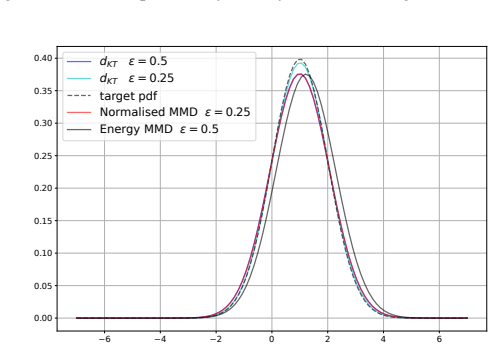
- As a gradient-flow objective, $d_{\mathrm{KT}}$ avoids the flattening that MMD's internal energy causes, which the particle-flow experiments exhibit.
Reading between the lines
- If the claimed rates survive contact with real spectra, $d_{\mathrm{KT}}$ could give kernel two-sample testing a practical way to keep discriminative power at high dimension; this is an extension the paper motivates but does not demonstrate beyond its experiments.
- The complex-weight extension of the Gram matrix could transfer to other signed-measure kernel tools, such as kernel Stein discrepancies, energy distances, or minimum distance estimators, wherever the difference of two empirical measures is the object of interest.
- The normalized-energy analysis suggests that any Schatten-1-style objective will be less prone than MMD to pushing particles outward in gradient flows; a direct comparison on other kernels and dimensions would test that prediction.
- The dimension-free rate for the kernel Bures-Wasserstein distance is a corollary the paper flags as new, but minimax optimality is not addressed, so a natural next check is whether the exponents are improvable.
Editorial analysis
A structured set of objections, weighed in public.
Referee Report
Summary. The paper introduces the kernel trace distance d_KT(µ,ν) = ||Σ_µ − Σ_ν||_1 between probability measures, based on RKHS covariance (density) operators. It establishes that d_KT is an integral probability metric, compares it to MMD, Wasserstein, Bures, and KKL-type distances, provides a finite-sample computational scheme via a signed 'difference kernel matrix', and derives dimension-free statistical convergence rates under polynomial or exponential eigenvalue decay of the population covariance operator. The numerical experiments demonstrate its use in robust approximate Bayesian computation and particle gradient flows.
Significance. The central idea of the paper—comparing measures through the Schatten-1 norm of their kernel covariance operators—is appealing and well-motivated from quantum information theory. The paper provides several theoretically interesting structural results: the IPM representation of d_KT, the MMD lower bound via the Schatten-2 norm, the Fuchs–van de Graaf inequalities for the kernel Bures–Wasserstein distance, and dimension-free convergence rates that would compare favorably with Wasserstein-type metrics. The authors also deliver a practical algorithm and credible experiments on ABC and particle flows, which are relevant applications. If the technical issues in the comparison inequalities and the spectral computation are resolved, this would be a valuable contribution to the kernel methods and statistical distances literature.
major comments (3)
- [§3.1, Corollary 3.2] The claimed upper bound d_KT(µ,ν) ≤ ||µ−ν||_TV is not established by the given proof. Proposition 3.1(ii) only shows that every f ∈ F1 takes values in [−1,1], and the IPM representation gives d_KT = sup_{f∈F1}|E_µ[f]−E_ν[f]|; the largest possible gap for functions bounded by 1 is 2, so the most that follows is d_KT ≤ 2||µ−ν||_TV. The factor 2 is not removable: for µ=δ_x and ν=δ_y with k(x,y)=0, d_KT = ||φ(x)φ(x)*−φ(y)φ(y)*||_1 = 2 while ||µ−ν||_TV = 1. The sandwich presented in the paper and in the abstract should be corrected accordingly.
- [§2.3, Proposition 2.3 and following paragraph] The construction of the difference kernel matrix K is under-specified, and the instruction to use SVD or Takagi factorization to 'get the eigenvalues' of K is problematic: the matrix K defined with blocks such as (i/√(mn))K_XY is not Hermitian positive semidefinite, and the SVD yields singular values rather than the signed eigenvalues needed to compute the Schatten-1 norm. The proof in Appendix A.4 relates the spectra of ZZ* and Z*Z, but the eigenvalue sign and the precise link to d_KT need a more careful treatment. Please specify the exact factorization (e.g., Takagi factorization of the complex symmetric matrix) that recovers the signed spectrum, and verify the method on a simple two-point example.
- [§4, Lemma 4.1 and Theorem 4.2] The rates in Theorem 4.2 depend on the eigenvalue decay assumptions P and E as well as Assumption 2, but several constants and technical conditions are not fully specified. In particular, the exponential-decay case in Lemma 4.1 presents a bound of order (log n)/√n for θ ≥ 1 without stating the precise dependence on θ, and the final rate (log n)^{3/2}/√n is obtained only by an argument that mentions 'θ=1' without showing how the three or four terms are balanced in the proof sketch. Please provide a complete proof of the exponential case with all constants and the exact choice of l and θ.
minor comments (6)
- [§2.3] The notation K = Z*Z is ambiguous because Z is first defined as a column of vectors and then as a linear map; please clarify the dimensions and ordering of the matrix entries.
- [§3.1, Corollary 3.4] The constant 2 in d_KT ≤ 2W_{c_k}(µ,ν) is presented without a sharpness discussion; a brief remark on whether this factor is optimal would help readers compare with the TV bound.
- [§3.2, Proposition 3.5] The orthogonality assumption on Σ_{µ1}, Σ_{ν1} and Σ_{µ2}, Σ_{ν2} is used without a precise definition of orthogonality for the signed summands; please clarify this in the proof.
- [§4.1, Assumption 2] The simplicity of eigenvalues is assumed for both Σ_µ and Σ_{µ_n} without discussion; please indicate its role in the proof and how it is dealt with in the experiments.
- [§5, Table 1] The ABC results in Table 1 report averages without standard deviations or the number of repetitions for the main comparisons; please add these details to assess the stability of the results.
- [Throughout] The definition ||µ−ν||_TV = (1/2)∫|dµ−dν| is used together with the statement that TV is a special Wasserstein case with cost 1_{x=y}; this is inconsistent because the Wasserstein-1 distance uses the unnormalized cost, and the normalization should be clarified.
Circularity Check
No circularity: the central claims follow from Schatten-norm duality, norm ordering, and external kernel-PCA results; same-author citations are background only.
full rationale
No circular step is present in the derivation chain. Definition 2.1 fixes d_KT as a Schatten-1 norm of a difference of covariance operators, and the IPM representation in Proposition 3.1(i) is the standard dual characterization of the Schatten norm (Eq. 2), not an input disguised as a conclusion. The comparison MMD_k2 <= d_KT (Lemma 3.3) follows from the ordering of Schatten p-norms and the identity ||Sigma_mu - Sigma_nu||_2 = MMD_k2, which is derived from a four-fold kernel product; no fitted parameter is renamed as a prediction. The convergence rates in Theorem 4.2 are obtained by a triangle-inequality decomposition (Eq. 11) and imported kernel-PCA estimates from Sterge et al. (2020), Blanchard et al. (2007), and Rudi et al. (2013), which are external results rather than self-citations; Assumptions 2, P, and E are stated hypotheses defining the rate regime, not conclusions obtained by fitting. The same-author references (Chazal et al. 2024, Korba et al. 2021) appear only as background, experimental baselines, or contextual prior work on KKL properties and gradient flows, and none is load-bearing for the central claims. The main reviewer concern about Corollary 3.2 (functions bounded by 1 yield an IPM of at most 2*TV, so the stated d_KT <= TV is not established) is a correctness defect, not a circular reduction, and it does not feed back into the definition of d_KT or into the rates. Therefore, the derivation is self-contained against external benchmarks and no circularity is identified.
Assumptions & free parameters
free parameters (2)
- Gaussian kernel bandwidth sigma =
sigma=1 in ABC; sigma=1 and 0.5 in particle flow
- Eigenvalue decay exponents alpha and tau (Assumptions P/E) =
assumed, not fitted
assumptions (6)
- ad hoc to paper Assumption 1: k(x,x)=1 for all x
- domain assumption Assumption 0: separable X, Borel sigma-algebra, separable RKHS with bounded continuous strictly positive kernel
- domain assumption Assumption 2: eigenvalues of Sigma_mu and Sigma_mu_n are positive, simple, decreasing
- domain assumption Assumption P: lambda_i ~ i^{-alpha} and Assumption E: lambda_i ~ e^{-tau i}
- domain assumption The kernel is characteristic (Phi injective) so d_KT is a metric
- ad hoc to paper Finite sample representer: for distinct z_k, phi(z_k) linearly independent; difference kernel matrix K has same eigenvalues as Sigma_{mu_n - nu_m}
invented entities (1)
-
Difference kernel matrix K
Cite this review
Pith. "Pith review of Kernel Trace Distance: Quantum Statistical Metric between Measures through RKHS Density Operators." pith.science (2026). https://pith.science/paper/I2OJHAG3
@misc{pith2026250706055,
  author       = {Pith},
  title        = {Pith review of: Kernel Trace Distance: Quantum Statistical Metric between Measures through RKHS Density Operators},
  year         = {2026},
  howpublished = {\url{https://pith.science/paper/I2OJHAG3}},
  note         = {Machine review of arXiv:2507.06055}
}
read the original abstract
Distances between probability distributions are a key component of many statistical machine learning tasks, from two-sample testing to generative modeling, among others. We introduce a novel distance between measures that compares them through a Schatten norm of their kernel covariance operators. We show that this new distance is an integral probability metric that can be framed between a Maximum Mean Discrepancy (MMD) and a Wasserstein distance. In particular, we show that it avoids some pitfalls of MMD, by being more discriminative and robust to the choice of hyperparameters. Moreover, it benefits from some compelling properties of kernel methods, that can avoid the curse of dimensionality for their sample complexity. We provide an algorithm to compute the distance in practice by introducing an extension of kernel matrix for difference of distributions that could be of independent interest. Those advantages are illustrated by robust approximate Bayesian computation under contamination as well as particle flow simulations.
Figures


Figures from the paper (5 more)



Reference graph
Works this paper leans on
-
[1]
Integral probability metrics PAC-bayes bounds
Ron Amit, Baruch Epstein, Shay Moran, and Ron Meir. Integral probability metrics PAC-bayes bounds . Advances in Neural Information Processing Systems, 35: 0 3123--3136, 2022
work page 2022
-
[2]
Maximum Mean Discrepancy Gradient Flow
Michael Arbel, Anna Korba, Adil Salim, and Arthur Gretton. Maximum Mean Discrepancy Gradient Flow . Advances in Neural Information Processing Systems, 32, 2019
work page 2019
-
[3]
Wasserstein generative adversarial networks
Martin Arjovsky, Soumith Chintala, and L \'e on Bottou. Wasserstein generative adversarial networks. In International Conference on Machine Learning, pages 214--223. PMLR, 2017
work page 2017
-
[4]
Sur les matrices hypohermitiennes et sur les matrices unitaires
L \'e on Autonne. Sur les matrices hypohermitiennes et sur les matrices unitaires. A. Rey, 1915
work page 1915
-
[5]
Information theory with kernel methods
Francis Bach. Information theory with kernel methods. IEEE Transactions on Information Theory, 69 0 (2): 0 752--775, 2022
work page 2022
-
[6]
Statistical Inference: the Minimum Distance Approach
Ayanendranath Basu, Hiroyuki Shioya, and Chanseok Park. Statistical Inference: the Minimum Distance Approach . CRC press, 2011
work page 2011
-
[7]
Approximate Bayesian computation with the Wasserstein distance
Espen Bernton, Pierre E Jacob, Mathieu Gerber, and Christian P Robert. Approximate Bayesian computation with the Wasserstein distance . Journal of the Royal Statistical Society Series B: Statistical Methodology, 81 0 (2): 0 235--269, 2019
work page 2019
-
[8]
On the Bures-Wasserstein distance between positive definite matrices
Rajendra Bhatia, Tanvi Jain, and Yongdo Lim. On the Bures-Wasserstein distance between positive definite matrices . Expositiones Mathematicae, 37 0 (2): 0 165--191, 2019
work page 2019
Show all 49 references
-
[9]
(f, Gamma)-Divergences: Interpolating between f-Divergences and Integral Probability Metrics
Jeremiah Birrell, Paul Dupuis, Markos A Katsoulakis, Yannis Pantazis, and Luc Rey-Bellet. (f, Gamma)-Divergences: Interpolating between f-Divergences and Integral Probability Metrics . Journal of Machine Learning Research, 23 0 (39): 0 1--70, 2022
2022
-
[10]
Statistical properties of kernel principal component analysis
Gilles Blanchard, Olivier Bousquet, and Laurent Zwald. Statistical properties of kernel principal component analysis. Machine Learning, 66: 0 259--294, 2007
2007
-
[11]
Statistical and Geometrical properties of regularized Kernel Kullback-Leibler divergence
Cl \'e mentine Chazal, Anna Korba, and Francis Bach. Statistical and Geometrical properties of regularized Kernel Kullback-Leibler divergence . Advances in Neural Information Processing Systems, 2024
2024
-
[12]
(De)-regularized Maximum Mean Discrepancy Gradient Flow
Zonghao Chen, Aratrika Mustafi, Pierre Glaser, Anna Korba, Arthur Gretton, and Bharath K Sriperumbudur. (De)-regularized Maximum Mean Discrepancy Gradient Flow . arXiv preprint arXiv:2409.14980, 2024
2024
-
[13]
Testing for homogeneity with kernel fisher discriminant analysis
Moulines Eric, Francis Bach, and Za\" d Harchaoui. Testing for homogeneity with kernel fisher discriminant analysis. In J. Platt, D. Koller, Y. Singer, and S. Roweis, editors, Advances in Neural Information Processing Systems, volume 20. Curran Associates, Inc., 2007 a . URL h...
2007
-
[14]
Testing for homogeneity with kernel Fisher discriminant analysis
Moulines Eric, Francis Bach, and Za \" d Harchaoui. Testing for homogeneity with kernel Fisher discriminant analysis . Advances in Neural Information Processing Systems, 20, 2007 b
2007
-
[15]
Interpolating between Optimal Transport and MMD using Sinkhorn Divergences
Jean Feydy, Thibault S \'e journ \'e , Fran c ois-Xavier Vialard, Shun-ichi Amari, Alain Trouve, and Gabriel Peyr \'e . Interpolating between Optimal Transport and MMD using Sinkhorn Divergences . In The 22nd International Conference on Artificial Intelligence and Statistics, ...
2019
-
[16]
Robust and efficient approximate Bayesian computation: A minimum distance approach
David T Frazier. Robust and efficient approximate Bayesian computation: A minimum distance approach . arXiv preprint arXiv:2006.14126, 2020
2006 arXiv
-
[17]
Cryptographic distinguishability measures for quantum-mechanical states
Christopher A Fuchs and Jeroen Van De Graaf. Cryptographic distinguishability measures for quantum-mechanical states. IEEE Transactions on Information Theory, 45 0 (4): 0 1216--1227, 1999
1999
-
[18]
Learning Generative Models with Sinkhorn Divergences
Aude Genevay, Gabriel Peyr \'e , and Marco Cuturi. Learning Generative Models with Sinkhorn Divergences . In International Conference on Artificial Intelligence and Statistics, pages 1608--1617. PMLR, 2018
2018
-
[19]
Generative Adversarial Nets
Ian Goodfellow, Jean Pouget-Abadie, Mehdi Mirza, Bing Xu, David Warde-Farley, Sherjil Ozair, Aaron Courville, and Yoshua Bengio. Generative Adversarial Nets . Advances in neural information processing systems, 27, 2014
2014
-
[20]
A Kernel Two-Sample Test
Arthur Gretton, Karsten M Borgwardt, Malte J Rasch, Bernhard Sch \"o lkopf, and Alexander Smola. A Kernel Two-Sample Test . The Journal of Machine Learning Research, 13 0 (1): 0 723--773, 2012
2012
-
[21]
Spectral Regularized Kernel Goodness-of-Fit Tests
Omar Hagrass, Bharath K Sriperumbudur, and Bing Li. Spectral Regularized Kernel Goodness-of-Fit Tests . Journal of Machine Learning Research, 25 0 (309): 0 1--52, 2024
2024
-
[22]
Generative sliced MMD flows with Riesz kernels
Johannes Hertrich, Christian Wald, Fabian Altekr \"u ger, and Paul Hagemann. Generative sliced MMD flows with Riesz kernels . arXiv preprint arXiv:2305.11463, 2023
2023 arXiv
-
[23]
Robust Estimation of a Location Parameter
Peter J Huber. Robust Estimation of a Location Parameter . The Annals of Mathematical Statistics, 35 0 (1): 0 73--101, 1964
1964
-
[24]
Adversarial interpretation of Bayesian inference
Hisham Husain and Jeremias Knoblauch. Adversarial interpretation of Bayesian inference . In International Conference on Algorithmic Learning Theory, pages 553--572. PMLR, 2022
2022
-
[25]
Approximate Bayesian computation with Kullback-Leibler divergence as data discrepancy
Bai Jiang. Approximate Bayesian computation with Kullback-Leibler divergence as data discrepancy . In International Conference on Artificial Intelligence and Statistics, pages 1711--1721. PMLR, 2018
2018
-
[26]
Approximation by finitely supported measures
Benoit Kloeckner. Approximation by finitely supported measures. ESAIM: Control, Optimisation and Calculus of Variations, 18 0 (2): 0 343--359, 2012
2012
-
[27]
Kernel stein discrepancy descent
Anna Korba, Pierre-Cyril Aubin-Frankowski, Szymon Majewski, and Pierre Ablin. Kernel stein discrepancy descent. In International Conference on Machine Learning, pages 5719--5730. PMLR, 2021
2021
-
[28]
Concentration of discrepancy-based ABC via Rademacher complexity
Sirio Legramanti, Daniele Durante, and Pierre Alquier. Concentration of discrepancy-based ABC via Rademacher complexity . arXiv preprint arXiv:2206.06991, 2022
2022 arXiv
-
[29]
Mmd gan: Towards deeper understanding of moment matching network
Chun-Liang Li, Wei-Cheng Chang, Yu Cheng, Yiming Yang, and Barnab \'a s P \'o czos. Mmd gan: Towards deeper understanding of moment matching network. Advances in Neural Information Processing Systems, 30, 2017
2017
-
[30]
Lindsay, Marianthi Markatou, Surajit Ray, Ke Yang, and Shu-Chuan Chen
Bruce G. Lindsay, Marianthi Markatou, Surajit Ray, Ke Yang, and Shu-Chuan Chen. Quadratic distances on probabilities: A unified foundation . The Annals of Statistics, 36 0 (2): 0 983 -- 1006, 2008
2008
-
[31]
Mcgan: Mean and covariance feature matching gan
Youssef Mroueh, Tom Sercu, and Vaibhava Goel. Mcgan: Mean and covariance feature matching gan . In International Conference on Machine Learning, pages 2527--2535. PMLR, 2017
2017
-
[32]
Integral Probability Metrics and Their Generating Classes of Functions
Alfred M \"u ller. Integral Probability Metrics and Their Generating Classes of Functions . Advances in applied probability, 29 0 (2): 0 429--443, 1997
1997
-
[33]
Wasserstein gradient flows for Moreau envelopes of f-divergences in reproducing kernel Hilbert spaces
Sebastian Neumayer, Viktor Stein, Gabriele Steidl, and Nicolaj Rux. Wasserstein gradient flows for Moreau envelopes of f-divergences in reproducing kernel Hilbert spaces . arXiv preprint arXiv:2402.04613, 2024
2024 arXiv
-
[34]
A novel kernel Wasserstein distance on Gaussian measures: an application of identifying dental artifacts in head and neck computed tomography
Jung Hun Oh, Maryam Pouryahya, Aditi Iyer, Aditya P Apte, Joseph O Deasy, and Allen Tannenbaum. A novel kernel Wasserstein distance on Gaussian measures: an application of identifying dental artifacts in head and neck computed tomography . Computers in biology and medicine, 12...
2020
-
[35]
On the Sample Complexity of Subspace Learning
Alessandro Rudi, Guillermo D Canas, and Lorenzo Rosasco. On the Sample Complexity of Subspace Learning . Advances in Neural Information Processing Systems, 26, 2013
2013
-
[36]
Equivalence of distance-based and rkhs-based statistics in hypothesis testing
Dino Sejdinovic, Bharath Sriperumbudur, Arthur Gretton, and Kenji Fukumizu. Equivalence of distance-based and rkhs-based statistics in hypothesis testing. The Annals of Statistics, pages 2263--2291, 2013
2013
-
[37]
Trace ideals and their applications
Barry Simon. Trace ideals and their applications. Number 120. American Mathematical Society, 2005
2005
-
[38]
Approximate kernel PCA: Computational versus statistical trade-off
Bharath K Sriperumbudur and Nicholas Sterge. Approximate kernel PCA: Computational versus statistical trade-off . The Annals of Statistics, 50 0 (5): 0 2713--2736, 2022
2022
-
[39]
Non-parametric Estimation of Integral Probability Metrics
Bharath K Sriperumbudur, Kenji Fukumizu, Arthur Gretton, Bernhard Sch \"o lkopf, and Gert RG Lanckriet. Non-parametric Estimation of Integral Probability Metrics . In 2010 IEEE International Symposium on Information Theory, pages 1428--1432. IEEE, 2010
2010
-
[40]
On the Influence of the Kernel on the Consistency of Support Vector Machines
Ingo Steinwart. On the Influence of the Kernel on the Consistency of Support Vector Machines . Journal of Machine Learning Research, 2 0 (Nov): 0 67--93, 2001
2001
-
[41]
Statistical Optimality and Computational Efficiency of Nystrom Kernel PCA
Nicholas Sterge and Bharath K Sriperumbudur. Statistical Optimality and Computational Efficiency of Nystrom Kernel PCA . Journal of Machine Learning Research, 23 0 (337): 0 1--32, 2022
2022
-
[42]
Gain with no Pain: Efficiency of Kernel-PCA by Nyström Sampling
Nicholas Sterge, Bharath Sriperumbudur, Lorenzo Rosasco, and Alessandro Rudi. Gain with no Pain: Efficiency of Kernel-PCA by Nyström Sampling . In International Conference on Artificial Intelligence and Statistics, pages 3642--3652. PMLR, 2020
2020
-
[43]
On an Algebraic Problem reluted to an Analytic Theorem of Carath \'e odory and Fej \'e r and on an Allied Theorem of Landau
Teiji Takagi. On an Algebraic Problem reluted to an Analytic Theorem of Carath \'e odory and Fej \'e r and on an Allied Theorem of Landau . In Japanese Journal of Mathematics: transactions and abstracts, volume 1, pages 83--93. The Mathematical Society of Japan, 1924
1924
-
[44]
Inferring coalescence times from DNA sequence data
Simon Tavar \'e , David J Balding, Robert C Griffiths, and Peter Donnelly. Inferring coalescence times from DNA sequence data . Genetics, 145 0 (2): 0 505--518, 1997
1997
-
[45]
An Introduction to Matrix Concentration Inequalities
Joel A Tropp et al. An Introduction to Matrix Concentration Inequalities . Foundations and Trends in Machine Learning , 8 0 (1-2): 0 1--230, 2015
2015
-
[46]
Optimal transport: Old and New , volume 338
C \'e dric Villani. Optimal transport: Old and New , volume 338. Springer, 2009
2009
-
[47]
The Theory of Quantum Information
John Watrous. The Theory of Quantum Information . Cambridge university press, 2018
2018
-
[48]
The Minimum Distance Method
Jacob Wolfowitz. The Minimum Distance Method . The Annals of Mathematical Statistics, pages 75--88, 1957
1957
-
[49]
Optimal transport in reproducing kernel hilbert spaces: Theory and applications
Zhen Zhang, Mianzhi Wang, and Arye Nehorai. Optimal transport in reproducing kernel hilbert spaces: Theory and applications . IEEE transactions on pattern analysis and machine intelligence, 42 0 (7): 0 1741--1754, 2019
2019
Reviewed August 6, 2026 · model on record in the stance chip above.
Discussion (0). Sign in to comment.