REVIEW 3 major objections 5 minor 94 references
Safe Domain Randomization via Uncertainty-Aware Out-of-Distribution Detection and Policy Adaptation
T0 review · 3 major / 5 minor · reviewed 2026-08-06 · deepseek-v4-flash
Pith's one-line read A simulation-trained policy is certified for real-world deployment by measuring how much an ensemble of critics disagrees on a small target-domain dataset.
desk verdict A practical deployment gate for domain randomization with strong experiments, but the central safety claim is not supported by the paper's own theory. read the letter →
The pith
A machine-rendered reading of the paper's core claim, the machinery that carries it, and where it could break.
The reading
What carries the argument
The argument is carried by an ensemble of critic networks trained with a diversity objective adapted from repulsive-location ensemble learning. Each critic is fit to Bellman targets on the nominal dataset, while a diversity term pushes each critic away from its own Bellman target on a repulsive dataset collected under wider randomization, making the critics agree in-distribution and disagree out-of-distribution. A deployment gate compares the critics' variance on the target-domain dataset $D_t$ against a threshold $\tau$, and a curriculum progressively expands the randomization range whenever the variance is too high. The theoretical backbone is a Lipschitz analysis showing that a nonzero shift in domain parameters forces a proportional change in the Q-function fixed point, which the paper uses to argue that out-of-distribution dynamics are detectable through ensemble variance.
What would settle it
Introduce a target-domain shift that is invisible to the randomized parameters: keep mass, friction, and noise in-distribution but add sensor latency, actuator delay, or communication loss to the real system, then check whether the variance gate passes while deployment performance collapses. A cheaper proxy test is to collect $D_t$ only from a narrow region of the target dynamics, such as flat-floor rollouts, while the deployment surface is slippery, and see whether the gate certifies a policy that then fails.
Extended reading notes
Core claim
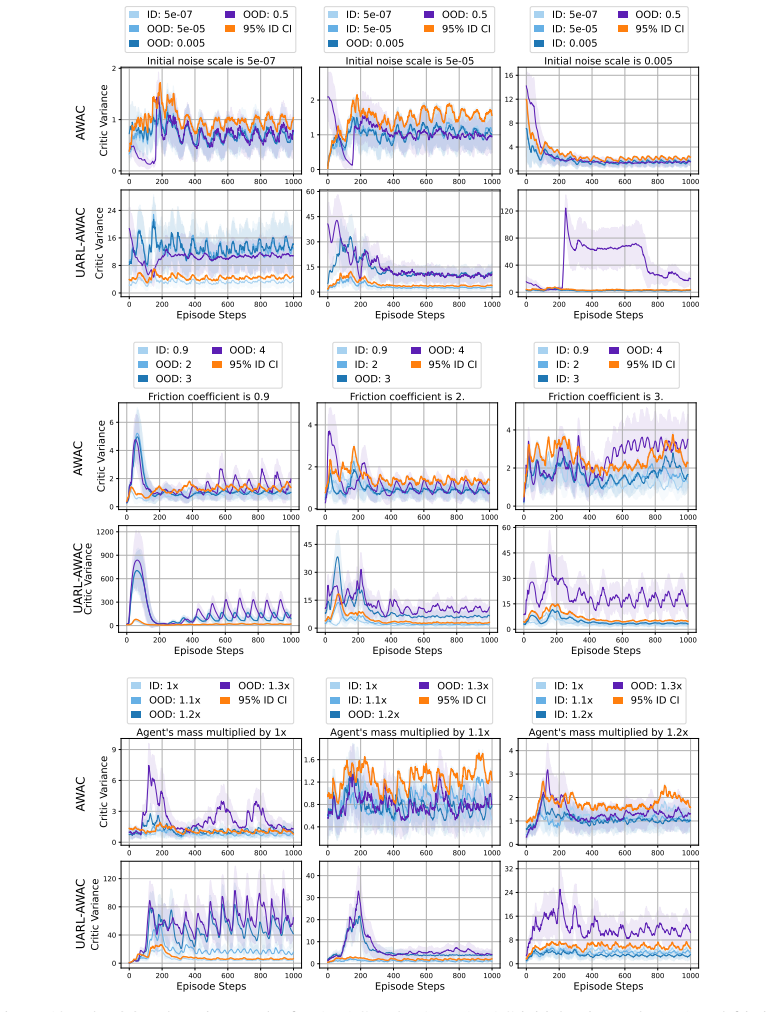
The central claim is that critic-ensemble variance computed on a limited target-domain dataset $D_t$ serves as an effective proxy for policy performance in the target environment $E_t$. Specifically, low variance on $D_t$ indicates that the target dynamics fall within the simulation coverage established by progressive domain randomization, while high variance flags out-of-distribution conditions. The policy is iteratively fine-tuned on progressively more randomized simulated environments until the variance drops below a threshold $\tau$, at which point deployment is allowed. The paper supports this claim with experiments showing that UARL consistently separates in-distribution from out-of-distribution critic variance across MuJoCo environments and randomized parameters, that the variance gate correlates with deployment returns, and that the gate vetoed an earlier ANYmal policy before certifying a zero-shot transfer that succeeded on three real-world surfaces.
Load-bearing premise
The safety guarantee rests on the assumption that how much the learned value estimators disagree on a small sample of target-domain data tells you whether the policy will actually behave safely in that domain.
Editorial extensions
If this is right
- Deployment can be gated using critic variance on a small target-domain dataset, blocking policies whose uncertainty exceeds a threshold and preventing unsafe real-world trials.
- The progressive randomization curriculum can stop once the variance gate is satisfied, reducing over-randomization and improving sample efficiency relative to training on the full expanded range from the start.
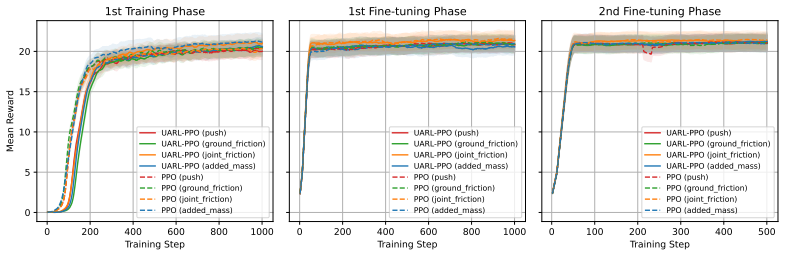
- UARL can be layered onto existing offline RL algorithms such as CQL, AWAC, and TD3BC, and also onto an on-policy PPO setup for a quadruped, improving OOD detection without degrading nominal locomotion performance.
- Under an abrupt distribution shift during an episode, only the UARL critics show a sharp variance spike, enabling online detection of the shift while off-dynamics baselines remain flat.
- A zero-shot sim-to-real transfer on the ANYmal-D quadruped passed the variance gate after expanding the mass randomization interval, and the robot tracked commands on concrete, carpet, and epoxy-resin-coated terrazzo surfaces without failures.
Reading between the lines
- If the variance gate is a reliable safety proxy, the same ensemble could serve as a continuous runtime monitor that halts operation when critic disagreement spikes during deployment, an extension the paper only partially explores.
- The reliability of the gate likely depends on how representative $D_t$ is of the true deployment conditions; a natural testable extension is to vary the size, coverage, and collection policy of $D_t$ and measure how often the gate's verdict matches actual deployment safety.
- Since the paper proves only that low variance is necessary, not sufficient, for in-distribution dynamics, a stronger certification might combine the variance gate with a conservative Q-value or trajectory-filtering check, a direction the authors leave implicit.
- The single-parameter-at-a-time curriculum could be extended to multi-parameter randomization where the variance signal is used to identify which parameter most needs expansion, potentially reducing the number of fine-tuning iterations.
Editorial analysis
A structured set of objections, weighed in public.
Referee Report
Summary. The paper proposes UARL, an offline-to-sim-to-real RL framework that trains an ensemble of critics with a diversity loss on nominal and repulsive datasets, maintains a balancing replay buffer, and gates deployment on the ensemble variance computed over a limited target-domain dataset D_t. The central claim is that low critic variance on D_t certifies that the policy is safe to deploy in the target environment. The method is instantiated on CQL, AWAC, and TD3BC, evaluated on five MuJoCo environments across three randomized dynamics parameters, and demonstrated on an ANYmal-D quadruped with a zero-shot hardware transfer. Theoretical support is attempted in App. B through value-gap bounds, a variance decomposition, and a convergence theorem.
Significance. If the central deployment-gate claim were sound, UARL would be a practically valuable contribution: it addresses a real gap in domain randomization and off-dynamics RL, ships a public code link, provides unusually detailed appendices, and presents a real-hardware ANYmal experiment with a certified zero-shot transfer. However, the load-bearing claim that low ensemble variance on D_t certifies safety is not established by the paper's own formal results. Eq. (17) leaves the shared-bias term unbounded, Prop. B.4 explicitly concedes that low variance is insufficient, and the only direct empirical support is a three-phase negative correlation in Fig. 5 and a single zero-shot trial. The method is a plausible engineering heuristic, but it is not currently a safety certificate.
major comments (3)
- [Sec. 4.3, Eq. (17), Prop. B.4] The deployment gate treats sigma^2(D_t) < tau as sufficient evidence for safe deployment, but the paper's own bias-variance decomposition in App. B.3 gives E[(Q_t - Q)^2] = sigma^2 + (mu - Q_t)^2. Low variance removes only the disagreement term; the shared-bias term (mu - Q_t)^2 is never bounded by any theorem in the paper. Prop. B.4 explicitly states that low variance is necessary but not sufficient to conclude that E_t is in-distribution without full coverage of the parameter space. Prop. 4.3 and Thm. B.7 bound the value gap in terms of ||phi - phi_t||, not in terms of ensemble variance, so they do not close this gap. The only direct evidence is the negative correlation over three fine-tuning phases in Fig. 5 and a single ANYmal zero-shot trial; this does not rule out the concrete failure mode in which all critics agree on a common biased extrapolation for OOD target points. The safety claim should be weakened to a necessary-condition gate, or supplemented with an explicit bound on (mu - Q_t)^2 under stated coverage assumptions.
- [Sec. 4.2, Eq. (8); App. B.4.3, Eq. (29)] There is an internal contradiction in the balancing replay buffer. Eq. (8) assigns weight sigma^{-2} to repulsive samples from D' and sigma^2 to nominal samples from D, so higher-variance OOD samples receive lower weight. This contradicts the prose in Sec. 4.2 ('increasing sampling probability for high-uncertainty states from diverse simulations') and the statement in App. B.4.3 that 'high-variance (OOD) samples should receive larger weights in the Bellman update.' If the implementation follows Eq. (8), then the BRB ablation in Fig. 20 is not testing the mechanism described in the text; if the implementation follows the text, then Eq. (8) and Prop. B.9 are incorrect. The authors must resolve this discrepancy and rerun the ablation under the intended weighting.
- [App. B.4.4, Thm. B.10; Assum. B.8] Theorem B.10 is stated as a guarantee that weighted fitted-Q iteration recovers an eta-optimal target policy with polynomial samples and iterations, but the proof is only described as 'standard fitted Q-iteration analysis' and the key sample-complexity constant C_1 is left unspecified, with its dependence on L_R, R_max, L_T, epsilon_F, and the state/action dimensions deferred to future work. More importantly, the bias-reduction result in Prop. B.9 depends on Assum. B.8, which postulates a positive covariance between critic variance and parameter distance to the target. That assumption is essentially the property the deployment gate needs to establish, and the paper provides no mechanism by which Eq. (7) guarantees it. Thus the formal apparatus in App. B does not prove the safety claim; it restates a key part of the claim as an assumption.
minor comments (5)
- [Def. 4.2, Sec. 5.1] The symbol tau is used both for the KL-divergence threshold tau_KL in Def. 4.2 and for the deployment variance threshold in Sec. 4.3 and Sec. 5.1; a distinct notation such as tau_var would avoid ambiguity.
- [Fig. 4 caption] The caption contains typos ('incosistent', 'seprates') and does not explain how the rows (fine-tuning iterations) are labeled; please clarify the row/column semantics.
- [Alg. 1, lines 6 and 13] The variance formula uses Q^(0) in line 6 and Q^(i+1) in line 13, but the notation is not defined; please specify that the variance is averaged over the ensemble and over the samples in D_t.
- [App. E.7, Fig. 28] The text refers to ground friction as the randomized parameter, but the Fig. 28 legend says 'joint friction'; please make the parameter naming consistent.
- [Table 1, App. C] The table reports UARL memory of ~4 GB against a baseline of ~2 GB, which is a 100% increase, but the table and text say '50%'; please correct the percentage or the memory values.
Circularity Check
OOD detection evaluation partly restates the Eq. 7 training objective on repulsive data; the central safety claim retains independent held-out support.
-
fitted input called prediction
[Section 4.1 (Eq. 7) and Section 5.1, Fig. 4]
"The diversity term LRL div in Eq. 7 encourages each Qi to diverge from its own Bellman target on the repulsive dataset D′... Each row represents a fine-tuning iteration with an expanded ID range by multiplying the agent’s mass vector by a constant: 1x→5x→10x. Clear “OOD-awareness” places blue curves below and red curves above the black curve; UARL-AWAC does so consistently."
The repulsive dataset D′ for a given iteration is collected from the newly expanded randomization range (e.g., 5x mass). Eq. 7 explicitly trains the ensemble to have high variance on D′ by penalizing each critic for matching its own Bellman target on D′. The OOD detection evaluation in Fig. 4 then labels exactly these newly expanded ranges (5x in the first row, 10x in the second) as 'OOD' and reports that UARL produces high variance on them. For those data points, the high variance is a direct consequence of the training loss, not a prediction; the experiment is partially restating the objective the critics were optimized against.
full rationale
The central safety claim — that critic ensemble variance on a target-domain dataset Dt proxies policy performance in Et — is validated with held-out target-domain rollouts (Fig. 5) and a real-robot ANYmal zero-shot transfer trial, so it has independent grounding. However, the OOD detection experiments in Sec. 5.1 partially evaluate the training objective on the repulsive data used to fit it: Eq. 7 explicitly drives high variance on D′, and Fig. 4 then reports high variance on those same newly expanded ranges as evidence of OOD detection. This is a mild fitted-input-called-prediction pattern. The theory (Eq. 17, Props. B.3–B.4) does not establish that low variance implies small bias, but that is a correctness gap rather than circularity, and the paper itself concedes the insufficiency of low variance. Self-citations to the authors' prior DENN work are normal and not load-bearing in a circular way, since DENN is an independent published method with its own validation.
Assumptions & free parameters
free parameters (5)
- lambda (diversity coefficient) =
adaptive, ~10% of total loss
- delta (diversity scale) =
1e-2
- tau (deployment threshold) =
95th percentile (or 5th percentile) of ID critic variances
- Randomization expansion schedule =
e.g., Ant mass 1x,5x,10x,15x; friction increments vary per environment
- Ensemble size N =
2 critics
assumptions (5)
- domain assumption Assum. 4.4: Ensemble critics optimize Eq. 7 until loss stabilizes, implying low variance on nominal D and high variance on repulsive D'.
- standard math Assum. B.5: Reward and transition kernel are Lipschitz; critic class approximates Q within epsilon_F.
- ad hoc to paper Assum. B.8: Covariance between critic variance and parameter distance to target is at least rho > 0.
- domain assumption D_t is a representative proxy for the target domain E_t.
- domain assumption Definition 4.2: Coverage set C defined by KL divergence; OOD means phi_t not in C.
Cite this review
Pith. "Pith review of Safe Domain Randomization via Uncertainty-Aware Out-of-Distribution Detection and Policy Adaptation." pith.science (2026). https://pith.science/paper/KWILOZRS
@misc{pith2026250706111,
  author       = {Pith},
  title        = {Pith review of: Safe Domain Randomization via Uncertainty-Aware Out-of-Distribution Detection and Policy Adaptation},
  year         = {2026},
  howpublished = {\url{https://pith.science/paper/KWILOZRS}},
  note         = {Machine review of arXiv:2507.06111}
}
read the original abstract
Deploying reinforcement learning (RL) policies in real-world involves significant challenges, including distribution shifts, safety concerns, and the impracticality of direct interactions during policy refinement. Existing methods, such as domain randomization (DR) and off-dynamics RL, enhance policy robustness by direct interaction with the target domain, an inherently unsafe practice. We propose Uncertainty-Aware RL (UARL), a novel framework that prioritizes safety during training by addressing Out-Of-Distribution (OOD) detection and policy adaptation without requiring direct interactions in target domain. UARL employs an ensemble of critics to quantify policy uncertainty and incorporates progressive environmental randomization to prepare the policy for diverse real-world conditions. By iteratively refining over high-uncertainty regions of the state space in simulated environments, UARL enhances robust generalization to the target domain without explicitly training on it. We evaluate UARL on MuJoCo benchmarks and a quadrupedal robot, demonstrating its effectiveness in reliable OOD detection, improved performance, and enhanced sample efficiency compared to baselines.
Figures


Figures from the paper (26 more)






Reference graph
Works this paper leans on
-
[1]
MIT press, 2018
Richard S Sutton and Andrew G Barto.Reinforcement learning: An introduction. MIT press, 2018
2018
-
[2]
Sergey Levine, Aviral Kumar, George Tucker, and Justin Fu. Offline reinforcement learning: Tutorial, review, and perspectives on open problems.arXiv preprint arXiv:2005.01643, 2020
arXiv 2005
-
[3]
Reinforcement learning in robotics: A survey
Jens Kober, J Andrew Bagnell, and Jan Peters. Reinforcement learning in robotics: A survey. The International Journal of Robotics Research, 32(11):1238–1274, 2013
2013
-
[4]
Toward self-driving processes: A deep reinforcement learning approach to control.AIChE journal, 65(10):e16689, 2019
Steven Spielberg, Aditya Tulsyan, Nathan P Lawrence, Philip D Loewen, and R Bhushan Gopaluni. Toward self-driving processes: A deep reinforcement learning approach to control.AIChE journal, 65(10):e16689, 2019
2019
-
[5]
Sim-to-real transfer in deep reinforcement learning for robotics: a survey
Wenshuai Zhao, Jorge Peña Queralta, and Tomi Westerlund. Sim-to-real transfer in deep reinforcement learning for robotics: a survey. In2020 IEEE symposium series on computational intelligence (SSCI), pages 737–744. IEEE, 2020
2020
-
[6]
Mohamad H Danesh and Alan Fern. Out-of-distribution dynamics detection: Rl-relevant benchmarks and results.arXiv preprint arXiv:2107.04982, 2021
arXiv 2021
-
[7]
Off-dynamics reinforcement learning: Training for transfer with domain classifiers
Benjamin Eysenbach, Shreyas Chaudhari, Swapnil Asawa, Sergey Levine, and Ruslan Salakhut- dinov. Off-dynamics reinforcement learning: Training for transfer with domain classifiers. In International Conference on Learning Representations, 2021
2021
-
[8]
Robust dynamic programming.Mathematics of Operations Research, 30(2):257–280, 2005
Garud N Iyengar. Robust dynamic programming.Mathematics of Operations Research, 30(2):257–280, 2005
2005
Show all 94 references
-
[9]
Offline-to-online reinforcement learning via balanced replay and pessimistic q-ensemble
Seunghyun Lee, Younggyo Seo, Kimin Lee, Pieter Abbeel, and Jinwoo Shin. Offline-to-online reinforcement learning via balanced replay and pessimistic q-ensemble. InConference on Robot Learning, pages 1702–1712. PMLR, 2022
2022
-
[10]
Adaptive policy learning for offline-to-online reinforcement learning
Han Zheng, Xufang Luo, Pengfei Wei, Xuan Song, Dongsheng Li, and Jing Jiang. Adaptive policy learning for offline-to-online reinforcement learning. InProceedings of the AAAI Conference on Artificial Intelligence, volume 37, pages 11372–11380, 2023
2023
-
[11]
Domain randomization for transferring deep neural networks from simulation to the real world
Josh Tobin, Rachel Fong, Alex Ray, Jonas Schneider, Wojciech Zaremba, and Pieter Abbeel. Domain randomization for transferring deep neural networks from simulation to the real world. In2017 IEEE/RSJ international conference on intelligent robots and systems (IROS), pages 23–30...
2017
-
[12]
Pal, and Liam Paull
Bhairav Mehta, Manfred Diaz, Florian Golemo, Christopher J. Pal, and Liam Paull. Active domain randomization. InProceedings of the Conference on Robot Learning, volume 100, pages 1162–1176. PMLR, 30 Oct–01 Nov 2020
2020
-
[13]
Mujoco: A physics engine for model-based control
Emanuel Todorov, Tom Erez, and Yuval Tassa. Mujoco: A physics engine for model-based control. In2012 IEEE/RSJ International Conference on Intelligent Robots and Systems, pages 5026–5033. IEEE, 2012
2012
-
[14]
Towards a generic solution for inspection of industrial sites
Marco Hutter, Remo Diethelm, Samuel Bachmann, Peter Fankhauser, Christian Gehring, Vassilios Tsounis, Andreas Lauber, Fabian Guenther, Marko Bjelonic, Linus Isler, et al. Towards a generic solution for inspection of industrial sites. InField and Service Robotics: Results of th...
2018
-
[15]
Offline reinforcement learning with implicit q-learning
Ilya Kostrikov, Ashvin Nair, and Sergey Levine. Offline reinforcement learning with implicit q-learning. InInternational Conference on Learning Representations, 2022
2022
-
[16]
Way off-policy batch deep reinforcement learning of implicit human preferences in dialog.arXiv preprint arXiv:1907.00456, 2019
Natasha Jaques, Asma Ghandeharioun, Judy Hanwen Shen, Craig Ferguson, Agata Lapedriza, Noah Jones, Shixiang Gu, and Rosalind Picard. Way off-policy batch deep reinforcement learning of implicit human preferences in dialog.arXiv preprint arXiv:1907.00456, 2019
1907 arXiv
-
[17]
A minimalist approach to offline reinforcement learning
Scott Fujimoto and Shixiang Shane Gu. A minimalist approach to offline reinforcement learning. Advances in Neural Information Processing Systems, 34:20132–20145, 2021. 10
2021
-
[18]
Conservative q-learning for offline reinforcement learning
Aviral Kumar, Aurick Zhou, George Tucker, and Sergey Levine. Conservative q-learning for offline reinforcement learning. InAdvances in Neural Information Processing Systems, volume 33, pages 1179–1191. Curran Associates, Inc., 2020
2020
-
[19]
Uncertainty-based of- fline reinforcement learning with diversified q-ensemble
Gaon An, Seungyong Moon, Jang-Hyun Kim, and Hyun Oh Song. Uncertainty-based of- fline reinforcement learning with diversified q-ensemble. InAdvances in Neural Information Processing Systems, volume 34, pages 7436–7447. Curran Associates, Inc., 2021
2021
-
[20]
Iteratively refined behavior regularization for offline reinforcement learning
Yi Ma, HAO Jianye, Xiaohan Hu, Yan Zheng, and Chenjun Xiao. Iteratively refined behavior regularization for offline reinforcement learning. InThe Thirty-eighth Annual Conference on Neural Information Processing Systems, 2023
2023
-
[21]
Offline reinforcement learning with OOD state correction and OOD action suppression
Yixiu Mao, Cheems Wang, Chen Chen, Yun Qu, and Xiangyang Ji. Offline reinforcement learning with OOD state correction and OOD action suppression. InThe Thirty-eighth Annual Conference on Neural Information Processing Systems, 2024
2024
-
[22]
Model-Bellman inconsistency for model-based offline reinforcement learning
Yihao Sun, Jiaji Zhang, Chengxing Jia, Haoxin Lin, Junyin Ye, and Yang Yu. Model-Bellman inconsistency for model-based offline reinforcement learning. In Andreas Krause, Emma Brunskill, Kyunghyun Cho, Barbara Engelhardt, Sivan Sabato, and Jonathan Scarlett, edi- tors,Proceedin...
2023
-
[23]
Pessimistic bootstrapping for uncertainty-driven offline reinforcement learning
Chenjia Bai, Lingxiao Wang, Zhuoran Yang, Zhi-Hong Deng, Animesh Garg, Peng Liu, and Zhaoran Wang. Pessimistic bootstrapping for uncertainty-driven offline reinforcement learning. InInternational Conference on Learning Representations, 2022
2022
-
[24]
Rorl: Ro- bust offline reinforcement learning via conservative smoothing.Advances in neural information processing systems, 35:23851–23866, 2022
Rui Yang, Chenjia Bai, Xiaoteng Ma, Zhaoran Wang, Chongjie Zhang, and Lei Han. Rorl: Ro- bust offline reinforcement learning via conservative smoothing.Advances in neural information processing systems, 35:23851–23866, 2022
2022
-
[25]
When to trust your simulator: Dynamics-aware hybrid offline-and-online reinforcement learning
Haoyi Niu, Yiwen Qiu, Ming Li, Guyue Zhou, Jianming Hu, Xianyuan Zhan, et al. When to trust your simulator: Dynamics-aware hybrid offline-and-online reinforcement learning. Advances in Neural Information Processing Systems, 35:36599–36612, 2022
2022
-
[26]
Cross-domain policy adaptation via value-guided data filtering
Kang Xu, Chenjia Bai, Xiaoteng Ma, Dong Wang, Bin Zhao, Zhen Wang, Xuelong Li, and Wei Li. Cross-domain policy adaptation via value-guided data filtering. InThirty-seventh Conference on Neural Information Processing Systems, 2023
2023
-
[27]
Cross-domain policy adaptation by capturing representation mismatch
Jiafei Lyu, Chenjia Bai, Jing-Wen Yang, Zongqing Lu, and Xiu Li. Cross-domain policy adaptation by capturing representation mismatch. InForty-first International Conference on Machine Learning, 2024
2024
-
[28]
Unsolved problems in ml safety.arXiv preprint arXiv:2109.13916, 2021
Dan Hendrycks, Nicholas Carlini, John Schulman, and Jacob Steinhardt. Unsolved problems in ml safety.arXiv preprint arXiv:2109.13916, 2021
2021 arXiv
-
[29]
Learning dexterous in-hand manipulation.The International Journal of Robotics Research, 39(1):3–20, 2020
OpenAI: Marcin Andrychowicz, Bowen Baker, Maciek Chociej, Rafal Jozefowicz, Bob Mc- Grew, Jakub Pachocki, Arthur Petron, Matthias Plappert, Glenn Powell, Alex Ray, et al. Learning dexterous in-hand manipulation.The International Journal of Robotics Research, 39(1):3–20, 2020
2020
-
[30]
Network randomization: A simple technique for generalization in deep reinforcement learning
Kimin Lee, Kibok Lee, Jinwoo Shin, and Honglak Lee. Network randomization: A simple technique for generalization in deep reinforcement learning. InInternational Conference on Learning Representations, 2020
2020
-
[31]
Learning domain randomization distributions for training robust locomotion policies
Melissa Mozian, Juan Camilo Gamboa Higuera, David Meger, and Gregory Dudek. Learning domain randomization distributions for training robust locomotion policies. In2020 IEEE/RSJ International Conference on Intelligent Robots and Systems (IROS), pages 6112–6117. IEEE, 2020
2020
-
[32]
A Markovian Decision Process.Indiana University Mathematics Journal, 6(4):679–684, 1957
Richard Bellman. A Markovian Decision Process.Indiana University Mathematics Journal, 6(4):679–684, 1957. 11
1957
-
[33]
Handling black swan events in deep learning with diversely extrapolated neural networks
Maxime Wabartha, Audrey Durand, Vincent François-Lavet, and Joelle Pineau. Handling black swan events in deep learning with diversely extrapolated neural networks. InProceedings of the Twenty-Ninth International Joint Conference on Artificial Intelligence, IJCAI-20, pages 2140...
2020
-
[34]
Cal-QL: Calibrated offline RL pre-training for efficient online fine-tuning
Mitsuhiko Nakamoto, Yuexiang Zhai, Anikait Singh, Max Sobol Mark, Yi Ma, Chelsea Finn, Aviral Kumar, and Sergey Levine. Cal-QL: Calibrated offline RL pre-training for efficient online fine-tuning. InThirty-seventh Conference on Neural Information Processing Systems, 2023
2023
-
[35]
Awac: Accelerating online reinforcement learning with offline datasets.arXiv preprint arXiv:2006.09359, 2020
Ashvin Nair, Abhishek Gupta, Murtaza Dalal, and Sergey Levine. Awac: Accelerating online reinforcement learning with offline datasets.arXiv preprint arXiv:2006.09359, 2020
2006 arXiv
-
[36]
D4rl: Datasets for deep data-driven reinforcement learning.arXiv preprint arXiv:2004.07219, 2020
Justin Fu, Aviral Kumar, Ofir Nachum, George Tucker, and Sergey Levine. D4rl: Datasets for deep data-driven reinforcement learning.arXiv preprint arXiv:2004.07219, 2020
2004 arXiv
-
[37]
Terry, Ariel Kwiatkowski, John U
Mark Towers, Jordan K. Terry, Ariel Kwiatkowski, John U. Balis, Gianluca de Cola, Tristan Deleu, Manuel Goulão, Andreas Kallinteris, Arjun KG, Markus Krimmel, Rodrigo Perez- Vicente, Andrea Pierré, Sander Schulhoff, Jun Jet Tai, Andrew Tan Jin Shen, and Omar G. Younis. Gymnasi...
2023
-
[38]
Soft actor-critic: Off- policy maximum entropy deep reinforcement learning with a stochastic actor
Tuomas Haarnoja, Aurick Zhou, Pieter Abbeel, and Sergey Levine. Soft actor-critic: Off- policy maximum entropy deep reinforcement learning with a stochastic actor. InInternational Conference on Machine Learning, pages 1861–1870. PMLR, 2018
2018
-
[39]
Addressing function approximation error in actor-critic methods
Scott Fujimoto, Herke Hoof, and David Meger. Addressing function approximation error in actor-critic methods. InInternational Conference on Machine Learning, pages 1587–1596. PMLR, 2018
2018
-
[40]
Corl: Research-oriented deep offline reinforcement learning library
Denis Tarasov, Alexander Nikulin, Dmitry Akimov, Vladislav Kurenkov, and Sergey Kolesnikov. Corl: Research-oriented deep offline reinforcement learning library. In3rd Offline RL Workshop: Offline RL as a ”Launchpad”, 2022
2022
-
[41]
Efficient online reinforcement learning with offline data
Philip J Ball, Laura Smith, Ilya Kostrikov, and Sergey Levine. Efficient online reinforcement learning with offline data. InInternational Conference on Machine Learning, pages 1577–1594. PMLR, 2023
2023
-
[42]
Odrl: A benchmark for off-dynamics reinforcement learning
Jiafei Lyu, Kang Xu, Jiacheng Xu, Mengbei Yan, Jingwen Yang, Zongzhang Zhang, Chenjia Bai, Zongqing Lu, and Xiu Li. Odrl: A benchmark for off-dynamics reinforcement learning. InThe Thirty-eight Conference on Neural Information Processing Systems Datasets and Benchmarks Track, 2024
2024
-
[43]
Darl: distance-aware uncertainty estimation for offline reinforcement learning
Hongchang Zhang, Jianzhun Shao, Shuncheng He, Yuhang Jiang, and Xiangyang Ji. Darl: distance-aware uncertainty estimation for offline reinforcement learning. InProceedings of the AAAI Conference on Artificial Intelligence, volume 37, pages 11210–11218, 2023
2023
-
[44]
Open rl benchmark: Comprehensive tracked experiments for reinforcement learning.arXiv preprint arXiv:2402.03046, 2024
Shengyi Huang, Quentin Gallouédec, Florian Felten, Antonin Raffin, Rousslan Fernand Julien Dossa, Yanxiao Zhao, Ryan Sullivan, Viktor Makoviychuk, Denys Makoviichuk, Mohamad H Danesh, et al. Open rl benchmark: Comprehensive tracked experiments for reinforcement learning.arXiv ...
2024 arXiv
-
[45]
Dario Bellicoso, Vassilios Tsounis, Jemin Hwangbo, Karen Bodie, Peter Fankhauser, Michael Bloesch, Remo Diethelm, Samuel Bachmann, Amir Melzer, and Mark Hoepflinger
Marco Hutter, Christian Gehring, Dominic Jud, Andreas Lauber, C. Dario Bellicoso, Vassilios Tsounis, Jemin Hwangbo, Karen Bodie, Peter Fankhauser, Michael Bloesch, Remo Diethelm, Samuel Bachmann, Amir Melzer, and Mark Hoepflinger. Anymal - a highly mobile and dynamic quadruped...
2016
-
[46]
Learning to walk in minutes using massively parallel deep reinforcement learning
Nikita Rudin, David Hoeller, Philipp Reist, and Marco Hutter. Learning to walk in minutes using massively parallel deep reinforcement learning. InConference on Robot Learning, pages 91–100. PMLR, 2022. 12
2022
-
[47]
Learning agile and dynamic motor skills for legged robots.Science Robotics, 4(26):eaau5872, 2019
Jemin Hwangbo, Joonho Lee, Alexey Dosovitskiy, Dario Bellicoso, Vassilios Tsounis, Vladlen Koltun, and Marco Hutter. Learning agile and dynamic motor skills for legged robots.Science Robotics, 4(26):eaau5872, 2019
2019
-
[48]
REvolveR: Continuous evolutionary models for robot-to-robot policy transfer
Xingyu Liu, Deepak Pathak, and Kris Kitani. REvolveR: Continuous evolutionary models for robot-to-robot policy transfer. In Kamalika Chaudhuri, Stefanie Jegelka, Le Song, Csaba Szepesvari, Gang Niu, and Sivan Sabato, editors,Proceedings of the 39th International Confer- ence o...
2022
-
[49]
Proto: Iterative policy regularized offline-to-online reinforcement learning.arXiv preprint arXiv:2305.15669, 2023
Jianxiong Li, Xiao Hu, Haoran Xu, Jingjing Liu, Xianyuan Zhan, and Ya-Qin Zhang. Proto: Iterative policy regularized offline-to-online reinforcement learning.arXiv preprint arXiv:2305.15669, 2023
2023 arXiv
-
[50]
Off-policy deep reinforcement learning without exploration
Scott Fujimoto, David Meger, and Doina Precup. Off-policy deep reinforcement learning without exploration. InProceedings of the 36th International Conference on Machine Learning, volume 97, pages 2052–2062. PMLR, 09–15 Jun 2019
2019
-
[51]
An optimistic perspective on offline reinforcement learning
Rishabh Agarwal, Dale Schuurmans, and Mohammad Norouzi. An optimistic perspective on offline reinforcement learning. InInternational Conference on Machine Learning, pages 104–114. PMLR, 2020
2020
-
[52]
Tree-based batch mode reinforcement learning.Journal of Machine Learning Research, 6, 2005
Damien Ernst, Pierre Geurts, and Louis Wehenkel. Tree-based batch mode reinforcement learning.Journal of Machine Learning Research, 6, 2005
2005
-
[53]
Stabilizing off-policy q-learning via bootstrapping error reduction
Aviral Kumar, Justin Fu, Matthew Soh, George Tucker, and Sergey Levine. Stabilizing off-policy q-learning via bootstrapping error reduction. InAdvances in Neural Information Processing Systems, volume 32. Curran Associates, Inc., 2019
2019
-
[54]
Batch reinforcement learning
Sascha Lange, Thomas Gabel, and Martin Riedmiller. Batch reinforcement learning. In Reinforcement learning: State-of-the-art, pages 45–73. Springer, 2012
2012
-
[55]
Critic regularized regression.Advances in Neural Information Processing Systems, 33:7768–7778, 2020
Ziyu Wang, Alexander Novikov, Konrad Zolna, Josh S Merel, Jost Tobias Springenberg, Scott E Reed, Bobak Shahriari, Noah Siegel, Caglar Gulcehre, Nicolas Heess, et al. Critic regularized regression.Advances in Neural Information Processing Systems, 33:7768–7778, 2020
2020
-
[56]
Revisiting the minimalist approach to offline reinforcement learning.Advances in Neural Information Processing Systems, 36, 2024
Denis Tarasov, Vladislav Kurenkov, Alexander Nikulin, and Sergey Kolesnikov. Revisiting the minimalist approach to offline reinforcement learning.Advances in Neural Information Processing Systems, 36, 2024
2024
-
[57]
Behavior regularized offline reinforcement learning.arXiv preprint arXiv:1911.11361, 2019
Yifan Wu, George Tucker, and Ofir Nachum. Behavior regularized offline reinforcement learning.arXiv preprint arXiv:1911.11361, 2019
1911 arXiv
-
[58]
Keep doing what worked: Behavior modelling priors for offline reinforcement learning
Noah Siegel, Jost Tobias Springenberg, Felix Berkenkamp, Abbas Abdolmaleki, Michael Neunert, Thomas Lampe, Roland Hafner, Nicolas Heess, and Martin Riedmiller. Keep doing what worked: Behavior modelling priors for offline reinforcement learning. InInternational Conference on L...
2020
-
[59]
Offline reinforcement learning with fisher divergence critic regularization
Ilya Kostrikov, Rob Fergus, Jonathan Tompson, and Ofir Nachum. Offline reinforcement learning with fisher divergence critic regularization. InProceedings of the 38th International Conference on Machine Learning, volume 139, pages 5774–5783. PMLR, 18–24 Jul 2021
2021
-
[60]
Uncertainty weighted actor-critic for offline reinforcement learning
Yue Wu, Shuangfei Zhai, Nitish Srivastava, Joshua M Susskind, Jian Zhang, Ruslan Salakhutdi- nov, and Hanlin Goh. Uncertainty weighted actor-critic for offline reinforcement learning. In Proceedings of the 38th International Conference on Machine Learning, volume 139, pages 11...
2021
-
[61]
Uni-o4: Unifying online and offline deep reinforcement learning with multi-step on-policy optimization
Kun LEI, Zhengmao He, Chenhao Lu, Kaizhe Hu, Yang Gao, and Huazhe Xu. Uni-o4: Unifying online and offline deep reinforcement learning with multi-step on-policy optimization. InThe Twelfth International Conference on Learning Representations, 2024
2024
-
[62]
Enoto: Improving offline-to-online reinforcement learning with q-ensembles
Kai Zhao, Jianye Hao, Yi Ma, Jinyi Liu, Yan Zheng, and Zhaopeng Meng. Enoto: Improving offline-to-online reinforcement learning with q-ensembles. InProceedings of the Thirty-Third International Joint Conference on Artificial Intelligence, IJCAI-24, pages 5563–5571. Interna- ti...
2024
-
[63]
Online decision transformer
Qinqing Zheng, Amy Zhang, and Aditya Grover. Online decision transformer. InInternational Conference on Machine Learning, pages 27042–27059. PMLR, 2022
2022
-
[64]
Actor-critic alignment for offline-to-online reinforcement learning
Zishun Yu and Xinhua Zhang. Actor-critic alignment for offline-to-online reinforcement learning. InProceedings of the 40th International Conference on Machine Learning, volume 202, pages 40452–40474. PMLR, 23–29 Jul 2023
2023
-
[65]
Train once, get a family: State-adaptive balances for offline-to-online reinforcement learning.Advances in Neural Information Processing Systems, 36, 2024
Shenzhi Wang, Qisen Yang, Jiawei Gao, Matthieu Lin, Hao Chen, Liwei Wu, Ning Jia, Shiji Song, and Gao Huang. Train once, get a family: State-adaptive balances for offline-to-online reinforcement learning.Advances in Neural Information Processing Systems, 36, 2024
2024
-
[66]
Policy expansion for bridging offline-to-online reinforcement learning
Haichao Zhang, Wei Xu, and Haonan Yu. Policy expansion for bridging offline-to-online reinforcement learning. InThe Eleventh International Conference on Learning Representations, 2023
2023
-
[67]
Albrecht, and Amos Storkey
Trevor McInroe, Adam Jelley, Stefano V . Albrecht, and Amos Storkey. Planning to go out-of- distribution in offline-to-online reinforcement learning. InReinforcement Learning Conference (RLC), 2024
2024
-
[68]
A comprehensive survey on safe reinforcement learning
Javier Garcıa and Fernando Fernández. A comprehensive survey on safe reinforcement learning. Journal of Machine Learning Research, 16(1):1437–1480, 2015
2015
-
[69]
Consideration of risk in reinforcement learning
Matthias Heger. Consideration of risk in reinforcement learning. InMachine Learning Proceed- ings 1994, pages 105–111. Elsevier, 1994
1994
-
[70]
Robust control of markov decision processes with uncertain transition matrices.Operations Research, 53(5):780–798, 2005
Arnab Nilim and Laurent El Ghaoui. Robust control of markov decision processes with uncertain transition matrices.Operations Research, 53(5):780–798, 2005
2005
-
[71]
Safe offline reinforcement learning with feasibility-guided diffusion model
Yinan Zheng, Jianxiong Li, Dongjie Yu, Yujie Yang, Shengbo Eben Li, Xianyuan Zhan, and Jingjing Liu. Safe offline reinforcement learning with feasibility-guided diffusion model. In The Twelfth International Conference on Learning Representations, 2024
2024
-
[72]
Enhancing efficiency of safe reinforcement learning via sample manipulation
Shangding Gu, Laixi Shi, Yuhao Ding, Alois Knoll, Costas Spanos, Adam Wierman, and Ming Jin. Enhancing efficiency of safe reinforcement learning via sample manipulation. InThe Thirty-eighth Annual Conference on Neural Information Processing Systems, 2024
2024
-
[73]
Curriculum learning for reinforcement learning domains: A framework and survey.Journal of Machine Learning Research, 21(181):1–50, 2020
Sanmit Narvekar, Bei Peng, Matteo Leonetti, Jivko Sinapov, Matthew E Taylor, and Peter Stone. Curriculum learning for reinforcement learning domains: A framework and survey.Journal of Machine Learning Research, 21(181):1–50, 2020
2020
-
[74]
Causally aligned curriculum learning
Mingxuan Li, Junzhe Zhang, and Elias Bareinboim. Causally aligned curriculum learning. In The Twelfth International Conference on Learning Representations, 2024
2024
-
[75]
Au- tomated curriculum learning for neural networks
Alex Graves, Marc G Bellemare, Jacob Menick, Remi Munos, and Koray Kavukcuoglu. Au- tomated curriculum learning for neural networks. Ininternational conference on machine learning, pages 1311–1320. Pmlr, 2017
2017
-
[76]
MIT press, 2016
Ian Goodfellow, Yoshua Bengio, and Aaron Courville.Deep learning. MIT press, 2016
2016
-
[77]
Robust training with ensemble consensus
Jisoo Lee and Sae-Young Chung. Robust training with ensemble consensus. InInternational Conference on Learning Representations, 2020
2020
-
[78]
Simple and scalable predictive uncertainty estimation using deep ensembles
Balaji Lakshminarayanan, Alexander Pritzel, and Charles Blundell. Simple and scalable predictive uncertainty estimation using deep ensembles. InAdvances in Neural Information Processing Systems, volume 30. Curran Associates, Inc., 2017
2017
-
[79]
Improving robustness and calibration in ensembles with diversity regularization
Hendrik Alexander Mehrtens, Camila González, and Anirban Mukhopadhyay. Improving robustness and calibration in ensembles with diversity regularization. InDAGM German Conference on Pattern Recognition, pages 36–50. Springer, 2022
2022
-
[80]
Maximizing overall diversity for improved uncertainty estimates in deep ensembles.Proceedings of the AAAI Conference on Artificial Intelligence, 34(04):4264–4271, Apr
Siddhartha Jain, Ge Liu, Jonas Mueller, and David Gifford. Maximizing overall diversity for improved uncertainty estimates in deep ensembles.Proceedings of the AAAI Conference on Artificial Intelligence, 34(04):4264–4271, Apr. 2020. 14
2020
-
[81]
Improving adversarial robustness via promoting ensemble diversity
Tianyu Pang, Kun Xu, Chao Du, Ning Chen, and Jun Zhu. Improving adversarial robustness via promoting ensemble diversity. InInternational Conference on Machine Learning, pages 4970–4979. PMLR, 2019
2019
-
[82]
Webb, Henry W
Danny Wood, Tingting Mu, Andrew M. Webb, Henry W. J. Reeve, Mikel Luján, and Gavin Brown. A unified theory of diversity in ensemble learning.Journal of Machine Learning Research, 24(359):1–49, 2023
2023
-
[83]
Ensemble of averages: Improv- ing model selection and boosting performance in domain generalization
Devansh Arpit, Huan Wang, Yingbo Zhou, and Caiming Xiong. Ensemble of averages: Improv- ing model selection and boosting performance in domain generalization. InAdvances in Neural Information Processing Systems, 2022
2022
-
[84]
Noise contrastive priors for functional uncertainty
Danijar Hafner, Dustin Tran, Timothy Lillicrap, Alex Irpan, and James Davidson. Noise contrastive priors for functional uncertainty. InUncertainty in Artificial Intelligence, pages 905–914. PMLR, 2020
2020
-
[85]
Deep exploration via bootstrapped dqn.Advances in neural information processing systems, 29, 2016
Ian Osband, Charles Blundell, Alexander Pritzel, and Benjamin Van Roy. Deep exploration via bootstrapped dqn.Advances in neural information processing systems, 29, 2016
2016
-
[86]
Sunrise: A simple unified framework for ensemble learning in deep reinforcement learning
Kimin Lee, Michael Laskin, Aravind Srinivas, and Pieter Abbeel. Sunrise: A simple unified framework for ensemble learning in deep reinforcement learning. InInternational Conference on Machine Learning, pages 6131–6141. PMLR, 2021
2021
-
[87]
Accurate uncertainty estimation and decomposition in ensemble learning.Advances in Neural Information Processing Systems, 32, 2019
Jeremiah Liu, John Paisley, Marianthi-Anna Kioumourtzoglou, and Brent Coull. Accurate uncertainty estimation and decomposition in ensemble learning.Advances in Neural Information Processing Systems, 32, 2019
2019
-
[88]
Disentangling epistemic and aleatoric uncertainty in reinforcement learning.arXiv preprint arXiv:2206.01558, 2022
Bertrand Charpentier, Ransalu Senanayake, Mykel Kochenderfer, and Stephan Günnemann. Disentangling epistemic and aleatoric uncertainty in reinforcement learning.arXiv preprint arXiv:2206.01558, 2022
2022 arXiv
-
[89]
Kingma and Jimmy Ba
Diederik P. Kingma and Jimmy Ba. Adam: A method for stochastic optimization. In Yoshua Bengio and Yann LeCun, editors,3rd International Conference on Learning Representations, ICLR 2015, San Diego, CA, USA, May 7-9, 2015, Conference Track Proceedings, 2015
2015
-
[90]
Robustness
John Schulman, Filip Wolski, Prafulla Dhariwal, Alec Radford, and Oleg Klimov. Proximal policy optimization algorithms.arXiv preprint arXiv:1707.06347, 2017. 15 Appendix Table of Contents A Related Work 17 B Theoretical Analysis of UARL 20 B.1 Definitions and Notations . . . ....
2017 arXiv
-
[91]
|R(s, a)−R(s′, a′)| ≤LR (s, a)−(s′, a′) ,∀(s, a),(s ′, a′)∈S×A,(19) and satisfies|R(s, a)| ≤Rmax
The rewardR(s, a)isL R–Lipschitzin(s, a), i.e. |R(s, a)−R(s′, a′)| ≤LR (s, a)−(s′, a′) ,∀(s, a),(s ′, a′)∈S×A,(19) and satisfies|R(s, a)| ≤Rmax
-
[92]
We acknowledge that real-world contact dynamics can violate global Lipschitz continuity
For any two domain parametersϕ 1, ϕ2 ∈Φ, W1 Tϕ1 (· |s, a), Tϕ2 (· |s, a) ≤L T ∥ϕ1 −ϕ 2∥,∀(s, a)∈S×A,(20) where W1 is the 1-Wasserstein distance. We acknowledge that real-world contact dynamics can violate global Lipschitz continuity. In such cases one must either restrict to l...
-
[93]
distance
The critic class F can uniformly approximate the true Q-function up to error ϵF . Defining the projection operator ΠF [f] = arg min g∈F ∥f−g∥ ∞,(21) we require ∥Qπ ϕ −Π F [Qπ ϕ]∥∞ ≤ϵ F ,(22) meaning there exists some ˜Q∈Fwith∥Q π ϕ − ˜Q∥∞ ≤ϵ F . Assum. B.5 ensures both the Bel...
-
[94]
• Depending on the country in which research is conducted, IRB approval (or equivalent) may be required for any human subjects research
Institutional review board (IRB) approvals or equivalent for research with human subjects Question: Does the paper describe potential risks incurred by study participants, whether such risks were disclosed to the subjects, and whether Institutional Review Board (IRB) approvals...
2025
Reviewed August 6, 2026 · model on record in the stance chip above.
Discussion (0). Sign in to comment.