REVIEW 4 major objections 5 minor 95 references
Hedge Funds on a Swamp: Analyzing Patterns, Vulnerabilities, and Defense Measures in Blockchain Bridges
T0 review · 4 major / 5 minor · reviewed 2026-08-06 · deepseek-v4-flash
Pith's one-line read The paper claims that most blockchain bridge hacks come from two classes of failure—off-chain trust failures and on-chain validation bugs—and that fully trustless designs have so far escaped major exploits.
desk verdict Useful SoK-style synthesis with original measurements, but overclaims novelty and its 'trustless is safer' conclusion needs a reproducible dataset and a consistent classification before it should be taken at face value. read the letter →
The pith
A machine-rendered reading of the paper's core claim, the machinery that carries it, and where it could break.
The reading
What carries the argument
The load-bearing mechanism is a layered attack-surface model combined with a trust-set decomposition. A bridge's trust set is written $T=T_{\mathrm{src}}\cup T_{\mathrm{off}}\cup T_{\mathrm{dest}}$, and its attack surface is $\Sigma=\langle T, I\rangle$, where $I$ is the implementation. Three security priors are formalized: bridge peg (equation 4), bridge causality (equation 5), and bridge consistency (equations 6 and 7), with an attack defined as a malicious violation of any of them. The damage-to-effort ratio $\mathrm{der}(V)=I(V)/E(V)$ converts incident stories into a scalar whose sum over vectors gives a bridge's attack surface area. These objects carry the argument by letting the paper map every historical exploit to a specific layer and trust assumption, and then read off which designs remove entire classes of vectors (notably V3) by having no external signers at all.
What would settle it
A documented, confirmed exploit of a fully trustless light-client bridge or rollup-native bridge, such as a forged proof or state root accepted by a light-client contract or a fraud-proof bypass, would directly contradict the paper's central design claim; one concrete check is whether any Cosmos IBC channel or Ethereum rollup bridge has suffered a fund-draining incident through verification logic since 2021.
Extended reading notes
Core claim
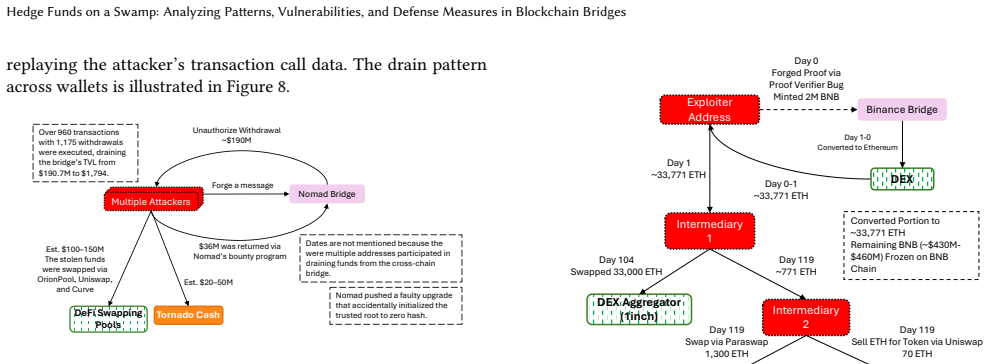
On the paper's own terms, the discovery is that bridge vulnerability is a design property, not an accident. The majority of the 43 representative attacks violate the causality or consistency priors, while the peg prior is violated only as a downstream effect of unauthorized minting or release. Across the incident table, two vectors dominate—access control flaws (V3) and key leakage or theft (V13), each appearing ten times—and these map cleanly onto the two failure classes: off-chain trust failures (Ronin, Harmony, Multichain, Orbit) and on-chain validation bugs (Poly Network, Wormhole, Nomad, BSC Token Hub, Qubit). The paper argues that no major exploit has occurred on fully trustless light-client bridges or rollup-native bridges, whereas trusted and loosely trust-minimized bridges, whose validator sets are weaker than either chain's consensus, keep falling. The damage-to-effort ratio, $\mathrm{der}(V)=I(V)/E(V)$, is introduced to explain why these vectors persist: the impact is often hundreds of millions of dollars while the effort, key theft or a poorly audited contract, remains relatively low.
Load-bearing premise
The central claim depends on the completeness and representativeness of the dataset of 43 attacks: if a real exploit on a fully trustless light-client or rollup bridge was missed, or a bridge-type label is wrong, the conclusion that trustless designs are safer loses its empirical ground.
Editorial extensions
If this is right
- Bridge security investment should shift from stronger cryptography to shrinking the trust set: eliminating multisig signers and adopting light-client verification removes the two highest-frequency vectors.
- Rollup-native bridges and IBC-style light-client channels should be the default for compatible chains, because their security reduces to the underlying chains' own consensus.
- Layered validation, such as requiring both an off-chain multisig and an on-chain light client to agree, should drastically cut exploit probability, at the cost of added complexity and latency.
- Verification-logic bugs (Wormhole, BSC Token Hub) argue for formal verification and independent double-checks of proof code, not just conventional audits.
- Detection latency and containment need to become first-class benchmarks, since the Ronin case shows a $624 million theft going unnoticed for six days.
Reading between the lines
- The 'trustless has never been hacked' conclusion is only as strong as the incident dataset behind Table 8; a single missed exploit on a light-client or rollup bridge would invert the design ranking, so a completeness audit of attack collections is a natural next step.
- The damage-to-effort framework suggests a testable prediction: bridges whose trust set is a bonded, slashable validator set with hundreds of nodes should show attack rates between those of naive multisigs and light-client designs, and that gradient could be quantified from incident history.
- The transaction tracing is Ethereum-centric, so extending the same methodology to Solana and Cosmos exploit flows could reveal laundering and attacker-behavior patterns that are invisible from an Ethereum full node.
- If the design hierarchy holds, insurance underwriters and regulators could price bridge risk by trust-set size and verification method, an application the paper itself does not develop.
Editorial analysis
A structured set of objections, weighed in public.
Referee Report
Summary. This paper presents a systematization of blockchain bridge security, combining a formal model of bridge architectures and trust sets, a taxonomy of 23 attack vectors, a static analysis of 16 deployed smart contracts, transaction-level tracing of 18 attacker wallets, and a catalog of 43 real-world incidents. The authors argue that most bridge exploits stem from off-chain trust failures and on-chain validation bugs, and that fully trustless designs (light-client and rollup-native bridges) have so far resisted major attacks while trusted and trust-minimized bridges remain disproportionately vulnerable. They also discuss detection, mitigation, and outlook in four research questions.
Significance. If the central empirical claim held, the paper would provide actionable guidance for bridge architects by shifting attention from cryptographic weaknesses to trust-set design and verification-logic correctness. The paper usefully assembles a broad incident table, a layered threat model, and a concrete static-analysis metric set; it also ships traceable case narratives for Ronin, Wormhole, Nomad, and others. However, the load-bearing conclusion is undermined by an internal contradiction involving the BSC Token Hub incident and by the absence of a verifiable incident-selection and classification methodology. The taxonomy and formal framework have merit, but the empirical claims need substantial rework before the conclusions are reliable.
major comments (4)
- [Section 5 (RQ1), Appendix F, Table 8] The central claim that "no major exploits have occurred on fully trustless light-client bridges or rollup bridges" is contradicted by the manuscript's own Binance Bridge/BSC Token Hub case. Appendix F states that the root cause was "a bug in the light-client based proof verification" and that "even a seemingly trustless bridge (a light-client-based one) can have implementation flaws in its verification logic," while Table 8 classifies the same incident as "Custodial" with technique "Proof Verifier Bug" (V9). If BSC Token Hub is excluded from the trustless category because of custodial control, the category is effectively defined by custody rather than by verification mechanism, and the claim that trustless verification has not been breached becomes circular; if it is included, the "no major exploits" claim is false. Please reconcile the taxonomy with this case, and provide a rubric that maps each incident to the Section 3.3 trust-set definitions.
- [Section 5, Table 8] The empirical foundation of RQ1 is not verifiable as presented. The paper does not state how the 43 attacks were selected, does not provide a completeness analysis, and does not supply the dataset (the "repository URL" mentioned in Section 2 is not given). The negative claim about trustless bridges depends on the set of considered incidents being representative and complete, so a missed or mislabeled exploit would invalidate the conclusion. In addition, the "Architecture Type" labels in Table 8 are asserted without a visible mapping from Section 3.3's T_src/T_off/T_dest definitions to each incident; for example, "Binance Bridge" is labeled Custodial despite the appendix describing light-client verification. Please add the incident-selection methodology, a completeness discussion, and a per-incident classification rubric.
- [Section 3.6, Appendix E, Tables 2 and 8] The attack-vector numbering used in Table 8 is unreliable because the vector definitions in Appendix E do not match Table 2. Table 2 defines V3 as access control, V9 as malicious transaction modification, and V10 as light-client verification flaws, whereas Appendix E assigns V3 to reentry, V9 to oracle manipulation, and V10 to consensus failure, and it lists only vectors V1–V18 against Table 2's V1–V23. Since Table 8 uses these vector codes (e.g., V9 for the Binance proof-verifier bug and V10 for Nomad's trusted-root exploit), the frequency counts and causal attributions built on them cannot be checked. The two lists must be aligned, or the vector codes should be removed from the incident table.
- [Section 3.5.2, Eq. (8)] Definition 3.5 first defines der(V)=I(V)/E(V) as a damage-to-effort ratio, then immediately redefines the same symbol as an indicator: "der(V)=1 if der(V)>1, 0 otherwise." Equation (8) sums these indicator values while the surrounding text and Section 5 interpret der as a ratio ("high damage-to-effort ratios"). This conflation makes the formal attack-surface model internally inconsistent and should be fixed by introducing a separate viability indicator, e.g., viable(V)=1[der(V)>1], and using it in the area sum.
minor comments (5)
- [Appendix B vs. main text] The theorem is numbered Theorem 1 in Section 3.4 but appears as Theorem 2 in Appendix B; please renumber consistently.
- [Section 3.2.3] The transaction definition tx_b2=(theta_2, v_2=0, ...) conflicts with the subsequent balance update a_2 maps to v_x-f_2; clarify that v_2 is the amount in the transaction tuple, not the resulting balance.
- [Section 4.2 and Table 10] The text reports "6 out of 18 wallets continued transacting," but Table 10 lists 19 exploit addresses; please align the count and provide full addresses in a supplementary dataset.
- [Section 2] The phrase "available at our repository URL" is a placeholder; include an actual URL or remove the pointer so reviewers can access the claimed dataset and code.
- [Table 10 caption] The caption contains a typo, "Blockhain," and the address entries are truncated; consider providing complete addresses in the data release.
Circularity Check
No significant circularity: the central empirical claims rest on external incident data and independent code/transaction analysis, not on self-referential definitions or fitted parameters.
full rationale
The paper's central claims are empirical. Table 8's 43 incidents are labeled from external reports, the static code metrics in Tables 3-5 come from deployed contracts, and the transaction traces come from a Geth full node (Section 4.2). None of these are fitted parameters renamed as predictions. The formal apparatus (Definitions 3.1-3.5, Theorem 1) is not load-bearing for the main conclusions: Theorem 1's claim that every attack violates the peg requires the substantive argument in Appendix B, not merely Definition 3.1, since an attack is defined as violating any one of (4)-(7), not necessarily (4). The RQ1 claim that no major exploit has hit fully trustless light-client or rollup bridges is classification-sensitive. The paper's own BSC Token Hub case is labeled 'Custodial' in Table 8 and Table 9, so excluding it from the 'fully trustless' set is consistent with the paper's stated trust-model definitions rather than a definitional dodge; the tension with Appendix F ('even a seemingly trustless bridge (a light-client-based one) can have implementation flaws') is a potential labeling/validity concern, not circularity. The only self-citations ([37,38]) support a minor research-gap remark in RQ2 and are not load-bearing for the bridge-security thesis. No derivation reduces to its own inputs by construction.
Assumptions & free parameters
assumptions (4)
- domain assumption Underlying blockchains are live and capable of processing transactions in a timely manner
- domain assumption The 43 attack scenarios and Table 8 incident list are representative and complete enough to support comparative safety claims across bridge architectures
- domain assumption The three security priors (peg, causality, consistency) in Section 3.4 capture the relevant bridge security properties
- domain assumption The attack vector taxonomy in Table 2 is complete and disjoint
Cite this review
Pith. "Pith review of Hedge Funds on a Swamp: Analyzing Patterns, Vulnerabilities, and Defense Measures in Blockchain Bridges." pith.science (2026). https://pith.science/paper/52Y2JCVH
@misc{pith2026250706156,
  author       = {Pith},
  title        = {Pith review of: Hedge Funds on a Swamp: Analyzing Patterns, Vulnerabilities, and Defense Measures in Blockchain Bridges},
  year         = {2026},
  howpublished = {\url{https://pith.science/paper/52Y2JCVH}},
  note         = {Machine review of arXiv:2507.06156}
}
abstract
Blockchain bridges have become essential infrastructure for enabling interoperability across different blockchain networks, with more than $24B monthly bridge transaction volume. However, their growing adoption has been accompanied by a disproportionate rise in security breaches, making them the single largest source of financial loss in Web3. For cross-chain ecosystems to be robust and sustainable, it is essential to understand and address these vulnerabilities. In this study, we present a comprehensive systematization of blockchain bridge design and security. We define three bridge security priors, formalize the architectural structure of 13 prominent bridges, and identify 23 attack vectors grounded in real-world blockchain exploits. Using this foundation, we evaluate 43 representative attack scenarios and introduce a layered threat model that captures security failures across source chain, off-chain, and destination chain components. Our analysis at the static code and transaction network levels reveals recurring design flaws, particularly in access control, validator trust assumptions, and verification logic, and identifies key patterns in adversarial behavior based on transaction-level traces. To support future development, we propose a decision framework for bridge architecture design, along with defense mechanisms such as layered validation and circuit breakers. This work provides a data-driven foundation for evaluating bridge security and lays the groundwork for standardizing resilient cross-chain infrastructure.
Figures


Figures from the paper (7 more)




Reference graph
Works this paper leans on
-
[1]
Bridge Volume - DefiLlama
“Bridge Volume - DefiLlama. ” https://defillama.com/bridges. Accessed: 2025-05- 29
2025
-
[2]
Rollups are the most secure bridges
B. Kiepuszewski, “Rollups are the most secure bridges. ” https://archive.devcon. org/devcon-6/rollups-are-the-most-secure-bridges/, 2022. Devcon 6, Bogota, October 13, 2022
2022
-
[3]
Multichain
“Multichain. ” https://multichain.org/. Accessed: 2025-04-24
2025
-
[4]
Ronin bridge
“Ronin bridge. ” https://docs.roninchain.com/apps/ronin-bridge, 2025. Accessed: 2025-05-21. Official documentation for the Ronin Bridge, facilitating ERC-20 token and NFT transfers between Ethereum and the Ronin chain
2025
-
[5]
Rainbow bridge
“Rainbow bridge. ” https://rainbowbridge.app/, 2025. Accessed: 2025-05-21. Offi- cial interface for the Rainbow Bridge, facilitating trustless and permissionless asset transfers between Ethereum, NEAR, and Aurora blockchains
2025
-
[6]
Polygon plasma bridge
“Polygon plasma bridge. ” https://docs.polygon.technology/, 2025. Accessed: 2025- 05-21. Official documentation for the Polygon Plasma Bridge, enabling secure asset transfers between Ethereum and Polygon using Ethereum’s Plasma scaling framework
2025
-
[7]
Xchain- watcher: Monitoring and identifying attacks in cross-chain bridges,
A. Augusto, R. Belchior, J. Pfannschmidt, A. Vasconcelos, and M. Correia, “Xchain- watcher: Monitoring and identifying attacks in cross-chain bridges, ”arXiv preprint arXiv:2410.02029, 2024
arXiv 2024
-
[8]
J. Wu, K. Lin, D. Lin, B. Zhang, Z. Wu, and J. Su, “Safeguarding blockchain ecosystem: Understanding and detecting attack transactions on cross-chain bridges, ”arXiv preprint arXiv:2410.14493, 2024
arXiv 2024
Show all 95 references
-
[9]
Sok: A review of cross-chain bridge hacks in 2023,
N. Belenkov, V. Callens, A. Murashkin, K. Bak, M. Derka, J. Gorzny, and S.- S. Lee, “Sok: A review of cross-chain bridge hacks in 2023, ”arXiv preprint arXiv:2501.03423, 2025
2023 arXiv
-
[10]
Blockchain cross- chain bridge security: Challenges, solutions, and future outlook,
N. Li, M. Qi, Z. Xu, X. Zhu, W. Zhou, S. Wen, and Y. Xiang, “Blockchain cross- chain bridge security: Challenges, solutions, and future outlook, ”Distributed Ledger Technologies: Research and Practice, vol. 4, no. 1, pp. 1–34, 2025
2025
-
[11]
Ethereum
“Ethereum. ” https://ethereum.org/, 2025. Accessed: 2025-05-21. Official website of Ethereum, a decentralized platform supporting smart contracts and decentralized applications (dApps)
2025
-
[12]
Seamlessly transferring assets through layer- 0 bridges: An empirical analysis of stargate bridge’s architecture and dynamics,
C. Huang, T. Yan, and C. J. Tessone, “Seamlessly transferring assets through layer- 0 bridges: An empirical analysis of stargate bridge’s architecture and dynamics, ” inCompanion Proceedings of the ACM Web Conference 2024, pp. 1776–1784, 2024
2024
-
[13]
Polygon
“Polygon. ” https://polygon.technology/, 2025. Accessed: 2025-05-21. Official website of Polygon, an Ethereum scaling platform offering Layer 2 solutions such as the PoS chain, zkEVM, and other modular frameworks for building interoperable blockchain networks
2025
-
[14]
Binance smart chain whitepaper,
Binance, “Binance smart chain whitepaper, ” 2020
2020
-
[15]
Avalanche
“Avalanche. ” https://avax.network/, 2025. Accessed: 2025-05-21. Official website of Avalanche, a high-performance Layer 1 blockchain platform developed by Ava Labs, featuring a unique three-chain architecture (X-Chain, C-Chain, and P-Chain) and the Avalanche Consensus Protoco...
2025
-
[16]
Arbitrum
“Arbitrum. ” https://arbitrum.io/, 2025. Accessed: 2025-05-21. Official website of Arbitrum, a Layer 2 scaling solution for Ethereum utilizing optimistic rollups to enhance transaction throughput and reduce fees while maintaining security. Hedge Funds on a Swamp: Analyzing Pat...
2025
-
[17]
Optimism
“Optimism. ” https://www.optimism.io/, 2025. Accessed: 2025-05-21. Official website of Optimism, a Layer 2 scaling solution for Ethereum utilizing optimistic rollups to enhance transaction throughput and reduce fees while maintaining security
2025
-
[18]
Bench- marking blockchain bridge aggregators,
S. Subramanian, A. Augusto, R. Belchior, A. Vasconcelos, and M. Correia, “Bench- marking blockchain bridge aggregators, ” in2024 IEEE International Conference on Blockchain (Blockchain), pp. 37–45, IEEE, 2024
2024
-
[19]
Xchaindatagen: A cross- chain dataset generation framework,
A. Augusto, A. Vasconcelos, M. Correia, and L. Zhang, “Xchaindatagen: A cross- chain dataset generation framework, ”arXiv preprint arXiv:2503.13637, 2025
2025 arXiv
-
[20]
Sok: Security and privacy of blockchain interoperability,
A. Augusto, R. Belchior, M. Correia, A. Vasconcelos, L. Zhang, and T. Hardjono, “Sok: Security and privacy of blockchain interoperability, ” in2024 IEEE Symposium on Security and Privacy (SP), pp. 3840–3865, IEEE, 2024
2024
-
[21]
” https://app.nomad.xyz/, 2025
“Nomad. ” https://app.nomad.xyz/, 2025. Accessed: 2025-05-21. Official website of Nomad, a security-first cross-chain messaging protocol enabling secure and gas-efficient communication between blockchains
2025
-
[22]
Track and trace: Automatically uncovering cross-chain transactions in the multi-blockchain ecosystems,
D. Lin, Z. Zheng, J. Wu, J. Yang, K. Lin, H. Xiao, B. Song, and Z. Zheng, “Track and trace: Automatically uncovering cross-chain transactions in the multi-blockchain ecosystems, ”arXiv preprint arXiv:2504.01822, 2025
2025 arXiv
-
[23]
Bitcoin
“Bitcoin. ” https://bitcoin.org/, 2025. Accessed: 2025-05-21. Official website of Bitcoin, the first decentralized cryptocurrency and blockchain network
2025
-
[24]
Solana
“Solana. ” https://solana.com/, 2025. Accessed: 2025-05-21. Official website of Solana, a high-performance blockchain platform supporting decentralized appli- cations and smart contracts
2025
-
[25]
Orbs network
“Orbs network. ” https://www.orbs.com/, 2025. Accessed: 2025-05-21. Official website of Orbs Network, a decentralized Layer-3 blockchain infrastructure designed to enhance the capabilities of existing smart contracts by providing decentralized backend services
2025
-
[26]
Xai games
“Xai games. ” https://xai.games/, 2025. Accessed: 2025-05-21. Official website of Xai Games, a Layer 3 blockchain platform built on Arbitrum, designed to bring AAA gaming experiences to Web3 by enabling seamless integration of blockchain technology into games
2025
-
[27]
zksync
“zksync. ” https://zksync.io/, 2025. Accessed: 2025-05-21. Official website of zkSync, a Layer 2 Ethereum scaling solution utilizing zero-knowledge rollups to enhance scalability and reduce transaction costs while maintaining high security
2025
-
[28]
Wormhole
“Wormhole. ” https://wormhole.com/. Accessed: 2025-04-24
2025
-
[29]
Loopring
“Loopring. ” https://loopring.org/, 2025. Accessed: 2025-05-21. Official website of Loopring, a Layer 2 zkRollup protocol on Ethereum that enables scalable, secure, and low-cost decentralized trading and payments
2025
-
[30]
Connext: The interoperability protocol for cross-chain applications
Connext, “Connext: The interoperability protocol for cross-chain applications. ” https://www.connext.network/, 2025. Accessed: 2025-06-03
2025
-
[31]
Across: Cross-chain bridge for ethereum and layer 2 networks
Across, “Across: Cross-chain bridge for ethereum and layer 2 networks. ” https: //across.to/, 2025. Accessed: 2025-06-03
2025
-
[32]
Qubit finance
“Qubit finance. ” https://qbt.fi/, 2025. Accessed: 2025-05-21. Official website of Qubit Finance, a decentralized money market platform on Binance Smart Chain (BSC) that connects lenders and borrowers efficiently and securely
2025
-
[33]
Tornado cash
“Tornado cash. ” https://tornado.cash/, 2025. Accessed: 2025-05-21. Official website of Tornado Cash, a decentralized, non-custodial privacy protocol on Ethereum that uses zero-knowledge proofs to enable anonymous transactions
2025
-
[34]
Horizon bridge
“Horizon bridge. ” https://bridge.harmony.one/, 2025. Accessed: 2025-05-21. Offi- cial website of Horizon Bridge, a cross-chain bridge developed by Harmony that facilitates the transfer of crypto assets between Ethereum, Binance Smart Chain, and Harmony networks
2025
-
[35]
Cosmos patches ‘critical’ ibc protocol bug, saving $126m,
B. Lindrea, “Cosmos patches ‘critical’ ibc protocol bug, saving $126m, ” 2024. Accessed: 2025-05-19
2024
-
[36]
Li.fi: With bridges, trust is a spectrum,
A. Chand and M. Murdock, “Li.fi: With bridges, trust is a spectrum, ” July 2022. LI.FI Knowledge Hub
2022
-
[37]
Alphacore: data depth based core decomposition,
F. Victor, C. G. Akcora, Y. R. Gel, and M. Kantarcioglu, “Alphacore: data depth based core decomposition, ” inProceedings of the 27th ACM SIGKDD Conference on Knowledge Discovery & Data Mining, pp. 1625–1633, 2021
2021
-
[38]
Machine learning for blockchain data analy- sis: Progress and opportunities,
P. Azad, C. Akcora, and A. Khan, “Machine learning for blockchain data analy- sis: Progress and opportunities, ”Distributed Ledger Technologies: Research and Practice, 2024
2024
-
[39]
Ef/cf: High performance smart contract fuzzing for exploit generation,
M. Rodler, D. Paaßen, W. Li, L. Bernhard, T. Holz, G. Karame, and L. Davi, “Ef/cf: High performance smart contract fuzzing for exploit generation, ” in8th IEEE European Symposium on Security and Privacy, EuroS&P 2023, Delft, Netherlands, July 3-7, 2023, pp. 449–471, IEEE, 2023
2023
-
[40]
Chainlink cross-chain interoperability protocol (ccip)
Chainlink Labs, “Chainlink cross-chain interoperability protocol (ccip). ” https: //chain.link/cross-chain, 2025. Accessed: 2025-04-24
2025
-
[41]
Sok: Validating bridges as a scaling solution for blockchains,
P. McCorry, C. Buckland, B. Yee, and D. Song, “Sok: Validating bridges as a scaling solution for blockchains, ”Cryptology ePrint Archive, 2021
2021
-
[42]
ICT Convergence Powered by Smart Intelligence
Han’guk T’ongsin Hakhoe, IEEE Communications Society, Denshi J¯oh¯o Ts¯ushin Gakkai (Japan). Ts¯ushin Sosaieti, Institute of Electrical, and E. Engineers,ICTC 2018 : the 9th International Conference on ICT Convergence : "ICT Convergence Powered by Smart Intelligence" : October...
2018
-
[43]
SoK: Not Quite Water Under the Bridge: Review of Cross-Chain Bridge Hacks,
S.-S. Lee, A. Murashkin, M. Derka, and J. Gorzny, “SoK: Not Quite Water Under the Bridge: Review of Cross-Chain Bridge Hacks, ” in2023 IEEE International Conference on Blockchain and Cryptocurrency (ICBC), pp. 1–14, IEEE, 10 2023
2023
-
[44]
Exploring Blockchains Interoperability: A Systematic Survey,
G. Wang, Q. Wang, and S. Chen, “Exploring Blockchains Interoperability: A Systematic Survey, ”ACM Computing Surveys, vol. 55, pp. 1–38, 12 2023
2023
-
[45]
A Survey on Blockchain Interoperability: Past, Present, and Future Trends,
R. Belchior, A. Vasconcelos, S. Guerreiro, and M. Correia, “A Survey on Blockchain Interoperability: Past, Present, and Future Trends, ” 11 2022
2022
-
[46]
SoK: Communication Across Distributed Ledgers,
A. Zamyatin, M. Al-Bassam, D. Zindros, E. Kokoris-Kogias, P. Moreno-Sanchez, A. Kiayias, and W. J. Knottenbelt, “SoK: Communication Across Distributed Ledgers, ” tech. rep., 2019
2019
-
[47]
Inter blockchain communication: A survey,
I. A. Qasse, M. A. Talib, and Q. Nasir, “Inter blockchain communication: A survey, ” inACM International Conference Proceeding Series, Association for Computing Machinery, 10 2019
2019
-
[48]
S. K. Niranjan, REVA University, Institute of Electrical, E. E. B. Section, Institute of Electrical, and E. Engineers,Proceedings of the International Conference on Smart Technologies in Computing, Electrical and Electronics (ICSTCEE 2020) : October 9-10, 2020, Virtual Confere...
2020
-
[49]
Towards Blockchain Interoperability,
S. Schulte, M. Sigwart, P. Frauenthaler, and M. Borkowski, “Towards Blockchain Interoperability, ” inBusiness Process Management: Blockchain and Central and Eastern Europe Forum: BPM 2019 Blockchain and CEE Forum, Vienna, Austria, September 1–6, 2019, Proceedings 17, pp. 3–10, 2019
2019
-
[50]
Toward an Interoperability Architec- ture for Blockchain Autonomous Systems,
T. Hardjono, A. Lipton, and A. Pentland, “Toward an Interoperability Architec- ture for Blockchain Autonomous Systems, ”IEEE Transactions on Engineering Management, vol. 67, pp. 1298–1309, 10 2020
2020
-
[51]
About Blockchain Interoperability,
P. Lafourcade and M. Lombard-Platet, “About Blockchain Interoperability, ” tech. rep., Université Clermont Auvergne, 2020
2020
-
[52]
Attacks Against Cross-Chain Systems and Defense Approaches: A Contemporary Survey,
L. Duan, Y. Sun, W. Ni, S. Member, W. Ding, J. Liu, and W. Wang, “Attacks Against Cross-Chain Systems and Defense Approaches: A Contemporary Survey, ”IEEE, 2023
2023
-
[53]
Towards Atomic Cross- Chain Token Transfers: State of the Art and Open Questions within TAST,
M. Borkowski, D. Mcdonald, C. Ritzer, and S. Schulte, “Towards Atomic Cross- Chain Token Transfers: State of the Art and Open Questions within TAST, ” tech. rep., TU Wien, 2018
2018
-
[54]
Wrapping trust for interoperability: A preliminary study of wrapped tokens,
G. Caldarelli, “Wrapping trust for interoperability: A preliminary study of wrapped tokens, ” 10 2022
2022
-
[55]
Cross-Blockchain Technologies: Review, State of the Art, and Out- look,
M. Borkowski, P. Frauenthaler, M. Sigwart, T. Hukkinen, H. Hladk ´y, and S. Schulte, “Cross-Blockchain Technologies: Review, State of the Art, and Out- look, ” tech. rep., TU Wien, 2019
2019
-
[56]
Cross-Chain Deals and Adversarial Com- merce,
M. Herlihy, B. Liskov, and L. Shrira, “Cross-Chain Deals and Adversarial Com- merce, ” inProceedings of the VLDB Endowment, vol. 13, pp. 100–113, 2019
2019
-
[57]
Anonymous Multi-Hop Locks for Blockchain Scalability and Interoperability,
G. Malavolta, P. Moreno-Sanchez, C. Schneidewind, A. Kate, and M. Maffei, “Anonymous Multi-Hop Locks for Blockchain Scalability and Interoperability, ” inNetwork and Distributed System Security Symposium (NDSS), 2019
2019
-
[58]
Universal Atomic Swaps: Secure Exchange of Coins Across All Blockchains,
S. A. K. Thyagarajan, G. Malavolta, and P. Moreno-Sanchez, “Universal Atomic Swaps: Secure Exchange of Coins Across All Blockchains, ” in2022 IEEE Sympo- sium on Security and Privacy (SP), pp. 1299–1316, 2022
2022
-
[59]
FlyClient: Super-Light Clients for Cryptocurrencies,
B. Bünz, L. Kiffer, L. Luu, and M. Zamani, “FlyClient: Super-Light Clients for Cryptocurrencies, ” in2020 IEEE Symposium on Security and Privacy (SP), pp. 928– 946, 2020
2020
-
[60]
Non-Interactive Proofs of Proof-of-Work,
A. Kiayias, A. Miller, and D. Zindros, “Non-Interactive Proofs of Proof-of-Work, ” inFinancial Cryptography and Data Security (FC), vol. 12059 ofLNCS, pp. 505–522, Springer, 2020
2020
-
[61]
Alba: The Dawn of Scalable Bridges for Blockchains,
G. Scaffino, L. Aumayr, M. Bastankhah, Z. Avarikioti, and M. Maffei, “Alba: The Dawn of Scalable Bridges for Blockchains, ” inNetwork and Distributed System Security Symposium (NDSS), 2025
2025
-
[62]
zkBridge: Trustless Cross-Chain Bridges Made Practical,
T. Xie, J. Zhang, Z. Cheng, F. Zhang, Y. Zhang, Y. Jia, D. Boneh, and D. Song, “zkBridge: Trustless Cross-Chain Bridges Made Practical, ” inProceedings of the 2022 ACM SIGSAC Conference on Computer and Communications Security (CCS), pp. 3003–3017, ACM, 2022
2022
-
[63]
XCLAIM: Trustless, Interoperable, Cryptocurrency-Backed Assets,
A. Zamyatin, D. Harz, J. Lind, P. Panayiotou, A. Gervais, and W. Knottenbelt, “XCLAIM: Trustless, Interoperable, Cryptocurrency-Backed Assets, ” in2019 IEEE Symposium on Security and Privacy (SP), pp. 193–210, 2019
2019
-
[64]
SmartAxe: De- tecting Cross-Chain Vulnerabilities in Bridge Smart Contracts via Fine-Grained Static Analysis,
Z. Liao, Y. Nan, H. Liang, S. Hao, J. Zhai, J. Wu, and Z. Zheng, “SmartAxe: De- tecting Cross-Chain Vulnerabilities in Bridge Smart Contracts via Fine-Grained Static Analysis, ” inProceedings of the 2024 ACM Joint European Software Engi- neering Conference and Symposium on the...
2024
-
[65]
Near protocol
“Near protocol. ” https://near.org/, 2025. Accessed: 2025-05-21. Official website of NEAR Protocol, a scalable, developer-friendly Layer 1 blockchain platform utilizing sharding (Nightshade) and a unique consensus mechanism (Doomslug) to support decentralized applications and ...
2025
-
[66]
” https://aptosfoundation.org/, 2025
“Aptos. ” https://aptosfoundation.org/, 2025. Accessed: 2025-05-21. Official web- site of Aptos, a high-performance Layer 1 blockchain developed by former Meta engineers. Aptos leverages the Move programming language and the Block-STM parallel execution engine to achieve high ...
2025
-
[67]
” https://sui.io/, 2025
“Sui. ” https://sui.io/, 2025. Accessed: 2025-05-21. Official website of Sui, a high- performance Layer 1 blockchain designed for scalability and low latency. Sui utilizes the Move programming language and features an object-centric data model, enabling parallel transaction ex...
2025
-
[68]
Cosmwasm
“Cosmwasm. ” https://cosmwasm.com/, 2025. Accessed: 2025-05-21. Official web- site of CosmWasm, a WebAssembly-based smart contract platform designed for Poupak Azad, Jiahua Xu, Yebo Feng, Preston Strowbridge, and Cuneyt Gurcan Akcora the Cosmos ecosystem, enabling secure, inte...
2025
-
[69]
” https://base.org/, 2025
“Base. ” https://base.org/, 2025. Accessed: 2025-05-21. Official website of Base, a secure, low-cost, builder-friendly Ethereum Layer 2 (L2) blockchain incubated by Coinbase. Base is designed to bring the next billion users onchain by offering fast transactions and low fees. I...
2025
-
[70]
” https://celo.org/, 2025
“Celo. ” https://celo.org/, 2025. Accessed: 2025-05-21. Official website of Celo, a mobile-first, carbon-negative blockchain platform that transitioned from an independent Layer 1 to an Ethereum Layer 2 solution. Celo focuses on real-world applications, offering low-cost trans...
2025
-
[71]
Litecoin
“Litecoin. ” https://litecoin.org/, 2025. Accessed: 2025-05-21. Official website of Litecoin, a peer-to-peer cryptocurrency enabling instant, near-zero cost pay- ments to anyone in the world. Litecoin is an open-source, global payment network that is fully decentralized withou...
2025
-
[72]
Blocknet
“Blocknet. ” https://blocknet.co/, 2025. Accessed: 2025-05-21. Official website of Blocknet, a decentralized interoperability protocol that enables communication, exchange, and service delivery between different blockchains through a cross- chain architecture
2025
-
[73]
Colossusxt
“Colossusxt. ” https://www.colossusxt.io/, 2025. Accessed: 2025-05-21. Official website of ColossusXT, a community-oriented, energy-efficient cryptocurrency focused on decentralization, privacy, and real-world implementation
2025
-
[74]
Terra blockchain
“Terra blockchain. ” https://www.terra.money/, 2025. Accessed: 2025-05-21. Offi- cial website of Terra, an open-source blockchain protocol that supports algorith- mic stablecoins and decentralized applications. Terra experienced a significant collapse in May 2022, leading to t...
2025
-
[75]
The complete platform for onchain finance - wormhole
“The complete platform for onchain finance - wormhole. ” https://wormhole.com/ institutions, 2025. Accessed: 2025-06-02
2025
-
[76]
Bridges | flow developer portal
“Bridges | flow developer portal. ” https://developers.flow.com/ecosystem/bridges,
-
[77]
Cardano
“Cardano. ” https://cardano.org/, 2025. Accessed: 2025-05-21. Official website of Cardano, a decentralized proof-of-stake blockchain platform built on peer- reviewed research, designed for secure and scalable smart contracts and decen- tralized applications
2025
-
[78]
What is IBC?
Cosmos Developer Portal, “What is IBC?. ” https://tutorials.cosmos.network/ academy/3-ibc/1-what-is-ibc.html, 2024. Accessed: 2025-04-24
2024
-
[79]
Ibc/tao - clients - developer portal
“Ibc/tao - clients - developer portal. ” https://tutorials.cosmos.network/academy/3- ibc/4-clients.html, 2025. Accessed: 2025-06-02
2025
-
[80]
Trustless interoperability between rollups: Landscape, constructions, and chal- lenges
“Trustless interoperability between rollups: Landscape, constructions, and chal- lenges. ” https://medium.com/1kxnetwork/trustless-interoperability-between- rollups-landscape-constructions-and-challenges-8ff195ea92cc, 2024. Accessed: 2025-06-02
2024
-
[81]
Blockchain scaling using rollups: A comprehensive survey,
L. T. Thibault, T. Sarry, and A. S. Hafid, “Blockchain scaling using rollups: A comprehensive survey, ”IEEE Access, vol. 10, pp. 93039–93054, 2022
2022
-
[82]
Axelar network
“Axelar network. ” https://axelar.network/. Accessed: 2025-04-24
2025
-
[83]
Layerzero protocol
LayerZero Foundation, “Layerzero protocol. ” https://docs.layerzero.network/v2/ developers/solana/getting-started, 2025. Accessed: 2025-04-24
2025
-
[84]
Celer cbridge
“Celer cbridge. ” https://cbridge.celer.network/. Accessed: 2025-04-24
2025
-
[85]
Bnb chain
“Bnb chain. ” https://www.bnbchain.org/, 2025. Accessed: 2025-05-21. Official website of BNB Chain, a decentralized blockchain ecosystem supporting smart contracts and decentralized applications (dApps)
2025
-
[86]
Bridging the gap: Ethereum-binance smart chain bridge (eth-bep)
“Bridging the gap: Ethereum-binance smart chain bridge (eth-bep). ” https://www. binance.com/en/square/post/891550, 2023. Accessed: 2025-06-02
2023
-
[87]
Osmosis
“Osmosis. ” https://osmosis.zone/, 2025. Accessed: 2025-05-21. Official website of Osmosis, a decentralized exchange (DEX) and Layer 1 blockchain in the Cosmos ecosystem, enabling cross-chain asset swaps and liquidity provision through the Inter-Blockchain Communication (IBC) protocol
2025
-
[88]
Cronos
“Cronos. ” https://cronos.org/, 2025. Accessed: 2025-05-21. Official website of Cronos, an open-source, EVM-compatible Layer 1 blockchain developed by Crypto.com. Built on the Cosmos SDK and powered by Ethermint, Cronos sup- ports the Inter-Blockchain Communication (IBC) proto...
2025
-
[89]
Gravity bridge
“Gravity bridge. ” https://www.gravitybridge.net/, 2025. Accessed: 2025-05-21. Official website of Gravity Bridge, a decentralized, neutral Cosmos SDK-based blockchain facilitating trustless interoperability between Ethereum and Cosmos ecosystems through the Inter-Blockchain C...
2025
-
[90]
Exploring cross-chain solutions: How to bridge into the cosmos ecosystem
“Exploring cross-chain solutions: How to bridge into the cosmos ecosystem. ” https://www.axelar.network/blog/cosmos-bridge-explained, 2023. Accessed: 2025-06-02
2023
-
[91]
Fantom
“Fantom. ” https://fantom.foundation/, 2025. Accessed: 2025-05-21. Official web- site of Fantom, a high-performance, scalable, and secure smart-contract platform designed for decentralized applications (dApps) and digital assets
2025
-
[92]
debridge finance
deBridge Foundation, “debridge finance. ” https://debridge.finance, 2025. Accessed: 2025-04-24
2025
-
[93]
Polkadot
“Polkadot. ” https://polkadot.com/, 2025. Accessed: 2025-05-21. Official website of Polkadot, a scalable, interoperable, and secure multi-chain blockchain platform designed to connect various blockchains into a unified network
2025
-
[94]
Introduction to xcm (cross-consensus messaging)
Polkadot Documentation, “Introduction to xcm (cross-consensus messaging). ” https://docs.polkadot.network/develop/interoperability/intro-to-xcm/, 2025. Ac- cessed: 2025-04-24. Hedge Funds on a Swamp: Analyzing Patterns, Vulnerabilities, and Defense Measures in Blockchain Bridg...
2025
-
[2025]
Accessed: 2025-06-02
2025
Reviewed August 6, 2026 · model on record in the stance chip above.
Discussion (0). Continue with ORCID to comment.