REVIEW 4 major objections 5 minor 128 references
Feed-Forward SceneDINO for Unsupervised Semantic Scene Completion
T0 review · 4 major / 5 minor · reviewed 2026-08-06 · deepseek-v4-flash
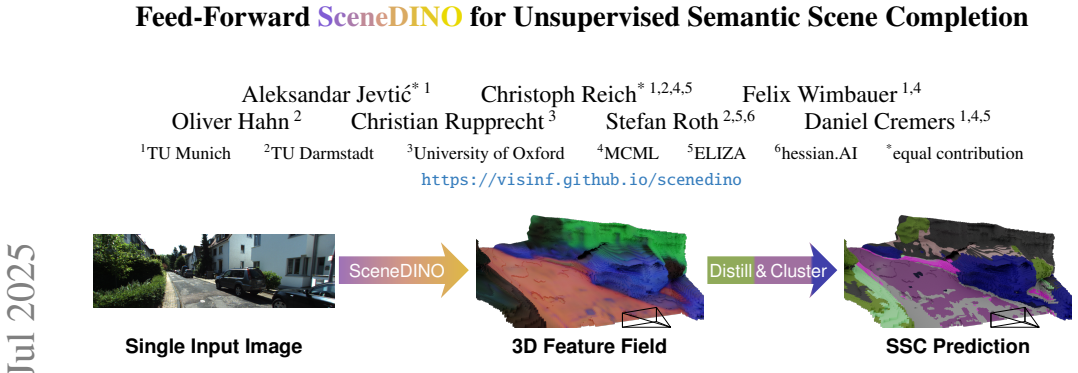
Pith's one-line read SceneDINO learns 3D semantic scene completion from a single image with zero labeled data, training only on multi-view photometric and DINO-feature consistency, then distills its 3D feature field into unsupervised semantics.
desk verdict Genuinely first unsupervised SSC, but the quantitative superiority claim is statistically shaky; still deserves review. read the letter →
The pith
A machine-rendered reading of the paper's core claim, the machinery that carries it, and where it could break.
The reading
What carries the argument
A continuous 3D feature field parameterized by a two-layer MLP decoder that maps position and a queried per-pixel embedding to density and a 64-dim feature (up-projected to 768). The field is trained by differentiable volume rendering of depth and features: photometric multi-view consistency (L1+SSIM with color sampling from source views) learns geometry, while a cosine-similarity feature loss—with a learned downsampler and a constant positional-encoding decomposition—learns view-consistent DINO features. Unsupervised semantics come from a novel 3D feature distillation: surface points are sampled in depth-sorted chunks with density-filtered neighborhood sampling, paired through a feature buffer, and pulled/pushed by the STEGO contrastive correlation loss into a low-dimensional space that is clustered by k-means.
What would settle it
Measure per-region SSC accuracy on images containing strong cast shadows and moving vehicles: if the density field and semantic predictions degrade precisely where brightness consistency fails (the authors already report this in their failure cases), then photometric multi-view consistency is not sufficient for general scenes. A cleaner test is comparing SceneDINO's rendered depth against LiDAR ground-truth depth in shadowed and dynamic regions; large errors there mean the feature field has nothing reliable to align to.
Extended reading notes
Core claim
SceneDINO is the first method to perform fully unsupervised semantic scene completion: from a single input image it predicts both dense 3D geometry and a high-dimensional semantic feature field in a feed-forward pass, trained without any geometric or semantic ground truth. The key step is lifting 2D DINO features into 3D by training a density-and-feature field with multi-view image and feature reconstruction, then distilling the resulting 3D features with a contrastive correlation loss and clustering them into pseudo-semantic classes. The authors report that this unsupervised pipeline outperforms their S4C+STEGO baseline in 3D (8.00 vs 6.60 mIoU at 51.2 m) and in 2D segmentation (25.81 vs 23.57 mIoU), generalizes to Cityscapes and BDD100K, and, when linearly probed on 2D labels, matches or slightly exceeds the 2D-supervised S4C (10.57 vs 10.19 mIoU at 51.2 m).
Load-bearing premise
The whole pipeline assumes that photometric consistency across the sampled views produces a reliable density field, which requires scenes to be static and brightness-consistent; the authors note shadows and moving objects break this and that semantics are limited to what DINO already encodes.
Editorial extensions
If this is right
- Semantic scene completion can be trained from unlabeled multi-view video plus a pretrained self-supervised feature extractor, removing the need for 3D semantic annotations.
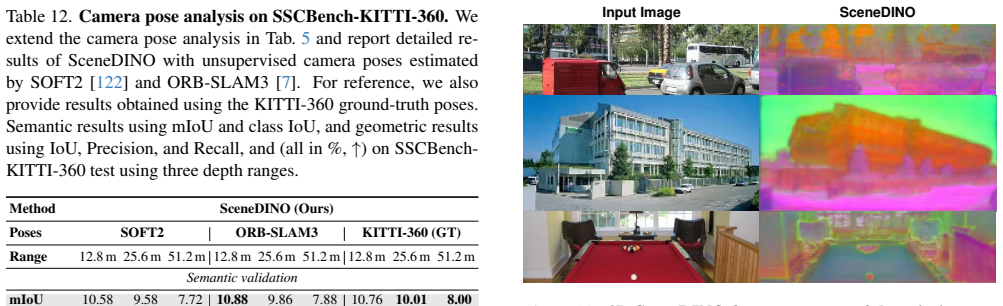
- The lifted feature field is multi-view consistent: cosine similarity between aligned rendered features from different views reaches 0.93–0.97, versus 0.70–0.75 for plain DINO/DINOv2 features.
- The 3D feature field generalizes across driving domains, transferring from KITTI-360 to Cityscapes and BDD100K with mIoU gains over 2D unsupervised baselines.
- Because SceneDINO is agnostic to target features, stronger future SSL features translate directly into better SSC; switching DINO to DINOv2 raised mIoU by 1.08 points without any other change.
- Linear probing the distilled features nearly closes the gap to a fully 2D-supervised SSC pipeline, suggesting the unsupervised feature field can serve as a backbone for weakly supervised 3D understanding.
Reading between the lines
- If the method scales to heterogeneous video collections, unsupervised single-image scene completion could be trained on internet-scale driving footage, yielding zero-shot 3D semantics for new cities without annotation.
- The 3D feature field itself, before distillation, may be reusable for other tasks—such as open-vocabulary queries or panoptic 3D segmentation—since the paper only probes it with clustering and a linear head.
- A testable extension is applying temporal consistency across longer video, not just nearby multi-view frames, which could suppress the tail-like artifacts on moving objects that the authors attribute to their static-scene assumption.
- One could test whether the density filter threshold and depth-chunk sampling are load-bearing by ablating them on scenes with many thin structures, where the current method misses poles and signs.
Editorial analysis
A structured set of objections, weighed in public.
Referee Report
Summary. The paper introduces SceneDINO, a method for semantic scene completion (SSC) from a single RGB image that is trained entirely without ground-truth semantic or geometric annotations. During training, a 2D encoder-decoder and an MLP predict a 3D density and feature field, supervised by multi-view photometric and DINO-feature reconstruction losses together with smoothness regularizers. A novel 3D feature distillation stage, based on contrastive correlation losses over 3D-sampled feature batches, produces lower-dimensional features that are clustered with k-means to yield pseudo-semantic labels. The authors evaluate on SSCBench-KITTI-360, reporting that SceneDINO outperforms their self-constructed S4C+STEGO baseline in 3D mIoU (8.00 vs 6.60 at 51.2 m) and in 2D unsupervised segmentation (25.81 vs 23.57 mIoU), and that with DINOv2 target features plus linear probing it reaches 10.57 mIoU at 51.2 m versus 10.19 for the 2D-supervised S4C. The paper also reports multi-view feature consistency improvements over 2D SSL features and domain generalization results on Cityscapes and BDD100K.
Significance. SceneDINO is, to the best of my knowledge, the first fully unsupervised semantic scene completion approach, with no task-specific supervision or ground-truth labels entering training. The idea of lifting self-supervised DINO features into a volumetric feature field and then performing distillation directly in 3D is a timely and sensible extension of STEGO-style 2D unsupervised segmentation. The paper is commendably concrete: the code is released, the ablations in Tabs. 5 and 6 isolate the contribution of each proposed component, and the supplement candidly analyzes failure cases and limitations. If the quantitative superiority claims are confirmed with proper statistical rigor, this would be a meaningful step toward label-efficient 3D scene understanding. However, the current evidence for the central comparative claims is statistically thin because all results are single runs without variance or significance estimates, and the primary baseline is constructed by the authors.
major comments (4)
- [Sec. 4.1, Table 1] The central quantitative claims — SceneDINO 8.00 vs 6.60 mIoU at 51.2 m and 10.76 vs 10.53 at 12.8 m — are each reported for a single run with no variance or significance estimates. The 12.8 m margin is only 0.23 points, well within plausible seed-to-seed noise for a pipeline involving stochastic training, distillation, and k-means clustering. The abstract's 'state-of-the-art segmentation accuracy' and the text's claim of 'significantly improving' (Sec. 4.1) therefore rest on statistically unsupported comparisons. Please report means and standard deviations over at least three seeds, and where possible a paired significance test, to substantiate the outperformance claim.
- [Sec. 4.1, Table 1, Baselines] The only SSC competitor is the authors' own baseline S4C + STEGO, which is constructed by lifting STEGO's 2D pseudo-semantics through S4C. Because this baseline is self-constructed, it is unknown whether the 1.4-point gain at 51.2 m is an artifact of this particular combination. I recommend adding at least one additional unsupervised 2D segmenter (e.g., PiCIE or a DINOv2-based STEGO) lifted to 3D, and reporting the baseline's variance as well. The supplement's Table 9 does provide an S4C + STEGO with DINOv2 variant, but it is also a single run and the comparison is not integrated into the main narrative.
- [Sec. 4.4, Tables 5 and 6] All ablation deltas (0.47–1.61 mIoU) are reported without any measure of uncertainty. Since the full model itself is a single run, the claimed benefits of the 3D distillation, kNN-correlation loss, neighborhood sampling, and 3D sampling over 5-crop sampling could all be within the same seed-to-seed noise band as the main results. The same applies to the pose-analysis row in Table 5 (a 0.12 mIoU drop is described as 'insignificant' without any statistical evidence). Please provide error bars for at least the full model and the main ablations, or explicitly acknowledge that the ablation conclusions are suggestive rather than statistically established.
- [Sec. 4.4, Table 7 and Supplement Table 9] The linear-probing result of 10.57 mIoU at 51.2 m with DINOv2 targets uses 2D semantic labels, so it is a weakly supervised evaluation, not an unsupervised result. The sentence in Sec. 4.4 stating that SceneDINO 'even surpasses 2D supervised S4C slightly' is based on a single-run 0.38-point margin (10.57 vs 10.19) and is not statistically supported. This overstates the finding; the abstract's more cautious wording ('matches the segmentation accuracy') is appropriate. Please either add variance and a significance test or soften the claim to 'matches' or 'is comparable to'.
minor comments (5)
- [Sec. 4.2] In the text, 'BDD10K' appears once; this should be 'BDD100K' to match the dataset name used elsewhere.
- [Fig. 2 vs Sec. 3.1] Figure 2's caption refers to the 'MLP encoder ϕ' while the main text (Sec. 3.1) calls it the 'two-layer MLP decoder ϕ'. Please make the terminology consistent.
- [Table 7 caption] The caption lists the target features as 'DINO [11] and DINOv2 [11]'; the second citation should be [80], not [11].
- [Sec. 3.3] The notation for the number of center points is inconsistent: M center points are sampled from M chunks, but the text later refers to 'G center points in each scene' without defining G. Presumably G = M; please unify the notation.
- [Supplement Sec. B] The multi-view consistency evaluation, which uses RAFT optical flow and forward-backward occlusion estimation, is described only in the supplement. Since Table 4 is an important empirical contribution, a brief description of this protocol should be included in the main paper.
Circularity Check
No significant circularity: SceneDINO's outputs derive from external photometric and DINO-feature supervision, not from its own predictions.
full rationale
The paper's derivation chain is self-contained and does not reduce to its inputs by construction. SceneDINO is trained with two external supervisory signals: multi-view photometric consistency (Eq. 4) and frozen 2D DINO/DINOv2 feature reconstruction (Eq. 6). The 3D feature field is learned to render these external targets; no predicted quantity is defined from a fitted label. The distillation step (Sec. 3.3) uses STEGO's correlation loss on features sampled from SceneDINO's own field, but the similarity structure being distilled is inherited from the external DINO feature space, which is an input representation rather than the paper's own output. The linear probing experiments use 2D labels only as a downstream evaluation probe, and the paper clearly labels them as such. The multi-view consistency improvement over DINO is an expected consequence of the training objective, not a circular prediction. The baseline S4C+STEGO is self-constructed, but that concerns the strength of the comparison, not circularity of the derivation. The paper also relies on prior work by the same authors (BTS, S4C) for architecture, color sampling, and evaluation setup; these are published, code-reproduced building blocks, not unverified premises that force the conclusion. The supplement (Sec. D) explicitly admits that SceneDINO cannot improve the discriminative power of DINO target features, correctly locating the external ceiling of the method. No self-definitional, fitted-input-called-prediction, or self-citation-load-bearing step is present.
Assumptions & free parameters
free parameters (5)
- SceneDINO training loss weights (lambda_p, lambda_s, lambda_f, lambda_fs) =
1.0, 0.001, 0.2, 0.25
- Distillation loss weights (lambda_self, lambda_kNN, lambda_rand) =
0.08, 0.43, 0.67
- Contrastive thresholds (b_self, b_kNN, b_rand) =
0.44, 0.18, 0.87
- Pseudo-class count C =
19
- 3D sampling hyperparameters (radius, density threshold, feature batch size, center points, k, buffer size) =
r=0.5 m, sigma>0.5, N=576, M=5, k=4, buffer=256
assumptions (5)
- domain assumption Multi-view photometric consistency is a sufficient training signal for accurate 3D geometry; scenes are static and brightness-consistent between views.
- domain assumption DINO or DINOv2 pretrained self-supervised features provide semantically organized representations that transfer to 3D, and their discriminative power is an upper bound on SceneDINO.
- domain assumption Pinhole camera model with known or SLAM-estimated camera poses is accurate enough for voxel and feature warping and rendering.
- standard math Volume rendering, specifically the alpha-compositing model of Max (1995) in Eqs. (2)-(3), correctly models visibility and density accumulation.
- domain assumption Hungarian matching of pseudo-classes to ground-truth labels is a valid protocol for measuring unsupervised segmentation accuracy.
Cite this review
Pith. "Pith review of Feed-Forward SceneDINO for Unsupervised Semantic Scene Completion." pith.science (2026). https://pith.science/paper/HAHO7BS5
@misc{pith2026250706230,
  author       = {Pith},
  title        = {Pith review of: Feed-Forward SceneDINO for Unsupervised Semantic Scene Completion},
  year         = {2026},
  howpublished = {\url{https://pith.science/paper/HAHO7BS5}},
  note         = {Machine review of arXiv:2507.06230}
}
read the original abstract
Semantic scene completion (SSC) aims to infer both the 3D geometry and semantics of a scene from single images. In contrast to prior work on SSC that heavily relies on expensive ground-truth annotations, we approach SSC in an unsupervised setting. Our novel method, SceneDINO, adapts techniques from self-supervised representation learning and 2D unsupervised scene understanding to SSC. Our training exclusively utilizes multi-view consistency self-supervision without any form of semantic or geometric ground truth. Given a single input image, SceneDINO infers the 3D geometry and expressive 3D DINO features in a feed-forward manner. Through a novel 3D feature distillation approach, we obtain unsupervised 3D semantics. In both 3D and 2D unsupervised scene understanding, SceneDINO reaches state-of-the-art segmentation accuracy. Linear probing our 3D features matches the segmentation accuracy of a current supervised SSC approach. Additionally, we showcase the domain generalization and multi-view consistency of SceneDINO, taking the first steps towards a strong foundation for single image 3D scene understanding.
Figures


Figures from the paper (7 more)


Reference graph
Works this paper leans on
-
[1]
write newline
" write newline "" before.all 'output.state := FUNCTION n.dashify 't := "" t empty not t #1 #1 substring "-" = t #1 #2 substring "--" = not "--" * t #2 global.max substring 't := t #1 #1 substring "-" = "-" * t #2 global.max substring 't := while if t #1 #1 substring * t #2 global.max substring 't := if while FUNCTION format.date year duplicate empty "emp...
-
[2]
Self-supervised augmentation consistency for adapting semantic segmentation
Nikita Araslanov and Stefan Roth. Self-supervised augmentation consistency for adapting semantic segmentation. In CVPR, pages 15384--15394, 2021
2021
-
[3]
Self-labelling via simultaneous clustering and representation learning
Yuki Markus Asano, Christian Rupprecht, and Andrea Vedaldi. Self-labelling via simultaneous clustering and representation learning. In ICLR, 2020
2020
-
[4]
Devon Hjelm, and William Buchwalter
Philip Bachman, R. Devon Hjelm, and William Buchwalter. Learning representations by maximizing mutual information across views. In NeurIPS*2019, pages 15509--15519
2019
-
[5]
VICRegL : S elf-supervised learning of local visual features
Adrien Bardes, Jean Ponce, and Yann LeCun. VICRegL : S elf-supervised learning of local visual features. In NeurIPS*2022, pages 8799--8810
2022
-
[6]
VICR eg: V ariance-invariance-covariance regularization for self-supervised learning
Adrien Bardes, Jean Ponce, and Yann LeCun. VICR eg: V ariance-invariance-covariance regularization for self-supervised learning. In ICLR, 2022
2022
-
[7]
Semantic scene completion via integrating instances and scene in-the-loop
Yingjie Cai, Xuesong Chen, Chao Zhang, Kwan - Yee Lin, Xiaogang Wang, and Hongsheng Li. Semantic scene completion via integrating instances and scene in-the-loop. In CVPR, pages 324--333, 2021
2021
-
[8]
G \'o mez Rodr \' guez, Jos \'e M
Carlos Campos, Richard Elvira, Juan J. G \'o mez Rodr \' guez, Jos \'e M. M. Montiel, and Juan D Tard \'o s. ORB-SLAM3 : A n accurate open-source library for visual, visual-inertial and multi-map SLAM . IEEE Trans. Robot. , 37 0 (6): 0 1874--1890, 2021
2021
Show all 128 references
-
[9]
Monoscene: Monocular 3D semantic scene completion
Anh - Quan Cao and Raoul de Charette. Monoscene: Monocular 3D semantic scene completion. In CVPR, pages 3981--3991, 2022
2022
-
[10]
Unsupervised learning of visual features by contrasting cluster assignments
Mathilde Caron, Ishan Misra, Julien Mairal, Priya Goyal, Piotr Bojanowski, and Armand Joulin. Unsupervised learning of visual features by contrasting cluster assignments. In NeurIPS*2020, pages 9912--9924
2020
-
[11]
Deep clustering for unsupervised learning of visual features
Mathilde Caron, Piotr Bojanowski, Armand Joulin, and Matthijs Douze. Deep clustering for unsupervised learning of visual features. In ECCV, pages 132--149, 2018
2018
-
[12]
Emerging properties in self-supervised vision transformers
Mathilde Caron, Hugo Touvron, Ishan Misra, Herv \'e J \'e gou, Julien Mairal, Piotr Bojanowski, and Armand Joulin. Emerging properties in self-supervised vision transformers. In ICCV, pages 9650--9660, 2021
2021
-
[13]
Improved baselines with momentum contrastive learning
Xinlei Chen, Haoqi Fan, Ross Girshick, and Kaiming He. Improved baselines with momentum contrastive learning. arXiv:2003.04297 [cs.CV], 2020 a
2003 arXiv
-
[14]
3d sketch-aware semantic scene completion via semi-supervised structure prior
Xiaokang Chen, Kwan - Yee Lin, Chen Qian, Gang Zeng, and Hongsheng Li. 3d sketch-aware semantic scene completion via semi-supervised structure prior. In CVPR, pages 4192--4201, 2020 b
2020
-
[15]
An empirical study of training self-supervised vision transformers
Xinlei Chen, Saining Xie, and Kaiming He. An empirical study of training self-supervised vision transformers. In CVPR, pages 9640--9649, 2021
2021
-
[16]
MVSplat360 : F eed-forward 360 scene synthesis from sparse views
Yuedong Chen, Chuanxia Zheng, Haofei Xu, Bohan Zhuang, Andrea Vedaldi, Tat-Jen Cham, and Jianfei Cai. MVSplat360 : F eed-forward 360 scene synthesis from sparse views. In NeurIPS*2024, pages 107064--107086
2024
-
[17]
S3CNet : A sparse semantic scene completion network for LiDAR point clouds
Ran Cheng, Christopher Agia, Yuan Ren, Xinhai Li, and Bingbing Liu. S3CNet : A sparse semantic scene completion network for LiDAR point clouds. In CoRL, pages 2148--2161, 2020
2020
-
[18]
Pi C I E : U nsupervised semantic segmentation using invariance and equivariance in clustering
Jang Hyun Cho, Utkarsh Mall, Kavita Bala, and Bharath Hariharan. Pi C I E : U nsupervised semantic segmentation using invariance and equivariance in clustering. In CVPR, pages 16794--16804, 2021
2021
-
[19]
3D U-Net : L earning dense volumetric segmentation from sparse annotation
\"O zg \"u n C i c ek, Ahmed Abdulkadir, Soeren S Lienkamp, Thomas Brox, and Olaf Ronneberger. 3D U-Net : L earning dense volumetric segmentation from sparse annotation. In MICCAI , pages 424--432, 2016
2016
-
[20]
The Cityscapes dataset for semantic urban scene understanding
Marius Cordts, Mohamed Omran, Sebastian Ramos, Timo Rehfeld, Markus Enzweiler, Rodrigo Benenson, Uwe Franke, Stefan Roth, and Bernt Schiele. The Cityscapes dataset for semantic urban scene understanding. In CVPR, pages 3213--3223, 2016
2016
-
[21]
Cluster and predict latent patches for improved masked image modeling
Timoth \'e e Darcet, Federico Baldassarre, Maxime Oquab, Julien Mairal, and Piotr Bojanowski. Cluster and predict latent patches for improved masked image modeling. arXiv:2502.08769 [cs.CV] , 2025
2025 arXiv
-
[22]
ImageNet : A large-scale hierarchical image database
Jia Deng, Wei Dong, Richard Socher, Li-Jia Li, Kai Li, and Li Fei-Fei. ImageNet : A large-scale hierarchical image database. In CVPR, pages 248--255, 2009
2009
-
[23]
Carl Doersch, Abhinav Gupta, and Alexei A. Efros. Unsupervised visual representation learning by context prediction. In ICCV, pages 1422--1430, 2015
2015
-
[24]
An image is worth 16 16 words: T ransformers for image recognition at scale
Alexey Dosovitskiy, Lucas Beyer, Alexander Kolesnikov, Dirk Weissenborn, Xiaohua Zhai, Thomas Unterthiner, Mostafa Dehghani, Matthias Minderer, Georg Heigold, Sylvain Gelly, Jakob Uszkoreit, and Neil Houlsby. An image is worth 16 16 words: T ransformers for image recognition a...
2021
-
[25]
Hospedales
Linus Ericsson, Henry Gouk, Chen Change Loy, and Timothy M. Hospedales. Self-supervised representation learning: Introduction, advances, and challenges. IEEE Trans. Signal Process. , 39 0 (3): 0 42--62, 2022
2022
-
[26]
Brandt, Axel Feldmann, Zhoutong Zhang, and William T
Stephanie Fu, Mark Hamilton, Laura E. Brandt, Axel Feldmann, Zhoutong Zhang, and William T. Freeman. FeatUp : A model-agnostic framework for features at any resolution. In ICLR, 2024
2024
-
[27]
Vision meets robotics: T he KITTI dataset
Andreas Geiger, Philip Lenz, Christoph Stiller, and Raquel Urtasun. Vision meets robotics: T he KITTI dataset. Int. J. Robot. Res. , 32 0 (11): 0 1231--1237, 2013
2013
-
[28]
Cl \'e ment Godard, Oisin Mac Aodha, and Gabriel J. Brostow. Unsupervised monocular depth estimation with left-right consistency. In CVPR, pages 270--279, 2017
2017
-
[29]
Richemond, Elena Buchatskaya, Carl Doersch, Bernardo Avila Pires, et al
Jean-Bastien Grill, Florian Strub, Florent Altché, Corentin Tallec, Pierre H. Richemond, Elena Buchatskaya, Carl Doersch, Bernardo Avila Pires, et al. Bootstrap your own latent: A new approach to self-supervised learning. In NeurIPS*2020, pages 21271--21284
2020
-
[30]
Siamese Masked Autoencoders
Agrim Gupta, Jiajun Wu, Jia Deng, and Li Fei-Fei. Siamese Masked Autoencoders . In NeurIPS*2023, pages 40676--40693
2023
-
[31]
Semantic abstraction: O pen-world 3D scene understanding from 2D vision-language models
Huy Ha and Shuran Song. Semantic abstraction: O pen-world 3D scene understanding from 2D vision-language models. In CoRL , pages 643--653, 2023
2023
-
[32]
Boosting unsupervised semantic segmentation with principal mask proposals
Oliver Hahn, Nikita Araslanov, Simone Schaub-Meyer, and Stefan Roth. Boosting unsupervised semantic segmentation with principal mask proposals. Trans. Mach. Learn. Res., 2024
2024
-
[33]
Scene-centric unsupervised panoptic segmentation
Oliver Hahn, Christoph Reich, Nikita Araslanov, Daniel Cremers, Christian Rupprecht, and Stefan Roth. Scene-centric unsupervised panoptic segmentation. In CVPR , pages 24485--24495, 2025
2025
-
[34]
Mark Hamilton, Zhoutong Zhang, Bharath Hariharan, Noah Snavely, and William T. Freeman. Unsupervised semantic segmentation by distilling feature correspondences. In ICLR, 2022
2022
-
[35]
Boosting self-supervision for single-view scene completion via knowledge distillation
Keonhee Han, Dominik Muhle, Felix Wimbauer, and Daniel Cremers. Boosting self-supervision for single-view scene completion via knowledge distillation. In CVPR, pages 9837--9847, 2024
2024
-
[36]
Image-based 3D object reconstruction: S tate-of-the-art and trends in the deep learning era
Xian-Feng Han, Hamid Laga, and Mohammed Bennamoun. Image-based 3D object reconstruction: S tate-of-the-art and trends in the deep learning era. IEEE Trans. Pattern Anal. Mach. Intell., 43 0 (5): 0 1578--1604, 2019
2019
-
[37]
InfoSeg : U nsupervised semantic image segmentation with mutual information maximization
Robert Harb and Patrick Kn \"o belreiter. InfoSeg : U nsupervised semantic image segmentation with mutual information maximization. In GCPR , pages 18--32, 2021
2021
-
[38]
Multiple view geometry in computer vision
Richard Hartley and Andrew Zisserman. Multiple view geometry in computer vision. Cambridge University Press, 2003
2003
-
[39]
S4C : S elf-supervised semantic scene completion with neural fields
Adrian Hayler, Felix Wimbauer, Dominik Muhle, Christian Rupprecht, and Daniel Cremers. S4C : S elf-supervised semantic scene completion with neural fields. In 3DV, pages 409--420, 2024
2024
-
[40]
Momentum contrast for unsupervised visual representation learning
Kaiming He, Haoqi Fan, Yuxin Wu, Saining Xie, and Ross Girshick. Momentum contrast for unsupervised visual representation learning. In CVPR, pages 9729--9738, 2020
2020
-
[41]
Masked autoencoders are scalable vision learners
Kaiming He, Xinlei Chen, Saining Xie, Yanghao Li, Piotr Doll \'a r, and Ross Girshick. Masked autoencoders are scalable vision learners. In CVPR, pages 16000--16009, 2022
2022
-
[42]
Data-efficient image pecognition with contrastive predictive coding
Olivier Henaff. Data-efficient image pecognition with contrastive predictive coding. In ICML, pages 4182--4192, 2020
2020
-
[43]
Devon Hjelm, Alex Fedorov, Samuel Lavoie-Marchildon, Karan Grewal, Phil Bachman, Adam Trischler, and Yoshua Bengio
R. Devon Hjelm, Alex Fedorov, Samuel Lavoie-Marchildon, Karan Grewal, Phil Bachman, Adam Trischler, and Yoshua Bengio. Learning deep representations by mutual information estimation and maximization. In ICLR, 2019
2019
-
[44]
Metric3D v2 : A versatile monocular geometric foundation model for zero-shot metric depth and surface normal estimation
Mu Hu, Wei Yin, Chi Zhang, Zhipeng Cai, Xiaoxiao Long, Hao Chen, Kaixuan Wang, Gang Yu, Chunhua Shen, and Shaojie Shen. Metric3D v2 : A versatile monocular geometric foundation model for zero-shot metric depth and surface normal estimation. IEEE Trans. Pattern Anal. Mach. Inte...
2024
-
[45]
Segment3D : L earning fine-grained class-agnostic 3D segmentation without manual labels
Rui Huang, Songyou Peng, Ayca Takmaz, Federico Tombari, Marc Pollefeys, Shiji Song, Gao Huang, and Francis Engelmann. Segment3D : L earning fine-grained class-agnostic 3D segmentation without manual labels. In ECCV, pages 278--295, 2024 a
2024
-
[46]
Tri-perspective view for vision-based 3D semantic occupancy prediction
Yuanhui Huang, Wenzhao Zheng, Yunpeng Zhang, Jie Zhou, and Jiwen Lu. Tri-perspective view for vision-based 3D semantic occupancy prediction. In CVPR, pages 9223--9232, 2023
2023
-
[47]
SelfOcc : S elf-supervised vision-based 3D occupancy prediction
Yuanhui Huang, Wenzhao Zheng, Borui Zhang, Jie Zhou, and Jiwen Lu. SelfOcc : S elf-supervised vision-based 3D occupancy prediction. In CVPR, pages 19946--19956, 2024 b
2024
-
[48]
Computer vision for autonomous vehicles: P roblems, datasets and state of the art
Joel Janai, Fatma G \"u ney, Aseem Behl, and Andreas Geiger. Computer vision for autonomous vehicles: P roblems, datasets and state of the art. Found. Trends Comput. Graph. Vis. , 12 0 (1--3): 0 1--308, 2020
2020
-
[49]
Henriques, and Andrea Vedaldi
Xu Ji, Joao F. Henriques, and Andrea Vedaldi. Invariant information clustering for unsupervised image classification and segmentation. In ICCV, pages 9865--9874, 2019
2019
-
[50]
GaussTR : F oundation model-aligned G aussian transformer for self-supervised 3D spatial understanding
Haoyi Jiang, Liu Liu, Tianheng Cheng, Xinjie Wang, Tianwei Lin, Zhizhong Su, Wenyu Liu, and Xinggang Wang. GaussTR : F oundation model-aligned G aussian transformer for self-supervised 3D spatial understanding. arXiv:2412.13193 [cs.CV] , 2024
2024 arXiv
-
[51]
LERF : L anguage embedded radiance fields
Justin Kerr, Chung Min Kim, Ken Goldberg, Angjoo Kanazawa, and Matthew Tancik. LERF : L anguage embedded radiance fields. In ICCV, pages 19729--19739, 2023
2023
-
[52]
EAGLE: E igen aggregation learning for object-centric unsupervised semantic segmentation
Chanyoung Kim, Woojung Han, Dayun Ju, and Seong Jae Hwang. EAGLE: E igen aggregation learning for object-centric unsupervised semantic segmentation. In CVPR, pages 3523--3533, 2024
2024
-
[53]
Kingma and Jimmy Lei Ba
Diederik P. Kingma and Jimmy Lei Ba. Adam: A method for stochastic optimization. In ICLR, 2015
2015
-
[54]
Berg, Wan-Yen Lo, Piotr Doll \'a r, and Ross Girshick
Alexander Kirillov, Eric Mintun, Nikhila Ravi, Hanzi Mao, Chloe Rolland, Laura Gustafson, Tete Xiao, Spencer Whitehead, Alexander C. Berg, Wan-Yen Lo, Piotr Doll \'a r, and Ross Girshick. Segment Anything . In ICCV, pages 4015--4026, 2023
2023
-
[55]
Decomposing NeRF for editing via feature field distillation
Sosuke Kobayashi, Eiichi Matsumoto, and Vincent Sitzmann. Decomposing NeRF for editing via feature field distillation. In NeurIPS*2022, pages 23311--23330
2022
-
[56]
Uncovering the inner workings of STEGO for safe unsupervised semantic segmentation
Alexander Koenig, Maximilian Schambach, and Johannes Otterbach. Uncovering the inner workings of STEGO for safe unsupervised semantic segmentation. In CVPRW , pages 3789--3798, 2023
2023
-
[57]
a henb \
Philipp Kr \" a henb \" u hl and Vladlen Koltun. Efficient inference in fully connected CRFs with G aussian edge potentials. In NIPS*2011, pages 109--117
2011
-
[58]
Harold W. Kuhn. The H ungarian method for the assignment problem. Nav. Res. Logist. Q., 2: 0 83--97, 1955
1955
-
[59]
Jie Li, Yu Liu, Dong Gong, Qinfeng Shi, Xia Yuan, Chunxia Zhao, and Ian D. Reid. RGBD based dimensional decomposition residual network for 3D semantic scene completion. In CVPR, pages 7693--7702, 2019
2019
-
[60]
Anisotropic convolutional networks for 3D semantic scene completion
Jie Li, Kai Han, Peng Wang, Yu Liu, and Xia Yuan. Anisotropic convolutional networks for 3D semantic scene completion. In CVPR, pages 3348--3356, 2020 a
2020
-
[61]
Depth based semantic scene completion with position importance aware loss
Jie Li, Yu Liu, Xia Yuan, Chunxia Zhao, Roland Siegwart, Ian Reid, and Cesar Cadena. Depth based semantic scene completion with position importance aware loss. IEEE Robotics Autom. Lett. , 5 0 (1): 0 219--226, 2020 b
2020
-
[62]
Prototypical contrastive learning of unsupervised representations
Junnan Li, Pan Zhou, Caiming Xiong, and Steven Hoi. Prototypical contrastive learning of unsupervised representations. In ICLR, 2021 a
2021
-
[63]
Semi-supervised implicit scene completion from sparse LiDAR
Pengfei Li, Yongliang Shi, Tianyu Liu, Hao Zhao, Guyue Zhou, and Ya - Qin Zhang. Semi-supervised implicit scene completion from sparse LiDAR . arXiv:2111.14798 [cs.CV] , 2021 b
2021 arXiv
-
[64]
Choy, Chaowei Xiao, Jos \' e M
Yiming Li, Zhiding Yu, Christopher B. Choy, Chaowei Xiao, Jos \' e M. \' A lvarez, Sanja Fidler, Chen Feng, and Anima Anandkumar. VoxFormer : S parse voxel transformer for camera-based 3D semantic scene completion. In CVPR, pages 9087--9098, 2023 a
2023
-
[65]
SSCBench : A large-scale 3D semantic scene completion benchmark for autonomous driving
Yiming Li, Sihang Li, Xinhao Liu, Moonjun Gong, Kenan Li, Nuo Chen, Zijun Wang, Zhiheng Li, Tao Jiang, Fisher Yu, Yue Wang, Hang Zhao, Zhiding Yu, and Chen Feng. SSCBench : A large-scale 3D semantic scene completion benchmark for autonomous driving. In IROS , pages 13333--13340, 2024
2024
-
[66]
\' A lvarez
Zhiqi Li, Zhiding Yu, David Austin, Mingsheng Fang, Shiyi Lan, Jan Kautz, and Jos \' e M. \' A lvarez. FB-OCC: 3D occupancy prediction based on forward-backward view transformation. arXiv:2307.01492 [cs.CV], 2023 b
2023 arXiv
-
[67]
KITTI-360: A novel dataset and benchmarks for urban scene understanding in 2D and 3D
Yiyi Liao, Jun Xie, and Andreas Geiger. KITTI-360: A novel dataset and benchmarks for urban scene understanding in 2D and 3D . IEEE Trans. Pattern Anal. Mach. Intell., 45 0 (3): 0 3292--3310, 2023
2023
-
[68]
Lawrence Zitnick
Tsung-Yi Lin, Michael Maire, Serge Belongie, James Hays, Pietro Perona, Deva Ramanan, Piotr Doll \'a r, and C. Lawrence Zitnick. Microsoft COCO : C ommon objects in context. In ECCV, pages 740--755, 2024
2024
-
[69]
See and think: Disentangling semantic scene completion
Shice Liu, Yu Hu, Yiming Zeng, Qiankun Tang, Beibei Jin, Yinhe Han, and Xiaowei Li. See and think: Disentangling semantic scene completion. In NeurIPS*2018, pages 261--272
2018
-
[70]
Least squares quantization in PCM
Stuart Lloyd. Least squares quantization in PCM . IEEE Trans. Inf. Theory , 28 0 (2): 0 129--137, 1982
1982
-
[71]
A review of 3D reconstruction techniques in civil engineering and their applications
Zhiliang Ma and Shilong Liu. A review of 3D reconstruction techniques in civil engineering and their applications. Adv. Eng. Inform. , 37: 0 163--174, 2018
2018
-
[72]
Some methods for classification and analysis of multivariate observations
James MacQueen. Some methods for classification and analysis of multivariate observations. In Berkeley Symp. on Math. Statist. and Prob. , pages 281--298, 1967
1967
-
[73]
Optical models for direct volume rendering
Nelson Max. Optical models for direct volume rendering. IEEE Trans. Vis. Comput. Graph. , 1 0 (2): 0 99--108, 1995
1995
-
[74]
Feature-realistic neural fusion for real-time, open set scene understanding
Kirill Mazur, Edgar Sucar, and Andrew J Davison. Feature-realistic neural fusion for real-time, open set scene understanding. In ICRA , pages 8201--8207, 2023
2023
-
[75]
Occdepth: A depth-aware method for 3D semantic scene completion
Ruihang Miao, Weizhou Liu, Mingrui Chen, Zheng Gong, Weixin Xu, Chen Hu, and Shuchang Zhou. Occdepth: A depth-aware method for 3D semantic scene completion. arXiv.2302.13540 [cs.CV], 2023
2023 arXiv
-
[76]
Srinivasan, Matthew Tancik, Jonathan T
Ben Mildenhall, Pratul P. Srinivasan, Matthew Tancik, Jonathan T. Barron, Ravi Ramamoorthi, and Ren Ng. NeRF : Representing scenes as neural radiance fields for view synthesis. Commun. ACM , 65 0 (1): 0 99--106, 2021
2021
-
[77]
Deep learning for monocular depth estimation: A review
Yue Ming, Xuyang Meng, Chunxiao Fan, and Hui Yu. Deep learning for monocular depth estimation: A review. Neurocomputing , 438: 0 14--33, 2021
2021
-
[78]
Oswald, Alexander Kirillov, Cees G
Duy Kien Nguyen, Yanghao Li, Vaibhav Aggarwal, Martin R. Oswald, Alexander Kirillov, Cees G. M. Snoek, and Xinlei Chen. R- MAE : Regions meet masked autoencoders. In ICLR, 2024
2024
-
[79]
Unsupervised universal image segmentation
Dantong Niu, Xudong Wang, Xinyang Han, Long Lian, Roei Herzig, and Trevor Darrell. Unsupervised universal image segmentation. In CVPR, pages 22744--22754, 2024
2024
-
[80]
Unsupervised learning of visual representations by solving jigsaw puzzles
Mehdi Noroozi and Paolo Favaro. Unsupervised learning of visual representations by solving jigsaw puzzles. In ECCV, pages 69--84, 2016
2016
-
[81]
Vo, Marc Szafraniec, Vasil Khalidov, Pierre Fernandez, Daniel Haziza, Francisco Massa, Alaaeldin El-Nouby, et al
Maxime Oquab, Timoth \'e e Darcet, Th \'e o Moutakanni, Huy V. Vo, Marc Szafraniec, Vasil Khalidov, Pierre Fernandez, Daniel Haziza, Francisco Massa, Alaaeldin El-Nouby, et al. DINO v2: L earning robust visual features without supervision. Trans. Mach. Learn. Res., 2024
2024
-
[82]
A review of geometry recovery from a single image focusing on curved object reconstruction
Martin R Oswald, Eno T \"o ppe, Claudia Nieuwenhuis, and Daniel Cremers. A review of geometry recovery from a single image focusing on curved object reconstruction. Innovations for Shape Analysis: Models and Algorithms , pages 343--378, 2013
2013
-
[83]
RenderOcc : V ision-centric 3D occupancy prediction with 2D rendering supervision
Mingjie Pan, Jiaming Liu, Renrui Zhang, Peixiang Huang, Xiaoqi Li, Hongwei Xie, Bing Wang, Li Liu, and Shanghang Zhang. RenderOcc : V ision-centric 3D occupancy prediction with 2D rendering supervision. In ICRA , pages 12404--12411, 2024
2024
-
[84]
OpenScene : 3D scene understanding with open vocabularies
Songyou Peng, Kyle Genova, Chiyu ``Max'' Jiang, Andrea Tagliasacchi, Marc Pollefeys, and Thomas Funkhouser. OpenScene : 3D scene understanding with open vocabularies. In CVPR, pages 815--824, 2023
2023
-
[85]
Vision transformers for dense prediction
Ren \'e Ranftl, Alexey Bochkovskiy, and Vladlen Koltun. Vision transformers for dense prediction. In ICCV, pages 12179--12188, 2021
2021
-
[86]
SAM 2 : S egment anything in images and videos
Nikhila Ravi, Valentin Gabeur, Yuan-Ting Hu, Ronghang Hu, Chaitanya Ryali, Tengyu Ma, Haitham Khedr, Roman R \"a dle, Chloe Rolland, Laura Gustafson, Eric Mintun, Junting Pan, et al. SAM 2 : S egment anything in images and videos. arXiv:2408.00714 [cs.CV] , 2024
2024 arXiv
-
[87]
Richter and Stefan Roth
Stephan R. Richter and Stefan Roth. Matryoshka networks: P redicting 3D geometry via nested shape layers. In CVPR, pages 1936--1944, 2018
1936
-
[88]
Rist, David Emmerichs, Markus Enzweiler, and Dariu M
Christoph B. Rist, David Emmerichs, Markus Enzweiler, and Dariu M. Gavrila. Semantic scene completion using local deep implicit functions on LiDAR data. IEEE Trans. Pattern Anal. Mach. Intell., 44 0 (10): 0 7205--7218, 2022
2022
-
[89]
LMSCNet : L ightweight multiscale 3D semantic completion
Luis Rold \ a o, Raoul de Charette, and Anne Verroust - Blondet. LMSCNet : L ightweight multiscale 3D semantic completion. In 3DV, pages 111--119, 2020
2020
-
[90]
3D semantic scene completion: A survey
Luis Roldao, Raoul De Charette, and Anne Verroust-Blondet. 3D semantic scene completion: A survey. Int. J. Comput. Vis., 130 0 (8): 0 1978--2005, 2022
1978
-
[91]
Schönberger and Jan-Michael Frahm
Johannes L. Schönberger and Jan-Michael Frahm. Structure-from-motion revisited. In CVPR, pages 4104--4113, 2016
2016
-
[92]
Web-scale k -means clustering
David Sculley. Web-scale k -means clustering. In WWW , page 1177–1178, 2010
2010
-
[93]
Leveraging hidden positives for unsupervised semantic segmentation
Hyun Seok Seong, WonJun Moon, SuBeen Lee, and Jae-Pil Heo. Leveraging hidden positives for unsupervised semantic segmentation. In CVPR, pages 19540--19549, 2023
2023
-
[94]
CLIP-Fields : W eakly supervised semantic fields for robotic memory
Nur Muhammad Mahi Shafiullah, Chris Paxton, Lerrel Pinto, Soumith Chintala, and Arthur Szlam. CLIP-Fields : W eakly supervised semantic fields for robotic memory. In ICRA Workshop on Pretraining for Robotics , 2023
2023
-
[95]
Distilled feature fields enable few-shot language-guided manipulation
William Shen, Ge Yang, Alan Yu, Jansen Wong, Leslie Pack Kaelbling, and Phillip Isola. Distilled feature fields enable few-shot language-guided manipulation. In CoRL , pages 405--424, 2023
2023
-
[96]
Unsupervised semantic segmentation through depth-guided feature correlation and sampling
Leon Sick, Dominik Engel, Pedro Hermosilla, and Timo Ropinski. Unsupervised semantic segmentation through depth-guided feature correlation and sampling. In CVPR, pages 3637--3646, 2024
2024
-
[97]
Chang, Manolis Savva, and Thomas A
Shuran Song, Fisher Yu, Andy Zeng, Angel X. Chang, Manolis Savva, and Thomas A. Funkhouser. Semantic scene completion from a single depth image. In CVPR, pages 190--198, 2017
2017
-
[98]
Henriques, Christian Rupprecht, and Andrea Vedaldi
Stanislaw Szymanowicz, Eldar Insafutdinov, Chuanxia Zheng, Dylan Campbell, Joao F. Henriques, Christian Rupprecht, and Andrea Vedaldi. Flash3D : F eed-forward generalisable 3D scene reconstruction from a single image. arXiv:2406.04343 [cs.CV] , 2024
2024 arXiv
-
[99]
Sumner, Marc Pollefeys, Federico Tombari, and Francis Engelmann
Ay c a Takmaz, Elisabetta Fedele, Robert W. Sumner, Marc Pollefeys, Federico Tombari, and Francis Engelmann. OpenMask3D : O pen-vocabulary 3D instance segmentation. In NeurIPS*2023, pages 68367--68390
2023
-
[100]
RAFT : R ecurrent all-pairs field transforms for optical flow
Zachary Teed and Jia Deng. RAFT : R ecurrent all-pairs field transforms for optical flow. In ECCV, pages 402--419, 2020
2020
-
[101]
Scene as occupancy
Wenwen Tong, Chonghao Sima, Tai Wang, Li Chen, Silei Wu, Hanming Deng, Yi Gu, Lewei Lu, Ping Luo, Dahua Lin, and Hongyang Li. Scene as occupancy. In ICCV, pages 8372--8381, 2023
2023
-
[102]
VL-Fields : T owards language-grounded neural implicit spatial representations
Nikolaos Tsagkas, Oisin Mac Aodha, and Chris Xiaoxuan Lu. VL-Fields : T owards language-grounded neural implicit spatial representations. In ICRA Workshop on Representations, Abstractions, and Priors for Robot Learning, 2023
2023
-
[103]
Neural feature fusion fields: 3D distillation of self-supervised 2D image representations
Vadim Tschernezki, Iro Laina, Diane Larlus, and Andrea Vedaldi. Neural feature fusion fields: 3D distillation of self-supervised 2D image representations. In 3DV , pages 443--453, 2022
2022
-
[104]
Efros, and Jitendra Malik
Shubham Tulsiani, Tinghui Zhou, Alexei A. Efros, and Jitendra Malik. Multi-view supervision for single-view reconstruction via differentiable ray consistency. In CVPR, 2017
2017
-
[105]
Yu, and Ishan Misra
Xudong Wang, Rohit Girdhar, Stella X. Yu, and Ishan Misra. Cut and learn for unsupervised object detection and instance segmentation. In CVPR, pages 3124--3134, 2023
2023
-
[106]
Bovik, Hamid R
Zhou Wang, Alan C. Bovik, Hamid R. Sheikh, and Eero P. Simoncelli. Image quality assessment: F rom error visibility to structural similarity. IEEE Trans. Image Process., 13 0 (4): 0 600--612, 2004
2004
-
[107]
LabelMaker : Automatic semantic label generation from RGB-D trajectories
Silvan Weder, Hermann Blum, Francis Engelmann, and Marc Pollefeys. LabelMaker : Automatic semantic label generation from RGB-D trajectories. In 3DV , pages 334--343, 2024
2024
-
[108]
Masked feature prediction for self-supervised visual pre-training
Chen Wei, Haoqi Fan, Saining Xie, Chao-Yuan Wu, Alan Yuille, and Christoph Feichtenhofer. Masked feature prediction for self-supervised visual pre-training. In CVPR, pages 14668--14678, 2022
2022
-
[109]
Behind the scenes: D ensity fields for single view reconstruction
Felix Wimbauer, Nan Yang, Christian Rupprecht, and Daniel Cremers. Behind the scenes: D ensity fields for single view reconstruction. In CVPR, pages 9076--9086, 2023
2023
-
[110]
Neural fields in visual computing and beyond
Yiheng Xie, Towaki Takikawa, Shunsuke Saito, Or Litany, Shiqin Yan, Numair Khan, Federico Tombari, James Tompkin, Vincent Sitzmann, and Srinath Sridhar. Neural fields in visual computing and beyond. In Comput. Graph. Forum , pages 641--676, 2022
2022
-
[111]
Sparse single sweep LiDAR point cloud segmentation via learning contextual shape priors from scene completion
Xu Yan, Jiantao Gao, Jie Li, Ruimao Zhang, Zhen Li, Rui Huang, and Shuguang Cui. Sparse single sweep LiDAR point cloud segmentation via learning contextual shape priors from scene completion. In AAAI, pages 3101--3109, 2021
2021
-
[112]
Emerne RF : E mergent spatial-temporal scene decomposition via self-supervision
Jiawei Yang, Boris Ivanovic, Or Litany, Xinshuo Weng, Seung Wook Kim, Boyi Li, Tong Che, Danfei Xu, Sanja Fidler, Marco Pavone, and Yue Wang. Emerne RF : E mergent spatial-temporal scene decomposition via self-supervision. In ICLR, 2024 a
2024
-
[113]
Denoising vision transformers
Jiawei Yang, Katie Z Luo, Jiefeng Li, Congyue Deng, Leonidas Guibas, Dilip Krishnan, Kilian Q Weinberger, Yonglong Tian, and Yue Wang. Denoising vision transformers. In ECCV, pages 453--469, 2024 b
2024
-
[114]
3D reconstruction from endoscopy images: A survey
Zhuoyue Yang, Ju Dai, and Junjun Pan. 3D reconstruction from endoscopy images: A survey. Comput. Biol. Med. , 175: 0 108546, 2024 c
2024
-
[115]
pixelNeRF : N eural radiance fields from one or few images
Alex Yu, Vickie Ye, Matthew Tancik, and Angjoo Kanazawa. pixelNeRF : N eural radiance fields from one or few images. In CVPR, pages 4578--4587, 2021
2021
-
[116]
BDD100K : A diverse driving dataset for heterogeneous multitask learning
Fisher Yu, Haofeng Chen, Xin Wang, Wenqi Xian, Yingying Chen, Fangchen Liu, Vashisht Madhavan, and Trevor Darrell. BDD100K : A diverse driving dataset for heterogeneous multitask learning. In CVPR, pages 2633--2642, 2020
2020
-
[117]
Improving 2D feature representations by 3D -aware fine-tuning
Yuanwen Yue, Anurag Das, Francis Engelmann, Siyu Tang, and Jan Eric Lenssen. Improving 2D feature representations by 3D -aware fine-tuning. In ECCV, pages 57--74, 2024
2024
-
[118]
Cascaded context pyramid for full-resolution 3D semantic scene completion
Pingping Zhang, Wei Liu, Yinjie Lei, Huchuan Lu, and Xiaoyun Yang. Cascaded context pyramid for full-resolution 3D semantic scene completion. In ICCV, pages 7800--7809, 2019
2019
-
[119]
OccFormer : D ual-path transformer for vision-based 3D semantic occupancy prediction
Yunpeng Zhang, Zheng Zhu, and Dalong Du. OccFormer : D ual-path transformer for vision-based 3D semantic occupancy prediction. In ICCV, pages 9433--9443, 2023
2023
-
[120]
Stereo magnification: L earning view synthesis using multiplane images
Tinghui Zhou, Richard Tucker, John Flynn, Graham Fyffe, and Noah Snavely. Stereo magnification: L earning view synthesis using multiplane images. ACM Trans. Graph. , 37 0 (4): 0 65, 2018
2018
-
[121]
A survey of structure from motion
Onur Özyeşil, Vladislav Voroninski, Ronen Basri, and Amit Singer. A survey of structure from motion. Acta Numer. , 26: 0 305–364, 2017
2017
-
[122]
Agostinho, Nuno M
Lucas R. Agostinho, Nuno M. Ricardo, Maria I. Pereira, Pinto Antoine, and Andry M. Pinto. A practical survey on visual odometry for autonomous driving in challenging scenarios and conditions. IEEE Access, 10:72182-72205, 2022
2022
-
[123]
SOFT2: Stereo visual odometry for road vehicles based on a point-to-epipolar-line metric
Igor Cvišić, Ivan Marković, and Ivan Petrović. SOFT2: Stereo visual odometry for road vehicles based on a point-to-epipolar-line metric. IEEE Trans. Robot., 39(1):273-288, 2023
2023
-
[124]
Yang, Zachary DeVito, Martin Raison, Alykhan Tejani, Sasank Chilamkurthy, Benoit Steiner, Lu Fang, Junjie Bai, and Soumith Chintala
Adam Paszke, Sam Gross, Francisco Massa, Adam Lerer, James Bradbury, Gregory Chanan, Trevor Killeen, Zeming Lin, Natalia Gimelshein, Luca Antiga, Alban Desmaison, Andreas K \" o pf, Edward Z. Yang, Zachary DeVito, Martin Raison, Alykhan Tejani, Sasank Chilamkurthy, Benoit Stei...
2019
-
[125]
Dynamo-Depth: Fixing unsupervised depth estimation for dynamical scenes
Yihong Sun and Bharath Hariharan. Dynamo-Depth: Fixing unsupervised depth estimation for dynamical scenes. In NeurIPS*2023, pages 54987--55005
2023
-
[126]
Dense point trajectories by GPU-accelerated large displacement optical flow
Narayanan Sundaram, Thomas Brox, and Kurt Keutzer. Dense point trajectories by GPU-accelerated large displacement optical flow. In ECCV, pages 438–-451, 2010
2010
-
[127]
ProDepth: Boosting self-supervised multi-frame monocular depth with probabilistic fusion
Sungmin Woo, Wonjoon Lee, Woo Woo Jin, Dogyoon Lee, and Sangyoun Lee. ProDepth: Boosting self-supervised multi-frame monocular depth with probabilistic fusion. In ECCV, pages 201--217, 2024
2024
-
[128]
Scene parsing through ADE20K dataset
Bolei Zhou, Hang Zhao, Xavier Puig, Sanja Fidler, Adela Barriuso, and Antonio Torralba. Scene parsing through ADE20K dataset. In CVPR, pages 5122--5130, 2017
2017
Reviewed August 6, 2026 · model on record in the stance chip above.
Discussion (0). Sign in to comment.