REVIEW 3 major objections 5 minor 42 references
Spin precession and laser-induced spin-polarized photocurrents
T0 review · 3 major / 5 minor · reviewed 2026-08-06 · deepseek-v4-flash
Pith's one-line read Irradiating a 2D topological insulator with circularly polarized light and tuning Rashba coupling with a gate produces one-way, switchable spin-polarized photocurrents, realizing a spin-field-effect transistor inside a Floquet sideband.
desk verdict A real numerical observation of Rashba spin precession inside a Floquet sideband, but the 'switchable SFET' claim is an extrapolation the paper never actually simulates. read the letter →
The pith
A machine-rendered reading of the paper's core claim, the machinery that carries it, and where it could break.
The reading
What carries the argument
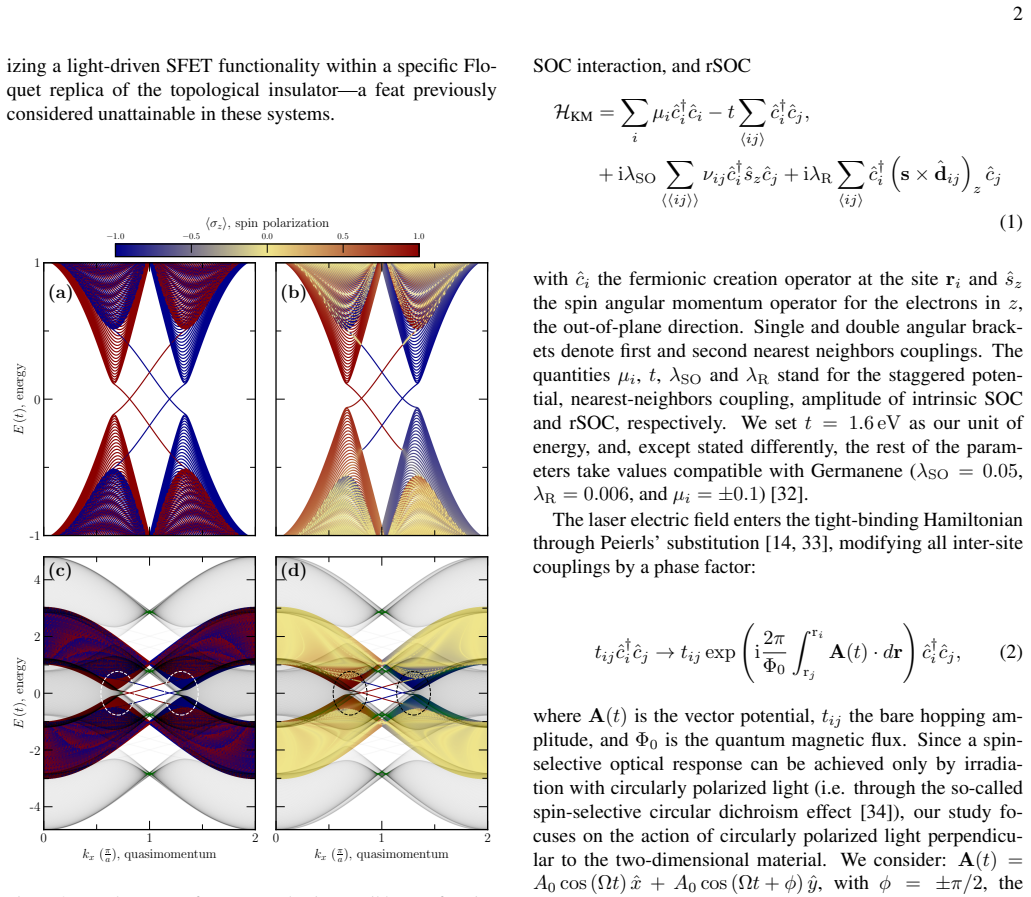
The central object is the Floquet-Hamiltonian spectrum of the laser-driven Kane-Mele model with Rashba spin-orbit coupling, built through Peierls substitution and solved in Sambe space. The spin-selective circular dichroism selection rule assigns spin-up edge states to the n=+1 photon replica and spin-down edge states to the n=-1 replica; the n=+1 replica supplies a spin-depolarized continuum in which Rashba coupling causes spin precession, while the n=-1 replica provides the inelastic backscattering that suppresses the opposite spin. Transport is obtained by summing replica-resolved transmission probabilities over all photon channels.
What would settle it
A direct test would be to compute, with the same Floquet transport machinery, the replica-resolved spin-flip transmission at a different laser amplitude (for example $\xi=0.1$ or $\xi=0.2$) and show that the $\lambda_\parallel^{-1}=1.57\lambda_R$ linear law and the spin-selective coupling assignment are unchanged; if the n=+1 spin-up selection rule breaks down or the slope changes by more than a few percent, the SFET-switching claim fails.
Extended reading notes
Core claim
Using a Kane-Mele tight-binding model of a 2D topological insulator with parameters compatible with germanene, the authors simulate a two-terminal device with graphene leads where only the central region is illuminated by circularly polarized light. The transport calculations show that the elastic channel retains ballistic transmission for one spin, while the opposite spin is backscattered through the n=-1 replica; in the n=+1 replica, the transmitted spin-up state enters a spin-depolarized continuum and undergoes Rabi-like precession. Fitting the longitudinal spin polarization of the scattering wave function gives $\lambda_\parallel^{-1}=1.57\lambda_R$ over the Rashba range $[0.005t,0.0095t]$, so the device length relative to the precession wavelength decides spin-conserving or spin-flipping behavior. The paper concludes that this realizes SFET functionality in a driven topological insulator, something the equilibrium edge states do not allow.
Load-bearing premise
The central claim rests on the assumption that the spin-selective dichroism selection rule (spin-up hybrids only with the n=+1 replica and spin-down only with n=-1) survives when Rashba coupling is present, and that the linear precession-wavelength fit drawn from a single parameter point continues to hold for other laser amplitudes, frequencies, and device sizes.
Editorial extensions
If this is right
- Within the simulated parameter regime, a gate that adjusts the Rashba strength changes the precession wavelength and switches the device between spin-preserving and spin-flipping operation for a fixed sample length.
- The simulated spin-flip efficiency reaches about 0.9, so the inelastic Floquet channel can convert most of the incident spin-polarized current into the opposite spin.
- The linear law $\lambda_\parallel^{-1}=1.57\lambda_R$ gives a design rule: choose the device length so that $L/\lambda_\parallel$ is an integer to preserve the spin, or a half-integer to flip it.
- These effects occur with parameters compatible with germanene, suggesting a concrete monolayer material in which the light-induced SFET could be sought.
- One-way transport is forbidden at equilibrium in these edge states, so the photocurrent direction and spin selectivity are a genuine non-equilibrium consequence of the driving.
Reading between the lines
- If the spin-selective Floquet assignment persists at lower laser amplitudes, the same mechanism could act as a helicity-controlled spin filter: reversing the laser handedness should reverse which spin channel is backscattered and thus the sign of the spin-polarized photocurrent.
- The linear relation between precession wavenumber and Rashba coupling could be inverted to extract the Rashba parameter from measured spin-polarized photocurrent oscillations in driven devices, turning the effect into a spectroscopic probe.
- The calculations are done at a single laser frequency ($\hbar\Omega=1.5t$) and one Fermi energy; a natural extension would be to map the switching condition across frequencies and lengths to see whether the integer/half-integer rule is universal or tied to this resonance.
Editorial analysis
A structured set of objections, weighed in public.
Referee Report
Summary. The manuscript proposes that a two-dimensional topological insulator (Kane-Mele model) irradiated by circularly polarized light and subject to gate-tunable Rashba spin-orbit coupling can act as a laser-driven spin-field effect transistor (SFET). The authors use Floquet theory and Kwant-based transport simulations to study an irradiated Kane-Mele ribbon connected to graphene leads. They show that in the presence of the drive, one spin channel is transmitted while the other is backscattered, producing one-way photocurrents, and that spin-flip transmission becomes significant (up to about 0.9) at the chosen parameter point. They further analyze the scattering wave function and observe a Rabi-like spatial oscillation in the n=+1 Floquet replica. From this oscillation they extract a precession wavelength λ∥ whose inverse scales linearly with Rashba coupling, λ∥^{-1}=1.57λR, and use this to propose a rule of thumb: a device of length L preserves spin for integer L/λ∥ and flips spin for half-integer L/λ∥. The paper concludes that this realizes switchable, one-way, spin-polarized photocurrents and effectively implements SFET functionality inside a Floquet replica of a TI.
Significance. If the central claim were fully demonstrated, this would be a noteworthy conceptual advance: it would show that Floquet engineering can circumvent the spin-momentum locking of TI edge states and enable a gate-tunable spin switch inside a driven topological system. The numerical approach is transparent and reproducible with Kwant, and the reported spin-flip transmission efficiency at the selected parameter point is striking. The linear scaling of the precession wavenumber with Rashba coupling is a useful heuristic that echoes the Datta-Das spin-precession picture. However, the paper's headline 'switchable SFET' functionality is currently an extrapolation rather than a directly computed result, because the output spin polarization is never calculated as a function of L/λ∥. The reliance on a spin-selective dichroism selection rule imported from the authors' earlier work (Ref. [29]) also needs independent support in the present parameter regime. These gaps are fillable within the scope of the manuscript, so the appropriate outcome is a major revision rather than rejection.
major comments (3)
- [Transport properties and Wavelength estimation (Figs. 4-6)] The central 'switchable' SFET claim is not directly verified. Figures 4 and 5 present total and spin-flip transmissions and scattering wave functions for a single device (500a x 200a) at a single parameter point (ξ=0.15, ℏΩ=1.5t, EF≈-0.15t). The device-level switching rule L/λ∥ integer or half-integer is introduced in the 'Wavelength estimation' section from the spatial oscillation of the n=+1 replica, but no simulation varies L at fixed λR, or varies λR at fixed L, and records the transmitted spin polarization. Without such a test, including possible contamination from the elastic n=0 channel and other replicas, the claim that the device will act as a spin-preserving or spin-flipping element remains an extrapolation.
- [Wavelength estimation, Fig. 6(b)] The linear law λ∥^{-1}=1.57λR is fitted over a narrow range λR ∈ [0.005t, 0.0095t] at one laser amplitude and one photon energy. The proposed rule of thumb generalizes this fit and assumes it holds over the full gate-tunable Rashba range, but no evidence is provided at other ξ, ℏΩ, or EF, nor is there a derivation of the slope 1.57. A perturbative estimate of λ∥(λR, ξ, ℏΩ) or additional data at a second laser amplitude and frequency would make the extrapolation credible; otherwise the switching claim should be explicitly restricted to the fitted regime.
- [Floquet theory and band-structure discussion (Figs. 2 and 3)] The mechanism relies on a spin-selective circular dichroism selection rule imported from Ref. [29], namely that spin-up edge states couple selectively to the n=+1 replica and spin-down states to n=-1. This rule is load-bearing for the interpretation of the one-way photocurrents and for the Rabi oscillation in Fig. 5(c), but it is not derived here in the presence of finite rSOC and finite-size leads. The text also contains an apparent inconsistency: on page 4 it states that the spin-up edge state 'can hybridize both n=1 and n=-1 replicas', while later it states that spin-up and spin-down electrons couple with n=+1 and n=-1, respectively. The authors should either derive the selection rule from the inter-replica coupling matrix elements or numerically verify it for the parameters used and reconcile the conflicting statements.
minor comments (5)
- [Fig. 2 caption] The caption uses μi=±0.2 and λSO=0.06, which differ from the 'Germanene' parameters (λSO=0.05, μi=±0.1) given in the Hamiltonian model section; please clarify which parameter set is used for Figs. 3-6.
- [Fig. 6 caption and Wavelength estimation] The notation '¯λ□1‖' in the Fig. 6 caption appears to be a garbled rendering of λ∥^{-1}; please fix this and also define the units of λ∥ and λR, since the equation λ∥^{-1}=1.57λR mixes lattice-length units with energy units.
- [Figs. 5 and 6 captions] The captions contain grammatical errors such as 'All the parameters are the same than in Fig.4'; these should be revised to 'the same as in Fig. 4'.
- [Wavelength estimation] The quantity n≡L/λ∥ is called the number of Rabi cycles, but the plotted quantity in Fig. 6(a) is the longitudinal spin-density difference ρ↑−ρ↓, not the spin direction itself; please clarify the relation between the spatial period of this density oscillation and the actual spin-precession angle.
- [Introduction and Transport properties] The phrase 'spin-depolarized continuum' is used repeatedly; 'spin-unpolarized' would be more accurate and consistent with the rest of the text.
Circularity Check
No significant circularity: the spin-selective dichroism premise is reproduced in this paper and also independently cited, while the L/λ∥ switching rule is an unvalidated extrapolation rather than an input-output tautology.
full rationale
The central derivation is self-contained: the Floquet-Kwant transport calculation directly produces the transmissions in Fig. 4 and the scattering wavefunctions in Fig. 5, including the spin-flip contributions and the Rabi-like oscillation in the n=+1 replica. The paper's key premise, spin-selective circular dichroism, is not merely imported from the authors' Ref. [29]; it is also cited to an independent source (Ezawa, Ref. [42]) and is qualitatively reproduced in the present numerics ('The total transmission profiles ... qualitatively resemble those previously reported in Ref. [29]'). Thus the self-citation is not load-bearing under the hard rules. The linear law λ∥^{-1}=1.57λ_R (Fig. 6b) is a genuine numerical result obtained from the computed SWF, and the 'rule of thumb' n=L/λ∥ is a heuristic extrapolation of Rabi precession, not a fit of the same quantity it predicts. The main weakness is that the paper never simulates the output spin polarization as a function of L at fixed λ_R (or vice versa), so the SFET-switching claim is under-validated; but under-validation is a correctness/validation gap, not a circular reduction. No equation in the paper is equivalent to its inputs by construction; the only self-citation (Ref. [29]) is for an effect that is independently supported and reproduced here.
Assumptions & free parameters
free parameters (5)
- Fitted slope for precession wavelength, lambda_parallel^-1 = 1.57 lambda_R =
1.57 (in units of 1/(t*a))
- Laser amplitude xi =
0.15
- Photon energy hbar-Omega =
1.5t
- Fermi energy EF =
-0.15t
- Device dimensions =
500a x 200a
assumptions (6)
- standard math Floquet theorem and Sambe-space expansion of the time-periodic Hamiltonian are valid for the driven TI and yield the physical quasienergy spectrum and scattering states.
- domain assumption The tight-binding Kane-Mele Hamiltonian with staggered potential, intrinsic SOC, and Rashba SOC describes the 2D TI, with germanene parameters from Ref. [32].
- standard math Peierls substitution correctly incorporates the circularly polarized laser field into the tight-binding hoppings.
- domain assumption The spin-selective circular dichroism selection rule (spin-up couples to n=+1, spin-down to n=-1 replicas) established in Ref. [29] remains valid when Rashba SOC is finite.
- domain assumption Transport is phase-coherent and non-interacting; lead states are equilibrium graphene and Floquet replica coupling exists only in the central region.
- ad hoc to paper The spatial Rabi-like oscillation of the scattering wavefunction represents spin precession of a propagating electron and can be mapped to a device-level spin-flip rule via integer/half-integer L/lambda_parallel.
Cite this review
Pith. "Pith review of Spin precession and laser-induced spin-polarized photocurrents." pith.science (2026). https://pith.science/paper/6QPVPZGZ
@misc{pith2026250706315,
  author       = {Pith},
  title        = {Pith review of: Spin precession and laser-induced spin-polarized photocurrents},
  year         = {2026},
  howpublished = {\url{https://pith.science/paper/6QPVPZGZ}},
  note         = {Machine review of arXiv:2507.06315}
}
read the original abstract
Controlling spin currents in topological insulators (TIs) is crucial for spintronics but challenged by the robustness of their chiral edge states, which impedes the spin manipulation required for devices like spin-field effect transistors (SFETs). We theoretically demonstrate that this challenge can be overcome by synergistically applying circularly polarized light and gate-tunable Rashba spin-orbit coupling (rSOC) to a 2D TI. Laser irradiation provides access to Floquet sidebands where rSOC induces controllable spin precession, leading to the generation of one-way, switchable spin-polarized photocurrents, an effect forbidden in equilibrium TIs. This mechanism effectively realizes SFET functionality within a driven TI, specifically operating within a distinct Floquet replica, offering a new paradigm for light-based control in topological spintronics.
Figures


Figures from the paper (3 more)


Reference graph
Works this paper leans on
-
[29]
Spin-Polarized Tunable Photocurrents,
M. Berdakin, E. A. Rodr ´ıguez-Mena, and L. E. F. Foa Torres, “Spin-Polarized Tunable Photocurrents,” Nano Lett. 21, 3177 (2021)
work page 2021
-
[1]
Electronic analog of the electro-optic modulator,
S. Datta and B. Das, “Electronic analog of the electro-optic modulator,” Appl. Phys. Lett. 56, 665 (1990)
work page 1990
-
[2]
How we proposed the spin transistor,
S. Datta, “How we proposed the spin transistor,” Nat. Electron. 1, 604 (2018)
work page 2018
-
[3]
Control of spin precession in a spin-injected field effect transistor,
H. C. Koo, J. H. Kwon, J. Eom, J. Chang, S. H. Han, and M. Johnson, “Control of spin precession in a spin-injected field effect transistor,” Science 325, 1515 (2009)
work page 2009
-
[4]
Quantum spin Hall effect and topological phase transition in HgTe quantum wells,
B. A. Bernevig, T. L. Hughes, and S.-C. Zhang, “Quantum spin Hall effect and topological phase transition in HgTe quantum wells,” Science 314, 1757 (2006)
work page 2006
-
[5]
Colloquium: Topological insula- tors,
M. Z. Hasan and C. L. Kane, “Colloquium: Topological insula- tors,” Rev. Mod. Phys.82, 3045 (2010)
work page 2010
-
[6]
F. Ortmann, S. Roche, and S. O. Valenzuela, Topological in- sulators: Fundamentals and perspectives (John Wiley & Sons, 2015)
work page 2015
-
[7]
Electric-field-tuned topological phase transition in ultrathin Na3Bi,
J. L. Collins, A. Tadich, W. Wu, L. C. Gomes, J. N. B. Ro- drigues, C. Liu, J. Hellerstedt, H. Ryu, S. Tang, S.-K. Mo, S. Adam, S. A. Yang, M. S. Fuhrer, and M. T. Edmonds, “Electric-field-tuned topological phase transition in ultrathin Na3Bi,” Nature 564, 390 (2018)
work page 2018
Show all 42 references
-
[8]
Quantum phases on demand,
“Quantum phases on demand,” Nat. Phys. 16, 1 (2020)
2020
-
[9]
Towards properties on demand in quantum materials,
D. N. Basov, R. D. Averitt, and D. Hsieh, “Towards properties on demand in quantum materials,” Nat. Mater.16, 1077 (2017)
2017
-
[10]
Analytic solu- tion for electrons and holes in graphene under electromagnetic waves: Gap appearance and nonlinear effects,
F. J. L ´opez-Rodr´ıguez and G. G. Naumis, “Analytic solu- tion for electrons and holes in graphene under electromagnetic waves: Gap appearance and nonlinear effects,” Phys. Rev. B78, 201406 (2008)
2008
-
[11]
Effect of radia- tion on transport in graphene,
S. V . Syzranov, M. V . Fistul, and K. B. Efetov, “Effect of radia- tion on transport in graphene,” Phys. Rev. B78, 045407 (2008)
2008
-
[12]
Photovoltaic Hall effect in graphene,
T. Oka and H. Aoki, “Photovoltaic Hall effect in graphene,” Phys. Rev. B 79, 081406 (2009)
2009
-
[13]
Metal-insulator transition in graphene induced by circularly polarized photons,
O. V . Kibis, “Metal-insulator transition in graphene induced by circularly polarized photons,” Phys. Rev. B81, 165433 (2010)
2010
-
[14]
Tuning laser-induced band gaps in graphene,
H. L. Calvo, H. M. Pastawski, S. Roche, and L. E. F. Foa Tor- res, “Tuning laser-induced band gaps in graphene,” Appl. Phys. Lett. 98, 232103 (2011)
2011
-
[15]
Selective scattering between Flo- quet–Bloch and V olkov states in a topological insulator,
F. Mahmood, C.-K. Chan, Z. Alpichshev, D. Gardner, Y . Lee, P. A. Lee, and N. Gedik, “Selective scattering between Flo- quet–Bloch and V olkov states in a topological insulator,” Nat. Phys. 12, 306 (2016)
2016
-
[16]
Observation of Floquet-Bloch States on the Surface of a Topo- logical Insulator,
Y . H. Wang, H. Steinberg, P. Jarillo-Herrero, and N. Gedik, “Observation of Floquet-Bloch States on the Surface of a Topo- logical Insulator,” Science 342, 453 (2013)
2013
-
[17]
Observation of floquet states in graphene,
M. Merboldt, M. Sch¨uler, D. Schmitt, J. P. Bange, W. Bennecke, K. Gadge, K. Pierz, H. W. Schumacher, D. Momeni, D. Steil, et al., “Observation of floquet states in graphene,” Nat. Phys. , 1 (2025)
2025
-
[18]
Observation of floquet– bloch states in monolayer graphene,
D. Choi, M. Mogi, U. De Giovannini, D. Azoury, B. Lv, Y . Su, H. H¨ubener, A. Rubio, and N. Gedik, “Observation of floquet– bloch states in monolayer graphene,” Nat. Phys. , 1 (2025)
2025
-
[19]
Signatures of Floquet elec- tronic steady states in graphene under continuous-wave mid- infrared irradiation,
Y . Liu, C. Yang, G. Gaertner, J. Huckabee, A. V . Suslov, G. Re- fael, F. Nathan, C. Lewandowski, L. E. F. Foa Torres, I. Esin, P. Barbara, and N. G. Kalugin, “Signatures of Floquet elec- tronic steady states in graphene under continuous-wave mid- infrared irradiation,” Nat. ...
2025
-
[20]
Engineer- ing floquet moir ´e patterns for scalable photocurrents,
H. L. Calvo, L. E. F. Foa Torres, and M. Berdakin, “Engineer- ing floquet moir ´e patterns for scalable photocurrents,” Nano Lett. 25, 1630 (2025)
2025
-
[21]
Topolog- ical signatures in quantum transport in anomalous Floquet- Anderson insulators,
E. A. Rodr ´ıguez-Mena and L. E. F. Foa Torres, “Topolog- ical signatures in quantum transport in anomalous Floquet- Anderson insulators,” Phys. Rev. B100, 195429 (2019)
2019
-
[22]
Band structure engineering and non-equilibrium dynamics in Floquet topological insula- tors,
M. S. Rudner and N. H. Lindner, “Band structure engineering and non-equilibrium dynamics in Floquet topological insula- tors,” Nat. Rev. Phys.2, 229 (2020)
2020
-
[23]
Floquet chiral edge states in graphene,
P. M. Perez-Piskunow, G. Usaj, C. A. Balseiro, and L. E. F. Foa Torres, “Floquet chiral edge states in graphene,” Phys. Rev. B 89, 121401 (2014)
2014
-
[24]
Theory of Floquet band formation and local pseudospin textures in pump-probe photoemission of graphene,
M. Sentef, M. Claassen, A. Kemper, B. Moritz, T. Oka, J. Fre- ericks, and T. Devereaux, “Theory of Floquet band formation and local pseudospin textures in pump-probe photoemission of graphene,” Nat. Commun. 6, 7047 (2015)
2015
-
[25]
Hierarchy of higher-order Flo- quet topological phases in three dimensions,
T. Nag, V . Juriˇci´c, and B. Roy, “Hierarchy of higher-order Flo- quet topological phases in three dimensions,” Phys. Rev. B103, 115308 (2021)
2021
-
[26]
Electric space-time translation and Floquet-Bloch wavefunction,
C. Ke, K. Yang, and C. Wu, “Electric space-time translation and Floquet-Bloch wavefunction,” (2024), arXiv:2409.15851. 7
2024 arXiv
-
[27]
Light-induced anomalous Hall effect in graphene,
J. W. McIver, B. Schulte, F.-U. Stein, T. Matsuyama, G. Jotzu, G. Meier, and A. Cavalleri, “Light-induced anomalous Hall effect in graphene,” Nat. Phys. 16, 38 (2020)
2020
-
[28]
Control over topological insulator photocurrents with light polarization,
J. W. McIver, D. Hsieh, H. Steinberg, P. Jarillo-Herrero, and N. Gedik, “Control over topological insulator photocurrents with light polarization,” Nat. Nanotechnol. 7, 96 (2012)
2012
-
[30]
Photoinduced topological phase transition and a single dirac-cone state in silicene,
M. Ezawa, “Photoinduced topological phase transition and a single dirac-cone state in silicene,” Phys. Rev. Lett.110, 026603 (2013)
2013
-
[31]
Quantum Spin Hall Effect in Graphene,
C. L. Kane and E. J. Mele, “Quantum Spin Hall Effect in Graphene,” Phys. Rev. Lett.95, 226801 (2005)
2005
-
[32]
Monolayer Topological Insulators: Silicene, Ger- manene, and Stanene,
M. Ezawa, “Monolayer Topological Insulators: Silicene, Ger- manene, and Stanene,” J. Phys. Soc. Jpn. 84, 121003 (2015)
2015
-
[33]
Non-perturbative effects of laser illu- mination on the electrical properties of graphene nanoribbons,
H. L. Calvo, P. M. Perez-Piskunow, H. M. Pastawski, S. Roche, and L. E. F. Foa Torres, “Non-perturbative effects of laser illu- mination on the electrical properties of graphene nanoribbons,” J. Phys.: Condens. Matter 25, 144202 (2013)
2013
-
[34]
Perfect Circular Dichroism in the Haldane Model,
K. Ghalamkari, Y . Tatsumi, and R. Saito, “Perfect Circular Dichroism in the Haldane Model,” J. Phys. Soc. Jpn.87, 063708 (2018)
2018
-
[35]
Steady States and Quasienergies of a Quantum- Mechanical System in an Oscillating Field,
H. Sambe, “Steady States and Quasienergies of a Quantum- Mechanical System in an Oscillating Field,” Phys. Rev. A 7, 2203 (1973)
1973
-
[36]
Kwant: a software package for quantum transport,
C. W. Groth, M. Wimmer, A. R. Akhmerov, and X. Waintal, “Kwant: a software package for quantum transport,” New J. Phys. 16, 063065 (2014)
2014
-
[37]
Z2 Topological Order and the Quantum Spin Hall Effect,
C. L. Kane and E. J. Mele, “ Z2 Topological Order and the Quantum Spin Hall Effect,” Phys. Rev. Lett.95, 146802 (2005)
2005
-
[38]
Multiterminal conductance of a floquet topological insulator,
L. E. F. Foa Torres, P. M. Perez-Piskunow, C. A. Balseiro, and G. Usaj, “Multiterminal conductance of a floquet topological insulator,” Phys. Rev. Lett.113, 266801 (2014)
2014
-
[39]
Floquet analysis of excita- tions in materials,
U. D. Giovannini and H. H ¨ubener, “Floquet analysis of excita- tions in materials,” J. Phys. Mater 3, 012001 (2020)
2020
-
[40]
One- way transport in laser-illuminated bilayer graphene: A Floquet isolator,
V . Dal Lago, E. Su´arez Morell, and L. E. F. Foa Torres, “One- way transport in laser-illuminated bilayer graphene: A Floquet isolator,” Phys. Rev. B96, 235409 (2017)
2017
-
[41]
Direc- tional control of charge and valley currents in a graphene-based device,
M. Berdakin, J. E. B. Vargas, and L. E. F. Foa Torres, “Direc- tional control of charge and valley currents in a graphene-based device,” Phys. Chem. Chem. Phys. 20, 28720 (2018)
2018
-
[42]
Spin-valley optical selection rule and strong circu- lar dichroism in silicene,
M. Ezawa, “Spin-valley optical selection rule and strong circu- lar dichroism in silicene,” Phys. Rev. B86, 161407 (2012)
2012
Reviewed August 6, 2026 · model on record in the stance chip above.
Discussion (0). Continue with ORCID to comment.