REVIEW 4 major objections 6 minor 67 references
MOST: Motion Diffusion Model for Rare Text via Temporal Clip Banzhaf Interaction
T0 review · 4 major / 6 minor · reviewed 2026-08-06 · deepseek-v4-flash
Pith's one-line read Rare-text motion generation improves when clip-level Banzhaf interaction scores, not whole sequences, drive retrieval and diffusion conditioning.
desk verdict Solid empirical T2M retrieval+generation paper, but the Banzhaf interaction is a self-derived reweighting of the model's own similarities rather than an independent clip-level signal; still worth refereeing. read the letter →
The pith
A machine-rendered reading of the paper's core claim, the machinery that carries it, and where it could break.
The reading
What carries the argument
The central object is the temporal clip Banzhaf interaction $I(\{i,j\})$ (Eq. 2): the cooperative-game quantity that measures how much two players, here a text clip and a motion clip, add to the total revenue when they join a coalition, averaged over all coalitions of other players. The paper computes it over clips produced by temporal conv1d pooling, with a revenue function $v$ (Eq. 12) built from the learned similarity matrix weighted by a generalization-degree ratio $W$ that downweights redundant, low-change frames. The interaction values serve as self-supervised pseudo-labels for a small predictor network, which at inference converts a text-motion similarity matrix into interaction scores that rank motion clips for each text clip. These same scores act as softmax weights in the motion prompt module, fusing retrieved clips before they enter the diffusion transformer's cross-attention. The mechanism carries the argument because it is the only component that operates below the whole-sequence level: it is what turns 'retrieve motion' into 'retrieve the motion clips that cooperate with each text clip'.
What would settle it
Train the same retrieval and generation pipeline but replace the Banzhaf ground-truth scores with a trivial baseline, for example random interaction values or plain similarity without coalition averaging, and re-run the rare-prompt evaluation. If retrieval recall, FID, and Weighted-MM-Dist on the Tail 0-15% prompts stay within noise of MOST, the Banzhaf computation is not carrying the claimed signal; alternatively, a hand-labeled clip-correspondence test set on which predicted Banzhaf scores fail to beat chance would directly falsify the alignment claim.
Extended reading notes
Core claim
The paper's central claim is that fine-grained clip-level alignment, rather than entity-level text-motion matching, is what lets a text-to-motion model handle rare text, and that the temporal clip Banzhaf interaction is a sound way to obtain that alignment without clip-level annotation. Treating text clips and motion clips as players in a cooperative game, the method defines a revenue function from the learned similarity matrix modulated by a generalization-degree ratio, then computes Banzhaf interaction values for clip coalitions as the ground truth. A predictor trained on these values (Eq. 13) supplies interaction scores at inference, selecting the top motion clips per text clip and later weighting them as prompts. The diffusion generator conditions on these weighted key clips through a cross-attention motion prompt module. The paper reports that this two-stage design improves retrieval recall and median rank over contrastive baselines and improves FID and text-motion match over prior generation models, with the clearest margin on rare prompts.
Load-bearing premise
The load-bearing premise is that Banzhaf interaction values computed from the model's own learned similarity matrix are a valid measure of real text-motion clip correspondence, since the predictor is trained on them and they decide which clips are retrieved and how they weight generation.
Editorial extensions
If this is right
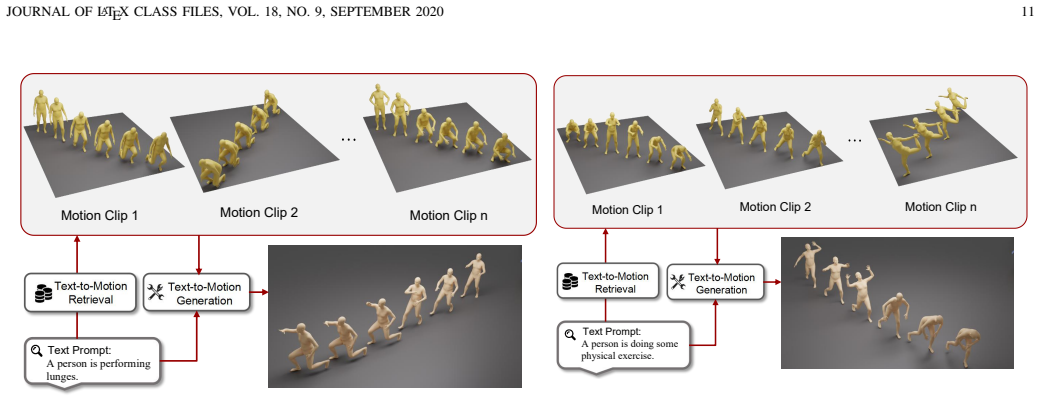
- Retrieval-augmented text-to-motion systems should operate on clips rather than whole sequences; the paper's ablations show clip prompts improve both FID and text-motion match over entire-motion prompts when injected into the same diffusion backbone.
- Fine-grained clip alignment can be obtained without clip-level annotations: the Banzhaf values derived from the model's own similarity matrix act as pseudo-ground-truth and improve retrieval R@1 and median rank on both datasets.
- Banzhaf interaction weights can serve as a general conditioning scheme, softmax-weighted fusion of retrieved clips, for diffusion models, yielding gains in R-TOP, FID, and MM-Dist over prior state-of-the-art.
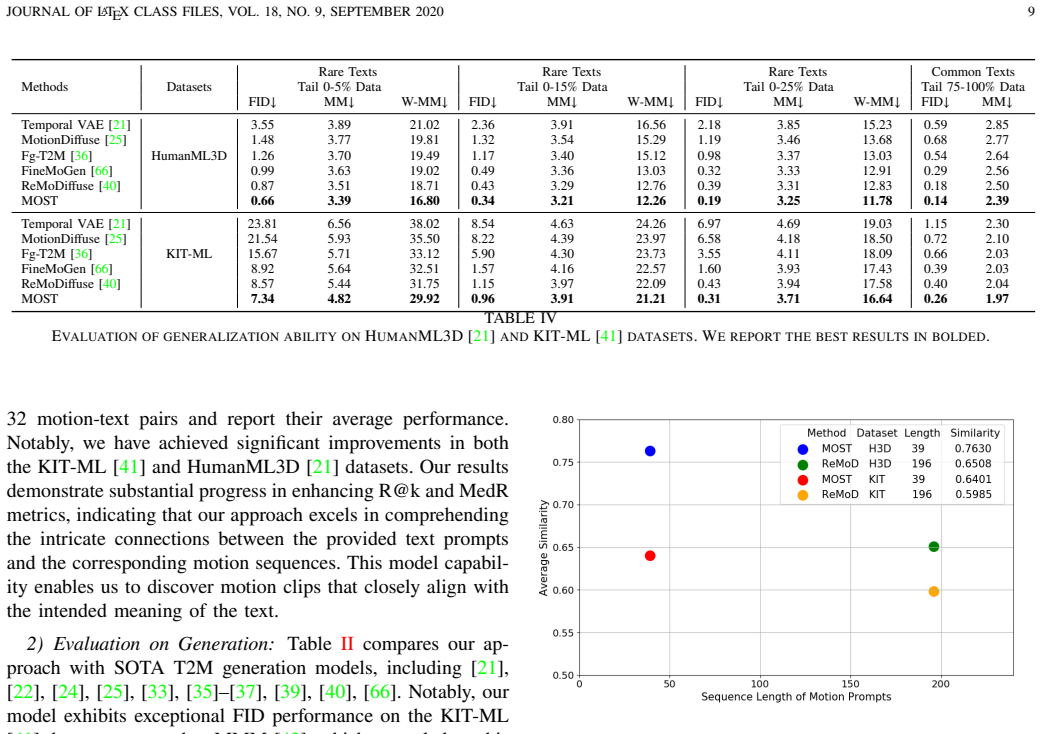
- Rare-prompt generalization, measured by FID and Weighted-MM-Dist on Tail 0-5%, 0-15%, and 0-25% prompts, improves most where text differs most from training descriptions, supporting the claim that the mechanism targets rare-text failure.
Reading between the lines
- Not tested in the paper: the same self-supervised pseudo-label recipe, deriving clip-level interaction targets from a model's own similarity matrix, could transfer to video-text or audio-text retrieval, where clip-level alignment is likewise under-annotated.
- Because the revenue function downweights frames with small inter-frame change, MOST implicitly equates informativeness with motion magnitude; a testable variant would replace the hand-defined generalization-degree ratio with a learned salience module and check whether rare-prompt gains persist.
- The reported failure on long, detailed texts points to the fixed clip count $T_s=5$ as a bottleneck; adaptive segmentation driven by text phrase boundaries is a concrete, testable fix.
- Since the Banzhaf pseudo-labels and the predictor both derive from the same encoder, the interaction scores inherit the encoder's blind spots; computing ground-truth interactions with a frozen independently trained encoder would isolate how much of the gain comes from the game-theoretic formula versus the underlying similarity structure.
Editorial analysis
A structured set of objections, weighed in public.
Referee Report
Summary. The paper proposes MOST, a two-stage text-to-motion model for retrieval and generation, targeting rare text prompts. In the retrieval stage, text and motion sequences are segmented into temporal clips, and a "Temporal Clip Banzhaf Interaction" is computed from the model's own learned text-motion similarity matrix; a predictor is trained to approximate these interaction values and is used to select motion clips. In the generation stage, a motion prompt module combines the retrieved clips, weighted by Banzhaf interaction scores, and feeds them through cross-attention into a motion diffusion transformer. The authors report state-of-the-art retrieval and generation results on HumanML3D and KIT-ML, with additional experiments on rare-prompt subsets, a user study, and ablations of the Banzhaf interaction and of using motion clips versus entire retrieved motions.
Significance. If the central mechanism is sound, MOST would be a useful contribution: it applies cooperative game theory to clip-level text-motion alignment and shows that retrieval-augmented generation with short, semantically selected clips can improve rare-prompt generation. The paper has considerable empirical substance: two datasets, full retrieval and generation tables, rare-prompt stratification, a user study, component analyses, and a candid limitations section. However, the load-bearing premise is not yet established. The Banzhaf "ground truth" is computed from the model's own similarity matrix, so the fine-grained alignment loss may add no independent clip-level supervision; the revenue function is not defined for arbitrary coalitions; and the reported gains could plausibly come from the motion prompt module or from simply using short clips instead of full sequences. The significance is therefore conditional on the authors providing controls and clarifications that disentangle these factors.
major comments (4)
- [Sec. IV-A.2, Eqs. (8)-(13)] The Banzhaf "ground truth" is self-derived: Eq. (12) is a reweighted version of the same similarity score S_m,t used in Eq. (8), and Eq. (13) trains a predictor to reproduce it. As written, the predictor is a separate module (five linear layers; Sec. V-A.3), and no gradient path from L_B to the text or motion encoders is described. If L_B only fits a surrogate to the entity-level similarity structure, it adds no new clip-level semantic supervision; if gradients do flow into the encoders, the targets are a moving function of the parameters and the training procedure must be specified. Please provide a control experiment in which the Banzhaf target is replaced by a random permutation, or by the raw similarity score, and show that the specific Banzhaf computation is responsible for the gains in Tables I and V rather than the clip-length reduction or the motion prompt module alone.
- [Sec. IV-A.2, Eqs. (2) and (12)] The Banzhaf interaction in Eq. (2) requires evaluating the revenue function v(S) for every coalition S subset of N\{i,j}, but Eq. (12) defines v only as a single scalar for the full text-motion pair, as a function of the complete matrix A. The manuscript never specifies how v(S) is computed for coalitions containing only motion clips, only text clips, or a partial set of clips. This makes the "ground truth" in Eq. (13) ill-defined as stated. Please define v(S) for arbitrary coalitions and state whether the exact 2^(2T_s-2) subset sums (trivial for T_s=5) or an approximation is used in training and inference.
- [Sec. IV-A.2 and Sec. V-A.3] There is a concrete inconsistency between the loss definition and the implementation: Eq. (13) is a cross-entropy loss between ground-truth interaction values and predicted values, while the implementation details say the predictor is trained with MSE loss. In addition, inference selects clips using the predictor outputs even though exact Banzhaf interaction values are cheap to compute at T_s=5. Please reconcile the loss definition and either use exact values at inference or justify the learned predictor; otherwise the reported retrieval and generation gains cannot be attributed unambiguously to the Banzhaf interaction itself.
- [Table I and Table V] The retrieval ablation for the Banzhaf component is incomplete: "MOST (w/o Banzhaf)" is reported only on HumanML3D (All), with a 1.02 R@1 gain over MOST and no confidence intervals, and the KIT-ML retrieval ablation is missing. Table V's "Base" retrieval strategy is not fully specified (does it still perform clip-level selection without Banzhaf weights?). Since this ablation is the primary evidence for the fine-grained alignment contribution, it should be reported on both datasets with uncertainty estimates and a precise description of the baseline retrieval procedure.
minor comments (6)
- [Sec. IV-A.2, Eq. (9)] Please define n = 2T_s explicitly when using the Banzhaf formulas, since Eq. (2)'s rho(S) depends on n.
- [Sec. IV-A.2, Eqs. (10)-(11)] The dimensions of W_m and W_w and the assertion l_m = l_w are unclear when text clips and motion clips have different lengths; please clarify how the generalization degree ratio is computed and matched.
- [Sec. V, Table V] The caption's abbreviations "S" and "N" are cryptic; spell them out as the number of motion clips (T_s) and the number of prompt motions (n), respectively.
- [Sec. V-B.2, User Study] The user study reports only asterisk significance levels in Figure 6; please provide the actual p-values or test statistics in the text or supplement.
- [Sec. IV-B.2, Eq. (17)] Please state whether B_m in the softmax weights are the predicted or exact interaction values and whether negative interaction values are allowed before exponentiation.
- [Sec. I and Sec. II-C] The abstract and introduction call the method "the first formulation of its kind," but HBI [59] already applies Banzhaf interaction to video-text alignment; please sharpen the distinction between frame-level hierarchical interaction and the proposed temporal clip formulation.
Circularity Check
Banzhaf 'ground truth' is computed from the model's own similarity matrix, so the claimed fine-grained clip alignment is a re-encoding of entity-level similarity rather than an independent signal.
-
self definitional
[Sec. IV-A.2 (Eqs. 11-13); Sec. V-A.3 implementation details]
"Thus, we obtain the revenue value function: ... To estimate these values accurately, we develop a predictor P for temporal clip Banzhaf interaction and align it with the ground truth through the following loss: ... It takes a text-motion similarity matrix and predicts the corresponding Banzhaf Interaction."
The revenue function v (Eq. 12) is a generalization-weighted version of the entity-level similarity S_{m,t} (Eq. 8), both built from the same learned matrix A_{ij} = (m_i)^T (t_j). The 'ground truth' Banzhaf interaction values I are computed from v via Eq. 2, and the predictor P is trained by Eq. 13 to reproduce I from the similarity matrix. At inference, P's outputs select motion clips.
full rationale
The paper's central novelty is the temporal clip Banzhaf interaction, claimed to 'precisely quantify textual-motion coherence at the clip level.' Tracing the derivation: entity-level NCE loss learns a similarity matrix A (Eqs. 7-8); the revenue function v (Eq. 12) is a weighted version of the same S_{m,t} built from A and clip statistics W (Eqs. 10-11); the 'ground truth' Banzhaf interaction I is computed from v via Eq. 2; and the predictor P is trained to match I via Eq. 13. The implementation states the predictor 'takes a text-motion similarity matrix and predicts the corresponding Banzhaf Interaction.' Thus the fine-grained clip-level signal is a learned function of the entity-level similarity matrix produced by the NCE loss; no independent clip-level supervision or external semantic target is added. The paper explicitly acknowledges this: 'our temporal clip Banzhaf interaction method inherently assesses the correspondence between text and motion clips, effectively obtaining ground truth even without clip-level annotations.' This is partial circularity: the Banzhaf module cannot independently validate clip-level coherence, and the stated reason for retrieval/generation gains—Banzhaf-based fine-grained alignment—is unsubstantiated by an external signal. The overall system is still benchmarked on HumanML3D and KIT-ML, so the state-of-the-art claim is not purely by construction; gains may also come from clip-length reduction and the motion prompt module. No load-bearing self-citation was found; the Fg-T2M citations are prior baselines, not the justification for the Banzhaf formulation. Score 6 reflects one central mechanism whose 'prediction' reduces to a self-derived target.
Assumptions & free parameters
free parameters (7)
- lambda_B =
0.5
- temperature tau =
0.1
- T_s =
5 clips (also used as 39 frames in Sec. IV-A.3)
- K_e =
10
- n =
2
- classifier-free guidance scale s =
3.2 on KIT-ML, 4.7 on HumanML3D
- beta in W-MM =
10
assumptions (4)
- domain assumption Banzhaf interaction of Eq. 2 is a meaningful measure of text-motion clip semantic coherence.
- domain assumption Fixed-length clip segmentation preserves the informative parts of a motion.
- domain assumption The similarity score S_m,t of Eq. 8 is a reliable basis for entity-level retrieval.
- standard math The diffusion forward and reverse processes as defined in Eqs. 3-6 are a valid generative model for motion.
Cite this review
Pith. "Pith review of MOST: Motion Diffusion Model for Rare Text via Temporal Clip Banzhaf Interaction." pith.science (2026). https://pith.science/paper/BLLOYXCQ
@misc{pith2026250706590,
  author       = {Pith},
  title        = {Pith review of: MOST: Motion Diffusion Model for Rare Text via Temporal Clip Banzhaf Interaction},
  year         = {2026},
  howpublished = {\url{https://pith.science/paper/BLLOYXCQ}},
  note         = {Machine review of arXiv:2507.06590}
}
read the original abstract
We introduce MOST, a novel motion diffusion model via temporal clip Banzhaf interaction, aimed at addressing the persistent challenge of generating human motion from rare language prompts. While previous approaches struggle with coarse-grained matching and overlook important semantic cues due to motion redundancy, our key insight lies in leveraging fine-grained clip relationships to mitigate these issues. MOST's retrieval stage presents the first formulation of its kind - temporal clip Banzhaf interaction - which precisely quantifies textual-motion coherence at the clip level. This facilitates direct, fine-grained text-to-motion clip matching and eliminates prevalent redundancy. In the generation stage, a motion prompt module effectively utilizes retrieved motion clips to produce semantically consistent movements. Extensive evaluations confirm that MOST achieves state-of-the-art text-to-motion retrieval and generation performance by comprehensively addressing previous challenges, as demonstrated through quantitative and qualitative results highlighting its effectiveness, especially for rare prompts.
Figures


Figures from the paper (8 more)





Reference graph
Works this paper leans on
-
[1]
Surface motion capture animation synthe- sis,
A. Boukhayma and E. Boyer, “Surface motion capture animation synthe- sis,”IEEE transactions on visualization and computer graphics, vol. 25, no. 6, pp. 2270–2283, 2018. 1
work page 2018
-
[2]
K. Zhou, Z. Hao, L. Wang, and X. Liang, “Adaptive score alignment learning for continual perceptual quality assessment of 360-degree videos in virtual reality,” IEEE Transactions on Visualization and Computer Graphics, 2025. 1
work page 2025
-
[3]
Two-character motion analysis and synthesis,
T. Kwon, Y.-S. Cho, S. I. Park, and S. Y. Shin, “Two-character motion analysis and synthesis,”IEEE Transactions on Visualization and Computer Graphics, vol. 14, no. 3, pp. 707–720, 2008. 1
work page 2008
-
[4]
Hierarchical graph convo- lutional networks for action quality assessment,
K. Zhou, Y. Ma, H. P. Shum, and X. Liang, “Hierarchical graph convo- lutional networks for action quality assessment,”IEEE Transactions on Circuits and Systems for Video Technology, vol. 33, no. 12, pp. 7749– 7763, 2023. 1
work page 2023
-
[5]
Combining recurrent neural networks and adversarial training for human motion synthesis and control,
Z. Wang, J. Chai, and S. Xia, “Combining recurrent neural networks and adversarial training for human motion synthesis and control,”IEEE transactions on visualization and computer graphics, vol. 27, no. 1, pp. 14–28, 2019. 1
work page 2019
-
[6]
Multi-task spatial- temporal graph auto-encoder for hand motion denoising,
K. Zhou, H. P. Shum, F. W. Li, and X. Liang, “Multi-task spatial- temporal graph auto-encoder for hand motion denoising,”IEEE Trans- actions on Visualization and Computer Graphics, vol. 30, no. 10, pp. 6754–6769, 2024. 1
work page 2024
-
[7]
Temporally guided music-to-body-movement generation,
H.-K. Kao and L. Su, “Temporally guided music-to-body-movement generation,” inProceedings of the 28th ACM International Conference on Multimedia, 2020, pp. 147–155. 1
work page 2020
-
[8]
Ai choreographer: Music conditioned 3d dance generation with aist++,
R. Li, S. Yang, D. A. Ross, and A. Kanazawa, “Ai choreographer: Music conditioned 3d dance generation with aist++,” inProceedings of the IEEE/CVF International Conference on Computer Vision, 2021, pp. 13401–13412. 1
work page 2021
Show all 67 references
-
[9]
Self-supervised dance video synthesis conditioned on music,
X. Ren, H. Li, Z. Huang, and Q. Chen, “Self-supervised dance video synthesis conditioned on music,” in Proceedings of the 28th ACM International Conference on Multimedia, 2020, pp. 46–54. 1
2020
-
[10]
Deepphase: Periodic autoencoders for learning motion phase manifolds,
S. Starke, I. Mason, and T. Komura, “Deepphase: Periodic autoencoders for learning motion phase manifolds,”ACM Transactions on Graphics (TOG), vol. 41, no. 4, pp. 1–13, 2022. 1
2022
-
[11]
Edge: Editable dance generation from music,
J. Tseng, R. Castellon, and K. Liu, “Edge: Editable dance generation from music,” inProceedings of the IEEE/CVF Conference on Computer Vision and Pattern Recognition, 2023, pp. 448–458. 1
2023
-
[12]
Rhythm is a dancer: Music-driven motion syn- thesis with global structure,
A. Aristidou, A. Yiannakidis, K. Aberman, D. Cohen-Or, A. Shamir, and Y. Chrysanthou, “Rhythm is a dancer: Music-driven motion syn- thesis with global structure,”IEEE Transactions on Visualization and Computer Graphics, 2022. 1
2022
-
[13]
Example-based automatic music-driven conventional dance motion synthesis,
R. Fan, S. Xu, and W. Geng, “Example-based automatic music-driven conventional dance motion synthesis,”IEEE transactions on visualiza- tion and computer graphics, vol. 18, no. 3, pp. 501–515, 2011. 1
2011
-
[14]
Action2motion: Conditioned generation of 3d human motions,
C. Guo, X. Zuo, S. Wang, S. Zou, Q. Sun, A. Deng, M. Gong, and L. Cheng, “Action2motion: Conditioned generation of 3d human motions,” inProceedings of the 28th ACM International Conference on Multimedia, 2020, pp. 2021–2029. 1, 7
2020
-
[15]
Action-conditioned 3d human motion synthesis with transformer vae,
M. Petrovich, M. J. Black, and G. Varol, “Action-conditioned 3d human motion synthesis with transformer vae,” inProceedings of the IEEE/CVF International Conference on Computer Vision, 2021, pp. 10985–10995. 1
2021
-
[16]
Implicit neural rep- resentations for variable length human motion generation,
P. Cervantes, Y. Sekikawa, I. Sato, and K. Shinoda, “Implicit neural rep- resentations for variable length human motion generation,” inEuropean Conference on Computer Vision. Springer, 2022, pp. 356–372. 1
2022
-
[17]
Action2video: Generating videos of human 3d actions,
C. Guo, X. Zuo, S. Wang, X. Liu, S. Zou, M. Gong, and L. Cheng, “Action2video: Generating videos of human 3d actions,”International Journal of Computer Vision, vol. 130, no. 2, pp. 285–315, 2022. 1
2022
-
[18]
Guided motion diffusion for controllable human motion synthesis,
K. Karunratanakul, K. Preechakul, S. Suwajanakorn, and S. Tang, “Guided motion diffusion for controllable human motion synthesis,” in Proceedings of the IEEE/CVF International Conference on Computer Vision, 2023, pp. 2151–2162. 1
2023
-
[19]
Tl- control: Trajectory and language control for human motion synthesis,
W. Wan, Z. Dou, T. Komura, W. Wang, D. Jayaraman, and L. Liu, “Tl- control: Trajectory and language control for human motion synthesis,” arXiv preprint arXiv:2311.17135, 2023. 1
2023 arXiv
-
[20]
Human motion diffusion as a generative prior,
Y. Shafir, G. Tevet, R. Kapon, and A. H. Bermano, “Human motion diffusion as a generative prior,”arXiv preprint arXiv:2303.01418, 2023. 1
2023 arXiv
-
[21]
Generating diverse and natural 3d human motions from text,
C. Guo, S. Zou, X. Zuo, S. Wang, W. Ji, X. Li, and L. Cheng, “Generating diverse and natural 3d human motions from text,” in Proceedings of the IEEE/CVF Conference on Computer Vision and Pattern Recognition, 2022, pp. 5152–5161. 1, 2, 3, 7, 8, 9, 10, 11, 12
2022
-
[22]
Temos: Generating diverse human motions from textual descriptions,
M. Petrovich, M. J. Black, and G. Varol, “Temos: Generating diverse human motions from textual descriptions,” inComputer Vision–ECCV 2022: 17th European Conference, Tel Aviv, Israel, October 23–27, 2022, Proceedings, Part XXII. Springer, 2022, pp. 480–497. 1, 2, 3, 7, 8, 9
2022
-
[23]
Human motion diffusion model,
G. Tevet, S. Raab, B. Gordon, Y. Shafir, D. Cohen-or, and A. H. Bermano, “Human motion diffusion model,” in The Eleventh International Conference on Learning Representations, 2023. [Online]. Available: https://openreview.net/forum?id=SJ1kSyO2jwu 1
2023
-
[24]
Executing your commands via motion diffusion in latent space,
X. Chen, B. Jiang, W. Liu, Z. Huang, B. Fu, T. Chen, and G. Yu, “Executing your commands via motion diffusion in latent space,” in Proceedings of the IEEE/CVF Conference on Computer Vision and Pattern Recognition, 2023, pp. 18000–18010. 1, 3, 8, 9
2023
-
[25]
Mo- tiondiffuse: Text-driven human motion generation with diffusion model,
M. Zhang, Z. Cai, L. Pan, F. Hong, X. Guo, L. Yang, and Z. Liu, “Mo- tiondiffuse: Text-driven human motion generation with diffusion model,” IEEE Transactions on Pattern Analysis and Machine Intelligence, pp. 1– 15, 2024. 1, 3, 7, 8, 9, 10, 11
2024
-
[26]
A two-part transformer network for controllable motion synthesis,
S. Hou, H. Tao, H. Bao, and W. Xu, “A two-part transformer network for controllable motion synthesis,”IEEE Transactions on Visualization and Computer Graphics, 2023. 1
2023
-
[27]
Generating animated videos of human activities from natural language descriptions,
A. S. Lin, L. Wu, R. Corona, K. Tai, Q. Huang, and R. J. Mooney, “Generating animated videos of human activities from natural language descriptions,” in Proceedings of the Visually Grounded Interaction and Language Workshop at NeurIPS 2018, December 2018. [Online]. JOURNAL OF ...
2018
-
[28]
Language2pose: Natural language grounded pose forecasting,
C. Ahuja and L.-P. Morency, “Language2pose: Natural language grounded pose forecasting,” in 2019 International Conference on 3D Vision (3DV). IEEE, 2019, pp. 719–728. 1, 2
2019
-
[29]
Synthesis of compositional animations from textual descriptions,
A. Ghosh, N. Cheema, C. Oguz, C. Theobalt, and P. Slusallek, “Synthesis of compositional animations from textual descriptions,” in Proceedings of the IEEE/CVF international conference on computer vision, 2021, pp. 1396–1406. 1, 2
2021
-
[30]
Text2gestures: A transformer-based network for generating emotive body gestures for virtual agents,
U. Bhattacharya, N. Rewkowski, A. Banerjee, P. Guhan, A. Bera, and D. Manocha, “Text2gestures: A transformer-based network for generating emotive body gestures for virtual agents,” in 2021 IEEE virtual reality and 3D user interfaces (VR). IEEE, 2021, pp. 1–10. 1
2021
-
[31]
Tm2t: Stochastic and tokenized modeling for the reciprocal generation of 3d human motions and texts,
C. Guo, X. Zuo, S. Wang, and L. Cheng, “Tm2t: Stochastic and tokenized modeling for the reciprocal generation of 3d human motions and texts,” in European Conference on Computer Vision. Springer, 2022, pp. 580–597. 1, 2, 3
2022
-
[32]
Momask: Generative masked modeling of 3d human motions,
C. Guo, Y. Mu, M. G. Javed, S. Wang, and L. Cheng, “Momask: Generative masked modeling of 3d human motions,” arXiv preprint arXiv:2312.00063, 2023. 1
2023 arXiv
-
[33]
Generating human motion from textual descriptions with discrete representations,
J. Zhang, Y. Zhang, X. Cun, Y. Zhang, H. Zhao, H. Lu, X. Shen, and Y. Shan, “Generating human motion from textual descriptions with discrete representations,” inProceedings of the IEEE/CVF Conference on Computer Vision and Pattern Recognition, 2023, pp. 14730–14740. 1, 2, 8, 9
2023
-
[34]
Tm2d: Bimodality driven 3d dance generation via music-text integration,
K. Gong, D. Lian, H. Chang, C. Guo, Z. Jiang, X. Zuo, M. B. Mi, and X. Wang, “Tm2d: Bimodality driven 3d dance generation via music-text integration,” inProceedings of the IEEE/CVF International Conference on Computer Vision, 2023, pp. 9942–9952. 1
2023
-
[35]
Motiongpt: Human motion as a foreign language,
B. Jiang, X. Chen, W. Liu, J. Yu, G. Yu, and T. Chen, “Motiongpt: Human motion as a foreign language,”Advances in Neural Information Processing Systems, vol. 36, 2024. 1, 8, 9
2024
-
[36]
Fg-t2m: Fine- grained text-driven human motion generation via diffusion model,
Y. Wang, Z. Leng, F. W. Li, S.-C. Wu, and X. Liang, “Fg-t2m: Fine- grained text-driven human motion generation via diffusion model,” in Proceedings of the IEEE/CVF International Conference on Computer Vision, 2023, pp. 22035–22044. 1, 3, 8, 9, 10, 11
2023
-
[37]
Human motion diffusion model,
G. Tevet, S. Raab, B. Gordon, Y. Shafir, D. Cohen-or, and A. H. Bermano, “Human motion diffusion model,” inThe Eleventh Interna- tional Conference on Learning Representations, 2022. 1, 3, 8, 9
2022
-
[38]
Flame: Free-form language-based motion synthesis&editing,
J. Kim, J. Kim, and S. Choi, “Flame: Free-form language-based motion synthesis&editing,”in ProceedingsoftheAAAIConferenceonArtificial Intelligence, vol. 37, no. 7, 2023, pp. 8255–8263. 1, 3
2023
-
[39]
Guess: Gradually enriching synthesis for text-driven human motion generation,
X. Gao, Y. Yang, Z. Xie, S. Du, Z. Sun, and Y. Wu, “Guess: Gradually enriching synthesis for text-driven human motion generation,” IEEE Transactions on Visualization and Computer Graphics, 2024. 1, 3, 8, 9
2024
-
[40]
Remodiffuse: Retrieval-augmented motion diffusion model,
M. Zhang, X. Guo, L. Pan, Z. Cai, F. Hong, H. Li, L. Yang, and Z. Liu, “Remodiffuse: Retrieval-augmented motion diffusion model,” arXiv preprint arXiv:2304.01116, 2023. 1, 3, 6, 7, 8, 9, 10, 12
2023 arXiv
-
[41]
The kit motion-language dataset,
M. Plappert, C. Mandery, and T. Asfour, “The kit motion-language dataset,” Big data, vol. 4, no. 4, pp. 236–252, 2016. 2, 7, 8, 9, 10, 12
2016
-
[42]
Attt2m: Text-driven hu- man motion generation with multi-perspective attention mechanism,
C. Zhong, L. Hu, Z. Zhang, and S. Xia, “Attt2m: Text-driven hu- man motion generation with multi-perspective attention mechanism,” in Proceedings of the IEEE/CVF International Conference on Computer Vision, 2023, pp. 509–519. 2
2023
-
[43]
Mmm: Generative masked motion model,
E. Pinyoanuntapong, P. Wang, M. Lee, and C. Chen, “Mmm: Generative masked motion model,”arXiv preprint arXiv:2312.03596, 2023. 2, 8, 9
2023 arXiv
-
[44]
Moconvq: Uni- fied physics-based motion control via scalable discrete representations,
H. Yao, Z. Song, Y. Zhou, T. Ao, B. Chen, and L. Liu, “Moconvq: Uni- fied physics-based motion control via scalable discrete representations,” ACM Transactions on Graphics (TOG), vol. 43, no. 4, pp. 1–21, 2024. 2
2024
-
[45]
Ase: Large- scale reusable adversarial skill embeddings for physically simulated characters,
X. B. Peng, Y. Guo, L. Halper, S. Levine, and S. Fidler, “Ase: Large- scale reusable adversarial skill embeddings for physically simulated characters,” ACM Transactions On Graphics (TOG), vol. 41, no. 4, pp. 1–17, 2022. 3
2022
-
[46]
Physdiff: Physics- guided human motion diffusion model,
Y. Yuan, J. Song, U. Iqbal, A. Vahdat, and J. Kautz, “Physdiff: Physics- guided human motion diffusion model,” inProceedings of the IEEE/CVF international conference on computer vision, 2023, pp. 16010–16021. 3
2023
-
[47]
Posescript: Linking 3d human poses and natural language,
G. Delmas, P. Weinzaepfel, T. Lucas, F. Moreno-Noguer, and G. Rogez, “Posescript: Linking 3d human poses and natural language,” IEEE Transactions on Pattern Analysis and Machine Intelligence, 2024. 3
2024
-
[48]
Como: Controllable motion generation through language guided pose code editing,
Y. Huang, W. Wan, Y. Yang, C. Callison-Burch, M. Yatskar, and L. Liu, “Como: Controllable motion generation through language guided pose code editing,”arXiv preprint arXiv:2403.13900, 2024. 3
2024 arXiv
-
[49]
Fg-t2m++: Llms-augmented fine-grained text driven human motion generation,
Y. Wang, M. Li, J. Liu, Z. Leng, F. W. Li, Z. Zhang, and X. Liang, “Fg-t2m++: Llms-augmented fine-grained text driven human motion generation,” International Journal of Computer Vision, pp. 1–17, 2025. 3
2025
-
[50]
High- resolution image synthesis with latent diffusion models,
R. Rombach, A. Blattmann, D. Lorenz, P. Esser, and B. Ommer, “High- resolution image synthesis with latent diffusion models,” inProceedings of the IEEE/CVF conference on computer vision and pattern recognition, 2022, pp. 10684–10695. 3
2022
-
[51]
Text-to-motion retrieval: Towards joint understanding of human motion data and natural language,
N. Messina, J. Sedmidubsky, F. Falchi, and T. Rebok, “Text-to-motion retrieval: Towards joint understanding of human motion data and natural language,” inProceedings of the 46th International ACM SIGIR Con- ference on Research and Development in Information Retrieval, 2023, pp...
2023
-
[52]
Learning transferable visual models from natural language supervision,
A. Radford, J. W. Kim, C. Hallacy, A. Ramesh, G. Goh, S. Agarwal, G. Sastry, A. Askell, P. Mishkin, J. Clarket al., “Learning transferable visual models from natural language supervision,” in International conference on machine learning. PMLR, 2021, pp. 8748–8763. 3, 7
2021
-
[53]
Attention is all you need,
A. Vaswani, N. Shazeer, N. Parmar, J. Uszkoreit, L. Jones, A. N. Gomez, Ł. Kaiser, and I. Polosukhin, “Attention is all you need,”Advances in neural information processing systems, vol. 30, 2017. 3, 7
2017
-
[54]
TMR: Text-to-motion re- trieval using contrastive 3D human motion synthesis,
M. Petrovich, M. J. Black, and G. Varol, “TMR: Text-to-motion re- trieval using contrastive 3D human motion synthesis,” inInternational Conference on Computer Vision (ICCV), 2023. 3, 7, 8
2023
-
[55]
Fine-grained semantically aligned vision-language pre- training,
J. Li, X. He, L. Wei, L. Qian, L. Zhu, L. Xie, Y. Zhuang, Q. Tian, and S. Tang, “Fine-grained semantically aligned vision-language pre- training,” Advances in neural information processing systems, vol. 35, pp. 7290–7303, 2022. 3
2022
-
[56]
Random shap- ley forests: cooperative game-based random forests with consistency,
J. Sun, H. Yu, G. Zhong, J. Dong, S. Zhang, and H. Yu, “Random shap- ley forests: cooperative game-based random forests with consistency,” IEEE transactions on cybernetics, vol. 52, no. 1, pp. 205–214, 2020. 3
2020
-
[57]
Tg-vqa: Ternary game of video question answering,
H. Li, P. Jin, Z. Cheng, S. Zhang, K. Chen, Z. Wang, C. Liu, and J. Chen, “Tg-vqa: Ternary game of video question answering,”arXiv preprint arXiv:2305.10049, 2023. 3
2023 arXiv
-
[58]
Weighted banzhaf power and inter- action indexes through weighted approximations of games,
J.-L. Marichal and P. Mathonet, “Weighted banzhaf power and inter- action indexes through weighted approximations of games,”European journal of operational research, vol. 211, no. 2, pp. 352–358, 2011. 3
2011
-
[59]
Video-text as game players: Hierarchical banzhaf interaction for cross- modal representation learning,
P. Jin, J. Huang, P. Xiong, S. Tian, C. Liu, X. Ji, L. Yuan, and J. Chen, “Video-text as game players: Hierarchical banzhaf interaction for cross- modal representation learning,” inProceedings of the IEEE/CVF Confer- enceonComputerVisionandPatternRecognition ,2023,pp.2472–2482. 3, 4
2023
-
[60]
An axiomatic approach to the concept of interaction among players in cooperative games,
M. Grabisch and M. Roubens, “An axiomatic approach to the concept of interaction among players in cooperative games,”International Journal of game theory, vol. 28, pp. 547–565, 1999. 3, 4
1999
-
[61]
Denoising diffusion probabilistic models,
J. Ho, A. Jain, and P. Abbeel, “Denoising diffusion probabilistic models,” Advances in Neural Information Processing Systems, vol. 33, pp. 6840– 6851, 2020. 4
2020
-
[62]
Representation learning with contrastive predictive coding,
A. v. d. Oord, Y. Li, and O. Vinyals, “Representation learning with contrastive predictive coding,”arXiv preprint arXiv:1807.03748, 2018. 5
2018 arXiv
-
[63]
Classifier-free diffusion guidance,
J. Ho and T. Salimans, “Classifier-free diffusion guidance,” arXiv preprint arXiv:2207.12598, 2022. 6
2022 arXiv
-
[64]
Efficient attention: Attention with linear complexities,
Z. Shen, M. Zhang, H. Zhao, S. Yi, and H. Li, “Efficient attention: Attention with linear complexities,” inProceedings of the IEEE/CVF winter conference on applications of computer vision, 2021, pp. 3531–
2021
-
[65]
Amass: Archive of motion capture as surface shapes,
N. Mahmood, N. Ghorbani, N. F. Troje, G. Pons-Moll, and M. J. Black, “Amass: Archive of motion capture as surface shapes,” inProceedings of the IEEE/CVF international conference on computer vision, 2019, pp. 5442–5451. 7
2019
-
[66]
Finemogen: Fine-grained spatio-temporal motion generation and editing,
M. Zhang, H. Li, Z. Cai, J. Ren, L. Yang, and Z. Liu, “Finemogen: Fine-grained spatio-temporal motion generation and editing,”Advances in Neural Information Processing Systems, vol. 36, 2024. 8, 9, 10, 12
2024
-
[67]
Avatargpt: All-in-one framework for motion understanding, planning, generation and beyond,
Z. Zhou, Y. Wan, and B. Wang, “Avatargpt: All-in-one framework for motion understanding, planning, generation and beyond,”arXiv preprint arXiv:2311.16468, 2023. 8
2023 arXiv
Reviewed August 6, 2026 · model on record in the stance chip above.
Discussion (0). Sign in to comment.