REVIEW 4 major objections 6 minor 56 references
Ambiguity-aware Point Cloud Segmentation by Adaptive Margin Contrastive Learning
T0 review · 4 major / 6 minor · reviewed 2026-08-06 · deepseek-v4-flash
Pith's one-line read Predicting per-point ambiguity lets adaptive margin contrastive learning raise 3D point cloud segmentation mIoU by about 1.7 points over a strong baseline.
desk verdict Solid but incremental extension of an earlier paper; the new module's gain is within noise and its test-time mechanism is unverified. read the letter →
The pith
A machine-rendered reading of the paper's core claim, the machinery that carries it, and where it could break.
The reading
What carries the argument
The load-bearing object is the per-point adaptive margin $m_i = \mu a_i + \nu$ inside a supervised contrastive objective. The margin generator (MG) maps the ambiguity score $a_i$, computed by the ambiguity estimation framework (AEF) from the imbalance of intra- and inter-class neighbors using closeness centrality, into a margin that sets the required gap between intra-class and inter-class similarity: positive for low ambiguity, zero at the crossover point, and negative for high ambiguity. The AMContrast3D++ extension adds two parts that operate on predicted rather than label-derived ambiguity: a lightweight ambiguity prediction module (APM), a small MLP that regresses $a_i$ from concatenated position and feature embeddings, and a masked refinement (MR) mechanism that applies a mask to anchors with predicted ambiguity in the interval $[\varepsilon, 1]$ (set to 0.9 to 1 in practice) and replaces their embeddings with the lowest-ambiguity neighbor's embedding, mixing the refined embedding with the original at rate $\gamma$. This machinery converts a position-space signal (which classes surround a point) into a feature-space training objective and, at test time, into a feature-replacement rule.
What would settle it
Train the APM on shuffled or inverted ambiguity targets so its predictions carry no true signal, keep everything else identical, and compare AMContrast3D++ against AMContrast3D; if the masked refinement still produces the full 0.6 or 0.5 point gain, the mechanism's benefit does not come from predicted ambiguity. Alternatively, measure the correlation between predicted ambiguity and actual label error or true AEF ambiguity on the validation split; near-zero correlation would falsify the claim that the APM supplies reliable ambiguity at inference.
Extended reading notes
Core claim
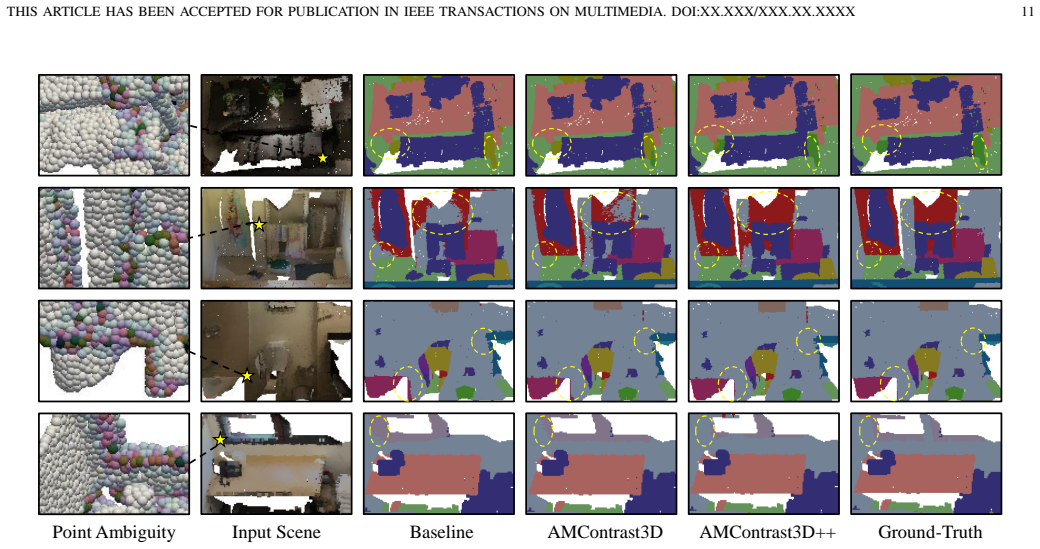
AMContrast3D++ claims that 3D semantic segmentation improves when the training objective reflects per-point ambiguity. The paper defines an ambiguity $a_i \in (0,1]$ for each point by comparing closeness centrality to intra- and inter-class neighbors, converts it into a margin $m_i = \mu a_i + \nu$ that can be positive, zero, or negative, and plugs this margin into a supervised contrastive loss so that unambiguous points are pushed to have larger separation than ambiguous ones. The extension adds an ambiguity prediction module (APM) that regresses $a_i$ from position and feature embeddings, and a masked refinement (MR) mechanism that, for points whose predicted ambiguity falls in a high band (for example, at least 0.9), replaces their feature embedding with the embedding of the lowest-ambiguity neighbor. Trained jointly with the segmentation branch, the APM supplies ambiguity at inference time, and the paper reports that replacing high-ambiguity anchor embeddings reduces errors in transition regions. On S3DIS Area 5 the method reaches 71.4% mIoU against a 69.8% baseline, and on ScanNet test it reaches 71.7% against 70.0%, with consistently lower variance across random runs.
Load-bearing premise
The entire gain of AMContrast3D++ over AMContrast3D rests on the untested assumption that the APM's predicted ambiguities, and the masked refinement that replaces high-ambiguity anchor embeddings with the lowest-ambiguity neighbor embedding, are accurate and beneficial at test time; the paper does not measure APM regression error on validation or test splits, and the high-ambiguity mask selects only about 0.5% of points.
Editorial extensions
If this is right
- If the central claim holds, training with ambiguity-aware margins should be more stable: the paper reports standard deviation across random runs dropping from 0.8 to 0.2 mIoU on S3DIS and from 1.0 to 0.3 on ScanNet.
- Per-class gains concentrate on objects in transition regions such as door, board, and clutter on S3DIS and chair and sofa on ScanNet, which is consistent with the ambiguity mechanism targeting boundary areas.
- The reported complexity increase over the baseline is small (about 0.03M parameters and 0.24 G FLOPs on S3DIS), so the gain does not come from a larger model.
- Because the APM supplies ambiguity without ground-truth labels, the method makes ambiguity-aware refinement usable at inference time, which is the paper's stated motivation for the two-branch design.
Reading between the lines
- The masked refinement in AMContrast3D++ touches only about 0.5% of points (those with predicted ambiguity in [0.9, 1]); the reported gain over AMContrast3D is therefore a very local correction that could shrink toward zero on distributions where the APM's high-ambiguity predictions are unreliable.
- The ambiguity score could double as an annotation-quality signal: points the AEF flags as highly ambiguous are roughly the points where human labelers disagree, so the same pipeline could be used to target re-labeling or to filter pseudo-labels in weakly supervised settings.
- A natural testable extension is to apply the predicted-ambiguity-plus-masked-refinement recipe to other dense prediction tasks, such as 2D semantic segmentation or instance segmentation, where transition regions likewise concentrate errors.
- If the APM is accurate, the method implies that decision boundaries in feature space need not be globally uniform; it offers a concrete way to learn locally varying margins from geometric context alone.
Editorial analysis
A structured set of objections, weighed in public.
Referee Report
Summary. The paper extends the authors' prior ICME 2024 AMContrast3D method with an ambiguity prediction module (APM) and a masked refinement (MR) mechanism, forming AMContrast3D++. AMContrast3D estimates per-point ambiguity from label/position neighborhoods and uses it to set per-point contrastive margins. AMContrast3D++ trains APM with an MAE regression loss against these ambiguity scores and, at both training and inference, replaces embeddings of points with high predicted ambiguity by the embedding of the neighboring point with the lowest predicted ambiguity. Experiments on S3DIS Area 5 and ScanNet report mIoU gains over a retrained PointNeXt baseline (69.8 to 71.4 and 70.0 to 71.7) using 4-run means and standard deviations, together with ablations of temperatures, margins, neighborhood sizes, thresholds, and refinement rates.
Significance. If the AMContrast3D++ mechanism works as described, the paper offers a practical way to inject per-point uncertainty awareness into point cloud segmentation with negligible parameter and FLOP overhead, and the released code and multi-run evaluation are strengths. However, the incremental gain over AMContrast3D is small, and the paper does not directly validate the APM's predictions or isolate the effect of MR. These gaps must be closed before the central claim that the ++ branch is responsible for the improvement is established.
major comments (4)
- [§IV-C, Table IX] The reported gain of AMContrast3D++ over AMContrast3D (S3DIS mIoU 71.4 vs 70.8; ScanNet test 71.7 vs 71.2) is attributed to the masked refinement mechanism in Eqs. (16)-(23), but no ablation isolates it. AMContrast3D++ differs from AMContrast3D by three simultaneous changes: the APM, the L_REG objective, and the MR embedding replacement. An ablation with APM and L_REG but with MR disabled, and separately an ablation with MR enabled during training but disabled at inference, is needed to show that the gain comes from the refinement rather than from the auxiliary regularizer or from seed variation. As written, the specific contribution of Eqs. (21)-(23) is unidentified.
- [§IV-B, Eq. (15)] The paper never measures whether APM predictions are accurate on held-out data. L_REG is only a training objective; no MAE, correlation coefficient, or mask precision/recall is reported for Area 5 or ScanNet validation at the operating point [0.9, 1]. Because Table VIII shows that only about 0.5% of points fall in the top ambiguity bin, small APM errors can substantially change the selected set. Without such a measure, the claim that MR refines genuinely high-ambiguity points is unsupported; an oracle-ambiguity comparison would also help bound the achievable benefit.
- [§IV-C, Eqs. (19)-(23)] CrossMask in Eq. (19) selects the neighbor with the lowest predicted ambiguity without checking its semantic label. For a transition-region anchor, that neighbor can belong to an adjacent class, and with gamma=1 on S3DIS Eq. (22) fully replaces the anchor embedding with that neighbor's embedding, potentially propagating wrong-class features. The paper should report, for the refined set, the fraction of anchors whose selected neighbor has the same ground-truth label, or ablate a label-consistent selection against the lowest-ambiguity selection; this determines whether MR is denoising or cross-label smoothing.
- [Tables II and III] The headline improvement of AMContrast3D++ over AMContrast3D is within the 4-run variability reported in Tables II and III: S3DIS mIoU 70.8±0.8 vs 71.4±0.2 and ScanNet test 71.2±1.0 vs 71.7±0.3. With four seeds and overlapping error bars, no significance test is reported, and the claim of 'significant improvements' and reduced standard deviation needs stronger support. The paper should report per-run paired differences between AMContrast3D and AMContrast3D++, or a bootstrap/permutation test, to establish that the gain is consistent rather than dominated by seed variance.
minor comments (6)
- [§V-B.1, Table II] The four S3DIS runs for AMContrast3D++ listed in Section V-B.1 (71.7, 71.4, 71.2, 71.5) have mean 71.45, which rounds to 71.5, not the reported 71.4; please verify the rounding convention and ensure all means in Tables II and III are consistent with the listed runs.
- [Eq. (2)] The function in Eq. (2) is a decreasing logistic function, not an inverse sigmoid (logit); the terminology should be corrected to avoid confusion.
- [Eqs. (19)-(21)] If several neighboring points share the minimal predicted ambiguity, Eq. (19) assigns CrossMask=1 to all of them and Eq. (21) sums their embeddings; the paper should specify tie-breaking or state that ties are handled by averaging.
- [§V-C.5, Table IX] The claim that MR is 'not sensitive' to hyperparameters is not supported by Table IX, where test mIoU ranges from 69.9 to 71.7 across the evaluated settings; the sentence should be softened or the range discussed.
- [Eq. (10), §V-A.3] With lambda=0.1, the joint objective L_SEG assigns weight 0.9 to the contrastive terms and 0.1 to cross-entropy; this strong weighting should be justified or the intended value of lambda verified.
- [Table VIII] The percentage of ai=1 points is nearly constant (0.51%, 0.51%, 0.50%, 0.48%) as K grows from 12 to 30, which is surprising if ai=1 requires |N+|=1; please clarify why enlarging the neighborhood does not change this count.
Circularity Check
No significant circularity: the reported mIoU gains come from a training objective and a test-time feature refinement, neither of which reduces to the label-derived ambiguity definition; the only self-citation is to the authors' conference version and is not load-bearing.
full rationale
The paper's derivation chain is self-contained. The per-point ambiguity a_i is a label-derived auxiliary quantity (Eqs. 1-3) used to shape the adaptive margin m_i in the contrastive objective (Eqs. 6-9) and to supervise the APM through the regression loss (Eq. 15). The final segmentation metric mIoU is computed on held-out scenes against ground-truth labels and compared with independently trained baselines; no equation makes the reported mIoU a deterministic function of the ambiguity definition or of the APM's fitted outputs. The masked refinement (Eqs. 16-23) operates on predicted ambiguities and embeddings at test time without access to ground-truth labels, so it is not a fitted predictor of the evaluation metric. The only self-citation is to the authors' prior conference paper [24], which is fully re-derived in Section III and retrained in the experiments, making it non-load-bearing. The skeptic's concern that APM regression accuracy is unmeasured is a risk to the empirical claim, not a circularity. Score 2 reflects the presence of a minor, non-load-bearing self-citation; otherwise the derivation is not circular.
Assumptions & free parameters
free parameters (9)
- Margin scale mu =
-1 (both datasets)
- Margin bias nu =
0.5 (S3DIS), 0.6 (ScanNet)
- Inverse sigmoid slope beta =
0.04
- Contrastive temperature tau =
0.3 (S3DIS), 0.5 (ScanNet)
- AEF neighbor size K =
24
- MR neighbor size eK =
12 (S3DIS), 8 (ScanNet)
- Refinement thresholds epsilon and epsilon_dot =
0.9, 1.0
- Refinement rate gamma =
1.0 (S3DIS), 0.6 (ScanNet)
- Loss weights lambda and omega =
0.1, 0.01
assumptions (4)
- domain assumption Per-point ambiguity from label disagreement in position space is a faithful proxy for human labeling uncertainty and for feature learnability.
- ad hoc to paper Closeness centrality discrepancy cc+ - cc- maps monotonically to ambiguity through the inverse sigmoid in Eq. (2).
- domain assumption The APM's predicted ambiguities at test time remain accurate enough for the masked refinement to improve segmentation.
- domain assumption The segmentation backbone features and positions supply sufficient signal for ambiguity prediction in unseen scenes.
invented entities (1)
-
Per-point ambiguity score ai
Cite this review
Pith. "Pith review of Ambiguity-aware Point Cloud Segmentation by Adaptive Margin Contrastive Learning." pith.science (2026). https://pith.science/paper/NYVMXNVI
@misc{pith2026250706592,
  author       = {Pith},
  title        = {Pith review of: Ambiguity-aware Point Cloud Segmentation by Adaptive Margin Contrastive Learning},
  year         = {2026},
  howpublished = {\url{https://pith.science/paper/NYVMXNVI}},
  note         = {Machine review of arXiv:2507.06592}
}
read the original abstract
This paper proposes an adaptive margin contrastive learning method for 3D semantic segmentation on point clouds. Most existing methods use equally penalized objectives, which ignore the per-point ambiguities and less discriminated features stemming from transition regions. However, as highly ambiguous points may be indistinguishable even for humans, their manually annotated labels are less reliable, and hard constraints over these points would lead to sub-optimal models. To address this, we first design AMContrast3D, a method comprising contrastive learning into an ambiguity estimation framework, tailored to adaptive objectives for individual points based on ambiguity levels. As a result, our method promotes model training, which ensures the correctness of low-ambiguity points while allowing mistakes for high-ambiguity points. As ambiguities are formulated based on position discrepancies across labels, optimization during inference is constrained by the assumption that all unlabeled points are uniformly unambiguous, lacking ambiguity awareness. Inspired by the insight of joint training, we further propose AMContrast3D++ integrating with two branches trained in parallel, where a novel ambiguity prediction module concurrently learns point ambiguities from generated embeddings. To this end, we design a masked refinement mechanism that leverages predicted ambiguities to enable the ambiguous embeddings to be more reliable, thereby boosting segmentation performance and enhancing robustness. Experimental results on 3D indoor scene datasets, S3DIS and ScanNet, demonstrate the effectiveness of the proposed method. Code is available at https://github.com/YangChenApril/AMContrast3D.
Figures


Figures from the paper (5 more)


Reference graph
Works this paper leans on
-
[1]
Pointnet: Deep learning on point sets for 3d classification and segmentation,
C. R. Qi, H. Su, K. Mo, and L. J. Guibas, “Pointnet: Deep learning on point sets for 3d classification and segmentation,” in CVPR, 2017, pp. 652–660
work page 2017
-
[2]
Pointnet++: Deep hierarchical feature learning on point sets in a metric space,
C. R. Qi, L. Yi, H. Su, and L. J. Guibas, “Pointnet++: Deep hierarchical feature learning on point sets in a metric space,” NeurIPS, vol. 30, 2017
work page 2017
-
[3]
Kpconv: Flexible and deformable convolution for point clouds,
H. Thomas, C. R. Qi, J.-E. Deschaud, B. Marcotegui, F. Goulette, and L. J. Guibas, “Kpconv: Flexible and deformable convolution for point clouds,” in ICCV, 2019, pp. 6411–6420
work page 2019
-
[4]
Region-enhanced feature learning for scene semantic segmentation,
X. Kang, C. Wang, and X. Chen, “Region-enhanced feature learning for scene semantic segmentation,” IEEE TMM, 2023
work page 2023
-
[5]
Mirageroom: 3d scene segmentation with 2d pre-trained models by mirage projection,
H. Sun, Y . Duan, J. Yan, Y . Liu, and J. Lu, “Mirageroom: 3d scene segmentation with 2d pre-trained models by mirage projection,” in CVPR, 2024, pp. 20 237–20 246
work page 2024
-
[6]
Geoauxnet: Towards universal 3d representation learning for multi-sensor point clouds,
S. Zhang, X. Fei, and Y . Duan, “Geoauxnet: Towards universal 3d representation learning for multi-sensor point clouds,” in CVPR, 2024, pp. 20 019–20 028
work page 2024
-
[7]
Point cloud pre-training with diffusion models,
X. Zheng, X. Huang, G. Mei, Y . Hou, Z. Lyu, B. Dai, W. Ouyang, and Y . Gong, “Point cloud pre-training with diffusion models,” in CVPR, 2024, pp. 22 935–22 945
work page 2024
-
[8]
Y . Song, F. He, Y . Duan, Y . Liang, and X. Yan, “A kernel correlation- based approach to adaptively acquire local features for learning 3d point clouds,” CAD, vol. 146, p. 103196, 2022
work page 2022
Show all 56 references
-
[9]
Look inside 3d point cloud deep neural network by patch-wise saliency map,
L. Fan, F. He, Y . Song, H. Xu, and B. Li, “Look inside 3d point cloud deep neural network by patch-wise saliency map,”ICAE, pp. 1–16, 2024
2024
-
[10]
Lslpct: An enhanced local semantic learning transformer for 3-d point cloud analysis,
Y . Song, F. He, Y . Duan, T. Si, and J. Bai, “Lslpct: An enhanced local semantic learning transformer for 3-d point cloud analysis,” IEEE TGRS, vol. 60, pp. 1–13, 2022
2022
-
[11]
Jsenet: Joint semantic segmentation and edge detection network for 3d point clouds,
Z. Hu, M. Zhen, X. Bai, H. Fu, and C.-l. Tai, “Jsenet: Joint semantic segmentation and edge detection network for 3d point clouds,” in ECCV, 2020, pp. 222–239
2020
-
[12]
Pointnext: Revisiting pointnet++ with improved training and scaling strategies,
G. Qian, Y . Li, H. Peng, J. Mai, H. Hammoud, M. Elhoseiny, and B. Ghanem, “Pointnext: Revisiting pointnet++ with improved training and scaling strategies,” NeurIPS, pp. 23 192–23 204, 2022
2022
-
[13]
Learning dynamic scene- conditioned 3d object detectors,
Y . Zheng, Y . Duan, Z. Li, J. Zhou, and J. Lu, “Learning dynamic scene- conditioned 3d object detectors,” IEEE TPAMI, 2023
2023
-
[14]
Pointcontrast: Unsupervised pre-training for 3d point cloud understanding,
S. Xie, J. Gu, D. Guo, C. R. Qi, L. Guibas, and O. Litany, “Pointcontrast: Unsupervised pre-training for 3d point cloud understanding,” in ECCV, 2020, pp. 574–591
2020
-
[15]
Contrastive boundary learning for point cloud segmentation,
L. Tang, Y . Zhan, Z. Chen, B. Yu, and D. Tao, “Contrastive boundary learning for point cloud segmentation,” in CVPR, 2022, pp. 8489–8499
2022
-
[16]
Hybridcr: Weakly-supervised 3d point cloud semantic segmentation via hybrid contrastive regularization,
M. Li, Y . Xie, Y . Shen, B. Ke, R. Qiao, B. Ren, S. Lin, and L. Ma, “Hybridcr: Weakly-supervised 3d point cloud semantic segmentation via hybrid contrastive regularization,” in CVPR, 2022, pp. 14 930–14 939
2022
-
[17]
Guided point contrastive learning for semi-supervised point cloud semantic segmentation,
L. Jiang, S. Shi, Z. Tian, X. Lai, S. Liu, C.-W. Fu, and J. Jia, “Guided point contrastive learning for semi-supervised point cloud semantic segmentation,” in ICCV, 2021, pp. 6423–6432
2021
-
[18]
Arcface: Additive angular margin loss for deep face recognition,
J. Deng, J. Guo, N. Xue, and S. Zafeiriou, “Arcface: Additive angular margin loss for deep face recognition,” in CVPR, 2019, pp. 4690–4699
2019
-
[19]
Cosface: Large margin cosine loss for deep face recognition,
H. Wang, Y . Wang, Z. Zhou, X. Ji, D. Gong, J. Zhou, Z. Li, and W. Liu, “Cosface: Large margin cosine loss for deep face recognition,” in CVPR, 2018, pp. 5265–5274
2018
-
[20]
Towards semi- supervised deep facial expression recognition with an adaptive confi- dence margin,
H. Li, N. Wang, X. Yang, X. Wang, and X. Gao, “Towards semi- supervised deep facial expression recognition with an adaptive confi- dence margin,” in CVPR, 2022, pp. 4166–4175
2022
-
[21]
Boosting few- shot learning with adaptive margin loss,
A. Li, W. Huang, X. Lan, J. Feng, Z. Li, and L. Wang, “Boosting few- shot learning with adaptive margin loss,” in CVPR, 2020, pp. 12 576– 12 584
2020
-
[22]
Joint 2d-3d-semantic data for indoor scene understanding,
I. Armeni, S. Sax, A. R. Zamir, and S. Savarese, “Joint 2d-3d-semantic data for indoor scene understanding,” arXiv preprint arXiv:1702.01105, 2017
2017 arXiv
-
[23]
Scannet: Richly-annotated 3d reconstructions of indoor scenes,
A. Dai, A. X. Chang, M. Savva, M. Halber, T. Funkhouser, and M. Nießner, “Scannet: Richly-annotated 3d reconstructions of indoor scenes,” in CVPR, 2017, pp. 5828–5839
2017
-
[24]
Adaptive margin contrastive learning for ambiguity-aware 3d semantic segmentation,
Y . Chen, Y . Duan, R. Zhang, and Y .-P. Tan, “Adaptive margin contrastive learning for ambiguity-aware 3d semantic segmentation,” in ICME, 2024, pp. 1–6
2024
-
[25]
A closer look at local aggregation operators in point cloud analysis,
Z. Liu, H. Hu, Y . Cao, Z. Zhang, and X. Tong, “A closer look at local aggregation operators in point cloud analysis,” in ECCV, 2020, pp. 326– 342
2020
-
[26]
Meta architecture for point cloud analysis,
H. Lin, X. Zheng, L. Li, F. Chao, S. Wang, Y . Wang, Y . Tian, and R. Ji, “Meta architecture for point cloud analysis,” in CVPR, 2023, pp. 17 682–17 691
2023
-
[27]
Paconv: Position adaptive convolution with dynamic kernel assembling on point clouds,
M. Xu, R. Ding, H. Zhao, and X. Qi, “Paconv: Position adaptive convolution with dynamic kernel assembling on point clouds,” in CVPR, 2021, pp. 3173–3182
2021
-
[28]
Semantic context encoding for accurate 3d point cloud segmentation,
H. Liu, Y . Guo, Y . Ma, Y . Lei, and G. Wen, “Semantic context encoding for accurate 3d point cloud segmentation,” IEEE TMM , vol. 23, pp. 2045–2055, 2020
2020
-
[29]
Large-scale point cloud semantic segmentation with superpoint graphs,
L. Landrieu and M. Simonovsky, “Large-scale point cloud semantic segmentation with superpoint graphs,” in CVPR, 2018, pp. 4558–4567. THIS ARTICLE HAS BEEN ACCEPTED FOR PUBLICATION IN IEEE TRANSACTIONS ON MULTIMEDIA. DOI:XX.XXX/XXX.XX.XXXX 14
2018
-
[30]
Pu-gcn: Point cloud upsampling using graph convolutional networks,
G. Qian, A. Abualshour, G. Li, A. Thabet, and B. Ghanem, “Pu-gcn: Point cloud upsampling using graph convolutional networks,” in CVPR, 2021, pp. 11 683–11 692
2021
-
[31]
Hapgn: Hierarchical attentive pooling graph network for point cloud segmentation,
C. Chen, S. Qian, Q. Fang, and C. Xu, “Hapgn: Hierarchical attentive pooling graph network for point cloud segmentation,” IEEE TMM , vol. 23, pp. 2335–2346, 2020
2020
-
[32]
Seggroup: Seg-level supervision for 3d instance and semantic segmentation,
A. Tao, Y . Duan, Y . Wei, J. Lu, and J. Zhou, “Seggroup: Seg-level supervision for 3d instance and semantic segmentation,” IEEE TIP , vol. 31, pp. 4952–4965, 2022
2022
-
[33]
Point transformer,
H. Zhao, L. Jiang, J. Jia, P. H. Torr, and V . Koltun, “Point transformer,” in ICCV, 2021, pp. 16 259–16 268
2021
-
[34]
Fast point transformer,
C. Park, Y . Jeong, M. Cho, and J. Park, “Fast point transformer,” in CVPR, 2022, pp. 16 949–16 958
2022
-
[35]
Noise-contrastive estimation: A new estimation principle for unnormalized statistical models,
M. Gutmann and A. Hyv ¨arinen, “Noise-contrastive estimation: A new estimation principle for unnormalized statistical models,” in AISTATS, 2010, pp. 297–304
2010
-
[36]
Representation learning with contrastive predictive coding,
A. v. d. Oord, Y . Li, and O. Vinyals, “Representation learning with contrastive predictive coding,” arXiv preprint arXiv:1807.03748 , 2018
2018 arXiv
-
[37]
Supervised contrastive learn- ing,
P. Khosla, P. Teterwak, C. Wang, A. Sarna, Y . Tian, P. Isola, A. Maschinot, C. Liu, and D. Krishnan, “Supervised contrastive learn- ing,” NeurIPS, pp. 18 661–18 673, 2020
2020
-
[38]
3d shape contrastive representation learning with adversarial examples,
C. Wen, X. Li, H. Huang, Y .-S. Liu, and Y . Fang, “3d shape contrastive representation learning with adversarial examples,” IEEE TMM, 2023
2023
-
[39]
Point-lgmask: Local and global contexts embedding for point cloud pre-training with multi-ratio masking,
Y . Tang, X. Li, J. Xu, Q. Yu, L. Hu, Y . Hao, and M. Chen, “Point-lgmask: Local and global contexts embedding for point cloud pre-training with multi-ratio masking,” IEEE TMM, 2023
2023
-
[40]
Self-supervised intra-modal and cross-modal contrastive learning for point cloud understanding,
Y . Wu, J. Liu, M. Gong, P. Gong, X. Fan, A. Qin, Q. Miao, and W. Ma, “Self-supervised intra-modal and cross-modal contrastive learning for point cloud understanding,” IEEE TMM, 2023
2023
-
[41]
Inter-modal masked autoencoder for self-supervised learning on point clouds,
J. Liu, Y . Wu, M. Gong, Z. Liu, Q. Miao, and W. Ma, “Inter-modal masked autoencoder for self-supervised learning on point clouds,” IEEE TMM, 2023
2023
-
[42]
M-rrfs: A memory-based robust region feature synthesizer for zero-shot object detection,
P. Huang, D. Zhang, D. Cheng, L. Han, P. Zhu, and J. Han, “M-rrfs: A memory-based robust region feature synthesizer for zero-shot object detection,” IJCV, pp. 1–22, 2024
2024
-
[43]
Continual all-in-one adverse weather removal with knowledge replay on a unified network structure,
D. Cheng, Y . Ji, D. Gong, Y . Li, N. Wang, J. Han, and D. Zhang, “Continual all-in-one adverse weather removal with knowledge replay on a unified network structure,” IEEE TMM, 2024
2024
-
[44]
Quad-tier entity fusion con- trastive representation learning for knowledge aware recommendation system,
R. K. Ong, W. Qiu, and A. W. Khong, “Quad-tier entity fusion con- trastive representation learning for knowledge aware recommendation system,” in CIKM, 2023, pp. 1949–1959
2023
-
[45]
Omni- supervised point cloud segmentation via gradual receptive field compo- nent reasoning,
J. Gong, J. Xu, X. Tan, H. Song, Y . Qu, Y . Xie, and L. Ma, “Omni- supervised point cloud segmentation via gradual receptive field compo- nent reasoning,” in CVPR, 2021, pp. 11 673–11 682
2021
-
[46]
Context-aware 3d point cloud semantic segmentation with plane guidance,
T. Weng, J. Xiao, F. Yan, and H. Jiang, “Context-aware 3d point cloud semantic segmentation with plane guidance,” IEEE TMM, 2022
2022
-
[47]
Pu-net: Point cloud upsampling network,
L. Yu, X. Li, C.-W. Fu, D. Cohen-Or, and P.-A. Heng, “Pu-net: Point cloud upsampling network,” in CVPR, 2018, pp. 2790–2799
2018
-
[48]
Finding critical links for closeness centrality,
A. Veremyev, O. A. Prokopyev, and E. L. Pasiliao, “Finding critical links for closeness centrality,” INFORMS JOC , vol. 31, no. 2, pp. 367–389, 2019
2019
-
[49]
Finding the most degree-central walks and paths in a graph: Exact and heuristic approaches,
D. Matsypura, A. Veremyev, E. L. Pasiliao, and O. A. Prokopyev, “Finding the most degree-central walks and paths in a graph: Exact and heuristic approaches,” EJOR, vol. 308, no. 3, pp. 1021–1036, 2023
2023
-
[50]
Detecting a most closeness-central clique in complex networks,
F. Nasirian, F. M. Pajouh, and B. Balasundaram, “Detecting a most closeness-central clique in complex networks,” EJOR, vol. 283, no. 2, pp. 461–475, 2020
2020
-
[51]
Momentum contrast for unsupervised visual representation learning,
K. He, H. Fan, Y . Wu, S. Xie, and R. Girshick, “Momentum contrast for unsupervised visual representation learning,” in CVPR, 2020, pp. 9729–9738
2020
-
[52]
Pct: Point cloud transformer,
M.-H. Guo, J.-X. Cai, Z.-N. Liu, T.-J. Mu, R. R. Martin, and S.-M. Hu, “Pct: Point cloud transformer,” CVM, pp. 187–199, 2021
2021
-
[53]
Pointmixer: Mlp-mixer for point cloud understanding,
J. Choe, C. Park, F. Rameau, J. Park, and I. S. Kweon, “Pointmixer: Mlp-mixer for point cloud understanding,” in ECCV, 2022, pp. 620– 640
2022
-
[54]
Hgnet: Learning hierarchical geometry from points, edges, and surfaces,
T. Yao, Y . Li, Y . Pan, and T. Mei, “Hgnet: Learning hierarchical geometry from points, edges, and surfaces,” in CVPR, 2023, pp. 21 846– 21 855
2023
-
[55]
Self-positioning point-based transformer for point cloud understanding,
J. Park, S. Lee, S. Kim, Y . Xiong, and H. J. Kim, “Self-positioning point-based transformer for point cloud understanding,” in CVPR, 2023, pp. 21 814–21 823
2023
-
[56]
Point could mamba: Point cloud learning via state space model,
T. Zhang, X. Li, H. Yuan, S. Ji, and S. Yan, “Point could mamba: Point cloud learning via state space model,” arXiv preprint arXiv:2403.00762, 2024
2024 arXiv
Reviewed August 6, 2026 · model on record in the stance chip above.
Discussion (0). Sign in to comment.