REVIEW 3 major objections 6 minor 68 references
Towards Efficient and Scalable Distributed Vector Search with RDMA
T0 review · 3 major / 6 minor · reviewed 2026-08-06 · deepseek-v4-flash
Pith's one-line read CoTra claims that distributed approximate vector search can keep a single global proximity graph index and still scale near-linearly, reporting 9.8–13.4x single-machine throughput on 16 machines at recall@10 ≥ 0.95.
desk verdict CoTra is a real distributed vector search system with a genuinely new coordination scheme and strong scaling numbers; the load-bearing navigation index is never directly validated and the artifact is missing, so it deserves a conditional peer review. read the letter →
The pith
A machine-rendered reading of the paper's core claim, the machinery that carries it, and where it could break.
The reading
What carries the argument
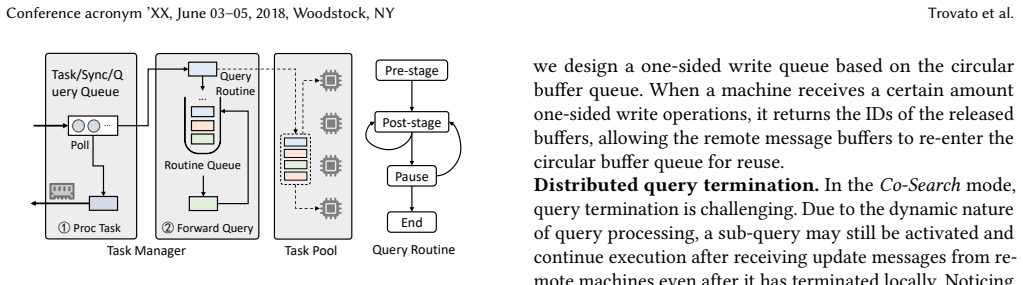
The load-bearing object is the navigation index: a proximity graph built on about 1% of the vectors, replicated on every machine. For each query it retrieves top-$k$ neighbors and counts which partitions hold them, declaring a partition primary when it holds more than $k/M$ of those neighbors; its top-$k$ results also seed the primary machines' candidate queues. Around that index, two execution modes carry the argument: Co-Search, in which primary machines run local graph traversal and exchange candidate-queue synchronization messages every few visited nodes, and Pull-Push, in which secondary machines deliver vectors via one-sided RDMA reads for a few neighbors or accept pushed distance-computation tasks for many neighbors. The claim is that this hybrid preserves the routing power of the global graph while shifting most traffic to small messages rather than raw vectors.
What would settle it
Run the same benchmark with the navigation index replaced by one built on random vectors, or with partitions labeled by nearest cluster center only, and measure QPS and average distance computations at recall@10 ≥ 0.95; a large drop would show that the reported scaling depends on navigation-index accuracy rather than on the asynchronous execution design itself.
Extended reading notes
Core claim
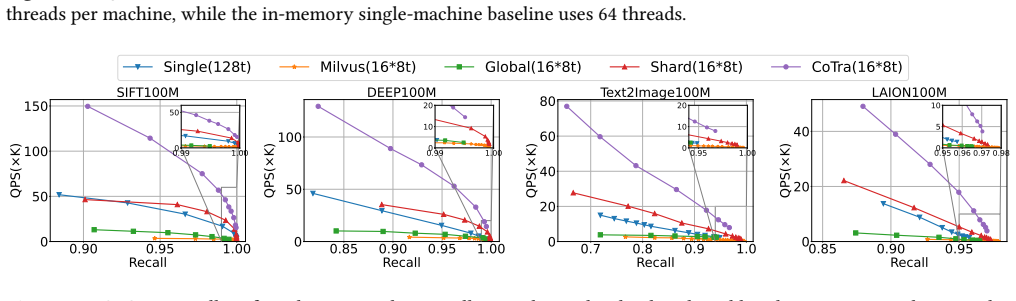
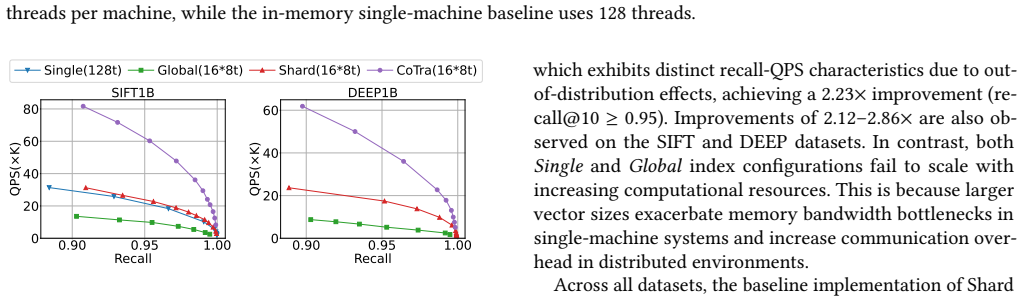
On the author's own terms, the paper establishes that a holistic proximity graph spanning all machines is practical for distributed vector search, contrary to the common shard-per-machine design. CoTra reports 9.8–13.4x QPS scaling on 16 machines relative to single-machine in-memory graph-index search at recall@10 ≥ 0.95, with a communication-to-computation ratio of about 22% and roughly 20% redundant distance computations on SIFT100M. The mechanism is collaborative traversal: after K-means partitions data, each query is classified through a 1%-sample navigation index into primary partitions, which host many close vectors, and secondary partitions, which host few far vectors. Primaries maintain and periodically synchronize candidate queues; secondaries answer pulls and pushes asynchronously. The paper also shows distributed index building reduces construction time on SIFT1B from over 96 hours on one machine to 8 hours on 16 nodes, and claims to be the first to run a holistic proximity graph index over multiple machines with close-to-linear scaling.
Load-bearing premise
The whole speedup rests on the assumption that the tiny sample-based navigation index almost always labels the right machines as primary and seeds the right candidates, so that delayed secondary-partition updates add only a little wasted work; if that labeling is often wrong, the communication savings evaporate and query cost rises.
Editorial extensions
If this is right
- Adding machines to a deployment can raise query throughput nearly in proportion, 9.8–13.4x at 16 machines with one global index, instead of the 4–6x seen with independent sharding.
- The primary/secondary split means most queries pay little for remote data: only about 25% of accessed vectors are remote, and those contribute roughly 22% of execution time as communication.
- A global graph index preserves the pruning power of proximity graphs, so per-query distance computations stay close to single-machine levels rather than multiplying with partition count.
- Distributed index construction makes billion-scale datasets buildable in hours rather than days: SIFT1B drops from over 96 hours on one machine to 8 hours on 16 nodes.
- The approach is index-agnostic and supports several standard proximity-graph index families, so existing single-machine graph indexes can be lifted to distributed mode.
Reading between the lines
- The paper never ablates navigation-index accuracy; one testable extension is to degrade the navigation index deliberately and observe where the 20% computation overhead breaks.
- Because communication is mostly distances rather than vectors, CoTra might run over commodity Ethernet with acceptable throughput if synchronization delays are batched; the paper flags this as future work.
- The primary/secondary idea suggests a query-routing predictor could be learned from historical queries, improving out-of-distribution workloads where locality is weaker.
- The same asynchronous primary/secondary template could apply to other iterative graph algorithms that tolerate stale updates, such as distributed PageRank or incremental graph neural network inference.
Editorial analysis
A structured set of objections, weighed in public.
Referee Report
Summary. CoTra addresses distributed approximate nearest neighbor search by maintaining a holistic proximity graph across multiple RDMA-connected machines. The system partitions vectors with balanced K-means, uses a 1%-sampled replicated navigation index to classify partitions as primary or secondary for each query, runs a synchronized Co-Search mode over primary partitions, and uses a Pull-Push mode (Pull-Data for at most two remote neighbors, Task-Push otherwise) for secondary partitions. Additional contributions include an RDMA-friendly graph layout, coroutine-based task scheduling, message batching, distributed termination detection, and distributed index construction. On four datasets up to 1B vectors, the paper reports 9.8–13.4x throughput over an 8-thread single-machine baseline and 2.12–3.58x over the best baseline at recall@10 >= 0.95.
Significance. If the scaling results hold, this is a substantial systems contribution: it would be the first demonstration that the pruning power of a single global proximity graph can be retained in a distributed setting, and the open-sourced implementation plus the broad evaluation (four datasets, two scales, four baselines, an ablation, and index-construction times) make the paper useful as a benchmark. The throughput numbers are measured rather than derived from fitted parameters, and the ablation isolates the contributions of Pull-Push, Co-Search, graph layout, and query manager. However, the validity of the central scaling claim is currently gated by an under-validated navigation index and by an uneven hardware/thread-count comparison between the distributed and single-machine baselines.
major comments (3)
- [Section 3.2, Algorithm 2 lines 3-4] The primary/secondary classification and the initial candidate queues are both produced by a navigation index built from only 1% of the vectors, yet the paper never measures the accuracy of this classification. Figure 5 demonstrates access locality for two queries only and does not validate the navigation index; the ablation in Figure 15 varies Pull-Push, Co-Search, layout, and query manager but not the navigation index; and Table 3 reports CoTra's average computation (4.33K) without attributing how much overhead comes from misclassified partitions. This omission is load-bearing because Figure 3 shows that a candidate-queue update delay of 24 increases computations from 3.59K to 10.14K (about 2.8x), so a query whose close vectors are placed on a 'secondary' partition would incur far more than the ~20% overhead claimed. Please report, for each dataset at recall@10 = 0.95, the fraction of queries for which the navigation index's primary set includes the partitions containing the ground-truth neighbors, together with a sensitivity analysis over the sampling ratio (e.g., 0.5%, 1%, 2%).
- [Section 5.1, Table 3, Figure 14] The headline scaling figures (9.8-13.4x on 16 machines) compare 16 nodes with Xeon Silver 4110 processors (8 threads per node) to a single 8-thread run on a different machine with four Xeon Gold 6252N processors. The sentence claiming that 'preliminary testing... confirmed that its performance is comparable to that of individual nodes in setup 1' provides no data, and processor-generation differences could materially affect the ratio. The five-run averages are also reported without variance. Because the paper's central claim is close-to-linear scaling, the comparison should be made like-for-like: at minimum, report CoTra on one node vs. 8 threads on the same node, and 16 nodes vs. 128 threads on the same single-node hardware when memory permits; also state whether the speedup is over an 8-thread baseline or over a same-total-thread-count baseline, and report per-run spread.
- [Section 3.3] Key design parameters are fixed without a sensitivity study: the sync interval (set to 4 candidates), the Pull-Data/Task-Push threshold (set to 2), and the navigation-index sample ratio (1%). The paper states these were chosen empirically, but no sweep or transferability evidence is given, so it is unclear whether the close-to-linear scaling is robust to these choices on other datasets and cluster configurations. Please add a parameter sweep (at least on SIFT100M and LAION100M) or an argument that the chosen operating point is not near a performance cliff.
minor comments (6)
- [Section 1] The phrase 'retrieval-argumented generation' should be 'retrieval-augmented generation'.
- [Table 3 caption] The caption uses 'Cotra' instead of 'CoTra'.
- [Figures 10-11, Section 2.2] The label 'T ext2Image100M' contains an erroneous space, and the text in Section 2.2 uses 'us' where 'μs' is intended.
- [Section 5.1] The sentence 'The baseline graph index types are Vamana [48], while HNSW [33] is used in Milvus' is awkward; please clarify which baselines use which graph type.
- [Figure 15] The ablation reports normalized throughput only; providing absolute QPS or computation counts would help readers judge the magnitude of each optimization.
- [Section 6] The sentence 'CoTra is the first to conduct distributed vector using a holistic proximity graph index' is missing the word 'search'.
Circularity Check
No significant circularity: CoTra's headline QPS scaling and recall comparisons are measured against external baselines; the 1% navigation-index accuracy gap is an unvalidated assumption, not a derivation that reduces to its own inputs.
full rationale
The paper's central claims are empirical. The 9.8-13.4x scaling and 2.12-3.58x baseline improvements are measured results from Table 2 and Figures 10-12, obtained on standard datasets against independently implemented baselines (DiskANN in-memory, Milvus, and self-built Global/Shard). No equation in the paper derives QPS from a fitted constant. The sync interval (4), the Pull-Data/Task-Push threshold (2), and the navigation sample ratio (1%) are hand-set design choices reported as defaults; the paper does not present these as predictions, and they do not appear in any derivation that is then verified. The navigation-index classification in Section 3.2 and Algorithm 2 (lines 3-4) is load-bearing but not circular: primary and secondary partitions are inferred from a separately built 1%-sample proximity graph, not from the search result itself, and the locality argument is supported by the measured access patterns in Figure 5. The absence of a direct accuracy measurement for the navigation index and the lack of an ablation varying the sample ratio are validation gaps, not circular reductions; the paper's own text does not claim a proof of classification accuracy. Self-citations to SPANN [7], SPFresh [58], and SPTAG [6], all involving co-author Qi Chen or Qianxi Zhang, appear only in related work and are not used to justify CoTra's core mechanism. The DiskANN/Vamana construction procedure is an external, code-reproduced method. There is no self-definitional step, no fitted parameter renamed as a prediction, and no uniqueness theorem imported from the authors. Score 0.
Assumptions & free parameters
free parameters (4)
- Co-Search sync interval =
4 candidates visited
- Pull-Data vs Task-Push threshold =
2 remote neighbors
- Navigation index sample ratio =
1%
- Graph construction replication factor S =
2
assumptions (6)
- domain assumption Approximate vector search is robust to asynchronous execution and bounded delays in candidate-queue updates.
- domain assumption K-means partitioning concentrates each query's accessed vectors in a few primary partitions that are also closer to the query.
- domain assumption The 1% navigation index accurately predicts primary/secondary partitions and initializes candidate queues.
- standard math Proximity graph search has O(log N) distance computations on a single machine.
- domain assumption RDMA one-sided operations provide 2-3 microseconds latency on the testbed and the 56 Gbps bandwidth is the limiting resource.
- domain assumption Single-machine memory bandwidth saturates beyond 48 threads, so adding threads does not improve QPS.
Cite this review
Pith. "Pith review of Towards Efficient and Scalable Distributed Vector Search with RDMA." pith.science (2026). https://pith.science/paper/IUXWHQSN
@misc{pith2026250706653,
  author       = {Pith},
  title        = {Pith review of: Towards Efficient and Scalable Distributed Vector Search with RDMA},
  year         = {2026},
  howpublished = {\url{https://pith.science/paper/IUXWHQSN}},
  note         = {Machine review of arXiv:2507.06653}
}
read the original abstract
Similarity-based vector search facilitates many important applications such as search and recommendation but is limited by the memory capacity and bandwidth of a single machine due to large datasets and intensive data read. In this paper, we present CoTra, a system that scales up vector search for distributed execution. We observe a tension between computation and communication efficiency, which is the main challenge for good scalability, i.e., handling the local vectors on each machine independently blows up computation as the pruning power of vector index is not fully utilized, while running a global index over all machines introduces rich data dependencies and thus extensive communication. To resolve such tension, we leverage the fact that vector search is approximate in nature and robust to asynchronous execution. In particular, we run collaborative vector search over the machines with algorithm-system co-designs including clustering-based data partitioning to reduce communication, asynchronous execution to avoid communication stall, and task push to reduce network traffic. To make collaborative search efficient, we introduce a suite of system optimizations including task scheduling, communication batching, and storage format. We evaluate CoTra on real datasets and compare with four baselines. The results show that when using 16 machines, the query throughput of CoTra scales to 9.8-13.4x over a single machine and is 2.12-3.58x of the best-performing baseline at 0.95 recall@10.
Figures


Figures from the paper (8 more)





Reference graph
Works this paper leans on
-
[1]
Cecilia Aguerrebere, Ishwar Singh Bhati, Mark Hildebrand, Mariano Tepper, and Theodore Willke. 2023. Similarity Search in the Blink of an Eye with Compressed Indices.Proc. VLDB Endow.16, 11 (July 2023), 3433–3446. doi:10.14778/3611479.3611537
arXiv 2023
-
[2]
Artem Babenko and Victor Lempitsky. 2014. The inverted multi-index. IEEE transactions on pattern analysis and machine intelligence37, 6 (2014), 1247–1260
work page 2014
-
[3]
Artem Babenko and Victor Lempitsky. 2016. Efficient indexing of billion-scale datasets of deep descriptors. InProceedings of the IEEE Conference on Computer Vision and Pattern Recognition. 2055–2063
work page 2016
-
[4]
Wout Bittremieux, Pieter Meysman, William Stafford Noble, and Kris Laukens. 2018. Fast open modification spectral library searching through approximate nearest neighbor indexing.Journal of proteome research17, 10 (2018), 3463–3474
work page 2018
-
[5]
Jianlv Chen, Shitao Xiao, Peitian Zhang, Kun Luo, Defu Lian, and Zheng Liu. 2024. Bge m3-embedding: Multi-lingual, multi- functionality, multi-granularity text embeddings through self- knowledge distillation.arXiv preprint arXiv:2402.03216(2024)
arXiv 2024
-
[6]
Qi Chen, Haidong Wang, Mingqin Li, Gang Ren, Scarlett Li, Jeffery Zhu, Jason Li, Chuanjie Liu, Lintao Zhang, and Jingdong Wang. 2018. SPTAG: A library for fast approximate nearest neighbor search.https: //github.com/Microsoft/SPTAG
work page 2018
-
[7]
Qi Chen, Bing Zhao, Haidong Wang, Mingqin Li, Chuanjie Liu, Zengzhong Li, Mao Yang, and Jingdong Wang. 2021. SPANN: Highly-efficient Billion-scale Approximate Nearest Neighborhood Search. InAdvances in Neural Information Processing Systems, M. Ranzato, A. Beygelzimer, Y. Dauphin, P.S. Liang, and J. Wort- man Vaughan (Eds.), Vol. 34. Curran Associates, Inc...
work page 2021
-
[8]
Yiqun Chen and James Zou. 2024. GenePT: a simple but effective foundation model for genes and cells built from ChatGPT.bioRxiv (2024), 2023–10
work page 2024
Show all 68 references
-
[9]
Benjamin Coleman, Santiago Segarra, Alexander J Smola, and An- shumali Shrivastava. 2022. Graph Reordering for Cache-Efficient Near Neighbor Search. InAdvances in Neural Information Process- ing Systems, S. Koyejo, S. Mohamed, A. Agarwal, D. Belgrave, K. Cho, and A. Oh (Eds.),...
2022
-
[10]
Paul Covington, Jay Adams, and Emre Sargin. 2016. Deep neural networks for youtube recommendations. InProceedings of the 10th ACM conference on recommender systems. 191–198
2016
-
[11]
Ng Kelvin, Chenyu Jiang, and James Cheng
Shiyuan Deng, Xiao Yan, K.W. Ng Kelvin, Chenyu Jiang, and James Cheng. 2019. Pyramid: A General Framework for Distributed Similarity Search on Large-scale Datasets. In2019 IEEE International Conference on Big Data (Big Data). 1066–1071. doi:10.1109/BigData47090.2019. 9006219
2019
-
[12]
Etienne Dilocker, Bob van Luijt, Byron Voorbach, Mohd Shukri Hasan, Abdel Rodriguez, Dirk Alexander Kulawiak, Marcin Antas, and Parker Duckworth. [n. d.].Weaviate.https://github.com/weaviate/weaviate
-
[13]
Artem Babenko Dmitry Baranchuk. 2021. Text-to-Image dataset for billion-scale similarity search. Retrieved April 13, 2025 fromhttps://research.yandex.com/datasets/text-to-image-dataset- for-billion-scale-similarity-search
2021
-
[14]
Philipp Fent, Alexander van Renen, Andreas Kipf, Viktor Leis, Thomas Neumann, and Alfons Kemper. 2020. Low-latency communication for fast DBMS using RDMA and shared memory. In2020 IEEE 36th International Conference on Data Engineering (ICDE). IEEE, 1477–1488
2020
-
[15]
Cong Fu, Chao Xiang, Changxu Wang, and Deng Cai. 2019. Fast approximate nearest neighbor search with the navigating spreading- out graph.Proc. VLDB Endow.12, 5 (Jan. 2019), 461–474. doi:10.14778/ 3303753.3303754
2019
-
[16]
Jianyang Gao and Cheng Long. 2024. RaBitQ: Quantizing High- Dimensional Vectors with a Theoretical Error Bound for Approximate Nearest Neighbor Search.Proc. ACM Manag. Data2, 3, Article 167 (May 2024), 27 pages. doi:10.1145/3654970
2024 doi
-
[17]
Tiezheng Ge, Kaiming He, Qifa Ke, and Jian Sun. 2014. Optimized Prod- uct Quantization.IEEE Transactions on Pattern Analysis and Machine Intelligence36, 4 (2014), 744–755. doi:10.1109/TPAMI.2013.240
2014 doi
-
[18]
Jui-Ting Huang, Ashish Sharma, Shuying Sun, Li Xia, David Zhang, Philip Pronin, Janani Padmanabhan, Giuseppe Ottaviano, and Linjun Yang. 2020. Embedding-based retrieval in facebook search. InProceed- ings of the 26th ACM SIGKDD International Conference on Knowledge Discovery &...
2020
-
[19]
Piotr Indyk and Rajeev Motwani. 1998. Approximate nearest neighbors: towards removing the curse of dimensionality. InProceedings of the Thirtieth Annual ACM Symposium on Theory of Computing(Dallas, Texas, USA)(STOC ’98). Association for Computing Machinery, New York, NY, USA, ...
1998
-
[20]
Junhyeok Jang, Hanjin Choi, Hanyeoreum Bae, Seungjun Lee, Miryeong Kwon, and Myoungsoo Jung. 2023. CXL-ANNS: Software- Hardware Collaborative Memory Disaggregation and Computation for Billion-Scale Approximate Nearest Neighbor Search. In2023 USENIX 13 Conference acronym ’XX, J...
2023
-
[21]
Herve Jegou, Matthijs Douze, and Cordelia Schmid. 2010. Product quantization for nearest neighbor search.IEEE transactions on pattern analysis and machine intelligence33, 1 (2010), 117–128
2010
-
[22]
Ziheng Jiang, Haibin Lin, Yinmin Zhong, Qi Huang, Yangrui Chen, Zhi Zhang, Yanghua Peng, Xiang Li, Cong Xie, Shibiao Nong, Yulu Jia, Sun He, Hongmin Chen, Zhihao Bai, Qi Hou, Shipeng Yan, Ding Zhou, Yiyao Sheng, Zhuo Jiang, Haohan Xu, Haoran Wei, Zhang Zhang, Pengfei Nie, Leqi...
2024
-
[23]
Jeff Johnson, Matthijs Douze, and Hervé Jégou. 2021. Billion-Scale Similarity Search with GPUs.IEEE Transactions on Big Data7, 3 (2021), 535–547. doi:10.1109/TBDATA.2019.2921572
2021
-
[24]
Herve Jégou, Matthijs Douze, and Cordelia Schmid. 2011. Product Quantization for Nearest Neighbor Search.IEEE Transactions on Pattern Analysis and Machine Intelligence33, 1 (2011), 117–128. doi:10.1109/ TPAMI.2010.57
2011
-
[25]
Yannis Kalantidis and Yannis Avrithis. 2014. Locally optimized product quantization for approximate nearest neighbor search. InProceedings of the IEEE conference on computer vision and pattern recognition. 2321– 2328
2014
-
[26]
Anuj Kalia, Michael Kaminsky, and David G Andersen. 2014. Using RDMA efficiently for key-value services. InProceedings of the 2014 ACM Conference on SIGCOMM. 295–306
2014
-
[27]
Andersen
Anuj Kalia, Michael Kaminsky, and David G. Andersen. 2016. FaSST: Fast, Scalable and Simple Distributed Transactions with Two-Sided (RDMA) Datagram RPCs. In12th USENIX Symposium on Operating Systems Design and Implementation (OSDI 16). USENIX Association, Savannah, GA, 185–201...
2016
-
[28]
Saim Khan, Somesh Singh, Harsha Vardhan Simhadri, Jyothi Vedurada, et al. 2024. BANG: Billion-Scale Approximate Nearest Neighbor Search using a Single GPU.arXiv preprint arXiv:2401.11324(2024)
2024 arXiv
-
[29]
Vladimir Yu Kiselev, Andrew Yiu, and Martin Hemberg. 2018. scmap: projection of single-cell RNA-seq data across data sets.Nature methods 15, 5 (2018), 359–362
2018
-
[30]
Avinash Lakshman and Prashant Malik. 2010. Cassandra: a decentral- ized structured storage system.SIGOPS Oper. Syst. Rev.44, 2 (April 2010), 35–40. doi:10.1145/1773912.1773922
2010
-
[31]
Hervé Jégou Laurent Amsaleg. 2010. Datasets for approximate nearest neighbor search.http://corpus-texmex.irisa.fr/Accessed: 2025-04-17
2010
-
[32]
Wen Li, Ying Zhang, Yifang Sun, Wei Wang, Mingjie Li, Wenjie Zhang, and Xuemin Lin. 2019. Approximate nearest neighbor search on high dimensional data—experiments, analyses, and improvement.IEEE Transactions on Knowledge and Data Engineering32, 8 (2019), 1475– 1488
2019
-
[33]
Malkov and D
Yu A. Malkov and D. A. Yashunin. 2020. Efficient and Robust Approx- imate Nearest Neighbor Search Using Hierarchical Navigable Small World Graphs.IEEE Transactions on Pattern Analysis and Machine Intelligence42, 4 (2020), 824–836. doi:10.1109/TPAMI.2018.2889473
2020
-
[34]
Magdalen Dobson Manohar, Zheqi Shen, Guy Blelloch, Laxman Dhuli- pala, Yan Gu, Harsha Vardhan Simhadri, and Yihan Sun. 2024. Par- layANN: Scalable and Deterministic Parallel Graph-Based Approx- imate Nearest Neighbor Search Algorithms. InProceedings of the 29th ACM SIGPLAN Ann...
2024
-
[35]
Priyanka Nigam, Yiwei Song, Vijai Mohan, Vihan Lakshman, Weitian Ding, Ankit Shingavi, Choon Hui Teo, Hao Gu, and Bing Yin. 2019. Semantic product search. InProceedings of the 25th ACM SIGKDD International Conference on Knowledge Discovery & Data Mining. 2876– 2885
2019
-
[36]
Hiroyuki Ootomo, Akira Naruse, Corey Nolet, Ray Wang, Tamas Feher, and Yong Wang. 2024. Cagra: Highly parallel graph construction and approximate nearest neighbor search for gpus. In2024 IEEE 40th International Conference on Data Engineering (ICDE). IEEE, 4236–4247
2024
-
[37]
Yun Peng, Byron Choi, Tsz Nam Chan, Jianye Yang, and Jianliang Xu. 2023. Efficient approximate nearest neighbor search in multi- dimensional databases.Proceedings of the ACM on Management of Data1, 1 (2023), 1–27
2023
-
[38]
Zhen Peng, Minjia Zhang, Kai Li, Ruoming Jin, and Bin Ren. 2023. iQAN: Fast and Accurate Vector Search with Efficient Intra-Query Parallelism on Multi-Core Architectures. InProceedings of the 28th ACM SIGPLAN Annual Symposium on Principles and Practice of Parallel Programming(...
2023
-
[39]
Liudmila Prokhorenkova and Aleksandr Shekhovtsov. 2020. Graph- based nearest neighbor search: From practice to theory. InInternational Conference on Machine Learning. PMLR, 7803–7813
2020
-
[40]
Alec Radford, Jong Wook Kim, Chris Hallacy, Aditya Ramesh, Gabriel Goh, Sandhini Agarwal, Girish Sastry, Amanda Askell, Pamela Mishkin, Jack Clark, et al. 2021. Learning transferable visual models from natural language supervision. InInternational conference on machine learnin...
2021
-
[41]
2013.Distributed Termination Detection
Michel Raynal. 2013.Distributed Termination Detection. Springer Berlin Heidelberg, Berlin, Heidelberg, 367–399. doi:10.1007/978-3-642-38123- 2_14
2013 doi
-
[42]
Jie Ren, Minjia Zhang, and Dong Li. 2020. HM-ANN: efficient billion- point nearest neighbor search on heterogeneous memory. InProceed- ings of the 34th International Conference on Neural Information Process- ing Systems(Vancouver, BC, Canada)(NIPS ’20). Curran Associates Inc.,...
2020
-
[43]
Christoph Schuhmann, Richard Vencu, Romain Beaumont, Robert Kaczmarczyk, Clayton Mullis, Aarush Katta, Theo Coombes, Jenia Jitsev, and Aran Komatsuzaki. 2021. Laion-400m: Open dataset of clip- filtered 400 million image-text pairs.arXiv preprint arXiv:2111.02114 (2021)
2021 arXiv
-
[44]
Konstantin Schütze, Michael Heinzinger, Martin Steinegger, and Burkhard Rost. 2022. Nearest neighbor search on embeddings rapidly identifies distant protein relations.Frontiers in Bioinformatics2 (2022), 1033775
2022
-
[45]
Rulin Shao, Jacqueline He, Akari Asai, Weijia Shi, Tim Dettmers, Sewon Min, Luke Zettlemoyer, and Pang Wei W Koh. 2024. Scaling retrieval- based language models with a trillion-token datastore.Advances in Neural Information Processing Systems37 (2024), 91260–91299
2024
-
[46]
Jiaxin Shi, Youyang Yao, Rong Chen, Haibo Chen, and Feifei Li. 2016. Fast and concurrent RDF queries with RDMA-based distributed graph exploration. InProceedings of the 12th USENIX Conference on Operating Systems Design and Implementation(Savannah, GA, USA)(OSDI’16). USENIX As...
2016
-
[47]
Harsha Vardhan Simhadri, George Williams, Martin Aumüller, Matthijs Douze, Artem Babenko, Dmitry Baranchuk, Qi Chen, Lucas Hosseini, Ravishankar Krishnaswamny, Gopal Srinivasa, et al. 2022. Results of the NeurIPS’21 challenge on billion-scale approximate near- est neighbor sea...
2022
-
[48]
2019.DiskANN: fast accurate billion-point nearest neighbor search on a single node
Suhas Jayaram Subramanya, Devvrit, Rohan Kadekodi, Ravishankar Krishaswamy, and Harsha Vardhan Simhadri. 2019.DiskANN: fast accurate billion-point nearest neighbor search on a single node. Curran Associates Inc., Red Hook, NY, USA. 14 Towards Efficient and Scalable Distributed...
2019
-
[49]
Eric S Tellez, Martin Aumüller, and Vladimir Mic. 2024. Overview of the SISAP 2024 Indexing Challenge. InInternational Conference on Similarity Search and Applications. Springer, 255–265
2024
-
[50]
Bing Tian, Haikun Liu, Zhuohui Duan, Xiaofei Liao, Hai Jin, and Yu Zhang. 2024. Scalable Billion-point Approximate Nearest Neighbor Search Using SmartSSDs. In2024 USENIX Annual Technical Conference (USENIX ATC 24). USENIX Association, Santa Clara, CA, 1135–1150. https://www.us...
2024
-
[51]
Christophe Van Gysel, Maarten de Rijke, and Evangelos Kanoulas. 2016. Learning latent vector spaces for product search. InProceedings of the 25th ACM international on conference on information and knowledge management. 165–174
2016
-
[52]
Jianguo Wang, Xiaomeng Yi, Rentong Guo, Hai Jin, Peng Xu, Shengjun Li, Xiangyu Wang, Xiangzhou Guo, Chengming Li, Xiaohai Xu, Kun Yu, Yuxing Yuan, Yinghao Zou, Jiquan Long, Yudong Cai, Zhenxiang Li, Zhifeng Zhang, Yihua Mo, Jun Gu, Ruiyi Jiang, Yi Wei, and Charles Xie
-
[53]
Mengzhao Wang, Weizhi Xu, Xiaomeng Yi, Songlin Wu, Zhangyang Peng, Xiangyu Ke, Yunjun Gao, Xiaoliang Xu, Rentong Guo, and Charles Xie. 2024. Starling: An I/O-Efficient Disk-Resident Graph Index Framework for High-Dimensional Vector Similarity Search on Data Segment.Proc. ACM M...
2024 doi
-
[54]
Mengzhao Wang, Xiaoliang Xu, Qiang Yue, and Yuxiang Wang. 2021. A comprehensive survey and experimental comparison of graph-based approximate nearest neighbor search.arXiv preprint arXiv:2101.12631 (2021)
2021 arXiv
-
[55]
Mengzhao Wang, Xiaoliang Xu, Qiang Yue, and Yuxiang Wang. 2021. A comprehensive survey and experimental comparison of graph-based approximate nearest neighbor search.Proc. VLDB Endow.14, 11 (July 2021), 1964–1978. doi:10.14778/3476249.3476255
2021
-
[56]
Chuangxian Wei, Bin Wu, Sheng Wang, Renjie Lou, Chaoqun Zhan, Feifei Li, and Yuanzhe Cai. 2020. AnalyticDB-V: a hybrid analytical engine towards query fusion for structured and unstructured data. Proc. VLDB Endow.13, 12 (Aug. 2020), 3152–3165. doi:10.14778/3415478. 3415541
2020 doi
-
[57]
Xingda Wei, Zhiyuan Dong, Rong Chen, and Haibo Chen. 2018. Decon- structing RDMA-enabled Distributed Transactions: Hybrid is Better!. In13th USENIX Symposium on Operating Systems Design and Imple- mentation (OSDI 18). USENIX Association, Carlsbad, CA, 233–251. https://www.usen...
2018
-
[58]
Yuming Xu, Hengyu Liang, Jin Li, Shuotao Xu, Qi Chen, Qianxi Zhang, Cheng Li, Ziyue Yang, Fan Yang, Yuqing Yang, Peng Cheng, and Mao Yang. 2023. SPFresh: Incremental In-Place Update for Billion-Scale Vector Search. InProceedings of the 29th Symposium on Operating Systems Princ...
2023
-
[59]
Shulin Zeng, Zhenhua Zhu, Jun Liu, Haoyu Zhang, Guohao Dai, Zix- uan Zhou, Shuangchen Li, Xuefei Ning, Yuan Xie, Huazhong Yang, and Yu Wang. 2023. DF-GAS: a Distributed FPGA-as-a-Service Architec- ture towards Billion-Scale Graph-based Approximate Nearest Neigh- bor Search. In...
2023
-
[60]
Yanhao Zhang, Pan Pan, Yun Zheng, Kang Zhao, Yingya Zhang, Xi- aofeng Ren, and Rong Jin. 2018. Visual search at alibaba. InProceedings of the 24th ACM SIGKDD international conference on knowledge discov- ery & data mining. 993–1001
2018
-
[61]
Zili Zhang, Chao Jin, Linpeng Tang, Xuanzhe Liu, and Xin Jin
-
[62]
Zili Zhang, Fangyue Liu, Gang Huang, Xuanzhe Liu, and Xin Jin. 2024. Fast Vector Query Processing for Large Datasets Beyond GPU Memory with Reordered Pipelining. In21st USENIX Symposium on Networked Systems Design and Implementation (NSDI 24). USENIX Association, Santa Clara, ...
2024
-
[63]
Penghao Zhao, Hailin Zhang, Qinhan Yu, Zhengren Wang, Yunteng Geng, Fangcheng Fu, Ling Yang, Wentao Zhang, Jie Jiang, and Bin Cui. 2024. Retrieval-augmented generation for ai-generated content: A survey.arXiv preprint arXiv:2402.19473(2024)
2024 arXiv
-
[64]
Yifan Zhao, Huiyu Cai, Zuobai Zhang, Jian Tang, and Yue Li. 2021. Learning interpretable cellular and gene signature embeddings from single-cell transcriptomic data.Nature communications12, 1 (2021), 5261
2021
-
[65]
Tobias Ziegler, Jacob Nelson-Slivon, Viktor Leis, and Carsten Binnig
-
[68]
1, 2, Article 131 (June 2023), 26 pages
Design Guidelines for Correct, Efficient, and Scalable Synchro- nization using One-Sided RDMA. 1, 2, Article 131 (June 2023), 26 pages. doi:10.1145/3589276 15
2023 doi
-
[2021]
In Proceedings of the 2021 International Conference on Management of Data (Virtual Event, China)(SIGMOD ’21)
Milvus: A Purpose-Built Vector Data Management System. In Proceedings of the 2021 International Conference on Management of Data (Virtual Event, China)(SIGMOD ’21). Association for Computing Ma- chinery, New York, NY, USA, 2614–2627. doi:10.1145/3448016.3457550
2021
-
[2023]
In20th USENIX Symposium on Networked Systems Design and Implementation (NSDI 23)
Fast, Approximate Vector Queries on Very Large Unstructured Datasets. In20th USENIX Symposium on Networked Systems Design and Implementation (NSDI 23). USENIX Association, Boston, MA, 995–1011. https://www.usenix.org/conference/nsdi23/presentation/zhang-zili
Reviewed August 6, 2026 · model on record in the stance chip above.
Discussion (0). Sign in to comment.