REVIEW 3 major objections 5 minor 51 references
Fast Gaussian Processes under Monotonicity Constraints
T0 review · 3 major / 5 minor · reviewed 2026-08-06 · deepseek-v4-flash
Pith's one-line read The paper claims that monotone Gaussian-process surrogates can be sampled by repeated constrained least-squares solves instead of MCMC, giving independent draws with autocorrelation near one.
desk verdict A genuinely useful and well-tested application of RLRTO to constrained GPs, whose practical speedup is real, but the paper should be clearer that RLRTO samples a different (censored) posterior than the truncated-Gaussian baselines. read the letter →
The pith
A machine-rendered reading of the paper's core claim, the machinery that carries it, and where it could break.
The reading
What carries the argument
The central object is RLRTO (Regularized Linear Randomize-then-Optimize), a sampling scheme that converts each posterior draw into one constrained quadratic program. The virtual-point construction places a finite set of constraint points $s$ in the input domain and enforces $f'(s)\ge 0$ there; the derivative-enhanced GP supplies the linear forward map $A=K_{01}(t,s)K_{11}(s,s)^{-1}$ and the conditional formulas that convert a drawn derivative vector $f'(s)$ into predictive function draws. RLRTO perturbs the data vector with $\hat b\sim\mathcal{N}(f(t),\Sigma_*(t))$ and the prior mean with $\hat c\sim\mathcal{N}(0,K_{11}(s,s))$, then solves the nonnegativity-constrained least-squares problem; the solution is the sample. The paper contrasts this with two MCMC alternatives, a truncated-Gaussian posterior sampled by Gibbs or NUTS and a ReLU-transformed non-Gaussian-likelihood posterior also sampled by Gibbs or NUTS.
What would settle it
Run a low-dimensional case, such as 1D-1 with four data points and a small virtual-point set, where exact samples from the truncated-Gaussian posterior are available by rejection or exact Monte Carlo; if a two-sample test on the derivative vectors shows the RLRTO empirical distribution does not approach the truncated-Gaussian target as the number of draws grows, then RLRTO samples a different posterior than intended.
Extended reading notes
Core claim
The paper's central claim is that the constrained posterior of a monotone Gaussian-process surrogate can be sampled, without MCMC, by repeatedly solving the constrained least-squares problem $\min_{f'(s)\ge 0}\,\frac{1}{2}\|A f'(s)-\hat b\|_{\Sigma_*^{-1}}^2+\frac{1}{2}\|f'(s)-\hat c\|_{K_{11}^{-1}}^2$, where $A=K_{01}(t,s)K_{11}(s,s)^{-1}$ links virtual-point derivative values to data values, $\hat b$ is drawn from $\mathcal{N}(f(t),\Sigma_*(t))$, and $\hat c$ is drawn from $\mathcal{N}(0,K_{11}(s,s))$. Each solution is taken as one independent sample from the constrained posterior; the paper explicitly says this posterior is implicit and cannot be written in a conventional Bayesian closed form. The claim is that these optimization-based samples give predictive accuracy comparable to or better than the truncated-prior and non-Gaussian-likelihood baselines while making the sampling cost nearly independent of sample correlation, with integrated autocorrelation time near one and much higher effective samples per second. The same idea is reported to extend to other linear inequality constraints through projection mappings, and the paper also demonstrates that replacing Gibbs with the No-U-Turn Sampler accelerates the two baseline samplers.
Load-bearing premise
The load-bearing premise is that repeatedly solving the randomized constrained least-squares problem yields samples from the constrained posterior the user intends; the paper does not derive that posterior in closed form.
Editorial extensions
If this is right
- Monotonicity-constrained GP surrogates can be built from independent samples, so no burn-in, thinning, or sequential correlation is needed, and sampling cost in effective samples per second improves sharply as the number of virtual points grows.
- Flat regions are representable: unlike the truncated-prior method, RLRTO solutions can lie on the boundary $f'(s)=0$, matching the non-Gaussian-likelihood flexibility at lower cost.
- The NUTS upgrade makes the two existing virtual-point methods practical for larger problems and, with enough virtual points, NUTS beats Gibbs on integrated autocorrelation time and effective samples per second.
- Because RLRTO samples are independent, the sampling loop is embarrassingly parallelizable, so wall-clock time can be reduced further by running many randomized solves concurrently.
- The constrained-optimization sampling extends to other linear inequality constraints (boundedness, convexity) and to higher-order derivative constraints, because only the projection onto the feasible set changes.
Reading between the lines
- The implicit-posterior caveat means that predictive accuracy parity with MCMC baselines does not by itself establish that RLRTO samples the truncated-Gaussian posterior; users who need faithful derivative-level credible intervals should first run a distributional check against a reference sampler.
- If the optimization-based samples are accepted as the target, the practical ceiling is set by convex-solver speed rather than mixing time, which suggests monotone GP surrogates with thousands of virtual points become feasible in Bayesian optimization and PDE-inversion loops.
- A natural testable extension is to enforce convexity in higher dimensions by replacing the scalar constraint $f''(s)\ge 0$ with a positive-semidefinite Hessian constraint inside each randomized solve, a direction the paper leaves open.
Editorial analysis
A structured set of objections, weighed in public.
Referee Report
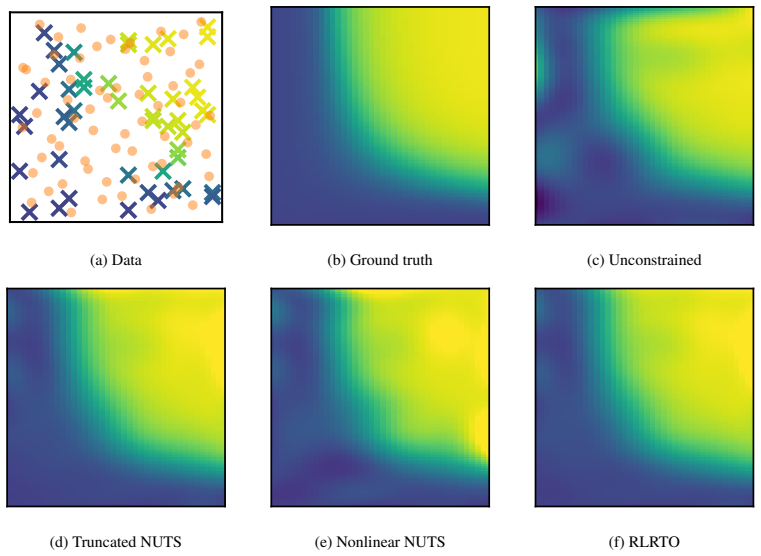
Summary. The paper develops a virtual-point Gaussian process framework for enforcing monotonicity constraints. It introduces a sampler based on regularized linear randomize-then-optimize (RLRTO), in which constrained derivative samples are obtained by repeatedly solving a non-negatively constrained randomized least-squares problem (Eq. 36). It also replaces the Gibbs samplers of two existing virtual-point methods (truncated prior and non-Gaussian likelihood) with NUTS. The methods are compared on six synthetic test functions and two differential-equation surrogate problems using MSE, 95% credible-interval width, integrated autocorrelation time, and effective samples per second. The authors report that RLRTO matches or improves predictive accuracy while being substantially faster, and they release code at a Zenodo repository.
Significance. The main contribution is the introduction of a fast, independent-sampling alternative to MCMC for constrained virtual-point GPs, with reproducible code and a broad experimental study. The RLRTO idea is interesting and the efficiency gains are large and credible. However, the statistical target of RLRTO is not characterized in the manuscript, and the sampling guarantee is imported from previous work; until the target distribution is specified and empirically validated, the comparison in Section 4 is not a comparison of samplers targeting the same posterior. The NUTS acceleration of the two baseline methods is a useful practical contribution, and the differential-equation demonstrations show the method's scope.
major comments (3)
- [Sec. 3.4, Eq. (36)] The statistical target of RLRTO is left implicit. The text states that the posterior 'can not be written in a conventional Bayesian sense', and the correctness of the sampler is cited to refs. [22–25], two of which are co-authored by an author of this manuscript. In a scalar linear-Gaussian example with a non-negativity constraint, the RLRTO solution has a censored distribution with a point mass at the boundary, whereas the truncated-Gaussian posterior in Eq. (29) has a continuous density. The paper therefore does not establish that RLRTO samples from the same posterior as the baselines; Section 4 and Tables 3–4 may be comparing different posterior models. Please provide a formal description of the distribution sampled by Eq. (36), including its dependence on the data and prior, or add a calibration/coverage experiment against a known target, or explicitly reframe the contribution as defining a new implicit-prior model rather than sampling an existing one.
- [Sec. 3.3, Eq. (33)] Equation (33) is not a valid joint Gaussian distribution because ReLU is a nonlinear transformation; the vector [f(t); ReLU(f'(s))] is not jointly Gaussian. The intended model appears to be f(t)|f'(s) ~ N(A ReLU(f'(s)), Σ*) with f'(s) ~ N(0, K11(s,s)), which yields the unnormalized density in Eq. (34). Please correct the displayed joint distribution and make the conditional likelihood explicit.
- [Sec. 4, Figs. 5–9 and Tables 3–4] All reported metrics appear to come from a single run without repeated trials or uncertainty estimates. Because the MSE and CI widths of the constrained methods are often close (e.g., the top-left panel of Fig. 5), the claims of 'comparable' or 'generally best' accuracy need support from multiple independent runs, different data realizations, or at least bootstrap confidence intervals. The efficiency comparisons are based on larger differences and are less sensitive, but the quality comparisons should be quantified.
minor comments (5)
- [References] References [22] and [44] are identical (Bardsley and Fox, 2012); please merge or renumber.
- [Sec. 3.2, Eq. (27)] In Eq. (27), the covariance matrix is denoted K00(t,t) but K00 is never defined; this should presumably be K(t,t).
- [Sec. 4.4] The sentence 'based on the scaling behavior of the IAT seen in Fig. 6' appears to refer to Fig. 8, which displays IAT.
- [Sec. 4.1] The phrase 'Withe these samples' contains a typo.
- [Sec. 4.4] The warm-starting of the RLRTO solver, mentioned in the efficiency discussion in Section 4.4, is not described in the implementation details of Section 4.1; if warm starts are used, the resulting samples are not strictly independent and the IAT and ESS/s values should be interpreted accordingly.
Circularity Check
No significant circularity: RLRTO is applied as an established sampler, and the GP construction, benchmarks, and metrics are independent of the fitted inputs.
full rationale
The paper's central derivation is the application of the existing RLRTO framework to virtual-point Gaussian process models under monotonicity constraints. The sampling-validity of RLRTO is imported from prior work (refs. [22-25]), including two papers co-authored by the current author J.M. Everink, but this is not a circular step: the paper does not re-derive or redefine the RLRTO guarantee in terms of its own results, and it explicitly acknowledges in Section 3.4 that the resulting posterior 'can not be written in a conventional Bayesian sense' and is instead an implicit posterior. Thus the paper is honest that RLRTO samples a projected/implicit distribution rather than the truncated Gaussian posterior used by the baselines. The application-specific construction—the GP conditional formulas in Eqs. (15)-(16), the constrained optimization problem in Eq. (36), and the Monte Carlo/NUTS implementations—is self-contained and does not reduce any prediction to a fitted constant. Hyperparameters are optimized once via marginal likelihood and then used for all methods, so no fitted value is renamed as a prediction. The comparisons on synthetic functions and differential-equation surrogates are external and falsifiable. The concern that RLRTO targets a different posterior than the baselines is a validity or calibration question, not evidence of circularity, and the paper's own limitation statement in Section 3.4 flags exactly this point.
Assumptions & free parameters
free parameters (2)
- GP kernel variance sigma^2 =
optimized via marginal likelihood
- GP correlation length l =
optimized via marginal likelihood
assumptions (4)
- standard math Squared exponential kernel is infinitely differentiable, so derivative observations follow a Gaussian process.
- domain assumption A finite set of virtual points approximates global monotonicity.
- domain assumption RLRTO solutions are samples from a valid posterior distribution.
- domain assumption The non-Gaussian likelihood model uses a ReLU transformation to allow zero gradients.
Cite this review
Pith. "Pith review of Fast Gaussian Processes under Monotonicity Constraints." pith.science (2026). https://pith.science/paper/7KHUCTD6
@misc{pith2026250706677,
  author       = {Pith},
  title        = {Pith review of: Fast Gaussian Processes under Monotonicity Constraints},
  year         = {2026},
  howpublished = {\url{https://pith.science/paper/7KHUCTD6}},
  note         = {Machine review of arXiv:2507.06677}
}
read the original abstract
Gaussian processes (GPs) are widely used as surrogate models for complicated functions in scientific and engineering applications. In many cases, prior knowledge about the function to be approximated, such as monotonicity, is available and can be leveraged to improve model fidelity. Incorporating such constraints into GP models enhances predictive accuracy and reduces uncertainty, but remains a computationally challenging task for high-dimensional problems. In this work, we present a novel virtual point-based framework for building constrained GP models under monotonicity constraints, based on regularized linear randomize-then-optimize (RLRTO), which enables efficient sampling from a constrained posterior distribution by means of solving randomized optimization problems. We also enhance two existing virtual point-based approaches by replacing Gibbs sampling with the No U-Turn Sampler (NUTS) for improved efficiency. A Python implementation of these methods is provided and can be easily applied to a wide range of problems. This implementation is then used to validate the approaches on approximating a range of synthetic functions, demonstrating comparable predictive performance between all considered methods and significant improvements in computational efficiency with the two NUTS methods and especially with the RLRTO method. The framework is further applied to construct surrogate models for systems of differential equations.
Figures


Figures from the paper (8 more)



Reference graph
Works this paper leans on
-
[1]
J.-P. Chil `es, N. Desassis, Fifty years of kriging, Handbook of mathematical geosciences: Fifty years of IAMG (2018) 589–612
work page 2018
-
[2]
C. E. Rasmussen, C. K. Williams, Gaussian processes for machine learning, MIT press Cambridge, MA, 2006
work page 2006
-
[3]
H. Liu, Y .-S. Ong, X. Shen, J. Cai, When Gaussian process meets big data: A review of scalable GPs, IEEE Transactions on Neural Networks and Learn- ing Systems 31 (11) (2020) 4405–4423
work page 2020
-
[4]
P. I. Frazier, A tutorial on Bayesian optimization, arXiv preprint arXiv:1807.02811 (2018)
arXiv 2018
- [5]
-
[6]
I. Bilionis, N. Zabaras, B. A. Konomi, G. Lin, Multi-output separable Gaus- sian process: Towards an efficient, fully Bayesian paradigm for uncertainty quantification, Journal of Computational Physics 241 (2013) 212–239. 30
work page 2013
-
[7]
P. Chen, N. Zabaras, I. Bilionis, Uncertainty propagation using infinite mix- ture of Gaussian processes and variational Bayesian inference, Journal of Computational Physics 284 (2015) 291–333
work page 2015
-
[8]
O. G. Ernst, B. Sprungk, C. Zhang, Uncertainty modeling and propagation for groundwater flow: a comparative study of surrogates, GEM-International Journal on Geomathematics 15 (1) (2024) 11
work page 2024
Show all 51 references
-
[9]
L. P. Swiler, M. Gulian, A. L. Frankel, C. Safta, J. D. Jakeman, A Survey of Constrained Gaussian Process Regression: Approaches and Implementation Challenges, Journal of Machine Learning for Modeling and Computing 1 (2) (2020) 119–156
2020
-
[10]
Agrell, Gaussian Processes with Linear Operator Inequality Constraints, Journal of Machine Learning Research 20 (135) (2019) 1–36
C. Agrell, Gaussian Processes with Linear Operator Inequality Constraints, Journal of Machine Learning Research 20 (135) (2019) 1–36
2019
-
[11]
Riihimaki, A
J. Riihimaki, A. Vehtari, Gaussian processes with monotonicity information, in: The Thirteenth International Conference on Artificial Intelligence and Statistics, 2010, pp. 645–652
2010
-
[12]
Da Veiga, A
S. Da Veiga, A. Marrel, Gaussian process modeling with inequality con- straints, Annales de la Facult ´e des sciences de Toulouse : Math ´ematiques 21 (3) (2012) 529–555
2012
-
[13]
X. Wang, J. O. Berger, Estimating Shape Constrained Functions Using Gaus- sian Processes, SIAM /ASA Journal on Uncertainty Quantification 4 (1) (2016) 1–25
2016
-
[14]
Da Veiga, A
S. Da Veiga, A. Marrel, Gaussian process regression with linear inequality constraints, Reliability Engineering & System Safety 195 (2020) 106732
2020
-
[15]
Maatouk, X
H. Maatouk, X. Bay, Gaussian process emulators for computer experiments with inequality constraints, Mathematical Geosciences 49 (2017) 557–582
2017
-
[16]
A. F. L ´opez-Lopera, F. Bachoc, N. Durrande, O. Roustant, Finite- dimensional Gaussian approximation with linear inequality constraints, SIAM/ASA Journal on Uncertainty Quantification 6 (3) (2018) 1224–1255
2018
-
[17]
Bachoc, A
F. Bachoc, A. F. L ´opez-Lopera, O. Roustant, Sequential construction and dimension reduction of Gaussian processes under inequality constraints, SIAM Journal on Mathematics of Data Science 4 (2) (2022) 772–800. 31
2022
-
[18]
L ´opez-Lopera, F
A. L ´opez-Lopera, F. Bachoc, O. Roustant, High-dimensional additive Gaus- sian processes under monotonicity constraints, Advances in Neural Informa- tion Processing Systems 35 (2022) 8041–8053
2022
-
[19]
S. Zhou, P. Ray, D. Pati, A. Bhattacharya, A mass-shifting phenomenon of truncated multivariate normal priors, Journal of the American Statistical Association 119 (545) (2024) 582–596
2024
-
[20]
Gamerman, H
D. Gamerman, H. F. Lopes, Markov chain Monte Carlo: stochastic simula- tion for Bayesian inference, Chapman and Hall/CRC, 2006
2006
-
[21]
A. E. Gelfand, Gibbs sampling, Journal of the American statistical Associa- tion 95 (452) (2000) 1300–1304
2000
-
[23]
J. M. Bardsley, P. C. Hansen, MCMC algorithms for computational UQ of nonnegativity constrained linear inverse problems, SIAM Journal on Scien- tific Computing 42 (2) (2020) A1269–A1288
2020
-
[24]
J. M. Everink, Y . Dong, M. S. Andersen, Bayesian Inference with Projected Densities, SIAM/ASA Journal on Uncertainty Quantification 11 (3) (2023) 1025–1043
2023
-
[25]
J. M. Everink, Y . Dong, M. S. Andersen, Sparse Bayesian inference with regularized Gaussian distributions, Inverse Problems 39 (11) (2023) 115004
2023
-
[26]
M. D. Ho ffman, A. Gelman, et al., The No-U-Turn sampler: adaptively set- ting path lengths in Hamiltonian Monte Carlo., J. Mach. Learn. Res. 15 (1) (2014) 1593–1623
2014
-
[27]
V . Rao, L. Lin, D. B. Dunson, Data augmentation for models based on rejec- tion sampling, Biometrika 103 (2) (2016) 319–335
2016
-
[28]
S. Chib, E. Greenberg, Understanding the Metropolis-Hastings algorithm, The American Statistician 49 (4) (1995) 327–335. 32
1995
-
[29]
J. H. Kotecha, P. M. Djuric, Gibbs sampling approach for generation of truncated multivariate Gaussian random variables, in: 1999 IEEE Interna- tional Conference on Acoustics, Sspeech, and Signal Processing. Proceed- ings. ICASSP99 (Cat. No. 99CH36258), V ol. 3, IEEE, 1999, pp...
1999
-
[30]
K. S. Zhang, G. Peyr ´e, J. Fadili, M. Pereyra, Wasserstein control of mirror Langevin Monte Carlo, in: Conference on Learning Theory, PMLR, 2020, pp. 3814–3841
2020
-
[31]
Durmus, E
A. Durmus, E. Moulines, M. Pereyra, E fficient Bayesian computation by proximal Markov chain Monte Carlo: when Langevin meets Moreau, SIAM Journal on Imaging Sciences 11 (1) (2018) 473–506
2018
-
[32]
Pakman, L
A. Pakman, L. Paninski, Exact Hamiltonian Monte Carlo for truncated mul- tivariate Gaussians, Journal of Computational and Graphical Statistics 23 (2) (2014) 518–542
2014
-
[33]
N. P. Archer, S. Wang, Application of the back propagation neural network algorithm with monotonicity constraints for two-group classification prob- lems, Decision Sciences 24 (1) (1993) 60–75
1993
-
[34]
Wehenkel, G
A. Wehenkel, G. Louppe, Unconstrained monotonic neural networks, Ad- vances in Neural Information Processing Systems 32 (2019)
2019
-
[35]
Nolte, O
N. Nolte, O. Kitouni, M. Williams, Expressive monotonic neural networks, in: The Eleventh International Conference on Learning Representations, 2023
2023
-
[36]
Runje, S
D. Runje, S. M. Shankaranarayana, Constrained monotonic neural net- works, in: International Conference on Machine Learning, PMLR, 2023, pp. 29338–29353
2023
-
[37]
Kitouni, N
O. Kitouni, N. Nolte, M. Williams, Robust and provably monotonic net- works, Machine Learning: Science and Technology 4 (3) (2023) 035020
2023
-
[38]
R. J. Adler, The geometry of random fields, SIAM, 2010
2010
-
[39]
Parzen, Stochastic Processes, SIAM, Philadelphia, 1999
E. Parzen, Stochastic Processes, SIAM, Philadelphia, 1999
1999
-
[40]
Eriksson, K
D. Eriksson, K. Dong, E. Lee, D. Bindel, A. G. Wilson, Scaling Gaussian process regression with derivatives, Advances in Neural Information Pro- cessing Systems 31 (2018). 33
2018
-
[41]
Padidar, X
M. Padidar, X. Zhu, L. Huang, J. Gardner, D. Bindel, Scaling Gaussian pro- cesses with derivative information using variational inference, Advances in Neural Information Processing Systems 34 (2021) 6442–6453
2021
-
[42]
J. M. Bardsley, A. Solonen, H. Haario, M. Laine, Randomize-then-optimize: A method for sampling from posterior distributions in nonlinear inverse problems, SIAM Journal on Scientific Computing 36 (4) (2014) A1895– A1910
2014
-
[43]
J. M. Bardsley, MCMC-based image reconstruction with uncertainty quan- tification, SIAM Journal on Scientific Computing 34 (3) (2012) A1316– A1332
2012
-
[44]
J. M. Bardsley, C. Fox, An MCMC method for uncertainty quantification in nonnegativity constrained inverse problems, Inverse Problems in Science and Engineering 20 (4) (2012) 477–498
2012
-
[45]
I. M. Sobol, The distribution of points in a cube and the approximate eval- uation of integrals, USSR Computational Mathematics and Mathematical Physics 7 (1967) 86–112
1967
-
[46]
N. A. Riis, A. M. Alghamdi, F. Uribe, S. L. Christensen, B. M. Afkham, P. C. Hansen, J. S. Jørgensen, CUQIpy: I. computational uncertainty quan- tification for inverse problems in Python, Inverse Problems 40 (4) (2024) 045009
2024
-
[47]
A. M. Alghamdi, N. A. Riis, B. M. Afkham, F. Uribe, S. L. Christensen, P. C. Hansen, J. S. Jørgensen, CUQIpy: II. computational uncertainty quantifica- tion for PDE-based inverse problems in Python, Inverse Problems 40 (4) (2024) 045010
2024
-
[48]
Bingham, J
E. Bingham, J. P. Chen, M. Jankowiak, F. Obermeyer, N. Pradhan, T. Kar- aletsos, R. Singh, P. Szerlip, P. Horsfall, N. D. Goodman, Pyro: Deep uni- versal probabilistic programming, Journal of Machine Learning Research 20 (28) (2019) 1–6
2019
-
[49]
Virtanen, R
P. Virtanen, R. Gommers, T. E. Oliphant, M. Haberland, T. Reddy, D. Cour- napeau, E. Burovski, P. Peterson, W. Weckesser, J. Bright, S. J. van der Walt, M. Brett, J. Wilson, K. J. Millman, N. Mayorov, A. R. J. Nelson, E. Jones, R. Kern, E. Larson, C. J. Carey, ˙I. Polat, Y . F...
2020
-
[50]
M. D. McKay, R. J. Beckman, W. J. Conover, A comparison of three meth- ods for selecting values of input variables in the analysis of output from a computer code, Technometrics 42 (1) (2000) 55–61
2000
-
[51]
Pinder, D
T. Pinder, D. Dodd, GPJax: A Gaussian process framework in JAX, Journal of Open Source Software 7 (75) (2022) 4455
2022
-
[52]
H. P. Langtangen, G. K. Pedersen, Scaling of differential equations, Springer Nature, 2016. 35
2016
Reviewed August 6, 2026 · model on record in the stance chip above.
Discussion (0). Continue with ORCID to comment.