REVIEW 6 minor 50 references
Rotational coherences in O$_2^+$ following strong-field ionization
T0 review · 0 major / 6 minor · reviewed 2026-08-06 · deepseek-v4-flash
Pith's one-line read Frequency-resolved quantum beats of O+ fragments identify the bound cation states populated by strong-field ionization, showing that the b4Σg− state dominates with both probes and that 800-nm resonant coupling between a4Πu and b4Σg−…
desk verdict Solid, independently grounded experiment that resolves a real O2+ discrepancy; referee it, but ask for typo fixes, error bars, and a softer abstract. read the letter →
The pith
A machine-rendered reading of the paper's core claim, the machinery that carries it, and where it could break.
The reading
What carries the argument
The load-bearing tool is long-scan Fourier-transform quantum-beat spectroscopy: the pump–probe delay is scanned over about 200 ps in 50-fs steps, and the delay-dependent O+ momentum images are Fourier-transformed to yield kinetic-energy-dependent power spectra whose line frequencies are energy differences between coherently populated rotational levels. Molecular constants (Dunham expansions for $b^4\Sigma_g^-$, a spin-orbit Hamiltonian for $X^2\Pi_g$) are used to calculate those frequencies, so each experimental line is assigned to a specific electronic, vibrational, and rotational transition. The physics is carried by resonant coupling between cationic states: 800-nm light couples $a^4\Pi_u$ and $b^4\Sigma_g^-$ during the pump, while 264-nm light couples $X^2\Pi_g(v=3)$ and $A^2\Pi_u(v=4)$ during the probe, and these resonances determine which wave packets are populated and which are detectable.
What would settle it
A dedicated search for the predicted rotational quantum-beat progression of $B^2\Sigma_g^-$, computed from its known rotational constants, in the 0.75–1.5 eV kinetic-energy-release region would settle whether that state contributes, and a measurement of its predissociation lifetime (whether it is below 2 ps or near 70 ns) would determine whether it could be seen at all.
Extended reading notes
Core claim
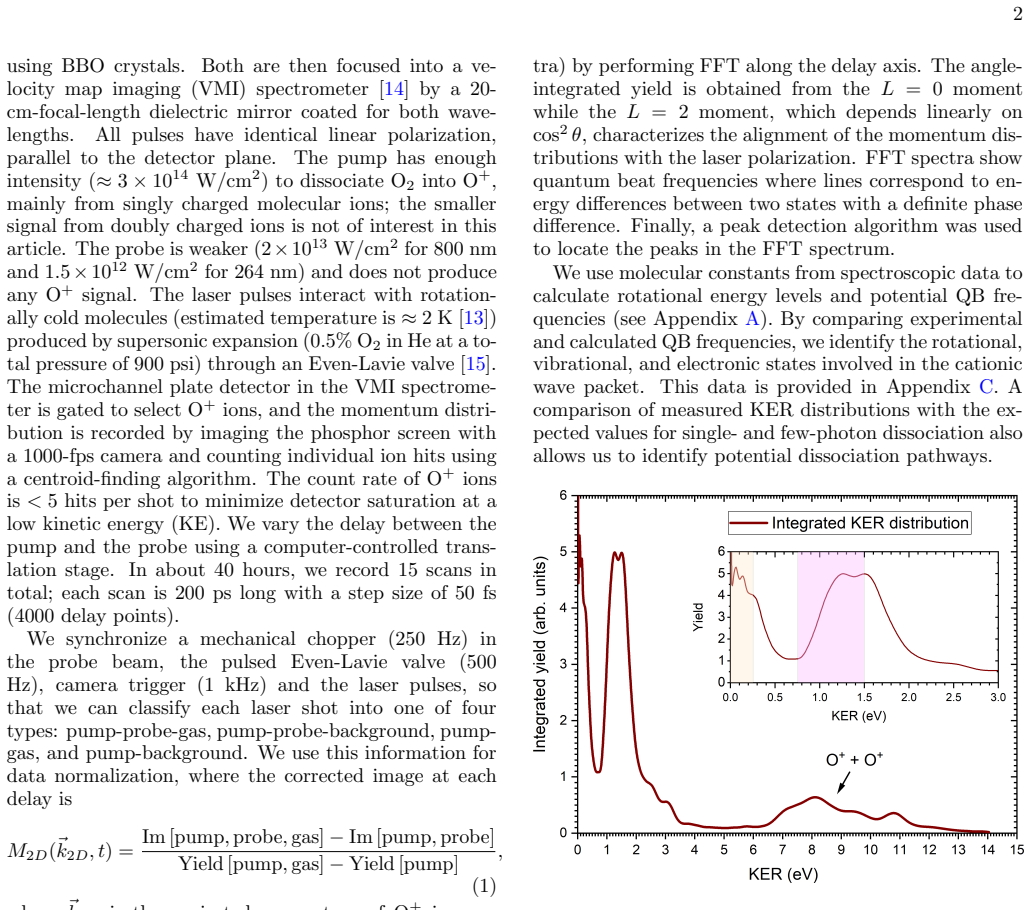
After strong-field ionization of O2, the cation wave packet that remains bound is dominated by $b^4\Sigma_g^-$ with vibrational levels $\nu=3$ and $\nu=4$, whose rotational quantum beats appear with both 800-nm and 264-nm probes. The similar appearance of the $b^4\Sigma_g^-$ beat spectra with the two probe wavelengths confirms that the 800-nm pump resonantly couples $b^4\Sigma_g^-$ and $a^4\Pi_u$, as predicted by the theory cited as [9]. With the 264-nm probe, a $X^2\Pi_g(\nu=3)$ wave packet is also observed, and its dominance is attributed to resonance with the $A^2\Pi_u(\nu=4)$ state at the probe wavelength; the Fourier transform resolves the $F_1(\Omega=1/2)$ and $F_2(\Omega=3/2)$ spin-orbit series and shows they evolve differently in time. The kinetic-energy-release bands are assigned to specific dissociation pathways, including two-photon dissociation of $b^4\Sigma_g^-$ through the $1^4\Delta_g$ state to the second dissociation limit and net-zero-photon dissociation near threshold driven by rotational Raman climbing.
Load-bearing premise
The assignment of the 0.75–1.5 eV band to dissociation through the $1^4\Delta_g$ state presumes that the $B^2\Sigma_g^-$ state is not populated, or decays on a timescale that removes it from the spectrum; the authors state that they cannot conclusively rule out its population.
Editorial extensions
If this is right
- The residual cation wave packet after strong-field ionization of O2 is dominated by $b^4\Sigma_g^-$ ($\nu=3,4$), not by the lower-lying $X^2\Pi_g$ or $a^4\Pi_u$ states, so initial ionization probabilities alone do not predict the observed state distribution.
- The agreement between 800-nm and 264-nm probe results confirms the resonant-coupling model: the 800-nm pump redistributes population from $a^4\Pi_u$ into $b^4\Sigma_g^-$.
- State visibility in pump–probe experiments is probe-dependent: $X^2\Pi_g$ appears only when the probe is resonant, so the absence of a state with one probe does not prove the pump failed to populate it.
- Kinetic-energy release distinguishes dissociation pathways, separating near-threshold net-zero-photon dissociation via rotational Raman climbing from two-photon dissociation through $1^4\Delta_g$ to the second dissociation limit.
- Sub-cm${}^{-1}$ frequency resolution resolves spin-orbit components and tracks their separate time evolutions, including revival structures that differ between the $\Omega=1/2$ and $\Omega=3/2$ series.
Reading between the lines
- If the dominance of $b^4\Sigma_g^-$ is general, strong-field ionization models of O2 must include post-ionization population redistribution on the pump-pulse timescale, not just field-ionization matrix elements.
- The same long-scan Fourier-transform technique could be applied to $N_2^+$, as the paper itself suggests, to determine which nitrogen cation states carry the rotational coherences relevant to air-lasing; that application lies beyond the present data.
- Because the 264-nm probe selectively enhances $X^2\Pi_g(v=3)$, tuning the probe to other $A$–$X$ resonances could map the full vibrational distribution of the ground-state cation and test whether the 800-nm probe underestimates the $X$-state population.
- The persistence of the net-zero-photon $b^4\Sigma_g^-$ channel with the nonresonant UV probe implies direct nonresonant two-photon coupling to the repulsive $f^4\Pi_g$ state; varying the probe wavelength would test how strongly that channel depends on resonance.
Editorial analysis
A structured set of objections, weighed in public.
Referee Report
Summary. The paper reports a pump-probe velocity-map-imaging study of O2 ionized by an intense 800-nm pulse, with a weak 800-nm or 264-nm probe dissociating the remaining bound cations. The O+ momentum distributions are recorded as a function of pump-probe delay over 200 ps scans, and the delay dependence is Fourier-transformed to produce kinetic-energy-release-resolved quantum beat spectra. By comparing measured beat frequencies with frequencies calculated from literature spectroscopic constants, the authors assign the coherences to rotational wave packets in the b4Σg− state (v = 2–4), the X2Πg state (v = 3, seen only with the 264-nm probe), and weak contributions from a4Πu. The central claim is that b4Σg− dominates the observed cationic wave packet with both probes, corroborating the three-state model of Xue et al., and that the 264-nm probe additionally reveals the X2Πg state through a resonant A–X transition.
Significance. The result is significant as a high-resolution rotational-coherence spectroscope for molecular cations: the sub-cm−1 resolution over 200 ps scans yields clean, state-resolved quantum beat spectra, and the comparisons in Tables II–V are based on independently known spectroscopic constants rather than fitted to the present data. This gives the rotational assignments real evidentiary weight. The confirmation of the b4Σg− dominance and the resonant coupling picture of Xue et al. is an important experimental anchor for strong-field ionization models of O2. The observation of spin-orbit-split F1/F2 series in X2Πg(v = 3) and the different revival behavior of the two series is a nice demonstration of the method's sensitivity to fine-structure couplings.
minor comments (6)
- [Sec. III C / Fig. 4(a)] The unassigned peak at 127.3 cm−1 in the ⟨P0⟩ spectrum should be discussed further or explicitly listed as an unassigned line, because the abstract's "unambiguous identification" is not fully supported while this feature remains unexplained.
- [Table II] In the row for N = 7, ΔN = 2, the experimental value 10.33 cm−1 is inconsistent with the calculated 40.33 cm−1 and with the neighboring entries; this appears to be a typographical error and should be corrected.
- [Tables II–V] The measured frequencies are quoted to 0.01 cm−1 without uncertainties; please state the FFT resolution (about 0.17 cm−1) and the peak-position uncertainty so that the agreement between measured and calculated frequencies can be evaluated quantitatively.
- [Sec. III C] The sentence "Thus, we can uniquely identify the intermediate state through which the ion dissociates in this energy range" is directly qualified by the next paragraph, which states that B2Σg− population cannot be conclusively ruled out; please replace "uniquely identify" with a more cautious phrase such as "is consistent with" or provide a quantitative argument that excludes B2Σg−.
- [Abstract] The phrase "unambiguous identification" overstates the results given the unassigned 127.3 cm−1 peak and the B2Σg− caveat; suggest "high-confidence identification" or "assignment" with these caveats noted.
- [Fig. 2 caption] The vertical placement of calculated points in the scatter plots is described as "for visual clarity," but the scaling is not specified; a brief statement of how the calculated frequencies are aligned with the experimental peaks would improve reproducibility.
Circularity Check
No significant circularity: state assignments are benchmarked against literature spectroscopic constants, not fitted to the present data.
full rationale
The paper's central claim is an assignment of measured quantum-beat frequencies to rotational levels of specific O2+ electronic states. The predicted frequencies are computed from independently published spectroscopic constants via the Dunham-type expressions in Appendix A, and the measured FFT peak positions in Tables II–V are compared with those calculated values. No parameter is fitted to the present data, so the central identification is not circular: it is a pattern match against an external benchmark. The resonant-coupling interpretation involving b4Σg− and a4Πu is presented as corroboration of an existing theoretical model by Xue et al. and is not itself used to generate the predicted frequencies. Self-citations [11–13] are limited to experimental methods, data-analysis procedures, and a rotational-temperature estimate; they do not carry the physical conclusion. The acknowledged inability to exclude B2Σg− population in Sec. III C is an explicitly stated limitation of one KER-band assignment, not a circular derivation. Overall, the derivation chain is self-contained against external spectroscopic benchmarks, so no significant circularity is present.
Assumptions & free parameters
assumptions (5)
- domain assumption Molecular constants for b4Sigma_g^- and X2Pi_g from literature (Albritton, Coxon & Haley, etc.) are accurate.
- domain assumption The weak probe pulse does not significantly perturb the bound wave packet before dissociation.
- domain assumption The rotational temperature of the neutral O2 is approximately 2 K.
- domain assumption Dipole selection rules and potential energy curves used to identify dissociation pathways are correct.
- standard math Fourier transform analysis correctly maps delay-dependent yield to frequency spectra.
Cite this review
Pith. "Pith review of Rotational coherences in O$_2^+$ following strong-field ionization." pith.science (2026). https://pith.science/paper/DJTJ2U4R
@misc{pith2026250706680,
  author       = {Pith},
  title        = {Pith review of: Rotational coherences in O$_2^+$ following strong-field ionization},
  year         = {2026},
  howpublished = {\url{https://pith.science/paper/DJTJ2U4R}},
  note         = {Machine review of arXiv:2507.06680}
}
abstract
We investigate the wave packet that remains bound in the ground and excited cationic states of oxygen after strong-field ionization by an intense 800-nm pulse. Much weaker probe pulses (800 or 264 nm) are used to dissociate these still-bound cations. The momentum distribution of O$^+$ is measured as a function of pump-probe delay and Fourier-transformed to obtain kinetic-energy-dependent and rotational-state-resolved quantum beat spectra. The sub-cm$^{-1}$ resolution of the Fourier transform allows unambiguous identification of the electronic, vibrational, and rotational states populated by the pump and then dissociated by the probe. Although strong-field ionization is expected to populate the lower-lying $X^2\Pi_g$ and $a^4\Pi_u$ states more effectively than the $b^4\Sigma^{-}_g$ state, a wave packet in the $X^2\Pi_g$ state is seen only with the 264-nm probe and only weak signatures of the $a^4\Pi_u$ states are found with either probe. The experiment confirms the role of the resonant coupling between the $b^4\Sigma^{-}_g$ and $a^4\Pi_u$ states by the 800 nm pulses [Xue \textit{et al.}, Phys. Rev. A 97, 043409 (2018)] and reveals the importance of rovibrational excitation in determining the momentum distribution of the O$^+$ fragments. The strong $X^2\Pi_g$ state contribution observed with the 264-nm probe also shows the importance of resonant coupling in the probe pulse. The sub-cm$^{-1}$ resolution also resolves spin-orbit splitting in both the $X^2\Pi_g$ and $a^4\Pi_u$ state wave packets.
Figures


Figures from the paper (4 more)


Reference graph
Works this paper leans on
-
[1]
S. De, I. A. Bocharova, M. Magrakvelidze, D. Ray, W. Cao, B. Bergues, U. Thumm, M. F. Kling, I. V. Litvinyuk, and C. L. Cocke, Tracking nuclear wave- packet dynamics in molecular oxygen ions with few-cycle infrared laser pulses, Phys. Rev. A 82, 013408 (2010)
work page 2010
-
[2]
J. Yao, S. Jiang, W. Chu, B. Zeng, C. Wu, R. Lu, Z. Li, H. Xie, G. Li, C. Yu, Z. Wang, H. Jiang, Q. Gong, and Y. Cheng, Population redistribution among multiple elec- tronic states of molecular nitrogen ions in strong laser fields, Phys. Rev. Lett. 116, 143007 (2016)
work page 2016
-
[3]
H. V. S. Lam, V.-H. Hoang, A. S. Venkatachalam, S. Bhattacharyya, K. Chen, S. Jacob, S. Kudagama, T. T. Nguyen, D. Rolles, U. Thumm, A. Rudenko, and V. Kumarappan, Simultaneous imaging of vibrational, rotational, and electronic wave-packet dynamics in a tri- atomic molecule, Phys. Rev. A 111, L061101 (2025)
2025
-
[4]
P. C¨ orlin, A. Fischer, M. Sch¨ onwald, A. Sperl, T. Mizuno, U. Thumm, T. Pfeifer, and R. Moshammer, Probing calculated O + 2 potential-energy curves with an XUV- IR pump-probe experiment, Phys. Rev. A 91, 043415 (2015)
work page 2015
-
[5]
Y. Malakar, F. Wilhelm, D. Trabert, K. R. P., X. Li, W. L. Pearson, W. Cao, B. Kaderiya, I. Ben-Itzhak, and A. Rudenko, State-selective dissociation dynamics of an oxygen molecular ion studied with single-harmonic pump and infrared-probe pulses, Phys. Rev. A98, 013418 (2018)
work page 2018
-
[6]
M. Zohrabi, J. McKenna, B. Gaire, N. G. Johnson, K. D. Carnes, S. De, I. A. Bocharova, M. Magrakvelidze, D. Ray, I. V. Litvinyuk, C. L. Cocke, and I. Ben-Itzhak, Vibrationally resolved structure in O + 2 dissociation in- duced by intense ultrashort laser pulses, Phys. Rev. A 83, 053405 (2011)
work page 2011
-
[7]
M. Magrakvelidze, C. M. Aikens, and U. Thumm, Dis- sociation dynamics of diatomic molecules in intense laser fields: A scheme for the selection of relevant adiabatic potential curves, Phys. Rev. A 86, 023402 (2012)
work page 2012
-
[8]
S. De, M. Magrakvelidze, I. A. Bocharova, D. Ray, W. Cao, I. Znakovskaya, H. Li, Z. Wang, G. Laurent, U. Thumm, M. F. Kling, I. V. Litvinyuk, I. Ben-Itzhak, and C. L. Cocke, Following dynamic nuclear wave packets in N2, O2, and CO with few-cycle infrared pulses, Phys. Rev. A 84, 043410 (2011)
work page 2011
Show all 50 references
-
[9]
S. Xue, H. Du, B. Hu, C. D. Lin, and A.-T. Le, Follow- ing coherent multichannel nuclear wave packets in pump- probe studies of O 2 with ultrashort laser pulses, Phys. Rev. A 97, 043409 (2018)
2018
-
[10]
Forbes, V
R. Forbes, V. Makhija, J. G. Underwood, A. Stolow, I. Wilkinson, P. Hockett, and R. Lausten, Quantum-beat photoelectron-imaging spectroscopy of xe in the vuv, Phys. Rev. A 97, 063417 (2018)
2018
-
[11]
H. V. S. Lam, T. N. Wangjam, and V. Kumarappan, Alignment dependence of photoelectron angular distri- butions in the few-photon ionization of molecules by ul- traviolet pulses, Phys. Rev. A 105, 053109 (2022)
2022
-
[12]
H. V. S. Lam, S. Yarlagadda, A. Venkatachalam, T. N. Wangjam, R. K. Kushawaha, C. Cheng, P. Svihra, A. Nomerotski, T. Weinacht, D. Rolles, and V. Kumarap- pan, Angle-dependent strong-field ionization and frag- mentation of carbon dioxide measured using rotational wave packets,...
2020
-
[13]
T. N. Wangjam, H. V. S. Lam, and V. Kumarappan, Strong-field ionization of the triplet ground state of O 2, Phys. Rev. A 104, 043112 (2021)
2021
-
[14]
A. T. J. B. Eppink and D. H. Parker, Velocity map imag- ing of ions and electrons using electrostatic lenses: Appli- cation in photoelectron and photofragment ion imaging of molecular oxygen, Review of Scientific Instruments68, 3477 (1997)
1997
-
[15]
Hillenkamp, S
H. Hillenkamp, S. Keinan, and U. Even, Condensation limited cooling in supersonic expansions, The Journal of Chemical Physics 118, 8699 (2003)
2003
-
[16]
G. A. Garcia, L. Nahon, and I. Powis, Two-dimensional charged particle image inversion using a polar basis func- tion expansion, Review of Scientific Instruments75, 4989 (2004)
2004
-
[17]
J. Yu, X. Yu, X. Zhao, Z. Yin, X. Li, P. Ma, C. Wang, S. Luo, and D. Ding, Revealing orbital dependent quantum interference of O 2 underlying channel-resolved strong-field spectroscopies, Journal of Physics B: Atomic, Molecular and Optical Physics 53, 085601 (2020)
2020
-
[18]
P. H. Krupenie, The spectrum of molecular oxygen, Jour- nal of Physical and Chemical Reference Data 1, 423 (1972)
1972
-
[19]
Tadjeddine, R
M. Tadjeddine, R. Abouaf, P. C. Cosby, B. A. Huber, and J. T. Moseley, Predissociation photofragment spec- troscopy of O + 2 quartet states, The Journal of Chemical Physics 69, 710 (1978)
1978
-
[20]
J. T. Moseley, P. C. Cosby, J. Ozenne, and J. Durup, Pre- dissociation lifetimes of the rotational and fine structure levels of O + 2 (b4Σ− g , v = 3, 4, 5), The Journal of Chemical Physics 70, 1474 (1979)
1979
-
[21]
A. M. F. Lau and C. K. Rhodes, Field-induced avoided crossing and new transition channels in atomic and molecular gases irradiated by lasers, Phys. Rev. A 16, 2392 (1977)
1977
-
[22]
A. M. F. Lau, Laser-induced molecular predissociation without absorption or emission of laser photons, Phys. Rev. A 18, 172 (1978)
1978
-
[23]
K¨ ubel, M
M. K¨ ubel, M. Spanner, Z. Dube, A. Y. Naumov, S. Chelkowski, A. D. Bandrauk, M. J. J. Vrakking, P. B. Corkum, D. M. Villeneuve, and A. Staudte, Probing multiphoton light-induced molecular potentials, Nature Communications 11, 2596 (2020)
2020
-
[24]
Hishikawa, S
A. Hishikawa, S. Liu, A. Iwasaki, and K. Yamanouchi, Light-induced multiple electronic-state coupling of O + 2 in intense laser fields, The Journal of Chemical Physics 114, 9856 (2001)
2001
-
[25]
C. M. Marian, R. Marian, S. D. Peyerimhoff, B. A. Hess, R. J. Buenker, and G. Seger, Ab initio CI calculation of O+ 2 predissociation phenomena induced by a spin-orbit coupling mechanism, Molecular Physics 46, 779 (1982)
1982
-
[26]
H. Liu, D. Shi, J. Sun, and Z. Zhu, Accurate theoreti- cal spectroscopic investigations of the 20 λ-s and 58 ω states of o + 2 cation including the spin–orbit coupling ef- fect, Molecular Physics 113, 120 (2015)
2015
-
[27]
Evans, S
M. Evans, S. Stimson, C. Y. Ng, C.-W. Hsu, and G. K. Jarvis, Rotationally resolved pulsed field ionization pho- toelectron study of O + 2 (B2Σ− g ,2 Σ− u ; v+ = 0 − 7) at 20.2-21.3 eV, The Journal of Chemical Physics 110, 315 (1999). 13
1999
-
[28]
Richard-Viard, O
M. Richard-Viard, O. Dutuit, M. Lavoll´ ee, T. Gov- ers, P. M. Guyon, and J. Durup, O + 2 ions dissocia- tion studied by threshold photoelectron–photoion coin- cidence method, The Journal of Chemical Physics 82, 4054 (1985)
1985
-
[29]
J. M. Brown and A. Carrington, Rotational Spectroscopy of Diatomic Molecules , Cambridge Molecular Science (Cambridge University Press, 2003)
2003
-
[30]
R. S. Mulliken and A. Christy, Λ-type doubling and elec- tron configurations in diatomic molecules, Phys. Rev.38, 87 (1931)
1931
-
[31]
Coxon and M
J. Coxon and M. Haley, Rotational analysis of the A2Πu → X 2Πg second negative band system of 16O+ 2 , Journal of Molecular Spectroscopy 108, 119 (1984)
1984
-
[32]
However, these couplings are crucial in determining the dynamics of excited and ionic states of molecules with higher spin multiplicity [33]
and the triplet ground state of O 2 [13]. However, these couplings are crucial in determining the dynamics of excited and ionic states of molecules with higher spin multiplicity [33]. V. CONCLUSIONS Our experiment shows clear evidence of the residual ionic wave packet in theb4...
-
[33]
S. B. Zhang, D. Baykusheva, P. M. Kraus, H. J. W¨ orner, and N. Rohringer, Theoretical study of molecular elec- tronic and rotational coherences by high-order-harmonic generation, Phys. Rev. A 91, 023421 (2015)
2015
-
[34]
S. B. Yaghlane, A. B. Houria, and M. Hochlaf, On the role of electronic molecular states of high spin multi- plicity, in Topics in the Theory Of Chemical and Phys- ical Systems, edited by S. Lahmar, J. Maruani, S. Wil- son, and G. Delgado-Barrio (Springer Netherlands, Dor- dre...
2007
-
[35]
J. Ma, W. Zhang, K. Lin, Q. Ji, H. Li, F. Sun, J. Qiang, F. Chen, J. Tong, P. Lu, H. Li, X. Gong, and J. Wu, Strong-field dissociative rydberg excitation of oxygen molecules: Electron-nuclear correlation, Phys. Rev. A 100, 063413 (2019)
2019
-
[36]
Fukahori, T
S. Fukahori, T. Matsubara, Y. Nabekawa, K. Ya- manouchi, and K. Midorikawa, Ultrafast electron–nuclear wavepacket in O+ 2 generated and probed with attosecond pulse trains, Journal of Physics B: Atomic, Molecular and Optical Physics 53, 164001 (2020)
2020
-
[37]
S. Xue, S. Sun, P. Ding, B. Hu, S. Yue, and H. Du, Reconstruction of the vibronic-state density matrix based on pump-probe state-resolved energy spectra, Phys. Rev. A 105, 043108 (2022)
2022
-
[38]
Rebholz, T
M. Rebholz, T. Ding, L. Aufleger, M. Hartmann, K. Meyer, V. Stooß, A. Magunia, D. Wachs, P. Birk, Y. Mi, G. D. Borisova, C. da Costa Castanheira, P. Rupprecht, M. Magrakvelidze, U. Thumm, S. Roling, M. Butz, H. Zacharias, S. D¨ usterer, R. Treusch, G. Bren- ner, C. Ott, and T....
2021
-
[39]
Fukahori, A
S. Fukahori, A. Kubo, and H. Hasegawa, Dissociative ionization and post-ionization alignment of aligned O 2 in an intense femtosecond laser field, Physical Chemistry Chemical Physics 26, 26277 (2024)
2024
-
[40]
Q. Luo, W. Liu, and S. L. Chin, Lasing action in air induced by ultra-fast laser filamentation, Applied Physics B 76, 337 (2003)
2003
-
[41]
air-laser
H. Zhang, C. Jing, J. Yao, G. Li, B. Zeng, W. Chu, J. Ni, H. Xie, H. Xu, S. L. Chin, K. Yamanouchi, Y. Cheng, and Z. Xu, Rotational coherence encoded in an “air-laser” spectrum of nitrogen molecular ions in an intense laser field, Phys. Rev. X 3, 041009 (2013)
2013
-
[42]
Y. Liu, P. Ding, G. Lambert, A. Houard, V. Tikhonchuk, and A. Mysyrowicz, Recollision-induced superradiance of ionized nitrogen molecules, Phys. Rev. Lett. 115, 133203 (2015)
2015
-
[43]
T. Ando, E. L¨ otstedt, A. Iwasaki, H. Li, Y. Fu, S. Wang, H. Xu, and K. Yamanouchi, Rotational, vibrational, and electronic modulations in n + 2 lasing at 391 nm: Evidence of coherent B2Σ + u − X 2Σ + g − A2Πu coupling, Phys. Rev. Lett. 123, 203201 (2019)
2019
-
[44]
Richter, M
M. Richter, M. Lytova, F. Morales, S. Haessler, O. Smirnova, M. Spanner, and M. Ivanov, Rotational quantum beat lasing without inversion, Optica 7, 586 (2020)
2020
-
[45]
Kleine, M.-O
C. Kleine, M.-O. Winghart, Z.-Y. Zhang, M. Richter, M. Ekimova, S. Eckert, M. J. J. Vrakking, E. T. J. Nib- bering, A. Rouz´ ee, and E. R. Grant, Electronic state population dynamics upon ultrafast strong field ioniza- tion and fragmentation of molecular nitrogen, Phys. Rev. L...
2022
-
[46]
Albritton, A
D. Albritton, A. Schmeltekopf, W. Harrop, R. Zare, and J. Czarny, An analysis of the O+ 2 b4Σ− g -a4Πu First Nega- tive band system, Journal of Molecular Spectroscopy 67, 157 (1977)
1977
-
[47]
Cosby, J.-B
P. Cosby, J.-B. Ozenne, J. Moseley, and D. Albritton, High-resolution photofragment spectroscopy of the O + 2 b4Σ− g (v′ = 3 , 4, 5) ← a4Πu (v′ = 3 , 4, 5) First neg- ative system using coaxial dye-laser and velocity-tuned ion beams, Journal of Molecular Spectroscopy 79, 203 (1980)
1980
-
[48]
J. C. Hansen, M. M. Graff, J. T. Moseley, and P. C. Cosby, Predissociation spectroscopy of O + 2 : a 4Πu (v” = 6 − 11) → b4Σ− g (v′ = 5 − 9), The Journal of Chemical Physics 74, 2195 (1981)
1981
-
[49]
Hansen, J
J. Hansen, J. Moseley, and P. Cosby, High-resolution photofragment spectroscopy of the O + 2 b4Σ− g (v′ = 5 −
-
[50]
← a4Πu (v′ = 6 − 9) first negative system, Journal of Molecular Spectroscopy 98, 48 (1983)
1983
Reviewed August 6, 2026 · model on record in the stance chip above.
Discussion (0). Continue with ORCID to comment.