REVIEW 4 major objections 5 minor 1 cited by
HVI-CIDNet+: Beyond Extreme Darkness for Low-Light Image Enhancement
T0 review · 4 major / 5 minor · reviewed 2026-08-06 · deepseek-v4-flash
Pith's one-line read The HVI color space removes the red and black noise artifacts that HSV introduces, and the HVI-CIDNet+ network built on it outperforms prior low-light enhancement methods on ten benchmark datasets.
desk verdict Plausible color-space idea with a decent LOL ablation, but Eq. (4) contradicts its own collapse mechanism and the SOTA claims overreach the evidence. read the letter →
The pith
A machine-rendered reading of the paper's core claim, the machinery that carries it, and where it could break.
The reading
What carries the argument
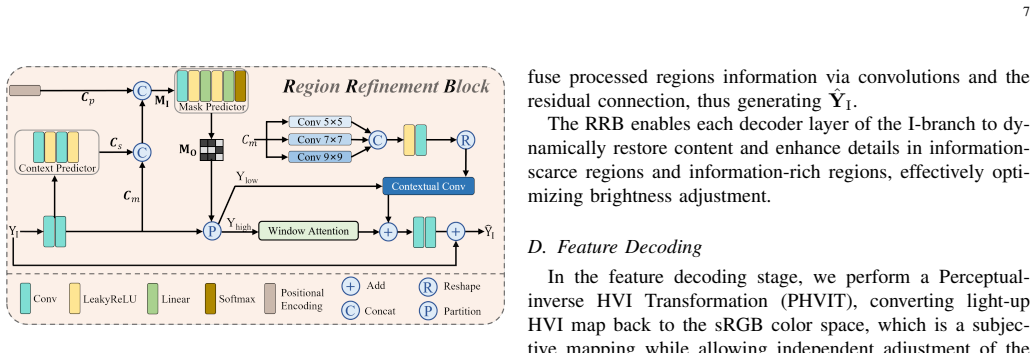
The load-bearing object is the HVI color space transform plus its inverse. Forward: $\hat H = C_k \odot S \odot \cos(\pi H/3)$, $\hat V = C_k \odot S \odot \sin(\pi H/3)$, with intensity $I_{\max}=\max_c I_c$ and $C_k(x)=k/\sqrt{\sin(\pi I_{\max}(x)/2)+\varepsilon}$. The cosine/sine polarization removes the hue-axis wrap that puts the same red at $h=0$ and $h=6$; the trainable scalar $k$ controls how strongly low-intensity chroma is collapsed toward zero, absorbing black noise. The inverse PHVIT recovers HSV by $\hat h = \hat H/(C_k+\varepsilon)$, $\hat v = \hat V/(C_k+\varepsilon)$, then converts back to sRGB, with user parameters $\alpha_S,\alpha_I$ for saturation and brightness. In the network, the Prior-guided Attention Block (PAB) uses cross-attention so the I-branch receives latent semantic priors $\mathbf{e}_s$ and the HV-branch receives degraded representations $\mathbf{e}_d$, and the Region Refinement Block (RRB) splits feature maps into information-scarce and information-rich regions, applying window attention to the former and multi-scale contextual convolution to the latter.
What would settle it
Take a method that currently benefits from the HVI plug-in and run it on a test set of very dark images whose maximum intensity is below 0.05 in most pixels and whose ground truth has saturated red objects. If $C_k$ has been trained on a dataset with milder darkness, the inverse PHVIT will divide predicted chroma by a value close to $\varepsilon$ in those regions; observing large false red or black blobs in the output, or a PSNR drop below the original sRGB method, would falsify the claim that HVI removes red and black artifacts in extreme darkness.
Extended reading notes
Core claim
On the paper's own terms, the central discovery is that the two characteristic artifacts of HSV-based low-light enhancement—red discontinuity noise, where the same red hue sits at both ends of the hue axis, and black-plane noise, where near-black pixels spread into a noisy plane—can be removed by a coordinate change. The HVI transform maps hue $h$ to $\hat{h}=\cos(\pi h/3)$ and $\hat{v}=\sin(\pi h/3)$, multiplies both by saturation $S$ and by a learnable intensity collapse $C_k(x)=k/\sqrt{\sin(\pi I_{\max}(x)/2)+\varepsilon}$, and keeps $I_{\max}$ as the intensity channel. The result is a color space in which similar colors have small Euclidean distances: red is continuous across the polar angle, and dark pixels are clustered at the origin. The companion network, HVI-CIDNet+, then learns enhancement in this space with an HV-branch for color and an I-branch for brightness, fused through cross-attention guided by semantic and degradation priors and refined per region. The paper claims this combination, measured by PSNR, SSIM, and LPIPS, beats state-of-the-art methods on ten datasets, and that the HVI transform itself transfers as a plug-in to other sRGB-based LLIE models.
Load-bearing premise
The load-bearing premise is that one learned number $k$ per dataset can collapse all near-black chroma toward zero without erasing the color information the network needs, and that dividing predicted chroma by $C_k+\varepsilon$ during the inverse transform remains numerically safe in exactly the darkest regions.
Editorial extensions
If this is right
- HVI-CIDNet+ achieves the best PSNR/SSIM/LPIPS on LOLv1 and LOLv2 among compared methods, so the combination of the color space and the architecture is claimed to be the current state of the art on those paired benchmarks.
- On the extreme-darkness SICE and Sony-Total-Dark sets, the reported gains over LLFlow are 1.713 dB and 7.256 dB PSNR, respectively.
- The HVI transform is claimed to be portable: wrapping sRGB-based methods in HVI (forward transform and PHVIT) improves their PSNR, e.g., GSAD gains 3.562 dB on LOLv2-Real, without retraining those methods' color assumptions.
- The ablation results identify the separate contributions: polarization alone or $C_k$ alone each improve HSV, and combining them yields the full HVI gain; adding degraded representations, semantic priors, and the region refinement block each raises the baseline.
- Supervising in both sRGB and HVI spaces yields better results than either loss alone, indicating that the HVI domain carries distributional information the sRGB loss misses.
Reading between the lines
- A single trainable scalar $k$ per dataset is a strong simplification; one testable extension is to make $k$ spatially adaptive (e.g., predicted per region or conditioned on the estimated noise level), which could extend HVI to scenes with mixed extreme-dark and well-lit regions.
- The inverse PHVIT divides by $C_k+\varepsilon$, so numerical stability near $I_{\max}\approx 0$ is the hidden failure mode; an explicit stability check or a regularized inverse would reveal whether the reported gains persist at even lower sensor exposures than the benchmarks.
- Because the HVI space is defined independently of the network, it may transfer to other low-level tasks that suffer from red/black artifacts, such as dehazing, white-balancing, or underexposed video enhancement; this is an inference, not a claim the paper makes.
- The plug-in results suggest that part of the improvement comes from the color space itself rather than the architecture; an editorial reading is that HVI could be combined with lightweight or zero-reference methods to make color-space gains available in low-compute settings, which the paper does not test.
Editorial analysis
A structured set of objections, weighed in public.
Referee Report
Summary. The paper proposes a new color space, Horizontal/Vertical-Intensity (HVI), derived from HSV by polarizing the Hue–Saturation plane and applying a learnable intensity collapse function C_k, together with a dual-branch enhancement network HVI-CIDNet+ that incorporates pre-trained vision-language priors. The authors claim that HVI removes red and black noise artifacts of HSV and that HVI-CIDNet+ outperforms state-of-the-art methods on 10 datasets, with ablations on LOLv1 and plug-in experiments on other LLIE models.
Significance. If the HVI color space and the reported results are correct, the paper would offer a practically useful color-space transformation for LLIE that can be grafted onto existing sRGB-based methods, which is a distinctive and potentially valuable contribution. Additional strengths are the availability of code, the breadth of evaluation across 10 datasets, and the explicit ablation isolating the color-space components from the network components. However, the central formula defining C_k appears to be internally inconsistent with the claimed collapse behavior, and several benchmark comparisons may be unfair because baseline training protocols are not stated; these issues must be resolved before the contribution can be assessed.
major comments (4)
- [§III-B, Eq. (4) and §IV-D] The intensity collapse function is printed as C_k(x) = k / (sin(π I_max(x)/2) + ε). This function is strictly decreasing in I_max on [0,1]: for a dark pixel with I_max ≈ 0, C_k ≈ k/ε ≈ 10^8, the largest possible value, while for a bright pixel with I_max = 1, C_k ≈ k. The text states that 'smaller C_k correspond[s] to smaller radius or lower intensity values' and that 'black points are clustered as C_k decreases', which is the opposite of what Eq. (4) computes. Consequently, the forward HVI transform in Eq. (5) expands the chroma radius of dark pixels rather than collapsing it, and the inverse PHVIT in Eq. (10) divides network outputs by C_k+ε, creating large numerical amplification in the darkest regions. If the intended formula is monotone increasing (e.g., C_k = k sin(π I_max/2)), then Eq. (4) is a typesetting error and the color-space ablations in Table V and the plug-in results in Table III must be re-run with the actually implemented transform; if the code implements Eq. (4) as printed, the HVI color space does not provide the advertised black-noise compression and the central claim of the paper is unsupported.
- [§V-B, Table IV] The SICE and Sony-Total-Dark results are used to support the claim that HVI-CIDNet+ outperforms prior methods under extreme darkness, but the manuscript does not specify whether the baseline methods (RetinexNet, ZeroDCE, URetinexNet, RUAS, LLFlow, CIDNet) were retrained on the SICE and Sony-Total-Dark training splits or evaluated with their original pretrained weights. Since HVI-CIDNet+ is trained on those datasets (as described in the Experiment Settings), comparing it against baselines that are not retrained would conflate the effect of training data with the effect of the proposed method. The PSNR gain of 7.256 dB over LLFlow on Sony-Total-Dark and the 1.713 dB gain on SICE are only meaningful under identical training protocols; please state the training setup for every baseline and, if they were not retrained, either retrain them or clearly qualify the comparison as a generalization test rather than a SOTA comparison.
- [§V-B, Table III] The text claims that applying the HVI transform as a plug-in to six SOTA methods gives 'consistent improvements in the PSNR, SSIM, and LPIPS metrics', but Table III shows several regressions: SNR-Aware loses 0.009 in SSIM and worsens by 0.011 in LPIPS, and LEDNet worsens by 0.005 in LPIPS. Other methods, such as FourLLIE, also show mixed changes. This contradicts the stated consistency and weakens the generalizability claim. Please correct the assertion, or provide an explanation (e.g., significance testing or per-image analysis) for why the plug-in degrades some metrics on some methods.
- [§III-B, Eq. (4) and §IV-B] The parameter k is described as a trainable 'darkness density' that adaptively controls the intensity collapse, and the paper motivates the entire HVI color space on this mechanism. However, the manuscript does not report the learned value(s) of k, how it varies across datasets, or its sensitivity to initialization. Since every downstream result depends on the behavior of C_k, the paper should include an analysis of the optimized k values and a stability study (e.g., perturbing k and measuring PSNR/SSIM on the validation set). Without this, the claim that k is 'learnable' and that the collapse is 'adaptive' is not empirically supported.
minor comments (5)
- [§III-B, Eq. (4)] The text says ε = 1×10⁻⁸ is used to 'avoid gradient explosion', but in Eq. (4) the role of ε is to prevent division by zero when I_max = 0; in Eq. (10) it also prevents division by zero in PHVIT. Please rephrase to accurately describe the purpose of ε.
- [§V-B, LOL results paragraph] The sentence 'it effectively balances enhancement across both information-rich regions and information-rich regions' appears to contain a typo; the second occurrence should likely be 'information-scarce regions'.
- [References, [12]] Reference [12] is cited as an arXiv preprint (arXiv:2502.20272) while the text states the work was published at CVPR 2025; please update the reference with the CVPR details if applicable.
- [Table I and Table III] GSAD is labeled with color model 'RGB' in Table I and as 'Diffusion' in Table III; the category labels should be harmonized to avoid confusion about the type of baseline.
- [Abstract and Introduction, code link] The provided code URL 'https://github.com/shikangbiao/CIDNet extension' contains a space and does not appear to be a valid repository address; please verify and provide the correct link.
Circularity Check
No circular derivation found; HVI transform and network are empirically evaluated on held-out benchmarks, with only disclosed, non-load-bearing self-citations.
full rationale
The paper's central claims are empirical: HVI-CIDNet+ is trained on standard training splits and evaluated on test splits of ten datasets; the trainable density parameter k in Eq. (4) is a fitted parameter of the proposed transform, not a quantity whose value is later reported as a prediction. The HVI transformation is fully specified by Eqs. (1)-(5) and the inverse PHVIT by Eq. (10), so the color-space properties (red continuity via cos/sin polarization, dark-region collapse via C_k) are design choices, not results derived from the fitted k. The plug-in experiments in Table III retrain each baseline with the HVI transform and compare held-out test metrics, so no improvement reduces to a fitted value by construction. The self-citations ([12] CIDNet, [84] DiffLight) are disclosed prior works used as baselines or architectural starting points; the equations and ablations in this manuscript are self-contained, and no load-bearing argument rests on an unverified self-citation or uniqueness theorem. The apparent sign/behavior inconsistency in Eq. (4) (C_k as printed grows for dark pixels, opposite to the stated collapse) is a correctness/consistency issue, not a circularity: no claimed output is equivalent to a fitted input by construction. Under the hard rules requiring a specific reduction to flag circularity, no circular step is present.
Assumptions & free parameters
free parameters (3)
- k (darkness density) =
trained per dataset, value not reported
- lambda (loss weight) =
not reported
- alpha_S, alpha_I =
not reported
assumptions (4)
- domain assumption Max-RGB intensity estimation (Eq. 1)
- domain assumption Noise primarily shifts hue and saturation with minimal effect on intensity (Sec. III-A)
- domain assumption DA-CLIP image and distortion encoders provide useful latent semantic and degraded representations for LLIE
- standard math C_k remains positive so the HVI transform is invertible
Cite this review
Pith. "Pith review of HVI-CIDNet+: Beyond Extreme Darkness for Low-Light Image Enhancement." pith.science (2026). https://pith.science/paper/FOECTRDI
@misc{pith2026250706814,
  author       = {Pith},
  title        = {Pith review of: HVI-CIDNet+: Beyond Extreme Darkness for Low-Light Image Enhancement},
  year         = {2026},
  howpublished = {\url{https://pith.science/paper/FOECTRDI}},
  note         = {Machine review of arXiv:2507.06814}
}
read the original abstract
Low-Light Image Enhancement (LLIE) aims to restore vivid content and details from corrupted low-light images. However, existing standard RGB (sRGB) color space-based LLIE methods often produce color bias and brightness artifacts due to the inherent high color sensitivity. While Hue, Saturation, and Value (HSV) color space can decouple brightness and color, it introduces significant red and black noise artifacts. To address this problem, we propose a new color space for LLIE, namely Horizontal/Vertical-Intensity (HVI), defined by the HV color map and learnable intensity. The HV color map enforces small distances for the red coordinates to remove red noise artifacts, while the learnable intensity compresses the low-light regions to remove black noise artifacts. Additionally, we introduce the Color and Intensity Decoupling Network+ (HVI-CIDNet+), built upon the HVI color space, to restore damaged content and mitigate color distortion in extremely dark regions. Specifically, HVI-CIDNet+ leverages abundant contextual and degraded knowledge extracted from low-light images using pre-trained vision-language models, integrated via a novel Prior-guided Attention Block (PAB). Within the PAB, latent semantic priors can promote content restoration, while degraded representations guide precise color correction, both particularly in extremely dark regions through the meticulously designed cross-attention fusion mechanism. Furthermore, we construct a Region Refinement Block that employs convolution for information-rich regions and self-attention for information-scarce regions, ensuring accurate brightness adjustments. Comprehensive results from benchmark experiments demonstrate that the proposed HVI-CIDNet+ outperforms the state-of-the-art methods on 10 datasets.
Figures


Figures from the paper (5 more)


Forward citations
Cited by 1 Pith paper
-
Learning Dexterous Grasping from Sparse Taxonomy Guidance
GRIT learns dexterous grasping from sparse taxonomy guidance, achieving 87.9% success and better generalization to novel objects via a two-stage prediction-plus-policy approach.
Reference graph
Works this paper leans on
-
[1]
Low-light image and video enhancement using deep learning: A sur- vey,
C. Li, C. Guo, L. Han, J. Jiang, M.-M. Cheng, J. Gu, and C. C. Loy, “Low-light image and video enhancement using deep learning: A sur- vey,” IEEE Transactions on Pattern Analysis and Machine Intelligence , vol. 44, no. 12, pp. 9396–9416, 2022
2022
-
[2]
Snr-aware low-light image enhancement,
X. Xu, R. Wang, C.-W. Fu, and J. Jia, “Snr-aware low-light image enhancement,” in 2022 IEEE/CVF Conference on Computer Vision and Pattern Recognition (CVPR), 2022, pp. 17 693–17 703
2022
-
[3]
Low-light image enhancement via structure modeling and guidance,
X. Xu, R. Wang, and J. Lu, “Low-light image enhancement via structure modeling and guidance,” in Proceedings of the IEEE/CVF Conference on Computer Vision and Pattern Recognition , 2023, pp. 9893–9903
2023
-
[4]
Kindling the darkness: A practical low-light image enhancer,
Y . Zhang, J. Zhang, and X. Guo, “Kindling the darkness: A practical low-light image enhancer,” in Proceedings of the 27th ACM International Conference on Multimedia , ser. MM ’19. New York, NY , USA: ACM, 2019, pp. 1632–1640. [Online]. Available: http://doi.acm.org/10.1145/3343031.3350926
arXiv 2019
-
[5]
Enlightengan: Deep light enhancement without paired supervision,
Y . Jiang, X. Gong, D. Liu, Y . Cheng, C. Fang, X. Shen, J. Yang, P. Zhou, and Z. Wang, “Enlightengan: Deep light enhancement without paired supervision,” IEEE Transactions on Image Processing , vol. 30, pp. 2340–2349, 2021
work page 2021
-
[6]
Zero-reference deep curve estimation for low-light image enhance- ment,
C. G. Guo, C. Li, J. Guo, C. C. Loy, J. Hou, S. Kwong, and R. Cong, “Zero-reference deep curve estimation for low-light image enhance- ment,” in Proceedings of the IEEE conference on computer vision and pattern recognition (CVPR) , June 2020, pp. 1780–1789
work page 2020
-
[7]
Glare: Low light image enhancement via generative latent feature based codebook retrieval,
H. Zhou, W. Dong, X. Liu, S. Liu, X. Min, G. Zhai, and J. Chen, “Glare: Low light image enhancement via generative latent feature based codebook retrieval,” in Proceedings of the European Conference on Computer Vision (ECCV) , 2024
work page 2024
-
[8]
Mpc-net: Multi- prior collaborative network for low-light image enhancement,
C. She, F. Han, L. Wang, S. Duan, and T. Huang, “Mpc-net: Multi- prior collaborative network for low-light image enhancement,” IEEE Transactions on Circuits and Systems for Video Technology , pp. 1–1, 2024. 13
work page 2024
Show all 83 references
-
[9]
Beyond brightening low-light images,
Y . Zhang, X. Guo, J. Ma, W. Liu, and J. Zhang, “Beyond brightening low-light images,” International Journal of Computer Vision , vol. 129, pp. 1013–1037, 2021
2021
-
[10]
Learning to enhance low-light image via zero-reference deep curve estimation,
C. Li, C. Guo, and C. C. Loy, “Learning to enhance low-light image via zero-reference deep curve estimation,” IEEE transactions on pattern analysis and machine intelligence , vol. 44, no. 8, pp. 4225–4238, 2021
2021
-
[11]
Inter- pretable optimization-inspired unfolding network for low-light image enhancement,
W. Wu, J. Weng, P. Zhang, X. Wang, W. Yang, and J. Jiang, “Inter- pretable optimization-inspired unfolding network for low-light image enhancement,” IEEE Transactions on Pattern Analysis and Machine Intelligence, 2025
2025
-
[12]
Hvi: A new color space for low-light image enhancement,
Q. Yan, Y . Feng, C. Zhang, G. Pang, K. Shi, P. Wu, W. Dong, J. Sun, and Y . Zhang, “Hvi: A new color space for low-light image enhancement,” arXiv preprint arXiv:2502.20272 , 2025
2025 arXiv
-
[13]
Gevers, A
T. Gevers, A. Gijsenij, J. Van de Weijer, and J.-M. Geusebroek, Color in computer vision: fundamentals and applications . John Wiley & Sons, 2012
2012
-
[14]
Rethinking RGB color representation for image restoration models,
J. Lee, J. Park, S. Baik, and K. M. Lee, “Rethinking RGB color representation for image restoration models,” 2024. [Online]. Available: https://openreview.net/forum?id=zhZXk5Ctz2
2024
-
[15]
Retinex- former: One-stage retinex-based transformer for low-light image en- hancement,
Y . Cai, H. Bian, J. Lin, H. Wang, R. Timofte, and Y . Zhang, “Retinex- former: One-stage retinex-based transformer for low-light image en- hancement,” in Proceedings of ICCV, October 2023, pp. 12 504–12 513
2023
-
[16]
Low illumination video image enhancement,
Z. Li, Z. Jia, J. Yang, and N. Kasabov, “Low illumination video image enhancement,” IEEE photonics journal , vol. 12, no. 4, pp. 1–13, 2020
2020
-
[17]
A low-light image enhancement method based on hsv space,
L. Zhou, X. Chen, B. Ye, X. Jiang, S. Zou, L. Ji, Z. Yu, J. Wei, Y . Zhao, and T. Wang, “A low-light image enhancement method based on hsv space,” The Imaging Science Journal , pp. 1–14, 2023
2023
-
[18]
Better than reference in low-light image enhancement: Conditional re-enhancement network,
Y . Zhang, X. Di, B. Zhang, R. Ji, and C. Wang, “Better than reference in low-light image enhancement: Conditional re-enhancement network,” IEEE Transactions on Image Processing , vol. 31, pp. 759–772, 2021
2021
-
[19]
Zero-reference low-light enhance- ment via physical quadruple priors,
W. Wang, H. Yang, J. Fu, and J. Liu, “Zero-reference low-light enhance- ment via physical quadruple priors,” in Proceedings of the IEEE/CVF Conference on Computer Vision and Pattern Recognition , 2024, pp. 26 057–26 066
2024
-
[20]
Region- based unsupervised low-light image enhancement in the wild with explicit domain supervision,
Y . Ma, S. Xie, W. Xu, X. Chen, X. Huang, Y . Sun, and W. Liu, “Region- based unsupervised low-light image enhancement in the wild with explicit domain supervision,” IEEE Transactions on Instrumentation and Measurement, 2024
2024
-
[21]
Learning semantic-aware knowledge guidance for low-light image en- hancement,
Y . Wu, C. Pan, G. Wang, Y . Yang, J. Wei, C. Li, and H. T. Shen, “Learning semantic-aware knowledge guidance for low-light image en- hancement,” in Proceedings of the IEEE/CVF Conference on Computer Vision and Pattern Recognition , 2023, pp. 1662–1671
2023
-
[23]
J. D. Foley and A. Van Dam, Fundamentals of interactive computer graphics. Addison-Wesley Longman Publishing Co., Inc., 1982
1982
-
[24]
Low-light image enhancement via breaking down the darkness,
X. Guo and Q. Hu, “Low-light image enhancement via breaking down the darkness,” International Journal of Computer Vision , vol. 131, no. 1, pp. 48–66, Jan 2023. [Online]. Available: https: //doi.org/10.1007/s11263-022-01667-9
2023 doi
-
[25]
Lyt-net: Lightweight yuv transformer-based network for low-light image enhancement,
A. Brateanu, R. Balmez, A. Avram, and C. Orhei, “Lyt-net: Lightweight yuv transformer-based network for low-light image enhancement,” 2024
2024
-
[26]
Deep retinex decomposition for low-light enhancement,
C. Wei, W. Wang, W. Yang, and J. Liu, “Deep retinex decomposition for low-light enhancement,” arXiv preprint arXiv:1808.04560 , 2018
2018 arXiv
-
[27]
Uretinex- net: Retinex-based deep unfolding network for low-light image enhance- ment,
W. Wu, J. Weng, P. Zhang, X. Wang, W. Yang, and J. Jiang, “Uretinex- net: Retinex-based deep unfolding network for low-light image enhance- ment,” in Proceedings of the IEEE/CVF Conference on Computer Vision and Pattern Recognition (CVPR) , June 2022, pp. 5901–5910
2022
-
[28]
Unsu- pervised low-light image enhancement with self-paced learning,
Y . Luo, X. Chen, J. Ling, C. Huang, W. Zhou, and G. Yue, “Unsu- pervised low-light image enhancement with self-paced learning,” IEEE Transactions on Multimedia , 2024
2024
-
[29]
Naturalness preserved enhancement algorithm for non-uniform illumination images,
S. Wang, J. Zheng, H.-M. Hu, and B. Li, “Naturalness preserved enhancement algorithm for non-uniform illumination images,” IEEE transactions on image processing , vol. 22, no. 9, pp. 3538–3548, 2013
2013
-
[30]
A prob- abilistic method for image enhancement with simultaneous illumination and reflectance estimation,
X. Fu, Y . Liao, D. Zeng, Y . Huang, X.-P. Zhang, and X. Ding, “A prob- abilistic method for image enhancement with simultaneous illumination and reflectance estimation,” IEEE Transactions on Image Processing , vol. 24, no. 12, pp. 4965–4977, 2015
2015
-
[31]
Llnet: A deep autoencoder approach to natural low-light image enhancement,
K. G. Lore, A. Akintayo, and S. Sarkar, “Llnet: A deep autoencoder approach to natural low-light image enhancement,” 2016
2016
-
[32]
Low-light image enhancement with multi-scale attention and frequency-domain optimization,
Z. He, W. Ran, S. Liu, K. Li, J. Lu, C. Xie, Y . Liu, and H. Lu, “Low-light image enhancement with multi-scale attention and frequency-domain optimization,” IEEE Transactions on Circuits and Systems for Video Technology, vol. 34, no. 4, pp. 2861–2875, 2024
2024
-
[33]
Multiscale low-light image enhancement network with illumination constraint,
G.-D. Fan, B. Fan, M. Gan, G.-Y . Chen, and C. L. P. Chen, “Multiscale low-light image enhancement network with illumination constraint,” IEEE Transactions on Circuits and Systems for Video Technology , vol. 32, no. 11, pp. 7403–7417, 2022
2022
-
[34]
Low-light image enhancement with normalizing flow,
Y . Wang, R. Wan, W. Yang, H. Li, L.-P. Chau, and A. C. Kot, “Low-light image enhancement with normalizing flow,” arXiv preprint arXiv:2109.05923, 2021
2021 arXiv
-
[35]
Flow learning based dual networks for low-light image enhancement,
S. Wang, C. Hu, W. Yi, Z. Cai, M. Zhai, and W. Yang, “Flow learning based dual networks for low-light image enhancement,” Neural Processing Letters, vol. 55, no. 6, pp. 8115–8130, 2023
2023
-
[36]
Residual-unet generative flow model for low- light image enhancement,
S. Wang and C. Hu, “Residual-unet generative flow model for low- light image enhancement,” in 2023 China Automation Congress (CAC) . IEEE, 2023, pp. 2046–2051
2023
-
[37]
Fourllie: Boosting low-light image enhancement by fourier frequency information,
C. Wang, H. Wu, and Z. Jin, “Fourllie: Boosting low-light image enhancement by fourier frequency information,” in Proceedings of the 31st ACM International Conference on Multimedia , 2023, pp. 7459– 7469
2023
-
[38]
Iterative prompt learning for unsupervised backlit image enhancement,
Z. Liang, C. Li, S. Zhou, R. Feng, and C. C. Loy, “Iterative prompt learning for unsupervised backlit image enhancement,” in Proceedings of the IEEE/CVF International Conference on Computer Vision , 2023, pp. 8094–8103
2023
-
[39]
Learning transferable visual models from natural language supervision,
A. Radford, J. W. Kim, C. Hallacy, A. Ramesh, G. Goh, S. Agarwal, G. Sastry, A. Askell, P. Mishkin, J. Clark et al., “Learning transferable visual models from natural language supervision,” in International conference on machine learning . PmLR, 2021, pp. 8748–8763
2021
-
[40]
Deep high-resolution representation learning for visual recognition,
J. Wang, K. Sun, T. Cheng, B. Jiang, C. Deng, Y . Zhao, D. Liu, Y . Mu, M. Tan, X. Wang et al. , “Deep high-resolution representation learning for visual recognition,” IEEE transactions on pattern analysis and machine intelligence , vol. 43, no. 10, pp. 3349–3364, 2020
2020
-
[41]
Denoising diffusion probabilistic models,
J. Ho, A. Jain, and P. Abbeel, “Denoising diffusion probabilistic models,” in Advances in Neural Information Processing Systems , H. Larochelle, M. Ranzato, R. Hadsell, M. Balcan, and H. Lin, Eds., vol. 33. Curran Associates, Inc., 2020, pp. 6840–6851
2020
-
[42]
Lightendiffusion: Unsupervised low-light image enhancement with latent-retinex diffusion models,
H. Jiang, A. Luo, X. Liu, S. Han, and S. Liu, “Lightendiffusion: Unsupervised low-light image enhancement with latent-retinex diffusion models,” in European Conference on Computer Vision. Springer, 2024, pp. 161–179
2024
-
[43]
Diff-retinex: Rethinking low-light image enhancement with a generative diffusion model,
X. Yi, H. Xu, H. Zhang, L. Tang, and J. Ma, “Diff-retinex: Rethinking low-light image enhancement with a generative diffusion model,” in Proceedings of the IEEE/CVF International Conference on Computer Vision, 2023, pp. 12 302–12 311
2023
-
[44]
Pyramid diffusion models for low-light image enhancement,
D. Zhou, Z. Yang, and Y . Yang, “Pyramid diffusion models for low-light image enhancement,” arXiv preprint arXiv:2305.10028 , 2023
2023 arXiv
-
[45]
Anligh- tendiff: Anchoring diffusion probabilistic model on low light image enhancement,
C.-Y . Chan, W.-C. Siu, Y .-H. Chan, and H. Anthony Chan, “Anligh- tendiff: Anchoring diffusion probabilistic model on low light image enhancement,” IEEE Transactions on Image Processing , vol. 33, pp. 6324–6339, 2024
2024
-
[46]
Multi-domain multi-scale diffusion model for low-light image enhancement,
K. Shang, M. Shao, C. Wang, Y . Cheng, and S. Wang, “Multi-domain multi-scale diffusion model for low-light image enhancement,” in Pro- ceedings of the AAAI Conference on Artificial Intelligence, vol. 38, no. 5, 2024, pp. 4722–4730
2024
-
[47]
Low-light image enhancement with wavelet-based diffusion models,
H. Jiang, A. Luo, H. Fan, S. Han, and S. Liu, “Low-light image enhancement with wavelet-based diffusion models,” ACM Transactions on Graphics (TOG) , vol. 42, no. 6, pp. 1–14, 2023
2023
-
[48]
Scaling up visual and vision-language representation learning with noisy text supervision,
C. Jia, Y . Yang, Y . Xia, Y .-T. Chen, Z. Parekh, H. Pham, Q. Le, Y .-H. Sung, Z. Li, and T. Duerig, “Scaling up visual and vision-language representation learning with noisy text supervision,” in International conference on machine learning . PMLR, 2021, pp. 4904–4916
2021
-
[49]
Blip: Bootstrapping language-image pre-training for unified vision-language understanding and generation,
J. Li, D. Li, C. Xiong, and S. Hoi, “Blip: Bootstrapping language-image pre-training for unified vision-language understanding and generation,” in International conference on machine learning . PMLR, 2022, pp. 12 888–12 900
2022
-
[50]
Lora-ir: Taming low-rank experts for efficient all-in-one image restoration,
Y . Ai, H. Huang, and R. He, “Lora-ir: Taming low-rank experts for efficient all-in-one image restoration,” arXiv preprint arXiv:2410.15385, 2024
2024 arXiv
-
[51]
A hard-to- beat baseline for training-free clip-based adaptation,
Z. Wang, J. Liang, L. Sheng, R. He, Z. Wang, and T. Tan, “A hard-to- beat baseline for training-free clip-based adaptation,” in ICLR, 2024
2024
-
[52]
Zegclip: Towards adapting clip for zero-shot semantic segmentation,
Z. Zhou, Y . Lei, B. Zhang, L. Liu, and Y . Liu, “Zegclip: Towards adapting clip for zero-shot semantic segmentation,” in Proceedings of the IEEE/CVF conference on computer vision and pattern recognition , 2023, pp. 11 175–11 185
2023
-
[53]
Improving zero-shot generalization for clip with synthesized prompts,
Z. Wang, J. Liang, R. He, N. Xu, Z. Wang, and T. Tan, “Improving zero-shot generalization for clip with synthesized prompts,” in ICCV, 2023, pp. 3032–3042
2023
-
[54]
Controlling vision-language models for universal image restoration,
Z. Luo, F. K. Gustafsson, Z. Zhao, J. Sj ¨olund, and T. B. Sch ¨on, “Controlling vision-language models for universal image restoration,” arXiv preprint arXiv:2310.01018 , 2023. 14
2023 arXiv
-
[55]
Learning a simple low-light image enhancer from paired low-light instances,
Z. Fu, Y . Yang, X. Tu, Y . Huang, X. Ding, and K.-K. Ma, “Learning a simple low-light image enhancer from paired low-light instances,” in Proceedings of the IEEE/CVF Conference on Computer Vision and Pattern Recognition, 2023, pp. 22 252–22 261
2023
-
[56]
The retinex theory of color vision,
E. H. Land, “The retinex theory of color vision,” Scientific american , vol. 237, no. 6, pp. 108–129, 1977
1977
-
[57]
Using color to separate reflection components,
S. A. Shafer, “Using color to separate reflection components,” Color Research & Application , vol. 10, no. 4, pp. 210–218, 1985
1985
-
[58]
Swin transformer: Hierarchical vision transformer using shifted windows,
Z. Liu, Y . Lin, Y . Cao, H. Hu, Y . Wei, Z. Zhang, S. Lin, and B. Guo, “Swin transformer: Hierarchical vision transformer using shifted windows,” in Proceedings of the IEEE/CVF international conference on computer vision, 2021, pp. 10 012–10 022
2021
-
[59]
Camixersr: Only details need more
Y . Wang, Y . Liu, S. Zhao, J. Li, and L. Zhang, “Camixersr: Only details need more” attention”,” in Proceedings of the IEEE/CVF Conference on Computer Vision and Pattern Recognition , 2024, pp. 25 837–25 846
2024
-
[60]
Lyt- net: Lightweight yuv transformer-based network for low-light image enhancement,
A. Brateanu, R. Balmez, A. Avram, C. Orhei, and C. Ancuti, “Lyt- net: Lightweight yuv transformer-based network for low-light image enhancement,” IEEE Signal Processing Letters , 2025
2025
-
[61]
Ultra-high- definition low-light image enhancement: A benchmark and transformer- based method,
T. Wang, K. Zhang, T. Shen, W. Luo, B. Stenger, and T. Lu, “Ultra-high- definition low-light image enhancement: A benchmark and transformer- based method,” in Proceedings of the AAAI Conference on Artificial Intelligence, vol. 37, no. 3, 2023, pp. 2654–2662
2023
-
[63]
Fast context-based low-light image enhancement via neural implicit repre- sentations,
T. Chobola, Y . Liu, H. Zhang, J. A. Schnabel, and T. Peng, “Fast context-based low-light image enhancement via neural implicit repre- sentations,” in Proceedings of the European Conference on Computer Vision (ECCV), 2024
2024
-
[64]
Zero-ig: Zero-shot illumination-guided joint denoising and adaptive enhancement for low- light images,
Y . Shi, D. Liu, L. Zhang, Y . Tian, X. Xia, and X. Fu, “Zero-ig: Zero-shot illumination-guided joint denoising and adaptive enhancement for low- light images,” in Proceedings of the IEEE/CVF Conference on Computer Vision and Pattern Recognition , 2024, pp. 3015–3024
2024
-
[65]
Lightendiffusion: Unsupervised low-light image enhancement with latent-retinex diffusion models,
H. Jiang, A. Luo, X. Liu, S. Han, and S. Liu, “Lightendiffusion: Unsupervised low-light image enhancement with latent-retinex diffusion models,” in European Conference on Computer Vision , 2024
2024
-
[66]
Sparse gradient reg- ularized deep retinex network for robust low-light image enhancement,
W. Yang, W. Wang, H. Huang, S. Wang, and J. Liu, “Sparse gradient reg- ularized deep retinex network for robust low-light image enhancement,” IEEE Transactions on Image Processing, vol. 30, pp. 2072–2086, 2021
2021
-
[67]
Contrast enhancement based on layered difference representation of 2d histograms,
C. Lee, C. Lee, and C.-S. Kim, “Contrast enhancement based on layered difference representation of 2d histograms,”IEEE Transactions on Image Processing, vol. 22, no. 12, pp. 5372–5384, 2013
2013
-
[68]
Lime: Low-light image enhancement via illumination map estimation,
X. Guo, Y . Li, and H. Ling, “Lime: Low-light image enhancement via illumination map estimation,” IEEE Transactions on Image Processing , vol. 26, no. 2, pp. 982–993, 2017
2017
-
[69]
Perceptual quality assessment for multi-exposure image fusion,
K. Ma, K. Zeng, and Z. Wang, “Perceptual quality assessment for multi-exposure image fusion,” IEEE Transactions on Image Processing, vol. 24, no. 11, pp. 3345–3356, 2015
2015
-
[70]
Naturalness preserved enhancement algorithm for non-uniform illumination images,
S. Wang, J. Zheng, H.-M. Hu, and B. Li, “Naturalness preserved enhancement algorithm for non-uniform illumination images,” IEEE transactions on image processing : a publication of the IEEE Signal Processing Society, vol. 22, 05 2013
2013
-
[71]
On the evaluation of illumination compensation algorithms,
V . V onikakis, R. Kouskouridas, and A. Gasteratos, “On the evaluation of illumination compensation algorithms,” Multimedia Tools and Appli- cations, vol. 77, pp. 1–21, 04 2018
2018
-
[72]
Learning a deep single image contrast enhancer from multi-exposure images,
J. Cai, S. Gu, and L. Zhang, “Learning a deep single image contrast enhancer from multi-exposure images,” IEEE Transactions on Image Processing, vol. 27, no. 4, pp. 2049–2062, 2018
2018
-
[73]
Low-light image and video enhancement: A comprehensive survey and beyond,
S. Zheng, Y . Ma, J. Pan, C. Lu, and G. Gupta, “Low-light image and video enhancement: A comprehensive survey and beyond,” arXiv preprint arXiv:2212.10772, 2022
2022 arXiv
-
[74]
Learning to see in the dark,
C. Chen, Q. Chen, J. Xu, and V . Koltun, “Learning to see in the dark,” in CVPR, 2018
2018
-
[75]
Adam: A method for stochastic optimization,
D. P. Kingma and J. Ba, “Adam: A method for stochastic optimization,” 2017
2017
-
[76]
Sgdr: Stochastic gradient descent with warm restarts,
I. Loshchilov and F. Hutter, “Sgdr: Stochastic gradient descent with warm restarts,” 2017
2017
-
[77]
Image quality assess- ment: from error visibility to structural similarity,
Z. Wang, A. Bovik, H. Sheikh, and E. Simoncelli, “Image quality assess- ment: from error visibility to structural similarity,” IEEE Transactions on Image Processing , vol. 13, no. 4, pp. 600–612, 2004
2004
-
[78]
The unreasonable effectiveness of deep features as a perceptual metric,
R. Zhang, P. Isola, A. A. Efros, E. Shechtman, and O. Wang, “The unreasonable effectiveness of deep features as a perceptual metric,” in CVPR, 2018
2018
-
[79]
Imagenet classification with deep convolutional neural networks,
A. Krizhevsky, I. Sutskever, and G. Hinton, “Imagenet classification with deep convolutional neural networks,” Advances in neural information processing systems, vol. 25, no. 2, 2012
2012
-
[80]
No-reference image quality assessment in the spatial domain,
A. Mittal, A. K. Moorthy, and A. C. Bovik, “No-reference image quality assessment in the spatial domain,” IEEE Transactions on Image Processing, vol. 21, no. 12, pp. 4695–4708, 2012
2012
-
[81]
Making a “completely blind
A. Mittal, R. Soundararajan, and A. C. Bovik, “Making a “completely blind” image quality analyzer,” IEEE Signal Processing Letters, vol. 20, no. 3, pp. 209–212, 2013
2013
-
[82]
Lednet: Joint low-light enhancement and deblurring in the dark,
S. Zhou, C. Li, and C. C. Loy, “Lednet: Joint low-light enhancement and deblurring in the dark,” in ECCV, 2022
2022
-
[83]
Global structure- aware diffusion process for low-light image enhancement,
J. Hou, Z. Zhu, J. Hou, H. Liu, H. Zeng, and H. Yuan, “Global structure- aware diffusion process for low-light image enhancement,” Advances in Neural Information Processing Systems , vol. 36, 2024
2024
-
[84]
Difflight: Integrating content and detail for low-light image enhancement,
Y . Feng, S. Hou, H. Lin, Y . Zhu, P. Wu, W. Dong, J. Sun, Q. Yan, and Y . Zhang, “Difflight: Integrating content and detail for low-light image enhancement,” in Proceedings of the IEEE/CVF Conference on Computer Vision and Pattern Recognition , 2024, pp. 6143–6152
2024
-
[85]
Retinex- inspired unrolling with cooperative prior architecture search for low- light image enhancement,
L. Risheng, M. Long, Z. Jiaao, F. Xin, and L. Zhongxuan, “Retinex- inspired unrolling with cooperative prior architecture search for low- light image enhancement,” in Proceedings of the IEEE Conference on Computer Vision and Pattern Recognition , 2021
2021
Reviewed August 6, 2026 · model on record in the stance chip above.
Discussion (0). Sign in to comment.