REVIEW 4 major objections 5 minor 36 references
Know Your Attention Maps: Class-specific Token Masking for Weakly Supervised Semantic Segmentation
T0 review · 4 major / 5 minor · reviewed 2026-08-06 · deepseek-v4-flash
Pith's one-line read The paper claims that a Vision Transformer with one [CLS] token per class, trained with random token masking and attention-head pruning, can turn image-level labels into segmentation pseudo-masks that rival fully supervised models.
desk verdict A real single-stage WSSS idea with strong scores on VOC and DFC2020, but the masking mechanism's role in class-specific attention is unproven and the fully-supervised parity claim overreaches. read the letter →
The pith
A machine-rendered reading of the paper's core claim, the machinery that carries it, and where it could break.
The reading
What carries the argument
The load-bearing mechanism is the class-specific [CLS] token combined with random output-embedding masking. In a Vision Transformer, each [CLS] token's self-attention over image patches defines a spatial distribution; with C tokens, attention head h for token c gives a class-specific map, and random masking of absent-class tokens during training removes the gradient signal that would let a token hedge across multiple classes. The auxiliary machinery is a register token, which absorbs generic background context that would otherwise pollute the class tokens, and attention-head pruning via Hard Concrete gates, which drives roughly two-thirds of heads to zero so the surviving heads produce cleaner, less fragmented maps. At inference, the maps are thresholded and fused in order of decreasing logit, with unassigned pixels filled from neighboring values.
What would settle it
Take the trained model, run inference without any masking, and for every [CLS] token record which ground-truth class's pixels its binarized attention map overlaps most. If the same token index does not predominantly correspond to the same class across images, the claimed hard token-class assignment is not actually learned, and the pseudo-masks could be right for the wrong reason.
Extended reading notes
Core claim
The central claim is that the self-attention maps of a Vision Transformer can be made class-specific by construction, rather than being post-hoc explanations. The authors extend the standard single [CLS] token to C class tokens, add a register token to absorb global context, and during training randomly set to zero the final embeddings of half of the absent-class tokens. This forces each token to specialize on its own class while preventing interference from classes not present in the image. Simultaneously, a Hard Concrete relaxation of $L_0$ regularization prunes roughly two-thirds of attention heads to remove noisy heads and sharpen the remaining maps. At inference, the binarized self-attention maps of the [CLS] tokens for predicted labels are aggregated, and the paper reports pseudo-mask mIoUs of 73.7% on VOC validation and 43.2% on COCO validation, with the resulting UNet reaching 73.5% mIoU on VOC test. On the DFC2020 remote sensing dataset, the weak supervision pipeline even outperforms fully supervised baselines. The paper's message is that attention maps themselves, if trained correctly, are not just interpretable artifacts but usable segmentation signal.
Load-bearing premise
The method assumes that randomly zeroing out half of the class tokens for classes not present in the image during training is enough to make each token lock onto a single class, and that this lock survives at inference when no tokens are masked.
Editorial extensions
If this is right
- Single-stage weakly supervised segmentation can match or beat multi-stage CAM-based pipelines on standard benchmarks, removing the need for CRF post-processing or iterative refinement.
- A segmentation model trained on these pseudo-masks comes close to fully supervised accuracy on several datasets, so annotation effort can shift from pixel-level to image-level labels.
- The method transfers to remote sensing, endoscopy, and general scene parsing, suggesting the mechanism is not tied to one domain.
- Attention-head pruning is not just a computational saving but part of what makes the pseudo-masks accurate, since without it the masks are noisier and mIoU drops.
- The parameter count grows with the number of classes because each class gets a token, so the approach has a scalability cost on label sets with hundreds or thousands of classes.
Reading between the lines
- A testable extension is a curriculum over masking ratios: start with heavy masking and anneal it down; the sensitivity curve in the paper already shows a peak near 50%, which suggests the amount of masking matters as much as its presence.
- If the token-class assignment is truly hard and stable, the same [CLS] tokens could be reused as pseudo-labels for other tasks such as open-vocabulary segmentation, detection, or self-training, since the paper only evaluates them through a UNet.
- The random masking may be doing its work by breaking correlations between co-occurring classes; if so, class-balanced sampling or negative-class weighting could achieve the same effect with less compute, an alternative the paper does not test.
- The large gap on ADE20K (38.2% mIoU versus 55.0% for supervised UNet) suggests dense scenes with many labels are the stress test; combining these attention pseudo-masks with pixel-affinity refinement, which the paper explicitly avoids, is an obvious next step.
Editorial analysis
A structured set of objections, weighed in public.
Referee Report
Summary. The paper proposes an end-to-end weakly supervised semantic segmentation (WSSS) method that uses a Vision Transformer with multiple [CLS] tokens, one per class. A random masking strategy zeroes the final output embeddings of a subset of absent-class [CLS] tokens during training, a register token is appended, and attention heads are pruned during training via a hard-concrete relaxation. At inference, the self-attention maps of the [CLS] tokens corresponding to predicted classes are thresholded and combined to form pseudo-masks, which are then used to train a UNet. Experiments on VOC, MS COCO, DFC2020, EndoTect, and ADE20K report strong pseudo-mask mIoU (73.7% on VOC val) and competitive or state-of-the-art results among the compared WSSS baselines.
Significance. If the central mechanism were validated, the paper would make a useful contribution: it would show that a single-stage ViT without CAMs or iterative refinement can generate high-quality pseudo-masks directly from attention maps, with interpretable class-token assignments. The paper covers multiple domain-specific datasets, provides ablations for each component, includes a sensitivity analysis of the masking ratio, and makes code available. However, the claimed causal mechanism for random masking is not directly supported by the evidence, and the fully-supervised parity claim holds for only one of the three specialized datasets. The reported improvements are also not accompanied by variance or significance measures, which matters for the small margins over prior work.
major comments (4)
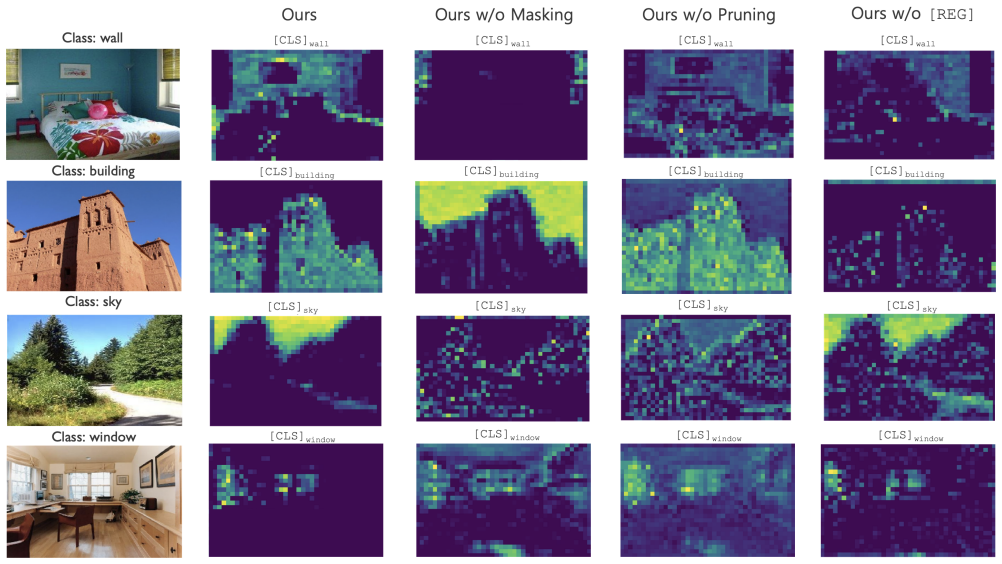
- [Section 3.3] The masking is applied as z[CLS]_i^L = z[CLS]_i^L · (1 − m(i)), i.e., to the final output embedding after all self-attention layers. During training, a masked absent-class token still participates in every attention computation, and at inference no token is masked at all. Therefore, the mechanism as described cannot directly enforce the claimed hard assignment between a [CLS] token and its class in the attention maps that are later thresholded into pseudo-masks. It also introduces a train/inference discrepancy: zeroed absent tokens are a reliable absent cue during training, but no such cue is present at inference. Table 4 reports only final pseudo-mask mIoU and does not measure per-token attention alignment with ground-truth classes, so the ablation does not establish the proposed causal mechanism. Please provide quantitative attention-class alignment evidence (for example, per-class IoU of the [CLS] attention maps before binarization) or an experiment that isolates the effect of masking on the attention maps themselves.
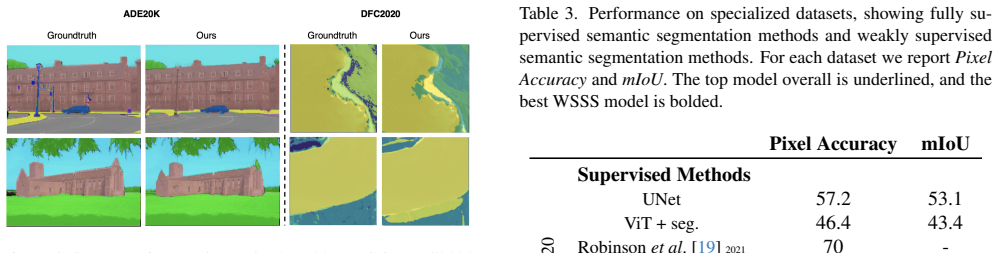
- [Abstract and Section 5.4, Table 3] The claim that the method 'achieves results comparable to fully-supervised models' is contradicted by two of the three specialized datasets in Table 3. On ADE20K the method reaches 38.2 mIoU versus 55.0 for the supervised UNet, and on EndoTect it reaches 69.8 versus 73.0. Only on DFC2020 does it surpass the supervised UNet (67.2 vs 53.1). The claim should be restricted to the datasets where it actually holds, and the gap on ADE20K and EndoTect should be analyzed rather than presented as general parity.
- [Tables 1–3 and Section 5.6] All reported results are single runs without error bars or significance tests. The headline VOC validation comparison is 73.7% vs 73.5% for DuPL, a margin of 0.2 percentage points that could easily arise from training stochasticity. In addition, the 50% masking ratio is selected from the sensitivity analysis in Section 5.6 on the same datasets where the final numbers are reported. Please provide multiple seeds with mean and standard deviation, and ideally perform hyperparameter selection on a validation split that is distinct from the split used for the reported final results.
- [Section 5.5, Table 4] The caption of Table 4 states that random masking gives 'considerable improvement on all datasets,' but the table only lists MS COCO and VOC; the ADE20K evidence is qualitative (Figure 5). Quantitative ablations on the specialized datasets are needed to support the generalization claim, especially because the masking mechanism is the paper's main novelty and the mechanism's effect on attention maps is not measured.
minor comments (5)
- [Section 3.1] The symbol z0 is used both for the sequence of image patch embeddings and for the full sequence after prepending the [CLS] token; please use distinct notation to avoid confusion.
- [References] References [35] and [36] are the same paper (Zhou et al., 'Learning Deep Features for Discriminative Localization'); please merge them or cite a single version.
- [Section 5.2, Table 1] The table reports a 'train' column for pseudo-mask evaluation on the VOC train set; please clarify what train-time evaluation means in this context, since pseudo-masks are generated without training on segmentation labels.
- [Section 5.6, Figure 6] The sensitivity analysis is described as covering masking ratios 0%, 20%, 50%, 80%, and 100%, but the text does not explain how the curves in Figure 6 map to datasets and metrics; please make the figure self-explanatory.
- [Throughout] The dataset name is written inconsistently as 'Endotect' and 'EndoTect'; please standardize it.
Circularity Check
No significant circularity: pseudo-masks are generated from inference-time attention maps and evaluated against external pixel-level benchmarks, while the training-time masking is a regularizer that does not by construction equal the reported predictions.
full rationale
An analysis of the derivation chain finds no circular step. Training uses only image-level labels; pixel-level annotations are used exclusively for evaluation (Section 4: "we use classification labels during training and pixel-level annotations to evaluate the weak segmentation accuracy"). Pseudo-masks are produced at inference by reshaping and thresholding the self-attention maps of [CLS] tokens for predicted classes (Section 3.5), not by the training-time masking function m(i) applied to final embeddings (Section 3.3). The masked quantity is z[CLS]_i^L scaled by (1-m(i)), whereas the pseudo-mask is derived from attention maps aggregated over the final layers; these are different objects, so the prediction does not reduce to the fit by construction. Hyperparameters (masking ratio 50%, lambda=0.01, pruning fraction) are chosen via sensitivity analyses and ablations on validation/domain datasets, which is standard practice and not circular. The self-citation to the authors' prior Sparse ViT [9] appears as motivation for head pruning alongside external references [18, 29] and is validated by the "w/o AH Pruning" ablation in Table 6; it is not load-bearing for the central masking claim. The claimed mechanism (masking enforces token-class assignment) may be under-analyzed, and the train/inference discrepancy is a legitimate correctness concern, but those are mechanism-validity issues, not circularity. External comparisons on Pascal VOC, MS COCO, DFC2020, EndoTect, and ADE20K with held-out pixel labels provide independent support.
Assumptions & free parameters
free parameters (4)
- mask ratio =
50%
- head pruning regularization lambda =
0.01
- threshold for binarizing attention maps =
not specified
- neighbor filling rule =
not specified
assumptions (4)
- domain assumption Each class is representable by a single trainable CLS token whose self-attention becomes class-specific after training.
- ad hoc to paper Randomly masking absent-class CLS tokens enforces hard class-token assignment and transfers to unmasked inference.
- standard math Hard Concrete relaxation is a valid differentiable approximation of L0 that produces useful head pruning.
- ad hoc to paper Binarized, thresholded attention maps combined in logit order yield coherent segmentation masks.
Cite this review
Pith. "Pith review of Know Your Attention Maps: Class-specific Token Masking for Weakly Supervised Semantic Segmentation." pith.science (2026). https://pith.science/paper/D2NGSP6I
@misc{pith2026250706848,
  author       = {Pith},
  title        = {Pith review of: Know Your Attention Maps: Class-specific Token Masking for Weakly Supervised Semantic Segmentation},
  year         = {2026},
  howpublished = {\url{https://pith.science/paper/D2NGSP6I}},
  note         = {Machine review of arXiv:2507.06848}
}
read the original abstract
Weakly Supervised Semantic Segmentation (WSSS) is a challenging problem that has been extensively studied in recent years. Traditional approaches often rely on external modules like Class Activation Maps to highlight regions of interest and generate pseudo segmentation masks. In this work, we propose an end-to-end method that directly utilizes the attention maps learned by a Vision Transformer (ViT) for WSSS. We propose training a sparse ViT with multiple [CLS] tokens (one for each class), using a random masking strategy to promote [CLS] token - class assignment. At inference time, we aggregate the different self-attention maps of each [CLS] token corresponding to the predicted labels to generate pseudo segmentation masks. Our proposed approach enhances the interpretability of self-attention maps and ensures accurate class assignments. Extensive experiments on two standard benchmarks and three specialized datasets demonstrate that our method generates accurate pseudo-masks, outperforming related works. Those pseudo-masks can be used to train a segmentation model which achieves results comparable to fully-supervised models, significantly reducing the need for fine-grained labeled data.
Figures


Figures from the paper (3 more)

Reference graph
Works this paper leans on
-
[1]
Jiwoon Ahn and Suha Kwak. Learning pixel-level seman- tic affinity with image-level supervision for weakly super- 8 vised semantic segmentation. 2018 IEEE/CVF Conference on Computer Vision and Pattern Recognition , pages 4981– 4990, 2018. 2
work page 2018
-
[2]
Emerg- ing properties in self-supervised vision transformers
Mathilde Caron, Hugo Touvron, Ishan Misra, Herv’e J’egou, Julien Mairal, Piotr Bojanowski, and Armand Joulin. Emerg- ing properties in self-supervised vision transformers. 2021 IEEE/CVF International Conference on Computer Vision (ICCV), pages 9630–9640, 2021. 3
work page 2021
-
[3]
Segment anything model (sam) enhanced pseudo labels for weakly supervised semantic segmentation
Tianle Chen, Zheda Mai, Ruiwen Li, and Wei-Lun Chao. Segment anything model (sam) enhanced pseudo labels for weakly supervised semantic segmentation. ArXiv, abs/2305.05803, 2023. 2
arXiv 2023
-
[4]
Semi-supervised semantic segmentation with cross pseudo supervision
Xiaokang Chen, Yuhui Yuan, Gang Zeng, and Jingdong Wang. Semi-supervised semantic segmentation with cross pseudo supervision. 2021 IEEE/CVF Conference on Com- puter Vision and Pattern Recognition (CVPR), pages 2613– 2622, 2021. 2
work page 2021
-
[5]
Class re-activation maps for weakly-supervised semantic segmentation
Zhaozheng Chen, Tan Wang, Xiongwei Wu, Xiansheng Hua, Hanwang Zhang, and Qianru Sun. Class re-activation maps for weakly-supervised semantic segmentation. 2022 IEEE/CVF Conference on Computer Vision and Pattern Recognition (CVPR), pages 959–968, 2022. 2, 5, 6
work page 2022
-
[6]
Vision transformers need registers
Timoth’ee Darcet, Maxime Oquab, Julien Mairal, and Pi- otr Bojanowski. Vision transformers need registers. ArXiv, abs/2309.16588, 2023. 3
arXiv 2023
-
[7]
An image is worth 16x16 words: Transformers for image recognition at scale
Alexey Dosovitskiy, Lucas Beyer, Alexander Kolesnikov, Dirk Weissenborn, Xiaohua Zhai, Thomas Unterthiner, Mostafa Dehghani, Matthias Minderer, Georg Heigold, Syl- vain Gelly, Jakob Uszkoreit, and Neil Houlsby. An image is worth 16x16 words: Transformers for image recognition at scale. ArXiv, abs/2010.11929, 2020. 1, 5
arXiv 2010
-
[8]
Mark Everingham, Luc Van Gool, Christopher K. I. Williams, John M. Winn, and Andrew Zisserman. The pascal visual object classes (voc) challenge. International Journal of Computer Vision, 88:303–338, 2010. 4
work page 2010
Show all 36 references
-
[9]
Sparse multimodal vision transformer for weakly supervised seman- tic segmentation
Joelle Hanna, Michael Mommert, and Damian Borth. Sparse multimodal vision transformer for weakly supervised seman- tic segmentation. 2023 IEEE/CVF Conference on Computer Vision and Pattern Recognition Workshops (CVPRW), pages 2145–2154, 2023. 2, 3, 6
2023
-
[10]
Bourdev, Subhransu Maji, and Jitendra Malik
Bharath Hariharan, Pablo Arbel ´aez, Lubomir D. Bourdev, Subhransu Maji, and Jitendra Malik. Semantic contours from inverse detectors. 2011 International Conference on Com- puter Vision, pages 991–998, 2011. 4
2011
-
[11]
Halvorsen, Hugo Lewi Hammer, and M
Steven Hicks, Debesh Jha, Vajira Lasantha Thambawita, P. Halvorsen, Hugo Lewi Hammer, and M. Riegler. The endo- tect 2020 challenge: Evaluation and comparison of classifi- cation, segmentation and inference time for endoscopy. In ICPR Workshops, 2020. 4
2020
-
[12]
Simple does it: Weakly supervised instance and semantic segmentation
Anna Khoreva, Rodrigo Benenson, Jan Hendrik Hosang, Matthias Hein, and Bernt Schiele. Simple does it: Weakly supervised instance and semantic segmentation. 2017 IEEE Conference on Computer Vision and Pattern Recognition (CVPR), pages 1665–1674, 2017. 2
2017
-
[13]
Berg, Wan-Yen Lo, Piotr Doll ´ar, and Ross B
Alexander Kirillov, Eric Mintun, Nikhila Ravi, Hanzi Mao, Chloe Rolland, Laura Gustafson, Tete Xiao, Spencer White- head, Alexander C. Berg, Wan-Yen Lo, Piotr Doll ´ar, and Ross B. Girshick. Segment anything. 2023 IEEE/CVF In- ternational Conference on Computer Vision (ICCV) ,...
2023
-
[14]
From sam to cams: Exploring segment anything model for weakly supervised semantic segmentation
Hyeokjun Kweon and Kuk-Jin Yoon. From sam to cams: Exploring segment anything model for weakly supervised semantic segmentation. In Proceedings of the IEEE/CVF Conference on Computer Vision and Pattern Recognition (CVPR), pages 19499–19509, 2024. 2
2024
-
[15]
Scribblesup: Scribble-supervised convolutional networks for semantic segmentation
Di Lin, Jifeng Dai, Jiaya Jia, Kaiming He, and Jian Sun. Scribblesup: Scribble-supervised convolutional networks for semantic segmentation. 2016 IEEE Conference on Computer Vision and Pattern Recognition (CVPR) , pages 3159–3167,
2016
-
[16]
Belongie, James Hays, Pietro Perona, Deva Ramanan, Piotr Doll ´ar, and C
Tsung-Yi Lin, Michael Maire, Serge J. Belongie, James Hays, Pietro Perona, Deva Ramanan, Piotr Doll ´ar, and C. Lawrence Zitnick. Microsoft coco: Common objects in context. In European Conference on Computer Vision, 2014. 4
2014
-
[17]
Christos Louizos, Max Welling, and Diederik P. Kingma. Learning sparse neural networks through l0 regularization. ArXiv, abs/1712.01312, 2017. 4
2017 arXiv
-
[18]
Maddison, Andriy Mnih, and Yee Whye Teh
Chris J. Maddison, Andriy Mnih, and Yee Whye Teh. The concrete distribution: A continuous relaxation of discrete random variables. ArXiv, abs/1611.00712, 2016. 4
2016 arXiv
-
[19]
Global land- cover mapping with weak supervision: Outcome of the 2020 ieee grss data fusion contest
Caleb Robinson, Kolya Malkin, Nebojsa Jojic, Huijun Chen, Rongjun Qin, Changlin Xiao, Michael Schmitt, Pedram Ghamisi, Ronny H ¨ansch, and Naoto Yokoya. Global land- cover mapping with weak supervision: Outcome of the 2020 ieee grss data fusion contest. IEEE Journal of Selecte...
2020
-
[20]
U-net: Convolutional networks for biomedical image segmentation
Olaf Ronneberger, Philipp Fischer, and Thomas Brox. U-net: Convolutional networks for biomedical image segmentation. ArXiv, abs/1505.04597, 2015. 5
2015 arXiv
-
[21]
Simone Rossetti, Damiano Zappia, Marta Sanzari, Marco Schaerf, and F. Pirri. Max pooling with vision transform- ers reconciles class and shape in weakly supervised semantic segmentation. ArXiv, abs/2210.17400, 2022. 5
2022
-
[22]
Learn- ing affinity from attention: End-to-end weakly-supervised semantic segmentation with transformers
Lixiang Ru, Yibing Zhan, Baosheng Yu, and Bo Du. Learn- ing affinity from attention: End-to-end weakly-supervised semantic segmentation with transformers. 2022 IEEE/CVF Conference on Computer Vision and Pattern Recognition (CVPR), pages 16825–16834, 2022. 5, 6
2022
-
[23]
To- ken contrast for weakly-supervised semantic segmentation
Lixiang Ru, Heliang Zheng, Yibing Zhan, and Bo Du. To- ken contrast for weakly-supervised semantic segmentation. 2023 IEEE/CVF Conference on Computer Vision and Pat- tern Recognition (CVPR), pages 3093–3102, 2023. 5, 6
2023
-
[24]
2020 ieee grss data fusion con- test, 2019
Michael Schmitt, Lloyd Hughes, Pedram Ghamisi, Naoto Yokoya, and Ronny H¨ansch. 2020 ieee grss data fusion con- test, 2019. 4
2020
-
[25]
Box-driven class-wise region masking and filling rate guided loss for weakly supervised semantic segmentation
Chunfeng Song, Yan Huang, Wanli Ouyang, and Liang Wang. Box-driven class-wise region masking and filling rate guided loss for weakly supervised semantic segmentation. 2019 IEEE/CVF Conference on Computer Vision and Pat- tern Recognition (CVPR), pages 3131–3140, 2019. 2
2019
-
[26]
Johansen, Dag Johansen, M
Nikhil Kumar Tomar, Debesh Jha, Sharib Ali, Haavard D. Johansen, Dag Johansen, M. Riegler, and Paal Halvorsen. 9 Ddanet: Dual decoder attention network for automatic polyp segmentation. In ICPR Workshops, 2020. 6
2020
-
[27]
Scribble- supervised lidar semantic segmentation
Ozan Unal, Dengxin Dai, and Luc Van Gool. Scribble- supervised lidar semantic segmentation. 2022 IEEE/CVF Conference on Computer Vision and Pattern Recognition (CVPR), pages 2687–2697, 2022. 2
2022
-
[28]
Shazeer, Niki Parmar, Jakob Uszkoreit, Llion Jones, Aidan N
Ashish Vaswani, Noam M. Shazeer, Niki Parmar, Jakob Uszkoreit, Llion Jones, Aidan N. Gomez, Lukasz Kaiser, and Illia Polosukhin. Attention is all you need. In Neural Infor- mation Processing Systems, 2017. 3
2017
-
[29]
Moiseev, Rico Sennrich, and Ivan Titov
Elena V oita, David Talbot, F. Moiseev, Rico Sennrich, and Ivan Titov. Analyzing multi-head self-attention: Special- ized heads do the heavy lifting, the rest can be pruned. 57th Conference of the Association for Computational Linguis- tics, pages 5797–5808, 2019. 3
2019
-
[30]
Shan, and Xilin Chen
Yude Wang, Jie Zhang, Meina Kan, S. Shan, and Xilin Chen. Self-supervised equivariant attention mechanism for weakly supervised semantic segmentation. 2020 IEEE/CVF Confer- ence on Computer Vision and Pattern Recognition (CVPR) , pages 12272–12281, 2020. 2
2020
-
[31]
Object region mining with adversarial erasing: A simple classification to seman- tic segmentation approach
Yunchao Wei, Jiashi Feng, Xiaodan Liang, Ming-Ming Cheng, Yao Zhao, and Shuicheng Yan. Object region mining with adversarial erasing: A simple classification to seman- tic segmentation approach. 2017 IEEE Conference on Com- puter Vision and Pattern Recognition (CVPR), pages 64...
2017
-
[32]
Dupl: Dual student with trustworthy progressive learning for robust weakly supervised semantic segmenta- tion
Yuanchen Wu, Xichen Ye, Kequan Yang, Jide Li, and Xiao- qiang Li. Dupl: Dual student with trustworthy progressive learning for robust weakly supervised semantic segmenta- tion. 2024 IEEE/CVF Conference on Computer Vision and Pattern Recognition (CVPR), pages 3534–3543, 2024. 5, 6
2024
-
[33]
Multi-class token transformer for weakly super- vised semantic segmentation
Lian Xu, Wanli Ouyang, Bennamoun, Farid Boussaid, and Dan Xu. Multi-class token transformer for weakly super- vised semantic segmentation. 2022 IEEE/CVF Conference on Computer Vision and Pattern Recognition (CVPR), pages 4300–4309, 2022. 2, 6
2022
-
[34]
Class tokens infusion for weakly super- vised semantic segmentation
Sung-Hoon Yoon, Hoyong Kwon, Hyeonseong Kim, and Kuk-Jin Yoon. Class tokens infusion for weakly super- vised semantic segmentation. 2024 IEEE/CVF Conference on Computer Vision and Pattern Recognition (CVPR), pages 3595–3605, 2024. 5, 6
2024
-
[36]
Learning deep features for discrim- inative localization
Bolei Zhou, Aditya Khosla, `Agata Lapedriza, Aude Oliva, and Antonio Torralba. Learning deep features for discrim- inative localization. 2016 IEEE Conference on Computer Vision and Pattern Recognition (CVPR) , pages 2921–2929,
2016
-
[37]
Scene parsing through ade20k dataset
Bolei Zhou, Hang Zhao, Xavier Puig, Sanja Fidler, Adela Barriuso, and Antonio Torralba. Scene parsing through ade20k dataset. 2017 IEEE Conference on Computer Vision and Pattern Recognition (CVPR) , pages 5122–5130, 2017. 4, 6 10
2017
Reviewed August 6, 2026 · model on record in the stance chip above.
Discussion (0). Continue with ORCID to comment.