REVIEW 1 major objections 6 minor 102 references
Calibration of Quantum Devices via Robust Statistical Methods
T0 review · 1 major / 6 minor · reviewed 2026-08-06 · deepseek-v4-flash
Pith's one-line read Upgrading the numerical engine of Bayesian inference—from a moment-preserving particle filter to Markov-chain and tempered samplers—is what makes quantum-device calibration data-efficient, cutting dephasing-time uncertainty by 10x on real…
desk verdict Useful sampler benchmark for quantum calibration, but the hardware claims are confounded by device drift and the 10x/3x factors are swapped in the abstract. read the letter →
The pith
A machine-rendered reading of the paper's core claim, the machinery that carries it, and where it could break.
The reading
What carries the argument
The central mechanism is the particle representation of the posterior inside sequential Monte Carlo (SMC): a weighted cloud of parameter samples that is updated data-point by data-point and periodically moved by a Markov kernel. The paper's upgrade is the choice of that kernel—random-walk accept/reject steps and gradient-guided Hamiltonian Monte Carlo moves, optionally embedded in tempered likelihood estimation (annealing the posterior through increasing powers) and accelerated by data subsampling with control variates and block pseudo-marginal index updates. This machinery is what handles multimodality and high dimensionality, and it is the same machinery applied to the hardware calibration likelihoods: exponential decay for coherence times and a damped cosinusoid for detuning frequencies.
What would settle it
Monitor a single qubit's backend-reported dephasing time before and after every data collection window, and interleave the Bayesian sampler and the default fitter on exactly matched datasets and timespans. If the factor-of-10 Hahn echo and factor-of-3 Ramsey advantages appear only when the backend's own estimate drifts between windows, or disappear on a qubit whose parameters are stable to within a few percent, the hardware advantage claim would be shown to be drift rather than algorithmic gain.
Extended reading notes
Core claim
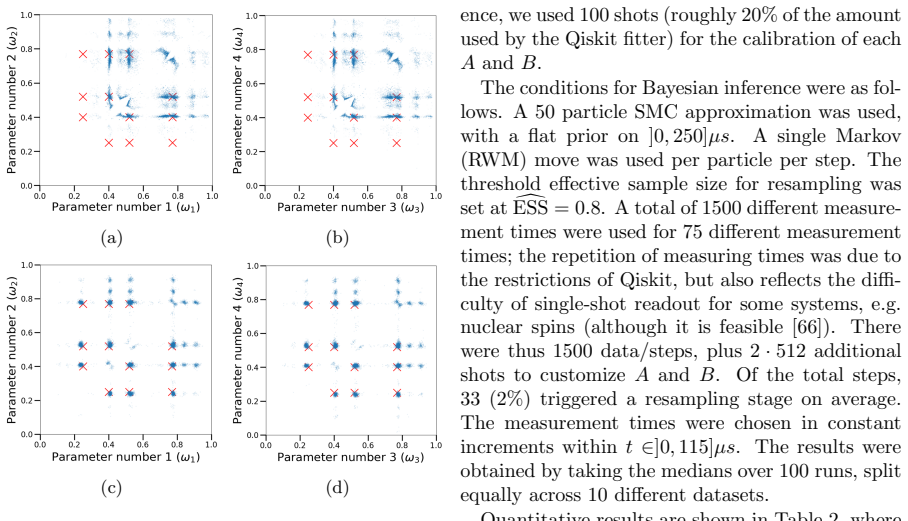
On the paper's own terms, the discovery is that the practical power of Bayesian quantum characterization is decided less by the Bayesian update itself than by how the posterior is represented numerically. The authors show that replacing the widely used Gaussian-shrinkage resampling filter—which preserves only the mean and variance of the particle cloud—with Markov-chain moves (random-walk proposals and gradient-guided Hamiltonian Monte Carlo) inside a sequential Monte Carlo scheme preserves the full posterior and therefore stays correct when the likelihood is multimodal or high-dimensional. Tempered likelihood estimation, in which the posterior is raised through increasing powers before the final target, adds further robustness: in the paper's four-dimensional, 24-mode test it raises correct-mode coverage from 50% to 100%. On cloud superconducting hardware, this machinery estimates dephasing time, energy relaxation time, and detuning frequency with less uncertainty per measurement than the platform's default fitting tools—a ten-fold reduction in Hahn echo dephasing-time uncertainty and three-fold in Ramsey experiments at equal data, and equal accuracy with up to 99.5% fewer measurements. The reported Ramsey detuning learning rate, roughly $\mathcal{O}(CPT^{-0.75})$, lies between the classical and quantum metrology limits, i.e., below the standard quantum limit.
Load-bearing premise
The hardware comparison assumes the qubit's true parameters stay effectively constant while the different methods collect their data, so that the gap in estimation error reflects method quality rather than device drift; the paper itself notes up to 50% variation between consecutive backend calibrations.
Editorial extensions
If this is right
- Calibration on current superconducting hardware can trade classical computation for experimental data: the same uncertainty is reached with far fewer measurements.
- Multimodal and high-dimensional posteriors, which arise naturally from symmetric or redundant likelihoods, are no longer a failure mode for Bayesian quantum learning if the resampling kernel is Markov-chain based.
- Tempered likelihood estimation recovers modes that plain sequential Monte Carlo misses, raising correct-mode coverage from 50% to 100% in the paper's four-dimensional test.
- Subsampled likelihoods with control variates and block pseudo-marginal index updates preserve posterior accuracy while cutting likelihood evaluations by roughly 60%.
- Data ordering matters: for exponential-decay likelihoods, feeding the longest evolution times first prevents particle collapse and gives steadier learning.
Reading between the lines
- A controlled drift audit, interleaving Bayesian and default fits on one qubit while monitoring backend-reported parameters, would separate method quality from device drift; the paper itself reports up to 50% variation between consecutive backend calibrations.
- The same sampler stack is a natural candidate for learning Lindblad dissipators in open quantum systems, where the paper expects multimodal, high-dimensional posteriors but does not demonstrate the learning itself.
- The reported $O(CPT^{-0.75})$ scaling suggests the residual gap to the Heisenberg limit might be a classical statistical inefficiency; combining the robust samplers with fully optimized adaptive controls could test whether the exponent moves toward 1.
- Because data ordering and heuristics change results, published calibration comparisons should report these details; otherwise apparent algorithmic gains may be confounded by unobserved experimental-design choices.
Editorial analysis
A structured set of objections, weighed in public.
Referee Report
Summary. The paper studies numerical representations for Bayesian inference in quantum characterization, comparing sequential importance resampling with Liu-West filtering, Markov chain Monte Carlo variants (random walk Metropolis, Hamiltonian Monte Carlo, stochastic-gradient and subsampling variants), tempered likelihood estimation, block pseudo-marginal methods, and Gaussian rejection filtering. It applies these methods to simulated iterative phase estimation, precession dynamics, and multimodal sum-of-cosines models, then to IBMQ hardware experiments for Hahn echo (T2), T1, Ramsey (T2* and detuning), and echoed Ramsey estimation. The central advertised claims are that the Bayesian methods are more robust to multimodality and high dimensionality than standard SMC-Liu-West, and that on IBMQ hardware they outperform Qiskit's default fitters by factors of 10 and 3 in uncertainty at equal data, or match Qiskit with up to 99.5% less data. The paper also proposes an adaptive occupation-rate heuristic (Eq. 6) and discusses dataset ordering and adaptive design, with pseudocode and a public code repository.
Significance. The paper addresses a real and practically relevant problem: choosing and tuning the numerical representation of Bayesian posteriors for quantum device calibration. Its strengths are the breadth of the method comparison, the explicit treatment of multimodality (Eq. 5) and high dimensionality, the pseudocode for the main algorithms, and the publicly available code. The simulated results, especially the SMC-with-MCMC behavior on multimodal targets and the occupation-rate heuristic in Table 1, are useful contributions. The hardware comparisons are the main advertised result, but as presented they are not yet reliable: the comparisons are not protected against backend drift, and the headline numbers are internally inconsistent between the abstract, the discussion, and the tables. If the drift issue is addressed and the numbers are reconciled, the paper could make a practically important claim about sample-efficient calibration of superconducting devices; at present that claim is not established.
major comments (1)
- [Abstract, §5, Tables 2 and 3] The quantity called 'number of measurements' is used inconsistently, which makes the data-saving claims unverifiable. Table 3 reports 150 measurements for both Bayesian inference and the curve fit, but the text says the curve fit used 512 shots per time point and Bayesian inference used 2 shots per time point, so the fair shot counts are 38,400 versus 150 (a 99.6% saving by shots). In Table 2, the 'Qiskit fitter' low-data row has 2,535 measurements versus Bayesian's 2,524, so there is no data saving in that row, while the high-data row's 38,400/2,524 is a factor of about 15.2, not 11 as stated in the table note. Please define the metric (shots versus data points) and recompute all quoted savings ('93.4%', '99.5%', '99.6%', '11 times') from that metric.
minor comments (6)
- [§3.3, Figure 5 caption, §5] Figure 5 says '4-dimensional estimation (24 modes)', and for dim=4 with Eq. (5) the number of modes is dim! = 24; Section 5 says 'a model with 4 dimensions and 16 modes'. The latter appears to be a typo and should be corrected.
- [§3.2, Figure 3 caption] Panel (b) of Figure 3 is labeled 'Gaussian rejection filtering' but the text describes sequential Monte Carlo with the Liu-West filter; the caption should match the method actually used.
- [§4.2] The sentence 'The final standard deviation was 2.9' is incomplete: it should state the units (microseconds) and preferably give the corresponding estimate of T1 as well.
- [§4.4, Table 4] The column header 'Precision(σ2CPT)' uses CPT without definition, while the text defines precision as σ²Δt_acc; the notation should be harmonized and the abbreviation defined.
- [Abstract, §4.3, Figure 14] The abstract contains a duplicated 'to' in 'up to to 99.5%', and Section 4.3/Figure 14 say the inference used '0.4% (2) of the data' while Table 3 reports 150 data; these statements should be reconciled under the same counting convention.
- [§3.3, Eq. (6)] The 'occupation rate' in Eq. (6) is not formally defined; please specify how it is computed from the particle cloud and use consistent subscript notation for the measurement time t_k.
Circularity Check
No circular derivation: the paper's central claims are empirical comparisons, with the main validity caveat being device drift rather than circularity.
full rationale
The paper's derivation chain is not circular. The headline hardware claims (Tables 2 and 3) are empirical comparisons between SMC/MCMC posteriors computed from stated likelihoods (Eqs. 7 and 10) and Qiskit/SciPy curve fits on IBMQ data; no parameter is fitted to the target uncertainty reductions and then renamed as a prediction. The adaptive heuristic in Eq. 6 is a variance proxy offered as a design heuristic and is benchmarked on a toy multimodal problem, not tuned to force Table 1's median sigma. Self-citations ([24], [26], [25]) are used for background, the particle-guess heuristic, and Gaussian rejection filtering; none carries the central 'Bayesian samplers beat Qiskit' conclusion. The paper itself flags the main non-circular validity threat: Appendix F states 'variations as high as 50% were observed between consecutive calibrations,' and Section 4.3 warns that 'T*_2 is susceptible to large variations, so comparisons are susceptible to time fluctuations,' so the Table 2/3 gap may be partly drift; this is a correctness risk, not a circular reduction. Nor is the abstract's 10x/3x factor swap a circularity. No equation is equal to another by construction, and no fitted quantity is relabeled as a prediction.
Assumptions & free parameters
free parameters (8)
- Liu-West parameter a =
0.98
- SMC particle counts =
50, 100, 225, 200 per experiment
- Resampling threshold dESS =
0.8 or 0.5
- RWM proposal variance scaling =
proportional to current variance, tuned for ~65% acceptance
- HMC hyperparameters (L, epsilon, mass) =
L=20, epsilon=0.001, mass=sigma_curr^2
- Number of tempering coefficients =
10
- Baseline constants C1, C2 =
optimized in a parameter sweep
- Prior bounds =
e.g., T2 in ]0,250] us, T1 in ]0,100] us, frequency in ]0,10] MHz
assumptions (4)
- domain assumption The likelihood models in Section 4 (single exponential decay, damped cosine with Lorentzian noise) describe the IBMQ devices
- domain assumption SMC with MCMC moves converges to the target posterior
- standard math Bernstein-von Mises theorem applies so prior dependence vanishes with data
- ad hoc to paper The classical and quantum limits plotted in Figure 13 correspond to 1/sqrt(T) and 1/T scaling of standard deviation with cumulative evolution time
Cite this review
Pith. "Pith review of Calibration of Quantum Devices via Robust Statistical Methods." pith.science (2026). https://pith.science/paper/AK7LYLZK
@misc{pith2026250706941,
  author       = {Pith},
  title        = {Pith review of: Calibration of Quantum Devices via Robust Statistical Methods},
  year         = {2026},
  howpublished = {\url{https://pith.science/paper/AK7LYLZK}},
  note         = {Machine review of arXiv:2507.06941}
}
read the original abstract
Bayesian inference is a widely used technique for real-time characterization of quantum systems. It excels in experimental characterization in the low data regime, and when the measurements have degrees of freedom. A decisive factor for its performance is the numerical representation of the Bayesian probability distributions. In this work, we explore advanced statistical methods for this purpose, and numerically analyze their performance against the state-of-the-art in quantum parameter learning. In particular, we consider sequential importance resampling, tempered likelihood estimation, Markov Chain Monte Carlo, random walk Metropolis (RWM), Hamiltonian Monte Carlo (HMC) and variants (stochastic gradients with and without friction, energy conserving subsampling), block pseudo-marginal Metropolis-Hastings with subsampling, hybrid HMC-RWM approaches, and Gaussian rejection filtering. We demonstrate advantages of these approaches over existing ones, namely robustness under multi-modality and high dimensionality. We apply these algorithms to the calibration of superconducting qubits from IBMQ, surpassing the standard quantum limit and achieving better results than Qiskit's default tools. In Hahn echo and Ramsey experiments, we reduce the uncertainty by factors of 10 and 3 respectively, without increasing the number of measurements; conversely, we match the performance of Qiskit's methods while using up to to 99.5% less experimental data. We additionally investigate the roles of adaptivity, dataset ordering and heuristics in quantum characterization. Our findings have applications in challenging quantum characterization tasks, namely learning the dynamics of open quantum systems.
Figures


Figures from the paper (17 more)



Reference graph
Works this paper leans on
-
[1]
Entanglement-free Heisenberg-limited phase estimation
B. L. Higgins et al. “Entanglement-free Heisenberg-limited phase estimation”. In: Nature450.7168 (Nov. 2007), pp. 393–396. doi:10 . 1038 / nature06257.url:https : //doi.org/10.1038%2Fnature06257
2007
-
[2]
Adaptive Hamiltonian Estimation Using Bayesian Experimental Design
Chris Ferrie, Cassandra Granade, and D. Cory. “Adaptive Hamiltonian Estimation Using Bayesian Experimental Design”. In: AIP Conference Proceedings1443 (Nov. 2011).doi:10.1063/1.3703632
-
[4]
Computationally efficient Bayesian quantum state tomogra- phy
Joseph M. Lukens et al. “Computationally efficient Bayesian quantum state tomogra- phy”. In:2020 IEEE Photonics Conference (IPC). IEEE, Sept. 2020.doi:10 . 1109 / ipc47351 . 2020 . 9252416.url:https : / / doi . org / 10 . 1109 % 2Fipc47351 . 2020 . 9252416
2020
-
[5]
Practical Bayesian tomogra- phy
Cassandra Granade, Joshua Combes, and D G Cory. “Practical Bayesian tomogra- phy”. In:New Journal of Physics18.3 (Mar. 2016), p. 033024.doi:10.1088/1367-2630/ 18/3/033024.url:https://doi.org/10. 1088/1367-2630/18/3/033024
-
[6]
Ian Hincks et al.Hamiltonian Learning with Online Bayesian Experiment Design in Practice. 2018. arXiv:1806 . 02427 [quant-ph]
2018
-
[7]
Robust online Hamiltonian learning
Cassandra E Granade et al. “Robust online Hamiltonian learning”. In:New Journal of Physics14.10 (Oct. 2012), p. 103013.doi: 10.1088/1367- 2630/14/10/103013.url: 33 https://doi.org/10.1088%2F1367-2630% 2F14%2F10%2F103013
doi:10.1088/1367- 2012
-
[8]
Learning models of quantum systems from experiments
Antonio A. Gentile et al. “Learning models of quantum systems from experiments”. In: Nature Physics17.7 (Apr. 2021), pp. 837– 843.doi:10 . 1038 / s41567 - 021 - 01201 - 7.url:https : / / doi . org / 10 . 1038 % 2Fs41567-021-01201-7
2021
-
[9]
Valentin Gebhart et al. “Learning quantum systems”. In:Nature Reviews Physics5.3 (2023), pp. 141–156.doi:10.1038/s42254- 022-00552-1.url:https://doi.org/10. 1038/s42254-022-00552-1
doi:10.1038/s42254- 2023
Show all 102 references
-
[10]
Quantum Computation of Molecular Structure Us- ing Data from Challenging-To-Classically- Simulate Nuclear Magnetic Resonance Ex- periments
Thomas E. O’Brien et al. “Quantum Computation of Molecular Structure Us- ing Data from Challenging-To-Classically- Simulate Nuclear Magnetic Resonance Ex- periments”. In:PRX Quantum3 (3 2022), p. 030345.doi:10 . 1103 / PRXQuantum . 3 . 030345.url:https://link.aps.org/doi/ 10.1...
2022 doi
-
[11]
How to best sample a peri- odic probability distribution, or on the accu- racy of Hamiltonian finding strategies
Christopher Ferrie, Cassandra E. Granade, and D. G. Cory. “How to best sample a peri- odic probability distribution, or on the accu- racy of Hamiltonian finding strategies”. In: Quantum Information Processing12.1 (Apr. 2012), pp. 611–623.doi:10.1007/s11128- 012- 0407- 6.url:ht...
2012 doi
-
[12]
Modern Bayesian Ex- perimental Design
Tom Rainforth et al. “Modern Bayesian Ex- perimental Design”. In:Statistical Science 39.1 (Feb. 2024).issn: 0883-4237.doi:10. 1214/23-sts915
2024
-
[13]
Michael Betancourt.A Conceptual Intro- duction to Hamiltonian Monte Carlo. 2018. arXiv:1701.02434 [stat.ME]
2018 arXiv
-
[14]
Inference with Hamiltonian Sequential Monte Carlo Simulators
Remi Daviet. “Inference with Hamiltonian Sequential Monte Carlo Simulators”. In: SSRN Electronic Journal(2016).doi:10. 2139/ssrn.2888242.url:https://doi. org/10.2139%2Fssrn.2888242
2016
-
[15]
An Introduction to Sequential Monte Carlo Methods
Arnaud Doucet, Nando Freitas, and Neil Gordon. “An Introduction to Sequential Monte Carlo Methods”. In:Sequential Monte Carlo Methods in Practice. Springer New York, 2001, pp. 3–14.doi:10.1007/ 978 - 1 - 4757 - 3437 - 9 _ 1.url:https : / / doi.org/10.1007%2F978- 1- 4757- 3437- 9_1
2001
-
[16]
Structured filtering
Cassandra Granade and Nathan Wiebe. “Structured filtering”. In:New Journal of Physics19.8 (Aug. 2017), p. 083014.doi: 10.1088/1367-2630/aa77cf.url:https: / / doi . org / 10 . 1088 % 2F1367 - 2630 % 2Faa77cf
2017 doi
-
[17]
2021.url:http : / / community
Stan Development Team.Stan Modeling Language Users Guide and Reference Man- ual 2.27. 2021.url:http : / / community . qiskit.org/textbook
2021
-
[18]
Probabilistic pro- gramming in Python using PyMC3
John Salvatier, Thomas V. Wiecki, and Christopher Fonnesbeck. “Probabilistic pro- gramming in Python using PyMC3”. In: PeerJ Computer Science2 (Apr. 2016), e55. issn: 2376-5992.doi:10.7717/peerj- cs. 55.url:http : / / dx . doi . org / 10 . 7717 / peerj-cs.55
2016 doi
-
[19]
Sequential Monte Carlo samplers
Pierre Del Moral, Arnaud Doucet, and Ajay Jasra. “Sequential Monte Carlo samplers”. In:Journal of the Royal Statistical Soci- ety: Series B (Statistical Methodology)68.3 (June 2006), pp. 411–436.doi:10.1111/j. 1467 - 9868 . 2006 . 00553 . x.url:https : / / doi . org / 10 . 111...
2006 arXiv
-
[20]
Quantum model learning agent: characterisation of quantum systems through machine learning
Brian Flynn et al. “Quantum model learning agent: characterisation of quantum systems through machine learning”. In:New Journal of Physics24.5 (2022), p. 053034.doi:10. 1088/1367- 2630/ac68ff.url:https:// dx.doi.org/10.1088/1367-2630/ac68ff
2022 doi
-
[21]
2021.doi:10.5281/zenodo.2573505
MD SAJID ANIS et al.Qiskit: An Open- source Framework for Quantum Computing. 2021.doi:10.5281/zenodo.2573505
2021 doi
-
[22]
com / alexandra - frca / bayesianlearning
Alexandra Ramˆ oa.Quantum parameter es- timation via Bayesian learning.https : / / github . com / alexandra - frca / bayesianlearning. 2021
2021
-
[23]
Cassandra Granade et al.QInfer: Library for Statistical Inference in Quantum Infor- mation. Sept. 2016.doi:10.5281/zenodo. 157007.url:http : / / dx . doi . org / 10 . 5281/zenodo.157007
2016 doi
-
[24]
2024.doi:10
Alexandra Ramˆ oa.Learning the physics of open quantum systems from experiments. 2024.doi:10 . 48550 / arXiv . 2412 . 00078. arXiv:2412 . 00078 [quant-ph]. url:https : / / arxiv . org / abs / 2412 . 00078
2024
-
[25]
Effi- cient Bayesian Phase Estimation
Nathan Wiebe and Chris Granade. “Effi- cient Bayesian Phase Estimation”. In:Phys- ical Review Letters117.1 (June 2016).doi: 10 . 1103 / physrevlett . 117 . 010503. url:https : / / doi . org / 10 . 1103 % 2Fphysrevlett.117.010503
2016
-
[26]
Hamiltonian Learn- ing and Certification Using Quantum Re- sources
Nathan Wiebe et al. “Hamiltonian Learn- ing and Certification Using Quantum Re- sources”. In:Physical Review Letters112.19 (May 2014).doi:10 . 1103 / physrevlett . 112.190501.url:https://doi.org/10. 1103%2Fphysrevlett.112.190501. 34
2014
-
[27]
A. W. van der Vaart.Asymptotic Statis- tics. Cambridge University Press, Oct. 1998. Chap. 10.2 Bernstein–von Mises Theo- rem.doi:10 . 1017 / cbo9780511802256. url:https : / / doi . org / 10 . 1017 % 2Fcbo9780511802256
1998
-
[28]
Combined Pa- rameter and State Estimation in Simulation- Based Filtering
Jane Liu and Mike West. “Combined Pa- rameter and State Estimation in Simulation- Based Filtering”. In:Sequential Monte Carlo Methods in Practice. Springer New York, 2001, pp. 197–223.doi:10 . 1007 / 978- 1- 4757- 3437- 9_10.url:https:// doi.org/10.1007%2F978- 1- 4757- 3437- 9_10
2001
-
[29]
Single-shot parameter estimation via con- tinuous quantum measurement
Bradley A. Chase and J. M. Geremia. “Single-shot parameter estimation via con- tinuous quantum measurement”. In:Phys. Rev. A79 (2 Feb. 2009), p. 022314.doi:10. 1103 / PhysRevA . 79 . 022314.url:https : //link.aps.org/doi/10.1103/PhysRevA. 79.022314
2009 doi
-
[30]
Quantum Hamilto- nian learning using imperfect quantum re- sources
Nathan Wiebe et al. “Quantum Hamilto- nian learning using imperfect quantum re- sources”. In:Physical Review A89.4 (Apr. 2014).doi:10.1103/physreva.89.042314. url:https : / / doi . org / 10 . 1103 % 2Fphysreva.89.042314
2014 doi
-
[31]
Experimental quantum Hamiltonian learning
Jianwei Wang et al. “Experimental quantum Hamiltonian learning”. In:Nature Physics 13.6 (Mar. 2017), pp. 551–555.issn: 1745- 2481.doi:10.1038/nphys4074.url:http: //dx.doi.org/10.1038/nphys4074
2017 doi
-
[32]
Evans, Robin Harper, and Steven T
Tim J. Evans, Robin Harper, and Steven T. Flammia.Scalable Bayesian Hamilto- nian learning. 2019. arXiv:1912 . 07636 [quant-ph]
2019
-
[33]
Sequential Monte Carlo Sam- plers with Independent Markov Chain Monte Carlo Proposals
L. F. South, A. N. Pettitt, and C. C. Drovandi. “Sequential Monte Carlo Sam- plers with Independent Markov Chain Monte Carlo Proposals”. In:Bayesian Anal- ysis14.3 (Sept. 2019).doi:10 . 1214 / 18 - ba1129.url:https://doi.org/10.1214% 2F18-ba1129
2019
-
[34]
Equation of State Calculations by Fast Computing Machines
Nicholas Metropolis et al. “Equation of State Calculations by Fast Computing Machines”. In:The Journal of Chemical Physics21.6 (June 1953), pp. 1087–1092. doi:10.1063/1.1699114
1953 doi
-
[35]
Pseudo- Bayesian quantum tomography with rank- adaptation
The Tien Mai and Pierre Alquier. “Pseudo- Bayesian quantum tomography with rank- adaptation”. In:Journal of Statistical Plan- ning and Inference184 (May 2017), pp. 62– 76.doi:10 . 1016 / j . jspi . 2016 . 11 . 003. url:https : / / doi . org / 10 . 1016 % 2Fj . jspi.2016.11.003
2017
-
[36]
A controlled-NOT gate for frequency-bin qubits
Hsuan-Hao Lu et al. “A controlled-NOT gate for frequency-bin qubits”. In:npj Quantum Information5.1 (Mar. 2019).doi: 10 . 1038 / s41534 - 019 - 0137 - z.url: https : / / doi . org / 10 . 1038 % 2Fs41534 - 019-0137-z
2019
-
[37]
Quantum state estimation when qubits are lost: a no-data-left-behind approach
Brian P Williams and Pavel Lougovski. “Quantum state estimation when qubits are lost: a no-data-left-behind approach”. In: New Journal of Physics19.4 (Apr. 2017), p. 043003.doi:10 . 1088 / 1367 - 2630 / aa65de.url:https://doi.org/10.1088% 2F1367-2630%2Faa65de
2017
-
[38]
A practical and ef- ficient approach for Bayesian quantum state estimation
Joseph M Lukens et al. “A practical and ef- ficient approach for Bayesian quantum state estimation”. In:New Journal of Physics 22.6 (July 2020), p. 063038.doi:10.1088/ 1367 - 2630 / ab8efa.url:https : / / doi . org/10.1088%2F1367-2630%2Fab8efa
2020
-
[39]
The Tien Mai.Efficient adaptive MCMC implementation for Pseudo-Bayesian quan- tum tomography. 2021. arXiv:2106.00577 [stat.AP]
2021 arXiv
-
[40]
MCMC Methods for Functions: Modifying Old Algorithms to Make Them Faster
S. L. Cotter et al. “MCMC Methods for Functions: Modifying Old Algorithms to Make Them Faster”. In:Statistical Science 28.3 (Aug. 2013).doi:10.1214/13-sts421. url:https : / / doi . org / 10 . 1214 % 2F13 - sts421
2013 doi
-
[41]
Geometric MCMC for infinite-dimensional inverse problems
Alexandros Beskos et al. “Geometric MCMC for infinite-dimensional inverse problems”. In:Journal of Computational Physics335 (Apr. 2017), pp. 327–351. doi:10.1016/j.jcp.2016.12.041.url: https : / / doi . org / 10 . 1016 % 2Fj . jcp . 2016.12.041
2017 doi
-
[42]
Pseudo-Marginal Hamiltonian Monte Carlo
Johan Alenl¨ ov, Arnoud Doucet, and Fredrik Lindsten. “Pseudo-Marginal Hamiltonian Monte Carlo”. In:Journal of Machine Learning Research22.141 (2021), pp. 1–45. url:http://jmlr.org/papers/v22/19- 486.html
2021
-
[43]
Hybrid Monte Carlo
Simon Duane et al. “Hybrid Monte Carlo”. In:Physics Letters B195.2 (1987), pp. 216– 222.issn: 0370-2693.doi:https : / / doi . org / 10 . 1016 / 0370 - 2693(87 ) 91197 - X.url:https : / / www . sciencedirect . com / science / article / pii/037026938791197X
1987
-
[44]
MCMC Using Hamilto- nian Dynamics
Radford Neal. “MCMC Using Hamilto- nian Dynamics”. In:Chapman & Hall/CRC Handbooks of Modern Statistical Methods. Chapman and Hall/CRC, May 2011.doi: 10 . 1201 / b10905 - 6.url:https : / / doi . org/10.1201%2Fb10905-6. 35
2011
-
[45]
Annealed importance sampling
Radford M. Neal. “Annealed importance sampling”. In:Statistics and Computing 11.2 (Apr. 2001), pp. 125–139.issn: 1573- 1375.doi:10 . 1023 / A : 1008923215028. url:https : / / doi . org / 10 . 1023 / A : 1008923215028
2001
-
[46]
Characteriza- tion of a qubit Hamiltonian using adaptive measurements in a fixed basis
Alexandr Sergeevich et al. “Characteriza- tion of a qubit Hamiltonian using adaptive measurements in a fixed basis”. In:Physical Review A84.5 (Nov. 2011).doi:10.1103/ physreva.84.052315.url:https://doi. org/10.1103%2Fphysreva.84.052315
2011
-
[47]
Resource-efficient adap- tive Bayesian tracking of magnetic fields with a quantum sensor
K Craigie et al. “Resource-efficient adap- tive Bayesian tracking of magnetic fields with a quantum sensor”. In:Journal of Physics: Condensed Matter33.19 (Apr. 2021), p. 195801.doi:10.1088/1361-648x/ abe34f.url:https://doi.org/10.1088% 2F1361-648x%2Fabe34f
2021 doi
-
[48]
Neural-Network Heuristics for Adaptive Bayesian Quantum Estimation
Lukas J. Fiderer, Jonas Schuff, and Daniel Braun. “Neural-Network Heuristics for Adaptive Bayesian Quantum Estimation”. In:PRX Quantum2.2 (Apr. 2021).doi:10. 1103/prxquantum.2.020303.url:https: / / doi . org / 10 . 1103 % 2Fprxquantum . 2 . 020303
2021
-
[49]
Likelihood-Free Methods for Quantum Parameter Estimation
Christopher Ferrie and Cassandra E. Granade. “Likelihood-Free Methods for Quantum Parameter Estimation”. In: Physical Review Letters112.13 (Apr. 2014). doi:10 . 1103 / physrevlett . 112 . 130402. url:https : / / doi . org / 10 . 1103 % 2Fphysrevlett.112.130402
2014
-
[50]
Quantum model aver- aging
Christopher Ferrie. “Quantum model aver- aging”. In:New Journal of Physics16.9 (Sept. 2014), p. 093035.doi:10 . 1088 / 1367 - 2630 / 16 / 9 / 093035.url:https : //doi.org/10.1088%2F1367-2630%2F16% 2F9%2F093035
2014
-
[51]
Andrew Gelman, Daniel Lee, and Jiqiang Guo. “Stan”. In:Journal of Educational and Behavioral Statistics40.5 (Oct. 2015), pp. 530–543.doi:10 . 3102 / 1076998615606113.url:https : / / doi . org/10.3102%2F1076998615606113
2015
-
[52]
Quantum measurements and the abelian stabilizer problem
A. Yu. Kitaev. “Quantum measurements and the abelian stabilizer problem”. In: Electronic Colloquium on Computational Complexity3 (1996)
1996
-
[53]
Kitaev, A
A. Kitaev, A. Shen, and M. Vyalyi.Clas- sical and Quantum Computation. American Mathematical Society, May 2002.doi:10. 1090/gsm/047.url:https://doi.org/10. 1090%2Fgsm%2F047
2002
-
[54]
Faster phase estima- tion
Krysta M. Svore, Matthew B. Hastings, and Michael Freedman. “Faster phase estima- tion”. In:Quantum Information and Com- putation14.3&4 (Mar. 2014), pp. 306–328. doi:10.26421/qic14.3-4-7.url:https: //doi.org/10.26421%2Fqic14.3-4-7
2014 doi
-
[55]
Arbitrary accu- racy iterative quantum phase estimation algorithm using a single ancillary qubit: A two-qubit benchmark
Miroslav Dobˇ s ´ ıˇ cek et al. “Arbitrary accu- racy iterative quantum phase estimation algorithm using a single ancillary qubit: A two-qubit benchmark”. In:Physical Re- view A76.3 (Sept. 2007).doi:10 . 1103 / physreva.76.030306.url:https://doi. org/10.1103%2Fphysreva.76.030306
2007
-
[56]
Sophia Simon et al.Dividing and Conquer- ing the Van Vleck Catastrophe. 2025. eprint: arXiv:2504.03465
2025 arXiv
-
[57]
IBM, 2020.url: http : / / community
Abraham Asfaw et al.Learn Quantum Com- putation Using Qiskit. IBM, 2020.url: http : / / community . qiskit . org / textbook
2020
-
[58]
Experimental Bayesian Quantum Phase Estimation on a Silicon Photonic Chip
S. Paesani et al. “Experimental Bayesian Quantum Phase Estimation on a Silicon Photonic Chip”. In:Physical Review Let- ters118.10 (Mar. 2017).doi:10 . 1103 / physrevlett.118.100503.url:https:// doi . org / 10 . 1103 % 2Fphysrevlett . 118 . 100503
2017
-
[59]
Discontinuous Hamiltonian Monte Carlo for discrete parameters and discontinuous likelihoods
Akihiko Nishimura, David B Dunson, and Jianfeng Lu. “Discontinuous Hamiltonian Monte Carlo for discrete parameters and discontinuous likelihoods”. In:Biometrika 107.2 (Mar. 2020), pp. 365–380.doi:10 . 1093/biomet/asz083.url:https://doi. org/10.1093%2Fbiomet%2Fasz083
2020
-
[60]
Zwiebach.Two state systems
B. Zwiebach.Two state systems. 2013.url: https://ocw.mit.edu/courses/physics/ 8- 05- quantum- physics- ii- fall- 2013/ lecture-notes/MIT8_05F13_Chap_07.pdf (visited on 09/20/2021)
2013
-
[61]
Fault-tolerant Hahn-Ramsey interferometry with pulse se- quences of alternating detuning
Nikolay V. Vitanov et al. “Fault-tolerant Hahn-Ramsey interferometry with pulse se- quences of alternating detuning”. In:Phys- ical Review A91.3 (Mar. 2015).doi:10 . 1103 / physreva . 91 . 033406.url:https : / / doi . org / 10 . 1103 % 2Fphysreva . 91 . 033406
2015
-
[62]
The classical Bloch equations
Martin Frimmer and Lukas Novotny. “The classical Bloch equations”. In:American Journal of Physics82.10 (Oct. 2014), pp. 947–954.doi:10 . 1119 / 1 . 4878621. url:https : / / doi . org / 10 . 1119 % 2F1 . 4878621. 36
2014
-
[63]
2024.doi:10
Alexandra Ramˆ oa and Luis Paulo San- tos.Bayesian Quantum Amplitude Estima- tion. 2024.doi:10 . 48550 / arXiv . 2412 . 04394. arXiv:2412 . 04394 [quant-ph]. url:https : / / arxiv . org / abs / 2412 . 04394
2024
-
[64]
Quan- tum Theory of Phase Estimation
Luca Pezz´ e and Augusto Smerzi. “Quan- tum Theory of Phase Estimation”. In:Atom Interferometry188 (Nov. 2014).doi:10 . 3254/978-1-61499-488-0-691
2014
-
[65]
Magnetic-Field Learn- ing Using a Single Electronic Spin in Dia- mond with One-Photon Readout at Room Temperature
R. Santagati et al. “Magnetic-Field Learn- ing Using a Single Electronic Spin in Dia- mond with One-Photon Readout at Room Temperature”. In:Phys. Rev. X9 (2 Apr. 2019), p. 021019.doi:10.1103/PhysRevX. 9.021019.url:https://link.aps.org/ doi/10.1103/PhysRevX.9.021019
2019 doi
-
[66]
Online adaptive quan- tum characterization of a nuclear spin
Timo Joas et al. “Online adaptive quan- tum characterization of a nuclear spin”. In: npj Quantum Information7.1 (2021), p. 56. doi:10.1038/s41534-021-00389-z.url: https://doi.org/10.1038/s41534-021- 00389-z
2021 doi
-
[67]
Bayesian Quantum Multiphase Estimation Algorithm
Valentin Gebhart, Augusto Smerzi, and Luca Pezz` e. “Bayesian Quantum Multiphase Estimation Algorithm”. In:Physical Re- view Applied16.1 (July 2021).issn: 2331- 7019.doi:10.1103/physrevapplied.16. 014035.url:http : / / dx . doi . org / 10 . 1103/physrevapplied.16.014035
2021 doi
-
[68]
Lorenzo Fioroni, Ivan Rojkov, and Florentin Reiter.A learning agent-based approach to the characterization of open quantum sys- tems. 2025. arXiv:2501.05350 [quant-ph]. url:https : / / arxiv . org / abs / 2501 . 05350
2025 arXiv
-
[69]
Qiskit pulse: pro- gramming quantum computers through the cloud with pulses
Thomas Alexander et al. “Qiskit pulse: pro- gramming quantum computers through the cloud with pulses”. In:Quantum Science and Technology5.4 (Aug. 2020), p. 044006. issn: 2058-9565.doi:10.1088/2058-9565/ aba404.url:http : / / dx . doi . org / 10 . 1088/2058-9565/aba404
2020 doi
-
[70]
Gross, A
R. Gross, A. Marx, and F. Deppe.Lecture notes on applied superconductivity, 10.3: control of quantum two-level systems. 2013. url:https : / / www . wmi . badw . de / teaching / Lecturenotes / AS / AS2013 _ Chapter10 _ 2 _ Slides . pdf(visited on 05/08/2021)
2013
-
[71]
2005.url:http : / / info.phys.unm.edu/ ~ideutsch/Classes/ Sandia%20F05/QI_Lecture8.pdf(visited on 09/26/2021)
Ivan Deutsch.Short Course in Quantum In- formation: Lecture 8. 2005.url:http : / / info.phys.unm.edu/ ~ideutsch/Classes/ Sandia%20F05/QI_Lecture8.pdf(visited on 09/26/2021)
2005
-
[72]
Experimen- tal Phase Estimation Enhanced by Ma- chine Learning
Alessandro Lumino et al. “Experimen- tal Phase Estimation Enhanced by Ma- chine Learning”. In:Physical Review Ap- plied10.4 (Oct. 2018).doi:10 . 1103 / physrevapplied.10.044033.url:https: //doi.org/10.1103%2Fphysrevapplied. 10.044033
2018
-
[73]
A Tu- torial on Particle Filtering and Smoothing: Fifteen Years Later
Arnaud Doucet and Adam Johansen. “A Tu- torial on Particle Filtering and Smoothing: Fifteen Years Later”. In:Handbook of Non- linear Filtering12 (Jan. 2009)
2009
-
[74]
Subsampling se- quential Monte Carlo for static Bayesian models
David Gunawan et al. “Subsampling se- quential Monte Carlo for static Bayesian models”. In:Statistics and Computing30.6 (Sept. 2020), pp. 1741–1758.doi:10.1007/ s11222-020-09969-z.url:https://doi. org/10.1007%2Fs11222-020-09969-z
2020
-
[75]
An Introduc- tion to MCMC for Machine Learning
Christophe Andrieu et al. “An Introduc- tion to MCMC for Machine Learning”. In: Machine Learning50.1 (Jan. 2003), pp. 5– 43.issn: 1573-0565.doi:10 . 1023 / A : 1020281327116.url:https : / / doi . org / 10.1023/A:1020281327116
2003 doi
-
[76]
Speagle.A Conceptual Introduc- tion to Markov Chain Monte Carlo Methods
Joshua S. Speagle.A Conceptual Introduc- tion to Markov Chain Monte Carlo Methods
-
[77]
Monte Carlo sampling methods using Markov chains and their ap- plications
W. K. Hastings. “Monte Carlo sampling methods using Markov chains and their ap- plications”. In:Biometrika57.1 (Apr. 1970), pp. 97–109.doi:10.1093/biomet/57.1. 97.url:https : / / doi . org / 10 . 1093 % 2Fbiomet%2F57.1.97
1970 doi
-
[78]
On thin- ning of chains in MCMC
William Link and Mitchell Eaton. “On thin- ning of chains in MCMC”. In:Methods in Ecology and Evolution3 (June 2011), pp. 112–115.doi:10.1111/j.2041- 210X. 2011.00131.x
2011 arXiv
-
[79]
Adaptively Scaling the Metropolis Algo- rithm Using Expected Squared Jumped Dis- tance
Andrew Gelman and Cristian Pasarica. “Adaptively Scaling the Metropolis Algo- rithm Using Expected Squared Jumped Dis- tance”. In:SSRN Electronic Journal(2007). doi:10.2139/ssrn.1010403.url:https: //doi.org/10.2139%2Fssrn.1010403
2007 doi
-
[80]
Hamiltonian and Langevin Monte Carlo
Adrian Barbu and Song Zhu. “Hamiltonian and Langevin Monte Carlo”. In: Springer Singapore, Feb. 2020, pp. 281–325.isbn: 978-981-13-2970-8.doi:10.1007/978-981- 13-2971-5_9
2020 doi
-
[81]
The No-U-Turn Sampler: Adaptively Set- ting Path Lengths in Hamiltonian Monte Carlo
Matthew Hoffman and Andrew Gelman. “The No-U-Turn Sampler: Adaptively Set- ting Path Lengths in Hamiltonian Monte Carlo”. In:Journal of Machine Learning Re- search15 (Nov. 2011). 37
2011
-
[82]
Rie- mann manifold Langevin and Hamiltonian Monte Carlo methods
Mark Girolami and Ben Calderhead. “Rie- mann manifold Langevin and Hamiltonian Monte Carlo methods”. In:Journal of the Royal Statistical Society: Series B (Statisti- cal Methodology)73.2 (Mar. 2011), pp. 123– 214.doi:10 . 1111 / j . 1467 - 9868 . 2010 . 00765.x.url:https://doi...
2011
-
[83]
M. J. Betancourt.Adiabatic Monte Carlo
-
[84]
Shiwei Lan, Jeffrey Streets, and Babak Shahbaba.Wormhole Hamiltonian Monte Carlo. 2014. arXiv:1306.0063 [stat.CO]
2014 arXiv
-
[85]
Minghao Gu and Shiliang Sun.Variational Langevin Hamiltonian Monte Carlo for Dis- tant Multi-modal Sampling. 2019. arXiv: 1906.00229 [cs.LG]
2019 arXiv
-
[86]
M. J. Betancourt.Scalable Bayesian Infer- ence with Hamiltonian Monte Carlo.https: / / www . youtube . com / watch ? v = jUSZboSq1zg & t = 1395s. London Machine Learning Meetup, 2018
2018
-
[87]
The Extended Liu and West Fil- ter: Parameter Learning in Markov Switch- ing Stochastic Volatility Models
Maria Paula Rios and Hedibert Freitas Lopes. “The Extended Liu and West Fil- ter: Parameter Learning in Markov Switch- ing Stochastic Volatility Models”. In:State- Space Models. Springer New York, 2013, pp. 23–61.doi:10 . 1007 / 978 - 1 - 4614 - 7789 - 1 _ 2.url:https : / / do...
2013
-
[88]
Adaptive Tuning of Hamiltonian Monte Carlo Within Sequential Monte Carlo
Alexander Buchholz, Nicolas Chopin, and Pierre E. Jacob. “Adaptive Tuning of Hamiltonian Monte Carlo Within Sequential Monte Carlo”. In:Bayesian Analysis16.3 (Sept. 2021).doi:10 . 1214 / 20 - ba1222. url:https : / / doi . org / 10 . 1214 % 2F20 - ba1222
2021
-
[89]
Springer New York, 2004.doi:10.1007/978- 1- 4684- 9393- 1
Pierre Del Moral.Feynman-Kac Formulae - Genealogical and Interacting Particle Sys- tems with Applications. Springer New York, 2004.doi:10.1007/978- 1- 4684- 9393- 1. url:https://doi.org/10.1007%2F978- 1-4684-9393-1
2004 doi
-
[90]
Pierre del Moral.An introduction to Feynman-Kac particle methods in statistical learning and rare event simulation. 2014
2014
-
[91]
M. J. Betancourt.The Fundamental Incom- patibility of Hamiltonian Monte Carlo and Data Subsampling. 2015. arXiv:1502.01510 [stat.ME]
2015 arXiv
-
[92]
Fox, and Carlos Guestrin.Stochastic Gradient Hamiltonian Monte Carlo
Tianqi Chen, Emily B. Fox, and Carlos Guestrin.Stochastic Gradient Hamiltonian Monte Carlo. 2014. arXiv:1402 . 4102 [stat.ME]
2014
-
[93]
Speeding up MCMC by Efficient Data Subsampling
Matias Quiroz et al. “Speeding up MCMC by Efficient Data Subsampling”. In:Jour- nal of the American Statistical Association 114 (Mar. 2018), pp. 1–35.doi:10.1080/ 01621459.2018.1448827
2018
-
[94]
Hamiltonian Monte Carlo with Energy Conserving Subsam- pling
Khue-Dung Dang et al. “Hamiltonian Monte Carlo with Energy Conserving Subsam- pling”. In:Journal of Machine Learning Re- search20.100 (2019), pp. 1–31.url:http: //jmlr.org/papers/v20/17-452.html
2019
-
[95]
Stochastic gradient Hamil- tonian Monte Carlo with variance reduction for Bayesian inference
Zhize Li et al. “Stochastic gradient Hamil- tonian Monte Carlo with variance reduction for Bayesian inference”. In:Machine Learn- ing108.8-9 (July 2019), pp. 1701–1727.doi: 10 . 1007 / s10994 - 019 - 05825 - y.url: https : / / doi . org / 10 . 1007 % 2Fs10994 - 019-05825-y
2019
-
[96]
University of Cambridge, 2012.url:https: / / www
David Tong.Lectures on Kinetic Theory. University of Cambridge, 2012.url:https: / / www . damtp . cam . ac . uk / user / tong / kintheory / three . pdf(visited on 08/15/2021)
2012
-
[97]
A practical guide to pseudo-marginal methods for computa- tional inference in systems biology
David J. Warne, Ruth E. Baker, and Matthew J. Simpson. “A practical guide to pseudo-marginal methods for computa- tional inference in systems biology”. In: Journal of Theoretical Biology496 (July 2020), p. 110255.doi:10 . 1016 / j . jtbi . 2020.110255.url:https://doi.org/10. 1...
2020
-
[98]
The pseudo-marginal approach for efficient Monte Carlo computations
Christophe Andrieu and Gareth O. Roberts. “The pseudo-marginal approach for efficient Monte Carlo computations”. In:The Annals of Statistics37.2 (Apr. 2009).doi:10.1214/ 07 - aos574.url:https : / / doi . org / 10 . 1214%2F07-aos574
2009
-
[99]
M. -N. Tran et al.The Block Pseudo- Marginal Sampler. 2017. arXiv:1603.02485 [stat.ME]
2017 arXiv
-
[100]
SciPy 1.0: Funda- mental Algorithms for Scientific Computing in Python
Pauli Virtanen et al. “SciPy 1.0: Funda- mental Algorithms for Scientific Computing in Python”. In:Nature Methods17 (2020), pp. 261–272.doi:10 . 1038 / s41592 - 019 - 0686-2
2020
-
[101]
Spin Echoes
Erwin Hahn. “Spin Echoes”. In:Phys. Rev. 80 (Nov. 1950), pp. 580–594.doi:10.1063/ 1.3066708. 38
1950
-
[2015]
arXiv:1405.3489 [stat.ME]
-
[2020]
arXiv:1909.12313 [stat.OT]
1909 arXiv
Reviewed August 6, 2026 · model on record in the stance chip above.
Discussion (0). Continue with ORCID to comment.