REVIEW 3 major objections 8 minor 26 references
MCCD: A Multi-Attribute Chinese Calligraphy Character Dataset Annotated with Script Styles, Dynasties, and Calligraphers
T0 review · 3 major / 8 minor · reviewed 2026-08-06 · deepseek-v4-flash
Pith's one-line read 329,715 calligraphy characters labeled by style, dynasty, and artist
desk verdict A genuinely useful multi-attribute calligraphy dataset, but the labels inherit the risk of scraped website metadata; a spot-check is needed. read the letter →
The pith
A machine-rendered reading of the paper's core claim, the machinery that carries it, and where it could break.
The reading
What carries the argument
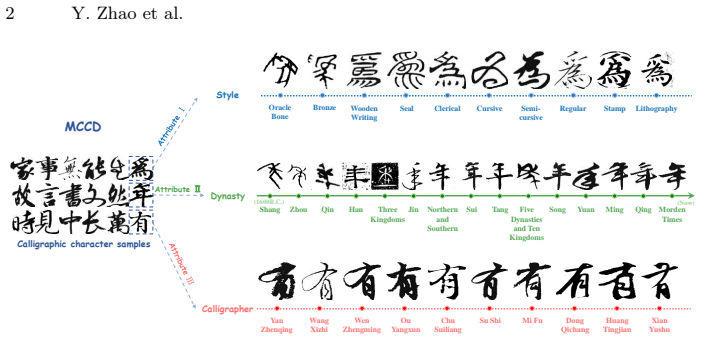
The carrying mechanism is the multi-attribute annotation structure: each character image is linked to a character category plus, where available, script style, dynasty, and calligrapher metadata drawn from two calligraphy websites. From these labels the paper constructs three task-specific subsets — MCCD-Style (10 styles), MCCD-Dynasty (15 periods), MCCD-Calligrapher (142 calligraphers) — and reports recognition benchmarks on each. This structure is what lets the same images be used for single-task recognition, attribute classification, and multi-task learning, and it is the property the paper claims no prior Chinese character dataset offers.
What would settle it
An expert audit of a random sample of images from each attribute subset, checking whether the recorded style, dynasty, and calligrapher labels match a historian's judgment, would directly test the dataset's reliability.
Extended reading notes
Core claim
The central contribution is the dataset itself and the claim that it is the first open-source Chinese calligraphy character corpus with multi-attribute annotations. MCCD contains 329,715 samples from two calligraphy websites; all samples carry character labels, 258,830 samples carry style and dynasty labels, and 92,122 samples form a 142-calligrapher subset. The benchmark experiments show that the task is hard: the best Top-1 character recognition accuracy is about 79% with ResNet50 and Swin Transformer, calligrapher identification peaks at 67.7% Top-1, while style recognition reaches 95.4%. Multi-task learning with character and attribute heads consistently underperforms single-task baselines, which the authors attribute to conflicting feature requirements across tasks. The paper concludes that a systematically multi-attribute labeled dataset provides data support for diverse calligraphy research while posing new challenges for Chinese character recognition models.
Load-bearing premise
The attribute labels (style, dynasty, calligrapher) come from the metadata of two calligraphy websites and were not independently re-verified, so if a substantial fraction are wrong or inconsistently merged, all subset benchmarks are undermined.
Editorial extensions
If this is right
- Researchers get a public benchmark with 7,765 character classes and the largest historical coverage (15 dynasties) among Chinese character datasets to the authors' knowledge.
- The reported numbers provide baselines for future work in calligraphy character recognition, style classification, dynasty attribution, and calligrapher identification.
- The observation that radical-based recognizers lag global-feature models on calligraphy suggests calligraphy-specific recognition models should emphasize global glyph structure.
- The consistent drop from single-task to multi-task training on this dataset signals that multi-attribute calligraphy learning needs task-interference-aware architectures rather than simple shared-backbone heads.
- The partial overlap between the subsets means future work can study how sample selection affects the comparability of attribute benchmarks.
Reading between the lines
- If the style, dynasty, and calligrapher labels are as reliable as the authors assume, the dataset would support quantitative studies of character-form evolution across dynasties, a direction the paper mentions but does not develop.
- A direct test of the core claim would be a small expert audit: randomly sample a few hundred images per attribute and have calligraphy historians verify the source-metadata labels; the agreement rate would bound how much of the benchmark accuracy reflects true stylistic signal.
- Because the two sources overlap for calligrapher labels but only one source provides style and dynasty labels, merging rules across sources are worth inspecting; inconsistent merges would affect subset statistics more than character recognition.
- The multi-task performance drop could be turned into a positive research target: the dataset is large enough to serve as a test bed for multi-task weighting and disentanglement methods in cultural-heritage recognition.
Editorial analysis
A structured set of objections, weighed in public.
Referee Report
Summary. The manuscript introduces MCCD, a dataset of 329,715 isolated Chinese calligraphy character images collected from two websites (ZiTong and ShuFaTuJi), with character labels for 7,765 categories and attribute labels for script style (10 classes), dynasty (15 classes), and calligrapher (142 classes). Three subsets are derived from the attribute labels, and the paper reports benchmark experiments for single-task character/style/dynasty/calligrapher recognition and for dual-task and four-task learning using ResNet50, ViT, Swin Transformer, HierCode, and CCR-CLIP. The authors claim that MCCD is the first open-source Chinese calligraphy character dataset with multi-attribute labels.
Significance. If the attribute labels are reliable, MCCD fills a clear gap: existing calligraphy and historical character datasets mostly provide only character-level annotations, while MCCD offers multi-attribute labels suited to style classification, dynasty attribution, writer identification, and multi-task learning. The paper provides useful dataset statistics, a public repository, and baseline results over several representative architectures. The contribution is empirical and does not rely on any theoretical derivation; its value rests on the quality and usability of the released data and on the reproducibility of the benchmarks.
major comments (3)
- [Section 3.1 (2) and Section 3.3] The central value of MCCD is the multi-attribute labels, but the paper does not report any verification of the semantic correctness of the style, dynasty, or calligrapher labels. The cleaning step in Section 3.1(2) removed duplicate, garbled, and blurred images and involved about 50 hours of manual validation per annotator, yet it is not stated that the annotators checked whether the scraped metadata matches the image content. Section 3.3 further states that style and dynasty labels come exclusively from ZiTong while calligrapher labels are "finely selected from both sources," with no cross-source consistency check described. Because every subset benchmark (Tables 5-9) and the claimed multi-attribute contribution inherit these labels, please add a label-quality validation study: for example, a human spot-check with inter-annotator agreement, a comparison of duplicate samples across the two sources, and/or verification against authoritative art-historical references, and report the disagreement rate. Please also clarify whether the character labels themselves were verified beyond the removal of garbled annotations.
- [Section 3.3, Table 3] The dataset statistics are internally inconsistent and need correction. In Table 3, the MCCD train and test counts sum to 234,225+95,460=329,685, not the stated total of 329,715 (which matches Table 1: 258,830+70,885). The MCCD-Dynasty training value is printed as 1,811,187; given that the test value is 77,643 and the subset total is 258,830, this is presumably a typo for 181,187. Please reconcile all counts across Table 1, Table 3, and Section 3.3 text, and audit the other rows for similar transcription errors.
- [Section 4.2, Tables 4-9] All benchmark tables report a single run with no variance or statistical significance. The differences between top methods are often small (e.g., ResNet50 at 79.085% vs Swin Transformer at 79.141% in Table 4), so it is impossible to assess whether any ranking is meaningful. Please report the mean and standard deviation over multiple runs with fixed random seeds, or at minimum provide the seeds and release the evaluation code so the baselines can be reproduced and extended.
minor comments (8)
- [Section 3.1 heading] The heading "Dataset Create Processs" should read "Dataset Creation Process."
- [Fig. 1 and Section 3.3] "Morden Times" appears in Fig. 1 and in Fig. 7; it should be "Modern Times."
- [Section 4.2, dynasty discussion] "Marco Accuracy" should be "Macro Accuracy" in the dynasty recognition paragraph.
- [Section 4.3] "muti-task" is a typo for "multi-task" in the discussion of multi-task learning.
- [Section 5] The phrase "given the the complexity" contains a duplicated article and should be corrected.
- [Section 3.3 and GitHub link] Please state the dataset license and the terms under which the scraped images are released; the paper currently gives only a GitHub URL without any license or usage terms.
- [Section 4.1 and Related Work] The novelty claim that MCCD is the first open-source Chinese calligraphy character dataset with multi-attribute labels would be easier to evaluate if the related work explicitly compared attribute coverage with EVOBC and ACCP, which already contain evolutionary-stage or dictionary metadata.
- [Section 4.3] The four-task experiment uses 67,628 samples with all four labels; please state how these samples were split into training and test sets, since this is not specified.
Circularity Check
No significant circularity: MCCD is a dataset construction and benchmarking paper whose claims rest on external measurements, not on a derivation that reduces to its own inputs.
full rationale
The paper makes no formal derivation from first principles; its contributions are (i) collecting and cleaning 329,715 calligraphy character images with character/style/dynasty/calligrapher labels from two external websites, and (ii) reporting benchmark accuracies for standard and specialized models on the resulting subsets. There is no fitted parameter that is later renamed as a prediction: the reported Top-1/Top-5/Macro accuracies are direct empirical evaluations of ResNet50, ViT, Swin Transformer, HierCode, and CCR-CLIP on the new data, with no quantity in the benchmark section being defined in terms of the result it claims to establish. The paper cites several prior datasets from its own group (SCUT-COUCH, CASIA-AHCDB, EVOBC, MegaHan97K, etc.), but these citations are contextual comparisons in the related-work section and are not load-bearing for the present dataset's construction or for any benchmark number. The claim that MCCD is 'the first open-source Chinese calligraphy character dataset to contain multi-attribute labels' (Section 4.1) is a factual novelty claim based on the authors' survey of existing datasets; even if the survey were incomplete, that would be a correctness issue, not circularity. The strongest actual risk in the paper is external validity: attribute labels are inherited from the metadata of the scraped websites ZiTong and ShuFaTuJi, and the cleaning step (Section 3.1(2)) removed duplicates, garbled annotations, and blurred images without explicit re-verification of style/dynasty/calligrapher semantics against the images or independent art-historical sources. That is a data-fidelity concern, not a circularity concern, because the labels are inputs to the benchmarks rather than outputs derived from them. No self-definitional identification, fitted-input-as-prediction reduction, or self-citation chain forces the paper's conclusions, so the circularity score is 0.
Assumptions & free parameters
assumptions (3)
- domain assumption Metadata scraped from ZiTong and ShuFaTuJi accurately records script style, dynasty, and calligrapher for each image.
- domain assumption The two sources can be merged and split at 7:3 without destructive label conflicts or sample leakage.
- domain assumption Standard image recognition protocols (resize to 96x96, RandAugment, AdamW) are adequate to benchmark calligraphy character recognition.
Cite this review
Pith. "Pith review of MCCD: A Multi-Attribute Chinese Calligraphy Character Dataset Annotated with Script Styles, Dynasties, and Calligraphers." pith.science (2026). https://pith.science/paper/NCX4XUFZ
@misc{pith2026250706948,
  author       = {Pith},
  title        = {Pith review of: MCCD: A Multi-Attribute Chinese Calligraphy Character Dataset Annotated with Script Styles, Dynasties, and Calligraphers},
  year         = {2026},
  howpublished = {\url{https://pith.science/paper/NCX4XUFZ}},
  note         = {Machine review of arXiv:2507.06948}
}
read the original abstract
Research on the attribute information of calligraphy, such as styles, dynasties, and calligraphers, holds significant cultural and historical value. However, the styles of Chinese calligraphy characters have evolved dramatically through different dynasties and the unique touches of calligraphers, making it highly challenging to accurately recognize these different characters and their attributes. Furthermore, existing calligraphic datasets are extremely scarce, and most provide only character-level annotations without additional attribute information. This limitation has significantly hindered the in-depth study of Chinese calligraphy. To fill this gap, we present a novel Multi-Attribute Chinese Calligraphy Character Dataset (MCCD). The dataset encompasses 7,765 categories with a total of 329,715 isolated image samples of Chinese calligraphy characters, and three additional subsets were extracted based on the attribute labeling of the three types of script styles (10 types), dynasties (15 periods) and calligraphers (142 individuals). The rich multi-attribute annotations render MCCD well-suited diverse research tasks, including calligraphic character recognition, writer identification, and evolutionary studies of Chinese characters. We establish benchmark performance through single-task and multi-task recognition experiments across MCCD and all of its subsets. The experimental results demonstrate that the complexity of the stroke structure of the calligraphic characters, and the interplay between their different attributes, leading to a substantial increase in the difficulty of accurate recognition. MCCD not only fills a void in the availability of detailed calligraphy datasets but also provides valuable resources for advancing research in Chinese calligraphy and fostering advancements in multiple fields. The dataset is available at https://github.com/SCUT-DLVCLab/MCCD.
Figures


Figures from the paper (5 more)


Reference graph
Works this paper leans on
-
[1]
International Journal on Document Analysis and Recognition (IJDAR) 20, 59–68 (2017)
Pengcheng, G., Gang, G., Jiangqin, W., Baogang, W.: Chinese Calligraphic Style Representation for Recognition. International Journal on Document Analysis and Recognition (IJDAR) 20, 59–68 (2017)
work page 2017
-
[2]
IEEE Access10, 8388–8398 (2022)
Li, X., Wang, J., Zhang, H., Huang, Y., Huang, H.: Swordnet: Chinese Character Font Style Recognition Network. IEEE Access10, 8388–8398 (2022)
work page 2022
-
[3]
Journal of Image and Graphics28(6), 1767–1791 (2023)
Yang, C., Liu, C., Fang, Z., Han, Z., Liu, C., Yin, X.: Open set text recognition technology. Journal of Image and Graphics28(6), 1767–1791 (2023)
work page 2023
-
[4]
In: 2009 10th Interna- tional Conference on Document Analysis and Recognition (ICDAR)
Zhang, H., Guo, J., Chen, G., Li, C.: HCL2000-a Large-scale Handwritten Chinese Character Database for Handwritten Character Recognition. In: 2009 10th Interna- tional Conference on Document Analysis and Recognition (ICDAR). pp. 286–290. IEEE (2009)
work page 2009
-
[5]
In: 10th International Workshop on Frontiers in Handwriting Recognition
Su, T., Zhang, T., Guan, D.: Hit-MW Dataset for Offline Chinese Handwritten Text Recognition. In: 10th International Workshop on Frontiers in Handwriting Recognition. Suvisoft (2006)
work page 2006
-
[6]
In: Proceedings of the 9th IAPR International Workshop on Document Analysis Systems
Zhou, S., Chen, Q., Wang, X.: Hit-OR3C: An Opening Recognition Corpus for Chinese Characters. In: Proceedings of the 9th IAPR International Workshop on Document Analysis Systems. pp. 223–230 (2010)
work page 2010
-
[7]
International Journal on Document Analysis and Recognition (IJDAR)14, 53–64 (2011)
Jin, L., Gao, Y., Liu, G., Li, Y., Ding, K.: Scut-Couch2009—A Comprehensive Online Unconstrained Chinese Handwriting Database and Benchmark Evaluation. International Journal on Document Analysis and Recognition (IJDAR)14, 53–64 (2011)
work page 2011
-
[8]
Li, Y., Jin, L., Zhu, X., Long, T.: Scut-Couch2008: A Comprehensive Online Un- constrained Chinese Handwriting Dataset (ICFHR), 165–170 (2008)
work page 2008
Show all 26 references
-
[9]
In: 2011 International Conference on Document Analysis and Recognition (ICDAR)
Liu, C.L., Yin, F., Wang, D.H., Wang, Q.F.: Casia Online and Offline Chinese Handwriting Databases. In: 2011 International Conference on Document Analysis and Recognition (ICDAR). pp. 37–41. IEEE (2011)
2011
-
[10]
In: 2020 17th International Conference on Frontiers in Handwriting Recognition (ICFHR)
Ma, W., Zhang, H., Jin, L., Wu, S., Wang, J., Wang, Y.: Joint Layout Analysis, Character Detection and Recognition for Historical Document Digitization. In: 2020 17th International Conference on Frontiers in Handwriting Recognition (ICFHR). pp. 31–36. IEEE (2020)
2020
-
[11]
IEEE Access6, 30174–30183 (2018)
Yang, H., Jin, L., Huang, W., Yang, Z., Lai, S., Sun, J.: Dense and Tight Detection of Chinese Characters in Historical Documents: Datasets and A Recognition Guided Detector. IEEE Access6, 30174–30183 (2018)
2018
-
[12]
In: 2019 Interna- tional Conference on Document Analysis and Recognition (ICDAR)
Xu, Y., Yin, F., Wang, D.H., Zhang, X.Y., Zhang, Z., Liu, C.L.: CASIA-AHCDB: A Large-scale Chinese Ancient Handwritten Characters Database. In: 2019 Interna- tional Conference on Document Analysis and Recognition (ICDAR). pp. 793–798. IEEE (2019)
2019
-
[13]
Scientific Data12(1), 169 (2025)
Shi, Y., Peng, D., Zhang, Y., Cao, J., Jin, L.: A Large-scale Dataset for Chinese Historical Document Recognition and Analysis. Scientific Data12(1), 169 (2025)
2025
-
[14]
Scientific Data11(1), 976 (2024)
Wang, P., Zhang, K., Wang, X., Han, S., Liu, Y., Wan, J., Guan, H., Kuang, Z., Jin, L., Bai, X., et al.: An open dataset for oracle bone character recognition and decipherment. Scientific Data11(1), 976 (2024)
2024
-
[15]
arXiv preprint arXiv:2401.12467 (2024)
Guan, H., Wan, J., Liu, Y., Wang, P., Zhang, K., Kuang, Z., Wang, X., Bai, X., Jin, L.: An Open Dataset for The Evolution of Oracle Bone Characters: EVOBC. arXiv preprint arXiv:2401.12467 (2024)
2024 arXiv
-
[16]
In: International Conference on Document Analysis and Recognition (ICDAR)
Wang, P., Zhang, K., Wang, X., Han, S., Liu, Y., Jin, L., Bai, X., Liu, Y.: Puzzle Pieces Picker: Deciphering Ancient Chinese Characters with Radical Reconstruc- tion. In: International Conference on Document Analysis and Recognition (ICDAR). pp. 169–187. Springer (2024) MCCD:...
2024
-
[17]
Pattern Recognition p
Zhang, Y., Shi, Y., Zhang, P., Zhao, Y., Yang, Z., Jin, L.: Megahan97k: A large- scale dataset for mega-category chinese character recognition with over 97k cate- gories. Pattern Recognition p. 111757 (2025)
2025
-
[18]
Journal of Image and Graphics28(08), 2223– 2252 (2023)
Liu, C., Jin, L., Bai, X., Li, X., Yin, F.: Frontiers of intelligent document analysis and recognition: review and prospects. Journal of Image and Graphics28(08), 2223– 2252 (2023)
2023
-
[19]
In: International Conference on Learning Representations (2019)
Loshchilov, I., Hutter, F.: Decoupled weight decay regularization. In: International Conference on Learning Representations (2019)
2019
-
[20]
In: Proceedings of the IEEE/CVF Conference on Computer Vision and Pattern Recognition Workshops (CVPR)
Cubuk, E.D., Zoph, B., Shlens, J., Le, Q.V.: Randaugment: Practical Auto- mated Data Augmentation with A Reduced Search Space. In: Proceedings of the IEEE/CVF Conference on Computer Vision and Pattern Recognition Workshops (CVPR). pp. 702–703 (2020)
2020
-
[21]
arXiv preprint arXiv:2112.150933(4), 5 (2021)
Chen, J., Yu, H., Ma, J., Guan, M., Xu, X., Wang, X., Qu, S., Li, B., Xue, X.: Benchmarking Chinese Text Recognition: Datasets, Baselines, and An Empirical Study. arXiv preprint arXiv:2112.150933(4), 5 (2021)
2021 arXiv
-
[22]
In: Proceedings of the IEEE Conference on Computer Vision and Pattern Recognition (CVPR)
He, K., Zhang, X., Ren, S., Sun, J.: Deep Residual Learning for Image Recog- nition. In: Proceedings of the IEEE Conference on Computer Vision and Pattern Recognition (CVPR). pp. 770–778 (2016)
2016
-
[23]
In: International Conference on Learning Representations (2021)
Dosovitskiy, A., Beyer, L., Kolesnikov, A., Weissenborn, D., Zhai, X., Unterthiner, T., Dehghani, M., Minderer, M., Heigold, G., Gelly, S., Uszkoreit, J., Houlsby, N.: An image is worth 16x16 words: Transformers for image recognition at scale. In: International Conference on L...
2021
-
[24]
In: Proceedings of the IEEE/CVF Conference on Computer Vision and Pattern Recognition (CVPR)
Liu, Z., Hu, H., Lin, Y., Yao, Z., Xie, Z., Wei, Y., Ning, J., Cao, Y., Zhang, Z., Dong, L., et al.: Swin Transformer v2: Scaling up Capacity and Resolution. In: Proceedings of the IEEE/CVF Conference on Computer Vision and Pattern Recognition (CVPR). pp. 12009–12019 (2022)
2022
-
[25]
Pattern Recognition 158, 110963 (2025)
Zhang, Y., Zhu, Y., Peng, D., Zhang, P., Yang, Z., Yang, Z., Yao, C., Jin, L.: Hier- code: A Lightweight Hierarchical Codebook for Zero-shot Chinese Text Recognition. Pattern Recognition 158, 110963 (2025)
2025
-
[26]
In: Proceedings of the IEEE/CVF International Conference on Computer Vision (ICCV)
Yu, H., Wang, X., Li, B., Xue, X.: Chinese Text Recognition with A Pre-trained Clip-like Model Through Image-ids Aligning. In: Proceedings of the IEEE/CVF International Conference on Computer Vision (ICCV). pp. 11943–11952 (2023)
2023
Reviewed August 6, 2026 · model on record in the stance chip above.
Discussion (0). Sign in to comment.