REVIEW 3 major objections 4 minor 1 cited by
Homothetic expansion of polyhedra in the two-vertex model: emergence of FLRW
T0 review · 3 major / 4 minor · reviewed 2026-08-06 · deepseek-v4-flash
Pith's one-line read This paper proves that in the symmetric U(N)-reduced sector of the two-vertex model, the twisted-geometry polyhedra expand homothetically—face angles stay constant—and the polyhedral expansion matches the Robertson-Walker one.
desk verdict The homothetic-expansion proof in Section V is solid and worth publishing on its own; the FLRW emergence section stumbles on an unacknowledged scale choice, so the title overreaches. read the letter →
The pith
A machine-rendered reading of the paper's core claim, the machinery that carries it, and where it could break.
The reading
What carries the argument
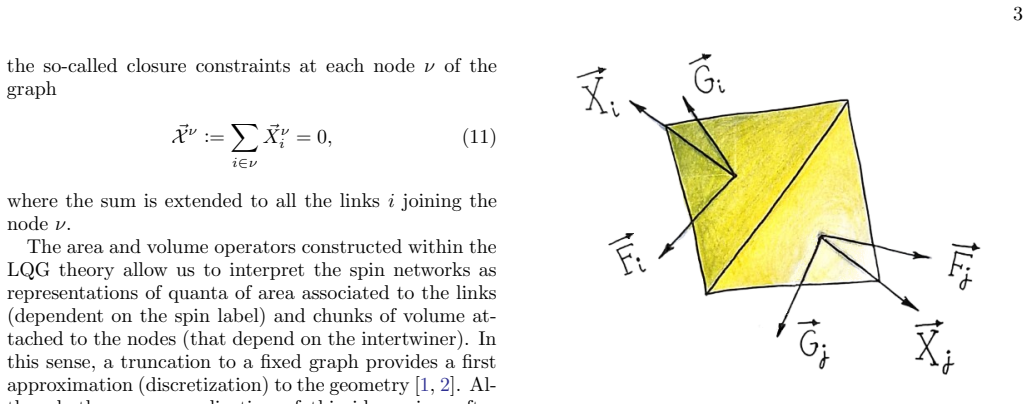
The central object is the frame basis attached to each polyhedron face, the triple $\{\vec X_i,\vec G_i,\vec F_i\}$ built from the spinor of that face, with $\vec X_i$ the outward normal, $\vec G_i$ and $\vec F_i$ tangent vectors satisfying $\vec X_i \times \vec G_i = A_i\vec F_i$ and $|\vec X_i| = |\vec G_i| = |\vec F_i| = A_i$. In the U(N)-reduced sector the evolution matrices (39)-(40) collapse to a single face-independent matrix, proportional to the identity plus an antisymmetric rotation, so every vector rescales by $(2/3)\vartheta$ and rotates by $\dot\varphi/2$. The planar-angle identity $\vec v_{ij} = (4/3)\vartheta\,\vec u_{ij}$, obtained by inserting this evolution into the definition of edge directions, is what makes $d\varepsilon_i/dt = 0$ and carries the homothety proof. The geometric correspondence with Robertson-Walker is carried by the conjugate pair $(\varphi, A)$, with $\{\varphi, A\} = 1$, together with the Robertson-Walker characterization by homogeneous leaves, umbilic embedding, shear-free expansion, and geodesic normal flow.
What would settle it
Choose U(N)-reduced initial data with $F'(A^2) \neq 0$ so the twist evolves, integrate the frame-basis evolution (57) numerically for, say, N = 5 faces, and measure a planar angle $\varepsilon_i(t)$ and the ratio $V(t)/A(t)^{3/2}$; if either changes instead of staying constant, the homothetic-expansion claim fails.
Extended reading notes
Core claim
The paper's central claim is that in the U(N)-reduced sector of the two-vertex model—the symmetric sector in which the twist angle $\varphi$ is the same on every link and the total area $A$ is the only remaining extensive degree of freedom—the frame basis at every face of every polyhedron evolves by the same formula, $d(\vec X_i,\vec G_i,\vec F_i)/dt = (2/3)\vartheta\,(\vec X_i,\vec G_i,\vec F_i)$ plus a common rotation in the tangent plane at rate $\dot\varphi/2$ (Eq. 57). Because the expansion and rotation are identical for all faces, the edge directions $\vec u_{ij}$ satisfy $\vec v_{ij} = (4/3)\vartheta\,\vec u_{ij}$, and every planar angle satisfies $d\varepsilon_i/dt = 0$ (Eq. 59). The authors thus establish the homothetic expansion that had been suggested earlier: polyhedra change only in scale, not in shape, so their volume obeys $V = a_0 A^{3/2}$ and the quadrupole-based approximate volume $\tilde V$ is proportional to the exact volume. With the continuum identifications $\vec X_i \simeq \vec E_i$ and $\xi = \varphi$ related to extrinsic curvature by $K = (1/\ell)\xi\,h$, the paper then identifies the discrete volume expansion $\theta$ with the Robertson-Walker expansion $\Theta$ (Eq. 77) and completes a four-point characterization of Robertson-Walker geometry in the model.
Load-bearing premise
The load-bearing premise is that the discrete face normals can be identified with continuum densitized triads, $\vec X_i \simeq \vec E_i$, and that the twist angle is related to extrinsic curvature by $K = (1/\ell)\xi\,h$; these identifications are asserted by a rough argument in Section VI rather than derived from the model's phase space, and the equality $\theta = \Theta$ and the Robertson-Walker correspondence depend on them.
Editorial extensions
If this is right
- Polyhedra in the U(N)-reduced two-vertex model are shape-preserving: all face areas grow at the same rate and the planar angles are constants of motion, so the geometry is a pure rescaling.
- The exact volume of each polyhedron scales as $V = a_0 A^{3/2}$, which justifies replacing the exact (generally unknown) volume by the quadrupole volume $\tilde V$ for any number of faces, not just tetrahedra.
- The volume expansion rate satisfies $(1/V)\,dV/dt = \vartheta = 3MA\gamma\sin\varphi$, tying the shape-preserving rescaling directly to the model's on-shell dynamics.
- If the continuum identifications are accepted, the discrete expansion $\theta$ equals the Robertson-Walker expansion $\Theta$, so the U(N)-reduced sector qualifies as a geometric realization of FLRW at the level of the twisted geometry.
Reading between the lines
- The homothetic proof itself does not depend on the continuum identifications, so the shape-preserving result would survive even if the FLRW correspondence were weakened.
- Because the rotation in the tangent plane is common to all faces and governed by $\dot\varphi \propto F'$, the choice of $F(A^2)$ affects how the frame twists but not the shape of the polyhedra, suggesting that shape is a dynamically frozen observable in this sector.
- A testable extension is to compute the planar angles in the anisotropic reduced sectors of the same model; deviations from $d\varepsilon_i/dt = 0$ would measure how anisotropy in the twist breaks homothety and could be compared with shear in Bianchi-type cosmologies.
- The relation $V = a_0 A^{3/2}$ offers a practical numerical check in generic evolutions: monitoring $V/A^{3/2}$ over time for $N > 4$ faces should remain constant in the reduced sector and drift outside it.
Editorial analysis
A structured set of objections, weighed in public.
Referee Report
Summary. The paper studies the classical two-vertex model of loop quantum gravity in its U(N)-symmetric sector. It constructs face frame bases (X_i, G_i, F_i) from the spinor variables and derives their evolution under the generalized Hamiltonian (30). In the U(N)-reduced sector it shows that all frame bases, for both polyhedra and every face, evolve by a common isotropic rescaling plus a common rotation in the tangent plane (Eqs. 56-57). Consequently the planar angles are constant (Eq. 59), the polyhedra undergo a homothetic expansion, and the volume satisfies V = a0 A^{3/2} (Eq. 61). The final section attempts to connect this discrete expansion to the Robertson-Walker expansion, claiming θ = Θ (Eq. 77) and the consistency condition β/γ = ℓ/a (Eq. 73).
Significance. The homothetic-expansion theorem in Section V.A is a genuine and explicit result: it upgrades the indirect evidence of [14] to a direct derivation, and it implies that the quadrupole-based volume is proportional to the exact volume for polyhedra with any number of faces. That part of the paper is self-contained and, as far as I can check, sound. However, the advertised emergence of FLRW rests on two extra ingredients that are not derived from the model's phase space: the continuum identifications X_i ≈ E_i and K = (1/ℓ) ξ h, and the condition β/γ = ℓ/a. The latter is inconsistent for fixed microscopic ℓ while a(t) evolves. The RW correspondence is therefore not established at the same level of rigor as the homothetic theorem; the paper would need either a derivation of these identifications or an explicit treatment of ℓ as a time-dependent projection scale. With those caveats, the homothetic result is a valuable contribution to truncated loop quantum gravity.
major comments (3)
- [Section VI, Eqs. (71)-(73) and (78)] The consistency condition β/γ = ℓ/a cannot hold for fixed constants β, γ and ℓ while a(t) evolves. The text introduces ℓ as 'a small length scale' before Eq. (69) and never states that it is time-dependent; β in Eq. (63) and γ in Eq. (27) are also fixed constants. Equation (73) then forces a(t) = γℓ/β, hence da/dt = 0, contradicting Eq. (50) (equivalently Eq. (64)) whenever γ sin φ ≠ 0. The derivation of (73) from (71) and (78) is not a resolution, because (71) and (78) hold at every time and therefore impose the same constraint at every time. The only consistent reading is that (73) defines a time-dependent length ℓ(t) = (β/γ) a(t), i.e. the projection scale expands with the scale factor; that is an additional physical identification that is not derived from the model's phase space and is not stated when ℓ is introduced. Until this is addressed, the equality θ = Θ in Eq. (77) and the claimed RW correspondence rest on an unacknowledged scale choice.
- [Section VI, Eqs. (69) and (74)] The continuum identifications X_i ≈ E_i and K = (1/ℓ) ξ h are asserted rather than derived. The text itself describes the first as what a 'pass to the continuum ... is usually called to allow establishing' and the second as arising from a 'rough argument'; these are exactly the load-bearing links between the discrete frame vectors and the continuum densitized triads and extrinsic curvature. In particular, Eq. (74) uses X_i ≈ E_i to translate Eq. (57) into [U, E_i] = (2/3) θ E_i, and the subsequent derivation of θ = Θ (Eq. (77)) uses that translation together with the umbilicity condition (76), which in turn imports K = (1/ℓ) ξ h from Eq. (69). These identifications are not consequences of the U(N) reduction and can fail independently of the homothetic theorem. They should either be derived from the model's phase space or be stated explicitly as assumptions; if they remain assumptions, the abstract and conclusions should not claim that the RW correspondence has been established.
- [Section VI, first consistency check (Eqs. (70)-(72))] The first consistency check derives Eq. (71) in the small-twist regime using Eq. (66). That local step is fine, but Eq. (72) then substitutes (73) into (71) to obtain U(a)/a = U(ã)/ã, and the text says (73) 'follows indeed for consistency' after the second check. This is not an independent derivation of (73): it simply re-encodes the same constraint identified in my first comment, and the phrase 'this choice may seem ad-hoc' is an accurate description of its status. The paper should either prove that the projection length ℓ scales as a(t) from the discrete geometry, or explicitly present (73) as an additional assumption limiting the validity of the RW correspondence.
minor comments (4)
- [Title and running header] The title and several occurrences in the text read 'FLR W' with a stray space; it should be 'FLRW'.
- [Eqs. (52) and (61)] The constant a0 in Eq. (61) uses the same symbol as the scale factor a(t); consider renaming it (e.g. c0) to avoid confusion.
- [Section VI, Eq. (69)] The length scale ℓ is introduced without a precise definition or units; please clarify whether it is a fixed graph/projection scale and how it relates to the graph edge length, since the consistency of Eq. (73) depends on this.
- [Section VI, Eqs. (66)-(67)] The small-twist regime is stated as |φ| ≪ 1 and 'equivalent to |π_a β/a| ≪ 1'; a one-sentence explanation of that equivalence would help the reader track the substitutions into (71).
Circularity Check
No significant circularity: the homothetic-expansion theorem follows from the model's Hamiltonian and U(N) reduction, and the FLRW correspondence is an interpretive consistency check rather than a self-fulfilling prediction.
full rationale
The central derivation in Section V.A is self-contained: Eq. (56) is obtained by directly substituting the U(N)-reduction condition (45) into the evolution matrices (39)-(40), and the resulting common frame-evolution matrix (57) yields dε_i/dt = 0 in Eq. (59) and, by geometry, V ∝ A^{3/2} in Eqs. (60)-(61). No fitted parameter is relabeled as a prediction, and the homothety proof does not assume the volume law it derives. The cited earlier work [14], which shares an author, supplies the approximate-volume scaling and the Friedmann-mapping review, but those are independently published results and are not needed for the homothety theorem; combining them with the new exact V ∝ A^{3/2} to obtain \tilde V ∝ V is a comparison of two independent scalings, not a circular reduction. The FLRW correspondence in Section VI is explicitly interpretive: X_i ≈ E_i and K = (1/ℓ)ξh are presented as continuum identifications, and the equality θ = Θ is a consistency check under those identifications rather than a definition of Θ in terms of θ. A separate, non-circular correctness concern is that Eq. (73) with fixed β, γ, ℓ while a(t) evolves would force ℓ to scale with a(t); this is a technical consistency issue in the correspondence, not a circularity.
Assumptions & free parameters
free parameters (4)
- λ
- γ
- β
- ℓ
assumptions (7)
- domain assumption Spinor parametrization of the holonomy-flux phase space (Section II) with Poisson brackets (10) and matching and closure constraints (8) and (11).
- standard math Minkowski's theorem associates a convex polyhedron with a closed set of face normals.
- domain assumption The dynamics of the two-vertex model is generated by the Hamiltonian (30), including the arbitrary function F(A^(αβ)).
- domain assumption The U(N)-reduced sector is defined by imposing E_ij = 0, equivalent to relation (45) between source and target spinors, and the constraints remain first class.
- domain assumption The approximate quadrupole volume Vtilde obeys (1/Vtilde)dVtilde/dt = 3MAγ sin φ (Eq. 51).
- standard math Robertson-Walker spacetimes are characterized by conditions (i)-(iv) from [26].
- ad hoc to paper Continuum identifications: face normals with densitized triads (X_i approximately E_i) and twist angle with extrinsic curvature via K = (1/ℓ)ξh.
Cite this review
Pith. "Pith review of Homothetic expansion of polyhedra in the two-vertex model: emergence of FLRW." pith.science (2026). https://pith.science/paper/MP4FA6E7
@misc{pith2026250706951,
  author       = {Pith},
  title        = {Pith review of: Homothetic expansion of polyhedra in the two-vertex model: emergence of FLRW},
  year         = {2026},
  howpublished = {\url{https://pith.science/paper/MP4FA6E7}},
  note         = {Machine review of arXiv:2507.06951}
}
read the original abstract
The cosmological behavior associated to a U(N)-symmetry reduced sector of the loop-quantum-gravity truncation known as the two-vertex model is further explored in this work. We construct convenient frame bases that encode the whole classical phase space of the twisted geometry associated to the graph. We show that the polyhedra of the twisted geometry suffer under evolution an homothetic expansion, which strengthens the correspondence to the Robertson-Walker geometry.
Figures


Figures from the paper (1 more)

Forward citations
Cited by 1 Pith paper
-
Area bounds and gauge fixing: alternative canonical variables for loop gravity
New canonical variables for loop gravity give analytical area bounds proving a non-zero lower limit in two-vertex models and ease gauge fixing.
Reference graph
Works this paper leans on
- [14]
-
[1]
Rovelli, Quantum Gravity (Cambridge University Press, UK, 2004)
C. Rovelli, Quantum Gravity (Cambridge University Press, UK, 2004)
work page 2004
-
[2]
On the geometry of loop quantum gravity on a graph
C. Rovelli and S. Speziale, Geometry of loop quantum gravity on a graph, Phys. Rev. D 82, 044018 (2010), arXiv:1005.2927
work page Pith review arXiv 2010
-
[3]
C. Rovelli and L. Smolin, Discreteness of area and vol- ume in quantum gravity, Nucl. Phys. B 442, 593 (1995), [Erratum: Nucl.Phys.B 456, 753–754 (1995)], arXiv:gr- qc/9411005
arXiv 1995
-
[4]
A. Ashtekar and J. Lewandowski, Quantum theory of ge- ometry: I. Area operators, Classical Quant. Grav. 14, A55 (1997), arXiv:gr-qc/9602046
arXiv 1997
-
[5]
E. R. Livine and J. Tambornino, Spinor representation for loop quantum gravity, J. Math. Phys. 53, 012503 (2012), arXiv:1105.3385
arXiv 2012
-
[6]
E. R. Livine and J. Tambornino, Holonomy operator and quantization ambiguities on spinor space, Phys. Rev. D 87, 104014 (2013), arXiv:1302.7142 [gr-qc]
arXiv 2013
- [7]
Show all 27 references
-
[8]
Freidel and S
L. Freidel and S. Speziale, Twisted geometries: A geo- metric parametrization of SU(2) phase space, Phys. Rev. D 82, 084040 (2010), arXiv:1001.2748
2010 arXiv
-
[9]
Freidel and S
L. Freidel and S. Speziale, Twistors to twisted geome- tries, Phys. Rev. D 82, 084041 (2010), arXiv:1006.0199
2010 arXiv
-
[10]
E. F. Borja, L. Freidel, I. Garay, and E. R. Livine, U(N) tools for loop quantum gravity: the return of the spinor, Classical Quant. Grav. 28, 055005 (2011), arXiv:1010.5451v1
2011 arXiv
-
[11]
E. F. Borja, J. Diaz-Polo, I. Garay, and E. R. Livine, Dy- namics for a 2-vertex quantum gravity model, Classical Quant. Grav. 27, 235010 (2010), arXiv:1006.2451
2010 arXiv
-
[12]
E. R. Livine and M. Mart ´ ın-Benito, Classical setting and effective dynamics for spinfoam cosmology, Classi- cal Quant. Grav. 30, 035006 (2013), arXiv:1111.2867
2013 arXiv
-
[13]
Aranguren, I
E. Aranguren, I. Garay, and E. R. Livine, Classical dy- namics for loop gravity: The 2-vertex model, Phys. Rev. D 105, 126024 (2022), arXiv:2204.00307
2022 arXiv
-
[15]
Garay, L
I. Garay, L. J. Garay, and D. H. Gugliotta, Two-vertex model of loop quantum gravity: Anisotropic reduced sec- tors, Phys. Rev. D 111, 086009 (2025)
2025
-
[16]
A. D. Aleksandrov, Convex Polyhedra (Springer, New York, 2005)
2005
-
[17]
Freidel and J
L. Freidel and J. Hnybida, A discrete and coherent basis of intertwiners, Classical Quant. Grav.31, 015019 (2013), arXiv:1305.3326 [math-ph]
2013 arXiv
-
[18]
Freidel and E
L. Freidel and E. R. Livine, The fine structure of SU(2) intertwiners from U(N) representations, J. Math. Phys. 51, 082502 (2010), arXiv:0911.3553 [gr-qc]
2010 arXiv
-
[19]
Freidel and E
L. Freidel and E. R. Livine, U(N) coherent states for loop quantum gravity, J. Math. Phys. 52, 052502 (2011), arXiv:1005.2090 [gr-qc]
2011 arXiv
-
[20]
Bonzom and E
V. Bonzom and E. R. Livine, Generating functions for coherent intertwiners, Classical Quant. Grav. 30, 055018 (2013), arXiv:1205.5677 [gr-qc]
2013 arXiv
-
[21]
Tisza, Applied Geometric Algebra(MIT Press, 2005)
L. Tisza, Applied Geometric Algebra(MIT Press, 2005)
2005
-
[22]
Rovelli and F
C. Rovelli and F. Vidotto, Stepping out of homogeneity in loop quantum cosmology, Classical Quant. Grav. 25, 225024 (2008), arXiv:0805.4585
2008 arXiv
-
[23]
E. F. Borja, I. Garay, and F. Vidotto, Learning about quantum gravity with a couple of nodes, SIGMA 8, 015 (2012), arXiv:1110.3020 [gr-qc]
2012 arXiv
-
[24]
Goeller and E
C. Goeller and E. R. Livine, Probing the shape of quan- tum surfaces: the quadrupole moment operator, Classical Quant. Grav. 35, 215004 (2018), arXiv:1805.08257v1
2018 arXiv
-
[25]
Avalos, On the rigidity of cosmological space-times, Letters in Mathematical Physics 113, 98 (2023)
R. Avalos, On the rigidity of cosmological space-times, Letters in Mathematical Physics 113, 98 (2023)
2023
-
[26]
Mars and R
M. Mars and R. Vera, New characterization of Robert- son–Walker geometries involving a single timelike curve, Journal of Physics A: Mathematical and Theoretical 57, 355402 (2024)
2024
-
[27]
Krasi´ nski, Inhomogeneous Cosmological Models (Cambridge University Press, 1997)
A. Krasi´ nski, Inhomogeneous Cosmological Models (Cambridge University Press, 1997)
1997
Reviewed August 6, 2026 · model on record in the stance chip above.
Discussion (0). Sign in to comment.