REVIEW 3 major objections 4 minor 34 references
Evaluating Attribute Confusion in Fashion Text-to-Image Generation
T0 review · 3 major / 4 minor · reviewed 2026-08-06 · deepseek-v4-flash
Pith's one-line read L-VQAScore, a metric that isolates each garment and asks a vision-language model both whether the correct attribute appears on it and whether another garment's attribute leaked onto it, matches human judgments of attribute confusion in…
desk verdict The localized leakage-question idea is promising, but the headline numbers rest on a tiny, component-selected evaluation and a muddled pilot test. read the letter →
The pith
A machine-rendered reading of the paper's core claim, the machinery that carries it, and where it could break.
The reading
What carries the argument
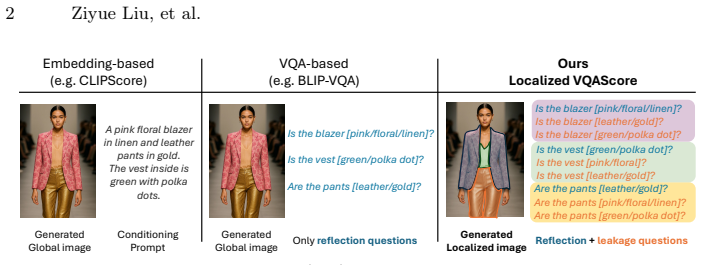
L-VQAScore is the paper's proposed metric. Its pipeline is: (1) query localization, where a segmentation model (Grounded-SAM-2, combining text-grounded detection with the Segment Anything architecture) produces a mask $M_i$ for each entity $e_i$ in a structured version of the prompt, the image outside the mask is blurred, and the region is cropped and resized; (2) attribute presence scoring, where a VQA model (CLIP-Flan-T5-xxl in the final form) answers templated questions with probability $\mathrm{Prob}(\text{'Yes'} \mid q)$ on each localized region, with reflection questions $Q_r$ asking whether the intended attribute is present and leakage questions $Q_l$ asking whether another entity's attribute has leaked there; and (3) metric computation, where reflection answers count as true/false positives and leakage answers as true/false negatives, yielding precision, recall, and F1. The design is carried by the idea that restricting the VQA model's visual input to the relevant garment prevents bag-of-words global matching from rewarding an attribute that is present anywhere in the image.
What would settle it
On a new held-out set of multi-garment fashion prompts, compare L-VQAScore rankings against independently collected localized human answers and compute segmentation masks' IoU against manual masks; the claim would fail if L-VQAScore's rank correlation does not beat VQAScore's, if any swapped-attribute description outscores its correct counterpart, or if low-IoU cases do not account for the errors.
Extended reading notes
Core claim
The paper's central claim is that attribute confusion in text-to-image generation is a distinct, measurable failure that existing metrics systematically miss, and that it can be detected by combining visual localization with attribute-level visual question answering. Concretely, L-VQAScore segments each garment named in the prompt, blurs and crops the surrounding context, and asks a VQA model two kinds of yes/no questions: reflection questions about whether the expected attribute appears on that garment, and leakage questions about whether attributes belonging to other garments appear there as well. Treating reflection answers as positives and leakage answers as negatives, it reports precision, recall, and F1 for each generated image. On the authors' benchmark, L-VQAScore reaches Spearman $\rho = 0.818$ and Kendall $\tau = 0.650$ against the localized human study, outperforming VQAScore ($0.704/0.536$) and BLIP-VQA ($0.636/0.492$), and its failure rate on an attribute-swapping test is $0.00$, compared with $46.1$ for CLIPScore and $4.62$ for VQAScore. The intended conclusion is that localization plus explicit leakage checking, not stronger global alignment, is what lets an automatic metric recognize fine-grained entity-attribute bindings.
Load-bearing premise
The load-bearing premise is that the segmentation model reliably isolates each garment, because the VQA questions are answered on blurred-and-cropped regions of the entity mask; if a mask misses or misplaces a garment, both reflection and leakage answers are corrupted before the metric is computed.
Editorial extensions
If this is right
- Localized human evaluation with reflection and leakage questions raises inter-annotator agreement on attribute-level judgments to about 93%, versus 63.5% for the Likert protocol, so the paper's protocol is a more reliable reference for compositionality evaluation.
- Because L-VQAScore reports precision and recall separately, it can distinguish two failure modes: an intended attribute that was never generated (recall loss) and an attribute that was generated on the wrong entity (precision loss).
- The 0.00 failure rate on attribute-swapped descriptions means that, on this benchmark, L-VQAScore never prefers an image paired with a scrambled prompt over the same image paired with the correct prompt, so it can serve as a cheap first-pass detector of attribute confusion.
- The ablation results imply that the localization step is doing real work: removing localization drops correlation from 0.818 to 0.549, and the choice of segmentation and VQA backbones shifts results, so future stronger components should improve the metric further.
Reading between the lines
- As an extension beyond the paper, the same reflection/leakage design could transfer to other multi-entity compositional domains, such as scene graphs or medical captions, wherever a prompt names several objects each with distinct attributes; a testable prediction is that global VQA metrics will again under-detect swaps there.
- The attribute-swapping test used in the paper could be turned into a standalone diagnostic suite, independent of human ratings: any metric that gives a swapped prompt a higher score than the correct one is provably confused about entity-attribute binding.
- The paper's reliance on a strong segmentation model suggests a practical ceiling: on garments or domains where open-vocabulary segmentation is unreliable, L-VQAScore's advantage over global VQA may shrink, so coupling the metric with prompt-aware panoptic segmentation could extend its reach.
- Leakage questions also carry generative potential: a generation system could use the same reflection/leakage probes as a reward or correction signal to prevent misattributed attributes at inference time.
Editorial analysis
A structured set of objections, weighed in public.
Referee Report
Summary. The paper introduces L-VQAScore, an automatic metric for evaluating attribute confusion in fashion text-to-image generation. The metric localizes each garment using a segmentation model, blurs and crops the surrounding context, asks a VQA model both reflection questions (whether an expected attribute appears on the correct entity) and leakage questions (whether an attribute is incorrectly present on another entity), and computes Precision, Recall, and F1. The authors construct a benchmark of 50 outfit descriptions and 250 images from five T2I models, run a localized human study that reaches 93.2% agreement, and report that L-VQAScore achieves Spearman rho 0.818 versus 0.704 for VQAScore and 0.636 for BLIP-VQA, with a 0.00 failure rate on an attribute-swapping test. The paper argues that localization-aware VQA with reflection and leakage questions is a more reliable automatic detector of attribute confusion than global embedding or global VQA metrics.
Significance. If the reported correlations are reliable, the paper makes a useful contribution: it identifies a specific and understudied failure mode of T2I metrics, proposes a human evaluation protocol that substantially improves annotator agreement compared to Likert-scale ratings, and demonstrates that a localization-aware, question-based metric can track human judgments more closely than global baselines. The problem formulation is clear, the attribute-swapping test is a clean controlled probe of attribute confusion, and the paper includes ablation studies of both the localization strategy and the VQA backbone. The authors also provide explicit connections to Fashionpedia and to prior VQA-based metrics, which helps situate the work. The main uncertainty is whether the empirical evidence supports the claimed superiority, given the small sample size and the selection of components on the evaluation set.
major comments (3)
- [Sec. 5.1, Table 2] The central claim that L-VQAScore outperforms VQAScore rests on Spearman rho and Kendall tau computed over only 25 groups (N=25). The paper reports no confidence intervals, significance tests, or bootstrap estimates. With N=25, the approximate standard error of a Spearman correlation is about 0.2 (1/sqrt(24)), so the observed gap of 0.114 between rho=0.818 and rho=0.704 is well within sampling noise. The averaging over five random seeds does not change the effective sample size for the group-level correlation. The authors should report bootstrap confidence intervals, permutation tests, or a proper test for dependent correlations, and should discuss whether the advantage over VQAScore is statistically meaningful.
- [Sec. 5.2, Table 3] The final configuration of L-VQAScore—the Blurring and Cropping localization strategy and the CLIP-Flan-T5-xxl VQA model—is selected by maximizing the same human-correlation objective on the same 50-prompt benchmark that is used for the headline numbers in Table 2. Choosing the best of several variants on the evaluation set can inflate the reported performance, so the measured 0.818 may reflect selection bias rather than a generally superior metric. The paper should use a held-out validation split, nested cross-validation, or at minimum report the correlation for a pre-specified configuration that was not tuned on the test set.
- [Sec. 4.1, Eqs. (1)-(3)] L-VQAScore relies on the accuracy of the segmentation mask M_i for each entity. A missed, extra, or misaligned mask directly corrupts the blurred-and-cropped visual input used for both reflection and leakage questions, because the VQA questions are asked only on the localized region. The paper does not quantify segmentation accuracy on the generated images; the only evidence is the qualitative statement in Sec. 5.2 that OV-SEG 'struggles to segment fashion-related entities.' The authors should report mask quality (e.g., IoU against manual masks on a subset) or a sensitivity analysis that compares the metric's correlation when using predicted masks versus oracle masks. Without such evidence, it is unclear whether the method's advantage is driven by the localization step or by other components, and whether the approach will transfer to new fashion images or domains.
minor comments (4)
- [Sec. 3.1 and Sec. 4.2] The human protocol and the automatic metric use the same entity-attribute decomposition and the same reflection/leakage question templates. This structural overlap means that part of the measured agreement is built into the design rather than independently discovered. The authors should acknowledge this explicitly when interpreting the magnitude of the correlation; it does not invalidate the metric as an automation of the protocol, but it does affect how the result should be read.
- [Sec. 5.1] The question template t(e_i, a, x_i) used in Eqs. (4) and (5) is not fully specified. For reproducibility, the exact template (e.g., 'Is the [entity] [attribute]?') and the handling of plural entities should be stated, along with the number of questions per image.
- [Sec. 4.1] The hyperparameters of the localization step—crop margin, blur kernel size, and white padding size—are not reported. Please include the specific values used in the experiments.
- [Table 1] The attribute-swapping test reports failure rates as percentages but does not state the number of test cases per metric. Please report the denominator and describe how the negative (swapped) descriptions are generated from the 50 prompts.
Circularity Check
L-VQAScore's attribute-swapping zero-failure and its benchmark-selected component choices make part of the reported advantage self-confirming, but the core VQA-localization method has independent content.
-
fitted input called prediction
[Sec. 5.1 Performance measures; Sec. 5.2 Table 3; Sec. 5.1 Table 2]
"We employ rank correlation measures to quantify the agreement between automatic metric rankings and the one from the proposed localized human study. ... Blurring, Cropping(Ours) .818 .650 ... CLIP-Flan-T5-xxl [19] .818 .650"
The final localization strategy and VQA backbone are selected in Table 3 by maximizing Spearman/Kendall correlation against the same localized human study that is then used in Table 2 to report L-VQAScore's headline 0.818/0.650. Because the component selection and the headline evaluation share the same 50-prompt, 25-group benchmark, the reported superiority is the selected optimum of that search. The gap over VQAScore (0.704) and BLIP-VQA (0.636) is therefore not an out-of-sample prediction; part of the advantage may reflect selection on the evaluation set rather than a general property of the method.
-
self definitional
[Sec. 4.2, Eq. (5); Sec. 3.2, Table 1 (Bottom)]
"Leakage questions are designed to assess the presence of undesired attributes leaked from other entities, revealing attribute confusion. Formally, the set of leakage questions is constructed as: Q′l = {t(ei, a, xi) : ∀a ∈ Aj, i, j = 1, .., N, j̸= i}. ... By adopting a localized VQA strategy, inspired by our localized human evaluation, the proposed L-VQAScore can avoid failures due to attribute confusion completely on our evaluation data."
In the attribute-swapping test, the image is generated from the correct description and the negative description is obtained by swapping attributes across entities. Equations (4)-(5) construct reflection/leakage questions from the description, and Sec. 4.3 assigns positive targets to reflection and negative targets to leakage. For a swapped description, the same image now violates the reflection targets and satisfies the leakage targets, so any VQA that recognizes the visible attributes will score the swapped description lower. Thus the reported 0.00 failure rate is entailed by the metric's definition; it is a consistency check, not an empirical discovery.
full rationale
The paper is not fundamentally circular: L-VQAScore is a concrete pipeline (Grounded-SAM-2 masks, blur-and-crop, CLIP-Flan-T5-xxl VQA) whose outputs are compared with independent human Yes/No judgments, and no load-bearing self-citation chain is present. The design is openly inspired by the human protocol, and the human annotations are not generated by the metric. However, two specific steps reduce to the method's own construction. First, the 0.00 failure rate on the attribute-swapping test is entailed by Eq. (5): leakage questions explicitly ask whether an attribute of one entity appears on another, and Sec. 4.3 negatively targets those answers, so a swapped description will almost always score lower. This is a sanity check of the design, not evidence that the metric discovered attribute confusion independently. Second, the ablation in Table 3 selects the final localization strategy and VQA backbone by maximizing correlation with the very same localized human study used to report the headline numbers in Table 2. No held-out split or confidence interval is provided, so the reported 0.818 vs 0.704 advantage is optimistically biased by selection on the evaluation set. These issues affect the strength of the comparative claim, but they do not make the metric's core derivation equivalent to its inputs; the correlation between VQA answers on blurred crops and human answers remains an empirical measurement. Overall circularity score: 4.
Assumptions & free parameters
free parameters (3)
- Crop margin around bounding box =
not reported
- Blur kernel parameters =
not reported
- White padding size in Resize =
not reported
assumptions (4)
- domain assumption The conditioning prompt can be reliably parsed into structured entity-attribute pairs S = {(e_i, A_i)}.
- domain assumption Each attribute is associated with exactly one entity; leakage questions are removed when an attribute appears on multiple entities.
- domain assumption The VQA model's probability of 'Yes' is a faithful proxy for the visual presence of an attribute in the localized region.
- domain assumption Grounded-SAM-2 segmentation masks for fashion garments are sufficiently accurate on all generated images.
Cite this review
Pith. "Pith review of Evaluating Attribute Confusion in Fashion Text-to-Image Generation." pith.science (2026). https://pith.science/paper/64MABX2J
@misc{pith2026250707079,
  author       = {Pith},
  title        = {Pith review of: Evaluating Attribute Confusion in Fashion Text-to-Image Generation},
  year         = {2026},
  howpublished = {\url{https://pith.science/paper/64MABX2J}},
  note         = {Machine review of arXiv:2507.07079}
}
read the original abstract
Despite the rapid advances in Text-to-Image (T2I) generation models, their evaluation remains challenging in domains like fashion, involving complex compositional generation. Recent automated T2I evaluation methods leverage pre-trained vision-language models to measure cross-modal alignment. However, our preliminary study reveals that they are still limited in assessing rich entity-attribute semantics, facing challenges in attribute confusion, i.e., when attributes are correctly depicted but associated to the wrong entities. To address this, we build on a Visual Question Answering (VQA) localization strategy targeting one single entity at a time across both visual and textual modalities. We propose a localized human evaluation protocol and introduce a novel automatic metric, Localized VQAScore (L-VQAScore), that combines visual localization with VQA probing both correct (reflection) and miss-localized (leakage) attribute generation. On a newly curated dataset featuring challenging compositional alignment scenarios, L-VQAScore outperforms state-of-the-art T2I evaluation methods in terms of correlation with human judgments, demonstrating its strength in capturing fine-grained entity-attribute associations. We believe L-VQAScore can be a reliable and scalable alternative to subjective evaluations.
Figures

Reference graph
Works this paper leans on
-
[1]
Chefer, H., et al.: Attend-and-excite: Attention-based semantic guidance for text- to-image diffusion models. TOG (2023)
work page 2023
-
[2]
Cho, J., et al.: Davidsonian scene graph: Improving reliability in fine-grained evaluation for text-image generation. In: ICLR (2024)
work page 2024
-
[3]
Dai, W., et al.: InstructBLIP: Towards general-purpose vision-language models with instruction tuning. In: NeurIPS (2023)
work page 2023
-
[4]
Ding, M., et al.: Cogview2: Faster and better text-to-image generation via hierar- chical transformers. NeurIPS (2022)
work page 2022
-
[5]
arXiv preprint arXiv:2010.11929 (2020)
Dosovitskiy, A., et al.: An image is worth 16x16 words: Transformers for image recognition at scale. arXiv preprint arXiv:2010.11929 (2020)
arXiv 2020
-
[6]
Esser, P., et al.: Scaling rectified flow transformers for high-resolution image syn- thesis. In: ICML (2024)
work page 2024
-
[7]
arXiv preprint arXiv:2212.05032 (2022) 12 Ziyue Liu, et al
Feng, W., et al.: Training-free structured diffusion guidance for compositional text-to-image synthesis. arXiv preprint arXiv:2212.05032 (2022) 12 Ziyue Liu, et al
arXiv 2022
-
[8]
Hessel, J., et al.: Clipscore: A reference-free evaluation metric for image captioning. In: EMNLP (2021)
work page 2021
Show all 34 references
-
[9]
NIPS (2017)
Heusel, M., et al.: Gans trained by a two time-scale update rule converge to a local nash equilibrium. NIPS (2017)
2017
-
[10]
In: NeurIPS Workshop on Deep Generative Models and Downstream Applications (2021)
Ho, J., Salimans, T.: Classifier-free diffusion guidance. In: NeurIPS Workshop on Deep Generative Models and Downstream Applications (2021)
2021
-
[11]
NeurIPS (2023)
Huang, K., et al.: T2i-compbench: A comprehensive benchmark for open-world compositional text-to-image generation. NeurIPS (2023)
2023
-
[12]
In: ECCV (2020)
Jia, M., et al.: Fashionpedia: Ontology, segmentation, and an attribute localization dataset. In: ECCV (2020)
2020
-
[13]
arXiv preprint arXiv:2109.06835 (2021)
Karpinska, M., et al.: The perils of using mechanical turk to evaluate open-ended text generation. arXiv preprint arXiv:2109.06835 (2021)
2021 arXiv
-
[14]
NeurIPS (2023)
Kirstain, Y., et al.: Pick-a-pic: An open dataset of user preferences for text-to-image generation. NeurIPS (2023)
2023
-
[15]
arXiv preprint arXiv:2502.03566 (2025)
Koishigarina, D., et al.: Clip behaves like a bag-of-words model cross-modally but not uni-modally. arXiv preprint arXiv:2502.03566 (2025)
2025
-
[16]
In: ACL (2024)
Ku, M., et al.: Viescore: Towards explainable metrics for conditional image synthesis evaluation. In: ACL (2024)
2024
-
[17]
Labs, B.F.: Flux.https://github.com/black-forest-labs/flux (2024)
2024
-
[18]
In: CVPR (2023)
Liang, F., et al.: Open-vocabulary semantic segmentation with mask-adapted clip. In: CVPR (2023)
2023
-
[19]
In: ECCV (2024)
Lin, Z., et al.: Evaluating text-to-visual generation with image-to-text generation. In: ECCV (2024)
2024
-
[20]
In: CVPR (2024)
Liu, H., et al.: Improved baselines with visual instruction tuning. In: CVPR (2024)
2024
-
[21]
In: ICML (2022)
Nichol, A.Q., et al.: Glide: Towards photorealistic image generation and editing with text-guided diffusion models. In: ICML (2022)
2022
-
[22]
In: CVPR (2023)
Otani, M., et al.: Toward verifiable and reproducible human evaluation for text-to- image generation. In: CVPR (2023)
2023
-
[23]
In: ICLR (2024)
Podell, D., et al.: Sdxl: Improving latent diffusion models for high-resolution image synthesis. In: ICLR (2024)
2024
-
[24]
In: ICML (2021)
Radford, A., et al.: Learning transferable visual models from natural language supervision. In: ICML (2021)
2021
-
[25]
arXiv preprint arXiv:2204.06125 (2022)
Ramesh, A., et al.: Hierarchical text-conditional image generation with clip latents. arXiv preprint arXiv:2204.06125 (2022)
2022 arXiv
-
[26]
arXiv preprint arXiv:2408.00714 (2024)
Ravi, N., et al.: Sam 2: Segment anything in images and videos. arXiv preprint arXiv:2408.00714 (2024)
2024 arXiv
-
[27]
arXiv preprint arXiv:2401.14159 (2024)
Ren, T., et al.: Grounded sam: Assembling open-world models for diverse visual tasks. arXiv preprint arXiv:2401.14159 (2024)
2024 arXiv
-
[28]
In: CVPR (2022)
Rombach, R., et al.: High-resolution image synthesis with latent diffusion models. In: CVPR (2022)
2022
-
[29]
https://huggingface.co/stabilityai (2024)
stability.ai: Sd-3.5-large. https://huggingface.co/stabilityai (2024)
2024
-
[30]
https://huggingface.co/HiDream-ai (2025)
vivago.ai: Hidream-i1-full. https://huggingface.co/HiDream-ai (2025)
2025
-
[31]
CoRR (2023)
Wu, X., et al.: Human preference score v2: A solid benchmark for evaluating human preferences of text-to-image synthesis. CoRR (2023)
2023
-
[32]
NeurIPS (2023)
Xu, J., et al.: Imagereward: Learning and evaluating human preferences for text-to- image generation. NeurIPS (2023)
2023
-
[33]
NeurIPS (2023)
Yarom, M., et al.: What you see is what you read? improving text-image alignment evaluation. NeurIPS (2023)
2023
-
[34]
Yuksekgonul, M., et al.: When and why vision-language models behave like bags-of- words, and what to do about it? In: ICLR (2023)
2023
Reviewed August 6, 2026 · model on record in the stance chip above.
Discussion (0). Sign in to comment.