REVIEW 3 major objections 4 minor 20 references
Estimating Dataset Dimension via Singular Metrics under the Manifold Hypothesis: Application to Inverse Problems
T0 review · 3 major / 4 minor · reviewed 2026-08-06 · deepseek-v4-flash
Pith's one-line read The paper claims that a dataset's intrinsic dimension is the numerical rank of the VAE decoder's pullback metric, and shows this recovers the known dimension 12 on a CT-image manifold.
desk verdict The core idea—estimating intrinsic dimension from the numerical rank of a VAE pullback metric—is promising and the COULE demo is clean, but the paper's central theorem justifying the encoder-based shortcut is false as stated, so the main estimates rest on an unproved equivalence. read the letter →
The pith
A machine-rendered reading of the paper's core claim, the machinery that carries it, and where it could break.
The reading
What carries the argument
The load-bearing object is the pullback metric $g = J_D^T J_D$ of the VAE decoder, a possibly degenerate Riemannian metric whose numerical rank is taken as the intrinsic dimension. The method diagonalizes $g$ (or $J_E J_E^T$) at many data points, averages the eigenvalue curves, and cuts at the first order-of-magnitude gap; Proposition 3.1 supplies the encoder-side identity $J_D^T J_D = (J_E J_E^T)^\dagger$ that justifies using the cheaper encoder Jacobian. The atlas construction then uses mixtures of invertible VAEs built from affine coupling blocks, so each chart is a bijection between a latent patch and a manifold patch, with the estimated ID fixing the latent dimension. The same measured dimension is used as a manifold constraint for the CT inverse problem and as a monitoring signal under pruning.
What would settle it
Train a VAE on a synthetic manifold of known dimension $d$ with a deliberately weakened encoder, then compare the numerical rank of $J_D^T J_D$ with that of $J_E J_E^T$: if the two ranks disagree or the encoder-based estimate no longer equals $d$, the exact-inverse assumption is doing the work and the method as implemented is not measuring the decoder metric.
Extended reading notes
Core claim
The central discovery is that the singular Riemannian metric induced by a VAE carries the dimension of the learned data manifold in its rank. Concretely, for a decoder $D$ with latent dimension smaller than the ambient dimension, the pullback metric $g = J_D^T J_D$ is degenerate exactly along the latent directions the data do not use, and the intrinsic dimension is the number of eigenvalues that are not effectively null. Proposition 3.1 states that when the encoder and decoder are exact inverses ($DE = I$) this metric equals $(J_E J_E^T)^\dagger$, so the encoder Gram matrix can be used instead, which is cheaper to compute; Algorithm 1 averages the eigenvalue spectra over a sample and looks for the first large gap. Applied to the simplified COULE dataset, the method estimates the image manifold to have dimension 12, matching the known parametrization, and the sinogram manifold dimension 11, while lPCA, MLE, and correlation-dimension baselines miss at least one of the two. The paper further reports that the estimated ID stays at 12 up to a pruning ratio of about 0.996 and then drops (to 10 and 9), matching the visible collapse in reconstruction quality.
Load-bearing premise
The estimates rely on the trained encoder and decoder being exact or near-exact inverses of each other, so that the encoder-side computation faithfully stands in for the decoder's geometry — even though a perfect inverse is mathematically impossible when the ambient dimension exceeds the latent dimension.
Editorial extensions
If this is right
- If the estimate is correct, intrinsic dimension becomes a by-product of training any VAE: one forward pass of Jacobian computation per sample, averaged, is enough.
- A correct ID fixes the latent dimension for atlas construction, replacing the heuristic choice of chart count and latent size in mixture-of-VAE manifold learning.
- Constraining CT reconstructions to the learned manifold of dimension 12 (images) and 11 (sinograms) should regularize the ill-posed inversion without hand-designed priors.
- Because the estimated ID collapses at a pruning ratio of roughly 0.996 while reconstruction loss is still flat, ID can serve as a capacity monitor that flags the onset of manifold degradation before visible artifacts appear.
Reading between the lines
- Vary the number of projection angles in the CT setup and check whether the estimated sinogram dimension tracks the information content of the measurements; if it does, the ID gap between 11 and 12 quantifies the information loss of the discrete Radon transform.
- The same rank-of-the-pullback criterion could be applied to other generative architectures by replacing the decoder with a deterministic generator; stochastic maps would require a definition of Jacobian that this paper does not address.
- Because the encoder-side form relies on $DE = I$, a direct numerical comparison of the spectra of $J_D^T J_D$ and $(J_E J_E^T)^\dagger$ on a trained VAE would show whether the practical estimates are stable when the exact-inverse assumption is violated.
- The gap-based rank detection is currently visual; formalizing it as an eigenvalue-ratio threshold or a statistical test would turn the reported estimates into an automated decision rule.
Editorial analysis
A structured set of objections, weighed in public.
Referee Report
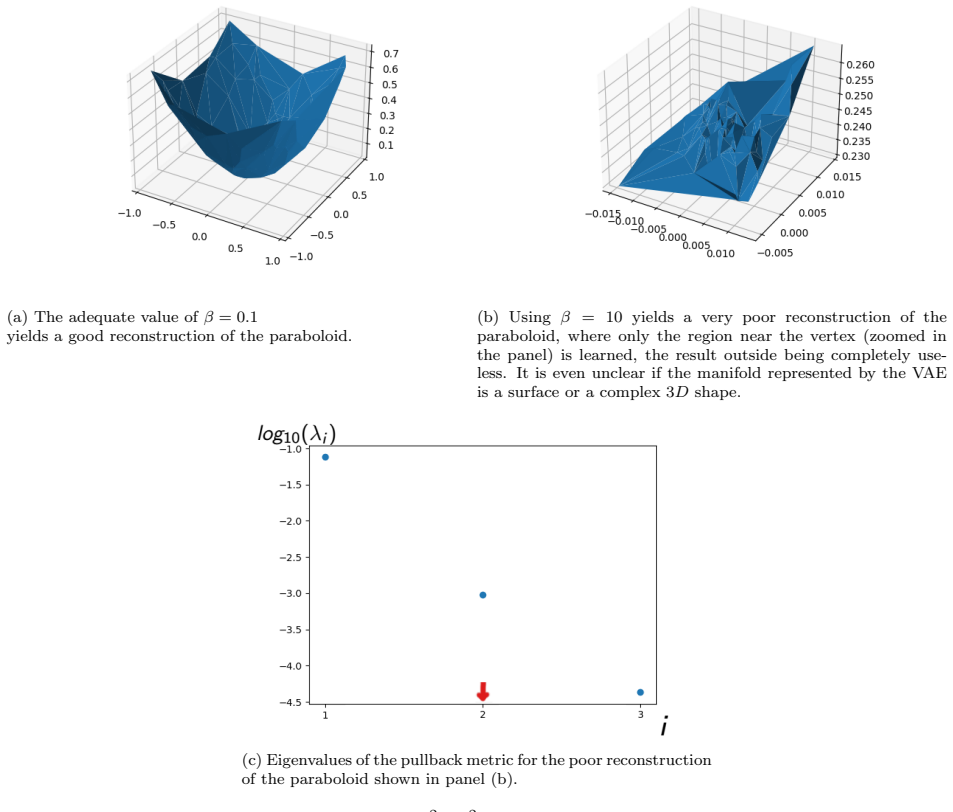
Summary. The paper proposes a method to estimate the intrinsic dimension (ID) of a data manifold under the manifold hypothesis by computing the numerical rank of a singular Riemannian metric induced by a VAE: the pullback metric J_D^T J_D of the decoder or, by a claimed equivalence, the matrix J_E J_E^T of the encoder. The estimated ID is used to set the latent dimension of a mixture of invertible VAEs that builds local charts, and the framework is applied to CT imaging on the COULE dataset, where the image manifold ID is reported as 12 and the sinogram manifold as 11. The paper also studies pruning of the VAE weights and proposes the estimated ID as a proxy for network capacity.
Significance. If the method is valid, it offers a practical, geometry-based ID estimator for generative models, with the notable strengths that the toy-circle and paraboloid examples reproduce known IDs and the COULE image ID=12 matches the known construction of the dataset. The authors provide open code, compare against three standard ID baselines, and demonstrate a plausible application to atlas construction and inverse problems. However, the paper's central theoretical justification for using the encoder metric is flawed, and the pruning analysis contains an internal inconsistency; these issues must be resolved before the contribution can be assessed reliably.
major comments (3)
- [Section 3, Proposition 3.1] The proposition is vacuous as stated. For differentiable maps E:R^n→R^m and D:R^m→R^n with n>m, the composition DE cannot equal the identity on R^n because rank(J_D J_E) ≤ min(rank J_D, rank J_E) ≤ m < n = rank(I_n). Hence the hypothesis DE=I is unsatisfiable, and the conclusion J_D^T J_D = (J_E J_E^T)^† does not follow. This is load-bearing because Algorithm 1 is implemented with J_E J_E^T (Section 5.2) and all reported ID estimates (circle, paraboloid, images, sinograms) rely on this step. The authors should replace the proposition with a restricted statement, e.g., assuming D∘E equals the identity on the data manifold M and that E has constant rank on M, in which case the numerical rank of J_E J_E^T equals dim(M), while noting that the eigenvalue spectra of the encoder- and decoder-based matrices need not coincide and that the gap criterion must be justified for J_E J_E^T separately.
- [Section 5.4, Figures 10 and 11] The pruning claim is internally inconsistent. The text states that reconstruction quality degrades beyond p=0.996 and that 'this restriction in the network's capacity for pruning ratios greater than p=0.996 is reflected by a change in the estimated intrinsic dimension, illustrated in Figure 11.' However, Figure 11 shows that the estimated ID remains 12 at p=0.996 and only drops to 10 at p=0.9999 and 9 at p=0.99995. The two thresholds do not coincide, so the ID is not acting as an early warning signal for the capacity threshold identified by reconstruction loss. The authors should either rerun the experiments to identify the pruning ratio at which ID first drops, or revise the claim to describe ID as degrading at a later, more aggressive pruning stage.
- [Section 3 and Table 1] The eigenvalue-gap criterion is subjective and no statistical support is provided. Table 1 reports single point estimates for each method, with no error bars, no repeated training runs, and no specification of the gap threshold used to declare an eigenvalue 'null'. Since the entire ID estimate hinges on this threshold, the comparison against lPCA, MLE, and CorrID is not meaningful without reporting the threshold and the variability of the estimate across training seeds or dataset subsamples.
minor comments (4)
- [Abstract] 'We how this approach' should read 'We show this approach'.
- [Hypothesis 2.1] The manifold M is said to be 'embedded in Rd' although the ambient space is later denoted R^D with D>2d+1; the notation should be corrected to R^D.
- [Algorithm 1] Step 8 instructs to 'search for the first null eigenvalue' without defining the gap threshold; a precise operationalization (e.g., relative gap > 10^k) is needed to make the algorithm reproducible.
- [Section 5.3] The number of charts K=4 is chosen from the known topology of the image manifold (S^1×S^1×(0,1)^10) rather than from the ID estimate; the text should be clearer that the ID estimate informs the latent dimension, not the number of charts.
Circularity Check
No circularity: the ID estimates are validated against externally known dimensions, and the paper's main mathematical defect (vacuous Proposition 3.1) is a correctness issue, not a circular derivation.
full rationale
The central derivation is not circular. Algorithm 1 estimates the intrinsic dimension from the numerical rank of a pullback-type metric, and no parameter is fitted to the target ID values. The toy examples (circle ID=1, paraboloid ID=2) and the COULE image ID=12 are checked against externally known dimensions, since the COULE dataset is constructed from 12 explicit geometric parameters; the atlas and pruning experiments are downstream applications and do not feed back into the estimator. The only self-citation used as infrastructure is [BCQ24] for the CT network architecture, but that architecture is not the load-bearing argument for the metric-rank ID estimate, so the ID claim stands or falls independently of that citation. The paper's real mathematical weakness is Proposition 3.1: the hypothesis DE=I with n>m is unsatisfiable by the rank inequality, so the claimed equivalence J_D^T J_D=(J_E J_E^T)^dagger is vacuous, and the subsequent switch to J_E J_E^T in Section 5.2 is mathematically unsupported. This is a validity/correctness problem rather than circularity: the reported ID values are not defined in terms of, or fitted to, the quantities against which they are checked.
Assumptions & free parameters
free parameters (4)
- Embedding latent dimension =
25
- VAE loss hyperparameters alpha, beta, gamma =
alpha=2D^2, beta=25, gamma=0.0001
- Number of atlas charts K =
4
- Eigenvalue null-gap criterion =
orders of magnitude gap, not quantified
assumptions (4)
- domain assumption Manifold Hypothesis (Hypothesis 2.1): data lie on a smooth d-dimensional Riemannian manifold embedded in ambient space with D>2d+1.
- domain assumption Encoder and decoder are approximate inverses on the data manifold, DE approx I.
- ad hoc to paper The decoder or encoder Jacobian has constant rank across the points of the manifold.
- domain assumption The COULE image manifold is S1 x S1 x (0,1)^10 and has ID=12.
Cite this review
Pith. "Pith review of Estimating Dataset Dimension via Singular Metrics under the Manifold Hypothesis: Application to Inverse Problems." pith.science (2026). https://pith.science/paper/RU4KKNN2
@misc{pith2026250707291,
  author       = {Pith},
  title        = {Pith review of: Estimating Dataset Dimension via Singular Metrics under the Manifold Hypothesis: Application to Inverse Problems},
  year         = {2026},
  howpublished = {\url{https://pith.science/paper/RU4KKNN2}},
  note         = {Machine review of arXiv:2507.07291}
}
read the original abstract
High-dimensional datasets often exhibit low-dimensional geometric structures, as suggested by the manifold hypothesis, which implies that data lie on a smooth manifold embedded in a higher-dimensional ambient space. While this insight underpins many advances in machine learning and inverse problems, fully leveraging it requires to deal with three key tasks: estimating the intrinsic dimension (ID) of the manifold, constructing appropriate local coordinates, and learning mappings between ambient and manifold spaces. In this work, we propose a framework that addresses all these challenges using a Mixture of Variational Autoencoders (VAEs) and tools from Riemannian geometry. We specifically focus on estimating the ID of datasets by analyzing the numerical rank of the VAE decoder pullback metric. The estimated ID guides the construction of an atlas of local charts using a mixture of invertible VAEs, enabling accurate manifold parameterization and efficient inference. We how this approach enhances solutions to ill-posed inverse problems, particularly in biomedical imaging, by enforcing that reconstructions lie on the learned manifold. Lastly, we explore the impact of network pruning on manifold geometry and reconstruction quality, showing that the intrinsic dimension serves as an effective proxy for monitoring model capacity.
Figures


Figures from the paper (8 more)


Reference graph
Works this paper leans on
-
[1]
Losing dimensions: Ge- ometric memorization in generative diffusion
[A VS24] Beatrice Achilli, Enrico Ventura, Gianluigi Silvestri, Gabriel Raya, Bao Pham, Dmitry Krotov, Carlo Lucibello, and Luca Ambrogioni. Losing dimensions: Ge- ometric memorization in generative diffusion. arXiv preprint arXiv:2410.08727,
-
[13]
Visualizing feature maps for model selec- tion in convolutional neural networks
[MMB+21] Sakib Mostafa, Debajyoti Mondal, Michael Beck, Christopher Bidinosti, Christopher Henry, and Ian Stavness. Visualizing feature maps for model selec- tion in convolutional neural networks. In 2021 IEEE/CVF International Con- ference on Computer Vision Workshops (ICCVW) , pages 1362–1371,
work page 2021
-
[14]
Manifold learning: What, how, and why
[MZ24] Marina Meil˘ a and Hanyu Zhang. Manifold learning: What, how, and why. Annual Review of Statistics and Its Application , 11(Volume 11, 2024):393–417,
work page 2024
-
[16]
InfoCatVAE: Representation Learning with Categorical Variational Autoencoders
Curran Associates Inc. [PL18] Edouard Pineau and Marc Lelarge. InfoCatV AE: Representation learning with categorical variational autoencoders, 10.48550/arXiv.1806.08240,
-
[18]
[TZ17] Alexandr G. Tashlinskiy and Alena V. Zhukova. Effectiveness of correlation and information measures for synthesis of recurrent algorithms for estimating spatial deformations of video sequences. CEUR Workshop Proceedings, 1901:235–239,
work page 1901
-
[19]
Score-based generative model learn manifold-like structures with constrained mixing
[WM22] Li Kevin Wenliang and Ben Moran. Score-based generative model learn manifold-like structures with constrained mixing. In NeurIPS 2022 Workshop on Score-Based Methods, 2022 [WYM20] Ge Wang, Jong Chul Ye, and Bruno De Man. Deep learning for tomographic image reconstruction. Nature Machine Intelligence , 2(12):737–748,
work page 2022
-
[20]
DOI: 10.1088/2632-2153/ad4ba5. 30 Appendix A. Architecture of the sub–networks Appendix A.1. Embedding networks The architecture of the two embedding subnetworks WS and WI is reported in Fig- ure A.12. Note that instead of using a max or average pooling layers to reduce the dimensions in the encoder, we downsample by means of convolutional layers that lea...
-
[1954]
Manifold learn- ing benefits GANs
28 [NKHN22] Yao Ni, Piotr Koniusz, Richard Hartley, and Richard Nock. Manifold learn- ing benefits GANs. In 2022 IEEE/CVF Conference on Computer Vision and Pattern Recognition (CVPR), pages 11255–11264,
work page 2022
Show all 20 references
-
[1999]
Little, Jason Lee, Yoon-Mo Jung, and Mauro Maggioni
27 [LLJM09] Anna V. Little, Jason Lee, Yoon-Mo Jung, and Mauro Maggioni. Estimation of intrinsic dimensionality of samples from noisy low-dimensional manifolds in high dimensions with multiscale SVD. In 2009 IEEE/SP 15th Workshop on Statistical Signal Processing, pages 85–88,
2009
-
[2001]
Caterini, Gabriel Loaiza-Ganem, Geoff Pleiss, and John P
[CLGPC21] Anthony L. Caterini, Gabriel Loaiza-Ganem, Geoff Pleiss, and John P. Cun- ningham. Rectangular flows for manifold learning, NeurIPS2021: 30228-30241, 2021 [COULE] COULE dataset. Available online: www.kaggle.com/loiboresearchgroup/coule- dataset, accessed Jun 11th, 20...
2021
-
[2005]
22nd International Conference on Machine Learn- ing (ICML 2005)
ACM Press. 22nd International Conference on Machine Learn- ing (ICML 2005). [TG22] Piotr Tempczyk and Adam Goliaski. Lidl: Local intrinsic dimension estimation using approximate likelihood. In International Conference on Machine Learning,
2005
-
[2011]
[L VT+19] Francesco Locatello, Damien Vincent, Ilya Tolstikhin, Gunnar R¨ atsch, Sylvain Gelly, and Bernhard Sch¨ olkopf
Springer Berlin Heidelberg. [L VT+19] Francesco Locatello, Damien Vincent, Ilya Tolstikhin, Gunnar R¨ atsch, Sylvain Gelly, and Bernhard Sch¨ olkopf. Competitive training of mixtures of independent deep generative models, arXiv preprint arXiv:1804.11130,
-
[2013]
Cress- well, and Gabriel Loaiza-Ganem
[KRH+24] Hamidreza Kamkari, Brendan Leigh Ross, Rasa Hosseinzadeh, Jesse C. Cress- well, and Gabriel Loaiza-Ganem. A geometric view of data complexity: Ef- ficient local intrinsic dimension estimation with diffusion models. ArXiv, abs/2406.03537,
-
[2014]
In- trinsic dimension estimation: Relevant techniques and a benchmark framework
24 [CCCR15] Paola Campadelli, Elena Casiraghi, Claudio Ceruti, and Alessandro Rozza. In- trinsic dimension estimation: Relevant techniques and a benchmark framework. Mathematical Problems in Engineering , 2015(1):759567,
2015
-
[2015]
Variational deep embedding: an unsupervised and generative approach to clus- tering
26 [JZT+17] Zhuxi Jiang, Yin Zheng, Huachun Tan, Bangsheng Tang, and Hanning Zhou. Variational deep embedding: an unsupervised and generative approach to clus- tering. In Proceedings of the 26th International Joint Conference on Artificial Intelligence, IJCAI’17, page 1965–197...
1965
-
[2017]
[Lip99] Alan H
https://doi.org/10.1038/nmeth.4346. [Lip99] Alan H. Lipkus. A proof of the triangle inequality for the Tanimoto distance. Journal of Mathematical Chemistry , 26:263–265,
-
[2018]
Learning manifolds and inverse problems with invertible V AEs and their mixtures
[BCQ24] Alessandro Benfenati, Paola Causin, and Martina Quinteri. Learning manifolds and inverse problems with invertible V AEs and their mixtures. arXiv preprint arXiv:2402.09277,
-
[2021]
Pel- legrini, Ralf S
[AKW+19] Lynton Ardizzone, Jakob Kruse, Sebastian Wirkert, Daniel Rahner, Eric W. Pel- legrini, Ralf S. Klessen, Lena Maier-Hein, Carsten Rother, and Ullrich K¨ othe. Analyzing inverse problems with invertible neural networks, ICLR 2019 Confer- ence,
2019
-
[2022]
[KSE18] Mahyar Khayatkhoei, Maneesh Singh, and Ahmed Elgammal
Curran Associates Inc. [KSE18] Mahyar Khayatkhoei, Maneesh Singh, and Ahmed Elgammal. Disconnected manifold learning for generative adversarial networks. In Samy Bengio, Hanna M. Wallach, Hugo Larochelle, Kristen Grauman, Nicol` o Cesa-Bianchi, and Roman Garnett, editors, Adva...
2018
-
[2024]
Effectiveness of correlation and information measures for synthesis of recurrent algorithms for estimating spatial deformations of video sequences
[MCBP14] Qaiser Mahmood, Artur Chodorowski, Babak Ehteshami Bejnordi, and Mikael Persson. Effectiveness of correlation and information measures for synthesis of recurrent algorithms for estimating spatial deformations of video sequences. SPIE Medical Imaging 2014: Biomedical A...
2014
Reviewed August 6, 2026 · model on record in the stance chip above.
Discussion (0). Sign in to comment.