REVIEW 4 major objections 5 minor 108 references
Implications of Rastall Theory on Stellar Solutions admitting Vanishing Complexity: A New Perspective
T0 review · 4 major / 5 minor · reviewed 2026-08-06 · deepseek-v4-flash
Pith's one-line read The paper claims that anisotropic stellar models built from the vanishing complexity condition are physically viable in Rastall gravity, and that a polytropic model unstable in general relativity becomes stable for nonzero values of the…
desk verdict The vanishing-complexity condition is algebraically wrong: Eq. (36) contradicts Eq. (35), so the models are not complexity-free and the Rastall-superiority claim is unsupported. read the letter →
The pith
A machine-rendered reading of the paper's core claim, the machinery that carries it, and where it could break.
The reading
What carries the argument
The central object is the structure scalar $\mathcal{Y}_{TF}$, the complexity factor obtained from the orthogonal splitting of the Riemann tensor into Weyl and Ricci parts. It carries the whole construction: setting $\mathcal{Y}_{TF}=0$ produces the vanishing-complexity condition that links the metric potentials with the fluid variables, and combining it with one of three constraints reduces the five-unknown system to solvable fourth-order differential equations in the metric potentials. The Rastall parameter $\alpha$ enters through the effective energy-momentum tensor and controls how far the solutions depart from general relativity.
What would settle it
Take the numerically generated solutions for the polytropic model and map the Rastall energy-momentum tensor to the effective Einstein tensor; if the resulting anisotropic fluid in general relativity satisfies the same energy and cracking conditions, then the stabilization is reproduced inside general relativity, undermining the claim that Rastall theory is distinct.
Extended reading notes
Core claim
In Rastall gravity, where the energy-momentum tensor has a non-zero divergence proportional to the Ricci scalar gradient, the complexity factor $\mathcal{Y}_{TF}$ obtained from the orthogonal decomposition of the Riemann tensor still encodes the combined effect of density inhomogeneity and pressure anisotropy. Setting $\mathcal{Y}_{TF}=0$ yields a non-local condition (Eq. 36) that, together with each of the three constraints, closes the under-determined field equations. The paper claims the resulting numerical solutions are non-singular, have energy density and pressures peaked at the center, meet all energy conditions, keep gravitational redshift below the observational bound, respect the Rastall-adjusted Buchdahl limit, and pass the cracking criterion except in the cases it identifies as unstable. Its headline result is that the polytropic model is unstable in general relativity but stable for nonzero Rastall parameter, which it presents as evidence that Rastall corrections improve stellar stability.
Load-bearing premise
The load-bearing premise is that Rastall gravity is a genuinely distinct theory from general relativity, with the non-conserved energy-momentum tensor as the true matter content; if the theory is only a relabeling of general relativity through an effective stress tensor, the claimed superiority of the Rastall model reduces to a choice of which anisotropic fluid is being described.
Editorial extensions
If this is right
- The complexity-factor program, developed in general relativity, remains workable in a non-conservative gravity theory: the same scalar $\mathcal{Y}_{TF}$ organizes the stellar equations.
- Polytropic anisotropic stars that develop cracking in general relativity can be stabilized by switching on the Rastall parameter, at least for $\alpha=0.1$ and $alpha=0.2$ within the paper's numerical setup.
- All three Rastall stellar models reproduce general-relativistic behavior at $\alpha=0$ and remain consistent with the standard physical viability tests for the $\alpha$ values considered.
- The Buchdahl compactness limit is numerically smaller for larger $\alpha$, meaning the Rastall corrections lower the maximum allowed mass-radius ratio for these solutions.
- The non-local equation-of-state model is stable only for $\alpha=0$ and $0.1$, while the zero-radial-pressure model is stable for all tested $\alpha$, giving a concrete stability ordering across the three constructions.
Reading between the lines
- If Rastall gravity is equivalent to general relativity through an effective stress-energy redefinition, then the claimed 'superiority' of the polytropic model may describe a particular anisotropic fluid rather than a genuinely different theory; the paper offers no quantitative rebuttal to that equivalence.
- The numerical scheme fixes the polytropic index and constant, so stability across a broader polytropic parameter space remains an open question that could be tested by repeating the calculation for other values.
- Matching these interior solutions to observed neutron-star masses and radii would test whether the Rastall-stabilized models are observationally favored over their general-relativistic counterparts.
Editorial analysis
A structured set of objections, weighed in public.
Referee Report
Summary. The paper extends Herrera's complexity-factor formalism to Rastall gravity for static, spherically symmetric, anisotropic stellar interiors. It derives the field equations and mass function, performs an orthogonal splitting of the Riemann tensor to obtain structure scalars, and identifies Y_TF as the complexity factor. Three stellar models are constructed by imposing Y_TF = 0 together with, respectively, a vanishing radial pressure, a polytropic equation of state, and a non-local equation of state. The models are solved numerically for several values of the Rastall parameter α, and their physical viability is assessed through energy conditions, redshift bounds, Buchdahl limits, and cracking stability. The paper concludes that the three models are consistent with GR and that Rastall theory yields more suitable results than GR for the polytropic model, 'indicating its superiority over Einstein's gravity theory'.
Significance. If the construction were correct, the paper would provide a useful extension of Herrera's complexity method to a non-conservative gravity theory and would offer explicit anisotropic stellar models that satisfy a vanishing-complexity condition. The authors deserve credit for deriving the Rastall field equations, defining the mass function, and checking a battery of viability criteria for three distinct models. However, the central derivation is undermined by an algebraic inconsistency between the expression for Y_TF and the condition (36) used to build all three models. The paper does not include machine-checked proofs, reproducible code, or a derivation of the structure scalars, and the numerical methods are described only vaguely. As written, the results do not support the claim that the models satisfy Y_TF = 0 or the accompanying conclusion of Rastall superiority.
major comments (4)
- [Section 3, Eqs. (35)-(36)] The condition called 'vanishing complexity' in Eq. (36) is not equivalent to setting Y_TF = 0 in Eq. (35). In the GR limit α = 0, Eq. (35) yields Π = ρ/2 − (3/(2r³))∫₀ʳ ρ r̄² d r̄, which is Herrera's standard condition after integration by parts, whereas Eq. (36) reduces to Π = ρ − (2/r³)∫₀ʳ ρ r̄² d r̄. These differ in both the local term and the integral coefficient. Since all three model-building equations in Section 5, including Eqs. (40), (41), (43), (44), and (51), are stated as consequences of Eq. (36), the numerical solutions are not shown to satisfy vanishing complexity. The paper's central claim about Rastall's superiority in model 2 therefore rests on an unvalidated constraint.
- [Section 3, Eqs. (28)-(31)] The four structure scalars are introduced with the comment 'simple but detailed calculations (which are not presented here)'. Because the identification of Y_TF as the complexity factor is foundational to the entire paper, the derivation should either be included in full or a direct reference to the Rastall-specific computation should be provided.
- [Section 4, Table 1] The numerical Buchdahl limits are presented without stating the method used to obtain them. The text only says that explicit analytical expressions cannot be derived because the equations are highly nonlinear; it does not specify the differential equations solved, the boundary conditions, or the numerical scheme. Without this information, the values 0.889, 0.772, 0.714, 0.652, and 0.636 cannot be reproduced or checked.
- [Sections 2, 5.2, and 6] The 'superiority over GR' conclusion is based on the instability of the α = 0 case versus stability for α = 0.1 and α = 0.2 in model 2. Because the models are constructed from the incorrect Eq. (36), this conclusion is unsupported. Moreover, the dismissal of Visser's equivalence argument is an assertion rather than a quantitative rebuttal; if Rastall solutions are simply GR solutions with a redefined energy-momentum tensor, then the stability difference reflects a relabeled effective fluid rather than a new physical theory. The paper should either demonstrate the physical distinctness of the Rastall fluid explicitly or soften the superiority claim.
minor comments (5)
- [Section 5.2, Eq. (42)] The notation 'η3 being a polytropic exponent' is unclear; the polytropic exponent should be defined consistently with the subsequent dimensionless variables in Eq. (45).
- [Section 5 (general)] The numerical integration is described as relying on 'carefully chosen initial conditions' without giving the actual values or solver details; please provide the initial conditions and numerical method used for each model.
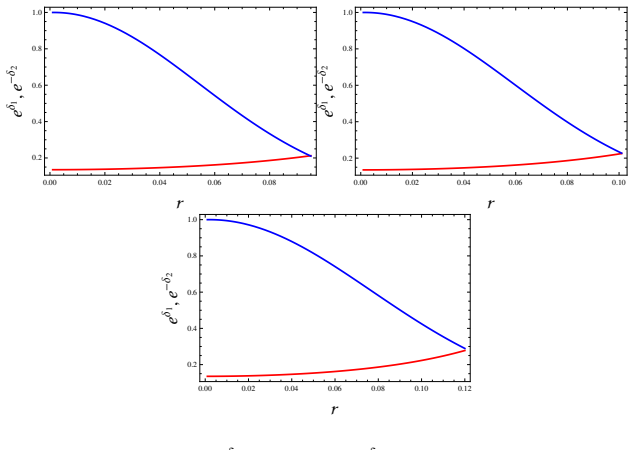
- [Figures 1-13] The figure captions contain placeholder symbols such as '/ScriptR' and '/ScriptE'; these should be replaced with standard mathematical notation (e.g., r, e^δ1, e^−δ2).
- [Abstract and Section 1] The abstract calls the vanishing complexity condition 'well-known', but Eq. (36) differs from the standard Herrera condition in the GR limit; this wording is misleading and should be revised.
- [Throughout] There are numerous typographical and language errors, such as 'heavily systems' in Section 1, 'deriv[e]' in Section 5.2, and 'orthogonally to' in Section 6; a careful proofread is needed.
Circularity Check
No significant circularity: the stellar models are constructed by imposing Y_TF=0 and chosen equations of state, with parameters scanned by hand rather than fitted, so no prediction reduces to its input by construction.
full rationale
The paper makes no empirical prediction: it constructs three static, anisotropic stellar models by imposing the vanishing complexity condition Y_TF=0 together with three different constraints (pr=0, a polytropic equation of state, and a non-local equation of state). The construction is a self-contained derivation from the Rastall field equations (10)-(12), the mass function (18), and the orthogonal decomposition of the Riemann tensor (23)-(31). No parameter is fitted to observational data: alpha, I, U, and tau are chosen or scanned by hand, and the physical viability checks in Section 4 are evaluated against the inequalities (37)-(39), not against any measured stellar dataset. There is thus no fitted-input-called-prediction pattern. The paper's rejection of Visser's GR-equivalence argument is an interpretive claim supported by an argument about other matter-geometry coupled theories, not by a self-citation chain, and it does not enter the algebraic construction of the models. The self-citations in the reference list are background references to the author's prior work on Rastall gravity and complexity; none is load-bearing for the three solutions presented here. A separate correctness concern should be noted: Eq. (36), as printed, does not follow from Eq. (35). In the GR limit alpha=0, setting Y_TF=0 in Eq. (35) gives Pi = rho/2 - (3/(2r^3)) * integral rho rbar^2 drbar (Herrera's condition), whereas Eq. (36) gives Pi = rho - (2/r^3) * integral rho rbar^2 drbar. This is an algebraic inconsistency in the vanishing-complexity constraint used for the models, and it is a serious correctness risk, but it is not circularity: a false derivation is not an input-output equivalence by construction. Because the circularity pass targets definitional or fit-based reductions rather than mathematical validity, the appropriate finding is no significant circularity.
Assumptions & free parameters
free parameters (6)
- Rastall parameter α =
0, 0.1, 0.2 (models); 0.3, 0.4 (Table 1)
- Polytropic constant I =
0.9
- Polytropic index U =
0.05 (first run); 0.06, 0.07, 0.08 (second run)
- Pressure ratio τ =
0.1
- Integration constants c1, c2, c4 =
not specified
- Non-local EoS constant c3 =
0
assumptions (6)
- domain assumption Rastall gravity is physically distinct from GR; the physical EMT T is not equivalent to the effective conserved T̃.
- domain assumption Herrera's complexity factor Y_TF retains its physical interpretation in Rastall gravity.
- domain assumption The vanishing complexity condition Y_TF=0 is a valid closure condition for stellar models.
- domain assumption The cracking criterion 0 ≤ v_r^2 - v_t^2 ≤ 1 determines stability.
- domain assumption Pointwise energy conditions (38) on the physical fluid T are the correct viability conditions.
- standard math Misner-Sharp mass function m(r)=r(1-e^{-δ2})/2 applies in Rastall gravity.
Cite this review
Pith. "Pith review of Implications of Rastall Theory on Stellar Solutions admitting Vanishing Complexity: A New Perspective." pith.science (2026). https://pith.science/paper/GTFYSOGN
@misc{pith2026250707425,
  author       = {Pith},
  title        = {Pith review of: Implications of Rastall Theory on Stellar Solutions admitting Vanishing Complexity: A New Perspective},
  year         = {2026},
  howpublished = {\url{https://pith.science/paper/GTFYSOGN}},
  note         = {Machine review of arXiv:2507.07425}
}
abstract
In this paper, the notion of complexity factor and its implication is extended to the framework of non-conserved Rastall theory of gravity. First of all, the field equations governing a static spherical geometry associated with the anisotropic fluid are formulated. The mass function corresponding to the considered geometry is defined in terms of both matter and geometric quantities. The orthogonal decomposition of the Riemann tensor is then performed through which a family of scalar quantities, known as structure scalars, is obtained. Using the Herrera's recent definition, one of the scalars among them is claimed as the complexity factor, \emph{i.e.}, $\mathcal{Y}_{TF}$. Since there are extra degrees of freedom in the gravitational equations, some constraints are needed to make their solution possible to obtain. In this regard, a well-known vanishing complexity condition is introduced along with three different constraints which ultimately lead to distinct stellar models. In order to check their physical feasibility, a detailed graphical interpretation is provided using multiple values of the Rastall parameter. It is concluded that the obtained results in all three cases are consistent with those of general relativity. Further, the Rastall theory provides more suitable results in the case of model 2, indicating its superiority over Einstein's gravity theory.
Figures


Figures from the paper (10 more)



Reference graph
Works this paper leans on
-
[1]
Riess, A.G. et al. : Astron. J. 116(1998)1009
1998
-
[2]
Perlmutter, S. et al. : Astrophys. J. 517(1999)565
1999
-
[3]
Tegmark, M. et al. : Phys. Rev. D 69(2004)103501
2004
-
[4]
Bennett, C.L. et al. : Astrophys. J. 583(2003)1
2003
-
[5]
Spergel, D.N. et al. : Astrophys. J., Suppl. Ser. 148(2003)175
2003
-
[6]
Caldwell, R.R.: Phys. Lett. B 545(2002)23
2002
-
[7]
and Odintsov, S.D.: Phys
Nojiri, S. and Odintsov, S.D.: Phys. Lett. B 565(2003)1
2003
-
[8]
High Energy Phys
Sen, A.: J. High Energy Phys. 04(2002)048
2002
Show all 108 references
-
[9]
and Moschella, U.: Phys
Gorini, V., Kamenshchik, A. and Moschella, U.: Phys. Rev. D 67(2003)063509
2003
-
[10]
Ratall, P.: Phys. Rev. D 6(1972)3357
1972
-
[11]
and Darabi, F.: Phys
Heydarzade, Y. and Darabi, F.: Phys. Lett. B 771(2017)365. 29
2017
-
[12]
and Corda, C.: Int
Licata, I., Moradpour, H. and Corda, C.: Int. J. Geom. Method s Mod. Phys. 14(2017)1730003
2017
-
[13]
and Wang, J.: Eur
Xu, Z., Hou, X., Gong, X. and Wang, J.: Eur. Phys. J. C 78(2018)01
2018
-
[14]
and Lobo, I.P.: Eur
Graca, J.M. and Lobo, I.P.: Eur. Phys. J. C 78(2018)101
2018
-
[15]
and Ghosh, S.G.: Eur
Kumar, R. and Ghosh, S.G.: Eur. Phys. J. C. 78(2018)750
2018
-
[16]
and Moradpour, H.: Eur
Bamba, K., Jawad, A., Rafique, S. and Moradpour, H.: Eur. Phys . J. C 78(2018)986
2018
-
[17]
Fabris, J.C. et al. : Int. J. Mod. Phys. D 27(2018)1841006
2018
-
[18]
and Smailagic, A.: Int
Spallucci, E. and Smailagic, A.: Int. J. Mod. Phys. D 27(2018)1850003
2018
-
[19]
and Salako, I.G.: In t
Lobo, I.P., Moradpour, H., Morais Graca, J.P. and Salako, I.G.: In t. J. Mod. Phys. D 27(2018)1850069
2018
-
[20]
and Heydarzade, Y.: Eur
Darabi, F., Atazadeh, K. and Heydarzade, Y.: Eur. Phys. J. Plu s 133(2018)249
2018
-
[21]
and Shahidi, S.: Phys
Haghani, Z., Harko, T. and Shahidi, S.: Phys. Dark Universe 21(2018)27
2018
-
[22]
Naseer, T.: Eur. Phys. J. C 84(2024)1256
2024
-
[23]
and Sharif, M.: Class
Naseer, T. and Sharif, M.: Class. Quantum Grav. 41(2024)245006
2024
-
[24]
Sharif, M. et al. : Chin. J. Phys. 92(2024)579
2024
-
[25]
Dark Universe 46(2024)101663
Naseer, T.: Phys. Dark Universe 46(2024)101663
2024
-
[26]
Naseer, T.: Astropart. Phys. 166(2025)103073
2025
-
[27]
and Santos, N.O.: Phys
Herrera, L. and Santos, N.O.: Phys. Rep. 286(1997)53
1997
-
[28]
Ovalle, J.: Phys. Rev. D 95(2017)104019
2017
-
[29]
and Sotomayor, A.: Eur
Ovalle, J., Casadio, R., da Rocha, R. and Sotomayor, A.: Eur. Phy s. J. C 78(2018)122
2018
-
[30]
Herrera, L.: Phys. Rev. D 101(2020)104024. 30
2020
-
[31]
and Di Prisco., A.: Phys
Herrera, L., Ospino, J. and Di Prisco., A.: Phys. Rev. D 77(2008)027502
2008
-
[32]
and Fuenmayor, E.: In t
Abellan, G., Bargueno, P., Contreras, E. and Fuenmayor, E.: In t. J. Mod. Phys. D 29(2020)2050082
2020
-
[33]
Chandrasekhar, S.: Mon. Not. R. Astron. Soc. 93(1933)390
1933
-
[34]
Liu, F.K.: Mon. Not. R. Astron. Soc. 281(1996)1197
1996
-
[35]
and Herrera, L.: Phys
Abellan, G., Fuenmayor, E. and Herrera, L.: Phys. Dark Univers e 28(2020)100549
2020
-
[36]
Tooper, R.F.: Astrophys. J. 140(1964)434
1964
-
[37]
Bludman, S.A.: Astrophys. J. 183(1973)637
1973
-
[38]
and Barreto, W.: Phys
Herrera, L. and Barreto, W.: Phys. Rev. D 88(2013)084022
2013
-
[39]
and Ospino, J.: Gen
Herrera, L., Di Prisco, A., Barreto, W. and Ospino, J.: Gen. Rela tiv. Gravit. 46(2014)1827
2014
-
[40]
and Herrera, L.: Phy s
Abellan, G., Fuenmayor, E., Contreras, E. and Herrera, L.: Phy s. Dark Universe 30(2020)100632
2020
-
[41]
Feng, Y. et al. : Phys. Scr. 99(2024)085034
2024
-
[42]
and Naseer, T.: Gen
Sharif, M. and Naseer, T.: Gen. Relativ. Gravit. 55(2023)87
2023
-
[43]
Demir, E. et al. : Chin. J. Phys. 91(2024)299
2024
-
[44]
and Sharif, M.: Chin
Naseer, T. and Sharif, M.: Chin. J. Phys. 88(2024)10
2024
-
[45]
Feng, Y. et al. : Eur. Phys. J. C 85(2025)18
2025
-
[46]
Naseer, T.: Int. J. Geom. Methods Mod. Phys. (2025)255014 3
2025
-
[47]
Karmarkar, K.R.: In Proceedings of the Indian Academy of Scien ces- Section A 27(1948)56
1948
-
[48]
and Tello-Ortiz, F.: Eur
Singh, K.N., Maurya, S.K., Rahaman, F. and Tello-Ortiz, F.: Eur. Phys. J. C 79(2019)381
2019
-
[49]
and Nunez, L.A.: Eur
Ospino, J. and Nunez, L.A.: Eur. Phys. J. C 80(2020)166. 31
2020
-
[50]
Mustafa, G. et al. : Phys. Dark Universe 31(2021)100747
2021
-
[51]
Ramos, A., Arias, C., Fuenmayor, E., and Contreras, E.: Eur. Ph ys. J. C 81(2021)203
2021
-
[52]
and Naseer, T.: Phys
Sharif, M. and Naseer, T.: Phys. Scr. 97(2022)055004
2022
-
[53]
Feng, Y. et al. : Chin. J. Phys. 90(2024)372-386
2024
-
[54]
and Said, J.L.: Eur
Naseer, T. and Said, J.L.: Eur. Phys. J. C 84(2024)808
2024
-
[55]
and Fuenmayor, E.: J
Herrera, L., Di Prisco, A., Ospino, J. and Fuenmayor, E.: J. Mat h. Phys. 42(2001)2129
2001
-
[56]
and Calbet, X.: Phys
Lopez-Ruiz, R., Mancini, H.L. and Calbet, X.: Phys. Lett. A 209(1995)321
1995
-
[57]
and Lopez-Ruiz, R.: Phys
Calbet, X. and Lopez-Ruiz, R.: Phys. Rev. E 63(2001)066116
2001
-
[58]
Nikolaidis, N.S., Chatzisavvas, K.C
Panos, C.P. Nikolaidis, N.S., Chatzisavvas, K.C. and Tsouros, C.C.: Phys. Lett. A 373(2009)2343
2009
-
[59]
Herrera, L.: Phys. Rev. D 97(2018)044010
2018
-
[60]
Bel, L.: in Ann. Inst. Henri Poincare 17(1961)37
1961
-
[61]
and Troco nis, O.: Phys
Herrera, L., Ospino, J., Di Prisco, A., Fuenmayor, E. and Troco nis, O.: Phys. Rev. D 79(2009)064025
2009
-
[62]
and Ospino, J.: Phys
Herrera, L., Di Prisco, A. and Ospino, J.: Phys. Rev. D 98(2018)104059
2018
-
[63]
and Ospino, J.: Phys
Herrera, L., Di Prisco, A. and Ospino, J.: Phys. Rev. D 99(2019)044049
2019
-
[64]
and Naseer, T.: Ann
Sharif, M. and Naseer, T.: Ann. Phys. 453(2023)169311
2023
-
[65]
and Naseer, T.: Class
Sharif, M. and Naseer, T.: Class. Quantum Grav. 40(2023)035009
2023
-
[66]
and Nazar, H.: Eur
Abbas, G. and Nazar, H.: Eur. Phys. J. C 78(2018)510
2018
-
[67]
and Nazar, H.: Eur
Abbas, G. and Nazar, H.: Eur. Phys. J. C 78(2018)957
2018
-
[68]
and Shahid, W.: Phys
Manzoor, R. and Shahid, W.: Phys. Dark Universe 33(2021)100844. 32
2021
-
[69]
and Naseer, T.: Ann
Sharif, M. and Naseer, T.: Ann. Phys. 459(2023)169527
2023
-
[70]
Siza, B. et al. : Eur. Phys. J. C 84(2024)1203
2024
-
[71]
and Sharif, M.: Fortschr
Naseer, T. and Sharif, M.: Fortschr. Phys. 72(2024)2300254
2024
-
[72]
Rehman, A et al. : Nucl. Phys. B 1013(2025)116852
2025
-
[73]
and Ramos, A.: Ann
Arias, C., Contreras, E., Fuenmayor, E. and Ramos, A.: Ann. Ph ys. 436(2022)168671
2022
-
[74]
Visser, M.: Phys. Lett. B 782(2018)83
2018
-
[75]
Golovnev, A.: Ann. Phys. 461(2024)169580
2024
-
[76]
Darabi, F. et al. : Eur. Phys. J. C 78(2018)25
2018
-
[77]
and Weinhorst, B.: Astron
Schwarz, D.J. and Weinhorst, B.: Astron. Astrophys. 474(2007)717
2007
-
[78]
and Perivolaropoulos, L.: J
Antoniou, I. and Perivolaropoulos, L.: J. Cosmol. Astropart. P hys. 12(2010)012
2010
-
[79]
and Nusser, A.: J
Tiwari, P. and Nusser, A.: J. Cosmol. Astropart. Phys. 3(2016)062
2016
-
[80]
and Shafieloo, A.: Astrophys
Ripa, J. and Shafieloo, A.: Astrophys. J. 851(2017)15
2017
-
[81]
and Reiprich, T.H.: Astron
Migkas, K. and Reiprich, T.H.: Astron. Astrophys. 611(2018)A50
2018
-
[82]
Hassan, K. et al. : Chin. J. Phys. 91(2024)916
2024
-
[83]
and Mustafa, G.: Ann
Naseer, T. and Mustafa, G.: Ann. Phys. 473(2025)169886
2025
-
[84]
Quantum Grav
Koivisto, T.: Class. Quantum Grav. 23(2006)4289
2006
-
[85]
and Sunhede, D.: Phys
Kainulainen, K., Piilonen, J., Reijonen, V. and Sunhede, D.: Phys. Rev. D 76(2007)024020
2007
-
[86]
Tolman, R.C.: Phys. Rev. 35(1930)875
1930
-
[87]
and Nunez, L.A.: Can
Hernandez, H. and Nunez, L.A.: Can. J. Phys. 82(2004)29
2004
-
[88]
and Lake, K.: Comput
Delgaty, M.S.R. and Lake, K.: Comput. Phys. Commun. 115(1998)395. 33
1998
-
[89]
Ivanov, B.V.: Eur. Phys. J. C 77(2017)738
2017
-
[90]
Buchdahl, H.A.: Phys. Rev. 116(1959)1027
1959
-
[91]
Alho, A., Natario, J., Pani, P., and Raposo, G.: Phys. Rev. D 106(2022)L041502
2022
-
[92]
Ivanov, B.V.: Phys. Rev. D 65(2002)104011
2002
-
[93]
and Gleiser, R.J.: Phys
Barraco, D.E., Hamity, V.H. and Gleiser, R.J.: Phys. Rev. D 67(2003)064003
2003
-
[94]
and Pani, P.: Living Rev
Cardoso, V. and Pani, P.: Living Rev. Relativ. 22(2019)4
2019
-
[95]
and Cardoso, V .: Phys
Raposo, G., Pani, P., Bezares, M., Palenzuela, C. and Cardoso, V .: Phys. Rev. D 99(2019)104072
2019
-
[96]
and Harko, T.: Class
Bohmer, C.G. and Harko, T.: Class. Quantum Grav. 23(2022)6479
2022
-
[97]
and El Hanafy, W.: Eur
Nasheda, G.G.L. and El Hanafy, W.: Eur. Phys. J. C 82(2022)679
2022
-
[98]
and Barausse, E.: J
Boskovic, M. and Barausse, E.: J. Cosmol. Astropart. Phys. 02(2022)032
2022
-
[99]
and Veermae, H.: J
Urbano, A. and Veermae, H.: J. Cosmol. Astropart. Phys. 04(2019)011
2019
-
[100]
and Raposo, G.: Phys
Alho, A., Natario, J., Pani, P. and Raposo, G.: Phys. Rev. D, 105(2022)044025
2022
-
[101]
and Raposo, G.: Phys
Alho, A., Natario, J., Pani, P. and Raposo, G.: Phys. Rev. D 106(2022)L041502
2022
-
[102]
El Hanafy, W.: Astrophys. J. 940(2022)51
2022
-
[103]
and Awad, A.: Astrophys
El Hanafy, W. and Awad, A.: Astrophys. J. 951(2023)144
2023
-
[104]
and Maharaj, S.D.: Eur
Bhattacharya, S., Sharma, R. and Maharaj, S.D.: Eur. Phys. J. C 84(2024)64
2024
-
[105]
and de la Cruz-Dombriz, A.: arXiv:2501.07933
Fernandez, R.C. and de la Cruz-Dombriz, A.: arXiv:2501.07933
-
[106]
Herrera, L.: Phys. Lett. A 165(1992)206. 34
1992
-
[107]
and Nunez, L.A.: Class
Abreu, H., Hernandez, H. and Nunez, L.A.: Class. Quantum Gra v. 24(2007)4631
2007
-
[108]
Florides, P.S.: Proc. R. Soc. Lond. A Math. Phys. Sci. 337(1974)529. 35
1974
Reviewed August 6, 2026 · model on record in the stance chip above.
Discussion (0). Continue with ORCID to comment.