REVIEW 5 major objections 5 minor 39 references
DrugMCTS: a drug repurposing framework combining multi-agent, RAG and Monte Carlo Tree Search
T0 review · 5 major / 5 minor · reviewed 2026-08-06 · deepseek-v4-flash
Pith's one-line read DrugMCTS claims that a lightweight 7-billion-parameter model, guided by five specialized agents and Monte Carlo Tree Search, achieves 55.34% recall on DrugBank and 49.24% on KIBA, surpassing larger LLMs and deep learning baselines without…
desk verdict A useful new integration of MCTS with multi-agent RAG for drug repurposing, but the headline recall number is inflated by a ground-truth-aware output budget; the fair comparison still looks strong. read the letter →
The pith
A machine-rendered reading of the paper's core claim, the machinery that carries it, and where it could break.
The reading
What carries the argument
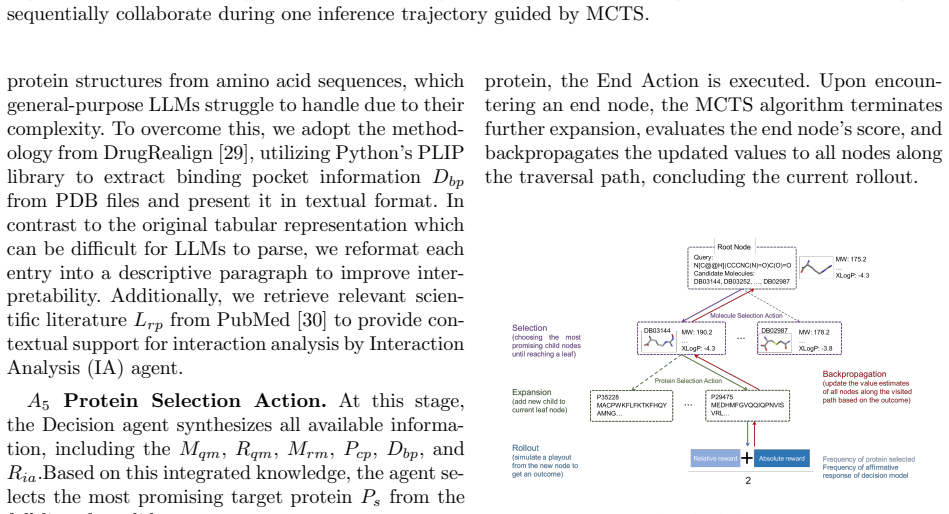
The load-bearing machinery is the combination of five specialized LLM agents with Monte Carlo Tree Search. The Retrieval Agent builds a candidate molecule pool by Tanimoto similarity and ChemBERTa cosine similarity; the Molecule-Analysis Agent converts RDKit and PubChem properties into a textual report; the Molecule-Selection Agent filters candidates for pharmacophore integrity and drug-likeness; the Interaction-Analysis Agent extracts binding-pocket descriptors from PDB files with PLIP and adds PubMed literature; and the Decision Agent selects the predicted target. MCTS selects, expands, simulates, and backpropagates over these agent actions using the UCT rule, with a final reward that averages a self-consistency score and an absolute 'yes' frequency from repeated model queries.
What would settle it
Re-run the DrugBank and KIBA evaluations with a fixed output budget for every method, for example exactly five proteins per drug, and compare recall and precision@k; if DrugMCTS no longer beats the deep-learning ensemble and the zero-shot LLMs by the reported margins, the headline result depends on oracle knowledge of the answer-set size.
Extended reading notes
Core claim
On the paper's own terms, the discovery is that retrieval-augmented multi-agent reasoning becomes decisively more accurate once Monte Carlo Tree Search is wrapped around it, and that this makes domain-specific fine-tuning unnecessary for competitive drug repositioning. With Qwen2.5-7B-Instruct as the backbone, DrugMCTS achieves a recall of 44.66% on DrugBank and 42.24% on KIBA using a base TopK rule, and 55.34% and 49.24% with TopK+3 dynamic selection, surpassing Deepseek-R1, GPT-4o-mini, and an ensemble of four deep learning models. Ablations attribute the largest gain to MCTS itself, with the molecule-analysis and interaction-analysis agents contributing several points each and the absolute reward component adding only about one point.
Load-bearing premise
The reported recall numbers assume that the number of true target proteins for each query is known in advance, because DrugMCTS and the baselines set their output count to the ground-truth count or the ground-truth count plus three.
Editorial extensions
If this is right
- A 7B-parameter model with inference-time search can replace domain fine-tuning for drug-target interaction prediction, cutting training cost and avoiding retraining-driven forgetting.
- MCTS plus agent-based filtering becomes a reusable recipe for making retrieval-augmented generation robust to noisy or long-context scientific input, addressing the 'lost in the middle' failure.
- The absolute reward contributes little (about 1% in ablations), so future gains should come from better reward signals; performance also plateaus after roughly 12 rollouts, bounding the compute-recall trade-off.
- Because the TopK+3 rule uses ground-truth target counts, operational deployment needs a separate mechanism for deciding how many proteins to output, or a ranking-based evaluation.
Reading between the lines
- Inference: on a genuinely new drug with unknown targets, the selection budget cannot be set to ground truth; comparing methods with precision@k, NDCG, or a calibrated confidence threshold would test whether the reported advantage carries over to practice.
- Inference: the candidate protein pool is built from molecules structurally similar to the query, so on a novel scaffold with few close analogues in the database, the retrieval stage itself becomes the bottleneck and the reported recall upper bound may not transfer.
- Inference: replacing the self-consistency reward with a structure-based docking score is a natural next step the authors do not test; their own case study uses docking only as post hoc validation.
Editorial analysis
A structured set of objections, weighed in public.
Referee Report
Summary. The paper proposes DrugMCTS, a drug repurposing framework that combines retrieval-augmented generation, five specialized LLM agents, and Monte Carlo Tree Search to predict protein targets for a query molecule without fine-tuning. The framework first retrieves similar molecules and their associated proteins, then uses a sequence of analysis, selection, and decision agents to build reasoning paths, with MCTS selecting among candidate proteins. The authors evaluate on DrugBank and KIBA, reporting that DrugMCTS with a TopK output strategy achieves 44.66% recall on DrugBank and 42.24% on KIBA, and that a TopK+3 output strategy reaches 55.34% and 49.24%, respectively, outperforming GPT-4o-mini, Deepseek-R1, and a four-model deep learning ensemble. The paper also includes ablations and a case study on Equol-CXCR3.
Significance. If the reported results survive scrutiny, the paper would make a useful contribution: it packages multi-agent RAG with MCTS in a relatively lightweight 7B model, avoids fine-tuning, and reports an interpretable, step-by-step reasoning pipeline. The framework is clearly described, and the ablation study showing that the MCTS process contributes beyond richer prompting is interesting. However, the central empirical claim is currently undermined by the way output budgets are chosen: the headline TopK+3 condition gives DrugMCTS three extra predictions relative to the deep learning baselines, and both the TopK and TopK+3 conditions assume knowledge of the ground-truth interaction count. The fair comparison row (Selection = GT count) still shows a real gap over baselines, so the framework is not refuted, but the specific numbers advertised in the abstract and conclusion are not yet supported. The reward function is also entirely model-internal, so the 'feedback-driven search' is more naturally interpreted as optimizing self-consistency than as optimizing biologically valid interactions.
major comments (5)
- [§3.3 and §3.4, Table 1] The headline result 'Selection = GT + 3' is not comparable to the baselines. Deep learning baselines output exactly k proteins with k equal to the ground-truth interaction count, while DrugMCTS is allowed k+3 outputs. Since recall has a fixed denominator, adding outputs cannot decrease recall and typically increases it; from the dataset statistics in Appendix Table 4, the expected random-chance recall on DrugBank rises from roughly 11% to roughly 27% when the budget grows from k to k+3. The paper reports no precision@K, no recall at a fixed K, and no baseline run with a k+3 budget, so the advertised +10.7-point DrugBank gain and +7.0-point KIBA gain may be in large part a budget effect. I ask for an equal-budget comparison (e.g., precision@K or recall at a fixed K for all systems), plus a version of Table 1 that clearly separates output-count effects from ranking quality.
- [§2.4, Eqs. (4)-(6)] The evaluation protocol assumes the number of true targets is known at inference time. Both 'Selection = GT count' and 'Selection = GT + 3' use the ground-truth interaction count to determine how many proteins DrugMCTS outputs, and the deep learning baselines are also instructed to choose top-k with k equal to the ground-truth length (Section 3.3). This is an oracle assumption: a real drug repurposing pipeline does not know in advance how many proteins a drug interacts with. The fair row (Selection = GT count) still shows a substantial improvement, but the abstract and conclusion claim built on 55.34% recall is not attainable under realistic deployment conditions. I request a non-oracle variant, for example fixing the output count to a constant or to a value estimated from the candidate pool, and reporting both recall and precision under that protocol.
- [§4.2, Table 2] The MCTS reward is computed entirely from the same LLM's outputs: the relative reward is the frequency with which the model itself selects a protein across repeated queries, and the absolute reward is the model's own yes/no rate on its own proposal. The search therefore optimizes the model's self-consistency rather than any external signal of true interaction. This is not by itself a fatal flaw, but it does mean the reported gains over baselines do not establish that the MCTS mechanism is learning biologically valid interactions; it may simply be selecting answers the model is internally confident about. The paper's own ablation (S6 vs. full reward, Table 2) shows that the absolute reward adds only about 1% over relative-only, which reinforces this concern. I ask for either an external reward signal (e.g., docking scores or a held-out classifier) or a direct analysis of how reward values correlate with ground-truth correctness.
- [§3.3] The ablation protocol changes the output count between conditions in a way that can confound the ablation comparisons. Section 4.1 states that MCTS-based baselines generate four candidate nodes during Protein Selection 'to ensure fair comparison', whereas Section 3.2 says the full pipeline generates only one node for protein selection. Since recall depends on the number of outputs, a condition that emits four proteins will have a mechanical advantage over one that emits one protein. Please report the output count used in each ablation row, or fix the output budget across all rows, so the component-wise drops are not explainable by node-count differences.
- [§5] The deep learning baseline protocol itself also uses oracle output counts: 'choosing the top-k proteins, where k corresponds to the length of the ground truth.' This makes the baseline numbers optimistic relative to any real deployment, but it is still a reasonable upper-bound baseline. The main problem is that DrugMCTS is given either the same oracle count or a larger oracle-based count, so the comparison does not isolate ranking quality. This is a load-bearing issue for the central claim and should be addressed with the equal-budget experiments described above.
minor comments (5)
- [§3.4] The text says RAG prompting made GPT-4o-mini 'drop' from 16.19% to 15.19%, but the zero-shot value in Table 1 is 15.52%; the language should be corrected to describe the actual small decrease or increase.
- [Figure 2] The caption contains a typo: 'pipeline' is misspelled as 'pipeline'.
- [§3.4] The sentence 'although the other three methods showed improved performance on the KIBA dataset' does not match Table 1, where some baseline values decrease (e.g., Deepseek-R1 RAG is lower than its zero-shot value). Please rephrase to describe the actual comparison.
- [§4.2] The ablation table caption reads 'Top-k/Top-k+3 accuracy', but the table and text report recall, not accuracy; the caption should be corrected.
- [§6] The limitations section acknowledges that the combined reward adds only about 1% over relative-only, which is useful honesty, but the statement should be reconciled with the stronger claims about the reward mechanism in the introduction and conclusion.
Circularity Check
TopK+3 recall is inflated by a ground-truth-derived output budget, and the MCTS reward is self-consistency rather than external feedback.
-
fitted input called prediction
[Section 3.3 (Deep Learning Models), Section 3.4 Results, Table 1]
"During testing, we applied majority voting to select the final answer by averaging the scores from the four models and choosing the top-k proteins, where k corresponds to the length of the ground truth. ... our dynamic adjustment strategy (TopK+3) boosted performance to 55.34% on DrugBank and 49.24% on KIBA; Table 1 rows 'Selection = GT count' (0.4466) and 'Selection = GT + 3' (0.5534)."
The number of outputs is taken from ground-truth labels: 'Selection = GT count' and 'Selection = GT + 3'. DL baselines are capped at top-k with k = GT count. Recall (Eq. 7) has a fixed denominator, so outputting more candidates cannot lower recall; the extra three outputs mechanically raise the expected recall. The +10.7-point DrugBank gain (44.66 to 55.34) therefore conflates ranking quality with an oracle-provided output budget. The 'dynamic adjustment strategy' is not a learned or predicted quantity; it is a function of the labels, making the headline recall partly forced by construction. The fair GT-count row still shows improvement, but the TopK+3 conclusion is not an equal-budget comparison.
-
self definitional
[Section 2.4, Eqs. (4)-(6)]
"The frequency of this answer serves as the relative reward. ... The frequency of affirmative responses (”yes”) is then used as the absolute reward. ... The final reward for each rollout is calculated as the average of the relative reward and the absolute reward."
Rrelative is the frequency of the model's own most-selected answer, and Rabsolute is the 'yes' rate of the same decision-making model on its own proposed interaction. Thus the MCTS 'reward' measures the model's self-consistency, not any external binding evidence. The 'feedback-driven search' claimed in Sections 1 and 2.1 reduces to maximizing the model's agreement with itself. While final recall is still measured against external labels, the mechanism's claimed 'feedback' is self-referential and cannot independently validate the interaction.
full rationale
The core derivation of DrugMCTS is not circular: the final protein selections are outputs of an LLM pipeline and are compared against external DrugBank/KIBA labels, not reconstructed from those labels. The self-citations (refs. 31, 32) are motivational and not load-bearing. Two issues lower the score. First, the headline TopK+3 result uses an oracle output budget: 'Selection = GT + 3' while baselines choose top-k with k equal to ground-truth length. Because recall has a fixed denominator and is nondecreasing in the number of outputs, the extra three outputs mechanically inflate recall; the +10.7-point DrugBank gain is therefore not an equal-budget comparison. Second, the MCTS reward (Eqs. 4-6) is computed entirely from the same LLM's own response frequencies—the relative reward is how often the model picks a protein and the absolute reward is the model's own 'yes' rate—so the claimed 'feedback-driven search' optimizes self-consistency rather than an external interaction signal. This weakens the causal interpretation of the MCTS improvement, though it does not invalidate the externally measured base recall. Overall, the fair 'Selection = GT count' row (44.66%/42.24%) still shows a substantial gain over DL baselines, so the framework is not refuted; but the specific 55.34% claim should not be treated as a ranking improvement until budgets are equalized.
Assumptions & free parameters
free parameters (6)
- Ground-truth-based selection offset (TopK+3) =
+3 over ground truth count
- Number of MCTS rollouts =
12
- Expansion width (nodes per action) =
4
- Temperature =
0.8
- Reward response count k =
4
- Retrieval top-k per similarity metric =
10
assumptions (4)
- domain assumption Structurally similar molecules tend to share protein interaction partners, so proteins bound by retrieved similar molecules form a valid candidate pool.
- ad hoc to paper LLM self-consistency (frequency of the same answer) is a useful reward signal for guiding MCTS toward correct protein selection.
- domain assumption PDB binding-pocket features extracted by PLIP and PubMed abstracts provide enough biological evidence for a general LLM to reason about drug-target interactions.
- standard math MCTS with UCT is an appropriate mechanism for composing LLM reasoning steps.
Cite this review
Pith. "Pith review of DrugMCTS: a drug repurposing framework combining multi-agent, RAG and Monte Carlo Tree Search." pith.science (2026). https://pith.science/paper/3B6WJRVM
@misc{pith2026250707426,
  author       = {Pith},
  title        = {Pith review of: DrugMCTS: a drug repurposing framework combining multi-agent, RAG and Monte Carlo Tree Search},
  year         = {2026},
  howpublished = {\url{https://pith.science/paper/3B6WJRVM}},
  note         = {Machine review of arXiv:2507.07426}
}
read the original abstract
Recent advances in large language models have demonstrated considerable potential in scientific domains such as drug repositioning. However, their effectiveness remains constrained when reasoning extends beyond the knowledge acquired during pretraining. Conventional approaches, such as fine-tuning or retrieval-augmented generation, face limitations in either imposing high computational overhead or failing to fully exploit structured scientific data. To overcome these challenges, we propose DrugMCTS, a novel framework that synergistically integrates RAG, multi-agent collaboration, and Monte Carlo Tree Search for drug repositioning. The framework employs five specialized agents tasked with retrieving and analyzing molecular and protein information, thereby enabling structured and iterative reasoning. Extensive experiments on the DrugBank and KIBA datasets demonstrate that DrugMCTS achieves substantially higher recall and robustness compared to both general-purpose LLMs and deep learning baselines. Our results highlight the importance of structured reasoning, agent-based collaboration, and feedback-driven search mechanisms in advancing LLM applications for drug repositioning.
Figures


Figures from the paper (5 more)


Reference graph
Works this paper leans on
-
[1]
D´ avid Bajusz, Anita R´ acz, and K´ aroly H´ eberger. Why is tanimoto index an appropriate choice for fingerprint-based similarity calculations? Journal of cheminformatics, 7:1–13, 2015
work page 2015
-
[2]
Guillaume Maurice Jean-Bernard Chaslot Chaslot. Monte-carlo tree search. 2010
work page 2010
-
[3]
Xinhao Che, Yujing Zhao, Qilei Liu, Fang Yu, Hanyu Gao, and Lei Zhang. Csstep: Step-by-step exploration of the chemical space of drug molecules via multi- agent and multi-stage reinforcement learning. Chem- ical Engineering Science, page 122048, 2025
work page 2025
-
[4]
Improving retrieval- augmented generation through multi-agent reinforce- ment learning
Yiqun Chen, Lingyong Yan, Weiwei Sun, Xinyu Ma, Yi Zhang, Shuaiqiang Wang, Dawei Yin, Yim- ing Yang, and Jiaxin Mao. Improving retrieval- augmented generation through multi-agent reinforce- ment learning. arXiv preprint arXiv:2501.15228 , 2025
arXiv 2025
-
[5]
Continuous upper confidence trees
Adrien Cou¨ etoux, Jean-Baptiste Hoock, Nataliya Sokolovska, Olivier Teytaud, and Nicolas Bonnard. Continuous upper confidence trees. In Learning and Intelligent Optimization: 5th International Confer- ence, LION 5, Rome, Italy, January 17-21, 2011. Se- lected Papers 5, pages 433–445. Springer, 2011
work page 2011
-
[6]
Carl Edwards, Ziqing Lu, Ehsan Hajiramezanali, Tommaso Biancalani, Heng Ji, and Gabriele Scalia. Molcap-arena: A comprehensive captioning bench- mark on language-enhanced molecular property pre- diction. arXiv preprint arXiv:2411.00737 , 2024
work page Pith review arXiv 2024
-
[7]
Deepseek-r1: Incen- tivizing reasoning capability in llms via reinforcement learning
Daya Guo, Dejian Yang, Haowei Zhang, Junxiao Song, Ruoyu Zhang, Runxin Xu, Qihao Zhu, Shirong Ma, Peiyi Wang, Xiao Bi, et al. Deepseek-r1: Incen- tivizing reasoning capability in llms via reinforcement learning. arXiv preprint arXiv:2501.12948 , 2025
arXiv 2025
-
[8]
Using autodock 4 and autodock vina with autodock- tools: a tutorial
Ruth Huey, Garrett M Morris, Stefano Forli, et al. Using autodock 4 and autodock vina with autodock- tools: a tutorial. The Scripps Research Institute Molecular Graphics Laboratory , 10550(92037):1000, 2012
work page 2012
Show all 39 references
-
[9]
Gpt-4o system card
Aaron Hurst, Adam Lerer, Adam P Goucher, Adam Perelman, Aditya Ramesh, Aidan Clark, AJ Os- trow, Akila Welihinda, Alan Hayes, Alec Rad- ford, et al. Gpt-4o system card. arXiv preprint arXiv:2410.21276, 2024
2024 arXiv
-
[10]
Lost but not only in the middle: Positional bias in retrieval augmented generation
Jan Hutter, David Rau, Maarten Marx, and Jaap Kamps. Lost but not only in the middle: Positional bias in retrieval augmented generation. In European Conference on Information Retrieval, pages 247–261. Springer, 2025
2025
-
[11]
Drugagent: Multi-agent large language model-based reasoning for drug-target interaction prediction
Yoshitaka Inoue, Tianci Song, Xinling Wang, Au- gustin Luna, and Tianfan Fu. Drugagent: Multi-agent large language model-based reasoning for drug-target interaction prediction. In ICLR 2025 Workshop on Machine Learning for Genomics Explorations , 2025
2025
-
[12]
Drugbank 6.0: the drugbank knowledgebase for 2024
Craig Knox, Mike Wilson, Christen M Klinger, Mark Franklin, Eponine Oler, Alex Wilson, Allison Pon, Jordan Cox, Na Eun Chin, Seth A Strawbridge, et al. Drugbank 6.0: the drugbank knowledgebase for 2024. Nucleic acids research, 52(D1):D1265–D1275, 2024
2024
-
[13]
Deepconv-dti: Prediction of drug-target interac- tions via deep learning with convolution on pro- tein sequences
Ingoo Lee, Jongsoo Keum, and Hojung Nam. Deepconv-dti: Prediction of drug-target interac- tions via deep learning with convolution on pro- tein sequences. PLoS computational biology , 15(6):e1007129, 2019
2019
-
[14]
Rag-enhanced collaborative llm agents for drug discovery
Namkyeong Lee, Edward De Brouwer, Ehsan Haji- ramezanali, Tommaso Biancalani, Chanyoung Park, and Gabriele Scalia. Rag-enhanced collaborative llm agents for drug discovery. arXiv preprint arXiv:2502.17506, 2025
2025
-
[15]
Alpha-sql: Zero- shot text-to-sql using monte carlo tree search
Boyan Li, Jiayi Zhang, Ju Fan, Yanwei Xu, Chong Chen, Nan Tang, and Yuyu Luo. Alpha-sql: Zero- shot text-to-sql using monte carlo tree search. arXiv preprint arXiv:2502.17248, 2025
2025 arXiv
-
[16]
Lost in the middle: How language models use long contexts
Nelson F Liu, Kevin Lin, John Hewitt, Ashwin Paran- jape, Michele Bevilacqua, Fabio Petroni, and Percy Liang. Lost in the middle: How language models use long contexts. arXiv preprint arXiv:2307.03172 , 2023
2023 arXiv
-
[17]
Drugagent: Automating ai-aided drug discovery programming through llm multi-agent collaboration
Sizhe Liu, Yizhou Lu, Siyu Chen, Xiyang Hu, Jieyu Zhao, Yingzhou Lu, and Yue Zhao. Drugagent: Automating ai-aided drug discovery programming through llm multi-agent collaboration. arXiv preprint arXiv:2411.15692, 2024
2024 arXiv
-
[18]
Does rag really per- form bad for long-context processing? arXiv preprint arXiv:2502.11444, 2025
Kun Luo, Zheng Liu, Peitian Zhang, Hongjin Qian, Jun Zhao, and Kang Liu. Does rag really per- form bad for long-context processing? arXiv preprint arXiv:2502.11444, 2025
2025 arXiv
-
[19]
Toward understanding catastrophic forgetting in con- tinual learning
Cuong V Nguyen, Alessandro Achille, Michael Lam, Tal Hassner, Vijay Mahadevan, and Stefano Soatto. Toward understanding catastrophic forgetting in con- tinual learning. arXiv preprint arXiv:1908.01091 , 2019
1908 arXiv
-
[20]
Perceiver cpi: a nested cross- attention network for compound–protein interaction prediction
Ngoc-Quang Nguyen, Gwanghoon Jang, Hajung Kim, and Jaewoo Kang. Perceiver cpi: a nested cross- attention network for compound–protein interaction prediction. Bioinformatics, 39(1):btac731, 2023
2023
-
[21]
Graphdta: predicting drug–target binding affin- ity with graph neural networks
Thin Nguyen, Hang Le, Thomas P Quinn, Tri Nguyen, Thuc Duy Le, and Svetha Venkatesh. Graphdta: predicting drug–target binding affin- ity with graph neural networks. Bioinformatics, 37(8):1140–1147, 2021
2021
-
[22]
Maximizing rag effi- ciency: A comparative analysis of rag methods
Tolga S ¸akar and Hakan Emekci. Maximizing rag effi- ciency: A comparative analysis of rag methods. Nat- ural Language Processing, 31(1):1–25, 2025
2025
-
[23]
Llm agent swarm for hypothesis-driven drug discovery
Kevin Song, Andrew Trotter, and Jake Y Chen. Llm agent swarm for hypothesis-driven drug discovery. arXiv preprint arXiv:2504.17967 , 2025
2025 arXiv
-
[24]
Pubchempy documentation
Matt Swain. Pubchempy documentation. In Pub- ChemPy documentation. 2014
2014
-
[25]
Making sense of large-scale kinase inhibitor bioactivity data sets: a comparative and in- tegrative analysis
Jing Tang, Agnieszka Szwajda, Sushil Shakyawar, Tao Xu, Petteri Hintsanen, Krister Wennerberg, and Tero Aittokallio. Making sense of large-scale kinase inhibitor bioactivity data sets: a comparative and in- tegrative analysis. Journal of chemical information and modeling, 54(3...
2014
-
[26]
Qwen2 technical report
Qwen Team. Qwen2 technical report. arXiv preprint arXiv:2412.15115, 2024
2024 arXiv
-
[27]
Assessment of fine-tuned large language models for real-world chem- istry and material science applications
Joren Van Herck, Mar ´ ıa Victoria Gil, Kevin Maik Jablonka, Alex Abrudan, Andy S Anker, Mehrdad Asgari, Ben Blaiszik, Antonio Buffo, Leander Choud- hury, Clemence Corminboeuf, et al. Assessment of fine-tuned large language models for real-world chem- istry and material scienc...
2025
-
[28]
Self-consistency improves chain of thought reasoning in language models
Xuezhi Wang, Jason Wei, Dale Schuurmans, Quoc Le, Ed Chi, Sharan Narang, Aakanksha Chowdhery, and Denny Zhou. Self-consistency improves chain of thought reasoning in language models. arXiv preprint arXiv:2203.11171, 2022
2022 arXiv
-
[29]
Drugrealign: a multisource prompt framework for drug repurposing based on large language models
Jinhang Wei, Linlin Zhuo, Xiangzheng Fu, XiangXi- ang Zeng, Li Wang, Quan Zou, and Dongsheng Cao. Drugrealign: a multisource prompt framework for drug repurposing based on large language models. BMC biology, 22(1):226, 2024
2024
-
[30]
Pubmed 2.0
Jacob White. Pubmed 2.0. Medical reference services quarterly, 39(4):382–387, 2020
2020
-
[31]
mhmg-dti: A drug-target interaction prediction framework combining modified hierarchical molecular graphs and improved convolutional block attention module
Zerui Yang, Yinqiao Li, Yudai Matsuda, and Linqi Song. mhmg-dti: A drug-target interaction prediction framework combining modified hierarchical molecular graphs and improved convolutional block attention module. In Trends and Applications in Knowledge Discovery and Data Mining...
2025
-
[32]
iresnetdm: An interpretable deep learning ap- proach for four types of dna methylation modification prediction
Zerui Yang, Wei Shao, Yudai Matsuda, and Linqi Song. iresnetdm: An interpretable deep learning ap- proach for four types of dna methylation modification prediction. Computational and Structural Biotechnol- ogy Journal, 23:4214–4221, 2024
2024
-
[33]
Drugassist: A large language model for molecule optimization
Geyan Ye, Xibao Cai, Houtim Lai, Xing Wang, Jun- hong Huang, Longyue Wang, Wei Liu, and Xiangx- iang Zeng. Drugassist: A large language model for molecule optimization. Briefings in Bioinformatics , 26(1):bbae693, 2025
2025
-
[34]
Using pymol as a platform for computational drug design
Shuguang Yuan, HC Stephen Chan, and Zhenquan Hu. Using pymol as a platform for computational drug design. Wiley Interdisciplinary Reviews: Com- putational Molecular Science , 7(2):e1298, 2017
2017
-
[35]
Rag2mol: Structure-based drug design based on retrieval augmented generation
Peidong Zhang, Xingang Peng, Rong Han, Ting Chen, and Jianzhu Ma. Rag2mol: Structure-based drug design based on retrieval augmented generation. Briefings in Bioinformatics , 26(3):bbaf265, 2025
2025
-
[36]
Fine-tuning large language models for chemical text mining
Wei Zhang, Qinggong Wang, Xiangtai Kong, Ji- acheng Xiong, Shengkun Ni, Duanhua Cao, Buying Niu, Mingan Chen, Yameng Li, Runze Zhang, et al. Fine-tuning large language models for chemical text mining. Chemical Science, 15(27):10600–10611, 2024
2024
-
[37]
Attentiondta: prediction of drug– target binding affinity using attention model
Qichang Zhao, Fen Xiao, Mengyun Yang, Yaohang Li, and Jianxin Wang. Attentiondta: prediction of drug– target binding affinity using attention model. In 2019 IEEE international conference on bioinformatics and biomedicine (BIBM), pages 64–69. IEEE, 2019
2019
-
[38]
Large language models for scientific discovery in molecular property prediction
Yizhen Zheng, Huan Yee Koh, Jiaxin Ju, Anh TN Nguyen, Lauren T May, Geoffrey I Webb, and Shirui Pan. Large language models for scientific discovery in molecular property prediction. Nature Machine Intelligence, pages 1–11, 2025
2025
-
[39]
Large language models in drug dis- covery and development: From disease mechanisms to clinical trials
Yizhen Zheng, Huan Yee Koh, Maddie Yang, Li Li, Lauren T May, Geoffrey I Webb, Shirui Pan, and George Church. Large language models in drug dis- covery and development: From disease mechanisms to clinical trials. arXiv preprint arXiv:2409.04481, 2024. A Appendix Algorithm 1 A ...
2024 arXiv
Reviewed August 6, 2026 · model on record in the stance chip above.
Discussion (0). Sign in to comment.