REVIEW 3 major objections 5 minor 37 references
Coding-Enforced Robust Secure Aggregation for Federated Learning Under Unreliable Communication
T0 review · 3 major / 5 minor · reviewed 2026-08-06 · deepseek-v4-flash
Pith's one-line read A coding scheme, SecCoGC, lets federated learning reconstruct the exact global model under unreliable links while canceling arbitrarily strong zero-sum privacy noise.
desk verdict The exact-recovery mechanism is sound, but the convergence proof analyzes a different update rule than Algorithm 1 implements, so the paper's central rate guarantee is unsupported. read the letter →
The pith
A machine-rendered reading of the paper's core claim, the machinery that carries it, and where it could break.
The reading
What carries the argument
The central object is the generator matrix $A$ together with the cyclic gradient-code pair $(G,C)$. $A \in \mathbb{R}^{K \times L}$ maps $L$ independent Gaussian components to $K$ secret keys so that each column sums to zero (correctness) and $\mathrm{rank}(A) = K-1$ (security); Construction IV.3 gives equal row norms (fairness), e.g., $A$ with diagonal entries $-2$ and off-diagonal entries $1$ for $K=5$, $\lambda^2=6$. The pair $(G,C)$ satisfies $CG = \mathbf{1}_{f \times K}$, so combining received complete partial sums with any row of $C$ whose support is contained in the received set reproduces the unweighted average of all $K$ local updates. The coding structure does the work: it fixes which coefficients each contribution receives, so the zero-sum noise is forced to cancel and partial participation cannot bias the update.
What would settle it
Run SecCoGC on a small known objective (e.g., a quadratic with known gradients) with two consecutive failed rounds followed by a success. Compare the model the server computes under Algorithm 1 with the accumulated-update value Lemma VI.2 assumes, $\sum_k \sum_{r=1}^{2} \Delta\Theta_k^{t_r,I}$. If they differ, the implemented protocol is not the one whose convergence is proved.
Extended reading notes
Core claim
The discovery is that the aggregation structure, not the noise cancellation, can be made the load-bearing element. Each client $k$ masks its local update $\Delta\Theta^{t,I}_k$ by adding a secret key $N^t_k$, with $\sum_k N^t_k = 0$. Using cyclic gradient codes whose allocation and combination matrices satisfy $CG = \mathbf{1}_{f \times K}$, relays form partial sums $S^t_k = \sum_{m \in U^t_k} g_{k,m} Y^t_m$. Whenever at least $K-s$ complete partial sums reach the server, the server picks a combinator row $c_f$ whose nonzero entries lie in the received set, and the aggregation in (12) equals $\frac{1}{K}\sum_k \Delta\Theta^{t,I}_k$ exactly; the noise terms cancel by the zero-sum property. The paper calls the decoding outcome binary: either this exact global model is obtained, or the result is not a meaningful aggregate. The paper further constructs fair real-field zero-sum noise with equal per-client power, derives per-layer local differential privacy guarantees, and proves a $99.74\%$-probability $O(1/\sqrt{T})$ convergence bound under arbitrary local solvers.
Load-bearing premise
The convergence proof assumes the server, after a series of failed rounds, rebuilds the model from all the local training done since the last successful round; the pseudocode instead transmits only the training done in the final round of that series, so the guarantee may describe a different protocol.
Editorial extensions
If this is right
- Under a failure pattern where at least $K-s$ complete partial sums arrive, the server's update is exactly the full-participation global model, so random client dropout no longer biases the optimization trajectory.
- Privacy noise strength no longer enters the convergence or accuracy picture, so clients can use arbitrarily strong masking without paying a utility price.
- Failed rounds leave no partial information: the server either reconstructs the exact global model or obtains a meaningless combination, so an adversary cannot peel off partial sums from failed aggregations.
- The fair construction (equal noise power per client, zero-sum columns) provides a privacy metric that can hold uniformly across clients under heterogeneous networks.
- The analysis supports an $O(1/\sqrt{T})$ convergence rate with probability $99.74\%$ under arbitrary local solvers and privacy levels for algorithms with binary global-model recovery.
Reading between the lines
- A failed round's output is deliberately meaningless, which suggests using failure detection as a privacy amplifier: the set of failed combiner rows could be chosen according to an adaptive privacy budget, something the paper does not explore.
- The equal-power fair construction could be rescaled per client to match heterogeneous learning weights, giving a weighted fairness notion that the paper leaves for future work.
- If the convergence-analysis mismatch is real, a protocol variant that actually transmits the accumulated update after failures would match the theorem; alternatively, the theorem's random $R_{t_s}$ bound could be rederived for incremental updates, a testable extension.
- The coding structure also gives a natural integrity check for aggregation: any server-side deviation from the fixed combinator structure is detectable, which could be combined with verifiable aggregation.
Editorial analysis
A structured set of objections, weighed in public.
Referee Report
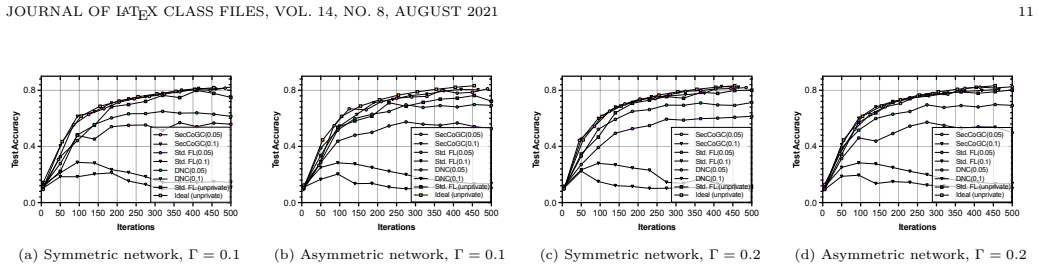
Summary. The paper proposes SecCoGC, a secure aggregation scheme for federated learning over unreliable communication. Clients mask local updates with zero-sum privacy noise, relay the masked updates through a cyclic gradient code, and the server combines complete partial sums to reconstruct the global model exactly while canceling all noise. The paper also constructs fair real-field zero-sum noises, provides local differential privacy guarantees at several protocol layers under channel outages, and gives a convergence analysis claiming O(1/sqrt(T)) with probability 99.74%. Experiments on MNIST and CINIC-10 compare SecCoGC with private and non-private baselines under varying privacy levels, heterogeneity, and network asymmetry.
Significance. If the mechanism works as intended, the paper's contribution is meaningful: it combines cyclic gradient coding with zero-sum noise so that, on a successful round, the server obtains the exact global model while the privacy noise cancels completely, and it permits arbitrarily strong privacy without sacrificing utility. The algebraic core of the scheme, Eqs. (12)-(13), is correct for a round in which clients start from the global model, and the fair noise construction in Construction IV.3 is simple and elegant. The multi-layer privacy analysis is detailed. The main weakness is that the convergence theorem analyzes an update rule different from the one implemented in Algorithm 1, so the central theoretical claim is not established for the protocol as written. The issue is fixable by aligning the algorithm with the analysis, which is why I recommend major revision rather than rejection.
major comments (3)
- [Section VI, Algorithm 1, Eq. (115a)] The convergence analysis does not match the implemented protocol. Theorem VI.1 and Lemma VI.2 analyze the accumulated local update ΔΘ^{ts,R_ts I}_k over R_ts I local iterations since the last successful global model (Eq. (115a)). In Algorithm 1, however, line 14 sets ΔΘ^{t,I}_k = Θ^{t,I}_k − Θ^{t,0}_k for the current round only, and after a failed round the next round continues from the previous local model (Section III and line 9). The server aggregation (12) therefore sums only the per-round increments of the successful round; local progress made in failed rounds is neither transmitted nor retained by the server. Consequently, Eq. (115a) describes an update rule that Algorithm 1 does not execute, and the stated O(1/sqrt(T)) convergence with probability 99.74% is not established for SecCoGC as written. The protocol should be revised so that clients transmit cumulative deltas since the last successful global model, or the analysis must be re-done for the actual update rule.
- [Section VI, footnote 13, Theorem VI.1] The failure probability P_O is a load-bearing parameter: it appears in the geometric distribution of R_ts in Lemma VI.1 and in the final bound (44). The paper does not derive P_O for SecCoGC; footnote 13 refers the reader to the authors' companion manuscript [35], an arXiv preprint. For a self-contained journal paper, the expression for P_O under the SecCoGC channel model and code parameters should be included, or the theorem should state the result conditionally on P_O with its derivation properly referenced.
- [Section VI, Lemma VI.2, Appendix H] Lemma VI.2's bound (43) is finite only when the denominator 1−2η²G²R_ts²∥a∥₁² is positive. With the learning rate η = G^{-1}√(K/T) used in Appendix H, this condition is 2(K/T)R_ts²∥a∥₁² < 1. Since R_ts is a geometric random variable with unbounded support, this condition is not guaranteed for every realized R_ts, and the event where it fails is not included in the 99.74% probability event C1∩C2 from Lemma VI.1. The theorem should either state a sufficient condition on T and ∥a∥₁ or incorporate the violation event into the probability bound.
minor comments (5)
- [Algorithm 1] Algorithm 1 contains several pseudocode problems: line 2's while condition is malformed, line 9 sets Θ^{t+1,0}_k = Θ^{t,I}_k before Θ^{t,I}_k is computed on lines 11–13, and line 32 increments an unused variable r. The pseudocode should be aligned with the prose in Section III.
- [Lemma VI.1] Lemma VI.1 states Pr(C1,C2)≈0.99872≈0.9974, which contains two inconsistent numerical values; Theorem VI.1 uses 99.74%. Please correct this to a single value with a consistent derivation.
- [Section II-A and Algorithm 1, line 14] Eq. (4) defines ΔΘ^{t,I}_k = Θ^{t,I}_k − Θ^t, while Algorithm 1 line 14 uses Θ^{t,0}_k. After a failed round the relationship between Θ^t and Θ^{t,0}_k is ambiguous and should be clarified.
- [References [21], [32], [35]] Several load-bearing derivations are deferred to the authors' own manuscripts: Lemma VI.2 is obtained by substitution into [21, Lemma 3], P_O is deferred to [35], and the complete proofs are placed in [32]. For a journal submission, the key derivations should be self-contained or properly referenced to published versions.
- [Throughout] There are numerous typographical and formatting errors, e.g., 'interation', 'Guassian', 'efficient', and 'axillary', as well as inconsistent notation such as the unexplained η = 1/L√(K/T) in Appendix H versus the theorem statement. A careful proofread is needed.
Circularity Check
No circularity found; the core coding identity and privacy analysis are self-contained, though the convergence proof has a non-circular protocol-mismatch gap.
full rationale
I find no step in the derivation chain that reduces to its own inputs. The central identity (12)-(13) rests on the cyclic-gradient-code property CG = 1_{f x K} from [34] together with the zero-sum condition (6); both are stated assumptions, not fitted or predicted quantities. The privacy theorems (V.1-V.5) are derived from the Gaussian mechanism and Construction IV.3, with details deferred to the paper's own supplementary file [32] rather than to a prior result that already contains the target claim. Lemmas IV.2-IV.4 are self-contained algebraic arguments. The convergence section is the only area with substantial self-citation: the failure probability P_O is said to be 'identical to the derivations in [35]', and Lemma VI.2 is obtained by substituting (42) into the authors' [21, Lemma 3]. These are reusable results from the authors' prior work, but Theorem VI.1 is stated for any algorithm with binary recovery and failure probability P_O, so P_O functions as an input parameter rather than as a fitted prediction; the cited lemma is parameter-free and does not presuppose the target convergence rate. Thus the self-citations are load-bearing but not circular under the definitions used here. Separately, there is a substantive correctness gap that is not circularity: Algorithm 1 line 14 transmits Delta_Theta^{t,I}_k = Theta^{t,I}_k - Theta^{t,0}_k, i.e. the current round's increment, whereas the proof of Theorem VI.1 in Eq. (115a) uses an accumulated update over all R_ts I local iterations since the last successful global model. The stated O(1/sqrt(T)) convergence with probability 99.74% is therefore not established for the protocol as written. That is a proof-protocol mismatch, not an input-equivalent derivation, and it does not make the paper's coding or privacy claims circular.
Assumptions & free parameters
free parameters (3)
- lambda (privacy noise std) =
0.05/0.1 (MNIST), 0.03/0.05 (CINIC-10)
- gamma (off-diagonal nonzeros in A) =
2 (Example IV.2)
- s (coding parameter, nonzeros per row of G) =
7 (experiments)
assumptions (6)
- domain assumption Local loss functions are G-smooth, lower bounded, unbiased gradients with bounded variance, and bounded dissimilarity (Assumptions VI.1-VI.3).
- domain assumption Inter-client and uplink channels are independent Bernoulli random variables.
- domain assumption Secret keys are generated by a key management server and each client knows only its own key; keys are Gaussian in Construction IV.3.
- ad hoc to paper Local model updates are i.i.d. Gaussian with covariance zeta^2 I_D for Theorem V.5.
- ad hoc to paper The learning rate and local steps satisfy 1 - 2*eta^2*G^2*R_ts^2*||a||_1^2 > 0 for every realized R_ts, so Lemma VI.2's bound is finite.
- standard math The cyclic gradient code from [34] has the property that any K-s complete rows allow a combination row c with CG = 1.
Cite this review
Pith. "Pith review of Coding-Enforced Robust Secure Aggregation for Federated Learning Under Unreliable Communication." pith.science (2026). https://pith.science/paper/BKJD7PSP
@misc{pith2026250707565,
  author       = {Pith},
  title        = {Pith review of: Coding-Enforced Robust Secure Aggregation for Federated Learning Under Unreliable Communication},
  year         = {2026},
  howpublished = {\url{https://pith.science/paper/BKJD7PSP}},
  note         = {Machine review of arXiv:2507.07565}
}
read the original abstract
This work studies privacy-preserving federated learning (ppFL) under unreliable communication. In ppFL, zero-sum privacy noises enables privacy protection without sacrificing model accuracy, effectively overcoming the privacy-utility trade-off. However, in practice, unreliable communication can randomly disrupt the coordination of zero-sum noises, leading to aggregation errors and unpredictable partial participation, which severely harm the model accuracy and learning performance. To overcome these challenges, we propose a robust coding-enforced structured secure aggregation method, termed secure cooperative gradient coding (SecCoGC), which enables exact reconstruction of the global model under unreliable communication while allowing for arbitrarily strong privacy preservation. In this paper, a complete problem formulation and constructions of real-field zero-sum privacy noise are presented, and fairness is introduced as a privacy metric. Privacy across all protocol layers in SecCoGC is evaluated, accounting for the correlation among privacy noises and their linear combination under unreliable communication. Moreover, a distinct convergence analysis for the FL algorithm with a binary outcome for global model recovery is provided. Experimental results demonstrate that SecCoGC achieves strong resilience to unreliable communication while maintaining varying levels of privacy preservation, yielding test accuracy improvements of up to 20%-70% over existing benchmark methods.
Figures


Figures from the paper (1 more)

Reference graph
Works this paper leans on
-
[35]
S. Weng, M. Xiao, C. Ren, and M. Skoglund, “Cooperative gradient coding,” arXiv preprint arXiv:2507.05230, 2025
work page Pith review arXiv 2025
-
[1]
J. Lee, F. Solat, T. Y. Kim, and H. V. Poor, “Federated learning- empowered mobile network management for 5g and beyond networks: From access to core,” IEEE Communications Surveys & Tutorials, vol. 26, no. 3, pp. 2176–2212, 2024
work page 2024
-
[2]
Advances and open challenges in federated foundation models,
C. Ren, H. Yu, H. Peng, X. Tang, B. Zhao, L. Yi, A. Z. Tan, Y. Gao, A. Li, X. Li et al., “Advances and open challenges in federated foundation models,” IEEE Communications Surveys & Tutorials, 2025
work page 2025
-
[3]
The algorithmic foundations of differential privacy,
C. Dwork, A. Roth et al., “The algorithmic foundations of differential privacy,” Foundations and Trends® in Theoretical Computer Science, vol. 9, no. 3–4, pp. 211–407, 2014
work page 2014
-
[4]
Privacy preserving semi-decentralized mean estimation over intermittently-connected networks,
R. Saha, M. Seif, M. Yemini, A. J. Goldsmith, and H. V. Poor, “Privacy preserving semi-decentralized mean estimation over intermittently-connected networks,” IEEE Transactions on Signal Processing, 2024
work page 2024
-
[5]
Attack-aware noise calibration for differential privacy,
B. Kulynych, J. F. Gomez, G. Kaissis, F. du Pin Calmon, and C. Troncoso, “Attack-aware noise calibration for differential privacy,” Advances in Neural Information Processing Systems, vol. 37, pp. 134 868–134 901, 2024
work page 2024
-
[6]
Locally differen- tially private online federated learning with correlated noise,
J. Zhang, L. Zhu, D. Fay, and M. Johansson, “Locally differen- tially private online federated learning with correlated noise,” IEEE Transactions on Signal Processing, 2025
work page 2025
-
[7]
Optimizing Privacy-Utility Trade-off in Decentralized Learning with Generalized Correlated Noise
A. Rodio, Z. Chen, and E. G. Larsson, “Optimizing privacy- utility trade-off in decentralized learning with generalized correlated noise,” 2025. [Online]. A vailable: https://arxiv.org/ abs/2501.14644
work page Pith review arXiv 2025
Show all 37 references
-
[8]
Dap-fl: Federated learning flourishes by adaptive tuning and secure aggregation,
Q. Chen, Z. Wang, J. Chen, H. Yan, and X. Lin, “Dap-fl: Federated learning flourishes by adaptive tuning and secure aggregation,” IEEE Transactions on Parallel and Distributed Systems, vol. 34, no. 6, pp. 1923–1941, 2023
1923
-
[9]
Practical secure aggregation for privacy-preserving machine learning,
K. Bonawitz, V. Ivanov, B. Kreuter, A. Marcedone, H. B. McMahan, S. Patel, D. Ramage, A. Segal, and K. Seth, “Practical secure aggregation for privacy-preserving machine learning,” in proceedings of the 2017 ACM SIGSAC Conference on Computer and Communications Security, 2017, ...
2017
-
[10]
Securing secure aggregation: Mitigating multi-round privacy leakage in federated learning,
J. So, R. E. Ali, B. Güler, J. Jiao, and A. S. A vestimehr, “Securing secure aggregation: Mitigating multi-round privacy leakage in federated learning,” in Proceedings of the AAAI Conference on Artificial Intelligence, vol. 37, no. 8, 2023, pp. 9864–9873
2023
-
[11]
Privacy-preserving deep learning via additively homomorphic encryption,
L. T. Phong, Y. Aono, T. Hayashi, L. Wang, and S. Moriai, “Privacy-preserving deep learning via additively homomorphic encryption,” IEEE Transactions on Information Forensics and Security, vol. 13, no. 5, pp. 1333–1345, 2018
2018
-
[12]
Turbo-aggregate: Breaking the quadratic aggregation barrier in secure federated learning,
J. So, B. Güler, and A. S. A vestimehr, “Turbo-aggregate: Breaking the quadratic aggregation barrier in secure federated learning,” IEEE Journal on Selected Areas in Information Theory, vol. 2, no. 1, pp. 479–489, 2021
2021
-
[13]
Information theoretic secure aggregation with user dropouts,
Y. Zhao and H. Sun, “Information theoretic secure aggregation with user dropouts,” IEEE Transactions on Information Theory, vol. 68, no. 11, pp. 7471–7484, 2022
2022
-
[14]
Fundamental limits of hierarchical secure aggregation with cyclic user association,
X. Zhang, Z. Li, K. Wan, H. Sun, M. Ji, and G. Caire, “Fundamental limits of hierarchical secure aggregation with cyclic user association,” 2025. [Online]. A vailable: https: //arxiv.org/abs/2503.04564
2025
-
[15]
Mds variable generation and secure sum- mation with user selection,
Y. Zhao and H. Sun, “Mds variable generation and secure sum- mation with user selection,” IEEE Transactions on Information Theory, vol. 71, no. 4, pp. 3129–3141, 2025
2025
-
[16]
Over-the-air feder- ated learning with privacy protection via correlated additive perturbations,
J. Liao, Z. Chen, and E. G. Larsson, “Over-the-air feder- ated learning with privacy protection via correlated additive perturbations,” in 2022 58th Annual Allerton Conference on Communication, Control, and Computing (Allerton), 2022, pp. 1–8
2022
-
[17]
Cod- edpaddedfl and codedsecagg: Straggler mitigation and secure aggregation in federated learning,
R. Schlegel, S. Kumar, E. Rosnes, and A. G. i Amat, “Cod- edpaddedfl and codedsecagg: Straggler mitigation and secure aggregation in federated learning,” IEEE Transactions on Com- munications, vol. 71, no. 4, pp. 2013–2027, 2023
2013
-
[18]
SCAFFOLD: Stochastic controlled averaging for federated learning,
S. P. Karimireddy, S. Kale, M. Mohri, S. Reddi, S. Stich, and A. T. Suresh, “SCAFFOLD: Stochastic controlled averaging for federated learning,” in International Conference on Machine Learning, vol. 119, 2020, pp. 5132–5143
2020
-
[19]
Tackling the objective inconsistency problem in heterogeneous federated optimization,
J. Wang, Q. Liu, H. Liang, G. Joshi, and H. V. Poor, “Tackling the objective inconsistency problem in heterogeneous federated optimization,” in Advances in Neural Information Processing Systems, vol. 33, 2020, pp. 7611–7623
2020
-
[20]
Quantized federated learning under transmission delay and outage constraints,
Y. Wang, Y. Xu, Q. Shi, and T.-H. Chang, “Quantized federated learning under transmission delay and outage constraints,” IEEE Journal on Selected Areas in Communications, vol. 40, no. 1, pp. 323–341, 2021
2021
-
[21]
Heterogeneity- aware client sampling: A unified solution for consistent federated learning,
S. Weng, C. Ren, M. Xiao, and M. Skoglund, “Heterogeneity- aware client sampling: A unified solution for consistent federated learning,” arXiv preprint:2505.11304, 2025
2025
-
[22]
Feder- ated learning in heterogeneous networks with unreliable com- munication,
P. Zheng, Y. Zhu, Y. Hu, Z. Zhang, and A. Schmeink, “Feder- ated learning in heterogeneous networks with unreliable com- munication,” IEEE Transactions on Wireless Communications, vol. 23, no. 4, pp. 3823–3838, 2023
2023
-
[23]
Communication- efficient device scheduling for federated learning using stochastic optimization,
J. Perazzone, S. Wang, M. Ji, and K. S. Chan, “Communication- efficient device scheduling for federated learning using stochastic optimization,” in IEEE INFOCOM 2022-IEEE Conference on Computer Communications, 2022, pp. 1449–1458
2022
-
[24]
Colrel: Collaborative relaying for federated learning over intermittently connected networks,
R. Saha, M. Yemini, E. Ozfatura, D. Gunduz, and A. Gold- smith, “Colrel: Collaborative relaying for federated learning over intermittently connected networks,” in Workshop on Federated Learning: Recent Advances and New Challenges (in Conjunction with NeurIPS 2022), 2022
2022
-
[25]
Robust semi-decentralized federated learning via collaborative relaying,
M. Yemini, R. Saha, E. Ozfatura, D. Gündüz, and A. J. Goldsmith, “Robust semi-decentralized federated learning via collaborative relaying,” IEEE Transactions on Wireless Com- munications, 2023
2023
-
[26]
A unified analysis of federated learning with arbitrary client participation,
S. Wang and M. Ji, “A unified analysis of federated learning with arbitrary client participation,” in Advances in Neural Information Processing Systems, vol. 35, 2022, pp. 19 124– 19 137
2022
-
[27]
A lightweight method for tackling unknown participation statistics in federated averaging,
S. Wang and M. Ji, “A lightweight method for tackling unknown participation statistics in federated averaging,” in International Conference on Learning Representations, vol. 104, 2024
2024
-
[28]
Efficient federated learning against heterogeneous and non- stationary client unavailability,
M. Xiang, S. Ioannidis, E. Yeh, C. Joe-Wong, and L. Su, “Efficient federated learning against heterogeneous and non- stationary client unavailability,” in Advances in Neural Infor- mation Processing Systems, vol. 37, 2024, pp. 104 281–104 328
2024
-
[29]
Coded coopera- tive networks for semi-decentralized federated learning,
S. Weng, M. Xiao, C. Ren, and M. Skoglund, “Coded coopera- tive networks for semi-decentralized federated learning,” IEEE Wireless Communications Letters, pp. 1–1, 2024
2024
-
[30]
Cooperative gradient coding,
S. Weng, C. Ren, M. Xiao, and M. Skoglund, “Cooperative gradient coding,” IEEE Transactions on Communications, pp. 1–1, 2025
2025
-
[31]
On secure distributed linearly separable computation,
K. Wan, H. Sun, M. Ji, and G. Caire, “On secure distributed linearly separable computation,” IEEE Journal on Selected Areas in Communications, vol. 40, no. 3, pp. 912–926, 2022
2022
-
[32]
Secure cooperative gradient coding: Optimality, reliability, and global privacy,
S. Weng, “Secure cooperative gradient coding: Optimality, reliability, and global privacy,” 2025. [Online]. A vailable: https://arxiv.org/abs/2507.07565
2025 arXiv
-
[33]
Goldreich, Foundations of Cryptography, Volume 2
O. Goldreich, Foundations of Cryptography, Volume 2. Cam- bridge university press Cambridge, 2004
2004
-
[34]
Gradient coding: A voiding stragglers in distributed learning,
R. Tandon, Q. Lei, A. G. Dimakis, and N. Karampatziakis, “Gradient coding: A voiding stragglers in distributed learning,” in International Conference on Machine Learning. PMLR, 2017, pp. 3368–3376
2017
-
[36]
Gradient- based learning applied to document recognition,
Y. LeCun, L. Bottou, Y. Bengio, and P. Haffner, “Gradient- based learning applied to document recognition,” Proceedings of the IEEE, vol. 86, no. 11, pp. 2278–2324, 1998
1998
-
[37]
Cinic-10 is not imagenet or cifar-10,
L. N. Darlow, E. J. Crowley, A. Antoniou, and A. J. Storkey, “Cinic-10 is not imagenet or cifar-10,” arXiv preprint arXiv:1810.03505, 2018. Appendices Due to the page limit, all supporting proofs are detailed in the supplementary file [ 32], which can be found at https://arxiv...
2018 arXiv
Reviewed August 6, 2026 · model on record in the stance chip above.
Discussion (0). Continue with ORCID to comment.