REVIEW 3 major objections 4 minor 55 references
First-principles analysis of the effect of magnetic states on the oxygen vacancy formation energy in doped La$_{0.5}$Sr$_{0.5}$CoO$_3$ perovskite
T0 review · 3 major / 4 minor · reviewed 2026-08-06 · deepseek-v4-flash
Pith's one-line read This paper establishes that oxygen-vacancy formation energies in doped La0.5Sr0.5CoO3 depend on the magnetic state, and that ferromagnetic-only models can mislead dopant screening.
desk verdict Systematic DFT+U study showing magnetic state matters for oxygen vacancy formation in doped cobaltite, but the 20-configuration PM sampling needs a convergence check. read the letter →
The pith
A machine-rendered reading of the paper's core claim, the machinery that carries it, and where it could break.
The reading
What carries the argument
The argument is carried by two complementary tools. First, the paramagnetic state is modelled by the magnetic sampling method: an average of 20 collinear spin configurations, each with zero total magnetic moment, in a 40-atom supercell. Second, the double exchange interaction, the coupling of two cation spins through a shared oxygen ion, is the physical mechanism invoked to explain the results: in the ferromagnetic state the oxygen between two cobalt ions bridges their spins, and removing that oxygen (or replacing a cobalt with a low-spin Ni or Cu) interrupts the bridge, changing the energetics of vacancy formation. The analysis is condensed into a band-center descriptor, the energy difference between the occupied O 2p and TM 3d band centers, whose FM–PM shift correlates linearly with the FM–PM shift in vacancy formation energy.
What would settle it
Repeat the vacancy-energy calculation for a doped system, such as Fe-doped La0.5Sr0.5CoO3, using a magnetic ensemble shown to converge (e.g., hundreds of collinear configurations or a CPA-based disordered-local-moment model), and compare the paramagnetic vacancy formation energies with the ferromagnetic ones; if the FM–PM differences of 0.3–0.4 eV vanish or reverse for either vacancy site, the central claim fails.
Extended reading notes
Core claim
The paper claims that the oxygen-vacancy formation energy in La0.5Sr0.5CoO3 doped with 3d transition metals cannot be reliably predicted from the ferromagnetic ground state alone. When a paramagnetic state is modelled by averaging collinear spin configurations, the vacancy formation energy is generally lowered relative to the ferromagnetic state, but by amounts that depend on both the dopant and the vacancy site: about 0.6 eV in undoped LSC, 0.3–0.4 eV for Mn and Fe dopants, and near zero at the nearest-neighbour vacancy for Ni and Cu. The ordering of vacancy formation energies across dopants changes between the two magnetic states, which is why ferromagnetic-only screening is misleading. The paper attributes these magnetic-state effects to double exchange: the oxygen between two cobalt ions acts as a magnetic bridge, and dopants or vacancies obstruct that bridge to different degrees. A linear correlation between the FM–PM shift in the O 2p / TM 3d band-center separation and the shift in vacancy formation energy supports this mechanism.
Load-bearing premise
The paramagnetic state is represented by an average of only 20 collinear spin configurations with zero net total moment, and the paper provides no convergence test showing that this sample captures the true magnetic ensemble.
Editorial extensions
If this is right
- Ferromagnetic-only computational screening of doped cobaltite cathodes can rank dopants incorrectly, because the paramagnetic state changes the ordering of vacancy formation energies for Mn, Fe, Ni, and Cu.
- In the paramagnetic state, which is relevant at operating temperatures, vacancy formation energies are generally lower than in the ferromagnetic state, with the largest reduction (about 0.6 eV) in undoped LSC and 0.3–0.4 eV in Mn- and Fe-doped systems.
- For Ni and Cu dopants, the nearest-neighbour vacancy formation energy is nearly unchanged between the two magnetic states, because these low-spin dopants already interrupt double exchange, while the 2NN vacancy is still lowered by about 0.2 eV.
- Oxygen vacancies reduce the energy difference between the ferromagnetic and paramagnetic states, which links vacancy formation to the experimentally observed lowering of the magnetic ordering temperature.
- The shift in the O 2p / TM 3d band-center separation between the two magnetic states correlates linearly with the shift in vacancy formation energy, providing a descriptor for which dopants will show strong magnetic-state effects.
Reading between the lines
- The paper implies but does not state that for Mn and Fe dopants, oxygen vacancies become easier to form at the high temperatures where the paramagnetic state prevails, which would make those dopants more favorable for fast ionic transport in operating fuel cells than ground-state screening would suggest.
- A practical extension is to use the linear band-center/vacancy-energy correlation as a high-throughput screening criterion: estimate the FM–PM band-center shift from a cheap electronic-structure calculation to flag dopants whose vacancy behavior is strongly magnetic-state dependent.
- By the same double-exchange logic, other low-spin B-site substituents beyond Ni and Cu should also mute the magnetic-state dependence of vacancy formation, so the need to model magnetic disorder may be weakest precisely for the dopants that most strongly suppress double exchange.
Editorial analysis
A structured set of objections, weighed in public.
Referee Report
Summary. The paper presents DFT+U calculations of oxygen vacancy formation energies in doped La0.5Sr0.5CoO3 (LSC) perovskite, comparing ferromagnetic (FM) and paramagnetic (PM) states. The PM state is modeled by averaging over 20 collinear spin configurations with zero total moment (MSM). The authors find that the vacancy formation energy depends on both the dopant (Mn, Fe, Ni, Cu) and the magnetic state, with FM-PM differences ranging from below 0.1 eV to about 0.6 eV. They attribute this magnetic-state dependence to the double exchange interaction and argue that screening based only on the FM ground state can yield misleading doping trends. A correlation between FM-PM shifts of the band-center separation and shifts of the vacancy formation energy is presented as support.
Significance. If the results hold, the work is significant for computational screening of perovskite oxide cathodes, since it challenges the common practice of evaluating defect energetics only in the magnetic ground state. The structural-distortion analysis is careful, the vacancy formation energies are direct DFT outputs, and the band-center analysis offers a potential descriptor. However, the central claim rests on a PM sampling approximation whose convergence is not demonstrated, and the correlation in Fig. 9 is overinterpreted. The study is therefore a useful contribution with a sound methodological core, but its quantitative conclusions need additional support.
major comments (3)
- [§II.B, Figs. 2 and 6-7] The PM state is represented by averaging exactly 20 collinear spin configurations with zero total magnetic moment, but no convergence test is provided: there is no check that 20 configurations are sufficient for a 40-atom supercell containing a dopant and an oxygen vacancy, no estimate of the statistical spread of individual-configuration energies, and no comparison with an independent method such as DLM-CPA for this specific system. Since the reported FM-PM differences in oxygen vacancy formation energy are 0.2-0.6 eV for most cases and below 0.1 eV for Ni/Cu at the 1NN site, even a small sampling bias could change the ordering or the qualitative trend that drives the paper's central claim. Please add convergence tests (e.g., energy vs. number of configurations, standard deviation over the ensemble, or a DLM-CPA benchmark) for at least pristine LSC and one or two doped systems.
- [§IV, Fig. 9] The statement that the linear relationship in Fig. 9 'confirms' the double-exchange hypothesis overstates the evidence. The figure contains 10 points derived from five compositions and two vacancy sites, but these points are not independent: both axes are computed from the same set of DFT calculations, and the band-center shifts are obtained from pristine crystals without vacancies. The correlation is suggestive but cannot by itself confirm a mechanistic explanation. Please rephrase this as a hypothesis and, if possible, provide additional validation (e.g., direct calculation of exchange interactions or a test on an additional dopant) and report error bars or scatter of the band-center values.
- [§III.B, Fig. 6] Several of the FM-PM differences in vacancy formation energy are small (0.2-0.6 eV, and below 0.1 eV for Ni and Cu at the 1NN site) and are comparable to typical DFT numerical uncertainties. The paper reports total-energy convergence criteria but does not provide an uncertainty estimate for the averaged PM energy, nor a sensitivity analysis with respect to the Hubbard U parameters taken from Ref. [42]. Since the qualitative conclusion of a dopant-specific magnetic-state effect depends on these small differences, a sensitivity analysis or a discussion of numerical uncertainty is needed.
minor comments (4)
- [Eq. (1)] The doping-energy formula appears to contain a sign error: the chemical potential term should be y(E_metal,M - E_metal,Co), not y(E_metal,M + E_metal,Co), since substituting one Co by M adds M and removes Co. With the plus sign the doping energy would be unphysically large. Please check and correct.
- [Fig. 3 and §II.B] The axis label in Fig. 3 is missing the degree symbol ('B-O-B angle distortion ( )'), and in §II.B the phrase 'a certain mount' should be 'a certain number'.
- [§III.C] The phrase 'the band center, as the famous effective electronic descriptor' is informal; consider replacing 'famous' with 'widely used'.
- [Fig. 9] The deliberate omission of element labels in Fig. 9 makes it difficult to assess which points correspond to which dopants; please add labels or a corresponding table.
Circularity Check
No circularity found: the oxygen vacancy formation energies are direct DFT outputs, and the band-center correlation is an independent diagnostic rather than a fitted input.
full rationale
The central claim that FM and PM states give dopant-specific oxygen vacancy formation energies is computed directly from Eq. (2) as total-energy differences of independently relaxed DFT supercells; no parameter in that equation is fitted to the vacancy data it is used to explain. The PM representation via 20 collinear spin configurations (Sec. II.B) is a modeling approximation with a real convergence concern, which the paper does not address, but that is a robustness limitation, not a circular reduction: the FM-PM energy differences are direct DFT outputs, not re-expressions of the assumed spin sample. Figure 9 plots the band-center shift, computed from pristine vacancy-free pDOS in Sec. III.C, against the E_V shift from Sec. III.B; both are independent DFT observables, and the linear fit is used only as interpretive evidence for the double-exchange narrative, not as an input that forces the reported trends. The MSM method is cited to external references [32-35], and no load-bearing step reduces to a self-citation or to a uniqueness claim by the authors. The absence of a convergence test for the 20-configuration PM sample is explicitly acknowledged in the manuscript's methodology and is weighed here as a correctness risk, but it does not make the derivation circular.
Assumptions & free parameters
free parameters (4)
- Hubbard U for Co =
3.3 eV
- Hubbard U for Mn, Fe, Cu =
4.0 eV
- Hubbard U for Ni =
6.4 eV
- Number of MSM spin configurations =
20
assumptions (4)
- domain assumption DFT+U with PBE approximates the electronic structure of La0.5Sr0.5CoO3 accurately enough for qualitative defect energy trends.
- ad hoc to paper The paramagnetic state is representable by an average of 20 collinear spin configurations with zero total magnetic moment (MSM).
- domain assumption A single ordered La/Sr configuration is representative of the disordered A-site cation arrangement.
- domain assumption The Jahn-Teller distorted pseudo-cubic structure is the correct structural reference for defect calculations.
Cite this review
Pith. "Pith review of First-principles analysis of the effect of magnetic states on the oxygen vacancy formation energy in doped La$_{0.5}$Sr$_{0.5}$CoO$_3$ perovskite." pith.science (2026). https://pith.science/paper/H2IF53CG
@misc{pith2026250707614,
  author       = {Pith},
  title        = {Pith review of: First-principles analysis of the effect of magnetic states on the oxygen vacancy formation energy in doped La$_0.5$Sr$_0.5$CoO$_3$ perovskite},
  year         = {2026},
  howpublished = {\url{https://pith.science/paper/H2IF53CG}},
  note         = {Machine review of arXiv:2507.07614}
}
abstract
Oxygen vacancies are critical for determining the electrochemical performance of fast oxygen ion conductors. The perovskite La$_{0.5}$Sr$_{0.5}$CoO$_3$, known for its excellent mixed ionic-electronic conduction, has attracted significant attention due to its favorable vacancy characteristics. In this study, we employ first-principles calculations to systematically investigate the impact of 3$d$ transition-metal doping on the oxygen vacancy formation energies in the perovskite. Two magnetic states, namely the ferromagnetic and paramagnetic states, are considered in our models to capture the influence of magnetic effects on oxygen vacancy energetics. Our results reveal that the oxygen vacancy formation energies are strongly dependent on both the dopant species and the magnetic state. Notably, the magnetic states alter the vacancy formation energy in a dopant-specific manner due to double exchange interactions, indicating that relying solely on the ferromagnetic ground state may result in misleading trends in doping behavior. These findings emphasise the importance of accounting for magnetic effects when investigating oxygen vacancy properties in perovskite oxides.
Figures
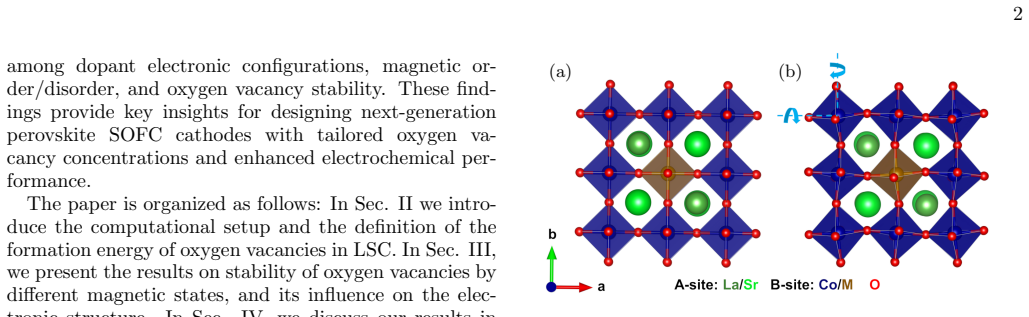


Figures from the paper (5 more)


Reference graph
Works this paper leans on
- [42]
-
[1]
A. D. Poletayev, J. A. Dawson, M. S. Islam, and A. M. Lindenberg, Defect-driven anomalous transport in fast- ion conducting solid electrolytes, Nature Materials 21, 1066 (2022)
work page 2022
-
[2]
Z. Shao and S. M. Haile, A high-performance cathode for the next generation of solid-oxide fuel cells, Nature 431, 170 (2004)
work page 2004
-
[3]
B. C. Steele and A. Heinzel, Materials for fuel-cell tech- nologies, Nature 414, 345 (2001)
work page 2001
-
[4]
M. Mogensen, D. Lybye, N. Bonanos, P. Hendriksen, and F. Poulsen, Factors controlling the oxide ion conductivity of fluorite and perovskite structured oxides, Solid State Ionics 174, 279 (2004)
work page 2004
-
[5]
A. Orera and P. Slater, New chemical systems for solid oxide fuel cells, Chemistry of Materials 22, 675 (2010)
work page 2010
-
[6]
C. Sun, J. A. Alonso, and J. Bian, Recent advances in perovskite-type oxides for energy conversion and storage applications, Advanced Energy Materials 11, 2000459 (2021)
work page 2021
-
[7]
J. A. Kilner, Fast oxygen transport in acceptor doped oxides, Solid State Ionics 129, 13 (2000)
work page 2000
Show all 55 references
-
[8]
S. J. Skinner and J. A. Kilner, Oxygen ion conductors, Materials Today 6, 30 (2003)
2003
-
[9]
Lee, Y.-L
D. Lee, Y.-L. Lee, W. T. Hong, M. D. Biegalski, D. Mor- gan, and Y. Shao-Horn, Oxygen surface exchange kinet- ics and stability of (La, Sr)2CoO4±δ/La1−xSrxMO3−δ(M= Co and Fe) hetero-interfaces at intermediate tempera- tures, Journal of Materials Chemistry A 3, 2144 (2015)
2015
-
[10]
E. D. Wachsman and K. T. Lee, Lowering the tempera- ture of solid oxide fuel cells, Science 334, 935 (2011)
2011
-
[11]
S. B. Adler, Factors governing oxygen reduction in solid oxide fuel cell cathodes, Chemical Reviews 104, 4791 (2004)
2004
-
[12]
Cheng, P
J. Cheng, P. Ganesan, Z. Wang, M. Zhang, G. Zhang, N. Maeda, J. Matsuda, M. Yamauchi, B. Chi, and N. Nakashima, Bifunctional electrochemical properties of La0.8Sr0.2Co0.8M0.2O3−δ (M= Ni, Fe, Mn, and Cu): ef- ficient elemental doping based on a structural and ph- dependent stud...
2022
-
[13]
Mantzavinos, A
D. Mantzavinos, A. Hartley, I. S. Metcalfe, and M. Sahibzada, Oxygen stoichiometries in La1−xSrxCo1−yFeyO3−δ perovskites at reduced oxy- gen partial pressures, Solid State Ionics 134, 103 (2000)
2000
-
[14]
Ingavale, M
S. Ingavale, M. Gopalakrishnan, C. M. Enoch, C. Pornrungroj, M. Rittiruam, S. Praserthdam, A. Somwangthanaroj, K. Nootong, R. Pornprasertsuk, and S. Kheawhom, Strategic design and insights into lanthanum and strontium perovskite oxides for oxygen reduction and oxygen evolution...
2024
-
[15]
W. Jia, Y. Wang, J. Huang, M. Li, B. Xiang, Y. Wang, L. Wu, L. Zheng, and L. Ge, Alternative B-site-doped La0.6Sr0.4Co0.2Fe0.8−xMxO3 (M= Ni, Cu, Nb; x= 0, 0.1, 0.2) as innovative cathode material for LT-SOFC with enhanced charge transfer and oxygen ion diffusion, Ap- plied Ene...
2024
-
[16]
H. Li, Z. Su, P. Zhang, F. Liu, C. Fan, L. Xu, G. Guo, and D. Zhang, A first-principles investigation of the effects of strain and Pd-doping on ion transfer in LSCF bulk of solid oxide cells, Computational Materials Science 227, 112276 (2023)
2023
-
[17]
T. Jia, J. W. Lekse, G. A. Hackett, and Y. Duan, Ef- fects of site and magnetic disorder on the oxygen va- cancy formation and electronic and optical properties of LaxSr1−xCoO3−δ and SrFeyCo1−yO3−δ, The Journal of Physical Chemistry C 125, 12374 (2021)
2021
-
[18]
Senarıs-Rodrıguez and J
M. Senarıs-Rodrıguez and J. Goodenough, Magnetic and transport properties of the system La 1−xSrxCoO3−δ (0≤ x≤ 0.50), Journal of Solid State Chemistry 118, 323 (1995)
1995
-
[19]
Bhide, D
V. Bhide, D. Rajoria, C. Rao, G. R. Rao, and V. Jadhao, Itinerant-electron ferromagnetism in La 1−xSrxCoO3: A M¨ ossbauer study, Physical Review B12, 2832 (1975)
1975
-
[20]
J. Meng, N. Yuan, X. Liu, C. Yao, Q. Liang, D. Zhou, F. Meng, and J. Meng, Synergistic effects of intrinsic cation disorder and electron-deficient substitution on ion and electron conductivity in La 1−xSrxCo0.5Mn0.5O3−δ (x= 0, 0.5, and 0.75), Inorganic Chemistry 54, 2820 (2015)
2015
-
[21]
Pavone, A
M. Pavone, A. B. Munoz-Garcia, A. M. Ritzmann, and E. A. Carter, First-principles study of lanthanum strontium manganite: Insights into electronic structure and oxygen vacancy formation, The Journal of Physical Chemistry C 118, 13346 (2014)
2014
-
[22]
Walter, G
J. Walter, G. Yu, B. Yu, A. Grutter, B. Kirby, J. Borchers, Z. Zhang, H. Zhou, T. Birol, M. Greven, et al., Ion-gel-gating-induced oxygen vacancy formation in epitaxial La 0.5Sr0.5CoO3−δ films from in operando X- ray and neutron scattering, Physical Review Materials 1, 071403 (2017)
2017
-
[23]
Woicik, C
J. Woicik, C. Xie, and B. Wells, Effect of strain on the lo- cal perovskite structure: La 0.5Sr0.5CoO3, Journal of Ap- plied Physics 109 (2011)
2011
-
[24]
Kubicek, Z
M. Kubicek, Z. Cai, W. Ma, B. Yildiz, H. Hutter, and J. Fleig, Tensile lattice strain accelerates oxygen surface exchange and diffusion in La 1−xSrxCoO3−δ thin films, ACS Nano 7, 3276 (2013)
2013
-
[25]
Kamecki, J
B. Kamecki, J. Karczewski, P. Jasi´ nski, and S. Molin, Improvement of oxygen electrode performance of inter- mediate temperature solid oxide cells by spray pyrolysis deposited active layers, Advanced Materials Interfaces 8, 2002227 (2021)
2021
-
[26]
Mizokawa and A
T. Mizokawa and A. Fujimori, Unrestricted hartree-fock study of transition-metal oxides: Spin and orbital or- dering in perovskite-type lattice, Physical Review B 51, 12880 (1995)
1995
-
[27]
A. Rata, A. Herklotz, K. Nenkov, L. Schultz, and K. D¨ orr, Strain-induced insulator state and giant gauge factor of La 0.7Sr0.3CoO3 films, Physical Review Letters 100, 076401 (2008)
2008
-
[28]
Z. Cai, Y. Kuru, J. W. Han, Y. Chen, and B. Yildiz, Sur- face electronic structure transitions at high temperature on perovskite oxides: the case of strained La0.8Sr0.2CoO3 thin films, Journal of the American Chemical Society 133, 17696 (2011)
2011
-
[29]
Louca, J
D. Louca, J. L. Sarrao, J. D. Thompson, H. R¨ oder, and G. Kwei, Correlation of local Jahn-Teller distortions to the magnetic/conductive states of La 1−xSrxCoO3, Phys- ical Review B 60, 10378 (1999)
1999
-
[30]
Mandal, Y
R. Mandal, Y. Mahton, C. Sowjanya, K. Sanket, S. K. Behera, and S. K. Pratihar, Electrocatalytic behaviour 10 of Cu-substituted La 0.5Sr0.5Co0.8Fe0.2−xCuxO3−δ (x= 0- 0.2) perovskite oxides, Journal of Solid State Chemistry 317, 123668 (2023)
2023
-
[31]
Baskar and S
D. Baskar and S. B. Adler, High temperature mag- netic properties of sr-doped lanthanum cobalt oxide (La1−xSrxCoO3−δ), Chemistry of Materials 20, 2624 (2008)
2008
-
[32]
Alling, T
B. Alling, T. Marten, and I. Abrikosov, Effect of magnetic disorder and strong electron correlations on the thermo- dynamics of CrN, Physical Review B—Condensed Mat- ter and Materials Physics 82, 184430 (2010)
2010
-
[33]
M. E. Merkel, A. M. Tehrani, and C. Ederer, Prob- ing the mott insulating behavior of Ba 2MgReO6 with DFT+DMFT, Physical Review Research 6, 023233 (2024)
2024
-
[34]
S. Yoon, K. Jin, S. Lee, K. T. Nam, M. Kim, and Y.-K. Kwon, Effects of paramagnetic fluctuations on the ther- mochemistry of MnO (100) surfaces in the oxygen evolu- tion reaction, Physical Chemistry Chemical Physics 23, 859 (2021)
2021
-
[35]
Golosova, D
N. Golosova, D. Kozlenko, L. Dubrovinsky, V. Ceran- tola, M. Bykov, E. Bykova, S. Kichanov, E. V. Lukin, B. Savenko, A. V. Ponomareva, et al., Magnetic and structural properties of FeCO 3 at high pressures, Physi- cal Review B 96, 134405 (2017)
2017
-
[36]
Kresse and J
G. Kresse and J. Furthm¨ uller, Efficiency of ab-initio total energy calculations for metals and semiconductors using a plane-wave basis set, Computational Materials Science 6, 15 (1996)
1996
-
[37]
P. E. Bl¨ ochl, Projector augmented-wave method, Physi- cal Review B 50, 17953 (1994)
1994
-
[38]
J. P. Perdew, K. Burke, and M. Ernzerhof, Generalized gradient approximation made simple, Physical Review Letters 77, 3865 (1996)
1996
-
[39]
In our calculations, an energy cutoff of 600 eV is used for the plane-wave basis
accounting for the on-site Coulomb interaction in the localized d orbital. In our calculations, an energy cutoff of 600 eV is used for the plane-wave basis. Total energy differences and forces on atoms for all structural degrees of freedom are converged within 1 × 10⁻⁵ eV and ...
-
[40]
S. L. Dudarev, G. A. Botton, S. Y. Savrasov, C. Humphreys, and A. P. Sutton, Electron-energy-loss spectra and the structural stability of nickel oxide: An LSDA+U study, Physical Review B 57, 1505 (1998)
1998
-
[41]
H. J. Monkhorst and J. D. Pack, Special points for brillouin-zone integrations, Physical Review B 13, 5188 (1976)
1976
-
[43]
L. Wang, T. Maxisch, and G. Ceder, Oxidation energies of transition metal oxides within the GGA+U frame- work, Physical Review B—Condensed Matter and Ma- terials Physics 73, 195107 (2006)
2006
-
[44]
Zunger and O
A. Zunger and O. I. Malyi, Understanding doping of quantum materials, Chemical Reviews 121, 3031 (2021)
2021
-
[45]
Hammer and J
B. Hammer and J. K. Norskov, Why gold is the noblest of all the metals, Nature 376, 238 (1995)
1995
-
[46]
F. Ando, T. Gunji, T. Tanabe, I. Fukano, H. D. Abruna, J. Wu, T. Ohsaka, and F. Matsumoto, Enhancement of the oxygen reduction reaction activity of Pt by tuning its d-band center via transition metal oxide support interac- tions, ACS Catalysis 11, 9317 (2021)
2021
-
[47]
P. V. Balachandran and J. M. Rondinelli, Inter- play of octahedral rotations and breathing distortions in charge-ordering perovskite oxides, Physical Review B—Condensed Matter and Materials Physics 88, 054101 (2013)
2013
-
[48]
J. M. Rondinelli and N. A. Spaldin, Structure and properties of functional oxide thin films: insights from electronic-structure calculations, Advanced Materials23, 3363 (2011)
2011
-
[49]
Phelan, D
D. Phelan, D. Louca, S. Rosenkranz, S.-H. Lee, Y. Qiu, P. Chupas, R. Osborn, H. Zheng, J. Mitchell, J. Copley, et al., Nanomagnetic droplets and implications to orbital ordering in La 1−xSrxCoO3, Physical Review Letters 96, 027201 (2006)
2006
-
[50]
Baldassarri, J
B. Baldassarri, J. He, X. Qian, E. Mastronardo, S. Griesemer, S. M. Haile, and C. Wolverton, Accu- racy of DFT computed oxygen-vacancy formation ener- gies and high-throughput search of solar thermochemical water-splitting compounds, Physical Review Materials 7, 065403 (2023)
2023
-
[51]
Y. Wang, B. Baldassarri, J. Shen, J. He, and C. Wolver- ton, Landscape of thermodynamic stabilities of A2BB’O6 compounds, Chemistry of Materials 36, 6816 (2024)
2024
-
[52]
P. W. Anderson and H. Hasegawa, Considerations on double exchange, Physical Review 100, 675 (1955)
1955
-
[53]
O. N. Meetei, O. Erten, A. Mukherjee, M. Randeria, N. Trivedi, and P. Woodward, Theory of half-metallic double perovskites. I. double exchange mechanism, Phys- ical Review B—Condensed Matter and Materials Physics 87, 165104 (2013)
2013
-
[54]
Erten, O
O. Erten, O. N. Meetei, A. Mukherjee, M. Randeria, N. Trivedi, and P. Woodward, Theory of half-metallic double perovskites. II. effective spin hamiltonian and dis- order effects, Physical Review B—Condensed Matter and Materials Physics 87, 165105 (2013)
2013
-
[55]
W. Lv, F. Kr¨ uger, and P. Phillips, Orbital ordering and unfrustrated (π, 0) magnetism from degenerate dou- ble exchange in the iron pnictides, Physical Review B—Condensed Matter and Materials Physics 82, 045125 (2010)
2010
Reviewed August 6, 2026 · model on record in the stance chip above.
Discussion (0). Continue with ORCID to comment.