REVIEW 5 major objections 6 minor 79 references
Sparse Causal Discovery with Generative Intervention for Unsupervised Graph Domain Adaptation
T0 review · 5 major / 6 minor · reviewed 2026-08-06 · deepseek-v4-flash
Pith's one-line read SLOGAN claims that sparse causal discovery plus generative intervention outperforms existing unsupervised graph domain adaptation methods and bounds target error by source error plus spurious and reconstruction terms.
desk verdict Worth a look for its novel intervention mechanism, but the theoretical bound is circular and the empirical tables need error bars before 'significantly outperforms' can be taken at face value. read the letter →
The pith
A machine-rendered reading of the paper's core claim, the machinery that carries it, and where it could break.
The reading
What carries the argument
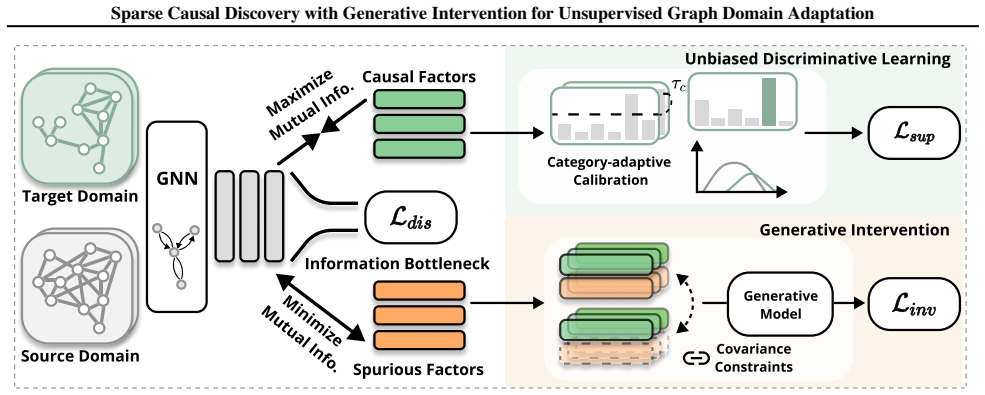
The machinery is a structural causal model with three edges: labels produce causal features, which generate the graph together with spurious features; pseudo-labels constrain causal features; source and target domains inject their variation only through spurious features. On top of this graph, an information-bottleneck objective maximizes $I(Y;Z^c)$, minimizes $I(Z^s;Y)$, and controls residual $I(Z^s;Z)$ with a variational bound. The generative intervention replaces each sample's spurious block with a spurious block from the other domain, $z^+_{i,k}=\mathcal{G}(z^c_i,z^s_k)$, and enforces that the reconstruction and the composite representation stay close to the original, so predictions cannot depend on which domain the spurious part came from. Covariance constraints keep the two feature blocks from re-entangling.
What would settle it
Simulate a domain shift in which the label-determining substructure itself changes between source and target while spurious statistics are held fixed: if SLOGAN's target accuracy stays high, the stable-mechanism assumption is not doing the work, and if it collapses, the assumption is load-bearing. Alternatively, train a domain classifier on the extracted causal features; any accuracy above chance means the 'causal' features still encode domain identity.
Extended reading notes
Core claim
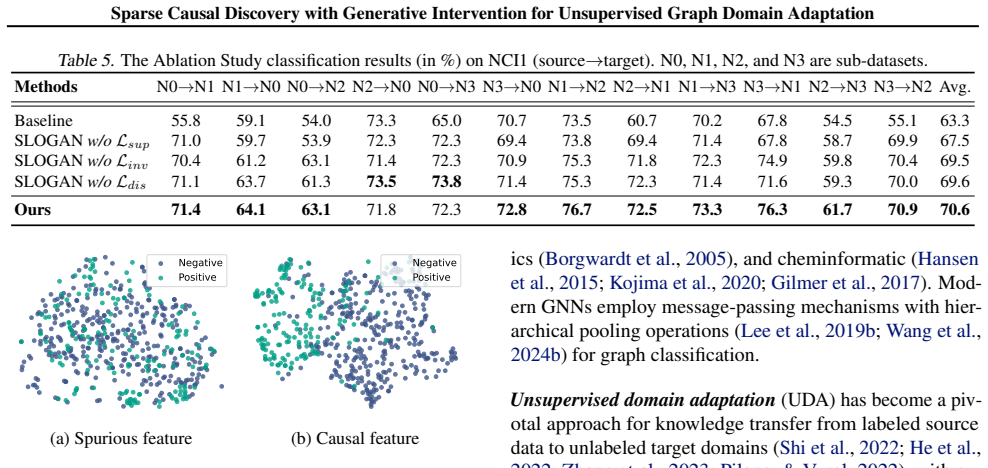
On the paper's own terms, the discovery is that a sparse-causal formulation plus a generative intervention converts unsupervised graph domain adaptation into a stable-feature learning problem. The model reports average accuracies of 67.8% on PTC, 70.6% on NCI1, 64.7% on TWITTER-Real-Graph-Partial, and 73.5% on Letter-Med, with gains over the strongest compared method up to 2.3%. The companion theory (Theorem 3.1) states that target error $\epsilon_T(h)$ is bounded by source empirical error $\hat{\epsilon}_S(h)$ plus terms that shrink as spurious information and reconstruction error shrink: $\epsilon_T(h) \le \hat{\epsilon}_S(h)+C\sqrt{\epsilon_1}+L\sqrt{\epsilon_2}+C(n_S,\delta)$. The intended reading is that domain shift lives in spurious features, so suppressing them and fixing causal features is enough to transfer.
Load-bearing premise
The whole argument depends on the assumption that the way features cause the label is identical in source and target domains, and that only incidental, domain-specific correlations differ.
Editorial extensions
If this is right
- On the four benchmarks reported, the disentangled representation outperforms each of the compared graph neural network, semi-supervised, and domain adaptation baselines, sometimes by large margins in individual source-to-target directions.
- The generative intervention removes the need for global distribution alignment, so rare but label-relevant substructures need not be washed out during adaptation.
- Because the target loss is only applied to confidently pseudo-labeled samples with class-adaptive thresholds, target training becomes class-balanced and less vulnerable to error accumulation.
- If Theorem 3.1 holds, practitioners can predict adaptation failure in advance by measuring source empirical error, spurious-label mutual information, and reconstruction loss, rather than waiting for target labels.
Reading between the lines
- A natural test of the stability assumption is to benchmark SLOGAN on a pair of domains where the causal mechanism itself shifts; the method's own theory predicts the bound only when causal features are stable across domains.
- The intervention loss could be repurposed as a diagnostic: if predictions change when spurious blocks are swapped, the model is still relying on spurious information, even if target accuracy looks acceptable.
- The same sparse-causal-plus-swap recipe may transfer to source-free graph adaptation, where the target has no labeled source at adaptation time, because the generator and covariance constraints are trained mostly on source data.
- One could extend the framework to temporal graphs by treating time-specific community structure as the spurious block and swapping it across time windows.
Editorial analysis
A structured set of objections, weighed in public.
Referee Report
Summary. The manuscript proposes SLOGAN, a method for unsupervised graph domain adaptation that disentangles graph representations into causal (Zc) and spurious (Zs) features via an information-bottleneck objective, then applies a generative intervention that recombines spurious features across domains and a category-adaptive pseudo-label calibration. The authors report average accuracies of 67.8%, 70.6%, 64.7%, and 73.5% on PTC, NCI1, TWITTER-Real-Graph-Partial, and Letter-Med, respectively, claiming to outperform baseline UGDA methods, and they provide a target-domain error bound (Theorem 3.1) that depends on spurious-suppression and reconstruction errors. They also include ablations, sensitivity analyses, and visualizations arguing that causal features are domain-agnostic and label-aligned.
Significance. If the claims were fully established, SLOGAN would be a meaningful step for UGDA: the component design is coherent, the ablation study isolates each term's contribution, and the problem of causal/spurious disentanglement under domain shift is timely. The paper also makes a concrete falsifiable prediction through the linear dependency of the target error on sqrt(epsilon_1) and sqrt(epsilon_2). However, the central theorem is not proven as stated: its key step assumes cross-domain causal stability that is not among the hypotheses and is not derived, and the generative intervention term in the loss is absent from the proof. On the empirical side, Tables 1-5 contain single-run accuracies without variance or significance tests, hyperparameters are tuned on the evaluation datasets, and Table 4 contains exact duplicate rows for distinct baselines. These issues affect the paper's two headline claims (significant empirical gains and a theoretical guarantee), so substantial revision is needed.
major comments (5)
- [Appendix B, Eq. (24)-(25)] The key step |epsilon'_S(h) - epsilon'_T(h)| <= C sqrt(epsilon_1) is asserted rather than derived. The total-variation bound in Eq. (24) only controls how much Y depends on Zs, but no argument connects that quantity to the difference of risks under the source and target distributions. The intervening sentence, 'Assuming the causal mechanism is stable across the source and target domains,' introduces a condition that is not stated in Theorem 3.1 and is not implied by the listed condition I(Y; Zc) > Ic. Please either add cross-domain stability of P(Y | Zc) as an explicit assumption and prove the bound from it, or revise the theorem to a conditional statement that is actually supported by the proof.
- [§3.4, Eq. (17) and Appendix B, Eq. (23)] The proof of Theorem 3.1 bounds only the original reconstruction error E||Z - G(Zc, Zs)||^2 <= epsilon_2, but the method's intervention loss Linv in Eq. (17) uses composite samples G(zc_i, zs_k) with swapped spurious features. No bound is provided for these composite reconstructions, and condition (3) of the theorem does not involve them. As a result, the theoretical guarantee does not cover the generative intervention mechanism, which is one of the three claimed contributions of the paper.
- [Tables 1-5 and §4.6] All accuracy numbers are single-run values with no standard deviations, no number of seeds, and no significance tests, so the abstract's claim that SLOGAN 'significantly outperforms' baselines is not supported by the reported evidence. Additionally, §4.6 selects the hyperparameters gamma and eta by sensitivity experiments on the same datasets (NCI1, PTC, TWITTER-Real-Graph-Partial) that are later used for the main results, which creates a selection-on-test-set risk. Please report mean and standard deviation over multiple seeds and fix hyperparameters using source-only validation or a held-out domain.
- [Table 4 (Letter-Med)] In Table 4, the DUA row is exactly identical to the GAT row in all 12 columns, and the DARE-GRAM row is exactly identical to the SAGE row in all 12 columns. These are different algorithms and cannot plausibly produce identical numbers unless there is a copying or implementation error. This undermines the reliability of the baseline comparison in Table 4 and must be corrected by re-running the affected baselines.
- [§3.2, 'Stability Guarantees'] The three bullets under 'Stability Guarantees' assert properties (Zc independent of D given Y, Cov(Zc, Zs) <= beta^{-1}, and I(Y; Zc) >= I(Y; X) - epsilon) without proof, and these properties are exactly the conditions needed for Theorem 3.1. Since Ldis is only minimized, these are optimization objectives, not guarantees. Either prove these properties for the proposed estimator under stated assumptions or relabel them as desiderata and restate the theorem accordingly.
minor comments (6)
- [§3.2, Figure 3] The structural causal model draws arrows L -> C and PL -> C, but the text and Figure 1 describe C as molecular structures that directly determine carcinogenicity (i.e., C -> Y). Please clarify whether the graph is intended as an anti-causal generative model or a causal model, since the direction of the arrow affects the interpretation of 'causal features' and the stability assumption.
- [§4.2, observation (3)] The text refers to a setting 'BM -> B' that does not appear in Tables 1-4; either add the corresponding experiment or remove the reference.
- [Theorem 3.1 and Appendix B] The constants are inconsistent: Eq. (19) states L sqrt(epsilon_2), while the proof in Eq. (25) concludes with 2L sqrt(epsilon_2). Please track constants consistently in the final bound.
- [Throughout] There are several typos: 'varfied our motivation' in the introduction, 'anlyzed' after Eq. (18), 'emprical' in Appendix B, and 'unspervised' in Appendix C.2.
- [§3.2, Eq. (4)] Eq. (4) mixes max and min operations in a single displayed expression; please write it as separate objectives or explicit constraints to avoid formal ambiguity.
- [§3.5, Complexity Analysis] The complexity statement O(L|V|d^2) ignores the edge term |E| in message passing; for graphs with varying density, the stated linearity in |V| is at best an approximation and should be qualified.
Circularity Check
Theorem 3.1's target-error bound assumes the cross-domain causal stability that SLOGAN claims to learn, making the theoretical guarantee a restatement of its own premise.
-
self definitional
[Section 3.5 (Theorem 3.1) and Appendix B, Eqs. (24)-(25)]
"Assuming the causal mechanism is stable across the source and target domains, the prediction based on Z^c remains consistent. Hence, the primary discrepancy between source and target domain errors arises due to Z^s, leading to, |ϵ′S(h) − ϵ′T (h)| ≤C√ϵ1."
The theorem concludes that the target error is close to the source error plus terms controlled by the spurious-suppression and reconstruction conditions. The proof's decisive step, however, is not derived from those conditions: it simply assumes that predictions based on Z^c remain consistent across domains. This cross-domain stability of Z^c is exactly the invariant that SLOGAN's causal-spurious disentanglement is supposed to discover and enforce (Section 3.2 defines Z^c as stable causal features that remain predictive across domains). Eq. (24) bounds a total-variation quantity by O(epsilon_1), but no argument connects that TV bound to |epsilon'_S - epsilon'_T| without the stability assumption.
full rationale
The empirical comparisons in Tables 1-4 are self-contained against external baselines and are not circular; no load-bearing self-citation was found. The circularity is confined to the theoretical guarantee. Theorem 3.1's proof injects 'Assuming the causal mechanism is stable across the source and target domains' as the step that produces the C√epsilon_1 domain-discrepancy term. That stability is precisely what the causal-feature extraction and intervention losses are designed to achieve, and without an independent argument it is equivalent to assuming the conclusion of the bound. The three stated conditions (causal sufficiency, spurious suppression, generative intervention) mirror the training objectives L_dis and L_inv, so the theorem is a conditional statement of the method's objectives rather than a derivation from external facts. Because the empirical results remain independent evidence of performance, the overall circularity is partial rather than total.
Assumptions & free parameters
free parameters (4)
- Gamma (loss weight for Ldis) =
0.003
- Eta (loss weight for Linv) =
0.1
- Beta (balance in spurious suppression objective) =
unspecified
- Tau (initial confidence threshold) =
0.95
assumptions (4)
- domain assumption The causal graph structure C to G to S, L to C to PL, and Dso to S to Dta describes the true data-generating process (Figure 3).
- domain assumption Causal features are domain-invariant: the mechanism from Z^c to Y is identical in source and target domains.
- domain assumption The InfoNCE and variational bounds in Eqs. (5) to (8) are tight enough to enforce the disentanglement objectives.
- standard math The loss function and predictor are Lipschitz continuous, and the Rosenfeld and Garg (2023) generalization bound applies.
Cite this review
Pith. "Pith review of Sparse Causal Discovery with Generative Intervention for Unsupervised Graph Domain Adaptation." pith.science (2026). https://pith.science/paper/HWHTQFDO
@misc{pith2026250707621,
  author       = {Pith},
  title        = {Pith review of: Sparse Causal Discovery with Generative Intervention for Unsupervised Graph Domain Adaptation},
  year         = {2026},
  howpublished = {\url{https://pith.science/paper/HWHTQFDO}},
  note         = {Machine review of arXiv:2507.07621}
}
read the original abstract
Unsupervised Graph Domain Adaptation (UGDA) leverages labeled source domain graphs to achieve effective performance in unlabeled target domains despite distribution shifts. However, existing methods often yield suboptimal results due to the entanglement of causal-spurious features and the failure of global alignment strategies. We propose SLOGAN (Sparse Causal Discovery with Generative Intervention), a novel approach that achieves stable graph representation transfer through sparse causal modeling and dynamic intervention mechanisms. Specifically, SLOGAN first constructs a sparse causal graph structure, leveraging mutual information bottleneck constraints to disentangle sparse, stable causal features while compressing domain-dependent spurious correlations through variational inference. To address residual spurious correlations, we innovatively design a generative intervention mechanism that breaks local spurious couplings through cross-domain feature recombination while maintaining causal feature semantic consistency via covariance constraints. Furthermore, to mitigate error accumulation in target domain pseudo-labels, we introduce a category-adaptive dynamic calibration strategy, ensuring stable discriminative learning. Extensive experiments on multiple real-world datasets demonstrate that SLOGAN significantly outperforms existing baselines.
Figures


Figures from the paper (4 more)



Reference graph
Works this paper leans on
-
[1]
write newline
" write newline "" before.all 'output.state := FUNCTION n.dashify 't := "" t empty not t #1 #1 substring "-" = t #1 #2 substring "--" = not "--" * t #2 global.max substring 't := t #1 #1 substring "-" = "-" * t #2 global.max substring 't := while if t #1 #1 substring * t #2 global.max substring 't := if while FUNCTION format.date year duplicate empty "emp...
-
[2]
Arjovsky, M., Bottou, L., Gulrajani, I., and Lopez-Paz, D. Invariant risk minimization. arXiv preprint arXiv:1907.02893, 2019
arXiv 1907
-
[3]
Borgwardt, K. M., Ong, C. S., Sch \"o nauer, S., Vishwanathan, S., Smola, A. J., and Kriegel, H.-P. Protein function prediction via graph kernels. Bioinformatics, 2005
work page 2005
-
[4]
Learning Causally Invariant Representations for Out-of-Distribution Generalization on Graphs
Chen, Y., Zhang, Y., Yang, H., Ma, K., Xie, B., Liu, T., Han, B., and Cheng, J. Invariance principle meets out-of-distribution generalization on graphs. arXiv preprint arXiv:2202.05441, 2022
work page Pith review arXiv 2022
-
[5]
Cheng, D., Li, J., Liu, L., Liu, J., and Le, T. D. Data-driven causal effect estimation based on graphical causal modelling: A survey. ACM Computing Surveys, 56 0 (5): 0 1--37, 2024
work page 2024
-
[6]
Chowdhury, J., Shivaraman, V., Sundaram, S., and Sujit, P. Graph-based prediction and planning policy network (gp3net) for scalable self-driving in dynamic environments using deep reinforcement learning. In Proc. of Association for the Advancement of Artificial Intelligence (AAAI), volume 38, pp.\ 11606--11614, 2024
work page 2024
-
[7]
Graph transfer learning via adversarial domain adaptation with graph convolution
Dai, Q., Wu, X.-M., Xiao, J., Shen, X., and Wang, D. Graph transfer learning via adversarial domain adaptation with graph convolution. 2022
work page 2022
-
[8]
Informative class-conditioned feature alignment for unsupervised domain adaptation
Deng, W., Cui, Y., Liu, Z., Kuang, G., Hu, D., Pietikäinen, M., and Liu, L. Informative class-conditioned feature alignment for unsupervised domain adaptation. In Proc. of ACM International Conference on Multimedia (MM), 2021
work page 2021
Show all 79 references
-
[9]
Semi-supervised learning on graphs with generative adversarial nets
Ding, M., Tang, J., and Zhang, J. Semi-supervised learning on graphs with generative adversarial nets. 2018
2018
-
[10]
Domain-adversarial training of neural networks
Ganin, Y., Ustinova, E., Ajakan, H., Germain, P., Larochelle, H., Laviolette, F., Marchand, M., and Lempitsky, V. Domain-adversarial training of neural networks. Journal of Machine Learning Research, 2016
2016
-
[11]
S., Riley, P
Gilmer, J., Schoenholz, S. S., Riley, P. F., Vinyals, O., and Dahl, G. E. Neural message passing for quantum chemistry. In Proc. of International Conference on Machine Learning (ICML), 2017
2017
-
[12]
Inductive representation learning on large graphs
Hamilton, W., Ying, Z., and Leskovec, J. Inductive representation learning on large graphs. In Proc. of Neural Information Processing Systems (NeurIPS), 2017
2017
-
[13]
A., M \"u ller, K.-R., and Tkatchenko, A
Hansen, K., Biegler, F., Ramakrishnan, R., Pronobis, W., Von Lilienfeld, O. A., M \"u ller, K.-R., and Tkatchenko, A. Machine learning predictions of molecular properties: Accurate many-body potentials and nonlocality in chemical space. The journal of physical chemistry letters, 2015
2015
-
[14]
Asgn: An active semi-supervised graph neural network for molecular property prediction
Hao, Z., Lu, C., Huang, Z., Wang, H., Hu, Z., Liu, Q., Chen, E., and Lee, C. Asgn: An active semi-supervised graph neural network for molecular property prediction. In Proc. of ACM SIGKDD Conference on Knowledge Discovery and Data Mining (KDD), 2020
2020
-
[15]
Momentum contrast for unsupervised visual representation learning
He, K., Fan, H., Wu, Y., Xie, S., and Girshick, R. Momentum contrast for unsupervised visual representation learning. In Proc. of Computer Vision and Pattern Recognition (CVPR), 2020
2020
-
[16]
Secret: Self-consistent pseudo label refinement for unsupervised domain adaptive person re-identification
He, T., Shen, L., Guo, Y., Ding, G., and Guo, Z. Secret: Self-consistent pseudo label refinement for unsupervised domain adaptive person re-identification. In Proc. of Association for the Advancement of Artificial Intelligence (AAAI), 2022
2022
-
[17]
D., Kramer, S., and Srinivasan, A
Helma, C., King, R. D., Kramer, S., and Srinivasan, A. The Predictive Toxicology Challenge 2000–2001 . Bioinformatics, 2001
2000
-
[18]
and Zitnik, M
Huang, K. and Zitnik, M. Graph meta learning via local subgraphs. Proc. of Neural Information Processing Systems (NeurIPS), 2020
2020
-
[19]
Incomplete graph learning via attribute-structure decoupled variational auto-encoder
Jiang, X., Qin, Z., Xu, J., and Ao, X. Incomplete graph learning via attribute-structure decoupled variational auto-encoder. In Proc. of ACM International Conference on Web Search and Data Mining (WSDM), pp.\ 304--312. 2023
2023
-
[20]
Ragraph: A general retrieval-augmented graph learning framework
Jiang, X., Qiu, R., Xu, Y., Zhang, W., Zhu, Y., Zhang, R., Fang, Y., Chu, X., Zhao, J., and Wang, Y. Ragraph: A general retrieval-augmented graph learning framework. Proc. of Neural Information Processing Systems (NeurIPS), 2024
2024
-
[21]
A survey of data-efficient graph learning
Ju, W., Yi, S., Wang, Y., Long, Q., Luo, J., Xiao, Z., and Zhang, M. A survey of data-efficient graph learning. In Proc. of International Joint Conference on Artificial Intelligence (IJCAI), pp.\ 8104--8113, 2024
2024
-
[22]
N., Rahnavard, N., Mian, A., and Shah, M
Karim, N., Rizve, M. N., Rahnavard, N., Mian, A., and Shah, M. Unicon: Combating label noise through uniform selection and contrastive learning. In Proceedings of the IEEE/CVF conference on computer vision and pattern recognition, pp.\ 9676--9686, 2022
2022
-
[23]
Learning topology-specific experts for molecular property prediction
Kim, S., Lee, D., Kang, S., Lee, S., and Yu, H. Learning topology-specific experts for molecular property prediction. In Proc. of Association for the Advancement of Artificial Intelligence (AAAI), 2023
2023
-
[24]
kgcn: a graph-based deep learning framework for chemical structures
Kojima, R., Ishida, S., Ohta, M., Iwata, H., Honma, T., and Okuno, Y. kgcn: a graph-based deep learning framework for chemical structures. Journal of Cheminformatics, 2020
2020
-
[25]
Adversary for social good: Protecting familial privacy through joint adversarial attacks
Kumar, C., Ryan, R., and Shao, M. Adversary for social good: Protecting familial privacy through joint adversarial attacks. In Proc. of Association for the Advancement of Artificial Intelligence (AAAI), volume 34, pp.\ 11304--11311, 2020
2020
-
[26]
H., and Ulbricht, D
Lee, C.-Y., Batra, T., Baig, M. H., and Ulbricht, D. Sliced wasserstein discrepancy for unsupervised domain adaptation. In Proc. of Computer Vision and Pattern Recognition (CVPR), 2019 a
2019
-
[27]
Self-attention graph pooling
Lee, J., Lee, I., and Kang, J. Self-attention graph pooling. In Proc. of International Conference on Machine Learning (ICML), 2019 b
2019
-
[28]
Relevance-aware anomalous users detection in social network via graph neural network
Li, Y., Ji, Y., Li, S., He, S., Cao, Y., Liu, Y., Liu, H., Li, X., Shi, J., and Yang, Y. Relevance-aware anomalous users detection in social network via graph neural network. In International Joint Conference on Neural Networks (IJCNN), 2021
2021
-
[29]
Multi-domain generalized graph meta learning
Lin, M., Li, W., Li, D., Chen, Y., Li, G., and Lu, S. Multi-domain generalized graph meta learning. In Proc. of Association for the Advancement of Artificial Intelligence (AAAI), 2023
2023
-
[30]
Content matters: A gnn-based model combined with text semantics for social network cascade prediction
Liu, Y., Zeng, K., Wang, H., Song, X., and Zhou, B. Content matters: A gnn-based model combined with text semantics for social network cascade prediction. In Pacific-Asia Conference on Knowledge Discovery and Data Mining. Springer, 2021
2021
-
[31]
Long, M., Cao, Z., Wang, J., and Jordan, M. I. Conditional adversarial domain adaptation. In Proc. of Neural Information Processing Systems (NeurIPS), 2018
2018
-
[32]
Graph out-of-distribution generalization with controllable data augmentation
Lu, B., Gan, X., Zhao, Z., Liang, S., Fu, L., Wang, X., and Zhou, C. Graph out-of-distribution generalization with controllable data augmentation. arXiv preprint arXiv:2308.08344, 2023
2023 arXiv
-
[33]
Gala: Graph diffusion-based alignment with jigsaw for source-free domain adaptation
Luo, J., Gu, Y., Luo, X., Ju, W., Xiao, Z., Zhao, Y., Yuan, J., and Zhang, M. Gala: Graph diffusion-based alignment with jigsaw for source-free domain adaptation. IEEE Transactions on Pattern Analysis and Machine Intelligence, 2024 a
2024
-
[34]
Rank and align: towards effective source-free graph domain adaptation
Luo, J., Xiao, Z., Wang, Y., Luo, X., Yuan, J., Ju, W., Liu, L., and Zhang, M. Rank and align: towards effective source-free graph domain adaptation. In Proc. of International Joint Conference on Artificial Intelligence (IJCAI), pp.\ 4706--4714, 2024 b
2024
-
[35]
Large language model agent: A survey on methodology, applications and challenges
Luo, J., Zhang, W., Yuan, Y., et al. Large language model agent: A survey on methodology, applications and challenges. arXiv preprint arXiv:2503.21460, 2025
2025 arXiv
-
[36]
Ma, X., Wu, J., Yang, J., and Sheng, Q. Z. Towards graph-level anomaly detection via deep evolutionary mapping. In Proc. of ACM SIGKDD Conference on Knowledge Discovery and Data Mining (KDD), 2023
2023
-
[37]
J., Micorek, J., Possegger, H., and Bischof, H
Mirza, M. J., Micorek, J., Possegger, H., and Bischof, H. The norm must go on: Dynamic unsupervised domain adaptation by normalization. In Proc. of Computer Vision and Pattern Recognition (CVPR), pp.\ 14765--14775, 2022
2022
-
[38]
Dare-gram: Unsupervised domain adaptation regression by aligning inverse gram matrices
Nejjar, I., Wang, Q., and Fink, O. Dare-gram: Unsupervised domain adaptation regression by aligning inverse gram matrices. In Proc. of Computer Vision and Pattern Recognition (CVPR), pp.\ 11744--11754, 2023
2023
-
[39]
Cogboost: Boosting for fast cost-sensitive graph classification
Pan, S., Wu, J., and Zhu, X. Cogboost: Boosting for fast cost-sensitive graph classification. 2015
2015
-
[40]
and Vural, E
Pilancı, M. and Vural, E. Domain adaptation on graphs by learning aligned graph bases. 34 0 (2): 0 587--600, 2022
2022
-
[41]
Asap: Adaptive structure aware pooling for learning hierarchical graph representations
Ranjan, E., Sanyal, S., and Talukdar, P. Asap: Adaptive structure aware pooling for learning hierarchical graph representations. In Proc. of Association for the Advancement of Artificial Intelligence (AAAI), volume 34, pp.\ 5470--5477, 2020
2020
-
[42]
and Bunke, H
Riesen, K. and Bunke, H. Iam graph database repository for graph based pattern recognition and machine learning. In Proceedings of Structural, Syntactic, and Statistical Pattern Recognition: Joint IAPR International Workshop, pp.\ 287--297, 2008
2008
-
[43]
and Garg, S
Rosenfeld, E. and Garg, S. (almost) provable error bounds under distribution shift via disagreement discrepancy. Advances in Neural Information Processing Systems, 36: 0 28761--28784, 2023
2023
-
[44]
Maximum classifier discrepancy for unsupervised domain adaptation
Saito, K., Watanabe, K., Ushiku, Y., and Harada, T. Maximum classifier discrepancy for unsupervised domain adaptation. In Proc. of Computer Vision and Pattern Recognition (CVPR), 2018
2018
-
[45]
Adversarial deep network embedding for cross-network node classification
Shen, X., Dai, Q., Chung, F.-l., Lu, W., and Choi, K.-S. Adversarial deep network embedding for cross-network node classification. In Proc. of Association for the Advancement of Artificial Intelligence (AAAI), 2020
2020
-
[46]
Pairwise adversarial training for unsupervised class-imbalanced domain adaptation
Shi, W., Zhu, R., and Li, S. Pairwise adversarial training for unsupervised class-imbalanced domain adaptation. In Proc. of ACM SIGKDD Conference on Knowledge Discovery and Data Mining (KDD), 2022
2022
-
[47]
A., Cubuk, E
Sohn, K., Berthelot, D., Carlini, N., Zhang, Z., Zhang, H., Raffel, C. A., Cubuk, E. D., Kurakin, A., and Li, C.-L. Fixmatch: Simplifying semi-supervised learning with consistency and confidence. In Proc. of Neural Information Processing Systems (NeurIPS), 2020
2020
-
[48]
Infograph: Unsupervised and semi-supervised graph-level representation learning via mutual information maximization
Sun, F.-Y., Hoffmann, J., Verma, V., and Tang, J. Infograph: Unsupervised and semi-supervised graph-level representation learning via mutual information maximization. In Proc. of International Conference on Learning Representations (ICLR), 2020
2020
-
[49]
Adversarial graph augmentation to improve graph contrastive learning
Suresh, S., Li, P., Hao, C., and Neville, J. Adversarial graph augmentation to improve graph contrastive learning. In Proc. of Neural Information Processing Systems (NeurIPS), 2021
2021
-
[50]
Multi-view teacher with curriculum data fusion for robust unsupervised domain adaptation
Tang, Y., Luo, J., Yang, L., Luo, X., Zhang, W., and Cui, B. Multi-view teacher with curriculum data fusion for robust unsupervised domain adaptation. In Proc. of IEEE International Conference on Data Engineering (ICDE), pp.\ 2598--2611, 2024
2024
-
[51]
and Valpola, H
Tarvainen, A. and Valpola, H. Mean teachers are better role models: Weight-averaged consistency targets improve semi-supervised deep learning results. In Proc. of Neural Information Processing Systems (NeurIPS), 2017
2017
-
[52]
and Radinsky, K
Turutov, S. and Radinsky, K. Molecular optimization model with patentability constraint. In Proc. of Association for the Advancement of Artificial Intelligence (AAAI), volume 38, pp.\ 257--264, 2024
2024
-
[53]
Graph attention networks
Veli c kovi \'c , P., Cucurull, G., Casanova, A., Romero, A., Li \`o , P., and Bengio, Y. Graph attention networks. In Proc. of International Conference on Learning Representations (ICLR), 2018
2018
-
[54]
L., Li \`o , P., Bengio, Y., and Hjelm, R
Velickovic, P., Fedus, W., Hamilton, W. L., Li \`o , P., Bengio, Y., and Hjelm, R. D. Deep graph infomax. In Proc. of International Conference on Learning Representations (ICLR), 2019
2019
-
[55]
and Karypis, G
Wale, N. and Karypis, G. Comparison of descriptor spaces for chemical compound retrieval and classification. In Proc. of IEEE International Conference on Data Mining (ICDM), 2006
2006
-
[56]
Idea: An invariant perspective for efficient domain adaptive image retrieval
Wang, H., Wu, H., Sun, J., Zhang, S., Chen, C., Hua, X.-S., and Luo, X. Idea: An invariant perspective for efficient domain adaptive image retrieval. Proc. of Neural Information Processing Systems (NeurIPS), 36, 2024 a
2024
-
[57]
A comprehensive graph pooling benchmark: Effectiveness, robustness and generalizability
Wang, P., Luo, J., Shen, Y., Zhang, M., Heng, S., and Luo, X. A comprehensive graph pooling benchmark: Effectiveness, robustness and generalizability. arXiv preprint arXiv:2406.09031, 2024 b
2024
-
[58]
Metaalign: Coordinating domain alignment and classification for unsupervised domain adaptation
Wei, G., Lan, C., Zeng, W., and Chen, Z. Metaalign: Coordinating domain alignment and classification for unsupervised domain adaptation. In Proc. of Computer Vision and Pattern Recognition (CVPR), 2021 a
2021
-
[59]
Toalign: Task-oriented alignment for unsupervised domain adaptation
Wei, G., Lan, C., Zeng, W., Zhang, Z., and Chen, Z. Toalign: Task-oriented alignment for unsupervised domain adaptation. In Proc. of Neural Information Processing Systems (NeurIPS), 2021 b
2021
-
[60]
and Kipf, T
Welling, M. and Kipf, T. N. Semi-supervised classification with graph convolutional networks. In Proc. of International Conference on Learning Representations (ICLR), 2016
2016
-
[61]
Unsupervised domain adaptive graph convolutional networks
Wu, M., Pan, S., Zhou, C., Chang, X., and Zhu, X. Unsupervised domain adaptive graph convolutional networks. In Proc. of ACM Web Conference (WWW), 2020
2020
-
[62]
and Zhang, L
Xiao, N. and Zhang, L. Dynamic weighted learning for unsupervised domain adaptation. In Proc. of Computer Vision and Pattern Recognition (CVPR), 2021
2021
-
[63]
Infogcl: Information-aware graph contrastive learning
Xu, D., Cheng, W., Luo, D., Chen, H., and Zhang, X. Infogcl: Information-aware graph contrastive learning. In NeurIPS, 2021
2021
-
[64]
How powerful are graph neural networks? In Proc
Xu, K., Hu, W., Leskovec, J., and Jegelka, S. How powerful are graph neural networks? In Proc. of International Conference on Learning Representations (ICLR), 2018
2018
-
[65]
Mind the class weight bias: Weighted maximum mean discrepancy for unsupervised domain adaptation
Yan, H., Ding, Y., Li, P., Wang, Q., Xu, Y., and Zuo, W. Mind the class weight bias: Weighted maximum mean discrepancy for unsupervised domain adaptation. In Proc. of Computer Vision and Pattern Recognition (CVPR), 2017
2017
-
[66]
Individual and structural graph information bottlenecks for out-of-distribution generalization
Yang, L., Zheng, J., Wang, H., Liu, Z., Huang, Z., Hong, S., Zhang, W., and Cui, B. Individual and structural graph information bottlenecks for out-of-distribution generalization. 2023
2023
-
[67]
Deal: An unsupervised domain adaptive framework for graph-level classification
Yin, N., Shen, L., Li, B., Wang, M., Luo, X., Chen, C., Luo, Z., and Hua, X.-S. Deal: An unsupervised domain adaptive framework for graph-level classification. In Proc. of ACM International Conference on Multimedia (MM), 2022
2022
-
[68]
Coco: A coupled contrastive framework for unsupervised domain adaptive graph classification
Yin, N., Shen, L., Wang, M., Lan, L., Ma, Z., Chen, C., Hua, X.-S., and Luo, X. Coco: A coupled contrastive framework for unsupervised domain adaptive graph classification. arXiv preprint arXiv:2306.04979, 2023
2023 arXiv
-
[69]
Hierarchical graph representation learning with differentiable pooling
Ying, Z., You, J., Morris, C., Ren, X., Hamilton, W., and Leskovec, J. Hierarchical graph representation learning with differentiable pooling. In Proc. of Neural Information Processing Systems (NeurIPS), 2018
2018
-
[70]
Graph domain adaptation via theory-grounded spectral regularization
You, Y., Chen, T., Wang, Z., and Shen, Y. Graph domain adaptation via theory-grounded spectral regularization. In Proc. of International Conference on Learning Representations (ICLR), 2022
2022
-
[71]
Stable learning via sparse variable independence
Yu, H., Cui, P., He, Y., Shen, Z., Lin, Y., Xu, R., and Zhang, X. Stable learning via sparse variable independence. In Proceedings of the AAAI Conference on Artificial Intelligence, volume 37, pp.\ 10998--11006, 2023
2023
-
[72]
To-ugda: target-oriented unsupervised graph domain adaptation
Zeng, Z., Xie, J., Yang, Z., Ma, T., and Chen, D. To-ugda: target-oriented unsupervised graph domain adaptation. Scientific Reports, 14 0 (1): 0 9165, 2024
2024
-
[73]
An end-to-end deep learning architecture for graph classification
Zhang, M., Cui, Z., Neumann, M., and Chen, Y. An end-to-end deep learning architecture for graph classification. In Proc. of Association for the Advancement of Artificial Intelligence (AAAI), 2018
2018
-
[74]
Adversarial separation network for cross-network node classification
Zhang, X., Du, Y., et al. Adversarial separation network for cross-network node classification. 2021
2021
-
[75]
Cglb: Benchmark tasks for continual graph learning
Zhang, X., Song, D., and Tao, D. Cglb: Benchmark tasks for continual graph learning. Advances in Neural Information Processing Systems, 35: 0 13006--13021, 2022
2022
-
[76]
Adaptive disentangled transformer for sequential recommendation
Zhang, Y., Wang, X., Chen, H., and Zhu, W. Adaptive disentangled transformer for sequential recommendation. In Proc. of ACM SIGKDD Conference on Knowledge Discovery and Data Mining (KDD), pp.\ 3434--3445, 2023
2023
-
[77]
Generative causal interpretation model for spatio-temporal representation learning
Zhao, Y., Deng, P., Liu, J., Jia, X., and Zhang, J. Generative causal interpretation model for spatio-temporal representation learning. In Proceedings of the 29th ACM SIGKDD Conference on Knowledge Discovery and Data Mining, 2023
2023
-
[78]
Maintaining the status quo: Capturing invariant relations for ood spatiotemporal learning
Zhou, Z., Huang, Q., Yang, K., Wang, K., Wang, X., Zhang, Y., Liang, Y., and Wang, Y. Maintaining the status quo: Capturing invariant relations for ood spatiotemporal learning. In Proc. of ACM SIGKDD Conference on Knowledge Discovery and Data Mining (KDD), 2023
2023
-
[79]
Unsupervised domain adaptation for semantic segmentation via class-balanced self-training
Zou, Y., Yu, Z., Kumar, B., and Wang, J. Unsupervised domain adaptation for semantic segmentation via class-balanced self-training. In Proc. of European Conference on Computer Vision (ECCV), 2018
2018
Reviewed August 6, 2026 · model on record in the stance chip above.
Discussion (0). Continue with ORCID to comment.