REVIEW 4 major objections 6 minor 38 references
HLF-FSL. A Decentralized Federated Split Learning Solution for IoT on Hyperledger Fabric
T0 review · 4 major / 6 minor · reviewed 2026-08-06 · deepseek-v4-flash
Pith's one-line read A permissioned blockchain can coordinate federated split learning without a central server, matching centralized accuracy.
desk verdict A plausible HLF-coordinated FSL system with a real prototype, but the data plane as described cannot work because Fabric transient fields are not retrievable by TxID — the paper must be revised to say how activations and gradients are actually exchanged. read the letter →
The pith
A machine-rendered reading of the paper's core claim, the machinery that carries it, and where it could break.
The reading
What carries the argument
The load-bearing mechanism is the chaincode-driven, client-executed aggregation protocol, culminating in the endGlobalModel consensus rule: each client independently computes FedAvg over the same retrieved parameter set and submits a hash, and the chaincode accepts a new global model only if more than two-thirds of submitted hashes match. This replaces a trusted aggregator with a hash-consensus check. Privacy is carried by Hyperledger Fabric's transient fields for ephemeral activations and gradients and by Private Data Collections for access-controlled hashes of intermediate data, client updates, and the global model, with large parameters stored off-chain and only references on the ledger.
What would settle it
Instrument the endGlobalModel chaincode to record, across all aggregation rounds, how often fewer than two-thirds of submitted global-model hashes match; any such round reverts to the previous model, and a realistic run where clients use different numerical libraries or summation orders would show whether the consensus rule actually holds.
Extended reading notes
Core claim
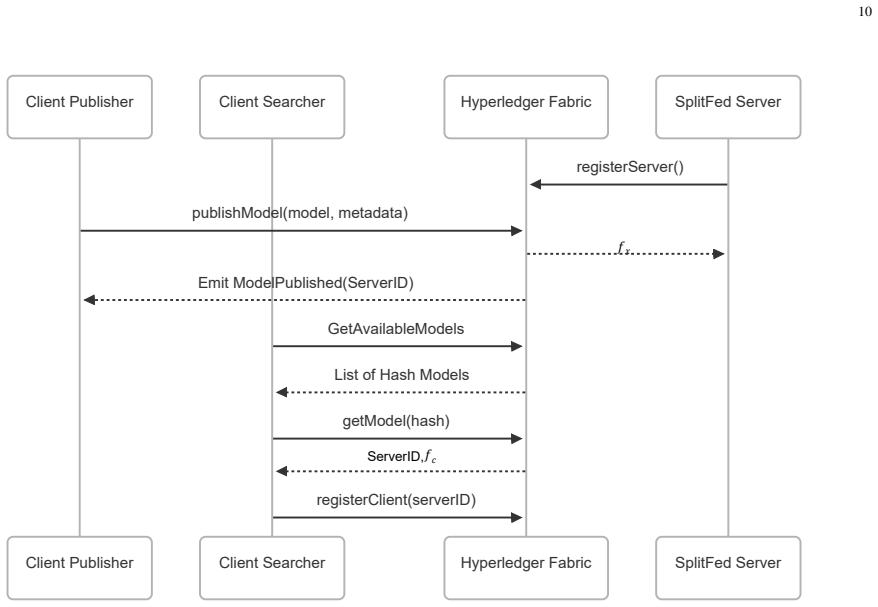
The central claim is that a permissioned blockchain can replace the central coordinator in federated split learning without hurting accuracy and with better per-epoch time than public-blockchain approaches. In HLF-FSL, clients run the client-side submodel $f_c$ and the server entity runs $f_s$, while Hyperledger Fabric's chaincode manages model registration, activation and gradient hash exchange, and aggregation triggers. Clients compute the FedAvg global model off-chain, submit hashes of their results, and chaincode commits a new global model only when more than two-thirds of submissions match. The paper reports 94.14% final test accuracy on CIFAR-10 (centralized FSL: 94.7%; Ethereum-based SL: 90.25%), 99.43% on MNIST, graceful degradation under non-IID Dirichlet partitions, and stable SDK latencies as clients scale from 1 to 25.
Load-bearing premise
The aggregation rule assumes every client computes a byte-identical FedAvg result from the same parameters, so that matching hashes are a dependable consensus signal; if numerical libraries or summation orders differ, hashes may diverge and training can stall.
Editorial extensions
If this is right
- Centralized FSL accuracy can be preserved when coordination moves to a permissioned blockchain: 94.14% versus 94.7% on CIFAR-10.
- Per-epoch training time drops relative to Ethereum-based split learning on the same task: 30m38s versus 1h25m.
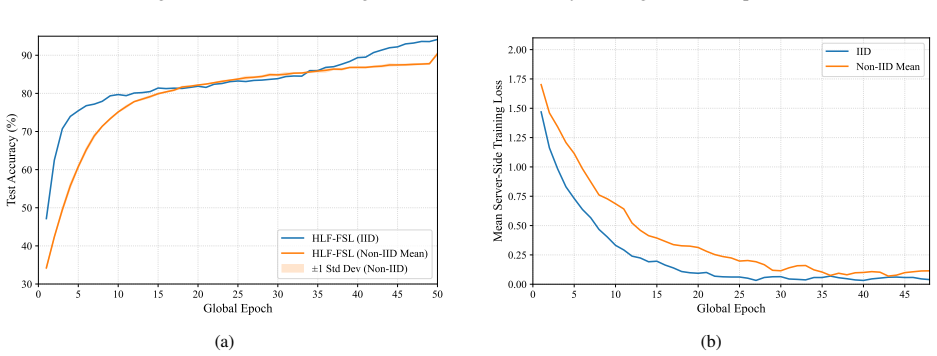
- The architecture degrades gracefully under non-IID data, with Dirichlet partitions tracking the IID convergence curve.
- Off-chain storage of parameters and on-chain hash references keep ledger growth small, on the order of 145 KB of references per epoch in the N=10 run.
- MNIST results (99.43% accuracy, 7m20s per epoch) suggest the mechanism transfers to simpler models and datasets.
Reading between the lines
- The hash-consensus rule generalizes to any off-chain computation that is deterministic across participants, so the same pattern could verify other multi-party computations, not just FedAvg.
- A testable extension is measuring how often client-computed FedAvg hashes actually diverge across organizations using different numerical libraries or summation orders; the paper does not report this.
- The privacy claim is about hiding intermediate artifacts from the ledger, not mathematical confidentiality; coupling with differential privacy or homomorphic encryption, named as future work, would be needed for stronger guarantees.
- Validation on image classification could extend to NLP or object detection, since the orchestration logic is not vision-specific.
Editorial analysis
A structured set of objections, weighed in public.
Referee Report
Summary. The paper proposes HLF-FSL, a decentralized Federated Split Learning (FSL) architecture built on Hyperledger Fabric, removing the central coordinator by using chaincode for orchestration, transient fields and Private Data Collections (PDCs) for privacy, and client-executed FedAvg for aggregation. The authors report CIFAR-10 accuracy of 94.14% versus 94.7% for centralized FSL, MNIST accuracy of 99.43%, an average CIFAR-10 epoch time of 30m38s versus 1h25m for their prior Ethereum-based SL system, and scalability experiments for up to 25 clients. The paper claims these results demonstrate enterprise-grade viability for collaborative learning in sensitive domains.
Significance. If the architecture operated as described, the paper would make a useful contribution: it provides a permissioned-blockchain alternative to centralized FSL, ships an open-source prototype, and reports measured accuracy and latency rather than fitted predictions. The comparison to centralized FSL and to an Ethereum baseline is appropriate. However, the core data-exchange mechanism and the client-aggregation consensus rule are not implementable as written, and the experimental tables lack the error bars promised by the text. These issues affect the central claims of privacy, decentralization, and scalability, so the significance can only be assessed after a substantive revision.
major comments (4)
- [IV-B, IV-C, Algorithm 1 (lines 5-20)] The described use of transient fields for activations and gradients is not implementable in Hyperledger Fabric v2.5. Transient data exists only in the transaction proposal during chaincode execution; after commit, peers discard it and no API retrieves it by TxID. Therefore Algorithm 1 line 10 ('fetches actual zi from Transient map (using TxID from event)') and line 20, as well as the corresponding text in Section IV-B, describe an operation that cannot execute a single training round. If the prototype actually stores activations and gradients in off-chain storage (OCS/IPFS), the paper must state this explicitly, because the claimed privacy contribution based on transient fields would not be what was evaluated, and the overhead results in Table VI would need to be reinterpreted.
- [IV-C (endGlobalModel) and Algorithm 1 (lines 27-33)] The client-executed aggregation consensus rule assumes that every client computing FedAvg over the same retrieved parameter list obtains a byte-identical parameter vector, so that a two-thirds majority of equal hashes is meaningful. This requires identical numerical libraries, data types, serialization order, and summation order across all client organizations. The manuscript does not state or test this assumption, and the only fallback when hashes diverge is to revert to the previous global model, which could stall training indefinitely. The paper should either specify a canonical arithmetic/serialization protocol and experimentally verify hash agreement across heterogeneous clients, or replace hash-based consensus with an error-tolerant verification mechanism.
- [VI-A, Table III] Section V states that experiments 'were repeated to report mean and standard deviation, ensuring statistical rigor,' but no standard deviations, confidence intervals, or number of runs are reported in Tables III, IV, V, or VI. The central accuracy-parity claim (94.14% vs. 94.7%) relies on a 0.56% difference that may be within run-to-run noise for N=10 clients, so the claim is not currently assessable. The authors should report means with standard deviations and the number of repeated runs for all reported metrics.
- [VI-C, Table V] The server fs batch processing times in Table V are non-monotonic: N=10 yields 3.25s, N=15 yields 1.85s, N=20 yields 13.48s, and N=25 yields 26.32s. This non-monotonicity is inconsistent with the scalability conclusion that the system operates efficiently with an elevated number of simultaneous clients, and no explanation or error bars are provided. The authors should clarify whether this reflects uncontrolled batching order, resource contention, or measurement artifacts, and should provide variance information before drawing scalability conclusions.
minor comments (6)
- [V] The text reports 'PyTorch (v3.9)', but PyTorch does not have a version 3.9; the authors should specify the PyTorch version and the Python version separately.
- [II-B] There are typos: 'mmonetary payment, knownn as gas fee' and 'prohibitevely expensive' should be corrected.
- [III-B] The citation [29] is mismatched: the text refers to 'Lu et al., 2022' survey of blockchain FL schemes, but reference [29] is a different paper on smart contracts; the intended survey should be identified and cited correctly.
- [VI-B, Figure 7] The text states Dirichlet concentration parameters alpha in {0.1, 0.5, 0.9}, while the Figure 7 caption mentions {0.1, 0.3, 0.5, 0.9}; these should be reconciled.
- [IV-C (triggerClientAggregation)] The description says triggerClientAggregation is 'invoked periodically or by a designated coordinator role', which reintroduces a central coordinator and contradicts the paper's claim of no central coordinator; the caller of this function should be specified in a way consistent with the decentralization claim.
- [Table VI] The reported average zi size of approximately 48-49 MB per transaction is difficult to reconcile with the claim that activations are passed via transient fields; if such data were placed in a transaction proposal, it would create enormous network and memory overhead, while if it is stored off-chain, the table should report the off-chain transfer cost rather than per-transaction size.
Circularity Check
No significant circularity: accuracy and latency are measured outcomes; the only self-citation is a legitimate external baseline.
full rationale
The paper's central claims are empirical, not derived from fitted parameters or self-referential definitions. The reported final accuracy (94.14% on CIFAR-10) and per-epoch training time (30m 38s) are measured results presented in Section VI, compared against a centralized FSL baseline (94.7%, 5m 50s) and the authors' prior Ethereum-based split learning system from reference [11] (90.25%, 1h 25m). The comparison to [11] is a self-citation, but it is used as an external baseline with independently reported measurements, not as a premise that logically forces the paper's measured outcomes. The aggregation protocol implements the standard FedAvg equation (Eq. 1) and the hash-based consensus rule is an empirically testable protocol assumption, not a quantity predicted from itself. There is no step where a 'prediction' reduces to a fitted value, no uniqueness theorem imported from the authors' prior work, and no ansatz smuggled in via citation. The skeptic's concern about Hyperledger Fabric transient fields being non-retrievable after commit is an implementability or correctness issue about the described data plane, not a circularity in the derivation chain. Therefore, no circular steps are identified and the score is 0.
Assumptions & free parameters
free parameters (2)
- consensus_threshold =
2/3
- aggregation_interval =
unspecified (predefined intervals)
assumptions (3)
- domain assumption Hyperledger Fabric's transient fields are not persisted to the ledger and PDC access policies are enforced as documented.
- domain assumption All clients compute byte-identical floating-point results when performing FedAvg on the same input parameters.
- domain assumption SHA-256 hashing of model parameters provides a collision-resistant integrity check, so matching hashes imply identical parameters.
Cite this review
Pith. "Pith review of HLF-FSL. A Decentralized Federated Split Learning Solution for IoT on Hyperledger Fabric." pith.science (2026). https://pith.science/paper/SIHYPX4X
@misc{pith2026250707637,
  author       = {Pith},
  title        = {Pith review of: HLF-FSL. A Decentralized Federated Split Learning Solution for IoT on Hyperledger Fabric},
  year         = {2026},
  howpublished = {\url{https://pith.science/paper/SIHYPX4X}},
  note         = {Machine review of arXiv:2507.07637}
}
read the original abstract
Collaborative machine learning in sensitive domains demands scalable, privacy preserving solutions for enterprise deployment. Conventional Federated Learning (FL) relies on a central server, introducing single points of failure and privacy risks, while Split Learning (SL) partitions models for privacy but scales poorly due to sequential training. We present a decentralized architecture that combines Federated Split Learning (FSL) with the permissioned blockchain Hyperledger Fabric (HLF). Our chaincode orchestrates FSL's split model execution and peer-to-peer aggregation without any central coordinator, leveraging HLF's transient fields and Private Data Collections (PDCs) to keep raw data and model activations private. On CIFAR-10 and MNIST benchmarks, HLF-FSL matches centralized FSL accuracy while reducing per epoch training time compared to Ethereum-based works. Performance and scalability tests show minimal blockchain overhead and preserved accuracy, demonstrating enterprise grade viability.
Figures


Figures from the paper (4 more)


Reference graph
Works this paper leans on
-
[1]
Split learning for collaborative deep learning in healthcare,
M. G. Poirot, P. Vepakomma, K. Chang, J. Kalpathy-Cramer, R. Gupta, and R. Raskar, “Split learning for collaborative deep learning in healthcare,” arXiv preprint arXiv:1912.12115 , 2019
arXiv 1912
-
[2]
Communication-Efficient Learning of Deep Networks from Decentralized Data,
B. McMahan, E. Moore, D. Ramage, S. Hampson, and B. A. y. Arcas, “Communication-Efficient Learning of Deep Networks from Decentralized Data,” in Proceedings of the 20th International Conference on Artificial Intelligence and Statistics , ser. Proceedings of Machine Learning Research, A. Singh and J. Zhu, Eds., vol. 54. PMLR, 20–22 Apr 2017, pp. 1273–1282....
work page 2017
-
[3]
Model inversion attacks that exploit confidence information and basic countermeasures,
M. Fredrikson, S. Jha, and T. Ristenpart, “Model inversion attacks that exploit confidence information and basic countermeasures,” in Proceedings of the 22nd ACM SIGSAC conference on computer and communications security , 2015, pp. 1322–1333
2015
-
[4]
Deep leakage from gradients,
L. Zhu, Z. Liu, and S. Han, “Deep leakage from gradients,” Advances in neural information processing systems , vol. 32, 2019
2019
-
[5]
Tackling the non-iid issue in heterogeneous federated learning by gradient harmonization,
X. Zhang, W. Sun, and Y . Chen, “Tackling the non-iid issue in heterogeneous federated learning by gradient harmonization,” IEEE Signal Processing Letters, 2024
work page 2024
-
[6]
Distributed learning of deep neural network over multiple agents,
O. Gupta and R. Raskar, “Distributed learning of deep neural network over multiple agents,” Journal of Network and Computer Applications, vol. 116, pp. 1–8, 2018. [Online]. Available: https://www.sciencedirect.com/science/article/pii/S1084804518301590
work page 2018
-
[7]
Privacy and efficiency of communications in federated split learning,
Z. Zhang, A. Pinto, V . Turina, F. Esposito, and I. Matta, “Privacy and efficiency of communications in federated split learning,” IEEE Transactions on Big Data , vol. 9, no. 5, pp. 1380–1391, 2023
work page 2023
-
[8]
Data leakage threats and protection in split learning: A survey,
N. D. Pham and N. Chilamkurti, “Data leakage threats and protection in split learning: A survey,” in Proceedings of the 2023 International Conference on Intelligent Computing and Its Emerging Applications , 2023, pp. 141–147
work page 2023
Show all 38 references
-
[9]
Splitfed: When federated learning meets split learning,
C. Thapa, P. C. Mahawaga Arachchige, S. Camtepe, and L. Sun, “Splitfed: When federated learning meets split learning,” Proceedings of the AAAI Conference on Artificial Intelligence , vol. 36, no. 8, pp. 8485–8493, Jun. 2022. [Online]. Available: https://ojs.aaai.org/index.php/...
2022
-
[10]
Hyperledger fabric: a distributed operating system for permissioned blockchains,
E. Androulaki, A. Barger, V . Bortnikov, C. Cachin, K. Christidis, A. De Caro, D. Enyeart, C. Ferris, G. Laventman, Y . Manevich et al., “Hyperledger fabric: a distributed operating system for permissioned blockchains,” in Proceedings of the thirteenth EuroSys conference , 201...
2018
-
[11]
Blockchain support for verifiable split learning,
C. Beis-Penedo, R. P. Díaz-Redondo, A. Fernández-Vilas, F. Troncoso-Pastoriza, and M. Fernández-Veiga, “Blockchain support for verifiable split learning,” in 2024 4th Intelligent Cybersecurity Conference (ICSC) , 2024, pp. 95–102
2024
-
[12]
Block-fest: A blockchain-based federated anomaly detection framework with computation offloading using transformers,
Z. Batool, K. Zhang, Z. Zhu, S. Aravamuthan, and U. Aivodji, “Block-fest: A blockchain-based federated anomaly detection framework with computation offloading using transformers,” in 2022 IEEE 1st Global Emerging Technology Blockchain Forum: Blockchain & Beyond (iGETblockchain...
2022
-
[13]
Blockchain challenges and opportunities: A survey,
Z. Zheng, S. Xie, H.-N. Dai, X. Chen, and H. Wang, “Blockchain challenges and opportunities: A survey,” International journal of web and grid services , vol. 14, no. 4, pp. 352–375, 2018
2018
-
[14]
Blockchain smart contracts: Applications, challenges, and future trends,
S. N. Khan, F. Loukil, C. Ghedira-Guegan, E. Benkhelifa, and A. Bani-Hani, “Blockchain smart contracts: Applications, challenges, and future trends,” Peer-to-peer Networking and Applications , vol. 14, pp. 2901–2925, 2021
2021
-
[15]
Wait or not to wait: Evaluating trade-offs between speed and precision in blockchain- based federated aggregation,
H. Nguyen, T. Nguyen, L. Lovén, and S. Pirttikangas, “Wait or not to wait: Evaluating trade-offs between speed and precision in blockchain- based federated aggregation,” in2024 IEEE 44th International Conference on Distributed Computing Systems Workshops (ICDCSW). IEEE, 2024, ...
2024
-
[16]
Advances and open problems in federated learning,
P. Kairouz, H. B. McMahan, B. Avent, A. Bellet, M. Bennis, A. N. Bhagoji, K. Bonawitz, Z. Charles, G. Cormode, R. Cummings et al., “Advances and open problems in federated learning,” Foundations and Trends in Machine Learning , vol. 12, no. 1–3, pp. 1–210, 2019
2019
-
[17]
A transactional perspective on execute-order-validate blockchains,
P. Ruan, D. Loghin, Q.-T. Ta, M. Zhang, G. Chen, and B. C. Ooi, “A transactional perspective on execute-order-validate blockchains,” in Proceedings of the 2020 ACM SIGMOD International Conference on Management of Data , 2020, pp. 543–557
2020
-
[18]
Private Data Collections,
“Private Data Collections,” Hyperledger Fabric Documentation, 2025. [Online]. Available: https://hyperledger-fabric.readthedocs.io/en/ latest/private-data/private-data.html
2025
-
[19]
Split federated learning: Speed up model training in resource-limited wireless networks,
S. Zhang, W. Wu, P. Hu, S. Li, and N. Zhang, “Split federated learning: Speed up model training in resource-limited wireless networks,” in 2023 IEEE 43rd International Conference on Distributed Computing Systems (ICDCS) . IEEE, 2023, pp. 985–986
2023
-
[20]
Edge-assisted u-shaped split federated learning with privacy-preserving for internet of things,
S. Zhang, Z. Zhao, D. Liu, Y . Cao, H. Tang, and S. You, “Edge-assisted u-shaped split federated learning with privacy-preserving for internet of things,” Expert Systems with Applications , vol. 262, p. 125494, 2025
2025
-
[21]
Introducing edge intelligence to smart meters via federated split learning,
Y . Li, D. Qin, H. V . Poor, and Y . Wang, “Introducing edge intelligence to smart meters via federated split learning,”Nature Communications, vol. 15, no. 1, p. 9044, 2024
2024
-
[22]
Eluding secure aggregation in federated learning via model inconsistency,
D. Pasquini, D. Francati, and G. Ateniese, “Eluding secure aggregation in federated learning via model inconsistency,” in Proceedings of the 2022 ACM SIGSAC Conference on Computer and Communications Security , 2022, pp. 2429–2443
2022
-
[23]
Can we use split learning on 1d cnn models for privacy preserving training?
S. Abuadbba, K. Kim, M. Kim, C. Thapa, S. A. Camtepe, Y . Gao, H. Kim, and S. Nepal, “Can we use split learning on 1d cnn models for privacy preserving training?” in Proceedings of the 15th ACM Asia conference on computer and communications security , 2020, pp. 305–318
2020
-
[24]
Baffle: Blockchain based aggregator free federated learning,
P. Ramanan and K. Nakayama, “Baffle: Blockchain based aggregator free federated learning,” in 2020 IEEE international conference on blockchain (Blockchain). IEEE, 2020, pp. 72–81
2020
-
[25]
Openfl: A scalable and secure decentralized federated learning system on the ethereum blockchain,
A. Wahrstätter, S. Khan, and D. Svetinovic, “Openfl: A scalable and secure decentralized federated learning system on the ethereum blockchain,” Internet of Things , vol. 26, p. 101174, 2024
2024
-
[26]
Enhancing privacy preservation and trustworthiness for decentralized federated learning,
L. Wang, X. Zhao, Z. Lu, L. Wang, and S. Zhang, “Enhancing privacy preservation and trustworthiness for decentralized federated learning,” Information Sciences, vol. 628, pp. 449–468, 2023
2023
-
[27]
Proof-of-authority-based secure and efficient aggregation with differential privacy for federated learning in industrial iot,
M. A. P. Putra, R. N. Alief, S. M. Rachmawati, G. A. Sampedro, D.-S. Kim, and J.-M. Lee, “Proof-of-authority-based secure and efficient aggregation with differential privacy for federated learning in industrial iot,” Internet of Things , vol. 25, p. 101107, 2024. [Online]. Ava...
2024
-
[28]
Federated learning optimization: A computational blockchain process with offloading analysis to enhance security,
S. Shitharth, H. Manoharan, A. Shankar, R. A. Alsowail, S. Pandiaraj, S. A. Edalatpanah, and W. Viriyasitavat, “Federated learning optimization: A computational blockchain process with offloading analysis to enhance security,” Egyptian informatics journal , vol. 24, no. 4, p. ...
2023
-
[29]
A systematic literature review on blockchain-based smart contracts: Platforms, applications, and challenges,
R. Singh, A. Gupta, and P. Mittal, “A systematic literature review on blockchain-based smart contracts: Platforms, applications, and challenges,” Distributed Ledger Technologies: Research and Practice , 2024
2024
-
[30]
Blockchain-based federated learning with homomorphic encryption for privacy-preserving healthcare data sharing,
M. Firdaus, H. T. Larasati, and K. Hyune-Rhee, “Blockchain-based federated learning with homomorphic encryption for privacy-preserving healthcare data sharing,” Internet of Things , vol. 31, p. 101579, 2025. [Online]. Available: https://www.sciencedirect.com/science/article/ p...
2025
-
[31]
A hyperledger fabric-based blockchain architecture to secure iot-based health monitoring systems,
F. P. Oikonomou, J. Ribeiro, G. Mantas, J. M. C. Bastos, and J. Rodriguez, “A hyperledger fabric-based blockchain architecture to secure iot-based health monitoring systems,” in 2021 IEEE international Mediterranean conference on communications and networking (MeditCom). IEEE,...
2021
-
[32]
A blockchain system for clustered federated learning with peer-to-peer knowledge transfer,
H. Wu, X. Zhu, and W. Hu, “A blockchain system for clustered federated learning with peer-to-peer knowledge transfer,” Proceedings of the VLDB Endowment , vol. 17, no. 5, pp. 966–979, 2024
2024
-
[33]
Blockbench: A framework for analyzing private blockchains,
T. T. A. Dinh, J. Wang, G. Chen, R. Liu, B. C. Ooi, and K.-L. Tan, “Blockbench: A framework for analyzing private blockchains,” in Proceedings of the 2017 ACM international conference on management of data , 2017, pp. 1085–1100
2017
-
[34]
Latency performance modeling and analysis for hyperledger fabric blockchain network,
X. Xu, G. Sun, L. Luo, H. Cao, H. Yu, and A. V . Vasilakos, “Latency performance modeling and analysis for hyperledger fabric blockchain network,” Information Processing & Management , vol. 58, no. 1, p. 102436, 2021
2021
-
[35]
Cifar-10 (canadian institute for advanced research),
A. Krizhevsky, V . Nair, and G. Hinton, “Cifar-10 (canadian institute for advanced research),” Canadian Institute for Advanced Research ,
-
[36]
The mnist database of handwritten digit images for machine learning research,
L. Deng, “The mnist database of handwritten digit images for machine learning research,” IEEE Signal Processing Magazine , vol. 29, no. 6, pp. 141–142, 2012
2012
-
[37]
Deep residual learning for image recognition,
K. He, X. Zhang, S. Ren, and J. Sun, “Deep residual learning for image recognition,” in Proceedings of the IEEE conference on computer vision and pattern recognition , 2016, pp. 770–778
2016
-
[2010]
Available: http://www.cs.toronto.edu/~kriz/cifar.html
[Online]. Available: http://www.cs.toronto.edu/~kriz/cifar.html
Reviewed August 6, 2026 · model on record in the stance chip above.
Discussion (0). Continue with ORCID to comment.