REVIEW 3 major objections 5 minor 41 references
Motion-Aware Adaptive Pixel Pruning for Efficient Local Motion Deblurring
T0 review · 3 major / 5 minor · reviewed 2026-08-06 · deepseek-v4-flash
Pith's one-line read M2AENet prunes sharp pixels and follows motion trajectories to deblur locally blurry images better and cheaper than prior methods.
desk verdict Pixel-level pruning for local deblurring is a genuinely useful step; the reblur-loss temporal alignment is the one load-bearing assumption to press on. read the letter →
The pith
A machine-rendered reading of the paper's core claim, the machinery that carries it, and where it could break.
The reading
What carries the argument
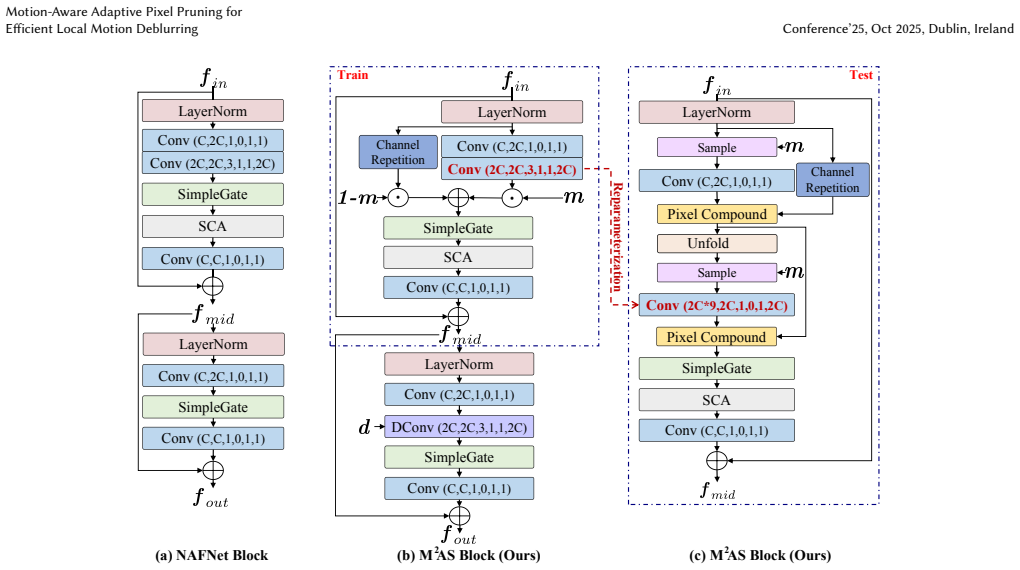
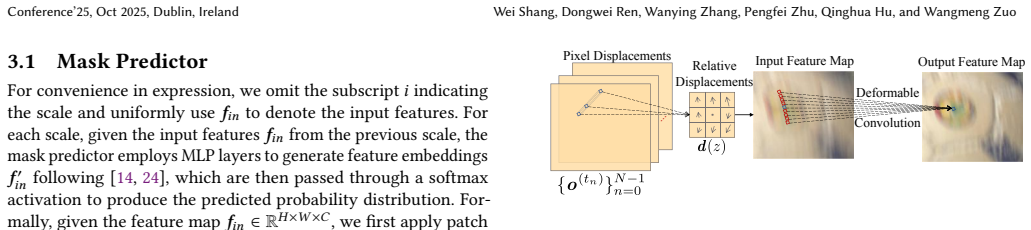
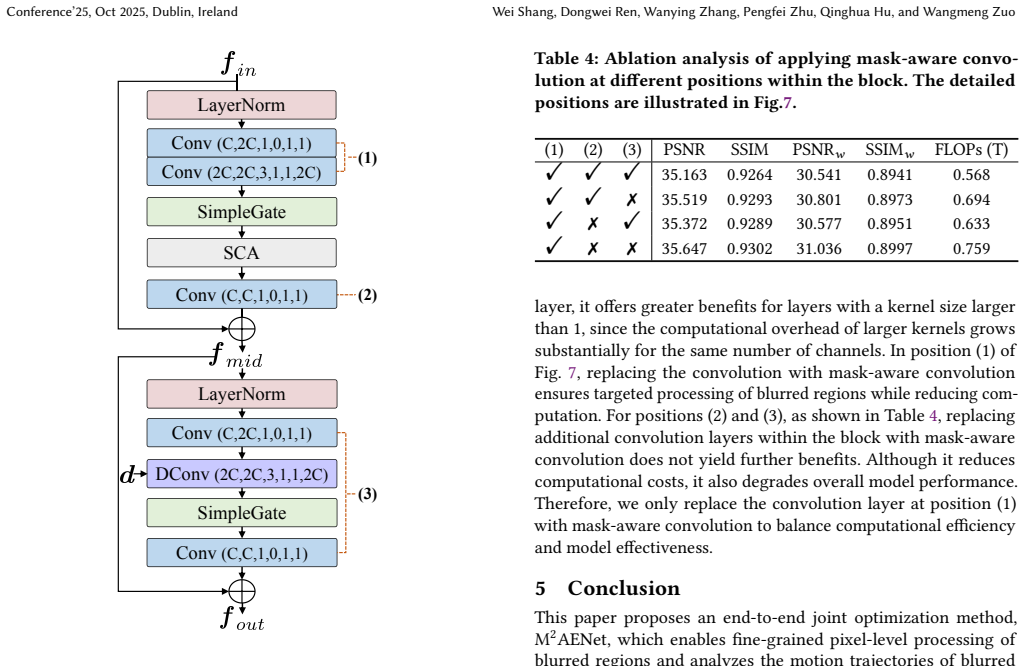
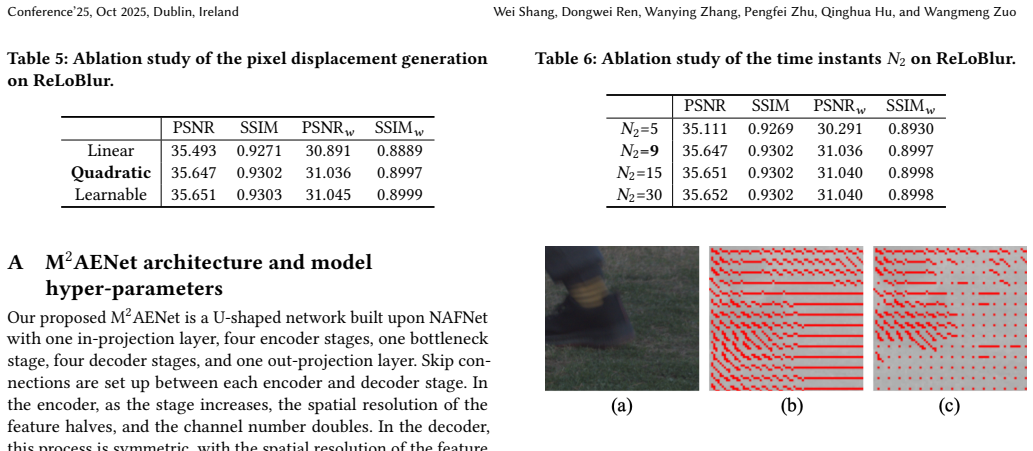
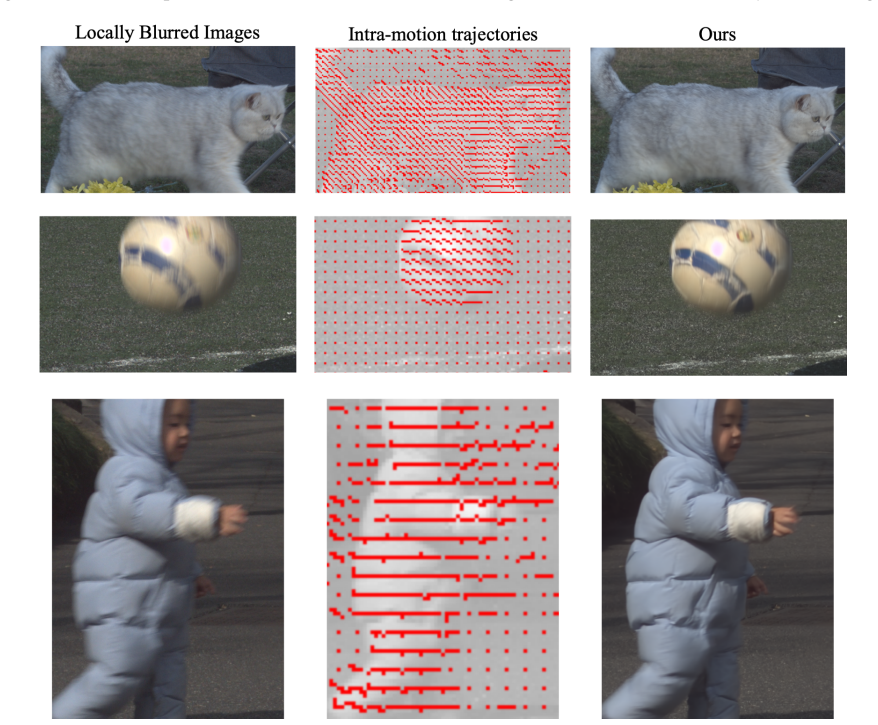
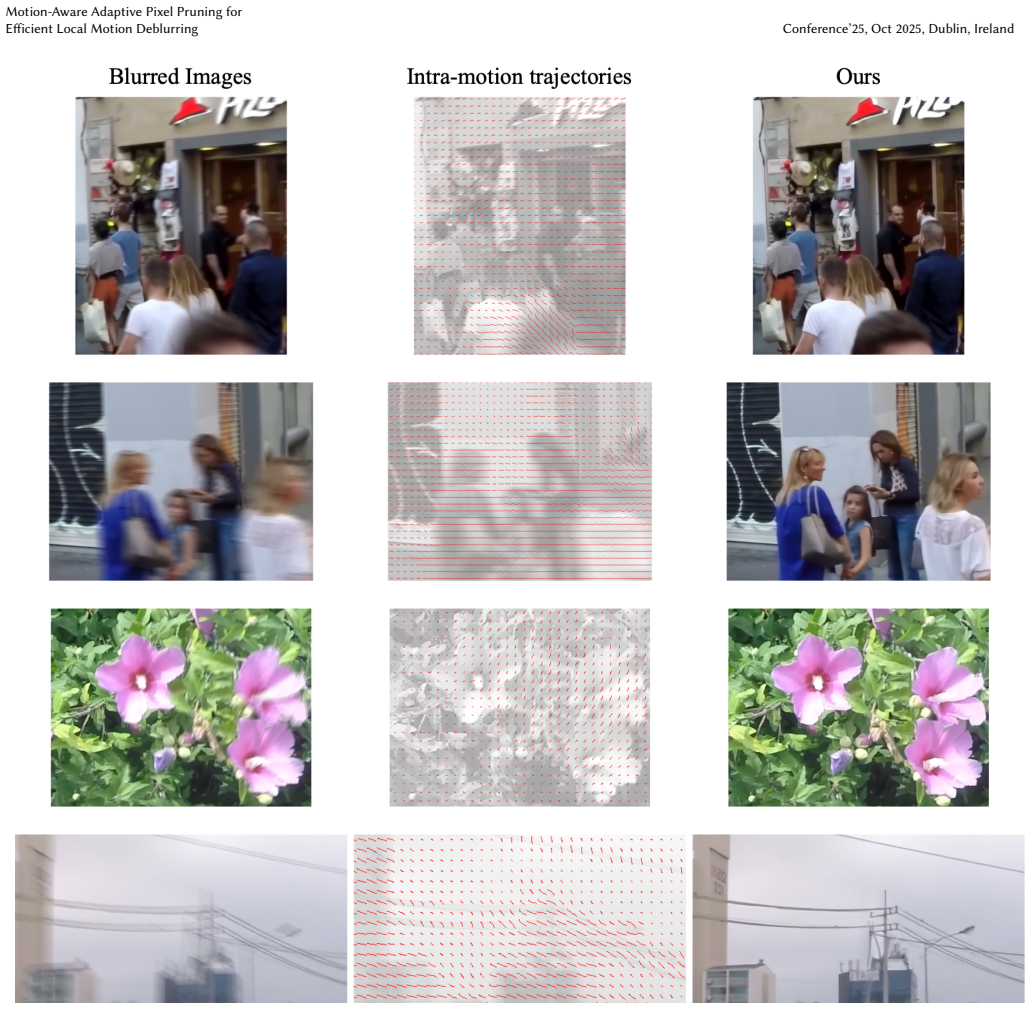
The load-bearing object is the mask- and motion-aware simple (M2AS) block, a modified NAFNet block with two inserted mechanisms. First, mask-aware convolution multiplies features elementwise by the predicted blur mask so sharp pixels are excluded while gradients still flow; at test time the network samples only the $Q$ blurred pixels and replaces each $3\times3$ convolution by the equivalent combination of an unfold operation and a reparameterized $1\times1$ convolution whose weights are the original kernel reshaped from $\mathbb{R}^{C_{\text{out}}\times C_{\text{in}}\times3\times3}$ to $\mathbb{R}^{C_{\text{out}}\times(C_{\text{in}}\times9)\times1\times1}$, cutting that layer's work by the factor $Q/(HW)$. Second, motion-aware deformable convolution takes the predicted per-pixel displacements $\{\boldsymbol{o}(t_n)\}_{n=0}^{N-1}$, converts them into relative offsets for a $3\times3$ deformable kernel by adding them to the standard kernel positions, and performs depthwise deformable convolution so the receptive field follows the motion trajectory. A quadratic interpolation formula generates the intermediate displacements from the two predicted endpoints, and a reblur loss warps the sharp ground truth along those displacements to supervise them.
What would settle it
Build a synthetic local-blur test set from a high-frame-rate video so the true exposure midpoint is known, then retrain M2AENet twice: once with the sharp reference at the true midpoint and once with it shifted to a known non-midpoint frame. If the second model's PSNR_w does not fall or its estimated displacement fields do not rotate or translate to compensate, the midpoint assumption is not actually carrying the result; if it degrades, the assumption is confirmed as load-bearing.
Extended reading notes
Core claim
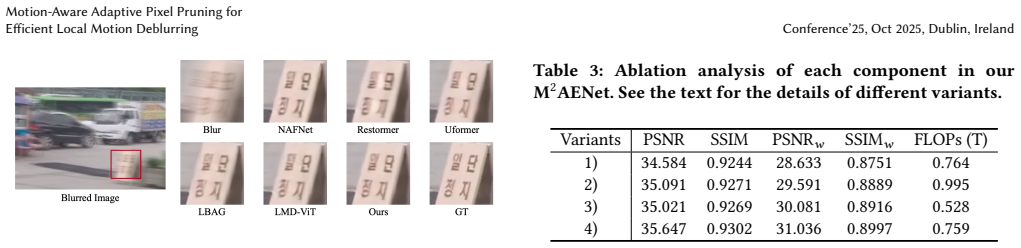
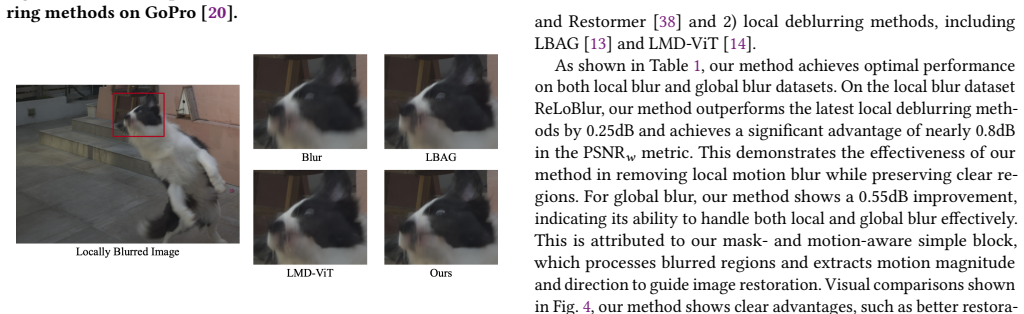
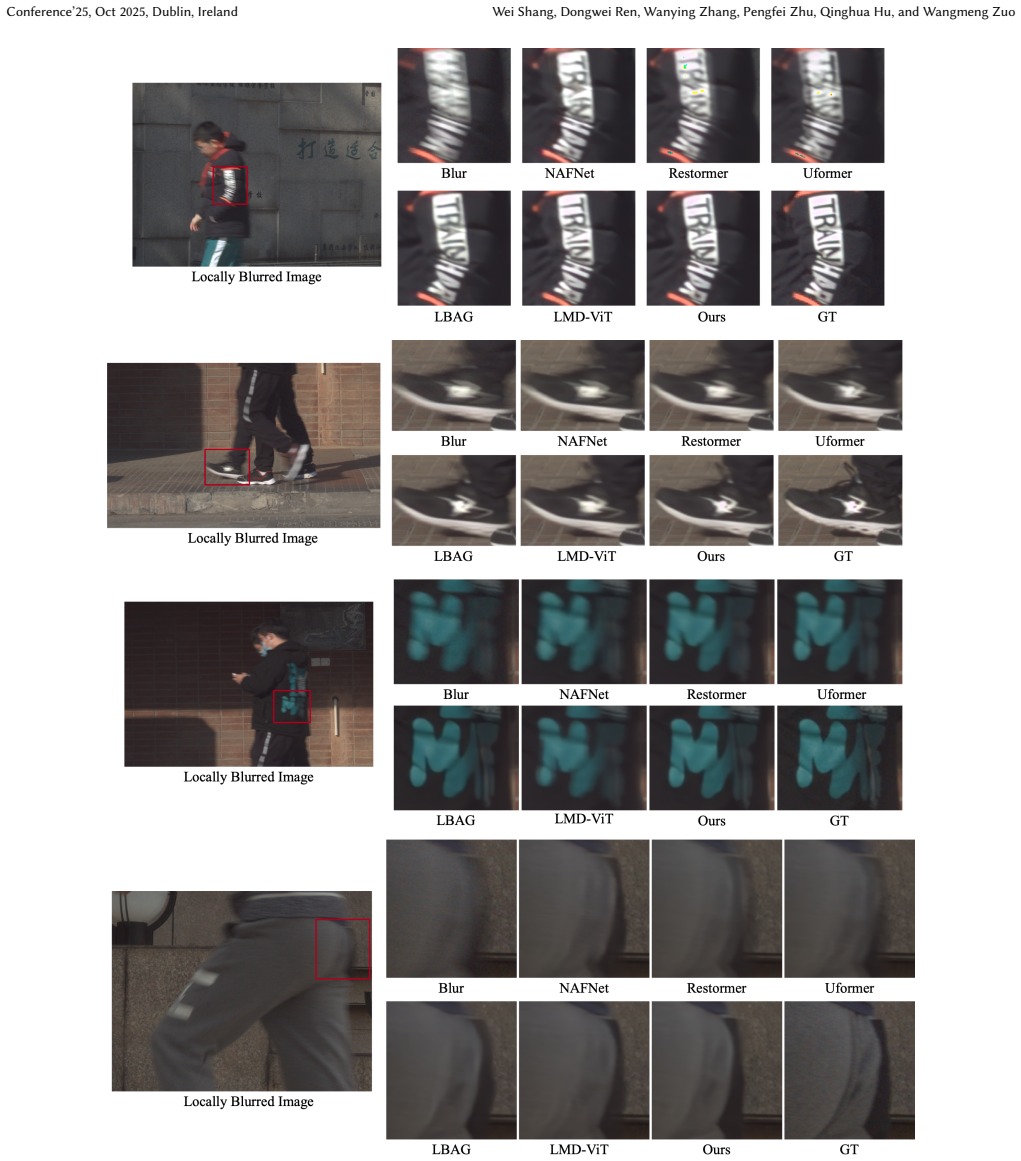
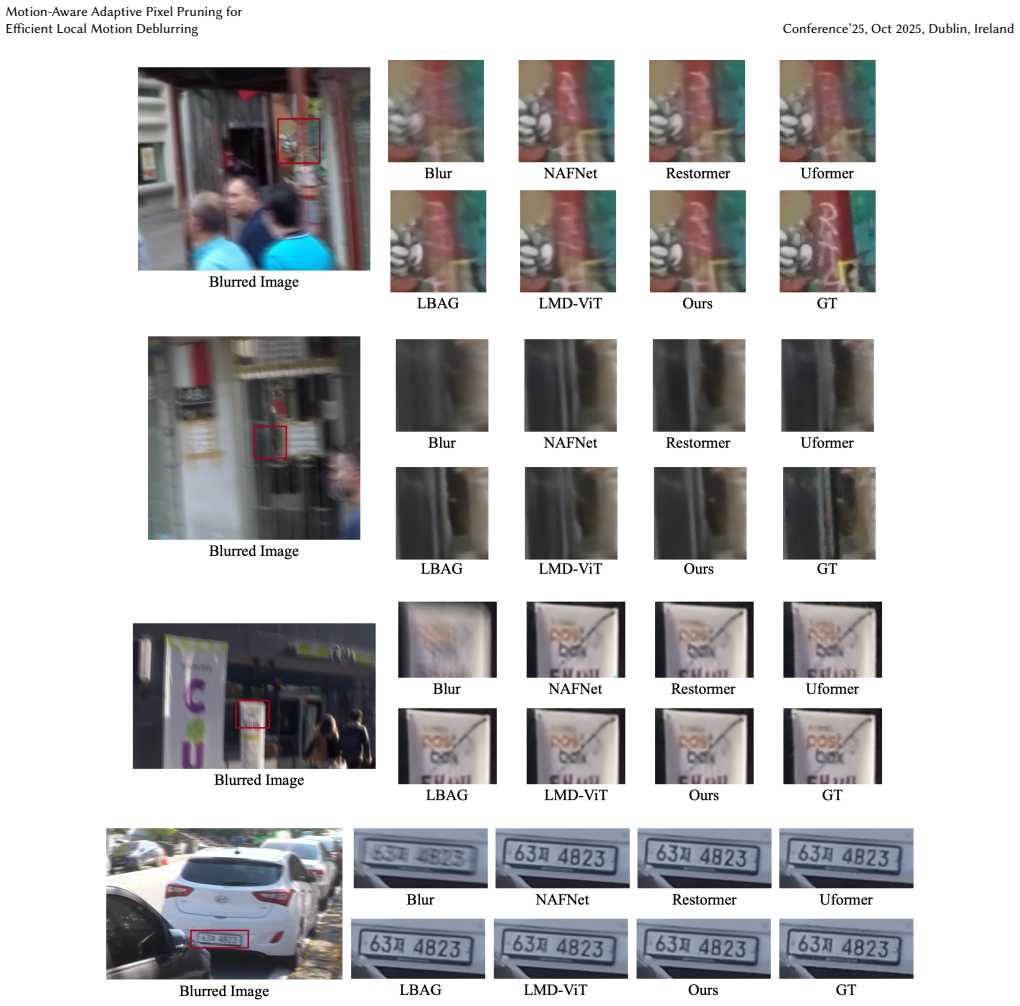
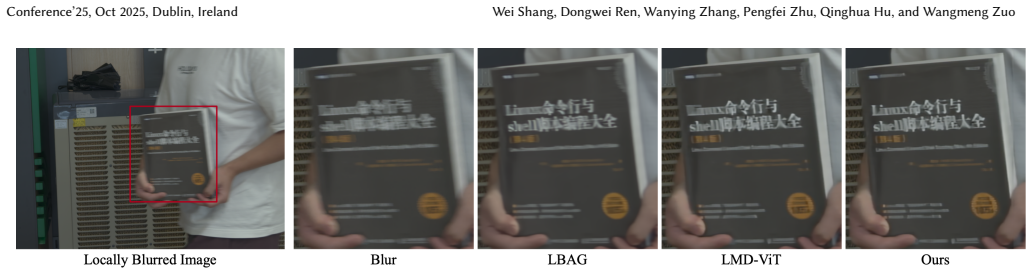
The central claim is that local motion deblurring can be cast as two coupled subproblems: locating the blurred pixels and following their motion. A mask predictor assigns each pixel a blur probability, converted to a binary mask through Gumbel-Softmax during training and a threshold at test time; an intra-motion analyzer predicts each pixel's displacement from the exposure midpoint to the start and end of the exposure, with intermediate positions filled by a quadratic trajectory. The mask gates feature processing so sharp pixels contribute nothing, and the trajectory offsets are fed into a depthwise deformable convolution so that restoration samples pixels along the direction and magnitude of motion. The paper reports that these two mechanisms together, not either alone, produce the best results: ablations show the mask mainly lifts weighted PSNR on local blur while the motion convolution mainly lifts global PSNR. The result is a single end-to-end network that outperforms existing local and global deblurring methods on ReLoBlur and GoPro while spending computation almost exclusively on blurred pixels.
Load-bearing premise
The load-bearing premise is that the paired sharp ground-truth frame sits exactly at the midpoint of the exposure interval, because the offset-prediction loss uses that midpoint as the anchor for all warped sharp frames; the paper says the ground truth only 'typically represents' the midpoint and does not verify this for the beam-splitter ReLoBlur captures.
Editorial extensions
If this is right
- Because pruning happens per pixel, the computational saving grows as the blurred region shrinks, which is exactly the regime of high-resolution images with small moving objects.
- Mask and motion information are complementary: removing the mask collapses weighted PSNR on local blur, while removing the motion convolution collapses global PSNR, so the paper's accuracy gain depends on both mechanisms being present.
- The same trained model handles global blur by treating the whole image as blurred with a mask of ones on GoPro, meaning pixel pruning does not prevent the network from behaving like a global deblurrer when needed.
- Applying mask-aware convolution to additional positions inside the block lowers FLOPs further but hurts accuracy, so the paper places it at only the first convolution of the block to balance speed and quality.
Reading between the lines
- The midpoint-exposure assumption behind the offset loss is testable: on a synthetic blur benchmark with known shutter timing, shifting the reference sharp frame away from the midpoint should measurably bias the learned displacements if the assumption is load-bearing.
- The predicted displacement fields are an interpretable by-product that could serve as self-supervised motion estimates for related tasks such as motion segmentation or optical-flow initialization, since the reblur loss provides supervision without manual annotations.
- The flat-region failure mode noted in the appendix suggests that reblur supervision alone cannot distinguish a sharp flat area from a blurred one; adding edge-aware or temporal constraints is a natural next step the paper leaves open.
Editorial analysis
A structured set of objections, weighed in public.
Referee Report
Summary. The paper proposes M2AENet, a CNN-based local motion deblurring method built on NAFNet, adding a trainable mask predictor for blurred-region localization and an intra-motion analyzer that estimates per-pixel displacements during exposure. The method uses mask-aware convolution with a pixel-pruning inference strategy that reparameterizes 3×3 convolutions into 1×1 convolutions, and a motion-aware deformable convolution guided by the estimated motion trajectories. The network is trained end-to-end with reconstruction, mask, and reblur losses. Experiments on ReLoBlur and GoPro report state-of-the-art PSNR/SSIM (and weighted metrics on ReLoBlur) while reducing FLOPs, inference time, and GPU memory compared with LMD-ViT. Ablations study the contribution of each component and the placement of mask-aware convolution.
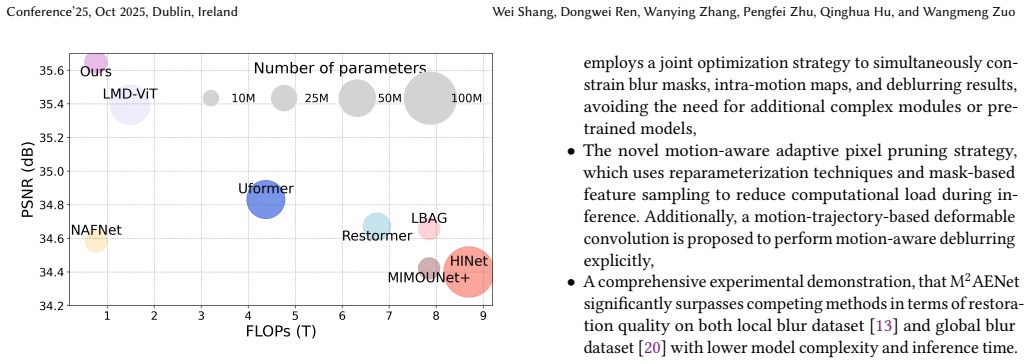
Significance. If the claims hold, M2AENet offers a practically valuable balance of quality and efficiency for local motion deblurring: pixel-level computation allocation is a natural next step beyond patch/window pruning, and the reported 0.25–0.8 dB gains on ReLoBlur and 0.55 dB on GoPro over strong baselines, together with a 49% FLOPs reduction versus LMD-ViT, are substantial. The paper's experimental protocol is more rigorous than many in the field, since all compared methods are retrained on the same combined dataset and cropping strategy. The authors also provide code, which supports reproducibility. However, several load-bearing technical descriptions are inconsistent or incomplete, and one physical assumption about the training data is unverified; these issues must be resolved before the contributions can be fully trusted.
major comments (3)
- [§3.3.1 and Fig. 2(c)] The reparameterization that converts the masked 3×3 convolution into a 1×1 convolution is described with weight shapes W∈R^{C_out×C_in×3×3} reshaped into W'∈R^{C_out×(C_in×9)×1×1}. However, the layer being reparameterized is the depthwise convolution in Eq. (5), whose actual weight tensor is W∈R^{2C×1×3×3} with groups 2C (as labeled in Fig. 2). A dense 1×1 convolution with input channels C_in×9 and output channels C_out is not equivalent to the original depthwise operation: it would have 4C^2×9 parameters and perform cross-channel mixing, whereas the depthwise convolution has 2C×9 parameters and no cross-channel mixing. The paper must either specify a grouped or block-structured reparameterization that exactly recovers the depthwise operation, or clarify the notation. Without this, the claimed FLOPs reduction and the equivalence of the pixel-pruning inference are not verifiable.
- [§3.4.3, Eq. (11)] The reblur loss assumes that the sharp ground-truth y_gt is the sharp frame at the midpoint of the exposure interval, since the model warps y_gt by the estimated displacements o(t_n) and sums over time instants to synthesize the blurred input. The paper states only that y_gt 'typically represents' the midpoint and provides no verification for ReLoBlur, which is captured with a beam-splitter system whose temporal alignment of the sharp frame within the exposure is not specified. If the sharp frame is not at the midpoint, the estimated o(t0) and o(t_{N-1}) are biased by a constant temporal offset, and the 'motion trajectories' used to guide the deformable convolution are systematically incorrect. The ablation in Table 3 shows that the motion-aware component improves PSNR, but that only demonstrates that the offsets carry useful information for the reconstruction loss, not that they are physically correct. The authors should verify the temporal alignment in the dataset or reformulate the loss to be independent of an unknown midpoint, and ideally provide a synthetic experiment where ground-truth motion is known.
- [§3.1, §3.4, and Appendix A] The main text repeatedly states that the mask predictor and intra-motion analyzer are applied at each scale and that the losses in Eqs. (9)–(10) sum over S scales. However, Appendix A states: 'To ease training, we added the mask predictor and intra-motion analyzer only to the fourth stage of the encoder.' These statements are directly contradictory. If only one stage uses these components, then the sum over S scales is either incorrect or S=1, and the claimed multi-scale joint optimization is not implemented as described. The authors must correct this inconsistency and specify precisely which stages contain the mask predictor and intra-motion analyzer, because it affects the interpretation of the mask loss, the offset loss, and the overall architecture.
minor comments (5)
- [Fig. 2 caption] The caption contains a typo: 'M AS Block (Ours)2' should likely read 'M2AS Block (Ours)'.
- [Eq. (8)] The frequency reconstruction loss FFT is not defined in the paper; an explicit equation or a reference would improve reproducibility.
- [Abstract and Fig. 1] The abstract claims 'superior performance' over state-of-the-art methods, while Fig. 1 describes 'comparable performance to state-of-the-art methods'; this wording should be unified to avoid undercutting the central claim.
- [§3.1, Eq. (3)] The test-time threshold ε is fixed at 0.5 even though the paper describes the pruning as 'adaptive'; the authors should briefly justify this choice or analyze its sensitivity.
- [Table 2] The column header 'Times (s)' should be 'Time (s)' for consistency with the caption.
Circularity Check
No significant circularity: the central claims are held-out benchmark comparisons, and the auxiliary losses are externally supervised or forward-model constraints rather than reductions to the method's own outputs.
full rationale
The paper's central claims are benchmark PSNR/SSIM and efficiency comparisons on held-out ReLoBlur and GoPro test sets, with all compared methods retrained under the same protocol. The three training losses are externally supervised or physically constrained: the reconstruction loss uses sharp ground truth; the mask loss uses annotated blur masks; and the reblur loss (Eq. 11) synthesizes a blurred frame by warping the sharp ground truth with predicted displacements and matching the input blurred frame. This is a forward blur-formation self-supervision, not an identity that defines the output in terms of itself. The mask predictor is supervised by ground-truth masks, and the displacement field is constrained by an independent reblur consistency term plus TV smoothness; neither the predicted mask nor the displacements are fitted to the target PSNR/SSIM. Ablations compare component removals against the same losses. The midpoint-exposure assumption in Sec. 3.4.3 is an unverified modeling assumption and therefore a correctness risk, but it is not circular: if the assumption fails, Eq. 11 is biased, yet the derivation does not define any predicted quantity in terms of the final metric. Self-citations ([25], [28]) appear only in related work and are not load-bearing; no uniqueness theorem or ansatz is imported from the authors' prior work. No circular step satisfies the quoted-reduction standard.
Assumptions & free parameters
free parameters (4)
- alpha
- mask threshold epsilon =
0.5
- number of exposure instants N2 =
9
- loss weights lambda and gamma =
lambda=0.01, gamma=0.1
assumptions (5)
- domain assumption A blurred frame is approximated by the sum of sharp frames warped forward to discrete time instants during exposure, as in Eq. 11.
- domain assumption The sharp ground-truth frame corresponds to the midpoint of the exposure interval.
- domain assumption Pixel displacements between the start and end of exposure follow a quadratic-in-time curve.
- standard math A 3x3 convolution can be exactly replaced by an unfold operation plus a 1x1 convolution.
- domain assumption Dataset blur masks from ReLoBlur, with the LMD-ViT annotation scheme, and the all-one masks for GoPro correctly supervise the mask predictor.
Cite this review
Pith. "Pith review of Motion-Aware Adaptive Pixel Pruning for Efficient Local Motion Deblurring." pith.science (2026). https://pith.science/paper/SJ5XDFV6
@misc{pith2026250707708,
  author       = {Pith},
  title        = {Pith review of: Motion-Aware Adaptive Pixel Pruning for Efficient Local Motion Deblurring},
  year         = {2026},
  howpublished = {\url{https://pith.science/paper/SJ5XDFV6}},
  note         = {Machine review of arXiv:2507.07708}
}
abstract
Local motion blur in digital images originates from the relative motion between dynamic objects and static imaging systems during exposure. Existing deblurring methods face significant challenges in addressing this problem due to their inefficient allocation of computational resources and inadequate handling of spatially varying blur patterns. To overcome these limitations, we first propose a trainable mask predictor that identifies blurred regions in the image. During training, we employ blur masks to exclude sharp regions. For inference optimization, we implement structural reparameterization by converting $3\times 3$ convolutions to computationally efficient $1\times 1$ convolutions, enabling pixel-level pruning of sharp areas to reduce computation. Second, we develop an intra-frame motion analyzer that translates relative pixel displacements into motion trajectories, establishing adaptive guidance for region-specific blur restoration. Our method is trained end-to-end using a combination of reconstruction loss, reblur loss, and mask loss guided by annotated blur masks. Extensive experiments demonstrate superior performance over state-of-the-art methods on both local and global blur datasets while reducing FLOPs by 49\% compared to SOTA models (e.g., LMD-ViT). The source code is available at https://github.com/shangwei5/M2AENet.
Figures
Figures from the paper (10 more)
Reference graph
Works this paper leans on
-
[1]
Taiebeh Askari Javaran, Hamid Hassanpour, and Vahid Abolghasemi. 2017. Local motion deblurring using an effective image prior based on both the first-and second-order gradients.Machine Vision and Applications28 (2017), 431–444
work page 2017
-
[2]
Liangyu Chen, Xiaojie Chu, Xiangyu Zhang, and Jian Sun. 2022. Simple baselines for image restoration. InEur. Conf. Comput. Vis.17–33
work page 2022
-
[3]
Liangyu Chen, Xin Lu, Jie Zhang, Xiaojie Chu, and Chengpeng Chen. 2021. HINet: Half instance normalization network for image restoration. InIEEE Conf. Comput. Vis. Pattern Recog.182–192
work page 2021
-
[4]
Sung-Jin Cho, Seo-Won Ji, Jun-Pyo Hong, Seung-Won Jung, and Sung-Jea Ko
-
[5]
Rob Fergus, Barun Singh, Aaron Hertzmann, Sam T Roweis, and William T Freeman. 2006. Removing camera shake from a single photograph. InACM SIGGRAPH. 787–794
work page 2006
-
[6]
Eric Jang, Shixiang Gu, and Ben Poole. 2017. Categorical reparameterization with gumbel-softmax. InInt. Conf. Learn. Represent
work page 2017
-
[7]
Jinho Jeong, Jinwoo Kim, Younghyun Jo, and Seon Joo Kim. 2024. Accelerating Image Super-Resolution Networks with Pixel-Level Classification. InEur. Conf. Comput. Vis.236–251
work page 2024
-
[8]
Diederik P Kingma and Jimmy Ba. 2014. Adam: A method for stochastic opti- mization. InInt. Conf. Learn. Represent
work page 2014
Show all 41 references
-
[9]
Lingshun Kong, Jiangxin Dong, Jianjun Ge, Mingqiang Li, and Jinshan Pan. 2023. Efficient frequency domain-based transformers for high-quality image deblurring. InIEEE Conf. Comput. Vis. Pattern Recog.5886–5895
2023
-
[10]
Xiangtao Kong, Hengyuan Zhao, Yu Qiao, and Chao Dong. 2021. ClassSR: Agen- eral framework to accelerate super-resolution networks by data characteristic. InIEEE Conf. Comput. Vis. Pattern Recog.12016–12025
2021
-
[11]
Orest Kupyn, Volodymyr Budzan, Mykola Mykhailych, Dmytro Mishkin, and Jiří Matas. 2018. Deblurgan: Blind motion deblurring using conditional adversarial networks. InIEEE Conf. Comput. Vis. Pattern Recog.8183–8192
2018
-
[12]
Anat Levin. 2006. Blind motion deblurring using image statistics. InAdv. Neural Inform. Process. Syst., Vol. 19
2006
-
[13]
Haoying Li, Ziran Zhang, Tingting Jiang, Peng Luo, Huajun Feng, and Zhihai Xu. 2023. Real-world deep local motion deblurring. InAss. Advance. Arti. Intell., Vol. 37. 1314–1322
2023
-
[14]
Haoying Li, Jixin Zhao, Shangchen Zhou, Huajun Feng, Chongyi Li, and Chen Change Loy. 2024. Adaptive Window Pruning for Efficient Local Motion Deblurring. InInt. Conf. Learn. Represent
2024
-
[15]
Ilya Loshchilov and Frank Hutter. 2017. SGDR: Stochastic Gradient Descent with Warm Restarts. InInt. Conf. Learn. Represent
2017
-
[16]
Xintian Mao, Qingli Li, and Yan Wang. 2024. AdaRevD: Adaptive Patch Exiting Reversible Decoder Pushes the Limit of Image Deblurring. InIEEE Conf. Comput. Vis. Pattern Recog.25681–25690
2024
-
[17]
Xintian Mao, Yiming Liu, Fengze Liu, Qingli Li, Wei Shen, and Yan Wang. 2023. Intriguing findings of frequency selection for image deblurring. InAss. Advance. Arti. Intell., Vol. 37. 1905–1913
2023
-
[18]
Xintian Mao, Jiansheng Wang, Xingran Xie, Qingli Li, and Yan Wang. 2024. LoFormer: Local frequency Transformer for image deblurring. InACM Int. Conf. Multimedia. 10382–10391
2024
-
[19]
Seungjun Nah, Sungyong Baik, Seokil Hong, Gyeongsik Moon, Sanghyun Son, Radu Timofte, and Kyoung Mu Lee. 2019. NTIRE 2019 challenge on video deblur- ring and super-resolution: Dataset and study. InIEEE Conf. Comput. Vis. Pattern Recog. Worksh.0–0
2019
-
[20]
Seungjun Nah, Tae Hyun Kim, and Kyoung Mu Lee. 2017. Deep multi-scale con- volutional neural network for dynamic scene deblurring. InIEEE Conf. Comput. Vis. Pattern Recog.3883–3891
2017
-
[21]
Simon Niklaus and Feng Liu. 2020. Softmax splatting for video frame interpolation. InIEEE Conf. Comput. Vis. Pattern Recog.5437–5446
2020
-
[22]
Jinshan Pan, Deqing Sun, Hanspeter Pfister, and Ming-Hsuan Yang. 2016. Blind image deblurring using dark channel prior. InIEEE Conf. Comput. Vis. Pattern Recog.1628–1636
2016
-
[23]
Bang-Dang Pham, Phong Tran, Anh Tran, Cuong Pham, Rang Nguyen, and Minh Hoai. 2024. Blur2Blur: Blur Conversion for Unsupervised Image Deblurring on Unknown Domains. InIEEE Conf. Comput. Vis. Pattern Recog.2804–2813
2024
-
[24]
Yongming Rao, Wenliang Zhao, Benlin Liu, Jiwen Lu, Jie Zhou, and Cho-Jui Hsieh. 2021. DynamicViT: Efficient vision Transformers with dynamic token sparsification.Adv. Neural Inform. Process. Syst.34 (2021), 13937–13949
2021
-
[25]
Dongwei Ren, Kai Zhang, Qilong Wang, Qinghua Hu, and Wangmeng Zuo. 2020. Neural blind deconvolution using deep priors. InIEEE Conf. Comput. Vis. Pattern Recog.3341–3350
2020
-
[26]
Wenqi Ren, Jiawei Zhang, Jinshan Pan, Sifei Liu, Jimmy S Ren, Junping Du, Xiaochun Cao, and Ming-Hsuan Yang. 2021. Deblurring dynamic scenes via spatially varying recurrent neural networks.IEEE Trans. Pattern Anal. Mach. Intell.44, 8 (2021), 3974–3987
2021
-
[27]
Qi Shan, Jiaya Jia, and Aseem Agarwala. 2008. High-quality motion deblurring from a single image.ACM Trans. Graph.27, 3 (2008), 1–10
2008
-
[28]
Wei Shang, Dongwei Ren, Yi Yang, and Wangmeng Zuo. 2025. Aggregating nearest sharp features via hybrid transformers for video deblurring.Information Sciences694 (2025), 121689
2025
-
[29]
Jian Sun, Wenfei Cao, Zongben Xu, and Jean Ponce. 2015. Learning a convo- lutional neural network for non-uniform motion blur removal. InIEEE Conf. Comput. Vis. Pattern Recog.769–777
2015
-
[30]
Xin Tao, Hongyun Gao, Xiaoyong Shen, Jue Wang, and Jiaya Jia. 2018. Scale- recurrent network for deep image deblurring. InIEEE Conf. Comput. Vis. Pattern Recog.8174–8182
2018
-
[31]
Fu-Jen Tsai, Yan-Tsung Peng, Yen-Yu Lin, Chung-Chi Tsai, and Chia-Wen Lin
-
[32]
John YA Wang and Edward H Adelson. 1993. Layered representation for motion analysis. InIEEE Conf. Comput. Vis. Pattern Recog.361–366
1993
-
[33]
Shizun Wang, Jiaming Liu, Kaixin Chen, Xiaoqi Li, Ming Lu, and Yandong Guo
-
[34]
Zhou Wang, Alan C Bovik, Hamid R Sheikh, and Eero P Simoncelli. 2004. Image quality assessment: from error visibility to structural similarity.IEEE Trans. Image Process.13, 4 (2004), 600–612
2004
-
[35]
Zhendong Wang, Xiaodong Cun, Jianmin Bao, Wengang Zhou, Jianzhuang Liu, and Houqiang Li. 2022. Uformer: A general U-shaped transformer for image restoration. InIEEE Conf. Comput. Vis. Pattern Recog.17683–17693
2022
-
[36]
Adaptive patch exiting for scalable single image super-resolution. InEur. Conf. Comput. Vis.292–307
-
[37]
Xiangyu Xu, Siyao Li, Wenxiu Sun, Qian Yin, and Ming-Hsuan Yang. 2019. Qua- dratic video interpolation. InAdv. Neural Inform. Process. Syst.1–10
2019
-
[38]
Syed Waqas Zamir, Aditya Arora, Salman Khan, Munawar Hayat, Fahad Shahbaz Khan, and Ming-Hsuan Yang. 2022. Restormer: Efficient transformer for high- resolution image restoration. InIEEE Conf. Comput. Vis. Pattern Recog.5728–5739. Conference’25, Oct 2025, Dublin, Ireland Wei S...
2022
-
[39]
Zeyu Xiao, Zhihe Lu, Michael Bi Mi, Zhiwei Xiong, and Xinchao Wang. 2024. Unraveling Motion Uncertainty for Local Motion Deblurring. InACM Int. Conf. Multimedia. 3065–3074
2024
-
[2021]
Rethinking coarse-to-fine approach in single image deblurring. InInt. Conf. Comput. Vis.4641–4650
-
[2022]
Stripformer: Strip Transformer for fast image deblurring. InEur. Conf. Comput. Vis.Springer, 146–162
Reviewed August 6, 2026 · model on record in the stance chip above.
Discussion (0). Sign in to comment.