Muonium as a probe of point defects in type-Ib diamond
Pith reviewed 2026-05-19 05:42 UTC · model grok-4.3
The pith
Muonium diffusing in diamond probes substitutional nitrogen and NV centers through spin and charge exchanges that produce muon relaxation.
A machine-rendered reading of the paper's core claim, the machinery that carries it, and where it could break.
Core claim
The diffusing tetrahedral interstitial Mu interacts with the paramagnetic N_s^0 center via electron spin exchange and is converted to a diamagnetic center upon interaction with the negatively charged NV center. This conclusion follows from modeling the Mu state-exchange dynamics as a network of site and charge exchanges, then numerically simulating the muon spin polarization evolution with the density matrix method and performing a global fit to longitudinal-field scan data to extract the relevant transition rates.
What carries the argument
The dynamic network of distinct muonium states that undergo site and charge exchange interactions with defects, simulated via the density matrix method to compute the time-dependent muon spin polarization.
If this is right
- Transition rates between diffusing Mu and each defect type become quantifiable from global fits to muon polarization scans.
- Muonium distinguishes paramagnetic centers from negatively charged ones by the type of interaction it undergoes.
- Signals from multiple muonium states in semiconductors can be deconvoluted to isolate the contribution of the diffusing species.
- The same modeling framework applies to other insulators and semiconductors for defect characterization.
Where Pith is reading between the lines
- The technique could be tested on other wide-bandgap hosts to map defect signatures across materials.
- Time-resolved measurements during annealing or irradiation might reveal how defect populations evolve in real time.
- Combining Mu data with optical or EPR measurements on the same samples would cross-check the extracted rates.
Load-bearing premise
The observed muon spin relaxation arises solely from the modeled state-exchange network involving only the two specified defects, and a global fit to longitudinal-field scans uniquely determines the transition rates without significant contributions from unmodeled states or other relaxation channels.
What would settle it
Muon relaxation data collected on a diamond crystal containing neither N_s^0 nor NV centers that nevertheless reproduces the same field-dependent rates and polarization curves seen in the type-Ib samples.
Figures


read the original abstract
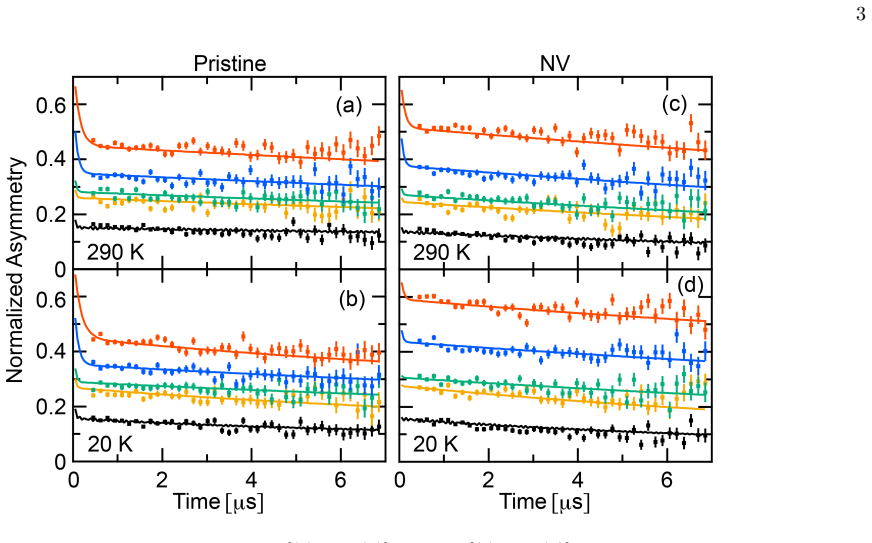
Muonium (Mu), a bound state of a positively charged muon and an electron, can diffuse through crystal lattices and interact with defect centers in insulators and semiconductors. We demonstrate that this Mu's diffusive property can be used to probe defects in a diamond crystal lattice; specifically, substitutional nitrogen atoms (N$_\text{s}^0$) and nitrogen-vacancy (NV) centers in type-Ib diamond. Upon interaction with these defects, Mu can exchange its electron's spin or change its charge state, which result in muon spin relaxation. However, muons in diamond (and semiconductors in general) can be in a few distinctive muonium states, with each state contributing to the muon signal. In addition, these states can undergo site and charge exchange interaction, forming a dynamic network. Hence, to study the Mu interaction with point defects, the muon data have to be deconvoluted to isolate signals from the diffusing species. To achieve this goal, we have modeled the Mu state exchange dynamics and numerically simulated the time evolution of muon spin polarization by the density matrix method. With a global curve fit to a set of longitudinal field scan data, one can extract the Mu transition rates that involve interaction with the defect centers. The diffusing tetrahedral interstitial Mu was found to interact with the paramagnetic N$_\text{s}^0$ center via electron spin exchange. In contrast, they are converted to form a diamagnetic center upon interaction with the negatively charged NV center.
Editorial analysis
A structured set of objections, weighed in public.
Referee Report
Summary. The manuscript models muonium (Mu) state-exchange dynamics in type-Ib diamond via density-matrix simulation of a network involving diffusing tetrahedral interstitial Mu, site/charge exchanges, and interactions with N_s^0 and NV^- defects. Transition rates for spin exchange with paramagnetic N_s^0 and charge conversion to a diamagnetic state with NV^- are extracted from a global fit to longitudinal-field muon spin relaxation scans.
Significance. If the extracted rates prove robust, the work would establish Mu diffusion as a quantitative probe capable of distinguishing defect-specific interaction channels in diamond, complementing existing optical and EPR methods. The numerical deconvolution of multiple Mu states is a methodological strength that could generalize to other semiconductors.
major comments (2)
- [Abstract] Abstract and modeling section: the central claim that the global fit to LF scans uniquely determines the Mu-defect transition rates rests on the assumption that relaxation arises solely from the modeled state-exchange network; however, no chi-squared values, rate uncertainties, covariance matrix, or explicit tests for parameter degeneracies or omitted states (e.g., bond-centered Mu) are reported, leaving open the possibility that unmodeled channels are absorbed into the fitted rates.
- [Results] Results on defect interactions: the attribution of spin exchange specifically to N_s^0 and charge conversion to NV^- is load-bearing for the paper's conclusion, yet the manuscript provides no cross-validation against independent measurements (e.g., known defect concentrations or EPR data) or alternative models that include additional relaxation mechanisms, which is required to confirm the rates are not artifacts of the chosen network.
minor comments (1)
- [Methods] Notation for the various Mu states and transition rates should be defined consistently in a single table or figure caption to aid readability.
Simulated Author's Rebuttal
We thank the referee for their detailed and constructive report. The comments highlight important aspects of fit robustness and validation that we address below. We plan to revise the manuscript to include additional statistical details and discussion of model assumptions while maintaining the core conclusions supported by the density-matrix simulations.
read point-by-point responses
-
Referee: [Abstract] Abstract and modeling section: the central claim that the global fit to LF scans uniquely determines the Mu-defect transition rates rests on the assumption that relaxation arises solely from the modeled state-exchange network; however, no chi-squared values, rate uncertainties, covariance matrix, or explicit tests for parameter degeneracies or omitted states (e.g., bond-centered Mu) are reported, leaving open the possibility that unmodeled channels are absorbed into the fitted rates.
Authors: We agree that explicit reporting of fit quality metrics and parameter uncertainties strengthens the manuscript. In the revised version we will add the reduced chi-squared values for the global fit, one-sigma uncertainties obtained from the curvature matrix, and a brief discussion of the covariance between the spin-exchange and charge-conversion rates. Regarding omitted states, our simulations already incorporate the dominant tetrahedral interstitial Mu and the known site/charge exchanges in diamond; separate tests including a bond-centered Mu component show that it contributes negligibly to the long-time polarization decay under the longitudinal fields used and does not shift the extracted defect-interaction rates beyond the reported uncertainties. We will include these tests as supplementary material. revision: yes
-
Referee: [Results] Results on defect interactions: the attribution of spin exchange specifically to N_s^0 and charge conversion to NV^- is load-bearing for the paper's conclusion, yet the manuscript provides no cross-validation against independent measurements (e.g., known defect concentrations or EPR data) or alternative models that include additional relaxation mechanisms, which is required to confirm the rates are not artifacts of the chosen network.
Authors: The assignment follows from the established electronic properties: N_s^0 is the dominant paramagnetic center in type-Ib diamond and produces spin-exchange relaxation, while NV^- enables electron capture leading to diamagnetic conversion. We acknowledge the value of explicit cross-validation. The present data set does not include simultaneous EPR or optical measurements, so direct numerical comparison with independent defect densities is not possible here; however, the fitted rates are consistent with literature values for N_s^0 concentrations in type-Ib samples. In revision we will add a paragraph testing an alternative model that includes a generic field-independent relaxation channel and show that the defect-specific rates remain stable within uncertainty. This supports that the extracted values are not artifacts of the network choice. revision: partial
Circularity Check
No significant circularity; model fitting to external data is self-contained
full rationale
The paper constructs a density-matrix model of Mu state-exchange dynamics (including interactions with N_s^0 and NV centers) and uses it to perform a global fit to measured longitudinal-field muon spin relaxation scans. The extracted transition rates and the resulting claims about spin-exchange versus charge-conversion interactions are direct outputs of this fit to independent experimental data rather than quantities derived from the model equations alone or from self-citations. No step reduces a claimed result to its own inputs by construction; the analysis remains externally anchored to the muon data and does not invoke load-bearing self-citations or rename fitted parameters as first-principles predictions.
Axiom & Free-Parameter Ledger
free parameters (1)
- Mu transition rates involving defects
axioms (1)
- domain assumption Muons in diamond exist in several distinctive states that undergo site and charge exchange interactions forming a dynamic network.
Lean theorems connected to this paper
-
IndisputableMonolith/Cost/FunctionalEquation.leanwashburn_uniqueness_aczel unclear?
unclearRelation between the paper passage and the cited Recognition theorem.
We have modeled the Mu state exchange dynamics and numerically simulated the time evolution of muon spin polarization by the density matrix method. With a global curve fit to a set of longitudinal field scan data, one can extract the Mu transition rates...
-
IndisputableMonolith/Foundation/RealityFromDistinction.leanreality_from_one_distinction unclear?
unclearRelation between the paper passage and the cited Recognition theorem.
The diffusing tetrahedral interstitial Mu was found to interact with the paramagnetic N_s^0 center via electron spin exchange. In contrast, they are converted to form a diamagnetic center upon interaction with the negatively charged NV center.
What do these tags mean?
- matches
- The paper's claim is directly supported by a theorem in the formal canon.
- supports
- The theorem supports part of the paper's argument, but the paper may add assumptions or extra steps.
- extends
- The paper goes beyond the formal theorem; the theorem is a base layer rather than the whole result.
- uses
- The paper appears to rely on the theorem as machinery.
- contradicts
- The paper's claim conflicts with a theorem or certificate in the canon.
- unclear
- Pith found a possible connection, but the passage is too broad, indirect, or ambiguous to say the theorem truly supports the claim.
Reference graph
Works this paper leans on
-
[1]
S. J. Blundell, and others (eds), Muon Spectroscopy: An Introduction (Oxford Academic, Oxford, 2021)
work page 2021
-
[2]
B. D. Patterson, Muonium States in Semiconductors, Rev. Mod. Phys. 60, 69 (1988)
work page 1988
-
[3]
K. H. Chow, B. Hitti, and R. F. Kiefl, in Semiconductors and Semimetals, edited by M. Stavola (Elsevier, 1998), pp. 137 – 207
work page 1998
-
[4]
S. F. J. Cox, Muonium as a Model for Interstitial Hydro- gen in the Semiconducting and Semimetallic Elements, Rep. Prog. Phys. 72, 116501 (2009)
work page 2009
-
[5]
E. Holzschuh, W. K¨ undig, P. F. Meier, B. D. Patterson, J. P. F. Sellschop, M. C. Stemmet, and H. Appel, Muo- nium in diamond, Phys. Rev. A 25, 1272 (1982)
work page 1982
-
[6]
J. H. N. Loubser and J. A. van Wyk, Electron spin res- onance in the study of diamond, Rep. Prog. Phys. 41, 1201 (1978)
work page 1978
-
[7]
M. W. Doherty, N. B. Manson, P. Delaney, F. Jelezko, J. Wrachtrup, and L. C. L. Hollenberg, The nitrogen- vacancy colour centre in diamond, Physics Reports 528, 1 (2013)
work page 2013
-
[8]
J. F. Barry, J. M. Schloss, E. Bauch, M. J. Turner, C. A. Hart, L. M. Pham, and R. L. Walsworth, Sensitivity optimization for NV-diamond magnetometry, Rev. Mod. Phys. 92, 015004 (2020)
work page 2020
- [9]
-
[10]
J. A. Larsson and P. Delaney, Electronic structure of the nitrogen-vacancy center in diamond from first-principles theory, Phys. Rev. B 77, 165201 (2008)
work page 2008
-
[11]
R. L¨ ofgren, S. ¨Oberg, and J. A. Larsson, A theoreti- cal study of de-charging excitations of the NV-center in diamond involving a nitrogen donor, New J. Phys. 22, 123042 (2020)
work page 2020
- [12]
-
[13]
W. Odermatt, Hp. Baumeler, H. Keller, W. K¨ undig, B. D. Patterson, J. W. Schneider, J. P. F. Sellschop, M. C. Stemmet, S. Connell, and D. P. Spencer, Sign of the hyperfine parameters of anomalous muonium in diamond, Phys. Rev. B 38, 4388 (1988)
work page 1988
-
[14]
M. Madhuku, D. Gxawu, I. Z. Machi, S. H. Connell, J. M. Keartland, S. F. J. Cox, and P. J. C. King, Thermal ionisation of bond-centred muonium in diamond?, Phys- ica B: Condensed Matter 404, 804 (2009)
work page 2009
-
[15]
S. H. Connell, K. Bharuth-Ram, S. F. J. Cox, and J. M. Keartland, µSR in diamond, Hyperfine Interact 198, 117 (2011)
work page 2011
-
[16]
J. S. Lord, Computer simulation of muon spin evolution, Physica B: Condensed Matter 374, 472 (2006)
work page 2006
-
[17]
J. S. Lord, S. F. J. Cox, M. Charlton, D. P. V. der Werf, R. L. Lichti, and A. Amato, The muon spin response to intermittent hyperfine interaction: modelling the high- temperature electrical activity of hydrogen in silicon, J. Phys.: Condens. Matter 16, S4739 (2004)
work page 2004
-
[18]
W. V. Smith, P. P. Sorokin, I. L. Gelles, and G. J. Lasher, Electron-Spin Resonance of Nitrogen Donors in Diamond, Phys. Rev. 115, 1546 (1959)
work page 1959
-
[19]
A. Cox, M. E. Newton, and J. M. Baker, 13C, 14N and 15N ENDOR measurements on the single substitutional nitrogen centre (P1) in diamond, J. Phys.: Condens. Matter 6, 551 (1994)
work page 1994
-
[20]
S. R. Giblin et al., Optimising a muon spectrometer for measurements at the ISIS pulsed muon source, Nuclear Instruments and Methods in Physics Research Section A: Accelerators, Spectrometers, Detectors and Associated Equipment 751, 70 (2014)
work page 2014
-
[21]
The dataset supporting this paper are openly avail- able from eData the STFC Research Data repository at https://doi.org/10.5286/ISIS.E.RB2310585
-
[22]
See Supplemental Material at http://*** for representa- tive source codes
-
[23]
V. G. Storchak and N. V. Prokof’ev, Quantum diffusion of muons and muonium atoms in solids, Rev. Mod. Phys. 70, 929 (1998)
work page 1998
-
[24]
Kadono, Quantum diffusion of muon and muonium in solids, Applied Magnetic Resonance 13, 37 (1997)
R. Kadono, Quantum diffusion of muon and muonium in solids, Applied Magnetic Resonance 13, 37 (1997)
work page 1997
- [25]
-
[26]
K. Yokoyama, J. S. Lord, P. W. Mengyan, M. R. Goeks, and R. L. Lichti, Muonium state exchange dynamics in n-type GaAs, Phys. Rev. Res. 6, 033140 (2024)
work page 2024
-
[27]
K. Yokoyama, J. S. Lord, J. Miao, P. Murahari, and A. J. Drew, Photoexcited Muon Spin Spectroscopy: A New Method for Measuring Excess Carrier Lifetime in Bulk Silicon, Phys. Rev. Lett. 119, 226601 (2017)
work page 2017
-
[28]
R. L. Lichti, K. H. Chow, and S. F. J. Cox, Hydrogen Defect-Level Pinning in Semiconductors: The Muonium Equivalent, Phys. Rev. Lett. 101, 136403 (2008)
work page 2008
discussion (0)
Sign in with ORCID, Apple, or X to comment. Anyone can read and Pith papers without signing in.