REVIEW 3 major objections 6 minor 20 references
Beyond Robustness: Learning Unknown Dynamic Load Adaptation for Quadruped Locomotion on Rough Terrain
T0 review · 3 major / 6 minor · reviewed 2026-08-06 · deepseek-v4-flash
Pith's one-line read A quadruped can adapt to an unknown shifting load if the load is represented by position, velocity, mass, and friction, and a neural estimator trained with the policy recovers those from proprioceptive history.
desk verdict A credible extension of concurrent teacher-student RL to dynamic loads, but the load estimator's accuracy is never directly measured, so the central mechanism is plausible yet unproven. read the letter →
The pith
A machine-rendered reading of the paper's core claim, the machinery that carries it, and where it could break.
The reading
What carries the argument
The load characteristics estimator: an MLP mapping the last 15 proprioceptive observations $o_{t-H:t}$ to an 8-dimensional estimate of load position, velocity, mass, and friction coefficient. It is trained by the supervised loss $L_{\mathrm{est}}$ against simulator ground truth, concurrently with a PPO actor-critic whose teacher phase uses a privileged encoder and whose student reinforcing phase fine-tunes the proprioceptive encoder and actor. This object carries the argument because it supplies the missing state that robust controllers ignore, and its concurrent training makes the policy compatible with the estimator's errors.
What would settle it
Measure the estimator's output on a real robot against motion-capture ground truth while it carries a 7 kg load over stairs: if the estimates are systematically wrong yet the robot still stabilizes the load, the model is not doing the claimed work, or if the robot falls with 7 kg under conditions it handles in simulation, the zero-shot transfer claim fails.
Extended reading notes
Core claim
The central claim is that load characteristics modeling converts an unobservable disturbance into a learnable state. The authors define the load state as an 8-dimensional vector $\hat{l}_t \in \mathbb{R}^8$ composed of load position, velocity, mass, and friction coefficient, and train a load estimator $E^l_\theta$ with a supervised loss $L_{\mathrm{est}}$ against simulator ground truth while the actor-critic policy is optimized with PPO. Because the estimator is trained concurrently, the policy learns to act on the estimator's imperfect output rather than on ground truth. In deployment only proprioception $o_{t-H:t}$ is used, yet the robot matches the Oracle on velocity tracking and base orientation in most terrains and outperforms both the no-load-privileged and load-privileged baselines in stabilizing the load. The authors conclude that robustness-based training is insufficient for heavy dynamic loads and that explicit load-state inference is the ingredient that enables adaptation.
Load-bearing premise
The load estimator must recover position, velocity, mass, and friction from 15 steps of joint and inertial readings, trained entirely in simulation, and the real robot's contacts and friction must behave enough like simulation for that estimate to ground the adaptation.
Editorial extensions
If this is right
- Robustness-only policies that treat the load as a disturbance via domain randomization are insufficient for heavy dynamic loads; explicit load-state information is required.
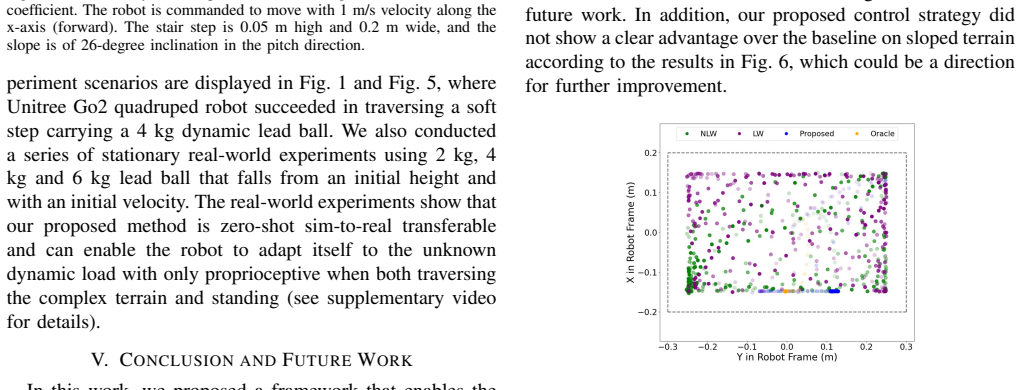
- A blind quadruped can carry a 7 kg, nearly frictionless load over stairs, rough terrain, and slopes in simulation, with velocity-tracking error and base-roll deviation close to a policy that observes the load directly.
- The load estimator trained only on simulated randomized cubes transfers zero-shot to a real Unitree Go2 carrying a 4 kg lead ball and recovering from 2 to 6 kg dropped loads.
- Keeping the base level emerges from the load-stabilizing reward rather than from a hand-designed orientation objective.
- The same teacher-student pipeline with a concurrently trained load estimator can be evaluated against Oracle performance to isolate how much of the benefit comes from the load representation itself.
Reading between the lines
- Beyond the paper, the same four-characteristic load state could be defined for other physical couplings, such as suspended, pulled, or rolling cargo, so the method is a template rather than a single-crate solution.
- Because the simulated Oracle is nearly matched, the practical ceiling is set by estimator sim-to-real accuracy; measuring the estimated states against motion capture on hardware would locate the remaining gap.
- A stress test the paper does not run is a load that slides toward the edge of the carrying surface, since the reward only penalizes the load falling and does not explicitly encourage keeping it centered.
- The method's dependence on a fixed carrying plate suggests that a container that lets the load leave the base plane would require additional representation terms beyond position, velocity, mass, and friction.
Editorial analysis
A structured set of objections, weighed in public.
Referee Report
Summary. The paper proposes a load characteristics modeling approach for quadruped locomotion with unknown dynamic loads, representing the load by its position, velocity, mass, and friction coefficient. The method combines this representation with a concurrent teacher-student RL framework and an asymmetric actor-critic architecture, training a load estimator from proprioceptive history and a policy that uses the estimated load characteristics. The authors evaluate the approach in simulation against three baselines (NLW, LW, Oracle) on plane, stair, rough terrain, and slope, and report real-world experiments with a Unitree Go2 carrying a lead ball. The main claims are that the proposed method achieves near-Oracle performance, clearly outperforms robustness-based baselines, and transfers zero-shot to the physical robot.
Significance. If the central claim is established, the paper would make a useful contribution to legged locomotion under dynamic loads: it moves beyond treating loads as pure disturbances and proposes an explicit, proprioception-only load state representation that can be integrated into modern RL training pipelines. The Oracle baseline is a good internal control and provides some support for the load-characteristics idea. The paper also ships a clear framework description, public project page, and qualitative physical deployment. However, the current evidence does not yet establish that the learned estimator actually recovers the load characteristics or that those estimates are causally used by the policy; the missing direct evaluation and ablation are load-bearing for the paper's main novelty.
major comments (3)
- [Section IV-A, Q3; Eqs. (1)-(2); Table II] Q3 is never answered directly: the paper does not report any accuracy metric for the estimated load characteristics \hat l_t against the simulator ground truth l_t, nor any intervention on the actor input. Because the deployed actor receives both the reconstructed latent zs_t and the estimated load characteristics \hat l_t (Table II), the near-Oracle performance of 'Ours' is also compatible with a mechanism in which the supervised loss of Eq. (2) shapes the latent representation and the policy reacts through zs_t, with \hat l_t serving as a correlated but non-essential auxiliary input. The Oracle-versus-LW comparison shows only that explicit load state at the actor input helps when it is ground truth; it does not establish that the estimated state is accurate or causally used. Please add a direct estimator evaluation (per-component error of position, velocity, mass, and friction versus l_t on held-out evaluation episodes) and an input-ablation experiment (e.g., remove \hat l_t from the actor input, or replace it by a zero/random vector, while keeping the estimator loss active). This is load-bearing for the claim that general load dynamics modeling, rather than representation learning under disturbance, drives the improvement.
- [Section IV-A, Figs. 6-8; Table V] The comparative results are reported without any statistical support: no number of seeds, no error bars, no repeated-episode statistics, and Figs. 6-8 appear to show single trajectories. Statements such as 'lower variance' in Section IV-A.1 are therefore not supported by the data. In addition, the LW baseline is not a clean control for the estimator: per Table V, LW differs from 'Ours' in two ways (no load estimator and no load characteristics at the actor input), so the Ours-versus-LW gap conflates the contribution of the explicit load representation with the contribution of the estimator. Please report mean and standard deviation over at least five training seeds and multiple evaluation episodes per terrain, and add an ablation that removes \hat l_t from the actor input while keeping the estimator and the load-related rewards, so that the effect of the estimated load state is isolated.
- [Section IV-B, Fig. 5] The real-world validation is qualitative: the paper reports that the robot succeeded in traversing a soft step with a 4 kg lead ball and in stationary tests, but no physical measurements are reported, such as base orientation, velocity tracking error, load-relative velocity, or estimated load characteristics. Since zero-shot sim-to-real transfer is a central claim, the video alone does not allow the reader to verify the magnitude of the adaptation or to compare with baselines on hardware. Please provide quantitative physical metrics, or state clearly which quantities were recorded and why only qualitative evidence is presented.
minor comments (6)
- [Eq. (2), Table IV] The loss weight wl is written as a vector with the Hadamard product, but the dimension and the ordering of the per-component weights are not defined; please state explicitly which entry corresponds to position, velocity, mass, and friction coefficient.
- [Section III-D] There is a typo in 'Issac-Gym' (should be 'Isaac-Gym').
- [Fig. 6 caption; Section III-D] The evaluation stair has a 0.05 m step height while the terrain curriculum covers steps up to 8.5 cm; please clarify whether the evaluation terrains are inside the training distribution and why the evaluation height was chosen.
- [Table II] The Actor row lists 'lt, ot, zt(zs_t)', but it is ambiguous which input is used in the teacher phase versus the student phase; please use separate columns or notation to distinguish ground-truth load characteristics from estimated ones.
- [Section III-B] The phrase 'For a limited condition that the load is unsensed' is awkward; consider rewording to 'Since the load is not directly sensed'.
- [References] Reference [5] lacks a publication venue and appears incomplete; please provide the full bibliographic entry.
Circularity Check
No significant circularity: the load estimator is trained by supervised regression against simulated ground truth, and the reported comparisons are independent behavior benchmarks.
full rationale
The paper's central derivation is a teacher-student RL pipeline in which a load-characteristics estimator El minimizes Eq. 2, a supervised Monte-Carlo regression against simulator ground truth lt. This is a standard supervised estimation loop, not a self-referential construction: the student policy is later evaluated on held-out terrains and load parameters (Figs. 6-8) against independently trained NLW, LW, and Oracle baselines. The load-stabilization reward in Table I is computed from the ground-truth vload, not from the estimated lhat, so strong load-velocity performance is not forced by the estimator's own output. Q3 is answered only via downstream behavior rather than by reporting lhat versus lt error; this is an omitted direct evaluation and an evidence gap, but it is not circular because the estimator's training target and the evaluation metric are distinct. The paper explicitly acknowledges a slope-terrain limitation in Section V, and the physical validation is qualitative video evidence with no measured load estimates; these weaken the empirical support but do not reduce the derivation to its inputs. The only self-citation, [12] (H. Chen), is used for reward-shaping guidance and the concurrent teacher-student paradigm; it is not a uniqueness theorem, and Eqs. 1-2 plus the specified PPO training make the method self-contained. No step in the claimed derivation chain equates a prediction with a fitted parameter or imports a load-bearing result by self-citation.
Assumptions & free parameters
free parameters (3)
- Load estimation loss weights w_l =
[3, 3, 3, 1, 1, 1, 10, 10]
- Load velocity reward weight =
2.0
- Episode push disturbance =
2 m/s every 15 s
assumptions (4)
- domain assumption The dynamic load is fully characterized by mass, friction coefficient, position, and velocity in the robot frame.
- domain assumption A 15-step history of proprioception contains enough information to estimate the load characteristics.
- domain assumption Simulated randomized cube loads transfer zero-shot to real lead-ball loads.
- standard math PPO with asymmetric actor-critic and concurrent estimation converges to a policy that exploits load estimates.
invented entities (1)
-
Load characteristics tuple (position, velocity, mass, friction coefficient)
Cite this review
Pith. "Pith review of Beyond Robustness: Learning Unknown Dynamic Load Adaptation for Quadruped Locomotion on Rough Terrain." pith.science (2026). https://pith.science/paper/QYXHFDYE
@misc{pith2026250707825,
  author       = {Pith},
  title        = {Pith review of: Beyond Robustness: Learning Unknown Dynamic Load Adaptation for Quadruped Locomotion on Rough Terrain},
  year         = {2026},
  howpublished = {\url{https://pith.science/paper/QYXHFDYE}},
  note         = {Machine review of arXiv:2507.07825}
}
read the original abstract
Unknown dynamic load carrying is one important practical application for quadruped robots. Such a problem is non-trivial, posing three major challenges in quadruped locomotion control. First, how to model or represent the dynamics of the load in a generic manner. Second, how to make the robot capture the dynamics without any external sensing. Third, how to enable the robot to interact with load handling the mutual effect and stabilizing the load. In this work, we propose a general load modeling approach called load characteristics modeling to capture the dynamics of the load. We integrate this proposed modeling technique and leverage recent advances in Reinforcement Learning (RL) based locomotion control to enable the robot to infer the dynamics of load movement and interact with the load indirectly to stabilize it and realize the sim-to-real deployment to verify its effectiveness in real scenarios. We conduct extensive comparative simulation experiments to validate the effectiveness and superiority of our proposed method. Results show that our method outperforms other methods in sudden load resistance, load stabilizing and locomotion with heavy load on rough terrain. \href{https://leixinjonaschang.github.io/leggedloadadapt.github.io/}{Project Page}.
Figures


Figures from the paper (5 more)


Reference graph
Works this paper leans on
-
[16]
Load awareness: Sensorless body payload sensing and local- ization for heavy quadruped robot,
S. Liu, S. Zhou, Z. Pan, Z. Niu, R. Wang, et al., “Load awareness: Sensorless body payload sensing and local- ization for heavy quadruped robot,” in 2023 IEEE/RSJ International Conference on Intelligent Robots and Systems (IROS), IEEE, 2023, pp. 759–766
work page 2023
-
[17]
Adap- tive force-based control for legged robots,
M. Sombolestan, Y . Chen, and Q. Nguyen, “Adap- tive force-based control for legged robots,” in 2021 IEEE/RSJ International Conference on Intelligent Robots and Systems (IROS) , IEEE, 2021, pp. 7440– 7447
work page 2021
-
[18]
Sim-to-real learning for bipedal locomotion under unsensed dynamic loads,
J. Dao, K. Green, H. Duan, A. Fern, and J. Hurst, “Sim-to-real learning for bipedal locomotion under unsensed dynamic loads,” in 2022 International Con- ference on Robotics and Automation (ICRA) , IEEE, 2022, pp. 10 449–10 455
work page 2022
-
[1]
Development of quadruped walking robots: A review,
P. Biswal and P. K. Mohanty, “Development of quadruped walking robots: A review,” Ain Shams Engineering Journal , vol. 12, no. 2, pp. 2017–2031, 2021
work page 2017
-
[2]
Learning to walk in minutes using massively parallel deep reinforcement learning,
N. Rudin, D. Hoeller, P. Reist, and M. Hutter, “Learning to walk in minutes using massively parallel deep reinforcement learning,” in Conference on Robot Learning, PMLR, 2022, pp. 91–100
work page 2022
-
[3]
Learning to walk in confined spaces using 3D representation
T. Miki, J. Lee, L. Wellhausen, and M. Hutter, “Learn- ing to walk in confined spaces using 3d representa- tion,” arXiv preprint arXiv:2403.00187 , 2024
work page Pith review arXiv 2024
-
[4]
A learning-based framework to adapt legged robots on-the-fly to unexpected disturbances,
N. Fey, H. Li, N. Adrian, P. Wensing, and M. Lem- mon, “A learning-based framework to adapt legged robots on-the-fly to unexpected disturbances,” in 6th Annual Learning for Dynamics & Control Conference , PMLR, 2024, pp. 1161–1173
work page 2024
-
[5]
B. Jin et al. , “High-payload online identification and adaptive control for an electrically-actuated quadruped robot.,” CoRR, 2021
work page 2021
Show all 20 references
-
[6]
Learning agile and dynamic motor skills for legged robots,
J. Hwangbo et al., “Learning agile and dynamic motor skills for legged robots,” Science Robotics , vol. 4, no. 26, eaau5872, 2019
2019
-
[7]
Learning quadrupedal locomotion over challenging terrain,
J. Lee, J. Hwangbo, L. Wellhausen, V . Koltun, and M. Hutter, “Learning quadrupedal locomotion over challenging terrain,” Science robotics , vol. 5, no. 47, eabc5986, 2020
2020
-
[8]
Dreamwaq: Learning robust quadrupedal locomotion with implicit terrain imagination via deep reinforce- ment learning,
I. M. A. Nahrendra, B. Yu, and H. Myung, “Dreamwaq: Learning robust quadrupedal locomotion with implicit terrain imagination via deep reinforce- ment learning,” in 2023 IEEE International Confer- ence on Robotics and Automation (ICRA) , IEEE, 2023, pp. 5078–5084
2023
-
[9]
Rapid locomotion via reinforcement learn- ing,
G. B. Margolis, G. Yang, K. Paigwar, T. Chen, and P. Agrawal, “Rapid locomotion via reinforcement learn- ing,” The International Journal of Robotics Research , vol. 43, no. 4, pp. 572–587, 2024
2024
-
[10]
Learning robust and agile legged locomotion using adversarial motion priors,
J. Wu, G. Xin, C. Qi, and Y . Xue, “Learning robust and agile legged locomotion using adversarial motion priors,” IEEE Robotics and Automation Letters , 2023
2023
-
[11]
Rma: Rapid motor adaptation for legged robots,
A. Kumar, Z. Fu, D. Pathak, and J. Malik, “Rma: Rapid motor adaptation for legged robots,” arXiv preprint arXiv:2107.04034, 2021
2021 arXiv
-
[12]
Com- bining teacher-student with representation learning: A concurrent teacher-student reinforcement learn- ing paradigm for legged locomotion,
H. Wang, H. Luo, W. Zhang, and H. Chen, “Com- bining teacher-student with representation learning: A concurrent teacher-student reinforcement learn- ing paradigm for legged locomotion,” arXiv preprint arXiv:2405.10830, 2024
2024 arXiv
-
[13]
Asymmetric actor critic for image-based robot learning,
L. Pinto, M. Andrychowicz, P. Welinder, W. Zaremba, and P. Abbeel, “Asymmetric actor critic for image-based robot learning,” arXiv preprint arXiv:1710.06542, 2017
2017 arXiv
-
[14]
Concur- rent training of a control policy and a state esti- mator for dynamic and robust legged locomotion,
G. Ji, J. Mun, H. Kim, and J. Hwangbo, “Concur- rent training of a control policy and a state esti- mator for dynamic and robust legged locomotion,” IEEE Robotics and Automation Letters , vol. 7, no. 2, pp. 4630–4637, 2022
2022
-
[15]
Proximal policy optimization algo- rithms,
J. Schulman, F. Wolski, P. Dhariwal, A. Radford, and O. Klimov, “Proximal policy optimization algo- rithms,” arXiv preprint arXiv:1707.06347 , 2017
2017 arXiv
-
[19]
Isaac gym: High performance gpu-based physics simulation for robot learning,
V . Makoviychuk et al., “Isaac gym: High performance gpu-based physics simulation for robot learning,” arXiv preprint arXiv:2108.10470 , 2021
2021 arXiv
-
[20]
Simulation tools for model-based robotics: Comparison of bullet, ha- vok, mujoco, ode and physx,
T. Erez, Y . Tassa, and E. Todorov, “Simulation tools for model-based robotics: Comparison of bullet, ha- vok, mujoco, ode and physx,” in 2015 IEEE interna- tional conference on robotics and automation (ICRA) , IEEE, 2015, pp. 4397–4404
2015
Reviewed August 6, 2026 · model on record in the stance chip above.
Discussion (0). Sign in to comment.