REVIEW 5 major objections 6 minor 1 cited by
The Trust Fabric: Decentralized Interoperability and Economic Coordination for the Agentic Web
T0 review · 5 major / 6 minor · reviewed 2026-08-06 · deepseek-v4-flash
Pith's one-line read This paper argues that a continuous trust score, not a connection protocol, is the missing layer for safe, scalable AI-agent collaboration, and that a five-layer architecture can make that score the basis of discovery, sandboxing, and…
desk verdict A readable blueprint that consolidates existing agent protocols, but the production claims and trust-engine specs are not backed by evidence; fine as a position paper, not as a research result. read the letter →
The pith
A machine-rendered reading of the paper's core claim, the machinery that carries it, and where it could break.
The reading
What carries the argument
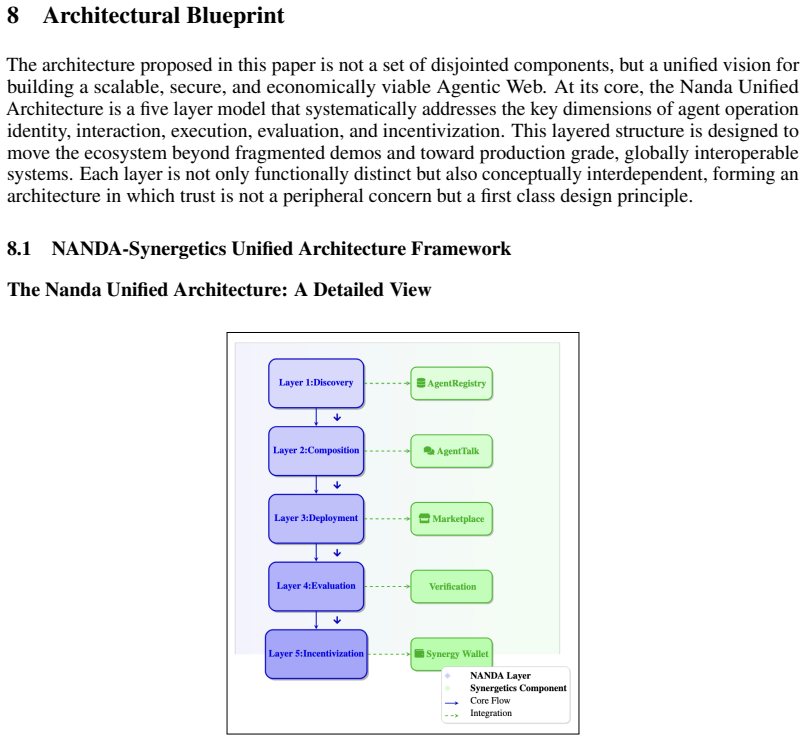
The load-bearing mechanism is the Nanda Trust Engine, a three-stage cycle inside the Evaluation Layer. It ingests signals from three sources: declarative policy compliance checks, telemetry-fed anomaly detection models, and cryptographically verifiable attestations of completed tasks. It then synthesizes those signals into a contextually weighted trust score, using a weighted graph-centrality recursion in the formal model. Finally, it feeds that score back into discovery ranking, deployment sandboxing, and payment terms, creating a self-regulating feedback loop. The two-layer DID registry with learning-to-rank deduplication carries the discovery half of the architecture.
What would settle it
Create a test where a colluding group of agents first follows all policies and produces valid small-task attestations to build a high trust score, then attempts a single large-value transaction that violates policy. If the trust score after the violation is still high enough to retain top discovery ranking and cleared deployment sandbox, the architecture's manipulation-resistance claim fails.
Extended reading notes
Core claim
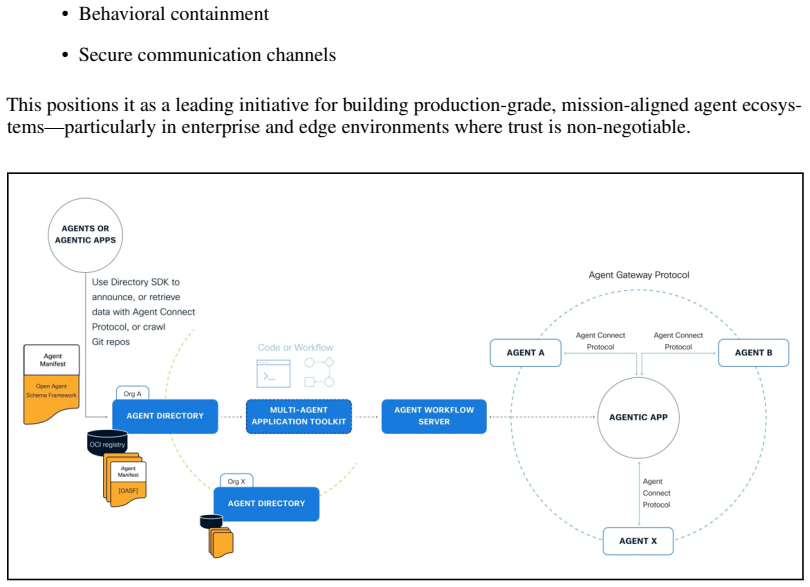
The central claim is that a decentralized 'trust fabric' is the missing infrastructure layer for the agentic web, and that this fabric can be built by unifying DID-based discovery, semantic agent cards, a trust engine that fuses behavioral attestations with policy compliance, and X42/H42 micropayments. In the paper's own terms, these components make agents 'trust-anchored participants' whose reputation continuously determines how they are ranked, how strictly they are contained, and on what financial terms they are allowed to interact.
Load-bearing premise
The entire trust economy rests on the assumption that a trust score computed from behavioral telemetry, policy compliance checks, and signed attestations is both meaningful and resistant to manipulation, even though no calibration data, concrete threat model, or adversarial test for that fusion is provided.
Editorial extensions
If this is right
- Discovery ranking becomes trust-aware: high-scoring agents are surfaced first and low-scoring agents are deprioritized automatically.
- Deployment becomes adaptive: high-trust agents get streamlined sandboxing while low-trust agents face stricter isolation and rate limits.
- Payments become score-based: the trust score can modulate transaction fees, credit terms, or access to premium agent services.
- The architecture positions X42/H42 micropayments as the economic rail that makes pay-per-call agent economies feasible.
- If the 99.9% healthcare compliance figure holds, the architecture becomes a template for regulated industries requiring auditable agent governance.
Reading between the lines
- The paper leaves the fusion weights of the trust engine unspecified; a natural extension is to calibrate them against each signal source's observed predictive error, making the score auditable rather than declared.
- The trust score could itself be issued as a verifiable credential, allowing third-party registries to import it and turning the architecture into a cross-registry reputation standard rather than a single silo.
- A sharper test than the reported compliance rate would be a longitudinal adversarial game where agents are incentivized to build reputation slowly and then defect on a high-value action; the architecture's resilience to that pattern is not demonstrated in the paper.
Editorial analysis
A structured set of objections, weighed in public.
Referee Report
Summary. The paper proposes the Nanda Unified Architecture, a five-layer decentralized framework for AI agent discovery, composition, deployment, evaluation, and incentivization. It claims to combine DID-based registries, verifiable agent cards, a dynamic trust layer, X42/H42 micropayments, and the MAESTRO security framework, and it asserts real-world deployment evidence including 99.9% healthcare compliance, $250k+ monthly marketplace volume, and 73% of high-consciousness agents operating in decentralized environments. The manuscript is primarily a position/architecture description supported by informal diagrams, protocol comparisons, and references to commercial products (notably Synergetics' AgentTalk) rather than a formal systems evaluation.
Significance. If the central claims were substantiated, the paper would describe a production-ready trust and payment infrastructure for the agentic web, which would be significant. The paper also usefully collates current agent-interoperability protocols (MCP, A2A, ACP, AGP, OASF) and articulates a layered architecture that could serve as a design blueprint. Its strengths include a clear identification of open problems (discovery, trust, economic coordination) and a broad survey of relevant industry efforts. However, the empirical and formal support for the architecture's core mechanisms is absent: the trust-score fusion is not specified, the Sybil-resistance claim is unsupported, and the deployment numbers are asserted without methodology. As a result, the paper currently reads as a vision document and vendor-adjacent overview rather than a validated scientific contribution.
major comments (5)
- [Section 8.1 (Layer 4) and 'The Evaluation Layer: A Deep Dive'] The trust engine, which controls discovery ranking, deployment sandboxing, and payment terms, is described only as a 'weighted synthesis model' that fuses policy compliance, behavioral anomaly signals, and verifiable attestations, with weights that 'adapt to the operational context.' No concrete model, weight-update rule, calibration procedure, or adversarial threat model is given. Because the trust score is the load-bearing mechanism that gates agent prioritization and operational constraints, this unspecified fusion is a critical gap: the paper does not demonstrate that the architecture's core control loop is well-defined, let alone manipulation-resistant.
- [Section 2.6.3, Eq. (5)] The PageRank-style trust propagation T = α W^T T + (1-α)e is a textbook recursive centrality formula. The paper asserts that this formulation 'enhances robustness to manipulation, such as Sybil attacks,' but no argument or proof is provided. Sybil resistance requires explicit assumptions about identity issuance costs, edge weight semantics, graph structure, or attack models; none are stated. This is a load-bearing unsupported claim because the trust score derived from this propagation is used for ranking and access control.
- [Sections 5.1 and 9, and the Conclusion] The manuscript asserts '73% of high-consciousness agents (Ψ>8.2)', '99.9% compliance rates in healthcare applications', and '$250k+ monthly transactions' without providing any dataset, metric definitions, collection methodology, confidence intervals, or audit trail. These empirical claims are the basis for the conclusion that the system 'achieves commercial scalability' and 'proves' that the proposed mechanisms can redefine agent trust. As written, these figures are unverifiable and cannot be evaluated by readers.
- [Section 2.6 and subsequent sections] The formal models in Section 2.6 (differential privacy, O(log N) registry resolution, PageRank) are standard definitions that are never connected to the proposed architecture: no parameter choices, derivations, or experiments use them, and they do not inform the design of Layers 1-5 in Section 8. This disconnect means the paper's 'formal methods' framing does not provide any support for the architecture's correctness or scalability.
- [Throughout (validation basis)] The paper validates the Nanda architecture using Synergetics' AgentTalk protocol and Agent Marketplace, but Synergetics is represented by co-author Raghu Bala, and the cited Nanda registry papers are by the same research group (Balija, Nanda, Sahoo). This self-referential evidence base does not by itself invalidate the work, but it means the paper presents no independent confirmation of its deployment claims. The manuscript should explicitly disclose this relationship and provide external evaluation or data.
minor comments (6)
- [Section 2.1] The 'protocol gene splicing' notation (DID ⊕ VC ⊗ X42 = Agent Gene) is informal and undefined; it adds rhetorical flavor but no technical content, and could be removed or replaced with a precise definition of composition operators.
- [Section 5.1] The term 'high-consciousness agents' and the threshold Ψ>8.2 are introduced without any operational definition or measurement procedure; this is a jargon-heavy assertion that should be either formally defined or omitted.
- [Sections 13.1-13.2] The security section uses hyperbolic language ('quantum leap', 'impenetrable', 'military-grade encryption', 'neurosurgical precision') that is not appropriate for a technical report and obscures the actual mechanisms; the section should be rewritten in measured, precise terms.
- [Figures generally] Several figures (e.g., Figures 4, 6, 7, 11) are referenced but not described in the text, and some appear to be decorative; the paper should either explain each figure's content or remove it.
- [References] Some references are incomplete or non-standard (e.g., 'arXiv preprint arXiv:2503.12345' appears to be a placeholder), and several industry blog posts are cited without authors; the reference list should be cleaned up.
- [Section 9] The claim that 'NANDA Quilt's ID Creator' enables 'seamless mapping between agent identifiers and DIDs' is not elaborated or linked to any implementation; as with other product-specific details, it needs a technical description or a citation to publicly available documentation.
Circularity Check
The paper's validation chain is largely self-referential: the trust layer is justified by the authors' own prior papers, and the commercial proof is Synergetics' own marketplace (a co-author's company), so the 'commercial scalability' conclusion rests on the same authors' claims rather than independent evidence.
-
self citation load bearing
[Section 1 (Introduction), registry layers paragraph]
"These two registry layers are unified via a trust layer that employs distributed and federated trust Balija et al. [2024], Ghosh et al. [2025], Nanda et al. [2024], Balija et al. [2025], Nanda et al. [2025], Balija [2025] authorities, behavioral evaluation engines, and credential-based attestations."
The load-bearing 'trust layer' is supported by six citations, five of which are the present authors' own papers (Balija, Nanda, and co-authors). Those cited works address federated learning, quantization, and interpretability, not a trust-layer specification or an independent trust evaluation. The architectural premise is thereby introduced and validated by the same author group's prior work rather than by an external theorem, dataset, or benchmark; Ghosh et al. is an MLCommons benchmark with no agent-trust content, so the trust-specific support is entirely self-citation.
-
self citation load bearing
[Section 2 (Related Work and Protocol Landscape), paragraph on Synergetics]
"Synergetics operates a production-ready AgentRegistry implementing NANDA's DID-based schema, demonstrating how academic research (MIT Media Lab) can bridge to enterprise adoption through decentralized agent discovery and verification services."
Synergetics is represented by co-author Raghu Bala, so this 'demonstration' is an in-paper claim about the authors' own commercial entity. The enterprise adoption being cited as evidence is the very product that is part of the author team. No independent deployment, audit, customer list, or external evaluation is supplied; the architecture's viability is thus supported by the same organization that is being used to prove it.
2 more flagged steps
-
self citation load bearing
[Section 8.1, Layer 4 (Evaluation Layer) / Layer 5 (Incentivization Layer)]
"Platforms like Synergetics' Agent Marketplace operationalize microtransactions (e.g., $0.10/transaction) at scale, with pricing tiers ($49-$199/month) that align agent monetization with NANDA's trust layer. Their verified listings for healthcare compliance and trade finance agents show how behavioral attestations and policy standards can be enforced while maintaining economic viability."
The paper argues that NANDA's trust layer works because Synergetics' marketplace 'shows' that behavioral attestations and policy standards can be enforced. Synergetics is a co-author's company, and the 'verified listings' are claims made by that same company. The closed loop in Layer 5 uses the same patented AgentTalk protocol, so the proof of the trust architecture reduces to the vendor's own self-description of its own product, without external data or an audit trail.
-
self citation load bearing
[Section 5.1 (The Consciousness Imperative)]
"Marketplace Validation: 73% of high-consciousness agents (Ψ>8.2 ) operate in decentralized environments; Patent Protection: US 12,244,584 B1 covers gradient-based consciousness measurement; NANDA Alignment: MIT's trust layers provide the scaffolding for emergent properties."
The 'Marketplace Validation' statistic is presented without any dataset, methodology, or external source, and it appears in a section praising Synergetics' patented AgentTalk. The patent is a Synergetics patent held by a co-author, and 'NANDA Alignment' is the present paper's own framework. The evidence chain is therefore: Synergetics patent plus the authors' own trust layers → the claimed 73% distribution. No independent measurement of 'consciousness' or external comparison is given, making the supportive chain self-referential.
full rationale
This paper is an architecture position paper rather than a formal derivation, so no equation is literally refitted as a 'prediction.' The circularity lies in the evidence base for the central claim: the Nanda trust layer is said to be built on Nanda research papers authored by the same people, and the commercial viability proof is Synergetics' AgentTalk, Agent Marketplace, and AgentRegistry, all belonging to a company represented by co-author Raghu Bala. The 99.9% healthcare compliance figure in the conclusion is similarly unattached to any dataset or audit. These are not independent validations; they are the authors' own prior work and the authors' own commercial products serving as proof for the architecture. There is, however, independent content in the paper: comparisons of MCP/A2A/ACP/AGP, the security threat taxonomy, and the discussion of open standards. The central 'proof of trust' is not reduced to a tautology by definition, and there is no fitted parameter that forces a numerical outcome, so a score of 5 (substantial self-referential validation without full equivalence) is appropriate.
Assumptions & free parameters
free parameters (4)
- PageRank damping factor α =
Not specified; conventionally 0.85.
- Trust weights w_ij =
Not specified.
- Contextual fusion weights in the Trust Engine =
Not specified.
- Consciousness threshold Ψ > 8.2 =
8.2
assumptions (6)
- standard math The PageRank recursion T = α W T + (1−α)e has a unique solution for a row-stochastic W and α in (0,1).
- domain assumption Privacy can be modeled by (ϵ,δ)-differential privacy for arbitrary agent computations.
- domain assumption Registry synchronization converges in O(log N) rounds for CRDT or gossip-based systems.
- domain assumption Behavioral attestations and policy signals can be merged into a trustworthy, manipulation-resistant trust score.
- ad hoc to paper A gradient-based consciousness measurement Ψ is meaningful and can be linked to decentralization choices.
- domain assumption X42/H42 header-based micropayments provide secure and low-latency economic coordination for agents.
invented entities (3)
-
Agent Gene
-
MAESTRO framework
-
Trust Engine
Cite this review
Pith. "Pith review of The Trust Fabric: Decentralized Interoperability and Economic Coordination for the Agentic Web." pith.science (2026). https://pith.science/paper/UWFU24D3
@misc{pith2026250707901,
  author       = {Pith},
  title        = {Pith review of: The Trust Fabric: Decentralized Interoperability and Economic Coordination for the Agentic Web},
  year         = {2026},
  howpublished = {\url{https://pith.science/paper/UWFU24D3}},
  note         = {Machine review of arXiv:2507.07901}
}
read the original abstract
The fragmentation of AI agent ecosystems has created urgent demands for interoperability, trust, and economic coordination that current protocols -- including MCP (Hou et al., 2025), A2A (Habler et al., 2025), ACP (Liu et al., 2025), and Cisco's AGP (Edwards, 2025) -- cannot address at scale. We present the Nanda Unified Architecture, a decentralized framework built around three core innovations: fast DID-based agent discovery through distributed registries, semantic agent cards with verifiable credentials and composability profiles, and a dynamic trust layer that integrates behavioral attestations with policy compliance. The system introduces X42/H42 micropayments for economic coordination and MAESTRO, a security framework incorporating Synergetics' patented AgentTalk protocol (US Patent 12,244,584 B1) and secure containerization. Real-world deployments demonstrate 99.9 percent compliance in healthcare applications and substantial monthly transaction volumes with strong privacy guarantees. By unifying MIT's trust research with production deployments from Cisco and Synergetics, we show how cryptographic proofs and policy-as-code transform agents into trust-anchored participants in a decentralized economy (Lakshmanan, 2025; Sha, 2025). The result enables a globally interoperable Internet of Agents where trust becomes the native currency of collaboration across both enterprise and Web3 ecosystems.
Figures


Figures from the paper (10 more)






Forward citations
Cited by 1 Pith paper
-
Blockchain Empowered Trustworthy Agent Networks: Foundations, Taxonomy, and Future Directions
A survey proposing a five-dimensional taxonomy of trust crises in open AI agent networks and analyzing blockchain's role as a shared trust infrastructure.
Reference graph
Works this paper leans on
-
[1]
write newline
" write newline "" before.all 'output.state := FUNCTION n.dashify 't := "" t empty not t #1 #1 substring "-" = t #1 #2 substring "--" = not "--" * t #2 global.max substring 't := t #1 #1 substring "-" = "-" * t #2 global.max substring 't := while if t #1 #1 substring * t #2 global.max substring 't := if while FUNCTION format.date year duplicate empty "emp...
-
[2]
Sree Bhargavi Balija. Fedmm-x: A trustworthy and interpretable framework for federated multi-modal learning in dynamic environments. arXiv preprint arXiv:2503.19564, 2025
work page Pith review arXiv 2025
-
[3]
Building communication efficient asynchronous peer-to-peer federated llms with blockchain
Sree Bhargavi Balija, Amitash Nanda, and Debashis Sahoo. Building communication efficient asynchronous peer-to-peer federated llms with blockchain. In Proceedings of the AAAI Symposium Series, volume 3, pages 288--292, 2024
work page 2024
-
[4]
Decoding Federated Learning: The FedNAM+ Conformal Revolution
Sree Bhargavi Balija, Amitash Nanda, and Debashis Sahoo. Decoding federated learning: The fednam+ conformal revolution. arXiv preprint arXiv:2506.17872, 2025
work page Pith review arXiv 2025
-
[5]
Introducing Model Context Protocol (MCP) in Copilot Studio
Zankar Desai. Introducing Model Context Protocol (MCP) in Copilot Studio . Microsoft Copilot Studio Blog, 2025
work page 2025
-
[6]
Benj Edwards. MCP : The new " USB-C for AI " that's bringing fierce rivals together. Ars Technica, 2025
work page 2025
-
[7]
Abul Ehtesham, Aditi Singh, Gaurav Kumar Gupta, and Saket Kumar. A survey of agent interoperability protocols: Model Context Protocol (MCP) , Agent Communication Protocol (ACP) , Agent-to-Agent Protocol (A2A) , and Agent Network Protocol (ANP) . arXiv preprint arXiv:2505.02279, 2025
arXiv 2025
-
[8]
Ailuminate: Introducing v1.0 of the ai risk and reliability benchmark from mlcommons
Sreya Ghosh, Heike Frase, Alexander Williams, Sophia Luger, Paul R \"o ttger, Fabian Barez, Sam McGregor, et al. Ailuminate: Introducing v1.0 of the ai risk and reliability benchmark from mlcommons. arXiv preprint arXiv:2503.05731, 2025
arXiv 2025
Show all 23 references
-
[9]
Building a secure agentic AI application leveraging A2A protocol
Idan Habler et al. Building a secure agentic AI application leveraging A2A protocol. arXiv preprint arXiv:2504.16902, 2025
2025 arXiv
-
[10]
Model Context Protocol (MCP) : Landscape , security threats, and future research directions
Xinyi Hou et al. Model Context Protocol (MCP) : Landscape , security threats, and future research directions. arXiv preprint arXiv:2503.12345, 2025
2025 arXiv
-
[11]
OpenAI agents now support rival Anthropic's protocol
Fiona Jackson. OpenAI agents now support rival Anthropic's protocol. TechRepublic, 2025
2025
-
[12]
The open source Model Context Protocol was just updated---here's why it's a big deal
Vinay Kumar. The open source Model Context Protocol was just updated---here's why it's a big deal. VentureBeat, 2025
2025
-
[13]
Researchers demonstrate how MCP prompt injection can be used for both attack and defense
Ravie Lakshmanan. Researchers demonstrate how MCP prompt injection can be used for both attack and defense. The Hacker News, 2025
2025
-
[14]
ACPs : Agent collaboration protocols for the Internet of Agents
Jun Liu et al. ACPs : Agent collaboration protocols for the Internet of Agents . arXiv preprint arXiv:2505.13523, 2025
2025 arXiv
-
[15]
LLMs for multi-agent cooperation
Xueguang Lyu. LLMs for multi-agent cooperation. arXiv preprint arXiv:2504.12345, 2025
2025 arXiv
-
[16]
Context is the missing link: The emergence of the Model Context Protocol in industrial AI
Colin Masson. Context is the missing link: The emergence of the Model Context Protocol in industrial AI . ARC Advisory Group, 2025
2025
-
[17]
Why Anthropic's Model Context Protocol is a big step in the evolution of AI agents
Janakiram MSV. Why Anthropic's Model Context Protocol is a big step in the evolution of AI agents. Forbes, 2024
2024
-
[18]
Cptquant--a novel mixed precision post-training quantization techniques for large language models
Amitash Nanda, Sree Bhargavi Balija, and Debashis Sahoo. Cptquant--a novel mixed precision post-training quantization techniques for large language models. arXiv preprint arXiv:2412.03599, 2024
2024 arXiv
-
[19]
Fednams: Performing interpretability analysis in federated learning context
Amitash Nanda, Sree Bhargavi Balija, and Debashis Sahoo. Fednams: Performing interpretability analysis in federated learning context. arXiv preprint arXiv:2506.17466, 2025
2025 arXiv
-
[20]
What is Model Context Protocol (MCP) explained
Arjun Sha. What is Model Context Protocol (MCP) explained. TechTalks, 2025
2025
-
[21]
Multi-agent collaboration mechanisms: A survey of LLMs
Khanh-Tung Tran et al. Multi-agent collaboration mechanisms: A survey of LLMs . arXiv preprint arXiv:2501.06322, 2025
2025 arXiv
-
[22]
OpenAI adopts rival Anthropic's standard for connecting AI models to data
Kyle Wiggers. OpenAI adopts rival Anthropic's standard for connecting AI models to data. TechCrunch, 2025
2025
-
[23]
write newline
" write newline "" before.all 'output.state := FUNCTION n.dashify 't := "" t empty not t #1 #1 substring "-" = t #1 #2 substring "--" = not "--" * t #2 global.max substring 't := t #1 #1 substring "-" = "-" * t #2 global.max substring 't := while if t #1 #1 substring * t #2 gl...
Reviewed August 6, 2026 · model on record in the stance chip above.
Discussion (0). Sign in to comment.