REVIEW 5 major objections 5 minor 1 references
Long-Term Stability of Superconducting Metal Superhydrides
T0 review · 5 major / 5 minor · reviewed 2026-08-06 · deepseek-v4-flash
Pith's one-line read The paper reports that the hydrogen-rich superconducting phase Fm-3m-LaH10 remained structurally intact and retained its ~250 K superconducting transition for at least 66 months after synthesis, directly contradicting a 2025 report that…
desk verdict Solid multi-year stability data for LaH10, but the direct contradiction with Zhou et al. is weakened by the different synthesis route and unverified sample equivalence. read the letter →
The pith
A machine-rendered reading of the paper's core claim, the machinery that carries it, and where it could break.
The reading
What carries the argument
The central object is the Fm-3m-LaH10 phase, a face-centered cubic lanthanum superhydride whose high hydrogen content is responsible for its high superconducting transition temperature. The load-bearing mechanism is the long-baseline comparison of two complementary measurements on the same diamond-anvil-cell sample: X-ray powder diffraction with Le Bail refinement to track the crystal lattice, and four-probe electrical resistance to track the superconducting transition. Because Tc in these hydrides is highly sensitive to hydrogen content, the reproducible ~250 K transition across 8, 34, and 66 months serves as an indirect stoichiometry check, while the diffraction pattern rules out a large-scale phase change. Pressure is tracked independently by the diamond Raman edge and the hydrogen vibron, so pressure drift can be separated from chemical change.
What would settle it
A decisive observation would be a hydrogen-sensitive measurement on a sample that has been aged for years under pressure: quantify the free H2 inside the diamond anvil cell and the hydrogen content of the solid phase, for example by NMR, neutron diffraction, or mass balance upon decompression. If the aged sample has measurably lost hydrogen or accumulated H2 gas while the ~250 K transition persists, then the unchanged XRD and Tc are indeed insufficient and the stability claim fails; if hydrogen content is unchanged, the claim is confirmed.
Extended reading notes
Core claim
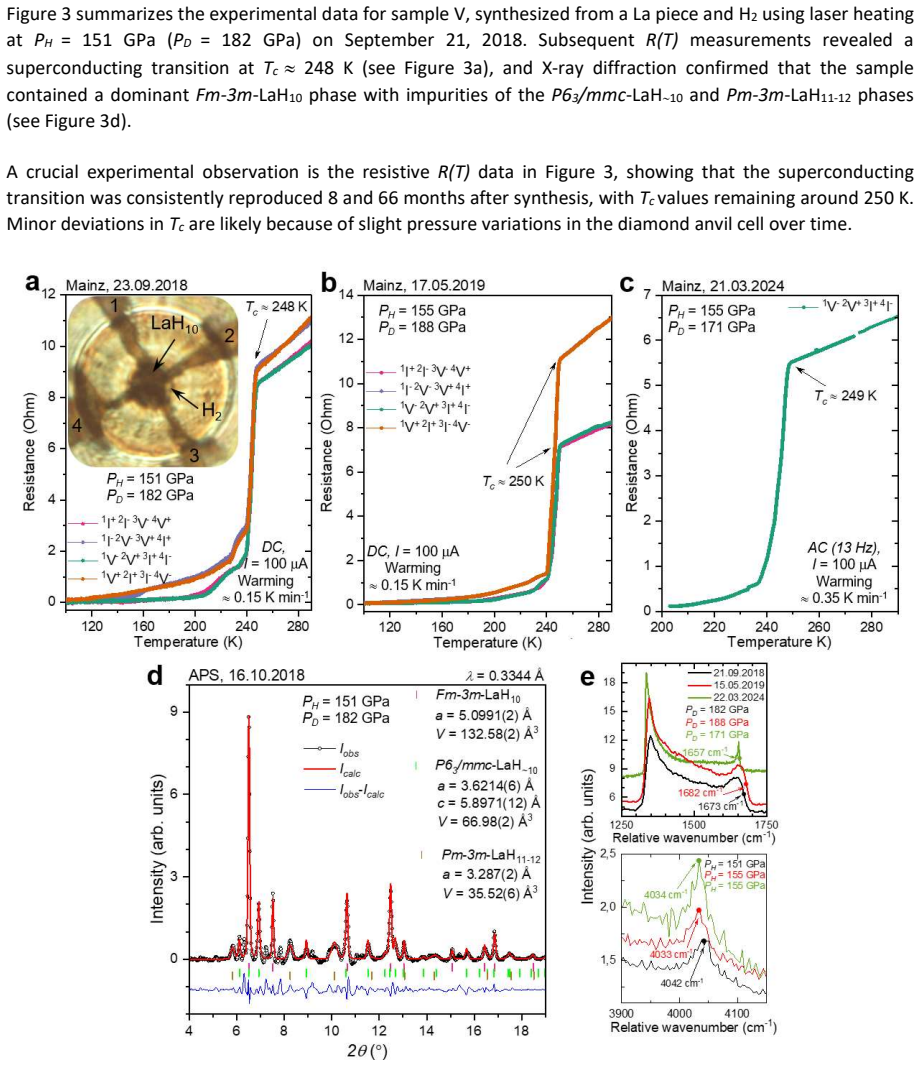
On its own terms, the paper's central claim is that Fm-3m-LaH10 — the hydrogen-rich lanthanum superhydride with a face-centered cubic structure that superconducts near 250 K — does not decompose on a timescale of months or years under the conditions used to synthesize it. The evidence is longitudinal: for one sample, X-ray diffraction one week and 55 months after synthesis shows the same Fm-3m phase with lattice parameters within 0.5%, and resistance at 34 months gives a superconducting transition near 247 K; for a second sample, resistance measurements 2 days, 8 months, and 66 months after synthesis all show a transition near 250 K, with X-ray diffraction about one month after synthesis confirming the Fm-3m phase. A sample decompressed to 120 GPa distorted structurally and lost its high Tc, but recompression to 136 GPa restored Tc around 241 K, showing that the phase is robust over a pressure range rather than being a transient product. The paper further argues that the earlier NMR-based decomposition study never structurally characterized its samples and that its resistance data show transitions well below the ~250 K signature of Fm-3m-LaH10, so the proposed decomposition scenario likely refers to a different material.
Load-bearing premise
The load-bearing premise is that an unchanged crystal structure and a superconducting transition near 250 K seen years after synthesis prove the sample is still the hydrogen-rich LaH10 phase with essentially full hydrogen content, a link the paper does not verify with a direct hydrogen-content measurement.
Editorial extensions
If this is right
- If LaH10 is stable for five years, the near-room-temperature superconducting transition can be reproduced and studied by multiple techniques on the same sample, removing the need to race against decomposition.
- The two-month decomposition scenario proposed by the criticized study would not apply to genuinely Fm-3m-LaH10 samples; the NMR-observed loss of proton signal likely needs an alternative explanation.
- The phase remains intact even when pressure drops to about 120 GPa, where it distorts structurally; recompression restores the high Tc, so pressure excursions do not destroy the material.
- The experimental stability data align with the theoretical prediction that Fm-3m-LaH10 is the thermodynamically stable phase above roughly 150 GPa, strengthening the case that high-Tc hydride phases are equilibrium phases rather than metastable transient products.
Reading between the lines
- A step beyond the paper's evidence would be a hydrogen-sensitive measurement on the aged samples, such as quantitative NMR of the cell contents, neutron diffraction, or mass balance upon decompression; if those confirmed full stoichiometry, the decomposition claim would be closed rather than merely contradicted.
- If long-term stability is generic across superhydrides, it would change experimental planning: beam time, transport, and multi-technique campaigns could be scheduled around months-old samples, making these materials much more practical to study.
- The disagreement between the two groups could be resolved by exchanging samples or protocols: if a structurally confirmed LaH10 sample is tracked by NMR under the criticized study's conditions and shows no hydrogen buildup, the earlier conclusion would be attributed to sample identity, not to intrinsic instability.
- One extension beyond the paper is to apply the same multi-year tracking to other superhydrides such as CeH9, YH9, or ternary hydrides, which would reveal whether thermodynamic stability is a general property of superhydrides or specific to the lanthanum-hydrogen system.
Editorial analysis
A structured set of objections, weighed in public.
Referee Report
Summary. This manuscript is a Comment on Zhou et al. (Nat. Commun. 16, 1135, 2025), who reported that a lanthanum superhydride synthesized by laser heating LaH3 with NH3BH3 at 170 GPa decomposes into LaH3 and H2 over roughly two months. The present authors argue instead that metal superhydrides are thermodynamically stable under their formation conditions, and they present long-term experimental data on two Fm-3m-LaH10 samples made from La and H2: X-ray diffraction at 9 days and 55 months after synthesis for one sample, and four-probe resistance measurements showing Tc near 250 K at 2 days, 8 months, and 66 months for another sample. They also describe an earlier sample that survived decompression to 120 GPa without decomposing. On this basis they claim that their results directly contradict Zhou et al. and that Fm-3m-LaH10 remains stable for at least 66 months.
Significance. If the long-term data are taken at face value, the paper provides a valuable and rare longitudinal dataset: repeated electrical resistance measurements on a sample over 66 months and repeated synchrotron X-ray diffraction on another sample over 55 months, both consistently indicating the persistence of a phase with Tc near 247-250 K. The paper is also transparent about the use of two different pressure scales and makes source data available. However, the central claim that these observations directly contradict Zhou et al. is not supported, because the samples studied here were made by a different synthesis route (La + H2) and are not demonstrated to be equivalent to Zhou's LaHx (x = 10.2-11.1) product. In addition, no direct hydrogen-content measurement was performed on aged samples, so the inference of unchanged chemical composition rests on an assumption.
major comments (5)
- [Abstract and first section of the main text] The paper's central assertion that its results 'directly contradict' Zhou et al. (Ref. 14) is not established because the samples are not shown to be equivalent. Zhou et al. synthesized LaH_x (x = 10.2-11.1) by laser heating LaH3 with NH3BH3 at 170 GPa, whereas the samples in Figures 2 and 3 were made from La + H2 and contain impurities of P63/mmc-LaH~10 and Pm-3m-LaH11-12; the manuscript neither reproduces the NH3BH3 route nor characterizes Zhou's product by X-ray diffraction. A concrete test of the contradiction would be to monitor a sample prepared exactly as in Ref. 14, and until then the 66-month stability of the La + H2 product does not, by itself, rule out decomposition of a differently synthesized, possibly non-stoichiometric hydride.
- [Figure 2 and its caption] The inference that an unchanged diffraction pattern implies 'the same chemical composition' over 55 months is underdetermined. The observed <0.5% lattice-parameter decrease is attributed entirely to a slight pressure increase, but a comparable contraction could also result from a modest hydrogen loss, and no direct hydrogen-content measurement, Rietveld occupancy refinement, mass balance, or NMR analysis of the aged samples is reported. The paper should either supply quantitative hydrogen-content information or explicitly limit the conclusion to lattice stability rather than chemical stability.
- [Thermodynamic-stability paragraph] The statement that under the formation conditions 'metal superhydrides are thermodynamically more stable than metal trihydrides' is based on external calculations (Refs. 1-3) for ideal stoichiometric Fm-3m-LaH10 relative to LaH3 + H2, not on a free-energy analysis of the non-stoichiometric LaH10.2-11.1 phase or of the LaH3 + NH3BH3 reaction environment. Without applying the calculation to the exact composition and synthesis route of Ref. 14, the claim that Zhou's samples 'cannot spontaneously decompose' is not supported.
- [Abstract and Figure 3] The abstract states that the Fm-3m-LaH10 phase has been found to remain stable for at least 66 months 'as confirmed by X-ray diffraction and four-probe electrical resistance measurements,' but no X-ray diffraction pattern at the 66-month time point is presented. The X-ray diffraction evidence extends to 55 months in Sample IV, whereas the 66-month datum is a resistance measurement in Sample V without a contemporaneous structural characterization; the combined claim overstates what is shown for a single sample.
- [Figure 3 and its caption] The 66-month stability claim relies on R(T) transitions with Tc quoted only as 'approximately 250 K' and with no transition widths, onset criteria, or error bars, while pressures are reported on two different Raman scales that differ by roughly 20 GPa. Because the paper attributes minor Tc and lattice-parameter variations to pressure drift, it should provide simultaneous pressure determinations and quantify the uncertainty in Tc; otherwise the stability of Tc over time cannot be cleanly separated from pressure-calibration effects.
minor comments (5)
- [Title] The title refers to 'metal superhydrides' generally, but the long-term stability data are for Fm-3m-LaH10 only; consider narrowing the title to reflect the actual scope.
- [Figures 2d and 3e] Pressures in the Raman spectra are presented using two scales (PH and PD) that differ by about 20 GPa; the text should state explicitly which scale is used for each pressure quoted in the main narrative.
- [Main text, discussion of Ref. 14] The argument that an increase in hydrogen content can also decrease Tc is logically fine but does not directly address the specific possibility of hydrogen loss in Zhou et al.; the example of lanthanum dihydride is not closely related to the superhydride regime and should be labeled as illustrative rather than as contrary evidence.
- [Main text, sample descriptions] The notation 'P63/mmc-LaH~10' is not defined; please clarify whether it denotes an off-stoichiometric LaH10-x phase or a distinct hexagonal structure.
- [Discussion of Ref. 14 electrical measurements] The claim that Zhou et al.'s broad low-Tc transitions indicate the absence of Fm-3m-LaH10 would be stronger if the manuscript provided quantitative transition widths and definitions of Tc for the comparison samples.
Circularity Check
No significant circularity: the long-term stability evidence is newly reported and independent of the cited theoretical and prior experimental inputs.
full rationale
The paper's central contribution is direct long-term monitoring of previously synthesized LaH10 samples: X-ray diffraction at 9 days versus 55 months after synthesis (Figure 2), and resistance measurements at 2 days, 8 months, and 66 months (Figure 3). These measurements are new, parameter-free observations, not outputs of a fitted model. The claim that Fm-3m-LaH10 is thermodynamically more stable than LaH3 plus H2 is supported by external theoretical calculations (refs 1-3) and by the observed formation of superhydrides from trihydrides in a hydrogen atmosphere; it is not derived by defining a result in terms of itself. The paper does cite the authors' own earlier work (refs 5, 9, 10) for sample characterization conventions and for the identification of Tc around 250 K with Fm-3m-LaH10, but those citations are background and are not the load-bearing derivation of the new stability result; the new data stand independently. The most serious challenge to the paper is not circularity but sample equivalence: the authors' samples were made from La + H2, whereas Zhou et al. used LaH3 + NH3BH3, so the direct contradiction claimed by the comment depends on an unverified assumption that the phases are identical. That is an empirical and logical concern about the strength of the rebuttal, not a case of the paper's prediction reducing to its inputs by construction. No circular step satisfying the quoted-evidence standard was found.
Assumptions & free parameters
assumptions (4)
- domain assumption Fm-3m-LaH10 is thermodynamically stable above about 150 GPa, as predicted by DFT calculations (Refs 2 and 3).
- domain assumption Theoretical quantum chemistry calculations of hydride stability are correct and applicable to the experimental pressure and temperature conditions.
- domain assumption A sharp resistance drop near 250 K is a reliable fingerprint of the Fm-3m-LaH10 phase.
- ad hoc to paper The <0.5% lattice parameter decrease over 55 months is caused solely by a slight pressure increase, not by any change in hydrogen content.
Cite this review
Pith. "Pith review of Long-Term Stability of Superconducting Metal Superhydrides." pith.science (2026). https://pith.science/paper/2RQMF2V6
@misc{pith2026250708009,
  author       = {Pith},
  title        = {Pith review of: Long-Term Stability of Superconducting Metal Superhydrides},
  year         = {2026},
  howpublished = {\url{https://pith.science/paper/2RQMF2V6}},
  note         = {Machine review of arXiv:2507.08009}
}
read the original abstract
Zhou et al., in their recent publication (Nat. Commun. 16, 1135, 2025), reported the synthesis of lanthanum superhydride, LaHx (x = 10.2-11.1), by laser heating LaH3 with NH3BH3 at a pressure of 170 GPa and investigated the temporal evolution of the NMR spectra of the reaction products. They observed a gradual decrease in the 1H-NMR signal intensity assigned to the synthesized metal hydride, accompanied by an increase in molecular hydrogen within the sample chamber over a period of 50 days. Based on these observations, the authors concluded that LaH10 progressively decomposes into LaH3 and H2 within two months after synthesis at its formation pressure of 170 GPa. Here, we demonstrate that, under their formation conditions, metal superhydrides are thermodynamically more stable than metal trihydrides. Furthermore, we present direct experimental evidence - based on X-ray diffraction and four-probe electrical resistance measurements - confirming the stability of both the crystal lattice and high-temperature superconducting properties of the Fm-3m-LaH10 phase for more than five years. This long-term stability is consistent with predictions from quantum chemistry calculations.
Figures


Reference graph
Works this paper leans on
-
[1]
1 Li, Y. et al. Pressure-stabilized superconductive yttrium hydrides. Sci Reports 5, 9948 (2015). 2 Peng, F. et al. Hydrogen clathrate structures in rare earth hydrides at high pressures: possible route to room-temperature superconductivity. Phys. Rev. Lett. 119, 107001 (2017). 3 Liu, H., Naumov, II, Hoffmann, R., Ashcroft, N. W. & Hemley, R. J. Potential...
work page 2015
Reviewed August 6, 2026 · model on record in the stance chip above.
Discussion (0). Continue with ORCID to comment.