REVIEW 2 major objections 6 minor 29 references
Neutron-induced reaction cross section measurements on carbon at neutron energies up to 55 MeV at LANSCE
T0 review · 2 major / 6 minor · reviewed 2026-08-06 · deepseek-v4-flash
Pith's one-line read This paper reports new neutron-induced reaction cross sections on carbon-12 at energies up to 55 MeV, extending the measured range for several reaction channels beyond previous studies.
desk verdict A solid, honest data paper extending carbon neutron cross sections to higher energies; the isotropic-efficiency assumption is the main caveat, but the high-energy points are already statistically limited enough that it does not sink the result. read the letter →
The pith
A machine-rendered reading of the paper's core claim, the machinery that carries it, and where it could break.
The reading
What carries the argument
The central object is the single-crystal chemical vapor deposited (sCVD) diamond detector, which serves simultaneously as the carbon target and as the charged-particle detector; because the carbon is the detector material, neutron reactions in the diamond produce charged particles whose deposited energy, combined with the neutron time-of-flight from the spallation source, reconstructs the reaction Q value and identifies the channel. The other load-bearing mechanism is the efficiency correction: Monte Carlo simulations assuming an isotropic center-of-mass angular distribution compute the probability that each charged reaction product deposits its full energy in the 0.5 mm diamond, and these efficiency curves correct the measured yields per energy bin. The cross sections are then normalized to a weighted average of previous $^{12}$C(n,$\alpha_0$)$^9$Be measurements at 14.1 MeV, canceling the need for an absolute target thickness and absolute neutron flux.
What would settle it
Measure the angular distributions of the $^{12}$C(n,$\alpha_0$), (n,p$_0$), (n,p$_1$), and (n,d$_0$) reactions at a few incident neutron energies between 15 and 30 MeV using a thin carbon target with position-sensitive detection, and recompute the efficiency corrections; if the resulting cross sections differ from those reported here by more than the quoted uncertainties, the isotropic-assumption correction is the failing link.
Extended reading notes
Core claim
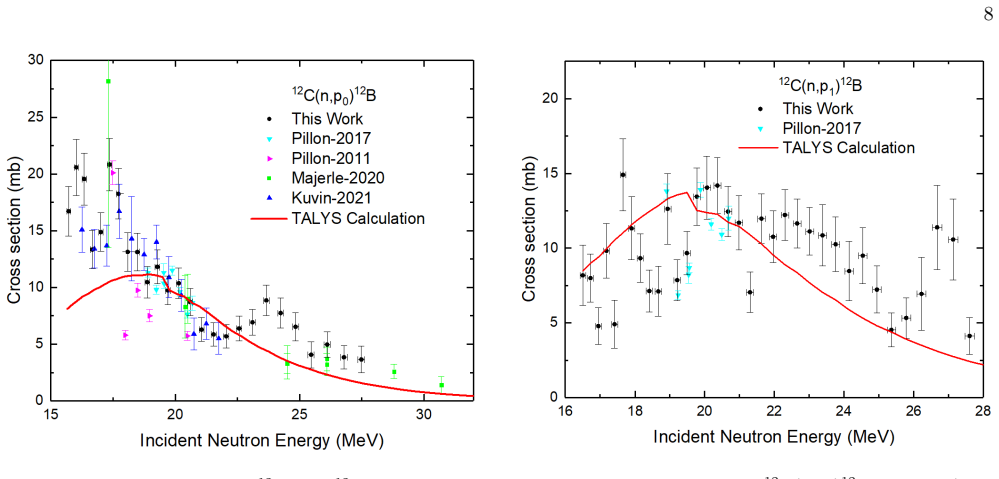
The central claim is that relative partial cross sections for four neutron-induced reactions on $^{12}$C can be reliably extracted at higher incident neutron energies than previous measurements reached, by using a sCVD diamond as both target and detector. From 12.5 to 55 MeV for $^{12}$C(n,$\alpha_0$)$^9$Be, from 15.8 to 46 MeV for $^{12}$C(n,d$_0$)$^{11}$B, from 15.7 to 27.5 MeV for $^{12}$C(n,p$_0$)$^{12}$B, and from 16.5 to 27.6 MeV for $^{12}$C(n,p$_1$)$^{12}$B, the reported cross sections show good agreement with recent experimental data in overlapping energy ranges and extend the measured energy windows substantially. The paper concludes that these data support updating the ENDF evaluation for the (n,$\alpha_0$) channel and provide a basis for new evaluations of the (n,p$_0$), (n,p$_1$), and (n,d$_0$) channels.
Load-bearing premise
The charged-particle efficiency correction assumes that the products of each reaction are emitted equally in all directions in the center-of-mass frame; if the real angular distributions are lopsided, every reported cross section would be shifted by a systematic amount that the paper only estimates at the 4% level.
Editorial extensions
If this is right
- Simulators of organic scintillator neutron detectors will have empirical partial cross sections for carbon up to 55 MeV instead of relying on cascade-model extrapolations above 20 MeV, improving the accuracy of simulated neutron detection efficiencies.
- The ENDF/B-VIII.0 evaluation for the $^{12}$C(n,$\alpha_0$)$^9$Be channel should be updated with the recent diamond-detector measurements, including the data reported here.
- The resolved (n,p$_0$), (n,p$_1$), and (n,d$_0$) data fill gaps above 22 MeV and provide the first empirical basis for evaluations of these exclusive channels.
- The improved channel-by-channel cross sections better constrain the fraction of carbon interactions that produce no detectable scintillator signal, the so-called dark-scatter fraction, reducing a systematic uncertainty in neutron event reconstruction.
- Comparisons with default TALYS calculations show that statistical models reproduce the general trend but not the resonant structure, indicating where nuclear model input for these channels needs refinement.
Reading between the lines
- Editorial extension: Because the reported cross sections are relative to an accepted 14.1 MeV value, a future absolute measurement of the $^{12}$C(n,$\alpha_0$)$^9$Be cross section at that energy would rescale the entire dataset, so presenting the raw counts and correction factors in the supplemental tables is especially valuable.
- Editorial extension: The same active-target approach could be extended to other detector materials, such as silicon or isotopically enriched diamonds, to measure partial cross sections for other nuclides that are currently poorly constrained at neutron energies above 20 MeV.
- Editorial extension: Beyond scintillator simulations, improved carbon cross sections feed neutron kerma-factor calculations and radiation-damage estimates for carbon-based materials, which matter for dosimetry and for predicting detector degradation.
- Editorial extension: A sum-rule comparison of the four measured channels against the total neutron-carbon cross section could quantify how much cross section remains in multi-neutron exit channels, a testable extension with existing total cross section data.
Editorial analysis
A structured set of objections, weighed in public.
Referee Report
Summary. The paper reports neutron-induced reaction cross sections on carbon for four channels—12C(n,α0), 12C(n,p0), 12C(n,p1), and 12C(n,d0)—measured with two single-crystal diamond detectors used as active targets at the LANSCE/WNR 90 m station. The use of a long flight path and a spectroscopic amplifier gives sufficient resolution to separate channels with similar Q values. Cross sections are normalized to the accepted 12C(n,α0) value at 14.1 MeV, and the relative flux shape is obtained from a fission chamber with an MCNP cross-check. The results extend the energy ranges of previous measurements to 55 MeV for (n,α0), 46 MeV for (n,d0), and about 27 MeV for the proton channels. The paper reports good agreement with existing EXFOR data in the overlap regions and discusses implications for ENDF evaluations and neutron detector simulations.
Significance. If the results are correct, these partial cross sections fill a genuine gap in nuclear data for carbon at neutron energies above ~30 MeV, where earlier data are sparse or absent. Such data are directly useful for improving the MENATE_R simulation package and for benchmarking ENDF evaluations, particularly for the (n,α0) channel where the evaluation is known to deviate from recent measurements. The experimental design is thoughtful, with two detectors, explicit background treatment, and a detailed uncertainty budget that is reproduced for every data point in the supplementary tables. The paper makes the full dataset available in machine-readable form, which is a strength for future evaluations.
major comments (2)
- [III.E, Fig. 5] The charged-particle detection efficiency is simulated with MENATE_R assuming an isotropic distribution in the center-of-mass frame, and a flat 4% systematic uncertainty is assigned to this assumption for all energies. However, the efficiency curves in Fig. 5 are strongly energy dependent and fall to about 65% for (n,α0) at 55 MeV, about 30% for (n,d0) at 46 MeV, and below 50% for the proton channels at the upper end of their ranges. At these energies the same fractional change in the angular distribution would produce a substantially larger relative change in the efficiency than at low energies, where the curves are flat and near unity. Thus the actual systematic error from the isotropic assumption likely grows with energy, and the flat 4% underestimates the uncertainty in the very region where the paper claims an extension of the cross sections. The authors should either validate the assumption against angle-sensitive data, perform a sensitivity study with plausible anisotropic distributions, or assign an energy-dependent uncertainty and demonstrate that the high-energy results are robust within that larger uncertainty.
- [III.F] The uncertainty in the relative neutron flux is described only as "derived from the differences between the fission chamber data and an MCNP simulation," with no quantitative description of how the energy-dependent values (5% at 12–17 MeV increasing to 20% at high energies) were obtained. The supplemental tables show flux uncertainties of roughly 20% at the highest energies, and this is one of the largest systematic contributions at the upper end of the measured range. Without a clear explanation of the comparison, the method of assigning these uncertainties, or the magnitude of the differences actually observed, it is difficult for a reader to assess whether the quoted uncertainties are realistic or overly optimistic. This is load-bearing for the high-energy extension because the flux uncertainty directly scales every cross section point. I request that the authors provide the fission chamber and MCNP flux values, the residuals, and the procedure used to convert residuals into the cited percentage uncertainties.
minor comments (6)
- [Abstract and Section IV] The abstract and text repeatedly call the results "relative cross sections," but Tables III–VI list absolute cross sections in millibarns. Since the normalization is tied to an absolute measurement at 14.1 MeV, the final values are absolute; please clarify the terminology for consistency.
- [Table II caption] The caption states that the uncertainties in energy reconstruction (0.49%), detection efficiency (4%), and normalization (4.9%) "are not included in the table," but the listed total uncertainties clearly include them in quadrature. Rephrase to indicate that these common uncertainties are not tabulated as separate columns but are included in the total.
- [III.C] The weighted average of 63.6 mb for the 12C(n,α0) cross section at 14.1 MeV is quoted, but the individual EXFOR values and their weights are not given. Providing this information (or a reference to a table in the supplemental material) would improve reproducibility.
- [II, Fig. 3] The quoted energy resolution that allows separation of the (n,p1) and (n,d0) channels is never quantified. State the FWHM of the peaks in Fig. 3 or give the resolution in the text to support the claim of channel isolation.
- [III.F] Reference [22] is a private communication for the MCNP simulation comparison. Since this comparison is used to assign the flux uncertainty, a published source or at least a description of the simulation details should be provided.
- [Author list] There is a typo in the affiliation: "Virgina State University" should be "Virginia State University."
Circularity Check
No significant circularity: the reported cross sections are normalized to an external EXFOR benchmark and the efficiency correction is kinematically simulated, not fitted from the claimed results.
full rationale
The derivation chain is self-contained against external benchmarks. The absolute scale is set by the accepted EXFOR value sigma_{n,alpha}(14.1 MeV) = 63.6 mb (Section III.C), and Eqs. (2)-(3) use that value only as a normalization constant; the paper explicitly labels all tables as 'normalized to previously measured 12C(n,alpha0)9Be experimental data at 14.1 MeV', so the 14.13 MeV point reproduces the input by construction and is not presented as an independent prediction. The central claim, the energy dependence from 12 to 55 MeV for four channels, comes from measured counts, fission-chamber relative flux, and simulated charged-particle full-energy-peak efficiencies. The MENATE_R efficiency simulation (Section III.E) assumes isotropic center-of-mass emission; this is a stated physical assumption with an assigned 4% systematic uncertainty, and the efficiency is derived from reaction kinematics and detector geometry, not from the cross sections being reported, so it does not make the result input-equivalent. The self-citation to Kuvin et al. [14] for the normalization method is not load-bearing: the method is a standard relative normalization and the new energy-extended data are independently compared with multiple EXFOR datasets. No uniqueness theorem or ansatz is imported from overlapping-author prior work. The isotropic-efficiency concern is a legitimate systematic-accuracy risk at high energies where the efficiency is lower and steeper, but it is an assumption about physics, not a circular derivation, and therefore does not raise the circularity score.
Assumptions & free parameters
free parameters (1)
- Normalization cross section for 12C(n,α0) at 14.1 MeV =
63.6 mb
assumptions (4)
- domain assumption The 235U(n,f) cross section reference standard [20] is valid for flux normalization.
- domain assumption Reaction products are emitted isotropically in the center-of-mass frame.
- standard math The number of target nuclei cancels in the normalization ratio.
- domain assumption MCNP simulations accurately model the neutron flux for uncertainty estimation.
Cite this review
Pith. "Pith review of Neutron-induced reaction cross section measurements on carbon at neutron energies up to 55 MeV at LANSCE." pith.science (2026). https://pith.science/paper/HVBJUW4Q
@misc{pith2026250708161,
  author       = {Pith},
  title        = {Pith review of: Neutron-induced reaction cross section measurements on carbon at neutron energies up to 55 MeV at LANSCE},
  year         = {2026},
  howpublished = {\url{https://pith.science/paper/HVBJUW4Q}},
  note         = {Machine review of arXiv:2507.08161}
}
abstract
Background: Single-crystal chemical vapor deposited (sCVD) diamond detectors offer a unique method to study cross sections of reactions on carbon since they can be used as active targets. Previous studies analyzing neutrons on carbon using these detectors were primarily focused on lower energy neutrons and reactions, and some of these did not have sufficient energy resolution to isolate the contributions of reaction channels with similar Q values. Purpose: This work extends neutron-induced reaction cross section measurements to higher energies, relevant to rare isotope facilities. These measurements can be used to inform and benchmark simulation of experiments that require neutron detection, particularly those utilizing organic scintillators. For some experiments, simulations are used to extract physics information from experimental data, reinforcing the need for accurate simulations. Methods: Two sCVD diamond detectors were used as active targets at LANSCE, where neutrons up to 800 MeV are produced via spallation. Results: Relative cross sections are reported from incident neutron (kinetic) energies E$_n$ = 12 MeV up to 55 MeV for $^{12}$C(n,$\alpha_0$), up to 46 MeV for $^{12}$C(n,d$_0$), and up to 27 MeV for $^{12}$C(n,p$_0$) and $^{12}$C(n,p$_1$). These measurements extend these cross sections to higher energies than those of previous studies. Conclusions: Good agreement is found between this work and recent experimental data from the EXFOR database in the neutron energies where the studies overlap. This work supports the need to update the ENDF evaluation for the (n,$\alpha_0$) channel with more recent data, and provides data that could allow for an evaluation of the (n,p$_0$), (n,p$_1$), and (n,d$_0$) channels. These cross sections will increase the accuracy of simulations by extending the energy range for which empirical cross sections are available.
Figures


Figures from the paper (5 more)



Reference graph
Works this paper leans on
-
[1]
The background from cosmic muons is negligible, due to the small size of the diamond detector
External background The small size of the diamond detectors drastically limits the contributions of external background. The background from cosmic muons is negligible, due to the small size of the diamond detector. Event rates due to muons are five orders of magnitude less than that of the neutron beam. Thermal neutrons have insufficient energy to trigger t...
-
[2]
This can occur in a few differ- ent ways
Internal background The primary sources of background are due to neu- trons interacting in the diamond and depositing less than their full energy. This can occur in a few differ- ent ways. First, there are a number of possible con- tinuum reactions that have one or more neutrons in the exit channel, including 12C(n,n)12C (elastic scatter- ing), 12C(n,n+3α ...
work page 2020
-
[3]
K. Abe, N. Abgrall, H. Aihara, Y. Ajima, J.B. Albert, D. Allan, P.-A. Amaudruz, C. Andreopoulos, B. An- drieu, M.D. Anerella, C. Angelsen, S. Aoki, O. Araoka, J. Argyriades, A. Ariga, T. Ariga, S. Assylbekov, J.P.A.M. de Andr´ e, D. Autiero and A. Badertscher et al., The T2K experiment, Nuclear Instruments and Methods in Physics Research Section A: Accele...
work page 2011
-
[4]
B. Abi, R. Acciarri, M.A. Acero, G. Adamov, D. Adams, M. Adinolfi, Z. Ahmad, J. Ahmed, T. Alion, S. Alonso Monsalve, C. Alt, J. Anderson, C. An- dreopoulos, M. Andrews, F. Andrianala, S. Andringa, A. Ankowski, M. Antonova, S. Antusch, A. Aranda- Fernandez et al., Volume I. Introduction to DUNE, Journal of Instrumentation 15 (08), T08008
-
[5]
D. S. Ayres et al. (NOvA), The NOvA Technical Design Report, Tech. Rep. (Fermilab, 2007)
work page 2007
-
[6]
T. Nakamura and Y. Kondo, Large acceptance spec- trometers for invariant mass spectroscopy of exotic nu- clei and future developments, Nuclear Instruments and Methods in Physics Research Section B: Beam Interac- tions with Materials and Atoms 376, 156 (2016)
work page 2016
-
[7]
V., Sajjad Athar, M., Bashyal, A., Bercellie, A., Betancourt, M., Bonilla, J
Olivier, A., Cai, T., Akhter, S., Ahmad Dar, Z., Ansari, V., Ascencio, M. V., Sajjad Athar, M., Bashyal, A., Bercellie, A., Betancourt, M., Bonilla, J. L., Bravar, A., Budd, H., Caceres, G., D ´ ıaz, G. A., Felix, J., Fields, L., Filkins, A., Fine, R. and Gago, A. M. et al. (MINER νA Collaboration), Measurement of the multineutron ν µ charged current diffe...
work page 2023
-
[8]
B. Luther, T. Baumann, M. Thoennessen, J. Brown, P. DeYoung, J. Finck, J. Hinnefeld, R. Howes, K. Kem- per, P. Pancella, G. Peaslee, W. Rogers, and S. Ta- bor, MoNA—The Modular Neutron Array, Nuclear In- struments and Methods in Physics Research Section A: Accelerators, Spectrometers, Detectors and Associated Equipment 505, 33 (2003)
work page 2003
Show all 29 references
-
[9]
Kohley, E
Z. Kohley, E. Lunderberg, P. DeYoung, B. Roeder, T. Baumann, G. Christian, S. Mosby, J. Smith, J. Sny- der, A. Spyrou, and M. Thoennessen, Modeling interac- tions of intermediate-energy neutrons in a plastic scin- tillator array with Geant4, Nuclear Instruments and Methods in ...
2012
-
[10]
Boretzky, I
K. Boretzky, I. Gaaparic, M. Heil, J. Mayer, A. Heinz, C. Caesar, D. Kresan, H. Simon, H.T. Tornqvist, D. Ko- rper, G. Alkhazov, L. Atar, T. Aumann, D. Bemmerer, S.V. Bondarev, L.T. Bott, S. Chakraborty, M.I. Cher- ciu, L.V. Chulkov and M. Ciobanu et al., NeuLAND: The high-res...
2021
-
[11]
Nuclear Science Advisory Committee, A new era of dis- covery: The 2023 long range plan for nuclear science (2023), NSAC was charged by the Department of En- ergy Office of Science and National Science Foundation to produce the long range plan
2023
-
[12]
Allison, K
J. Allison, K. Amako, J. Apostolakis, H. Araujo, P. Arce, M. Asai, G. Barrand, R. Capra, S. Chauvie, R. Chytracek, P. Cirrone, G. Cooperman, G. Cosmo, G. Cuttone, G. Daquino, M. Donszelmann, M. Dres- sel, G. Folger, F. Foppiano, and H. Yoshida, Geant4 developments and applicat...
2006
-
[13]
Agostinelli, J
S. Agostinelli, J. Allison, K. Amako, J. Apostolakis, H. Araujo, P. Arce, M. Asai, D. Axen, S. Banerjee, G. Barrand, F. Behner, L. Bellagamba, J. Boudreau, L. Broglia, A. Brunengo, H. Burkhardt, S. Chauvie, J. Chuma, R. Chytracek, G. Cooperman et al., Geant4—a simulation toolk...
2003
-
[14]
Allison, K
J. Allison, K. Amako, J. Apostolakis, P. Arce, M. Asai, T. Aso, E. Bagli, A. Bagulya, S. Banerjee, G. Barrand, B.R. Beck, A.G. Bogdanov, D. Brandt, J.M.C. Brown, H. Burkhardt, Ph. Canal, D. Cano-Ott, S. Chauvie, K. Cho and G.A.P. Cirrone et al., Recent developments in Geant4, ...
2016
-
[15]
Majerle, M
M. Majerle, M. Angelone, A. Kr´ asa, J. Nov´ ak, M. Pil- lon, R. Pilotti, A. Plompen, E. ˇSimeˇ ckov´ a, and M. ˇStef´ anik, The response of single crystal diamond de- tectors to 17–34 MeV neutrons, Nuclear Instruments and Methods in Physics Research Section A: Acceler- ators,...
2020
-
[16]
Rogers, A
W. Rogers, A. Kuchera, J. Boone, N. Frank, S. Mosby, M. Thoennessen, and A. Wantz, Measurements of fast neutron scattering in plastic scintillator with energies from 20 to 200 MeV, Nuclear Instruments and Meth- ods in Physics Research Section A: Accelerators, Spec- trometers, ...
2019
-
[17]
S. A. Kuvin, H. Y. Lee, B. DiGiovine, A. Georgiadou, S. Mosby, D. Votaw, M. White, and L. Zavorka, Vali- dation of neutron-induced reactions on natural carbon using an active target at neutron energies up to 22 MeV at LANSCE, Phys. Rev. C 104, 014603 (2021)
2021
-
[18]
with new data to resolve consistent systematic dif- ferences between the older cross section measurements on which ENDF is based and more recent experimental results. II. EXPERIMENT The proton accelerator at LANSCE sent 800 MeV protons to the spallation target at the Weapons N...
-
[19]
Pillon, M
M. Pillon, M. Angelone, A. Kr´ asa, A. J. M. Plompen, P. Schillebeeckx, and M. L. Sergi, Measurement of Neu- tron Reaction Cross Sections in Carbon using a Single Crystal Diamond Detector, AIP Conference Proceed- ings 1412, 121 (2011)
2011
-
[20]
146, 11005 (2017)
Pillon, M., Angelone, M., Belloni, F., Geerts, W., Loreti, S., Milocco, A., and Plompen, A.J.M., High- resolution measurements of the exited states (n,pn), (n,dn) C-12 cross sections, EPJ Web Conf. 146, 11005 (2017)
2017
-
[21]
Brown, M.B
D.A. Brown, M.B. Chadwick, R. Capote, A.C. Kahler, A. Trkov, M.W. Herman, A.A. Sonzogni, Y. Danon, A.D. Carlson, M. Dunn, D.L. Smith, G.M. Hale, G. Arbanas, R. Arcilla, C.R. Bates, B. Beck, B. Becker, F. Brown, R.J. Casperson and J. Conlin et al., ENDF/B- VIII.0: The 8th Major...
2018
-
[22]
Carlson, V
A. Carlson, V. Pronyaev, R. Capote, G. Hale, Z.-P. Chen, I. Duran, F.-J. Hambsch, S. Ku- nieda, W. Mannhart, B. Marcinkevicius, R. Nelson, D. Neudecker, G. Noguere, M. Paris, S. Simakov, P. Schillebeeckx, D. Smith, X. Tao, A. Trkov, A. Wall- ner, and W. Wang, Evaluation of the...
2018
-
[23]
Rising, J.C
M.E. Rising, J.C. Armstrong, S. R. Bolding, F.B. Brown, and J.S. Bull, T.P. Burke, A.R. Clark, D.A. Dixon, R.A. Forster, III, J.F. Giron, T.S. Grieve, H.G. Hughes, III, C.J. Josey, J.A. Kulesza, R.L. Martz, A.P. McCartney, G.W. McKinney, S.W. Mosher, E.J. Pearson, C.J. Solomon...
2023
-
[24]
T. N. Taddeucci, Private communication
-
[25]
Schmidt, R
D. Schmidt, R. B¨ ottger, H. Klein and R. Nolte, In- vestigation of the 9Be(a,n)12C reaction. pt. 2. dif- ferential cross sections for Ea=7.02-15.70 MeV and Eex(12C)=0.0, 4.439, 7.654, 9.641, 10.84, 11.83 and 12.71 MeV, Phys. Techn. Bundesanst, Neutronenphysik Reports (1992)
1992
-
[26]
R. C. Haight, S. M. Grimes, R. G. Johnson and H. H. Barschall, The 12C(n,alpha) Reaction and the Kerma Factor for Carbon at En = 14.1 MeV, Nuclear Science and Engineering 87, 41 (1984), https://doi.org/10.13182/NSE84-A17444
1984 doi
-
[27]
Kondo, I
K. Kondo, I. Murate, K. Ochiai, N. Kubota, H. Miya- maru, C. Konno, and T. Nishitani, Measurement and Analysis of Neutron-Induced Alpha Particle Emission Double-Differential Cross Section of Carbon at 14.2 MeV, Journal of Nuclear Science and Technology 45, 103 (2008)
2008
-
[28]
Sanami, M
T. Sanami, M. Baba, K. Saito, and N. Hirakawa, (n,alpha) cross-section measurement using a gaseous sample and a gridded ionization chamber, Nuclear In- struments and Methods in Physics Research Section A: Accelerators, Spectrometers, Detectors and Associated Equipment 440, 403 (2000)
2000
-
[29]
Neutron-induced reaction cross section measurements on carbon at neutron energies up to 55 MeV at LANSCE
A. Koning, S. Hilaire, S. Goriely, TALYS: modeling of nuclear reactions, The European Physical Journal A 59, 10.1140/epja/s10050-023-01034-3 (2023). 11 TABLE III. Partial cross sections and uncertainties for 12C(n,α 0)9Be, normalized to previously measured 12C(n,α 0)9Be experi...
2023 doi
Reviewed August 6, 2026 · model on record in the stance chip above.
Discussion (0). Continue with ORCID to comment.