REVIEW 4 major objections 5 minor 68 references
Cracking Instance Jigsaw Puzzles: An Alternative to Multiple Instance Learning for Whole Slide Image Analysis
T0 review · 4 major / 5 minor · reviewed 2026-08-06 · deepseek-v4-flash
Pith's one-line read Dropping permutation invariance and learning to unshuffle tile instances outperforms multiple instance learning for whole slide image analysis.
desk verdict Solid empirical contribution with a wobbly theoretical frame: the shuffling-equivalence regularizer appears to help, but the paper never shows it works by restoring order. read the letter →
The pith
A machine-rendered reading of the paper's core claim, the machinery that carries it, and where it could break.
The reading
What carries the argument
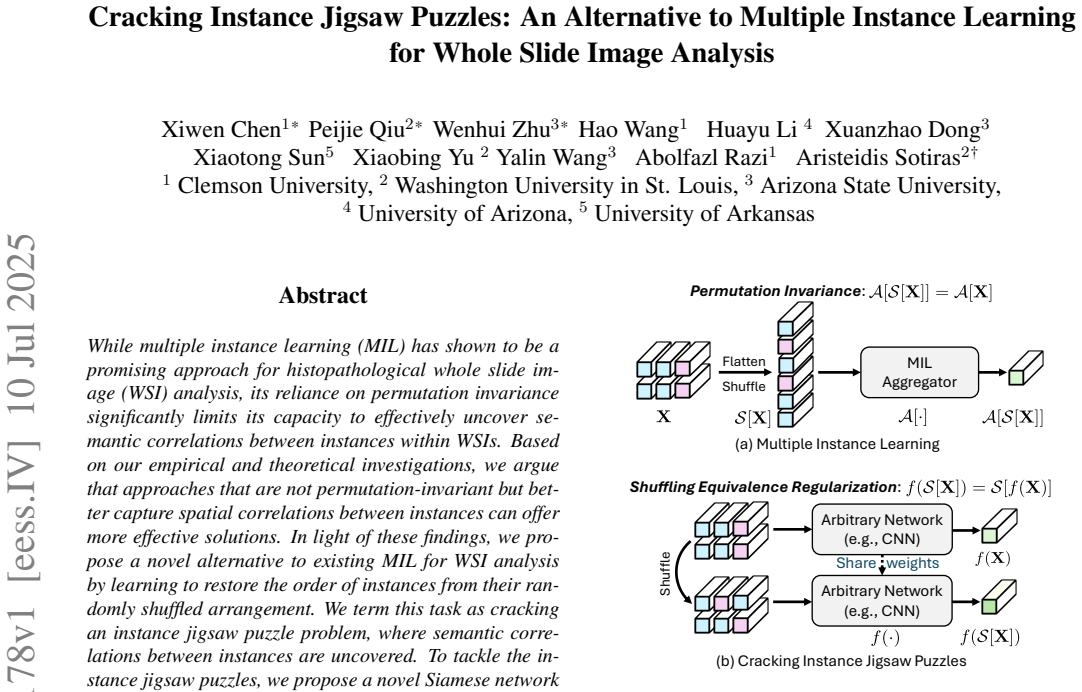
The load-bearing mechanism is the shuffling equivalence regularization loss $L_{\mathrm{Equv}}(X) = \frac{1}{2n}\|f(S[X]) - S[f(X)]\|_2^2$, which compares the network's output on a randomly shuffled bag with the same shuffle applied to its output on the unshuffled bag, via a Siamese network with two weight-sharing branches. This loss, combined with a task loss (binary cross-entropy for classification, negative log-likelihood for survival), is the entire departure from MIL. The paper grounds it in optimal transport: restoring order from a shuffled arrangement is a transportation problem, and using the inverse shuffle as the observed transport plan turns it into an inverse optimal transport problem whose solution is the equivalence loss.
What would settle it
Train the model with shuffling equivalence on bags where the instance order has no spatial meaning (e.g., a random fixed ordering unrelated to tissue layout). If the loss still decreases and the performance gain persists, then the benefit does not come from restoring spatial order, and the central claim is falsified; a negative result would instead point to the loss acting as a regularizer or data-augmentation scheme.
Extended reading notes
Core claim
The paper's central claim is that the orthodox MIL constraint—permutation invariance of the bag-level scoring function—is not merely unnecessary for whole slide image analysis but actively harmful, because it prevents the model from exploiting the spatial layout of tissue. Its proposed alternative, cracking an instance jigsaw puzzle, enforces shuffling equivalence: for any random permutation $S$ of the instances, the network must satisfy $f(S[X]) = S[f(X)]$, implemented as a Siamese network sharing weights between the original and shuffled bag. The authors prove that this regularizer is the solution to an inverse optimal transport problem in which the known transport plan is the inverse shuffling operation, so minimizing the loss amounts to learning instance semantics that can restore the original order. Empirically, both a transformer and a simple CNN with this regularizer outperform state-of-the-art MIL methods on CAMELYON16 and TCGA-NSCLC classification and on TCGA-LUAD and TCGA-BRCA survival prediction, and ablations show the regularizer itself is responsible for the gains.
Load-bearing premise
The load-bearing premise is that the shuffling equivalence loss actually forces the network to learn useful spatial semantics among tile instances, rather than pushing it toward a degenerate permutation-tolerant behavior or injecting meaningless noise; this mechanism is asserted and empirically supported but never proven, and a CNN cannot be exactly equivariant to arbitrary permutations of the reshaped instance grid.
Editorial extensions
If this is right
- The MIL aggregator can be replaced by any network that can handle spatial layout; the paper shows a plain CNN with the regularizer matches or beats attention-based MIL baselines, freeing WSI architecture design from the permutation-invariance constraint.
- The regularizer provides a self-supervised signal from the slide's own tile order, so no additional annotations beyond slide labels are needed to capture inter-instance semantics.
- The gains persist across three different feature extractors (ImageNet-pretrained ResNet and Swin, and self-supervised histopathology features), indicating the benefit is complementary to feature quality.
- On survival prediction the improvements are larger (about 3–4% in C-index), which the paper attributes to the CNN variant's ability to capture local tissue structures relevant to survival.
- The observed collapse of negative-instance representations under the regularizer suggests the method improves classification by making negative tiles homogeneous, simplifying the decision boundary.
Reading between the lines
- A testable implication of the paper's mechanism is that the method's advantage should shrink when tile order carries little information, for example on datasets where adjacent tiles are unrelated; measuring performance as a function of the spatial autocorrelation of tissue type would directly probe the claimed mechanism.
- Because the equivalence loss is essentially a jigsaw pretext task executed jointly with the main objective, the same trick could transfer to other weakly supervised settings with meaningful instance order, such as video frame classification or satellite image patch analysis.
- The current formulation fixes a particular 2D reshape of the instances; comparing different reshapes (e.g., raster scan, Hilbert curve, or the original tissue coordinates) could isolate how much of the benefit is genuine spatial geometry versus a generic regularization effect.
- The inverse-optimal-transport justification assumes the inverse shuffle is a good surrogate for the optimal transport plan; a full inverse-optimal-transport method that learns the plan might improve results further but would add iterative optimal transport solvers that the paper explicitly avoids.
Editorial analysis
A structured set of objections, weighed in public.
Referee Report
Summary. The paper challenges the necessity of permutation-invariant multiple instance learning (MIL) for whole-slide image (WSI) analysis and proposes an alternative called cracking instance jigsaw puzzles. The method trains a Siamese network with a shuffling-equivalence regularizer (Eq. 3), penalizing the discrepancy between f(S[X]) and S[f(X)], so that the feature extractor is encouraged to be equivariant to instance shuffles. The authors motivate the approach with empirical observations that positional encoding and a simple CNN improve over orthodox MIL aggregators, and with a theoretical framing based on conditional entropy (Theorem 2) and inverse optimal transport (Theorem 3). Experiments on CAMELYON16 and TCGA-NSCLC classification, plus TCGA-LUAD and TCGA-BRCA survival prediction, show consistent gains over recent MIL baselines across three feature extractors, with ablations isolating the regularizer and a statistical comparison. The code is claimed to be available, though the supplementary states it will be released upon acceptance.
Significance. If the empirical gains are robust, the paper makes a useful empirical case that permutation invariance is not necessary for WSI analysis. The evaluation has notable strengths: multiple feature extractors, error bars, ablations on the regularizer and its strength, a computational-efficiency benchmark, and a critical-difference diagram. However, the theoretical and mechanistic explanation is weak: Eq. (3) is a permutation-equivariance penalty, and Theorem 3 in Sec. 4.2 is essentially a restatement of the loss in inverse-optimal-transport notation. No experiment demonstrates that the trained model actually restores instance order or that spatial sensitivity increases. The paper is therefore best viewed as an empirically motivated regularization study, and the claims of optimal-transport justification and order-restoring semantics need to be substantially qualified or supported by additional diagnostics.
major comments (4)
- [Sec. 4.1, Eq. (2)-(3)] The regularizer is a permutation-equivariance penalty, not an order-prediction loss. When Eq. (3) is exactly satisfied, f(S[X]) differs from S[f(X)] only by the known permutation, and applying S^{-1} simply undoes that known permutation; the network itself never outputs the permutation or the restored order. For a 2D CNN operating on a reshaped grid, an arbitrary 1D permutation of the flattened instances is not a symmetry of the grid, so exact equivariance is impossible except by processing instances approximately pointwise; with the final average pooling and linear head, a fully satisfied regularizer makes the bag-level predictor permutation-invariant. This is in tension with the paper's central claim that the method 'uncover[s] semantic correlations' by restoring order. The authors should provide a diagnostic showing that a trained model can actually restore the original order (e.g., by predicting the permutation from f(S[X]) or by measuring permutation-classification accuracy) and that spatial sensitivity increases rather than decreases. Without such evidence, the mechanism claimed in Sec. 4.2 and the abstract is not supported.
- [Sec. 4.2 and Appendix C.2, Theorem 3] The inverse-OT justification is circular. The proof begins by approximating the optimal transport plan T# with the inverse-shuffle plan S^{-1}, substitutes this approximation into the inverse-OT objective, and then recovers exactly the shuffling-equivalence loss. Thus Theorem 3 is a restatement of the loss in OT notation rather than an independent result: it does not establish that minimizing L_Equiv approximates optimal transport, nor that the learned cost captures semantic correlations. The statement 'the proposed shuffling equivalence regularization is the solution to the inverse optimal transport problem' is true only by construction. I recommend either removing the OT-based justification or reformulating it as a heuristic interpretation, and adding a non-tautological consequence (e.g., a bound relating L_Equiv to restoration error) if the OT connection is to be kept.
- [Sec. 5.4, Fig. 4] The explanation that performance gains come from 'negative instance collapse' is not established. The PCA plots and the variability histogram show a reduction in spread among negative-instance representations when the regularizer is used, but this collapse could be a symptom of the equivariance penalty forcing features toward a degenerate, permutation-insensitive representation, rather than evidence of learned semantics. The paper does not quantify the collapse, does not compare against other regularizers that induce feature compactness (e.g., variance or covariance penalties), and does not show that the collapsed features correspond to better order restoration. The authors should report a quantitative representation-diversity measure and relate it to bag-level performance across regularizer strengths.
- [Sec. 5.1 and Appendix E] The abstract and Sec. 5.1 state that the proposed method 'significantly outperforms' MIL baselines, but the per-table pairwise significance is not reported. Many differences in Table 1 are within one standard deviation (e.g., TCGA-NSCLC CTransPath AUC differences around 0.2-0.4 with standard deviations around 0.5-0.8). The critical difference diagram in Appendix E is an aggregate test over datasets and metrics; it does not establish significance for each comparison. Please provide exact Wilcoxon or matched-pairs p-values for the key claims, or qualify the wording to match the strength of the statistical evidence.
minor comments (5)
- [Notation, Eq. (3)] In Eq. (3), f appears without a subscript even though Eq. (2) uses f_theta; state that f is the same parameterized network, or use f_theta consistently throughout.
- [Appendix B.3, Table S4] The text says 'Dual-branch w/o parallelization denotes ... whereas Dual-branchw/o parallelization denotes ...'; the second should almost certainly be 'Dual-branch w/ parallelization'. Please fix this typo.
- [Sec. D.1] The abstract states that the code is available at a public URL, while Sec. D.1 says that the code will be made publicly available upon acceptance and mentions a supplementary file; this inconsistency should be resolved, ideally by providing an anonymous link or clarifying the current repository status.
- [Figure 3 and loss name] The Figure 3 caption contains 't he effectiveness' typo, and the loss name is spelled both as LEquv and as LEquv variants; please standardize the notation for the loss.
- [Sec. 5.2] The sentence attributing the CNN variant's superiority to its 'ability to accurately capture local structures' is an untested hypothesis; please phrase it as a hypothesis or support it with evidence.
Circularity Check
The optimal-transport justification is an after-the-fact restatement of the shuffling-equivalence loss, though the empirical benchmarks are independent.
-
self definitional
[Section 4.2, Theorem 3, and Appendix C.2 (Proof of Theorem 3)]
"Hence, we approximate the optimal transport plan T# with the observed plan T̃. The above inverse OT objective is simplified to: min_θ Σ_ij T̃_ij c^θ_ij ... Instead, we consider penalizing the L2 norm between xi and x′j in the embedding space: ∥fθ(xi) − fθ(x′j)∥2^2 ... Replacing the permutation matrix Pσ with the corresponding operator S−1, the above equation reduces to the same as our shuffling equivalence regularization loss. This concludes the proof."
Theorem 3 claims the shuffling-equivalence loss solves the inverse OT problem, but the inverse OT problem is constructed so this holds by definition. The optimal plan T# is replaced by the observed plan T̃ = S^{-1}; the cost c_ij is chosen as the embedding MSE ∥fθ(xi) − fθ(x′j)∥^2 already used in Eq. (3); and T̃_ij is set to the permutation matrix P_σ^T. These choices reduce the objective to (1/2n)∥P_σ fθ(X) − fθ(S[X])∥^2, exactly L_Equiv. No independent constraint is added: the proof selects the plan and cost to match the loss, so the 'derivation' restates Eq. (3) in OT notation rather than deriving it from OT principles.
full rationale
The empirical core of the paper is self-contained and not circular: the method is evaluated against external MIL baselines on CAMELYON16, TCGA-NSCLC, TCGA-LUAD, and TCGA-BRCA, and the ablation in Table 3 measures the contribution of L_Equiv. Those results stand independently of the OT framing. The circularity is confined to the theoretical justification: the proof of Theorem 3 defines the observed transport plan as S^{-1} and the cost as the same embedding MSE that appears in Eq. (3), so minimizing the inverse-OT objective is algebraically identical to minimizing the proposed loss. The theorem therefore does not predict or constrain anything beyond the loss itself. The self-citations in the paper ([10], [39], [67], [68]) are used as related work, baselines, or supporting observations and are not load-bearing; no uniqueness theorem is imported. The concern that a 2D CNN cannot be exactly equivariant to arbitrary 1D permutations is a mechanistic correctness risk, not a circularity, and is not scored here.
Assumptions & free parameters
free parameters (1)
- regularization strength lambda =
1
assumptions (4)
- standard math Conditioning on additional information (positional coordinates) cannot increase the conditional entropy of the label.
- domain assumption Neighboring tiles in a whole slide image are likely to belong to the same tissue category.
- ad hoc to paper The inverse shuffling operation is a valid approximation to the optimal transport plan for the instance jigsaw puzzle.
- ad hoc to paper Enforcing shuffling equivalence on a network with spatial inductive biases (CNN) or positional encodings encourages learning of semantic correlations rather than a trivial permutation-invariant solution.
Cite this review
Pith. "Pith review of Cracking Instance Jigsaw Puzzles: An Alternative to Multiple Instance Learning for Whole Slide Image Analysis." pith.science (2026). https://pith.science/paper/UDVGMBQQ
@misc{pith2026250708178,
  author       = {Pith},
  title        = {Pith review of: Cracking Instance Jigsaw Puzzles: An Alternative to Multiple Instance Learning for Whole Slide Image Analysis},
  year         = {2026},
  howpublished = {\url{https://pith.science/paper/UDVGMBQQ}},
  note         = {Machine review of arXiv:2507.08178}
}
read the original abstract
While multiple instance learning (MIL) has shown to be a promising approach for histopathological whole slide image (WSI) analysis, its reliance on permutation invariance significantly limits its capacity to effectively uncover semantic correlations between instances within WSIs. Based on our empirical and theoretical investigations, we argue that approaches that are not permutation-invariant but better capture spatial correlations between instances can offer more effective solutions. In light of these findings, we propose a novel alternative to existing MIL for WSI analysis by learning to restore the order of instances from their randomly shuffled arrangement. We term this task as cracking an instance jigsaw puzzle problem, where semantic correlations between instances are uncovered. To tackle the instance jigsaw puzzles, we propose a novel Siamese network solution, which is theoretically justified by optimal transport theory. We validate the proposed method on WSI classification and survival prediction tasks, where the proposed method outperforms the recent state-of-the-art MIL competitors. The code is available at https://github.com/xiwenc1/MIL-JigsawPuzzles.
Figures


Figures from the paper (2 more)


Reference graph
Works this paper leans on
-
[1]
Pan-cancer analysis of the extent and con- sequences of intratumor heterogeneity
Noemi Andor, Trevor A Graham, Marnix Jansen, Li C Xia, C Athena Aktipis, Claudia Petritsch, Hanlee P Ji, and Carlo C Maley. Pan-cancer analysis of the extent and con- sequences of intratumor heterogeneity. Nature medicine, 22 (1):105–113, 2016. 4
work page 2016
-
[2]
Integra- tive spatial analysis of cell morphologies and transcriptional states with muse
Feng Bao, Yue Deng, Sen Wan, Susan Q Shen, Bo Wang, Qionghai Dai, Steven J Altschuler, and Lani F Wu. Integra- tive spatial analysis of cell morphologies and transcriptional states with muse. Nature biotechnology, 40(8):1200–1209,
-
[3]
A graph-based multi- scale approach with knowledge distillation for wsi classifica- tion
Gianpaolo Bontempo, Federico Bolelli, Angelo Porrello, Si- mone Calderara, and Elisa Ficarra. A graph-based multi- scale approach with knowledge distillation for wsi classifica- tion. IEEE Transactions on Medical Imaging , 43(4):1412– 1421, 2024. 3
work page 2024
-
[4]
The causes and consequences of genetic heterogeneity in cancer evolution
Rebecca A Burrell, Nicholas McGranahan, Jiri Bartek, and Charles Swanton. The causes and consequences of genetic heterogeneity in cancer evolution. Nature, 501(7467):338– 345, 2013. 4
work page 2013
-
[5]
Clinical-grade computational pathology using weakly supervised deep learning on whole slide images
Gabriele Campanella, Matthew G Hanna, Luke Geneslaw, Allen Miraflor, Vitor Werneck Krauss Silva, Klaus J Busam, Edi Brogi, Victor E Reuter, David S Klimstra, and Thomas J Fuchs. Clinical-grade computational pathology using weakly supervised deep learning on whole slide images. Nature medicine, 25(8):1301–1309, 2019. 2, 3
work page 2019
-
[6]
Histopathology whole slide image anal- ysis with heterogeneous graph representation learning
Tsai Hor Chan, Fernando Julio Cendra, Lan Ma, Guosheng Yin, and Lequan Yu. Histopathology whole slide image anal- ysis with heterogeneous graph representation learning. In Proceedings of the IEEE/CVF conference on computer vi- sion and pattern recognition, pages 15661–15670, 2023. 2, 3
work page 2023
-
[7]
Grad-cam++: General- ized gradient-based visual explanations for deep convolu- tional networks
Aditya Chattopadhay, Anirban Sarkar, Prantik Howlader, and Vineeth N Balasubramanian. Grad-cam++: General- ized gradient-based visual explanations for deep convolu- tional networks. In 2018 IEEE winter conference on appli- cations of computer vision (WACV) , pages 839–847. IEEE,
2018
-
[8]
Richard J Chen, Ming Y Lu, Muhammad Shaban, Chengkuan Chen, Tiffany Y Chen, Drew FK Williamson, and Faisal Mahmood. Whole slide images are 2d point clouds: Context-aware survival prediction using patch-based graph convolutional networks. In Medical Image Computing and Computer Assisted Intervention–MICCAI 2021: 24th In- ternational Conference, Strasbourg,...
work page 2021
Show all 68 references
-
[9]
Towards a general-purpose foundation model for com- putational pathology
Richard J Chen, Tong Ding, Ming Y Lu, Drew FK Williamson, Guillaume Jaume, Bowen Chen, Andrew Zhang, Daniel Shao, Andrew H Song, Muhammad Shaban, et al. Towards a general-purpose foundation model for com- putational pathology. Nature Medicine, 2024. 7, 17
2024
-
[10]
TimeMIL: Advancing multivariate time series classification via a time-aware multiple instance learning
Xiwen Chen, Peijie Qiu, Wenhui Zhu, Huayu Li, Hao Wang, Aristeidis Sotiras, Yalin Wang, and Abolfazl Razi. TimeMIL: Advancing multivariate time series classification via a time-aware multiple instance learning. In Forty-first International Conference on Machine Learning, 2024. 4
2024
-
[11]
Rankmix: Data augmentation for weakly supervised learning of classifying whole slide images with diverse sizes and imbalanced cat- egories
Yuan-Chih Chen and Chun-Shien Lu. Rankmix: Data augmentation for weakly supervised learning of classifying whole slide images with diverse sizes and imbalanced cat- egories. In Proceedings of the IEEE/CVF Conference on Computer Vision and Pattern Recognition , pages 23936– 239...
2023
-
[12]
Multiple instance learn- ing with center embeddings for histopathology classifica- tion
Philip Chikontwe, Meejeong Kim, Soo Jeong Nam, Heoun- jeong Go, and Sang Hyun Park. Multiple instance learn- ing with center embeddings for histopathology classifica- tion. In Medical Image Computing and Computer Assisted Intervention–MICCAI 2020: 23rd International Conference...
2020
-
[13]
Conditional positional encodings for vision transformers
Xiangxiang Chu, Zhi Tian, Bo Zhang, Xinlong Wang, and Chunhua Shen. Conditional positional encodings for vision transformers. arXiv preprint arXiv:2102.10882, 2021. 4
2021 arXiv
-
[14]
Classification and mutation prediction from non–small cell lung cancer histopathology images using deep learning
Nicolas Coudray, Paolo Santiago Ocampo, Theodore Sakel- laropoulos, Navneet Narula, Matija Snuderl, David Feny ¨o, Andre L Moreira, Narges Razavian, and Aristotelis Tsirigos. Classification and mutation prediction from non–small cell lung cancer histopathology images using dee...
2018
-
[15]
Elements of information theory
Thomas M Cover. Elements of information theory . John Wiley & Sons, 1999. 13
1999
-
[16]
Sinkhorn distances: Lightspeed computation of optimal transport
Marco Cuturi. Sinkhorn distances: Lightspeed computation of optimal transport. Advances in neural information pro- cessing systems, 26, 2013. 5, 16
2013
-
[17]
Statistical comparisons of classifiers over multiple data sets
Janez Dem ˇsar. Statistical comparisons of classifiers over multiple data sets. The Journal of Machine learning re- search, 7:1–30, 2006. 17
2006
-
[18]
Inherently interpretable time series classification via multiple instance learning
Joseph Early, Gavin Cheung, Kurt Cutajar, Hanting Xie, Jas Kandola, and Niall Twomey. Inherently interpretable time series classification via multiple instance learning. In The Twelfth International Conference on Learning Representa- tions, 2024. 4
2024
-
[19]
Deep residual learning for image recognition
Kaiming He, Xiangyu Zhang, Shaoqing Ren, and Jian Sun. Deep residual learning for image recognition. In Proceed- ings of the IEEE conference on computer vision and pattern recognition, pages 770–778, 2016. 14
2016
-
[20]
Deep residual learning for image recognition
Kaiming He, Xiangyu Zhang, Shaoqing Ren, and Jian Sun. Deep residual learning for image recognition. In Proceed- ings of the IEEE conference on computer vision and pattern recognition, pages 770–778, 2016. 1, 6
2016
-
[21]
Probability of error, equiv- ocation, and the chernoff bound
Martin Hellman and Josef Raviv. Probability of error, equiv- ocation, and the chernoff bound. IEEE Transactions on In- formation Theory, 16(4):368–372, 1970. 13
1970
-
[22]
Patch-based convolutional neural network for whole slide tissue image classification
Le Hou, Dimitris Samaras, Tahsin M Kurc, Yi Gao, James E Davis, and Joel H Saltz. Patch-based convolutional neural network for whole slide tissue image classification. In Pro- ceedings of the IEEE conference on computer vision and pat- tern recognition, pages 2424–2433, 2016. 2
2016
-
[23]
Hˆ 2-mil: ex- ploring hierarchical representation with heterogeneous mul- tiple instance learning for whole slide image analysis
Wentai Hou, Lequan Yu, Chengxuan Lin, Helong Huang, Rongshan Yu, Jing Qin, and Liansheng Wang. Hˆ 2-mil: ex- ploring hierarchical representation with heterogeneous mul- tiple instance learning for whole slide image analysis. InPro- ceedings of the AAAI conference on artificial...
2022
-
[24]
Attention-based deep multiple instance learning
Maximilian Ilse, Jakub Tomczak, and Max Welling. Attention-based deep multiple instance learning. In Inter- national conference on machine learning, pages 2127–2136. PMLR, 2018. 1, 2, 3, 5
2018
-
[25]
Model- ing dense multimodal interactions between biological path- ways and histology for survival prediction
Guillaume Jaume, Anurag Vaidya, Richard J Chen, Drew FK Williamson, Paul Pu Liang, and Faisal Mahmood. Model- ing dense multimodal interactions between biological path- ways and histology for survival prediction. InProceedings of the IEEE/CVF Conference on Computer Vision and ...
2024
-
[26]
Dual-stream multiple instance learning network for whole slide image classifica- tion with self-supervised contrastive learning
Bin Li, Yin Li, and Kevin W Eliceiri. Dual-stream multiple instance learning network for whole slide image classifica- tion with self-supervised contrastive learning. In Proceed- ings of the IEEE/CVF conference on computer vision and pattern recognition, pages 14318–14328, 202...
2021
-
[27]
Learning to match via inverse optimal transport
Ruilin Li, Xiaojing Ye, Haomin Zhou, and Hongyuan Zha. Learning to match via inverse optimal transport. Journal of machine learning research, 20(80):1–37, 2019. 5
2019
-
[28]
Interventional multi-instance learning with deconfounded instance-level prediction
Tiancheng Lin, Hongteng Xu, Canqian Yang, and Yi Xu. Interventional multi-instance learning with deconfounded instance-level prediction. In Proceedings of the AAAI Con- ference on Artificial Intelligence, pages 1601–1609, 2022. 2
2022
-
[29]
Interventional bag multi-instance learning on whole-slide pathological images
Tiancheng Lin, Zhimiao Yu, Hongyu Hu, Yi Xu, and Chang- Wen Chen. Interventional bag multi-instance learning on whole-slide pathological images. In Proceedings of the IEEE/CVF Conference on Computer Vision and Pattern Recognition, pages 19830–19839, 2023. 2, 3
2023
-
[30]
Swin transformer: Hierarchical vision transformer using shifted windows
Ze Liu, Yutong Lin, Yue Cao, Han Hu, Yixuan Wei, Zheng Zhang, Stephen Lin, and Baining Guo. Swin transformer: Hierarchical vision transformer using shifted windows. In Proceedings of the IEEE/CVF international conference on computer vision, pages 10012–10022, 2021. 6
2021
-
[31]
Decoupled weight decay regularization
I Loshchilov. Decoupled weight decay regularization. arXiv preprint arXiv:1711.05101, 2017. 16
2017 arXiv
-
[32]
Data-efficient and weakly supervised computational pathology on whole- slide images
Ming Y Lu, Drew FK Williamson, Tiffany Y Chen, Richard J Chen, Matteo Barbieri, and Faisal Mahmood. Data-efficient and weakly supervised computational pathology on whole- slide images. Nature Biomedical Engineering , 5(6):555– 570, 2021. 1, 3, 6
2021
-
[33]
Tumor heterogeneity: causes and consequences
Andriy Marusyk and Kornelia Polyak. Tumor heterogeneity: causes and consequences. Biochimica et Biophysica Acta (BBA)-Reviews on Cancer, 1805(1):105–117, 2010. 4
2010
-
[34]
Unsupervised learning of visual representations by solving jigsaw puzzles
Mehdi Noroozi and Paolo Favaro. Unsupervised learning of visual representations by solving jigsaw puzzles. In Euro- pean conference on computer vision, pages 69–84. Springer,
-
[35]
A threshold selection method from gray-level histograms
Nobuyuki Otsu et al. A threshold selection method from gray-level histograms. Automatica, 11(285-296):23–27,
-
[36]
Prevalence of neural collapse during the terminal phase of deep learning training
Vardan Papyan, XY Han, and David L Donoho. Prevalence of neural collapse during the terminal phase of deep learning training. Proceedings of the National Academy of Sciences , 117(40):24652–24663, 2020. 8
2020
-
[37]
Pytorch: An im- perative style, high-performance deep learning library
Adam Paszke, Sam Gross, Francisco Massa, Adam Lerer, James Bradbury, Gregory Chanan, Trevor Killeen, Zeming Lin, Natalia Gimelshein, Luca Antiga, et al. Pytorch: An im- perative style, high-performance deep learning library. Ad- vances in neural information processing systems ...
2019
-
[38]
Computational optimal transport: With applications to data science
Gabriel Peyr ´e, Marco Cuturi, et al. Computational optimal transport: With applications to data science. Foundations and Trends® in Machine Learning, 11(5-6):355–607, 2019. 5, 16
2019
-
[39]
Sc-mil: Sparsely coded multiple instance learning for whole slide image classification
Peijie Qiu, Pan Xiao, Wenhui Zhu, Yalin Wang, and Aris- teidis Sotiras. Sc-mil: Sparsely coded multiple instance learning for whole slide image classification. arXiv preprint arXiv:2311.00048, 2023. 3
2023 arXiv
-
[40]
Boosting whole slide image classification from the perspectives of dis- tribution, correlation and magnification
Linhao Qu, Zhiwei Yang, Minghong Duan, Yingfan Ma, Shuo Wang, Manning Wang, and Zhijian Song. Boosting whole slide image classification from the perspectives of dis- tribution, correlation and magnification. In Proceedings of the IEEE/CVF International Conference on Computer V...
2023
-
[41]
Reproducibility in multiple instance learning: a case for algorithmic unit tests
Edward Raff and James Holt. Reproducibility in multiple instance learning: a case for algorithmic unit tests. Advances in Neural Information Processing Systems, 36:13530–13544,
-
[42]
Reproducibility in multiple instance learning: a case for algorithmic unit tests
Edward Raff and James Holt. Reproducibility in multiple instance learning: a case for algorithmic unit tests. Advances in Neural Information Processing Systems, 36, 2024. 3
2024
-
[44]
The diagnostic path, a useful visualisation tool in virtual microscopy
Thomas Schrader, Sonja Niepage, Thomas Leuthold, Kai Saeger, Karsten Schluns, Peter Hufnagl, Klaus Kayser, and Manfred Dietel. The diagnostic path, a useful visualisation tool in virtual microscopy. Diagnostic Pathology, 1(1):1–7,
-
[45]
Grad-cam: Visual explanations from deep networks via gradient-based localization
Ramprasaath R Selvaraju, Michael Cogswell, Abhishek Das, Ramakrishna Vedantam, Devi Parikh, and Dhruv Batra. Grad-cam: Visual explanations from deep networks via gradient-based localization. In Proceedings of the IEEE in- ternational conference on computer vision , pages 618–626,
-
[46]
Transmil: Transformer based correlated multiple instance learning for whole slide image classification
Zhuchen Shao, Hao Bian, Yang Chen, Yifeng Wang, Jian Zhang, Xiangyang Ji, et al. Transmil: Transformer based correlated multiple instance learning for whole slide image classification. Advances in neural information processing systems, 34:2136–2147, 2021. 1, 2, 3, 4, 5, 12, 14, 16
2021
-
[47]
Mor- phological prototyping for unsupervised slide representation learning in computational pathology
Andrew H Song, Richard J Chen, Tong Ding, Drew FK Williamson, Guillaume Jaume, and Faisal Mahmood. Mor- phological prototyping for unsupervised slide representation learning in computational pathology. In Proceedings of the IEEE/CVF Conference on Computer Vision and Pattern Re...
2024
-
[48]
Multimodal prototyping for cancer survival prediction.arXiv preprint arXiv:2407.00224, 2024
Andrew H Song, Richard J Chen, Guillaume Jaume, Anurag J Vaidya, Alexander S Baras, and Faisal Mahmood. Multimodal prototyping for cancer survival prediction.arXiv preprint arXiv:2407.00224, 2024. 1, 7
2024 arXiv
-
[49]
Inverse op- timal transport
Andrew M Stuart and Marie-Therese Wolfram. Inverse op- timal transport. SIAM Journal on Applied Mathematics , 80 (1):599–619, 2020. 5
2020
-
[50]
Multiple instance learning framework with masked hard instance mining for whole slide image classification
Wenhao Tang, Sheng Huang, Xiaoxian Zhang, Fengtao Zhou, Yi Zhang, and Bo Liu. Multiple instance learning framework with masked hard instance mining for whole slide image classification. In Proceedings of the IEEE/CVF Inter- national Conference on Computer Vision, pages 4078–4087,
-
[51]
Attention is all you need
A Vaswani. Attention is all you need. Advances in Neural Information Processing Systems, 2017. 3
2017
-
[52]
Revisiting multiple instance neural networks
Xinggang Wang, Yongluan Yan, Peng Tang, Xiang Bai, and Wenyu Liu. Revisiting multiple instance neural networks. Pattern Recognition, 74:15–24, 2018. 2, 3
2018
-
[53]
Weakly supervised deep learning for whole slide lung cancer image analysis
Xi Wang, Hao Chen, Caixia Gan, Huangjing Lin, Qi Dou, Efstratios Tsougenis, Qitao Huang, Muyan Cai, and Pheng- Ann Heng. Weakly supervised deep learning for whole slide lung cancer image analysis. IEEE transactions on cybernet- ics, 50(9):3950–3962, 2019. 2
2019
-
[54]
Transpath: Transformer-based self-supervised learning for histopatho- logical image classification
Xiyue Wang, Sen Yang, Jun Zhang, Minghui Wang, Jing Zhang, Junzhou Huang, Wei Yang, and Xiao Han. Transpath: Transformer-based self-supervised learning for histopatho- logical image classification. In International Conference on Medical Image Computing and Computer-Assisted In...
2021
-
[55]
Exploring low-rank property in multiple instance learning for whole slide image classifica- tion
Jinxi Xiang and Jun Zhang. Exploring low-rank property in multiple instance learning for whole slide image classifica- tion. In The Eleventh International Conference on Learning Representations, 2023. 1, 2, 3, 5
2023
-
[56]
Diagnose like a pathologist: Transformer-enabled hierarchical attention-guided multiple instance learning for whole slide image classification
Conghao Xiong, Hao Chen, Joseph JY Sung, and Irwin King. Diagnose like a pathologist: Transformer-enabled hierarchical attention-guided multiple instance learning for whole slide image classification. arXiv preprint arXiv:2301.08125, 2023. 3
2023 arXiv
-
[57]
Remix: A general and efficient framework for multiple instance learning based whole slide image classification
Jiawei Yang, Hanbo Chen, Yu Zhao, Fan Yang, Yao Zhang, Lei He, and Jianhua Yao. Remix: A general and efficient framework for multiple instance learning based whole slide image classification. In International Conference on Med- ical Image Computing and Computer-Assisted Interv...
2022
-
[58]
Bias in cross- entropy-based training of deep survival networks
Shekoufeh Gorgi Zadeh and Matthias Schmid. Bias in cross- entropy-based training of deep survival networks. IEEE transactions on pattern analysis and machine intelligence , 43(9):3126–3137, 2020. 7
2020
-
[59]
Deep sets
Manzil Zaheer, Satwik Kottur, Siamak Ravanbakhsh, Barn- abas Poczos, Russ R Salakhutdinov, and Alexander J Smola. Deep sets. Advances in neural information processing sys- tems, 30, 2017. 12
2017
-
[60]
Dtfd- mil: Double-tier feature distillation multiple instance learn- ing for histopathology whole slide image classification
Hongrun Zhang, Yanda Meng, Yitian Zhao, Yihong Qiao, Xiaoyun Yang, Sarah E Coupland, and Yalin Zheng. Dtfd- mil: Double-tier feature distillation multiple instance learn- ing for histopathology whole slide image classification. In Proceedings of the IEEE/CVF Conference on Comp...
2022
-
[61]
Lookahead optimizer: k steps forward, 1 step back
Michael Zhang, James Lucas, Jimmy Ba, and Geoffrey E Hinton. Lookahead optimizer: k steps forward, 1 step back. Advances in neural information processing systems , 32, 2019. 17
2019
-
[62]
Attention-challenging multi- ple instance learning for whole slide image classification
Yunlong Zhang, Honglin Li, Yunxuan Sun, Sunyi Zheng, Chenglu Zhu, and Lin Yang. Attention-challenging multi- ple instance learning for whole slide image classification. In European Conference on Computer Vision, pages 125–143. Springer, 2024. 2, 3, 5
2024
-
[63]
Single-cell morphological and topological atlas reveals the ecosystem diversity of human breast cancer
Shen Zhao, De-Pin Chen, Tong Fu, Jing-Cheng Yang, Ding Ma, Xiu-Zhi Zhu, Xiang-Xue Wang, Yi-Ping Jiao, Xi Jin, Yi Xiao, et al. Single-cell morphological and topological atlas reveals the ecosystem diversity of human breast cancer. Nature Communications, 14(1):6796, 2023. 4
2023
-
[64]
A graph-transformer for whole slide image classifica- tion
Yi Zheng, Rushin H Gindra, Emily J Green, Eric J Burks, Margrit Betke, Jennifer E Beane, and Vijaya B Kolacha- lama. A graph-transformer for whole slide image classifica- tion. IEEE transactions on medical imaging , 41(11):3003– 3015, 2022. 2, 3
2022
-
[65]
Learning deep features for discrimina- tive localization
Bolei Zhou, Aditya Khosla, Agata Lapedriza, Aude Oliva, and Antonio Torralba. Learning deep features for discrimina- tive localization. In Proceedings of the IEEE conference on computer vision and pattern recognition, pages 2921–2929,
-
[66]
Are all losses created equal: A neural collapse perspective
Jinxin Zhou, Chong You, Xiao Li, Kangning Liu, Sheng Liu, Qing Qu, and Zhihui Zhu. Are all losses created equal: A neural collapse perspective. Advances in Neural Information Processing Systems, 35:31697–31710, 2022. 8
2022
-
[67]
Dgr-mil: Exploring diverse global representation in multiple instance learning for whole slide image classification
Wenhui Zhu, Xiwen Chen, Peijie Qiu, Aristeidis Sotiras, Abolfazl Razi, and Yalin Wang. Dgr-mil: Exploring diverse global representation in multiple instance learning for whole slide image classification. In European Conference on Com- puter Vision, pages 333–351. Springer, 202...
2025
-
[68]
How ef- fective can dropout be in multiple instance learning ? In Forty-second International Conference on Machine Learn- ing, 2025
Wenhui Zhu, Peijie Qiu, Xiwen Chen, Zhangsihao Yang, Aristeidis Sotiras, Abolfazl Razi, and Yalin Wang. How ef- fective can dropout be in multiple instance learning ? In Forty-second International Conference on Machine Learn- ing, 2025. 1
2025
-
[69]
A geometric analysis of neu- ral collapse with unconstrained features
Zhihui Zhu, Tianyu Ding, Jinxin Zhou, Xiao Li, Chong You, Jeremias Sulam, and Qing Qu. A geometric analysis of neu- ral collapse with unconstrained features. Advances in Neural Information Processing Systems, 34:29820–29834, 2021. 8 A. Proofs in Section 3 A.1. Proof of Proposi...
2021
Reviewed August 6, 2026 · model on record in the stance chip above.
Discussion (0). Sign in to comment.