REVIEW 4 major objections 4 minor 20 references
EvA: Evolutionary Attacks on Graphs
T0 review · 4 major / 4 minor · reviewed 2026-08-06 · deepseek-v4-flash
Pith's one-line read This paper claims that a carefully designed evolutionary search over discrete edge flips beats state-of-the-art gradient-based graph attacks and can break robustness certificates and conformal guarantees.
desk verdict A well-engineered evolutionary attack that beats gradient-based SOTA on inductive GNNs and opens two new attack surfaces, but the paper overclaims universality and ships no code. read the letter →
The pith
A machine-rendered reading of the paper's core claim, the machinery that carries it, and where it could break.
The reading
What carries the argument
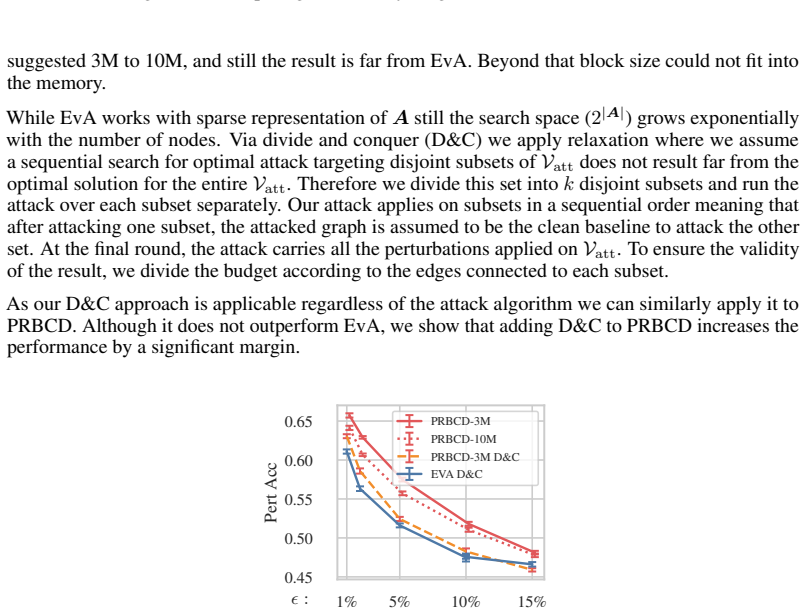
The load-bearing machinery is a genetic algorithm whose candidates are sparse vectors of edge indices to flip, with the true objective as fitness. Three design choices do most of the work: restricting initialization and mutation to edges incident to the attacked set $V_{\mathrm{att}}$ (so the search concentrates on the receptive field), adaptive targeted mutation that skips already-flipped nodes while still allowing them as partners, and a divide-and-conquer split of $V_{\mathrm{att}}$ that makes large graphs tractable. Evaluation cost is controlled by stacking many candidate perturbations into one batched forward pass, and local constraints are enforced by projecting with edge-frequency scores. Together these make the discrete edge-flip search both effective and memory-scalable.
What would settle it
Run EvA and a brute-force search on small graphs with a budget of two or three edge flips. If any global optimum lies entirely outside the attacked nodes' receptive field and EvA consistently misses it while brute force finds it, the receptive-field restriction is binding; conversely, if EvA matches brute force on such instances, the restriction is safe.
Extended reading notes
Core claim
On the paper's own terms, the central discovery is that careful engineering of an evolutionary search—sparse edge-index encoding, initialization and mutation restricted to the attacked nodes' receptive field, adaptive mutation that stops re-perturbing already-flipped nodes, direct accuracy fitness, and divide-and-conquer for large graphs—solves the original combinatorial attack problem better than the current gradient-based state of the art in global, local, and targeted settings. The method is model-agnostic: it only needs forward evaluations, so objectives like certified ratio and conformal coverage, which contain non-differentiable steps, can be attacked directly without surrogate losses. EvA's memory use is linear in the perturbation budget, and it can keep improving given more time or memory, a property gradient methods do not show.
Load-bearing premise
The search assumes any worthwhile perturbation has at least one endpoint inside the set of attacked nodes, so an attack that needs to flip two edges between neighbors of a target—neither edge touching the target—could never be found.
Editorial extensions
If this is right
- EvA provides a stronger adversary for evaluating GNN robustness, so defenses that report accuracy under prior attacks will look weaker under EvA.
- Any objective that can be computed as a scalar from model outputs—including quantiles, vote counts, or set sizes—becomes attackable without hand-designing a differentiable surrogate.
- Robustness certificates and conformal guarantees on graphs are more fragile than previously demonstrated, since a black-box attacker can shrink certified ratios and push empirical coverage below the nominal guarantee.
- Because EvA improves with more compute and memory, comparisons of attacks should report resource budgets; a fixed compute budget may unfairly favor gradient methods.
- Divide-and-conquer makes the attack practical on larger graphs, suggesting that search-based attacks scale beyond small citation networks.
Reading between the lines
- Editorial inference: the same black-box search could be repurposed as an evaluator for certifiable or conformal defenses by maximizing worst-case set inflation instead of coverage drop, which the paper only hints at.
- Editorial inference: because EvA needs only forward passes, it can be applied to models with nondifferentiable aggregations (e.g., median or majority-vote GNNs) without adapting the attack; the paper's SoftMedian result is one instance of this, but the claim is broader.
- Editorial inference: a hybrid search that occasionally proposes edges with both endpoints outside $V_{\mathrm{att}}$ would test whether the receptive-field restriction is ever limiting; the paper provides no experiment on this.
- Editorial inference: the divide-and-conquer relaxation suggests a general principle—sequential subspace search can beat full-space search under memory limits—which could transfer to other combinatorial attacks.
Editorial analysis
A structured set of objections, weighed in public.
Referee Report
Summary. The paper proposes EvA, an evolutionary (genetic-algorithm) attack that directly searches the discrete space of edge perturbations on graphs, bypassing gradient-based relaxations. The authors introduce several practical enhancements: sparse candidate encoding, targeted and adaptive mutation, local-degree-constrained projection, stacked inference, and a divide-and-conquer strategy for large graphs. They report that EvA outperforms state-of-the-art gradient-based attacks (PRBCD, LRBCD) across global, local, and targeted settings in the inductive regime, and they demonstrate two new attack objectives: reducing the certified ratio of smoothed classifiers and breaking conformal prediction guarantees. The paper includes extensive experiments on citation and Amazon datasets, multiple GNN architectures, robust models, and ablations of the proposed components.
Significance. If the central claims hold, EvA provides a strong and general search-based alternative to gradient-based graph attacks, with practical relevance for evaluating defenses and for attacking non-differentiable objectives such as certified ratio and conformal coverage. The paper's strengths include a broad empirical study with multiple models, datasets, seeds, and error bars; explicit ablations of initialization, mutation, fitness, and memory scaling; a fair reimplementation of the earlier genetic baseline; and a memory-efficient sparse encoding. These elements support the main outperformance result in the inductive setting. However, the advertised universality ('works with any black-box model and objective, eliminating the need for a differentiable proxy loss') is qualified in the body of the paper, and a few empirical and theoretical gaps need to be addressed.
major comments (4)
- [Section 4, 'Node-targeted attacks'] The paper's central claim that EvA 'works with any black-box model and objective, eliminating the need for a differentiable proxy loss' is internally contradicted here. The authors state that for a single target node the accuracy objective takes only values 0 or 1, so 'with the 0-1 accuracy objective, random search and GA are practically equivalent,' and they therefore switch to the differentiable tanh-margin loss as the fitness function. Thus, in one of the three regimes advertised (targeted attacks), EvA does require a differentiable proxy for a natural non-smooth objective. This is a load-bearing qualification: the abstract and Section 1 should be scoped to objectives that are sufficiently sensitive to small perturbations, or the paper should explain how the targeted regime can be handled without a proxy.
- [Table 4 and Section 5, 'Transductive setting'] The prose states that 'EvA outperforms SOTA consistent with other experiments' in the transductive setting, but Table 4 shows counterexamples at the largest budget. For GCN at epsilon=0.20, EvA achieves 57.41±2.51 while LRBCD achieves 56.86±1.92 and PRBCD 56.07±2.36; for GPRGNN at epsilon=0.20, EvA achieves 50.04±15.53 while LRBCD achieves 49.04±15.66. Since lower accuracy is better, EvA is not the best attack at these points. The central claim of consistent superiority should therefore be qualified, and the discrepancy should be discussed (for example, by analyzing the error bars or the behavior of the attack as the budget saturates).
- [Section 3, 'Enhancing the search' and 'Targeted and adaptive mutation'] The search restriction and the adaptive mutation operator assume that every useful perturbation has at least one endpoint in the attacked node set Vatt. For a two-layer GCN, however, an edge placed between two neighbors of a target node changes the neighbor embeddings that are aggregated into the target in the second layer, even though neither endpoint is in Vatt. Such an edge lies inside the receptive field but is excluded by the initialization and mutation rules. The paper offers no theoretical justification or experiment testing whether non-incident edges are ever needed for an optimal attack. I recommend adding an ablation (or at least a measurable argument) that quantifies the loss in attack quality caused by this restriction.
- [Section 4, 'Attacking conformal prediction'] The conformal attack uses the entire unlabeled set Vu as the calibration set during the attack, while the defender calibrates on a random subset of Vu. Exchangeability alone does not guarantee that the quantile computed on all of Vu behaves identically to the quantile computed on a random subset of fixed size, nor that an attack optimized against the full-set quantile transfers to the defender's actual calibration subset. The current justification ('Due to exchangeability we expect the similar effect from our perturbation for any random subset as well') is not a formal argument. Please provide either a formal statement with conditions or an empirical validation that the attack also reduces coverage when evaluated against several randomly drawn calibration subsets of the defender's size.
minor comments (4)
- [Abstract and Section 3] The abstract says the attack's memory complexity is 'linear in the attack budget,' but Section 3 gives O(|S|·δ) for a population of size |S|. This is linear in δ only if the population size is treated as a fixed constant; please state this qualification explicitly when defining the complexity claim.
- [Appendix C, Tables 13 and 14] The captions of Tables 13 and 14 describe the results as being on the CoraML dataset, but the surrounding text (Section C.2) discusses Ogbn-Arxiv with control nodes and smaller budgets. The captions should be corrected to match the dataset actually used.
- [Multiple places] The manuscript contains numerous typos and grammatical slips, including 'canididates,' 'carreis,' 'sence,' 'extensivelt,' 'grpah,' 'targetted,' and 'supplementary matrial.' A careful proofreading pass is needed.
- [Section 3, 'Stacking perturbations'] The description of stacked inference is clear in its intent, but the sentence 'we can use the remaining memory to combine k candidates in form of a large graph of k parts' should define how the disjoint graph is constructed (e.g., by block-diagonal concatenation) and how the candidate-specific predictions are extracted, to make the implementation reproducible.
Circularity Check
No circular derivation: EvA's gains are measured against external gradient-based baselines and its novel-objective attacks directly optimize the reported metrics; the abstract's no-proxy claim is overbroad but not circular.
full rationale
The derivation of EvA is self-contained rather than circular. For global and local attacks, the fitness function is literally the attack objective (accuracy, or the certified-ratio/conformal-coverage objective in the novel attacks), and the reported outcomes are those same objectives evaluated after the search; the paper does not fit a parameter to a subset and then re-predict that subset. The headline ~11% improvement is an empirical comparison against external gradient-based attacks (PRBCD, LRBCD, PGA) on the benchmark accuracy metric, not a quantity forced by construction. The self-citations in the paper—Zargarbashi and Bojchevski (2024) for the conformal inductive framework and Bojchevski et al. (2020) for sparse smoothing certificates—are used as attack targets. These are published, proof-backed constructions and are externally falsifiable (the attack is measured by whether coverage/certified ratio actually drops), so they do not make the argument circular. The one genuine weakness is the abstract's claim that EvA 'eliminat[es] the need for a differentiable proxy loss' for every objective: Section 4 immediately admits that node-targeted attacks must switch to the differentiable tanh-margin fitness because the 0-1 accuracy objective has no sensitivity for a single node. This is an internal overclaim about scope, not a circular derivation—the targeted-attack comparison to PRBCD still uses an external metric and an external baseline. No fitted input is renamed as a prediction, and no uniqueness theorem or ansatz is imported from the authors' prior work to force the result.
Assumptions & free parameters
free parameters (6)
- mutation_rate =
0.01
- population_size =
1024 (45 for Ogbn-Arxiv)
- num_crossovers =
30
- tournament_size =
2
- kdc =
98 for Ogbn-Arxiv
- twarm =
50 for Pubmed
assumptions (5)
- domain assumption Restricting the search space to edges with at least one endpoint in Vatt does not exclude optimal perturbations.
- domain assumption Divide-and-conquer: sequentially attacking disjoint subsets of Vatt with prorated budgets yields a perturbation close to the joint optimum.
- domain assumption Accuracy is a well-behaved fitness function for genetic search on graph perturbations.
- domain assumption For conformal prediction, calibrating on the whole unlabeled set Vu during the attack transfers to the defender's random subset due to exchangeability.
- domain assumption The certified ratio is monotone in the smooth prediction probability, so pushing probability below p suffices to remove certification.
Cite this review
Pith. "Pith review of EvA: Evolutionary Attacks on Graphs." pith.science (2026). https://pith.science/paper/LDCYST4Q
@misc{pith2026250708212,
  author       = {Pith},
  title        = {Pith review of: EvA: Evolutionary Attacks on Graphs},
  year         = {2026},
  howpublished = {\url{https://pith.science/paper/LDCYST4Q}},
  note         = {Machine review of arXiv:2507.08212}
}
abstract
Even a slight perturbation in the graph structure can cause a significant drop in the accuracy of graph neural networks (GNNs). Most existing attacks leverage gradient information to perturb edges. This relaxes the attack's optimization problem from a discrete to a continuous space, resulting in solutions far from optimal. It also restricts the adaptability of the attack to non-differentiable objectives. Instead, we introduce a few simple yet effective enhancements of an evolutionary-based algorithm to solve the discrete optimization problem directly. Our Evolutionary Attack (EvA) works with any black-box model and objective, eliminating the need for a differentiable proxy loss. This allows us to design two novel attacks that reduce the effectiveness of robustness certificates and break conformal sets. The memory complexity of our attack is linear in the attack budget. Among our experiments, EvA shows $\sim$11\% additional drop in accuracy on average compared to the best previous attack, revealing significant untapped potential in designing attacks.
Figures


Figures from the paper (8 more)


Reference graph
Works this paper leans on
-
[3]
Are Defenses for Graph Neural Networks Robust?
URLhttps://arxiv.org/abs/2301.13694. 10 Galileo Namata, Ben London, Lise Getoor, and Bert Huang. Query-driven active surveying for collective classification
-
[5]
Yexin Wang, Zhi Yang, Junqi Liu, Wentao Zhang, and Bin Cui
doi: 10.1109/TKDE.2022.3201243. Yexin Wang, Zhi Yang, Junqi Liu, Wentao Zhang, and Bin Cui. Scapin: Scalable graph structure perturbation by augmented influence maximization.Proc. ACM Manag. Data, 1(2), June
-
[6]
URLhttps://doi.org/10.1145/3589291
doi: 10.1145/3589291. URLhttps://doi.org/10.1145/3589291. Marcin Waniek, Tomasz P Michalak, Michael J Wooldridge, and Talal Rahwan. Hiding individuals and communities in a social network.Nature Human Behaviour, 2(2):139–147,
-
[8]
However, compared to PRBCD, EvA allocates more of the budget to higher-degree nodes
The results indicate that, in both attacks, most of the budget is spent connecting to low-degree nodes. However, compared to PRBCD, EvA allocates more of the budget to higher-degree nodes. Additionally, we calculate the margin loss for each node in the original graph and discretize them into eight levels. As shown in the right figure of Fig. 10, EvA alloc...
work page 2021
-
[9]
ISSN 2471-2566. doi: 10.1145/3611307. URLhttps://doi.org/10.1145/3611307. Jianfu Zhang, Yan Hong, Dawei Cheng, Liqing Zhang, and Qibin Zhao. Hierarchical attacks on large- scale graph neural networks. InICASSP 2024 - 2024 IEEE International Conference on Acoustics, Speech and Signal Processing (ICASSP), pages 7635–7639,
-
[10]
Finally, all of the experiments has been run in one Nvidia H100 gpu. E.4 Attack hyperparameters To assess the robustness of GNNs, we utilize the following attacks and hyperparameters. Based on Geisler et al. [2023], we also select the tanh-margin loss as the attack objective. PRBCD.We closely adhere to the setup outlined by Geisler et al. [2023]. A block ...
work page 2023
-
[11]
Simple and Efficient Partial Graph Adversarial Attack: A New Perspective
URLhttps://arxiv.org/abs/2308.07834. Daniel Zügner, Amir Akbarnejad, and Stephan Günnemann. Adversarial attacks on neural networks for graph data. InProceedings of the 24th ACM SIGKDD international conference on knowledge discovery & data mining, pages 2847–2856,
-
[13]
applies a greedy projection to apply local constraints. Orthogonally, Dai et al. [2018b] use reinforcement learning to refine their attack and disrupt the learning process of GNNs Sun et al. [2023]. They also introduce a genetic algorithm attack as a baseline; however, they did not design the components of GA carefully. In § 3 we design GA components (mut...
work page 2023
Show all 20 references
-
[14]
[2019], propose heuristic attacks based on the graph’s topology, but their performance is significantly lower than that of white-box methods like PRBCD
and Xu et al. [2019], propose heuristic attacks based on the graph’s topology, but their performance is significantly lower than that of white-box methods like PRBCD. Mu et al
2019
-
[16]
(see their Fig. 4). Second, even if we assume that the gradient correctly indicates the effect on the loss, it still only reflects the impact of individual changes and ignores the effects of interactions between edges. There are cases where flipping each individual edge would ...
2024
-
[17]
As stated in [Dai et al., 2018b], a genetic algorithm for global attacks requires PBA-C because it relies on logits, with the fitness function being the negative log-likelihood
C.3 Comparison with [Dai et al., 2018b] [Dai et al., 2018b] proposed a practical black-box attack (PBA), dividing it into PBA-C (with access to logits - continuous) and PBA-D (access only to the labels - discrete). As stated in [Dai et al., 2018b], a genetic algorithm for glob...
2020
-
[20]
This approach does not work on the Pubmed dataset. The intuition is that since Pubmed larger and more dense compared to other datasets, for each candidate there are a lot of edges that has at least one endpoint violating the local constraint. Therefore removing many edges from...
2023
-
[2004]
A hard label black-box adversarial attack against graph neural networks
Jiaming Mu, Binghui Wang, Qi Li, Kun Sun, Mingwei Xu, and Zhuotao Liu. A hard label black-box adversarial attack against graph neural networks. InProceedings of the 2021 ACM SIGSAC Conference on Computer and Communications Security, pages 108–125,
2021
-
[2008]
Pitfalls of graph neural network evaluation.arXiv preprint arXiv:1811.05868,
Oleksandr Shchur, Maximilian Mumme, Aleksandar Bojchevski, and Stephan Günnemann. Pitfalls of graph neural network evaluation.arXiv preprint arXiv:1811.05868,
-
[2018]
Topology attack and defense for graph neural networks: An optimization perspective.arXiv preprint arXiv:1906.04214,
Kaidi Xu, Hongge Chen, Sijia Liu, Pin-Yu Chen, Tsui-Wei Weng, Mingyi Hong, and Xue Lin. Topology attack and defense for graph neural networks: An optimization perspective.arXiv preprint arXiv:1906.04214,
1906 arXiv
-
[2019]
Conformal inductive graph neural networks
Soroush H Zargarbashi and Aleksandar Bojchevski. Conformal inductive graph neural networks. arXiv preprint arXiv:2407.09173,
-
[2020]
Based on the domain, (evasion) attacks can be further be categorized to global (aiming to flip the prediction of a subset of nodes) and targeted attacks (aiming at a single node)
11 A Supplementary to Related Work We focus on evasion attacks where perturbations are made after the model’s training. Based on the domain, (evasion) attacks can be further be categorized to global (aiming to flip the prediction of a subset of nodes) and targeted attacks (aim...
2019
-
[2021]
Furthermore, their approach does not scale well to graphs with even a few thousand nodes
approximate gradients by measuring changes with small perturbations, but even under ideal conditions, their method can at best match the performance of PRBCD, which directly utilizes exact gradients. Furthermore, their approach does not scale well to graphs with even a few tho...
2024
-
[2023]
Lukas Gosch, Simon Geisler, Daniel Sturm, Bertrand Charpentier, Daniel Zügner, and Stephan Günnemann
URL https://arxiv.org/ abs/2110.14038. Lukas Gosch, Simon Geisler, Daniel Sturm, Bertrand Charpentier, Daniel Zügner, and Stephan Günnemann. Adversarial training for graph neural networks: Pitfalls, solutions, and new directions. In37th Conference on Neural Information Process...
-
[2024]
2024.10448076
doi: 10.1109/ICASSP48485. 2024.10448076. Guanghui Zhu, Mengyu Chen, Chunfeng Yuan, and Yihua Huang. Simple and efficient partial graph adversarial attack: A new perspective,
2024
Reviewed August 6, 2026 · model on record in the stance chip above.
Discussion (0). Continue with ORCID to comment.