REVIEW 3 major objections 6 minor 1 cited by
The Rosetta Stone Project. I. A suite of radiative magnetohydrodynamics simulations of high-mass star-forming clumps
T0 review · 3 major / 6 minor · reviewed 2026-08-06 · deepseek-v4-flash
Pith's one-line read The paper argues that magnetic field strength dominates how high-mass star-forming clumps fragment and collapse, and that the luminosity-to-mass ratio is an evolutionary clock largely insensitive to initial conditions.
desk verdict Useful catalog, honest about its own limits, but the resolution convergence gap sits under the magnetic-field claim; still deserves refereeing. read the letter →
The pith
A machine-rendered reading of the paper's core claim, the machinery that carries it, and where it could break.
The reading
What carries the argument
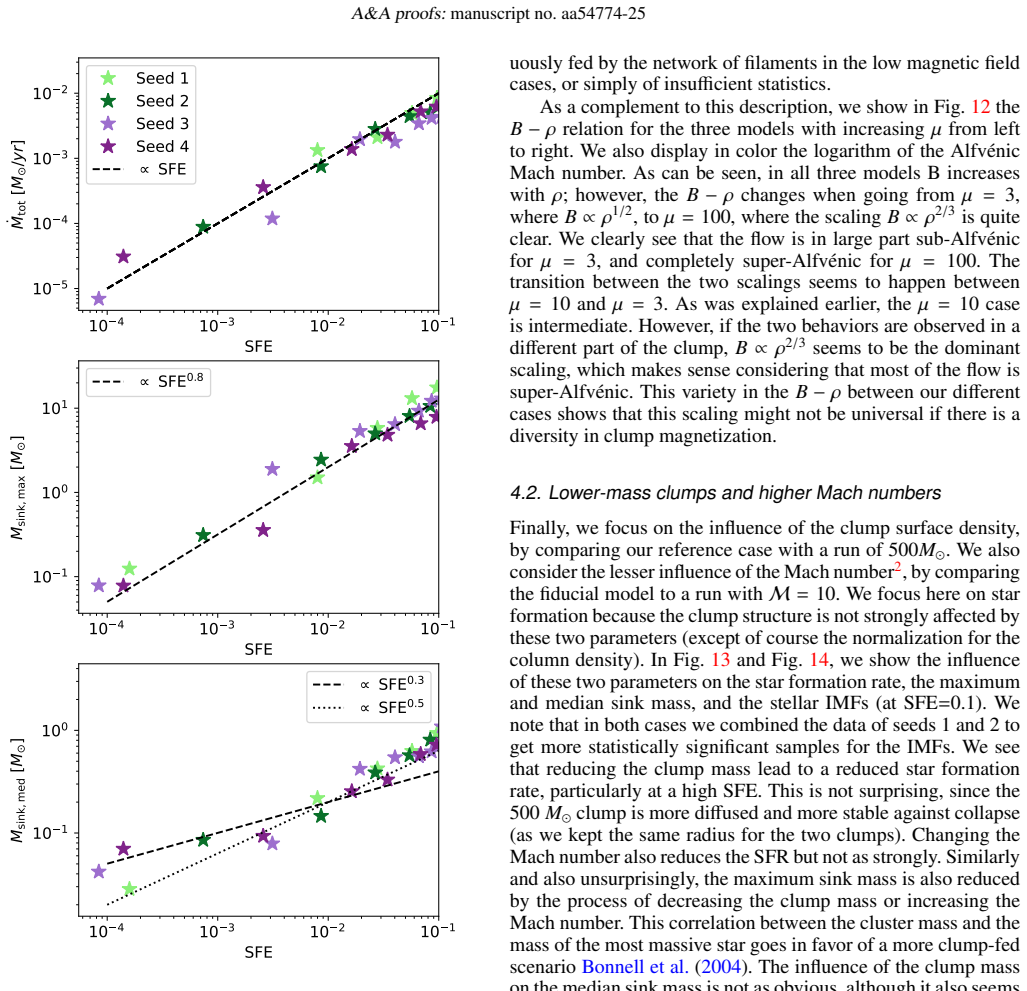
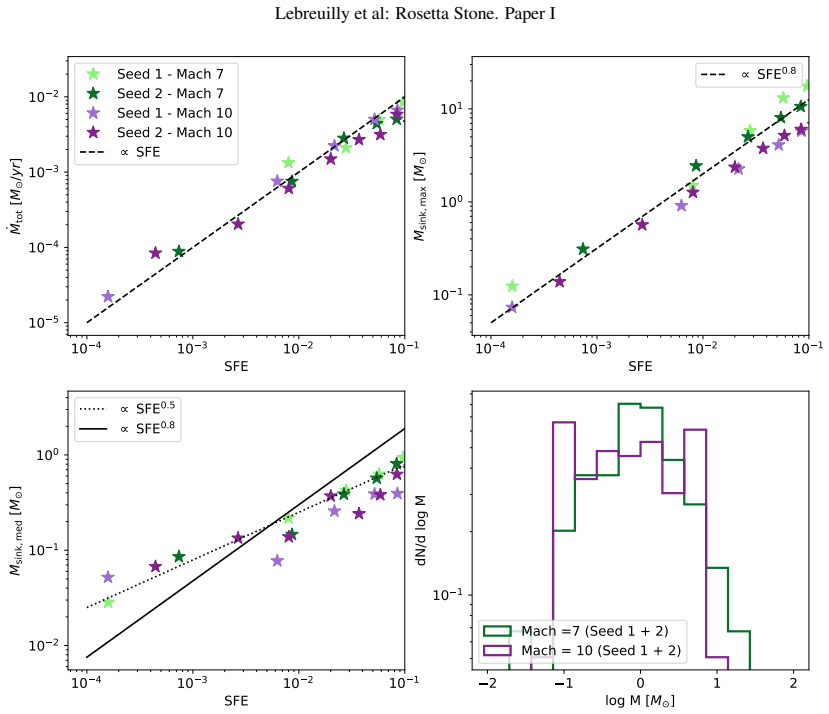
The machinery is a grid of adaptive-mesh-refinement simulations of radiative magnetohydrodynamics: each clump is a uniformly magnetized, supersonically turbulent sphere of 500 or 1000 $M_\odot$ at 10 K, with three mass-to-flux ratios ($\mu = 3, 10, 100$), two Mach numbers (7 and 10), and two random seeds, integrated with flux-limited-diffusion radiative transfer, self-gravity, and sink particles that accrete gas above $10^9$ cm$^{-3}$ and release accretion plus internal stellar luminosity. The load-bearing diagnostics are the sink population, which stands in for the stellar initial mass function, and the ratio $L/M = L_{\rm tot}/(M_0 - M_{\rm sinks})$. The near-universality of $L/M$ as an evolutionary clock is explained by two power-law mechanisms derived from the runs: at low star formation efficiency the accretion luminosity dominates and gives $L/M \propto {\rm SFE}^{1.5}$, because the accretion rate scales as the SFE, the median sink mass as ${\rm SFE}^{0.5}$, and the stellar radius is roughly constant; at higher efficiency the internal luminosity, scaling as the square of the maximal sink mass with $M_{\max} \propto {\rm SFE}^{0.8}$, takes over and gives $L/M \propto {\rm SFE}^{1.6}$.
What would settle it
Rerun the reference 1000 $M_\odot$ clump at 10, 20, 40, and 80 cells per Jeans length and compare the sink mass functions and the $L/M$ versus SFE relation across resolutions: if the peak near 1 $M_\odot$ or the ${\rm SFE}^{1.5}$ scaling shifts systematically, the headline results are numerical artifacts rather than physical outcomes.
Extended reading notes
Core claim
The paper's central claim is that magnetization outranks every other initial condition in shaping clump evolution. Strongly magnetized clumps (mass-to-flux ratio $\mu = 3$, only three times the critical value at which the field would halt collapse) collapse into sheet-like structures aligned with the field, confine star formation to a single filament, form roughly half as many sinks as weakly magnetized clumps, and push the median sink mass to about 3 $M_\odot$ at 10 percent star formation efficiency, whereas weakly magnetized clumps ($\mu = 100$) fragment into many scattered low-mass stars with a median near 0.8 $M_\odot$. The second headline claim is that the luminosity-to-mass ratio, $L/M \equiv L_{\rm tot}/(M_0 - M_{\rm sinks})$, the total luminosity of all sinks divided by the gas mass not yet converted into stars, increases almost monotonically as the star formation efficiency (the fraction of initial clump mass in sinks) rises, and collapses onto a common scaling, roughly $L/M \propto {\rm SFE}^{1.5}$ early on and ${\rm SFE}^{1.6}$ later, with about one dex of scatter across the whole catalog; different seeds, masses, Mach numbers, and magnetizations land on the same band. That universality is what makes $L/M$ usable as an evolutionary indicator of real clumps, even though it cannot measure absolute time because clumps of different mass or magnetization collapse at different rates. A final finding is methodological: the sink mass function's peak near 1 $M_\odot$ is partly a numerical artifact of not resolving the opacity limit, and the paper warns that jets, which are absent here, are needed to recover the Galactic peak near 0.3 $M_\odot$.
Load-bearing premise
The catalog assumes that resolving each Jeans length with 10 grid cells prevents artificial fragmentation in magnetized, turbulent, collapsing clumps; the authors themselves flag this in Section 5.2 as fragile because a run with 20 cells per Jeans length produced visibly different small-scale structure, and if the assumption fails the sink populations and the $L/M$ relation built from them are partly numerical.
Editorial extensions
If this is right
- Observers can use the luminosity-to-mass ratio to stage real star-forming clumps by evolutionary state without knowing their mass, magnetization, or turbulent driver, because in these runs $L/M$ tracks the star formation efficiency to within about an order of magnitude.
- Strongly magnetized clumps should appear observationally as single-filament nurseries forming fewer, more massive stars, while weakly magnetized clumps should fragment into many low-mass stars spread over a larger volume.
- The slope of the measured magnetic field-density relation ($B \propto \rho^{1/2}$ versus $B \propto \rho^{2/3}$) can act as a fingerprint of the clump's magnetization regime, connecting a hard-to-measure quantity to an observable scaling.
- The catalog's sink mass functions should not be read as converged predictions of the initial mass function: the paper argues the peak near 1 $M_\odot$ is partly artificial and that jets, absent from these runs, are needed to reproduce the Galactic peak near 0.3 $M_\odot$.
Reading between the lines
- If the $L/M$ clock survives conversion into synthetic observations, existing infrared surveys could be reinterpreted as maps of star formation efficiency, turning a single observed ratio into a statistical estimate of how much gas a clump has already turned into stars.
- The transition between the two regimes of the $L/M$ scaling, accretion-dominated below and internal-luminosity-dominated above a star formation efficiency near 0.01, coincides with the luminosity level at which HII regions appear in observations of real clumps, suggesting the break marks the onset of massive-star feedback; checking whether clumps above that threshold systematically show ionized ga
- The prediction that strong magnetization raises the median stellar mass is directly testable: within a sample of clumps with measured mass-to-flux ratios, the strongly magnetized subsample should show a top-heavier stellar mass distribution, connecting magnetic field measurements to variations in the initial mass function.
Editorial analysis
A structured set of objections, weighed in public.
Referee Report
Summary. The paper presents the first catalog (RS1.0) of 24 radiative magnetohydrodynamic simulations of high-mass star-forming clumps computed with RAMSES, varying clump mass (500, 1000 M_sun), Mach number (7, 10), mass-to-flux ratio (mu = 3, 10, 100), and turbulent seed (1, 2), plus four additional runs that vary the Jeans resolution (N_Jeans = 20) and the sink formation threshold (n_sink = 10^10 cm^-3). The reference model is analyzed in detail for its column density, temperature, magnetic field structure, and sink mass function. The parameter exploration identifies the magnetic field strength as the most influential parameter for clump evolution, and the luminosity-to-mass ratio (L/M) is found to correlate with the star formation efficiency (SFE) across the catalog. The authors explicitly acknowledge limitations: the IMF peak is partly artificial, jets and HII regions are not included, and the L/M-SFE relation may change when such feedback processes are added.
Significance. If the conclusions hold, the catalog and the planned synthetic-observation pipeline (Papers II and III) will be a valuable community resource for bridging simulations and observations of high-mass star-forming clumps. The paper is notably honest about its numerical limitations, and the L/M-SFE relation is measured from the simulations rather than tuned to an external target, so the circularity burden is modest. The main unresolved issue is whether the small-scale fragmentation pattern at N_Jeans = 10, on which the magnetization ranking and the IMF-based scalings rest, is converged; the single N_Jeans = 20 test shows non-negligible differences. This gap can be addressed with additional targeted runs or with explicitly weakened claims, and it does not appear to be an unfixable error.
major comments (3)
- [§2.3 and §5.2, Fig. 17] The resolution convergence test is performed only for the fiducial mu = 10 model: the N_Jeans = 20 run is not part of the magnetization sequence (mu = 3, 10, 100) that supports the headline claim that magnetic field strength has the strongest influence on small-scale fragmentation. The N_Jeans = 20 run itself shows visibly more small-scale structure than the fiducial N_Jeans = 10 run, and its sink distribution more closely resembles the n_sink = 10^10 cm^-3 run than the fiducial, as the authors note. This is direct evidence that small-scale fragmentation is not converged at N_Jeans = 10 in this regime, consistent with the Federrath et al. (2011) caveat cited by the authors. Because the mu = 3 and mu = 100 runs are available only at N_Jeans = 10, the differential fragmentation and the derived ranking of models could be partly numerical. I request either a resolution test for at least the extreme magnetization cases, or a clear restriction of the 'strongest influence' claim to large-scale morphology and collapse, with the small-scale statements downgraded to provisional.
- [§5.1, Eqs. (7)-(9)] The analytic explanation of the L/M-SFE scaling uses the relations Mdot_tot ∝ SFE, M_med ∝ SFE^0.5, and M_max ∝ SFE^0.8, all of which are read from the same simulation outputs (Figs. 9, 11, 13, 14) with no formal fit uncertainties. The derived L/M ∝ SFE^1.5-1.6 is therefore not an independent prediction; it is a restatement of correlations measured from the same data. The empirical relation in Fig. 15 is the actual result and appears reasonably supported, but the paper should present Eqs. (7)-(9) as a consistency check rather than a derivation, and it should quantify the scatter (~1 dex) and the fit uncertainties before drawing quantitative conclusions.
- [§5.2 and §3.4] The paper states that the IMF peak is 'still artificial and is not guaranteed to be correct for all the models.' This caveat applies directly to the median sink mass, which is one of the basis quantities in Eq. (8) for the L/M-SFE scaling, and to the sink populations used to rank the magnetization models in §4.1.1. The abstract's claim that L/M is 'a good indicator ... regardless of its initial condition' should be tempered by an explicit statement of which conclusions are robust to the artificial low-mass sink population and which would require higher-resolution or jet-including calculations.
minor comments (6)
- [§2.6, Eq. (6)] The sentence following the L/M definition, 'This quantity measures the relative conversion of the clump material into stars or sinks,' actually describes SFE in Eq. (5); L/M is a luminosity-to-remaining-gas-mass ratio. Please correct to avoid confusing the two quantities.
- [§4.1.1] The statement that 'for µ=1 the magnetic field is expected to completely prevent the collapse of the clump' is imprecise: in ideal MHD, complete magnetic support requires a subcritical cloud, µ < 1, while µ = 1 is the marginal critical value. Please rephrase.
- [§4.2] The phrase 'the opposed effect' should read 'the opposite effect.'
- [§5.1] The phrase 'he future RS models' should read 'the future RS models.'
- [Figs. 9, 11, 13, 14] The power-law overlays are labeled only as 'to guide the eye,' and neither the figures nor the text states the fitting procedure or the scatter associated with exponents such as SFE^0.3, SFE^0.5, and SFE^0.8. Please add a table or legend with the fitted slopes and uncertainties, or explicitly state that the exponents are rough visual estimates.
- [§4.1] The text uses 'M' both for the clump mass (in M_sun) and for the Mach number (e.g., 'M=1000M_sun, M=7, and µ=10'); this overloading is confusing. Please use distinct symbols for the Mach number.
Circularity Check
Central claims rest on direct simulation outputs; the only circularity is the post-hoc analytic L/M–SFE derivation that reuses the same fitted power-law exponents.
-
other
[Section 5.1, Eqs. (7)–(9), with Fig. 15; exponents from Figs. 9, 11, 13, 14]
"For this, we keep in mind that we have previously shown that Ṁ∝SFE and that the typical relation between the median mass and the SFE in our models is on the order of ∝SFE∼0.5. ... For a clump with only low-mass stars (when Mmax<2M⊙), the accretion luminosity dominates and we can therefore write L/M∝ Ṁ M_med / R. ... We therefore determine that L/M∝SFE^1.5."
The scalings Ṁ∝SFE, M_med∝SFE^0.5, and M_max∝SFE^0.8 are not independent inputs: they are power-law fits read off the same RS1.0 simulations (Figs. 9, 11, 13, 14). Substituting these fitted scalings into the accretion-luminosity expression (Eq. 4) yields L/M∝SFE^1.5–1.6 by construction, so the 'derivation' is a consistency check rather than an independent prediction. The paper introduces it as 'understand where this relation comes from', not as a prediction, and the underlying L/M–SFE correlation is measured directly from the simulations; hence the circularity is minor and non-load-bearing.
full rationale
The paper's two headline results—magnetic-field strength as the dominant influence on clump evolution, and L/M as an evolutionary indicator independent of initial conditions—are empirical statements based on controlled variations of initial parameters in the RS1.0 grid, not on fitting to an external target. The magnetic-field ranking follows from comparing µ=3, 10, 100 runs at fixed other parameters, and the L/M–SFE correlation is computed directly from sink masses and sink luminosities across all models. The §5.1 analytic scaling is post-hoc: it reuses the same fitted exponents (Ṁ∝SFE, M_med∝SFE^0.5, M_max∝SFE^0.8) to reproduce L/M∝SFE^1.5–1.6, so it adds no independent support, but this does not affect the empirical claim. Self-citations (e.g., Lebreuilly et al. 2024a for the sink-threshold comparison) are used with explicit hedges; §5.2 openly states that the IMF peak is 'still artificial and is not guaranteed to be correct for all the models' and that N_Jeans=10 may be insufficient in gravo-turbulent magnetized collapse (Federrath et al. 2011). Those are convergence limitations that lower robustness, not circularity. No uniqueness theorem is imported from the authors' prior work, and the resolution and sink-convergence discussion is transparent and targeted at the weakest numerical assumption. Circularity score is therefore low.
Assumptions & free parameters
free parameters (5)
- f_acc (accretion luminosity efficiency) =
0.1
- n_sink (sink formation density threshold) =
1e9 cm^-3
- N_Jeans (cells per Jeans length) =
10
- Median sink mass vs SFE exponent =
~0.3 to 0.6 depending on model
- Maximum sink mass vs SFE exponent =
~0.8
assumptions (7)
- domain assumption Ideal MHD (flux freezing) holds down to 38 au, with nonideal effects negligible.
- domain assumption N_Jeans = 10 cells per Jeans length is sufficient to avoid artificial fragmentation.
- domain assumption The flux-limited diffusion (FLD) approximation adequately captures radiative transfer in these clumps.
- domain assumption A decaying Kolmogorov turbulent velocity field with random phases is an acceptable initial condition.
- domain assumption Isolated uniform spherical clumps are representative of real star-forming clumps.
- domain assumption Kuiper & Yorke (2013) evolutionary tracks give reliable stellar radii and internal luminosities for all sinks.
- standard math The RAMSES implementation of the RMHD and sink equations is correct.
Cite this review
Pith. "Pith review of The Rosetta Stone Project. I. A suite of radiative magnetohydrodynamics simulations of high-mass star-forming clumps." pith.science (2026). https://pith.science/paper/BZYORIT6
@misc{pith2026250708436,
  author       = {Pith},
  title        = {Pith review of: The Rosetta Stone Project. I. A suite of radiative magnetohydrodynamics simulations of high-mass star-forming clumps},
  year         = {2026},
  howpublished = {\url{https://pith.science/paper/BZYORIT6}},
  note         = {Machine review of arXiv:2507.08436}
}
read the original abstract
Context. Star formation and, in particular, high-mass star formation are key astrophysical processes that are far from being fully understood. Unfortunately, progress in these fields is slow because observations are hard to interpret as they cannot be directly compared to numerical simulations. Synthetic observations are therefore necessary to better constrain the models. Aims. With the Rosetta Stone project, we aim to develop an end-to-end pipeline to compare star formation simulations with observations as accurately as possible in order to study the evolution from clumps scales to stars. Methods. Using the adaptive mesh-refinement code RAMSES, we computed a first grid of model of star-forming clumps to develop our pipeline and explore the impact of the clump initial conditions on their evolution. The main purpose of this set of simulations is to be converted into synthetic observations to enable a direct comparison with real star-forming clumps observed with Herschel and ALMA. Results. The Rosetta Stone simulations presented here provide a catalog available for full post-processing and subsequent comparison with observations (RS1). Among all the parameters explored here, the strength of the magnetic field has the strongest influence on the clump evolution (fragmentation, star formation, global collapse) at both large and small scales. Numerical parameters such as the resolution per Jeans length or the threshold for accretion onto sink particles affects the formation of low-mass sinks. Finally, the widely used L/M ratio is found to be a good indicator of the clump evolutionary state regardless of its initial condition, but this could change when more feedback processes (jets, HII regions) are included. Conclusions. We now have a new suite of simulations of star-forming clumps that is available for full post-processing and subsequent comparison with the observations,
Figures


Figures from the paper (14 more)






Forward citations
Cited by 1 Pith paper
-
How Should We Understand the Core Mass Function? A memo of the CMF2IMF conference at ESO Garching
The high-mass slope of the core mass function depends strongly on the minimum fitting mass: completeness-based fits look top-heavy, while KS-selected tail fits move toward Salpeter, and the early-stage ASHES sample ap...
Reference graph
Works this paper leans on
-
[1]
2021, MNRAS, 503, 5826
Agertz, O., Renaud, F., Feltzing, S., et al. 2021, MNRAS, 503, 5826
2021
-
[2]
2023, A&A, 680, A23
Ahmad, A., González, M., Hennebelle, P., & Commerçon, B. 2023, A&A, 680, A23
2023
-
[3]
2024, A&A, 687, A90
Ahmad, A., González, M., Hennebelle, P., & Commerçon, B. 2024, A&A, 687, A90
2024
-
[4]
E., et al
Anderson, M., Peretto, N., Ragan, S. E., et al. 2021, MNRAS, 508, 2964
2021
-
[5]
2011, ApJS, 196, 22
Baes, M., Verstappen, J., De Looze, I., et al. 2011, ApJS, 196, 22
2011
-
[6]
2016, ARA&A, 54, 491
Bally, J. 2016, ARA&A, 54, 491
2016
-
[7]
R., Bonnell, I
Bate, M. R., Bonnell, I. A., & Price, N. M. 1995, MNRAS, 277, 362 Benítez-Llambay, P. & Masset, F. S. 2016, ApJS, 223, 11
1995
-
[8]
2020, A&A, 638, A86
Bhandare, A., Kuiper, R., Henning, T., et al. 2020, A&A, 638, A86
2020
Show all 113 references
-
[9]
& Teyssier, R
Bleuler, A. & Teyssier, R. 2014, MNRAS, 445, 4015
2014
-
[10]
A., Bate, M
Bonnell, I. A., Bate, M. R., Clarke, C. J., & Pringle, J. E. 2001, MNRAS, 323, 785
2001
-
[11]
A., Vine, S
Bonnell, I. A., Vine, S. G., & Bate, M. R. 2004, MNRAS, 349, 735
2004
-
[12]
2020, ApJ, 896, L34
Brucy, N., Hennebelle, P., Bournaud, F., & Colling, C. 2020, ApJ, 896, L34
2020
-
[13]
2023, A&A, 675, A144
Brucy, N., Hennebelle, P., Colman, T., & Iteanu, S. 2023, A&A, 675, A144
2023
-
[14]
& Mocz, P
Burkhart, B. & Mocz, P. 2019, ApJ, 879, 129
2019
-
[15]
T., et al
Cesaroni, R., Pestalozzi, M., Beltrán, M. T., et al. 2015, A&A, 579, A71
2015
-
[16]
2025, A&A, 696, A151
Coletta, A., Molinari, S., Schisano, E., et al. 2025, A&A, 696, A151
2025
-
[17]
2018, A&A, 620, A21
Colling, C., Hennebelle, P., Geen, S., Iffrig, O., & Bournaud, F. 2018, A&A, 620, A21
2018
-
[18]
& Teyssier, R
Colman, T. & Teyssier, R. 2020, MNRAS, 492, 4727 Commerçon, B., Debout, V ., & Teyssier, R. 2014, A&A, 563, A11 Commerçon, B., Teyssier, R., Audit, E., Hennebelle, P., & Chabrier, G. 2011, A&A, 529, A35 Commerçon, B., González, M., Mignon-Risse, R., Hennebelle, P., & Vaytet, N...
2020
-
[19]
Crutcher, R. M. 1999, ApJ, 520, 706
1999
-
[20]
M., Wandelt, B., Heiles, C., Falgarone, E., & Troland, T
Crutcher, R. M., Wandelt, B., Heiles, C., Falgarone, E., & Troland, T. H. 2010, ApJ, 725, 466
2010
-
[21]
F., Testi, L., et al
Curone, P., Izquierdo, A. F., Testi, L., et al. 2022, A&A, 665, A25
2022
-
[22]
Dale, J. E. & Bonnell, I. 2011, MNRAS, 414, 321
2011
-
[23]
E., Ngoumou, J., Ercolano, B., & Bonnell, I
Dale, J. E., Ngoumou, J., Ercolano, B., & Bonnell, I. A. 2014, MNRAS, 442, 694
2014
-
[24]
2015, MNRAS, 453, L73
Dipierro, G., Price, D., Laibe, G., et al. 2015, MNRAS, 453, L73
2015
-
[25]
C., Dittmann, A
Duffell, P. C., Dittmann, A. J., D’Orazio, D. J., et al. 2024, ApJ, 970, 156
2024
-
[26]
2021, MNRAS, 504, 2742
Elia, D., Merello, M., Molinari, S., et al. 2021, MNRAS, 504, 2742
2021
-
[27]
2015, MNRAS, 450, 4035
Federrath, C. 2015, MNRAS, 450, 4035
2015
-
[28]
C., & Klessen, R
Federrath, C., Banerjee, R., Clark, P. C., & Klessen, R. S. 2010, ApJ, 713, 269
2010
-
[29]
& Klessen, R
Federrath, C. & Klessen, R. S. 2012, ApJ, 761, 156
2012
-
[30]
S., Iapichino, L., & Beattie, J
Federrath, C., Klessen, R. S., Iapichino, L., & Beattie, J. R. 2021, Nature Astron- omy, 5, 365
2021
-
[31]
Federrath, C., Schrön, M., Banerjee, R., & Klessen, R. S. 2014, ApJ, 790, 128
2014
-
[32]
Federrath, C., Sur, S., Schleicher, D. R. G., Banerjee, R., & Klessen, R. S. 2011, ApJ, 731, 62
2011
-
[33]
2023, A&A, 672, A193
Fensch, J., Bournaud, F., Brucy, N., et al. 2023, A&A, 672, A193
2023
-
[34]
2006, A&A, 457, 371
Fromang, S., Hennebelle, P., & Teyssier, R. 2006, A&A, 457, 371
2006
-
[35]
2000, ApJS, 131, 273
Fryxell, B., Olson, K., Ricker, P., et al. 2000, ApJS, 131, 273
2000
-
[36]
2015, MNRAS, 454, 4484
Geen, S., Hennebelle, P., Tremblin, P., & Rosdahl, J. 2015, MNRAS, 454, 4484
2015
-
[37]
Girichidis, P., Federrath, C., Banerjee, R., & Klessen, R. S. 2011, MNRAS, 413, 2741
2011
-
[38]
2018, MNRAS, 480, 3511 Göller, J., Girichidis, P., Brucy, N., et al
Girichidis, P., Seifried, D., Naab, T., et al. 2018, MNRAS, 480, 3511 Göller, J., Girichidis, P., Brucy, N., et al. 2025, arXiv e-prints, submitted to A&A, arXiv:2502.02646 Grudi´c, M. Y ., Guszejnov, D., Hopkins, P. F., Offner, S. S. R., & Faucher- Giguère, C.-A. 2021, MNRAS,...
2018 arXiv
-
[39]
Y ., Hopkins, P
Guszejnov, D., Grudi ´c, M. Y ., Hopkins, P. F., Offner, S. S. R., & Faucher- Giguère, C.-A. 2021, MNRAS, 502, 3646
2021
-
[40]
2018, A&A, 611, A24
Hennebelle, P. 2018, A&A, 611, A24
2018
-
[41]
2020, ApJ, 904, 194
Hennebelle, P., Commerçon, B., Lee, Y .-N., & Chabrier, G. 2020, ApJ, 904, 194
2020
-
[42]
& Grudi´c, M
Hennebelle, P. & Grudi´c, M. Y . 2024, ARA&A, 62, 63
2024
-
[43]
2022, A&A, 668, A147
Hennebelle, P., Lebreuilly, U., Colman, T., et al. 2022, A&A, 668, A147
2022
-
[44]
2019, ApJ, 883, 140
Hennebelle, P., Lee, Y .-N., & Chabrier, G. 2019, ApJ, 883, 140
2019
-
[45]
Hopkins, P. F. 2015, MNRAS, 450, 53
2015
-
[46]
Jeffreson, S. M. R., Sun, J., & Wilson, C. D. 2022, MNRAS, 515, 1663
2022
-
[47]
Kim, C.-G., Kim, J.-G., Gong, M., & Ostriker, E. C. 2023, ApJ, 946, 3
2023
-
[48]
& Ostriker, E
Kim, C.-G. & Ostriker, E. C. 2017, ApJ, 846, 133
2017
-
[49]
Klessen, R. S. & Glover, S. C. O. 2016, Saas-Fee Advanced Course, 43, 85
2016
-
[50]
R., Bate, M
Krumholz, M. R., Bate, M. R., Arce, H. G., et al. 2014, in Protostars and Planets VI, ed. H. Beuther, R. S. Klessen, C. P. Dullemond, & T. Henning, 243
2014
-
[51]
Kuffmeier, M., Calcutt, H., & Kristensen, L. E. 2019, A&A, 628, A112
2019
-
[52]
2017, ApJ, 846, 7
Kuffmeier, M., Haugbølle, T., & Nordlund, Å. 2017, ApJ, 846, 7
2017
-
[53]
& Yorke, H
Kuiper, R. & Yorke, H. W. 2013, ApJ, 772, 61
2013
-
[54]
Lada, C. J. & Lada, E. A. 2003, ARA&A, 41, 57
2003
-
[55]
B., Grudi´c, M
Lane, H. B., Grudi´c, M. Y ., Guszejnov, D., et al. 2022, MNRAS, 510, 4767
2022
-
[56]
Larson, R. B. 1969, MNRAS, 145, 271
1969
-
[57]
2021, ApJ, 917, L10
Lebreuilly, U., Hennebelle, P., Colman, T., et al. 2021, ApJ, 917, L10
2021
-
[58]
2023, MNRAS, 518, 3326
Lebreuilly, U., Vallucci-Goy, V ., Guillet, V ., Lombart, M., & Marchand, P. 2023, MNRAS, 518, 3326
2023
-
[59]
& Hennebelle, P
Lee, Y .-N. & Hennebelle, P. 2018, A&A, 611, A88
2018
-
[60]
2010, ApJ, 720, L26
Li, Z.-Y ., Wang, P., Abel, T., & Nakamura, F. 2010, ApJ, 720, L26
2010
-
[61]
2021, A&A, 653, A157 Article number, page 16 of 18 Lebreuilly et al: Rosetta Stone
Louvet, F., Hennebelle, P., Men’shchikov, A., et al. 2021, A&A, 653, A157 Article number, page 16 of 18 Lebreuilly et al: Rosetta Stone. Paper I Mac Low, M.-M. & Klessen, R. S. 2004, Reviews of Modern Physics, 76, 125
2021
-
[62]
Mathew, S. S. & Federrath, C. 2021, MNRAS, 507, 2448
2021
-
[63]
S., Federrath, C., & Seta, A
Mathew, S. S., Federrath, C., & Seta, A. 2023, MNRAS, 518, 5190
2023
-
[64]
J., Girart, J
Maury, A. J., Girart, J. M., Zhang, Q., et al. 2018, MNRAS, 477, 2760
2018
-
[65]
McKee, C. F. & Tan, J. C. 2003, ApJ, 585, 850
2003
-
[66]
P., Waters, B., Schiebel, D., Young, W., & Golap, K
McMullin, J. P., Waters, B., Schiebel, D., Young, W., & Golap, K. 2007, in As- tronomical Society of the Pacific Conference Series, V ol. 376, Astronomical Data Analysis Software and Systems XVI, ed. R. A. Shaw, F. Hill, & D. J. Bell, 127
2007
-
[67]
1966, MNRAS, 133, 265
Mestel, L. 1966, MNRAS, 133, 265
1966
-
[68]
2007, ApJS, 170, 228
Mignone, A., Bodo, G., Massaglia, S., et al. 2007, ApJS, 170, 228
2007
-
[69]
F., & Springel, V
Mocz, P., Burkhart, B., Hernquist, L., McKee, C. F., & Springel, V . 2017, ApJ, 838, 40
2017
-
[70]
2016, ApJ, 826, L8
Molinari, S., Merello, M., Elia, D., et al. 2016, ApJ, 826, L8
2016
-
[71]
2025, A&A, 696, A149
Molinari, S., Schilke, P., Battersby, C., et al. 2025, A&A, 696, A149
2025
-
[72]
2022, A&A, 662, A8
Motte, F., Bontemps, S., Csengeri, T., et al. 2022, A&A, 662, A8
2022
-
[73]
2018, ARA&A, 56, 41
Motte, F., Bontemps, S., & Louvet, F. 2018, ARA&A, 56, 41
2018
-
[74]
G., Federrath, C., & Krumholz, M
Nam, D. G., Federrath, C., & Krumholz, M. R. 2021, MNRAS, 503, 1138
2021
-
[75]
Offner, S. S. R. & Arce, H. G. 2014, ApJ, 784, 61
2014
-
[76]
Offner, S. S. R., Krumholz, M. R., Klein, R. I., & McKee, C. F. 2008, AJ, 136, 404
2008
-
[77]
& Kuiper, R
Oliva, A. & Kuiper, R. 2023, A&A, 669, A80
2023
-
[78]
2020, ApJ, 900, 82 Pencil Code Collaboration, Brandenburg, A., Johansen, A., et al
Padoan, P., Pan, L., Juvela, M., Haugbølle, T., & Nordlund, Å. 2020, ApJ, 900, 82 Pencil Code Collaboration, Brandenburg, A., Johansen, A., et al. 2021, The Jour- nal of Open Source Software, 6, 2807
2020
-
[79]
2006, A&A, 459, 797 Portegies Zwart, S
Pinte, C., Ménard, F., Duchêne, G., & Bastien, P. 2006, A&A, 459, 797 Portegies Zwart, S. F., McMillan, S. L. W., & Gieles, M. 2010, ARA&A, 48, 431
2006
-
[80]
J., Wurster, J., Tricco, T
Price, D. J., Wurster, J., Tricco, T. S., et al. 2018, PASA, 35, e031
2018
-
[81]
2016, A&A, 593, A87
Reissl, S., Wolf, S., & Brauer, R. 2016, A&A, 593, A87
2016
-
[82]
2013, MNRAS, 436, 1836
Renaud, F., Bournaud, F., Emsellem, E., et al. 2013, MNRAS, 436, 1836
2013
-
[83]
Rosen, A. L. 2022, ApJ, 941, 202
2022
-
[84]
2019, ApJ, 886, 102
Sanhueza, P., Contreras, Y ., Wu, B., et al. 2019, ApJ, 886, 102
2019
-
[85]
2017, MNRAS, 472, 4797
Seifried, D., Walch, S., Girichidis, P., et al. 2017, MNRAS, 472, 4797
2017
-
[86]
J., Treß, R
Smith, R. J., Treß, R. G., Sormani, M. C., et al. 2020, MNRAS, 492, 1594
2020
-
[87]
2010, MNRAS, 401, 791
Springel, V . 2010, MNRAS, 401, 791
2010
-
[88]
2024, A&A, 682, A76
Suin, P., Zavagno, A., Colman, T., et al. 2024, A&A, 682, A76
2024
-
[89]
E., Shirley, Y
Svoboda, B. E., Shirley, Y . L., Traficante, A., et al. 2019, ApJ, 886, 36
2019
-
[90]
C., Beltrán, M
Tan, J. C., Beltrán, M. T., Caselli, P., et al. 2014, in Protostars and Planets VI, ed. H. Beuther, R. S. Klessen, C. P. Dullemond, & T. Henning, 149–172
2014
-
[91]
2002, A&A, 385, 337
Teyssier, R. 2002, A&A, 385, 337
2002
-
[92]
& Galli, D
Toci, C. & Galli, D. 2015, MNRAS, 446, 2118
2015
-
[93]
2020, ApJ, 888, L4
Toci, C., Lodato, G., Fedele, D., Testi, L., & Pinte, C. 2020, ApJ, 888, L4
2020
-
[94]
2013, ApJ, 763, 6
Tomida, K., Tomisaka, K., Matsumoto, T., et al. 2013, ApJ, 763, 6
2013
-
[95]
2018, MNRAS, 477, 2220
Traficante, A., Duarte-Cabral, A., Elia, D., et al. 2018, MNRAS, 477, 2220
2018
-
[96]
A., Billot, N., et al
Traficante, A., Fuller, G. A., Billot, N., et al. 2017, MNRAS, 470, 3882
2017
-
[97]
A., Peretto, N., Pineda, J
Traficante, A., Fuller, G. A., Peretto, N., Pineda, J. E., & Molinari, S. 2015, MNRAS, 451, 3089
2015
-
[98]
M., Avison, A., et al
Traficante, A., Jones, B. M., Avison, A., et al. 2023, MNRAS, 520, 2306
2023
-
[99]
G., Sormani, M
Tress, R. G., Sormani, M. C., Glover, S. C. O., et al. 2020, MNRAS, 499, 4455
2020
-
[100]
K., Klein, R
Truelove, J. K., Klein, R. I., McKee, C. F., et al. 1997, ApJ, 489, L179
1997
-
[101]
2024, A&A, 684, A36
Tung, N.-D., Testi, L., Lebreuilly, U., et al. 2024, A&A, 684, A36
2024
-
[102]
S., König, C., Giannetti, A., et al
Urquhart, J. S., König, C., Giannetti, A., et al. 2018, MNRAS, 473, 1059
2018
-
[103]
S., Moore, T
Urquhart, J. S., Moore, T. J. T., Csengeri, T., et al. 2014, MNRAS, 443, 1555
2014
-
[104]
2022, A&A, 668, A83
Valdivia, V ., Maury, A., & Hennebelle, P. 2022, A&A, 668, A83
2022
-
[105]
2018, A&A, 615, A5 Vázquez-Semadeni, E., Palau, A., Ballesteros-Paredes, J., Gómez, G
Vaytet, N., Commerçon, B., Masson, J., González, M., & Chabrier, G. 2018, A&A, 615, A5 Vázquez-Semadeni, E., Palau, A., Ballesteros-Paredes, J., Gómez, G. C., & Zamora-Avilés, M. 2019, MNRAS, 490, 3061
2018
-
[106]
2022, A&A, 663, A6
Verliat, A., Hennebelle, P., González, M., Lee, Y .-N., & Geen, S. 2022, A&A, 663, A6
2022
-
[107]
P., Bisbas, T
Walch, S., Whitworth, A. P., Bisbas, T. G., Wünsch, R., & Hubber, D. A. 2013, MNRAS, 435, 917
2013
-
[108]
R., & Price, D
Wurster, J., Bate, M. R., & Price, D. J. 2019, MNRAS, 489, 1719
2019
-
[109]
2024, ApJS, 270, 9
Xu, F., Wang, K., Liu, T., et al. 2024, ApJS, 270, 9
2024
-
[110]
2022, arXiv e-prints, arXiv:2206.07440
Zamponi, J., Giannetti, A., Bovino, S., et al. 2022, arXiv e-prints, arXiv:2206.07440
2022 arXiv
-
[111]
E., Pillsworth, R., Robinson, H., & Wadsley, J
Zhao, B., Pudritz, R. E., Pillsworth, R., Robinson, H., & Wadsley, J. 2024, ApJ, 974, 240
2024
-
[112]
1982, Annals of the New York Academy of Sciences, 395, 226
Zinnecker, H. 1982, Annals of the New York Academy of Sciences, 395, 226
1982
-
[113]
& Yorke, H
Zinnecker, H. & Yorke, H. W. 2007, ARA&A, 45, 481 1 Université Paris-Saclay, Université Paris Cité, CEA, CNRS, AIM, F-91191, Gif-sur-Yvette, France 2 INAF - Istituto di Astrofisica e Planetologia Spaziali, Via Fosso del Cavaliere 100, I-00133 Roma, Italy 3 Dipartimento di Fisi...
2007
Reviewed August 6, 2026 · model on record in the stance chip above.
Discussion (0). Sign in to comment.